|
시장보고서
상품코드
2115017
피롤리돈 시장 : 시장 점유율 분석, 업계 동향 및 통계, 성장 예측(2026-2031년)Pyrrolidone - Market Share Analysis, Industry Trends & Statistics, Growth Forecasts (2026 - 2031) |
||||||
 Mordor Intelligence
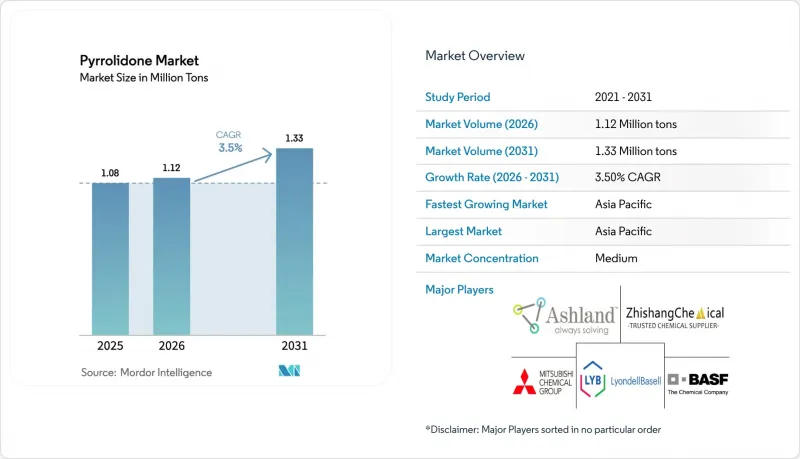
Mordor Intelligence에 의하면, 피롤리돈 시장 규모는 2025년에 108만 톤으로 평가되었고, 2026년에 112만 톤으로 추정되고, 2031년까지 133만 톤에 이를 것으로 예측되며, 2026-2031년 CAGR 3.5%로 성장할 전망입니다.
본 보고서는 유형별(N-메틸-2-피롤리돈, 2-피롤리돈, 기타), 용도별(용제, 탈색제 등), 최종 사용자 산업별(전자, 석유 및 가스, 제약, 페인트 및 코팅 등) 및 지역별(아시아태평양, 북미, 유럽, 남미, 중동 및 아프리카)로 분류되어 있습니다. 시장 예측은 수량(톤) 기준으로 제시되어 있습니다.
세계의 피롤리돈 시장 동향 및 인사이트
리튬 이온 배터리 양극재 제조 수요의 급증
2025년에는 리튬 이온 배터리 생산 라인에서 18만 톤의 NMP가 소비될 전망이며, 셀 1개당 용제 사용량은 감소하고 있지만 기가팩토리 건설은 계속되고 있습니다. 중국, 한국, 일본의 셀 공장에서는 용매의 95%-98%를 회수하는 증류 장치를 병설하고 있어, kW시당 소비량은 1.2kg에서 0.05kg으로 감소하고 있습니다. 2025년에는 양극재 생산량이 22% 증가했음에도 불구하고 현물 가격이 안정적이라는 점은 성장의 대부분을 신규 수요가 아닌 회수 수요가 흡수하고 있음을 보여줍니다. 폐루프 시스템에 대한 설비 투자액은 현재 50GWh 규모의 공장당 약 800만-1,200만 달러 수준이지만, 1kg당 에너지 비용이 3.5kWh에서 2kWh 미만으로 감소함에 따라 이익률과 ESG 점수 모두 향상되고 있습니다. 이러한 추세로 인해 다른 분야에서 규제 압력이 높아지고 있음에도 불구하고, 배터리 제조업체들은 피롤리돈 시장에서 발을 뗄 수 없게 되었습니다.
반도체 팹에서의 고순도 스트리핑 용매로서의 활용 확대
첨단 노드 팹에서는 SEMI C33-0213 등급 4의 순도를 충족하고, 각 금속 원소의 함량을 100 ppt 이하로 억제한 NMP가 필요합니다. 이 기준을 달성하려면 다단계 증류, 이온 교환 정제 및 인라인 ICP-MS 모니터링이 필요하며, 생산 비용은 최대 60% 증가하지만 판매 가격은 15%-20% 인상할 수 있습니다. 후지필름의 2024년형 EUV 포토레지스트 현상액은 소재 공급업체가 용매 정제를 부가가치가 높은 블렌딩 과정에 통합하여 웨이퍼 수율을 향상시키고 있는 실제 사례를 보여줍니다. 애리조나주와 텍사스주에서 새로 가동을 시작한 팹에서는 이미 전자 등급 NMP가 지정되어 있으며, 북미 수요도 2년 이내에 아시아의 순도 기준을 따라잡을 전망입니다. 그 결과, 불순물 수준을 10 ppb 미만으로 보장할 수 있는 공급업체에게는 수익성 높은 비즈니스 기회가 주어질 것입니다.
NMP에 대한 REACH 및 미국 EPA의 독성 규제
REACH 부속서 XVII에서는 NMP 함유율이 0.3% 이상인 혼합물이 금지되어 있으며, 미국 EPA의 2024년 6월 규정안에서도 일반 소비자용 도료 제거제에 대해 유사한 제한이 제안되고 있습니다. 배합 제조업체들이 프로파일렌 카보네이트나 디메틸설폭사이드로 전환을 추진한 결과, 2020년부터 2025년에 걸쳐 유럽 도료 시장에서 연간 약 3만 5,000톤 수요가 사라졌습니다. 산업용 사용자는 여전히 존재하지만, 밀폐 시스템을 통한 취급 편의성 및 안전 데이터 시트(SDS) 개정 등을 포함한 규정 준수 비용 측면에서 BASF나 애슈랜드와 같은 수직 통합형 제조업체가 유리한 입장에 있습니다. 특히 남유럽의 소규모 블렌딩 업체들은 피롤리돈 시장에서 완전히 철수했으며, 이로 인해 공급이 통합되면서 살아남은 기존 기업들의 이익률이 소폭 상승하고 있습니다.
부문 분석
2025년에는 N-메틸-2-피롤리돈이 판매량의 44.36%를 차지했습니다. 이는 배터리용 슬러리 및 포토레지스트 박리 공정에서 해당 화합물이 필수적임을 반영합니다. NMP가 계속해서 우위를 유지하는 한편, 제제 제조업체들이 경피 흡수형 패치에서 2-피롤리돈의 낮은 독성 특성을 활용하고 있어, 2-피롤리돈 시장은 연평균 성장률(CAGR) 4.18%로 확대되고 있습니다. 애슈랜드(Ashland)사의 ‘Pharmasolve 2-피롤리돈’은 패치 제조업체들에게 생식 독성 표시가 없는 침투 촉진제를 제공함으로써 높은 가격 책정을 뒷받침하고 있습니다. 기타 품종인 N-에틸-2-피롤리돈 및 N-비닐-2-피롤리돈은 주로 특수 폴리머 합성 용도로 제한되어 여전히 틈새 시장에 머물러 있습니다.
현재, 순도의 계층화가 주요 경쟁 차별화 요인으로 작용하고 있습니다. 반도체 등급 제품은 1톤당 4,500-5,200달러에 거래되는 반면, 배터리 등급은 2,800-3,200달러, 산업용 용제는 2,200-2,800달러입니다. 인라인 이온 크로마토그래피 및 ICP-MS의 도입으로 1kg당 0.15-0.25달러의 비용이 증가하지만, 이는 이익률 확보로 이어집니다. 그 결과, 생산자들은 분자 자체에 의한 차별화보다는 정제도의 깊이에 따른 차별화를 중시하게 되었으며, 이러한 동향이 피롤리돈 시장의 가격 형성을 재편하고 있습니다.
지역별 분석
아시아태평양은 2025년에 판매량의 48.89%를 차지한 것으로 평가되었으며, 2031년까지 연평균 성장률(CAGR) 3.92%로 성장할 것으로 전망됩니다. 이는 허난성에 위치한 MYJ Chemical사의 6만 톤 규모의 전자 등급 생산 시설과 LG 에너지 솔루션, 삼성 SDI, SK On이 운영하는 한국의 기가팩토리가 주도하고 있습니다. 중국은 산둥성에서 생산되는 저비용 Y-부티로락톤의 혜택을 받고 있으며, 공급 비용 면에서 유럽 및 미국공급업체보다 최대 20% 저렴합니다. 일본은 여전히 고순도 제품의 거점으로 남아 있지만, 자동차 제조업체들이 배터리 생산을 해외로 이전함에 따라 총 생산량은 정체되어 있습니다. 인도의 농약 및 도료 부문에서는 8,000-1만 톤의 새로운 수요가 발생하고 있으며, 그 대부분은 중국으로부터의 수입으로 충당되고 있습니다. 지역별 특화 경향이 뚜렷하여, 중국 공장은 생산량에, 한국 공장은 배터리 등급의 순도에, 일본 공장은 의약품 등급의 틈새 시장 생산량에 각각 주력하고 있습니다.
북미에서는 애리조나주와 텍사스주의 반도체 투자가 전자 등급 수요를 견인하는 한편, 제약 업계에서의 2-피롤리돈 채택이 특수 용도의 성장을 뒷받침하고 있습니다. 미국 환경보호청(EPA)의 2024년 규정안에 따라 소비자용 도료 박리제에서 수요가 12,000-15,000톤 감소했으나, 산업용에 대한 적용 제외로 인해 전자 및 제약 분야의 사용자들은 계속해서 활발히 활동하고 있습니다. 이스트먼사의 킹스포트 공장은 수입품에 비해 10%-12%의 가격 프리미엄이 있음에도 불구하고, 국내 안보상의 필요를 충족시키고 있습니다.
유럽에서는 REACH 부속서 XVII의 영향으로 시장이 위축되고 있습니다. 독일에는 여전히 BASF의 4만 톤 생산 능력이 있으며, 그 대부분은 폴란드와 헝가리의 기가팩토리로 수출되고 있습니다. 바이오 유래 NMP는 유럽 생산자들이 이익률을 유지하는 데 도움이 되고 있지만, 페인트 및 코팅 분야에서는 더 안전한 용제로의 전환이 거의 완료되었습니다. 남미, 중동 및 아프리카 시장 점유율은 브라질의 농약 및 사우디아라비아의 정제 프로젝트에 의해 견인되고 있지만, 이들 지역은 여전히 순수입국이며, 피롤리돈 시장에서 아시아의 우위를 더욱 공고히 하고 있습니다.
기타 혜택 :
- 엑셀 형식 시장 전망(ME) 시트
- 3개월간의 애널리스트 지원
자주 묻는 질문
목차
제1장 서론
제2장 조사 방법
제3장 주요 요약
제4장 시장 구도
제5장 시장 규모 및 성장 예측
제6장 경쟁 구도
제7장 시장 기회 및 향후 전망
AJY 26.08.28According to Mordor Intelligence, the pyrrolidone market size is projected to be 1.08 million tons in 2025, 1.12 million tons in 2026, and reach 1.33 million tons by 2031, growing at a CAGR of 3.5% from 2026 to 2031.
This report is Segmented by Type (N-Methyl-2-Pyrrolidone, 2-Pyrrolidone, and Other Types), Application (Solvent, Decolorant, and More), End-User Industry (Electronics, Oil and Gas, Pharmaceuticals, Paints and Coatings, and More ), and Geography (Asia-Pacific, North America, Europe, South America, and Middle-East and Africa). The Market Forecasts are Provided in Terms of Volume (Tons).
Global Pyrrolidone Market Trends and Insights
Soaring Demand for Li-Ion Battery Cathode Manufacturing
Lithium-ion battery lines consumed 180,000 tons of NMP in 2025, and gigafactory build-outs continue despite falling per-cell solvent intensity. Chinese, South Korean, and Japanese cell plants are co-locating distillation units that recover 95%-98% of solvent, shrinking consumption per kilowatt-hour from 1.2 kg to 0.05 kg. Stable spot pricing in 2025, despite a 22% rise in cathode output, shows that recovery rather than virgin demand absorbs much of the growth. Capital expenditure for closed-loop systems now sits at roughly USD 8 million-USD 12 million per 50 GWh plant, yet the lower energy cost per kilogram-down from 3.5 kWh to below 2 kWh-improves both margins and ESG scores. These dynamics keep battery producers locked into the pyrrolidone market even as regulatory pressure rises elsewhere.
Expanding Use as High-Purity Stripping Solvent in Semiconductor Fabs
Advanced-node fabs need NMP that meets SEMI C33-0213 Grade 4 purity, capping each metallic element at 100 ppt. Achieving this threshold requires multi-stage distillation, ion-exchange polishing, and inline ICP-MS monitoring, boosting production cost by up to 60% but allowing 15%-20% higher selling prices. Fujifilm's 2024 EUV photoresist developer shows how material suppliers integrate solvent purification into value-added blends that improve wafer yield. Newly commissioned fabs in Arizona and Texas already specify electronic-grade NMP, signaling that North American demand will align with Asian purity standards within two years. The result is a profitability corridor that rewards suppliers who can guarantee sub-10 ppb impurity levels.
REACH and US EPA Toxicity Restrictions on NMP
REACH Annex XVII prohibits mixtures with >=0.3% NMP, and the US EPA's June 2024 rule proposes similar limits for consumer paint removers. Roughly 35,000 tons of annual demand disappeared from European paints between 2020 and 2025 as formulators switched to propylene carbonate and dimethyl sulfoxide. Industrial users remain, but compliance costs-including closed-system handling and revised safety data sheets-favor vertically integrated producers such as BASF and Ashland. Smaller blenders, particularly in Southern Europe, have exited the pyrrolidone market entirely, consolidating supply and modestly increasing margins for surviving incumbents.
Other drivers and restraints analyzed in the detailed report include:
- Strong Uptake in Pharmaceutical Synthesis of 2-P Derivatives
- Bio-Based NMP Commercialization Gaining Regulatory Traction
- Feed-Stock Y-Butyrolactone Price Volatility
For complete list of drivers and restraints, kindly check the Table Of Contents.
Segment Analysis
N-Methyl-2-Pyrrolidone commanded 44.36% of volume in 2025, reflecting its indispensability in battery slurries and photoresist stripping. While NMP keeps dominance, 2-Pyrrolidone is expanding at a 4.18% CAGR as formulators exploit its lower toxicity profile in transdermal patches. Ashland's Pharmasolve 2-Pyrrolidone gives patch makers a penetration enhancer free of reproductive-hazard labeling, supporting premium pricing. Other variants-N-ethyl-2-pyrrolidone and N-vinyl-2-pyrrolidone-remain niche, mainly for specialty-polymer synthesis.
Purity stratification is now the primary competitive lever. Semiconductor-grade product commands USD 4,500-USD 5,200 per ton versus USD 2,800-USD 3,200 for battery-grade and USD 2,200-USD 2,800 for industrial solvent. Inline ion-chromatography and ICP-MS add USD 0.15-USD 0.25 per kilogram but protect margins. As a result, producers differentiate less on molecule and more on purification depth, a dynamic that reshapes pricing in the pyrrolidone market.
Complete Report Scope:
- By Type
- N-Methyl-2-Pyrrolidone
- 2-Pyrrolidone
- Other Types
- By Application
- Solvent
- Decolorant
- Plasticizers
- Other Applications
- By End-user Industry
- Electronics
- Oil and Gas
- Pharmaceuticals
- Paints and Coatings
- Agrochemicals
- Other End-user Industries
- By Geography
- Asia-Pacific
- China
- India
- Japan
- South Korea
- Malaysia
- Thailand
- Indonesia
- Vietnam
- Rest of Asia-Pacific
- North America
- United States
- Canada
- Mexico
- Europe
- Germany
- United Kingdom
- Italy
- France
- Spain
- NORDIC Countries
- Rest of Europe
- South America
- Brazil
- Argentina
- Colombia
- Rest of South America
- Middle-East and Africa
- Saudi Arabia
- United Arab Emirates
- Qatar
- Egypt
- Nigeria
- South Africa
- Rest of Middle-East and Africa
- Asia-Pacific
Geography Analysis
Asia-Pacific controlled 48.89% of volume in 2025 and will grow at 3.92% CAGR through 2031, anchored by MYJ Chemical's 60,000-ton electronic-grade facility in Henan and South Korean gigafactories run by LG Energy Solution, Samsung SDI, and SK On. China benefits from low-cost Y-butyrolactone in Shandong, undercutting Western suppliers by up to 20% delivered cost. Japan continues as a high-purity stronghold, yet total tonnage is flat because automotive OEMs offshore battery production. India's agrochemical and coatings sectors add 8,000-10,000 tons of new demand, mostly met by Chinese imports. Regionalization is evident: Chinese plants focus on volume, Korean operations on battery-grade purity, and Japanese units on pharma-grade niche volumes.
In North America, semiconductor investment in Arizona and Texas drives electronic-grade demand, while pharmaceutical adoption of 2-Pyrrolidone underpins specialty growth. The US EPA's 2024 draft rule removed 12,000-15,000 tons from consumer paint removers, but industrial exemptions keep electronics and pharma users active. Eastman's Kingsport plant satisfies domestic security needs despite a 10%-12% price premium over imports.
Europe is shrinking due to REACH Annex XVII. Germany still hosts 40,000 tons of BASF capacity, largely exported to Poland and Hungary gigafactories. Bio-based NMP helps European producers protect margins, but paints and coatings have largely switched to safer solvents. South America and the Middle East and Africa shares are fueled by Brazilian agrochemicals and Saudi refinery projects, yet they remain net importers, reinforcing Asia's dominance in the pyrrolidone market.
- Arkema
- Ashland
- BASF
- Chemex Organochem Pvt. Ltd.
- Covestro AG
- DAICEL CORPORATION
- DuPont
- Eastman Chemical Company
- Hefei TNJ Chemical Industry Co., Ltd.
- Huntsman Corporation
- iangyin Jiafeng Chemical Co,.Ltd.
- INEOS Composites
- Johnson Matthey
- LyondellBasell Industries Holdings B.V.
- Merck KGaA
- Mitsubishi Chemical Group Corporation
- Puyang Guangming Chemicals Co., Ltd.
- SHANDONG ZHISHANG CHEMICAL CO.LTD.
- Wanhua
- Zhejiang Realsun Chemical Co., Ltd.
Additional Benefits:
- The market estimate (ME) sheet in Excel format
- 3 months of analyst support
TABLE OF CONTENTS
1 Introduction
- 1.1 Study Assumptions and Market Definition
- 1.2 Scope of the Study
2 Research Methodology
3 Executive Summary
4 Market Landscape
- 4.1 Market Overview
- 4.2 Market Drivers
- 4.2.1 Soaring Demand for Li-Ion Battery Cathode Manufacturing
- 4.2.2 Expanding Use as High-Purity Stripping Solvent in Semiconductor Fabs
- 4.2.3 Strong Uptake in Pharmaceutical Synthesis of 2-P Derivatives
- 4.2.4 Bio-Based NMP Commercialization Gaining Regulatory Traction
- 4.2.5 Premium Pricing for Ultra-Low-Metal Grades (less than 10 ppb)
- 4.3 Market Restraints
- 4.3.1 REACH and US EPA Toxicity Restrictions on NMP
- 4.3.2 Feed-Stock Y-Butyrolactone Price Volatility
- 4.3.3 Investor ESG Screens on VOC-intensive Recovery Units
- 4.4 Value Chain Analysis
- 4.5 Porter's Five Forces
- 4.5.1 Bargaining Power of Suppliers
- 4.5.2 Bargaining Power of Buyers
- 4.5.3 Threat of New Entrants
- 4.5.4 Threat of Substitute Products
- 4.5.5 Competitive Rivalry
5 Market Size and Growth Forecasts (Volume)
- 5.1 By Type
- 5.1.1 N-Methyl-2-Pyrrolidone
- 5.1.2 2-Pyrrolidone
- 5.1.3 Other Types
- 5.2 By Application
- 5.2.1 Solvent
- 5.2.2 Decolorant
- 5.2.3 Plasticizers
- 5.2.4 Other Applications
- 5.3 By End-user Industry
- 5.3.1 Electronics
- 5.3.2 Oil and Gas
- 5.3.3 Pharmaceuticals
- 5.3.4 Paints and Coatings
- 5.3.5 Agrochemicals
- 5.3.6 Other End-user Industries
- 5.4 By Geography
- 5.4.1 Asia-Pacific
- 5.4.1.1 China
- 5.4.1.2 India
- 5.4.1.3 Japan
- 5.4.1.4 South Korea
- 5.4.1.5 Malaysia
- 5.4.1.6 Thailand
- 5.4.1.7 Indonesia
- 5.4.1.8 Vietnam
- 5.4.1.9 Rest of Asia-Pacific
- 5.4.2 North America
- 5.4.2.1 United States
- 5.4.2.2 Canada
- 5.4.2.3 Mexico
- 5.4.3 Europe
- 5.4.3.1 Germany
- 5.4.3.2 United Kingdom
- 5.4.3.3 Italy
- 5.4.3.4 France
- 5.4.3.5 Spain
- 5.4.3.6 NORDIC Countries
- 5.4.3.7 Rest of Europe
- 5.4.4 South America
- 5.4.4.1 Brazil
- 5.4.4.2 Argentina
- 5.4.4.3 Colombia
- 5.4.4.4 Rest of South America
- 5.4.5 Middle-East and Africa
- 5.4.5.1 Saudi Arabia
- 5.4.5.2 United Arab Emirates
- 5.4.5.3 Qatar
- 5.4.5.4 Egypt
- 5.4.5.5 Nigeria
- 5.4.5.6 South Africa
- 5.4.5.7 Rest of Middle-East and Africa
- 5.4.1 Asia-Pacific
6 Competitive Landscape
- 6.1 Market Concentration
- 6.2 Strategic Moves
- 6.3 Market Share/Ranking Analysis
- 6.4 Company Profiles (includes Global level Overview, Market level overview, Core Segments, Financials as available, Strategic Information, Market Rank/Share for key companies, Products and Services, and Recent Developments)
- 6.4.1 Arkema
- 6.4.2 Ashland
- 6.4.3 BASF
- 6.4.4 Chemex Organochem Pvt. Ltd.
- 6.4.5 Covestro AG
- 6.4.6 DAICEL CORPORATION
- 6.4.7 DuPont
- 6.4.8 Eastman Chemical Company
- 6.4.9 Hefei TNJ Chemical Industry Co., Ltd.
- 6.4.10 Huntsman Corporation
- 6.4.11 iangyin Jiafeng Chemical Co,.Ltd.
- 6.4.12 INEOS Composites
- 6.4.13 Johnson Matthey
- 6.4.14 LyondellBasell Industries Holdings B.V.
- 6.4.15 Merck KGaA
- 6.4.16 Mitsubishi Chemical Group Corporation
- 6.4.17 Puyang Guangming Chemicals Co., Ltd.
- 6.4.18 SHANDONG ZHISHANG CHEMICAL CO.LTD.
- 6.4.19 Wanhua
- 6.4.20 Zhejiang Realsun Chemical Co., Ltd.
7 Market Opportunities and Future Outlook
- 7.1 White-space and Unmet-need Assessment