

|
시장보고서
상품코드
2115031
전도성 접착제 시장 : 시장 점유율 분석, 업계 동향 및 통계, 성장 예측(2026-2031년)Electrically Conductive Adhesives - Market Share Analysis, Industry Trends & Statistics, Growth Forecasts (2026 - 2031) |
||||||
 Mordor Intelligence
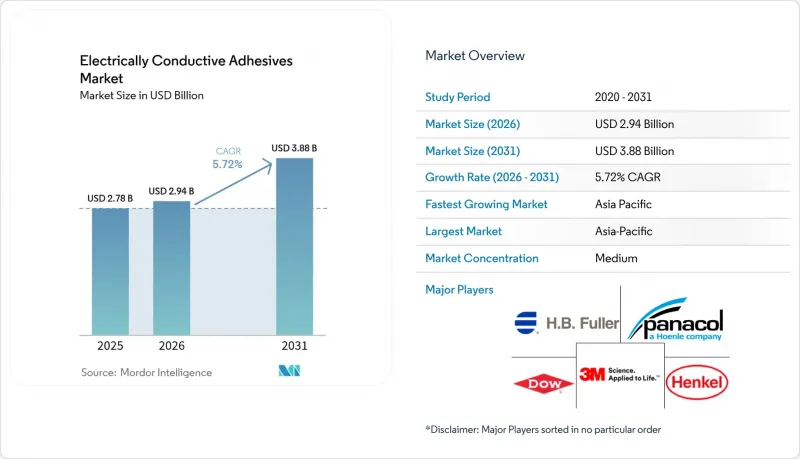
Mordor Intelligence에 의하면, 전도성 접착제 시장 규모는 2025년에 27억 8,000만 달러로 평가되었고, 2026년 29억 4,000만 달러에서 2031년까지 38억 8,000만 달러에 이를 것으로 예측되며, 예측 기간(2026-2031년) CAGR은 5.72%를 나타낼 전망입니다.
본 보고서는 화학 유형별(에폭시, 실리콘, 폴리우레탄,아크릴, 기타), 유형별(등방성, 이방성), 용도별(태양전지, 자동차, LED 조명, 인쇄회로기판 등), 지역별(아시아태평양, 북미, 유럽, 남미, 중동 및 아프리카)로 분류되어 있습니다. 시장 예측은 금액(달러) 기준으로 제시되어 있습니다.
세계의 전도성 접착제 시장 동향 및 인사이트
파워 일렉트로닉스 분야에서의 용도 확대
실리콘 카바이드(SiC) 및 갈륨 나이탈리아드(GaN) 소자를 탑재한 차세대 전력 변환기는 200°C를 초과하는 접합부 온도에서 작동하지만, 이 온도 범위에서는 주석·납 솔더나 저은 솔더를 사용할 수 없습니다. 고순도 은 은 코팅 구리 또는 하이브리드 그래핀 네트워크가 충전된 에폭시 및 실리콘계 접착제는 높은 전류 밀도에서도 전도성을 유지하면서 열 충격을 완화하므로, 기생 성분을 줄이면서 더 높은 스위칭 주파수를 실현하는 소형 전력 모듈이 가능해집니다. 또한, 이러한 배합물은 열 인터페이스 재료로도 기능하여, 트랙션 인버터의 접합부에서 인클로저로 전달되는 열 저항을 저감합니다. 재료 과학자들은 탄소나노튜브 섬유를 3차원 구조로 분산시켜 전기적 경로와 열적 경로를 병행하여 확보함으로써, 전도성 접착제 시장을 와이드 밴드갭 전력 설계의 최전선으로 끌어올리고 있습니다.
전기자동차에서의 활용 확대
셀-투-팩(Cell-to-Pack) 방식의 배터리 전략에서는 모듈 하우징이 불필요해지며, 하중 지지 및 열 관리의 역할이 접착제 층으로 이전됩니다. 전단 강도가 20 MPa를 초과하는 전도성 에폭시 수지는 진동이나 충돌 시의 충격을 견디면서, 팩당 3,000개 이상의 원통형 또는 각형 셀 전체에 전류를 균일하게 분배합니다. 금속 필러와 세라믹 구체를 결합한 하이브리드 시스템은 알루미늄 버스바와 구리 탭 간의 열팽창 차이를 흡수하는 유연한 격자 구조를 형성하여, 수천 회에 달하는 고속 충방전 사이클에 걸쳐 수명을 연장합니다. 경차의 보조 전동화에 채택된 48V 아키텍처에는 고밀도 배전 기판이 도입되어 있으며, 여기서 미세 피치의 이방성 접합이 단락을 방지함으로써 전도성 접착제 시장에 새로운 수요를 창출하고 있습니다.
은 필러의 가격 변동
은 분말은 일반적인 등방성 접착제의 60-80 중량%를 차지하고 있으며, 배합 설계자는 분기 내에 25%를 초과하기도 하는 금속 가격 변동에 노출되어 있습니다. 구리, 니켈, 탄소나노튜브는 비용 절감이 기대되지만, 산화, 확산 및 퍼콜레이션의 한계로 인해 은을 완전히 대체하는 데에는 한계가 있습니다. 구리 코어를 300 nm 두께의 은 쉘로 코팅한 하이브리드 입자 구조는 벌크 전도성을 저해하지 않으면서 귀금속 함량을 30-40% 줄여주지만, 공급망은 여전히 지정학적 요인으로 인한 광업 혼란의 영향을 받기 쉬운 상태입니다. 가격 전가 메커니즘은 항공우주 및 의료 분야 계약에서는 일반적이지만, 민수용 전자기기 OEM 업체들은 추가 비용 지불을 꺼리고 있어, 이로 인해 전도성 접착제 시장의 단기적인 성장이 억제되고 있습니다.
부문 분석
2025년 시점에서 에폭시 계열 제품은 전도성 접착제 시장의 44.62%를 차지했으며, 높은 랩 전단 강도와 도포 용이성이 유연성에 대한 우려를 상쇄하는 분야에서는 여전히 주력 제품으로 자리 잡고 있습니다. 배합 제조업체들은 비스페놀 A, 비스페놀 F, 노보락을 골격으로 활용하고, 점도, 유리전이온도, 탄성률을 조정함으로써 리지드 기판의 접합부터 파워 모듈의 다이 접합에 이르기까지 모든 용도에 대응하고 있습니다. 에폭시계 전도성 접착제 시장 규모는 경쟁이 격화되는 가운데서도 꾸준히 성장할 것으로 예측됩니다. 잠재성 이미다졸계 촉매를 사용하면 경화를 촉진할 수 있으며, 보관 기간을 해치지 않으면서 오븐 처리 시간을 단축할 수 있습니다. 고온용 실리콘 카바이드 디바이스의 경우, 이미드 변성 에폭시가 200°C의 접합부 환경을 견디며, 2,000사이클에 걸쳐 저항 드리프트를 5% 이내로 억제하는 열 사이클 안정성을 유지합니다. 환경 측면에서는 무할로겐 배합이 RoHS 지침 및 사용 후 제품 재활용 요건을 충족합니다.
2031년까지 연평균 성장률(CAGR) 6.42%를 나타낼 것으로 예측되는 실리콘계 시스템은 70%가 넘는 성장률과 1,000시간의 염수 분무 시험 후에도 지속되는 전도성을 발휘하여 시장 점유율 격차를 좁히고 있습니다. 이러한 특성은 자동차 보닛 내 제어 장치나 해상 풍력 발전용 컨버터에서 높이 평가받는 특성입니다. 폴리디메틸실록산 네트워크는 충격 하중을 흡수하고 습기 침투를 방지함으로써 에폭시로는 해결할 수 없는 고장 모드를 해결합니다. 백금 촉매를 사용한 상온 가황형 실리콘은 LED 조명의 정교한 렌즈 어셈블리에 가해지는 열 응력을 저감합니다. 에폭시와 실리콘을 결합한 하이브리드 화학 구조는 접착면의 무결성을 확보하는 강성이 있는 내층과, 열팽창계수(CTE)의 불일치를 완화하는 유연한 외층을 모두 갖추고 있습니다. 이러한 시너지 효과는 전도성 접착제 시장이 ‘단일 화학 구조가 모든 것을 지배한다’는 수렴 현상이 아니라, 조성의 혁신을 통해 어떻게 진화하고 있는지를 보여줍니다.
지역별 분석
아시아태평양은 2025년 매출의 54.83%를 차지했으며, 중국, 한국, 대만의 강력한 반도체 산업 생태계 덕분에 수량 및 금액 면에서 계속해서 선두를 유지하고 있습니다. 신에너지차 및 태양광 발전 도입에 관한 현지 정책이 지속적인 수요를 창출하고 있으며, 이 지역 전체의 전도성 접착제 시장은 연평균 성장률(CAGR) 6.31%로 성장을 지속하고, 있습니다. 국내 전기 승용차에 대한 국가 보조금 프로그램은 주요 접착제 공급업체와의 장기 공급 계약의 기반이 되어 환율 리스크를 줄이고 공장의 안정적인 가동률을 확보하고 있습니다. 선전, 쑤저우, 방갈로르의 스타트업 집적지는 플렉서블 전자기기, 웨어러블 기기, 프린티드 전자 제품 출시를 통해 기존 다국적 기업을 보완하고, 틈새 시장용 배합 제품의 고객 기반을 확대되고 있습니다.
북미에서는 방위용 아비오닉스, 우주 탐사 사업 및 파워 반도체 팹의 국내 복귀를 원동력으로 상당한 소비가 나타나고 있습니다. 이 지역의 인증 기준(NASA 아웃가스 시험, IPC-CC-830C, UL-94V0)은 진입 장벽을 높이고 있으며, 이로 인해 고품질 에폭시·은 페이스트 및 열전도 필름 공급업체는 건전한 매출 총이익률을 확보할 수 있게 되었습니다. DELO사와 헨켈사가 최근 텍사스주와 오하이오주에서 실시한 설비 투자 확대는 장기적인 수요에 대한 확신을 뒷받침하고 있습니다. ‘CHIPS and Science Act’에 따른 정부의 인센티브로 인해 첨단 패키징 프로젝트가 유치되면서 전도성 접착제 시장 규모가 더욱 확대되고 있습니다.
유럽은 자동차, 의료, 재생 에너지 분야에서 확고한 입지를 유지하고 있습니다. 독일은 전기차용 배터리 팩 통합을 주도하고 있으며, 프랑스와 북유럽 국가들은 해상 풍력 발전소 건설을 확대하고 있고, 네덜란드는 플렉서블 OLED 연구 개발을 선도하고 있습니다. 이러한 동향이 어우러져 거시경제의 역풍에도 불구하고 안정적인 구매량을 유지하고 있습니다. 엄격한 REACH 및 RoHS 규제를 준수함에 따라, 배합 제조업체들은 무할로겐, 무연 및 용제 저감형 시스템으로 전환하고 있으며, 성능과 지속가능성을 양립시킬 수 있는 혁신적인 기업들에게 선구자로서의 우위가 주어지고 있습니다. 기업의 평균 CO₂ 배출량 목표가 엄격해지는 가운데, 각 OEM 업체들은 전도성 접착제를 더 가벼운 와이어 하네스와 고효율 모듈을 구현하는 수단으로 간주하고 있어, 전도성 접착제 시장의 장기적인 중요성이 더욱 커지고 있습니다.
기타 혜택 :
- 엑셀 형식 시장 예측(ME) 시트
- 3개월간의 애널리스트 지원
자주 묻는 질문
목차
제1장 서론
제2장 조사 방법
제3장 주요 요약
제4장 시장 구도
제5장 시장 규모 및 성장 예측
제6장 경쟁 구도
제7장 시장 기회 및 향후 전망
AJY 26.08.28According to Mordor Intelligence, the electrically conductive adhesives market size was valued at USD 2.78 billion in 2025 and estimated to grow from USD 2.94 billion in 2026 to reach USD 3.88 billion by 2031, at a CAGR of 5.72% during the forecast period (2026-2031).
This report is Segmented by Chemistry Type (Epoxy, Silicone, Polyurethane, Acrylic, Other Chemistries), Type (Isotropic, Anisotropic), Application (Solar Cells, Automotive, LED Lighting, Printed Circuit Boards, and More), and Geography (Asia-Pacific, North America, Europe, South America, Middle East and Africa). The Market Forecasts are Provided in Terms of Value (USD).
Global Electrically Conductive Adhesives Market Trends and Insights
Increasing Application in Power Electronics
Next-generation power converters incorporating silicon-carbide and gallium-nitride devices run at junction temperatures above 200 °C, a regime that invalidates tin-lead and low-silver solders. Epoxy and silicone adhesives filled with high-purity silver, silver-coated copper, or hybrid graphene networks maintain conductivity under high current densities while buffering thermal shock, enabling miniaturized power modules that deliver higher switching frequencies with lower parasitics. The formulations also double as thermal interface materials, reducing junction-to-case resistance in traction inverters. Material scientists are dispersing carbon-nanotube strands in three-dimensional architectures to unlock parallel electrical and thermal pathways, pushing the electrically conductive adhesives market to the forefront of wide-bandgap power design.
Increasing Utilization in Electric Vehicles
Cell-to-pack battery strategies eliminate module housings, transferring load-bearing and thermal duties to the adhesive layer. Conductive epoxies with shear strengths above 20 MPa withstand vibration and crash pulses while equalizing current across 3,000-plus cylindrical or prismatic cells per pack. Hybrid systems that marry metallic fillers with ceramic spheres form a compliant lattice that absorbs differential expansion between aluminum busbars and copper tabs, extending service life over thousands of high-rate charge-discharge cycles. The 48-V architecture adopted for auxiliary electrification in light vehicles introduces dense power distribution boards where fine-pitch anisotropic joints prevent short circuits, adding fresh volume to the electrically conductive adhesives market.
Silver-Filler Price Volatility
Silver powders account for 60-80 wt% of typical isotropic adhesives, exposing formulators to bullion swings that can exceed 25% within a quarter. While copper, nickel, and carbon nanotubes promise cost relief, oxidation, diffusion, and percolation thresholds curb their ability to fully replace silver. Hybrid particle architectures that coat copper cores with 300-nm silver shells cut precious-metal content by 30-40% without compromising bulk conductivity, yet the supply chain remains vulnerable to geopolitical mining disruptions. Price pass-through mechanisms are standard in aerospace and medical contracts, but consumer electronics OEMs resist surcharges, trimming near-term expansion of the electrically conductive adhesives market.
Other drivers and restraints analyzed in the detailed report include:
- Growing Demand from Renewable Energy Systems
- Bio-Compatible Conductive Bio-Adhesives for Implants
- Reliability Limits Under High Current & Thermal Cycling
For complete list of drivers and restraints, kindly check the Table Of Contents.
Segment Analysis
Epoxy-based grades comprised 44.62% of the electrically conductive adhesives market in 2025 and remain a mainstay where high lap-shear strength and easy dispensing outweigh flexibility concerns. Formulators exploit bisphenol-A, bisphenol-F and novolac backbones to tailor viscosity, glass-transition temperature and modulus, covering everything from rigid board attach to die-attach in power modules. The electrically conductive adhesives market size for epoxy chemistries is projected to grow steadily even as competition intensifies. Their state-of-cure can be accelerated with latent imidazole catalysts, trimming oven time without compromising shelf life. For high-temperature silicon-carbide devices, imide-modified epoxies withstand 200 °C junction environments while keeping thermal cycling stability within 5% resistance drift over 2,000 cycles. On the environmental front, halogen-free formulations satisfy RoHS directives and end-of-life recycling mandates.
Silicone-based systems, recording a 6.42% CAGR to 2031, are closing the market-share gap by delivering elongation over 70% and sustained conductivity after 1,000 salt-spray hours-attributes prized in under-hood automotive controls and offshore wind converters. Polydimethylsiloxane networks absorb shock loads and seal against moisture ingress, addressing failure modes that epoxy cannot. Room-temperature-vulcanizing silicones with platinum catalysts reduce thermal stress on sensitive lens assemblies in LED lighting. Hybrid epoxy-silicone chemistries combine a rigid inner phase for bondline integrity with a compliant outer domain that relieves CTE mismatch. Such synergies reveal how the electrically conductive adhesives market evolves through compositional innovation rather than one-chemistry-wins-all convergence.
Complete Report Scope:
- By Chemistry Type
- Epoxy
- Silicone
- Polyurethane
- Acrylic
- Other Chemistries
- By Type
- Isotropic
- Anisotropic
- By Application
- Solar Cells
- Automotive
- LED Lighting
- Printed Circuit Boards
- LCD Displays
- Other Applications
- By Geography
- Asia-Pacific
- China
- India
- Japan
- South Korea
- Rest of Asia-Pacific
- North America
- United States
- Canada
- Mexico
- Europe
- Germany
- United Kingdom
- France
- Italy
- Rest of Europe
- South America
- Brazil
- Argentina
- Rest of South America
- Middle East and Africa
- Saudi Arabia
- South Africa
- Rest of Middle East and Africa
- Asia-Pacific
Geography Analysis
Asia-Pacific retained 54.83% of 2025 revenue and continues as both volume and value leader due to semiconductor powerhouse ecosystems in China, South Korea and Taiwan. Local policy mandates for new-energy vehicles and photovoltaic rollouts funnel sustained demand, translating to a 6.31% CAGR for the electrically conductive adhesives market across the region. National subsidy programs for domestic electric passenger cars anchor long-term offtake contracts with major adhesive suppliers, reducing currency-exchange risk and ensuring steady plant utilization. Start-up clusters in Shenzhen, Suzhou, and Bangalore complement entrenched multinationals by launching flexible, wearable, and printed-electronics products, widening the customer base for niche formulations.
North America demonstrates significant consumption, driven by defense avionics, space exploration initiatives, and the reshoring of power-semiconductor fabs. The region's qualification standards-NASA outgassing, IPC-CC-830C, UL-94V0-elevate entry barriers, allowing suppliers of premium epoxy-silver pastes and thermally conductive films to command healthy gross margins. Recent capital expansions by DELO and Henkel in Texas and Ohio underscore confidence in long-term demand. Government incentives under the CHIPS and Science Act draw advanced-packaging projects that further enlarge the electrically conductive adhesives market footprint.
Europe maintains a stronghold in automotive, medical and renewable segments. Germany spearheads EV battery pack integration, France and the Nordic nations ramp offshore wind farms, and the Netherlands leads in flexible OLED R&D. These trends converge to sustain steady purchasing volumes despite macroeconomic headwinds. Stringent REACH and RoHS compliance pushes formulators toward halogen-free, lead-free, and solvent-reduced systems, awarding first-mover advantage to innovators capable of aligning performance with sustainability. With corporate average CO2 targets tightening, OEMs view conductive adhesives as enablers for lighter wiring harnesses and higher-efficiency modules, reinforcing their long-run importance within the electrically conductive adhesives market.
- 3M
- Aremco
- Arkema
- Creative Materials
- DELO Industrie Klebstoffe GmbH & Co. KGaA
- Dow
- Dymax
- H.B. Fuller Company
- Henkel AG & Co. KGaA
- Heraeus Electronics
- HITEK Electronic Materials Ltd
- Master Bond Inc.
- MG Chemicals
- Nagase ChemteX America LLC
- Panacol-Elosol GmbH
- Parker Hannifin Corp.
- Permabond
- Protavic International
Additional Benefits:
- The market estimate (ME) sheet in Excel format
- 3 months of analyst support
TABLE OF CONTENTS
1 Introduction
- 1.1 Study Assumptions and Market Definition
- 1.2 Scope of the Study
2 Research Methodology
3 Executive Summary
4 Market Landscape
- 4.1 Market Overview
- 4.2 Market Drivers
- 4.2.1 Increasing application in power electronics
- 4.2.2 Increasing utilization in electric vehicles
- 4.2.3 Increasing usage in aerospace and defense applications
- 4.2.4 Growing demand from renewable energy systems
- 4.2.5 Bio-compatible conductive bio-adhesives for implants
- 4.3 Market Restraints
- 4.3.1 Silver-filler price volatility
- 4.3.2 Reliability limits under high current and thermal cycling
- 4.3.3 Longer curing times and process complexity
- 4.4 Value Chain Analysis
- 4.5 Porter's Five Forces
- 4.5.1 Threat of New Entrants
- 4.5.2 Bargaining Power of Buyers
- 4.5.3 Bargaining Power of Suppliers
- 4.5.4 Threat of Substitute Products
- 4.5.5 Degree of Competition
5 Market Size and Growth Forecasts (Value)
- 5.1 By Chemistry Type
- 5.1.1 Epoxy
- 5.1.2 Silicone
- 5.1.3 Polyurethane
- 5.1.4 Acrylic
- 5.1.5 Other Chemistries
- 5.2 By Type
- 5.2.1 Isotropic
- 5.2.2 Anisotropic
- 5.3 By Application
- 5.3.1 Solar Cells
- 5.3.2 Automotive
- 5.3.3 LED Lighting
- 5.3.4 Printed Circuit Boards
- 5.3.5 LCD Displays
- 5.3.6 Other Applications
- 5.4 By Geography
- 5.4.1 Asia-Pacific
- 5.4.1.1 China
- 5.4.1.2 India
- 5.4.1.3 Japan
- 5.4.1.4 South Korea
- 5.4.1.5 Rest of Asia-Pacific
- 5.4.2 North America
- 5.4.2.1 United States
- 5.4.2.2 Canada
- 5.4.2.3 Mexico
- 5.4.3 Europe
- 5.4.3.1 Germany
- 5.4.3.2 United Kingdom
- 5.4.3.3 France
- 5.4.3.4 Italy
- 5.4.3.5 Rest of Europe
- 5.4.4 South America
- 5.4.4.1 Brazil
- 5.4.4.2 Argentina
- 5.4.4.3 Rest of South America
- 5.4.5 Middle East and Africa
- 5.4.5.1 Saudi Arabia
- 5.4.5.2 South Africa
- 5.4.5.3 Rest of Middle East and Africa
- 5.4.1 Asia-Pacific
6 Competitive Landscape
- 6.1 Market Concentration
- 6.2 Strategic Moves
- 6.3 Market Share(%)/Ranking Analysis
- 6.4 Company Profiles (includes Global level Overview, Market level overview, Core Segments, Financials as available, Strategic Information, Market Rank/Share for key companies, Products and Services, and Recent Developments)
- 6.4.1 3M
- 6.4.2 Aremco
- 6.4.3 Arkema
- 6.4.4 Creative Materials
- 6.4.5 DELO Industrie Klebstoffe GmbH & Co. KGaA
- 6.4.6 Dow
- 6.4.7 Dymax
- 6.4.8 H.B. Fuller Company
- 6.4.9 Henkel AG & Co. KGaA
- 6.4.10 Heraeus Electronics
- 6.4.11 HITEK Electronic Materials Ltd
- 6.4.12 Master Bond Inc.
- 6.4.13 MG Chemicals
- 6.4.14 Nagase ChemteX America LLC
- 6.4.15 Panacol-Elosol GmbH
- 6.4.16 Parker Hannifin Corp.
- 6.4.17 Permabond
- 6.4.18 Protavic International


