

|
시장보고서
상품코드
2115044
혈액은행 시장 : 시장 점유율 분석, 업계 동향 및 통계, 성장 예측(2026-2031년)Blood Bank - Market Share Analysis, Industry Trends & Statistics, Growth Forecasts (2026 - 2031) |
||||||
 Mordor Intelligence
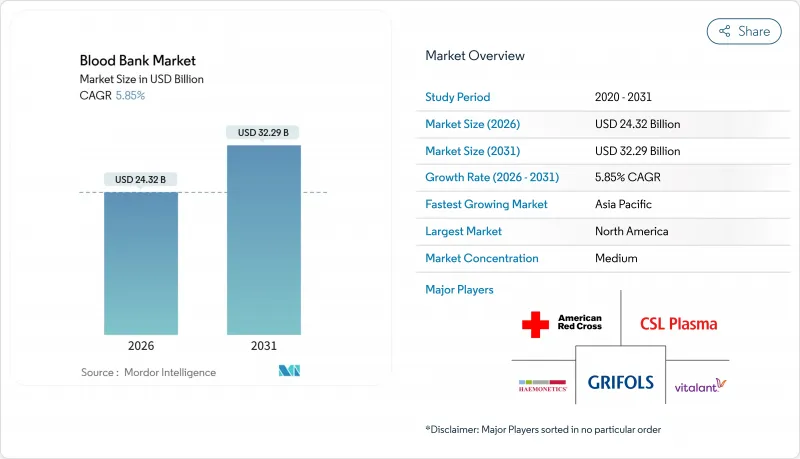
Mordor Intelligence에 의하면, 혈액은행 시장 규모는 2026년에 243억 2,000만 달러로 추정되고, 2031년까지 322억 9,000만 달러에 이를 것으로 예측됩니다.
이는 예측 기간 동안 연평균 성장률(CAGR)이 5.85%로 성장할 전망입니다.
본 보고서는 제품별(전혈, 적혈구(농축 적혈구 등), 혈소판, 혈장 등), 기능별(채혈, 처리, 검사 등), 혈액은행 유형별(민간 및 공공), 최종 사용자별(병원, 외래수술센터(ASC) 등), 지역별(북미, 유럽, 아시아태평양 등)로 분류되어 있습니다. 시장 예측은 금액(달러) 기준으로 제시되어 있습니다.
세계의 혈액은행 시장 동향 및 인사이트
수술 건수 및 교통사고 건수 증가
2024년 전 세계 외과 수술 건수는 7.3% 증가했습니다. 그 주된 요인은 관절 치환술과 심장혈관 재건술로, 각각 1건당 약 2단위의 농축 적혈구를 소비합니다. 2024년에는 교통사고로 인한 부상자 중 119만 명이 사망했으며, 사고 발생 후 1시간 이내에 최대 10 단위의 농축 적혈구가 필요한 대량 수혈 프로토콜이 시행되었습니다. 2024년 인도에서 89개 외상 센터를 대상으로 실시된 조사에 따르면, 42%의 시설에서 응급용 O형 음성 혈액 비축량이 부족하여 이로 인해 근치 수술이 지연되고 있었습니다. 이동 채혈팀과 병원 도착 전 트리아지를 통해 이러한 공급 부족은 점차 완화되고 있지만, 사하라 사막 이남의 아프리카와 동남아시아에서는 인프라 구축이 인구 증가를 따라가지 못하고 있습니다. 저침습 수술 기술로 인해 1건당 사용량은 감소하고 있지만, 의료 접근성이 확대됨에 따라 수술 건수가 대폭 증가하고 있어 그 효과가 상쇄되고 있습니다.
혈액 질환 및 종양성 질환 유병률 증가
미국에서는 2024년에 204만 건의 신규 암 진단이 기록되었으며, 급성 백혈병 환자의 최대 절반이 예방적 혈소판 보충이 필요합니다. 유럽에서는 2020년부터 2024년 사이에 만성 림프구성 백혈병 및 다발성 골수종 환자 수가 18% 증가하여 혈장 유래 면역글로불린에 대한 수요가 높아지고 있습니다. 겸상적혈구빈혈의 경우, 유전자 치료가 승인되었음에도 불구하고 여전히 환자 1명당 연간 8-12회의 수혈이 필요한 반면, 지중해빈혈에 대해서는 남아시아 및 동남아시아 전역에서 지속적인 수요가 이어지고 있습니다. 임상의들은 면역 결핍 환자에게 병원체 제거 혈소판을 선택하는 경향이 강해지고 있으며, 감염 위험 감소를 대가로 단위당 비용 상승을 감수하고 있습니다.
엄격한 규제 준수 및 인증에 드는 비용
AABB 제34판 기준에는 47개의 새로운 요건이 추가되어, 미국의 혈액 센터는 소프트웨어, 감사, 교육에 120만-350만 달러를 지출해야 하는 상황에 처해 있습니다. 21 CFR 606에 따른 FDA 조사에서는 위반 1건당 최대 50만 달러의 벌금이 부과되므로, 2022년 이후 18개의 소규모 혈액은행이 합병을 단행했습니다. 유럽에서는 2024년 혈액 지침 개정에 따라 운영 비용이 8-12% 상승했습니다. 아프리카 지방에 위치한 혈액 은행들은 5만 달러가 넘는 ISO 9001 인증 취득 비용으로 어려움을 겪고 있으며, 인증된 공급원에 대한 접근이 제한되고 있습니다. 또한, 말라리아 유행 지역 방문 이력에 대한 추가적인 헌혈자 제외 기준이 도입됨에 따라, 다문화가 공존하는 도시 지역에서는 헌혈 적격 기준이 더욱 엄격해졌습니다.
부문 분석
혈장 유래 제품은 연평균 성장률(CAGR) 8.32%를 나타낼 것으로 예측되며, 이는 제품 카테고리 중 가장 높은 성장률입니다. 한편, 적혈구는 2025년에도 혈액은행 시장에서 42.5%의 점유율을 유지했습니다. 원발성 면역결핍증 및 CIDP(만성 염증성 탈수초성 다발 신경염)용 면역글로불린은 2024년 미국 혈장 생산량의 3분의 2를 차지하며, 그리폴스(Grifols)와 CSL 플라즈마(CSL Plasma)의 적극적인 채혈을 뒷받침했습니다. 감염 관리 기준이 강화됨에 따라, 2025년에는 병원체가 제거된 혈장이 유럽 병원 수요의 18%를 차지했습니다. 혈소판 공급은 5일간의 보존 기간으로 인해 여전히 제약을 받고 있으며, 이로 인해 AI를 활용한 수요 예측이 촉진되어 유통기한 만료량을 최대 25%까지 줄였습니다. 전혈은 현재 고소득국의 채혈량에서 8% 미만을 차지할 뿐이며, 주로 군용 비축분이나 자원이 부족한 지역을 위해 확보되고 있습니다.
백혈구 제거 적혈구나 방사선 조사 적혈구와 같은 특수 성분은 높은 가격에 거래되고 있지만, 소규모 병원의 처리 능력에 부담을 주고 있습니다. 백혈구 제거는 유럽 및 캐나다 대부분에서 표준화되어 있으며, 2024년에는 미국 재고의 92%를 차지했습니다. 병원체 제거 적혈구는 2025년 미국에서 시범 프로그램이 시작되었으며, 환급 제도가 안정됨에 따라 각 공급업체들은 2031년까지 15% 시장 침투율을 목표로 하고 있습니다.
채혈은 적혈구를 기증자에게 환원하고 고용량의 혈소판을 회수할 수 있는 아페레시스 기술 덕분에 연평균 성장률(CAGR) 7.87%로 가장 빠르게 성장하는 분야입니다. 헤모네틱스(Hemoneotics)사의 MCS+는 시술 시간을 78분으로 단축하고, 기증자 유지율을 9% 향상시켰습니다. 검사는 2025년 매출의 39.8%를 차지했으며, HIV, HBV, HCV에 대한 NAT(핵산 증폭 검사)는 미국 및 EU 규제에 따라 계속해서 의무화되어 있습니다. 고속 처리 장비의 도입으로 검사당 비용은 18달러에서 12달러로 낮아졌지만, 새로 도입된 지카바이러스 및 웨스트나일바이러스 검사 패널로 인해 헌혈 1회당 25-40달러의 추가 비용이 발생하고 있습니다. 처리 업무는 하루 최대 3,000 단위를 처리하는 지역 허브로 통합되고 있으며, 인도에서는 자동화된 물류와 블록체인을 통한 추적성 덕분에 시설 간 운송 시간이 18% 단축되었습니다.
지역별 분석
북미는 환자 혈액 관리 프로그램에 대한 메디케어의 환급과 FDA의 엄격한 감독에 힘입어 2025년 매출의 45.32%를 차지했습니다. 그러나 헌혈자 모집은 부진한 상태이며, 18-24세 참가율은 2020-2024년 11% 감소했기 때문에 폐기량을 최대 25%까지 줄일 수 있는 AI 재고 관리 도구의 도입이 추진되고 있습니다. 캐나다의 자발적 헌혈률은 3.8%를 자랑하지만, 헌혈자의 52%가 50세 이상으로, 헌혈 기피 위험이 높아지고 있습니다. 세라스(Ceras)사가 병원체 저감 적혈구(RBC)에 대해 FDA 승인을 획득함에 따라, 미국의 22개 외상 센터가 PRT 도입의 최전선에 서 있습니다.
아시아태평양은 연평균 성장률(CAGR) 7.21%로 예측되는 가장 빠르게 성장하는 지역입니다. 중국이 시민 1,000명당 20회의 헌혈을 목표로 내걸고 있는 점과, 인도의 블록체인 등록 제도가 지방 지역의 콜드체인 부족에도 불구하고 견조한 헌혈량 증가를 뒷받침하고 있습니다. 일본은 헌혈자 수의 4.1% 감소에 대응하기 위해 2025년에 헌혈자 연령 상한을 74세로 상향 조정했습니다. 한국에서는 고등학교 의무 교육 프로그램 덕분에 2024년 헌혈 건수가 290만 단위에 달했으나, 주요 대도시권 이외의 지역에서는 여전히 혈소판 부족 현상이 지속되고 있습니다.
유럽은 2025년 수익의 약 28%를 차지했으며, 연령 중앙값이 45세에 가까워짐에 따라 헌혈자 수의 구조적 감소에 직면해 있습니다. 프랑스에서는 모든 혈소판에 대해 병원체 제거 처리(PRT)를 실시하고 있으며, 독일에서는 2025년부터 면역 결핍 환자를 수용하는 시설에 PRT를 의무화하여 혈소판 1단위당 150-250달러의 추가 비용이 발생하고 있습니다. 영국에서는 2024년에 헌혈 건수가 3.2% 감소했으며, 이에 따라 모바일 앱을 통한 예약 시스템과 소셜 미디어를 활용한 인식 제고 활동에 1,200만 파운드가 투자되었습니다. 중동 및 아프리카(MEA) 및 남미 지역의 콜드체인 취약성이 적혈구 폐기율 12%의 원인 중 하나이며, 브라질에서는 카니발 시즌 동안 긴급 헌혈 호소에 의존할 수밖에 없는 상황입니다.
기타 혜택 :
- 엑셀 형식 시장 예측(ME) 시트
- 3개월간의 애널리스트 지원
자주 묻는 질문
목차
제1장 서론
제2장 조사 방법
제3장 주요 요약
제4장 시장 구도
제5장 시장 규모 및 성장 예측
제6장 경쟁 구도
제7장 시장 기회 및 향후 전망
AJY 26.08.28According to Mordor Intelligence, the blood bank market size is expected to reach USD 24.32 billion in 2026 and is projected to reach USD 32.29 billion by 2031, reflecting a CAGR of 5.85% over the forecast period.
This report is Segmented by Product (Whole Blood, Red Blood Cells [Packed RBC, and More], Platelets, Plasma, and More), Function (Collection, Processing, Testing, and More), Bank Type (Private and Public), End User (Hospitals, Ambulatory Surgical Centers, and More), and Geography (North America, Europe, Asia-Pacific, and More). The Market Forecasts is Provided in Terms of Value (USD).
Global Blood Bank Market Trends and Insights
Rising Number of Surgeries & Road-Traffic Accidents
Global surgical volume climbed 7.3% in 2024, led by joint arthroplasty and cardiac revascularization, each consuming nearly 2 units of packed red blood cells per case. Road-traffic injuries caused 1.19 million deaths in 2024, triggering massive-transfusion protocols that demand up to 10 units of RBCs within the first hour . India's 2024 survey of 89 trauma centers showed 42% lacked emergency O-negative reserves, delaying definitive surgery. Mobile collection teams and pre-hospital triage are easing the mismatch, yet infrastructure lags population growth in Sub-Saharan Africa and Southeast Asia. Minimally invasive techniques reduce per-case usage but are offset by the sheer rise in procedures as healthcare access broadens.
Growing Prevalence of Hematologic & Oncologic Disorders
The United States recorded 2.04 million new cancer diagnoses in 2024, with up to half of acute leukemia patients requiring prophylactic platelet support . Chronic lymphocytic leukemia and multiple myeloma cohorts expanded 18% in Europe between 2020 and 2024, intensifying plasma-derived immunoglobulin demand. Sickle-cell disease still drives 8-12 transfusions per patient annually despite gene-therapy approvals, while thalassemia maintains chronic demand across South and Southeast Asia. Clinicians increasingly select pathogen-reduced platelets for immunocompromised recipients, absorbing higher per-unit costs in exchange for lower infection risk.
Stringent Regulatory Compliance & Accreditation Costs
AABB's 34th-edition standards added 47 new requirements, compelling U.S. centers to spend USD 1.2-3.5 million on software, audits, and training. FDA inspections under 21 CFR 606 carry penalties of up to USD 500,000 per violation, prompting 18 small banks to merge since 2022. In Europe, the 2024 Blood Directive amendment lifted operating costs by 8-12%. Rural African banks struggle with ISO 9001 fees exceeding USD 50,000, limiting access to accredited supply. Additional donor-deferral rules for malaria travel further tighten eligibility in multicultural urban centers.
Other drivers and restraints analyzed in the detailed report include:
- Expansion of Voluntary Non-Remunerated Donation Programs
- Rapid Adoption of Pathogen-Reduction Technologies (PRTs)
- Shrinking Donor Base in High-Income Nations
For complete list of drivers and restraints, kindly check the Table Of Contents.
Segment Analysis
Plasma-derived products are forecast to grow at an 8.32% CAGR, the quickest among product categories, while red blood cells maintained a 42.5% blood bank market share in 2025. Immunoglobulins for primary immunodeficiency and CIDP consumed two-thirds of U.S. plasma output in 2024, driving aggressive collection by Grifols and CSL Plasma. Pathogen-reduced plasma captured 18% of European hospital demand in 2025 as infection-control standards rose. Platelet supply remains constrained by a five-day shelf life, spurring AI-guided demand forecasts that cut outdating up to 25%. Whole blood now represents less than 8% of high-income-country collections, retained mainly for military stockpiles and low-resource settings.
Specialty components such as leukoreduced and irradiated RBCs command premiums but strain small-hospital capacity. Leukoreduction is standard in most of Europe and Canada, covering 92% of U.S. stock in 2024. Pathogen-reduced red blood cells entered U.S. pilot programs in 2025, and vendors aim for 15% penetration by 2031 as reimbursement stabilizes.
Collection is the fastest-growing function at a 7.87% CAGR, thanks to apheresis technology that returns RBCs to donors and yields higher-dose platelets. Haemonetics' MCS+ cut procedure time to 78 minutes, boosting donor retention by 9%. Testing accounted for 39.8% of 2025 revenue as NAT for HIV, HBV, and HCV remains compulsory under U.S. and EU rules. High-throughput devices dropped the cost per assay from USD 18 to USD 12, though new Zika and West Nile panels add USD 25-40 per donation. Processing is consolidating into regional hubs that handle up to 3,000 units per day, while automated logistics and blockchain traceability shorten inter-facility transport times by 18% in India.
Complete Report Scope:
- By Product
- Whole Blood
- Red Blood Cells (RBCs)
- Packed RBC
- Leukoreduced RBC
- Irradiated RBC
- Platelets
- Pooled Platelets
- Apheresis Platelets
- Pathogen-Reduced Platelets
- Plasma
- Fresh-Frozen Plasma (FFP)
- Cryoprecipitate
- Pathogen-Reduced Plasma
- White Blood Cells & Buffy Coat Products
- Specialty Components
- Deglycerolised RBC
- Washed Platelets
- By Function
- Collection
- Processing
- Testing
- Storage
- Transportation
- By Bank Type
- Private
- Public
- By End User
- Hospitals
- Ambulatory Surgical Centres
- Specialised Haematology & Oncology Clinics
- Military & Emergency Medical Services
- Research & Academic Institutes
- Geography
- North America
- United States
- Canada
- Mexico
- Europe
- Germany
- United Kingdom
- France
- Italy
- Spain
- Rest of Europe
- Asia-Pacific
- China
- Japan
- India
- South Korea
- Australia
- Rest of Asia-Pacific
- Middle East & Africa
- GCC
- South Africa
- Rest of Middle East & Africa
- South America
- Brazil
- Argentina
- Rest of South America
- North America
Geography Analysis
North America generated 45.32% of 2025 revenue, anchored by Medicare reimbursement for patient blood-management programs and rigorous FDA oversight. Donor recruitment, however, is faltering; 18-24-year-old participation dropped 11% from 2020 to 2024, prompting the adoption of AI inventory tools that trim wastage by up to 25%. Canada boasts a 3.8% voluntary-donor rate, yet 52% of donors are over 50, elevating deferral risk. Cerus' FDA approval for pathogen-reduced RBCs placed 22 U.S. trauma centers at the forefront of PRT rollouts.
Asia-Pacific is the fastest-growing region with a 7.21% CAGR forecast. China's push to 20 donations per 1,000 citizens and India's blockchain registry underpin robust volume growth despite cold-chain gaps in rural districts. Japan raised its donor age limit to 74 years in 2025 to counter a 4.1% donor pool contraction. South Korea's mandatory high-school education program lifted donations to 2.9 million units in 2024, though platelet shortages persist outside major metros.
Europe held about 28% of 2025 revenue but faces structural donor declines as the median age approaches 45 years. France pathogen-reduces all platelets, and Germany mandated PRT for immunocompromised facilities in 2025, adding USD 150-250 per platelet dose. The U.K. saw donations fall 3.2% in 2024, triggering a GBP 12 million investment in mobile-app scheduling and social-media outreach. Cold-chain weaknesses in MEA and South America contribute to 12% RBC spoilage, with Brazil relying on emergency appeals during Carnival season.
- American Association of Blood Banks
- American Red Cross
- Australian Red Cross Lifeblood
- BioLife Plasma Services (Takeda)
- Blood Bank of Alaska
- Canadian Blood Services
- Cerus
- CSL Plasma
- Fresenius
- Grifols
- Haemonetics
- Immucor
- New York Blood Center (NYBC)
- NHS Blood & Transplant (NHSBT)
- Octapharma Plasma
- Sanquin Blood Supply Foundation
- Vitalant
- Wuhan Plasma Plant
Additional Benefits:
- The market estimate (ME) sheet in Excel format
- 3 months of analyst support
TABLE OF CONTENTS
1 Introduction
- 1.1 Study Assumptions & Market Definition
- 1.2 Scope of the Study
2 Research Methodology
3 Executive Summary
4 Market Landscape
- 4.1 Market Overview
- 4.2 Market Drivers
- 4.2.1 Rising Number of Surgeries & Road-Traffic Accidents
- 4.2.2 Growing Prevalence of Hematologic & Oncologic Disorders
- 4.2.3 Expansion Of Voluntary, Non-Remunerated Blood-Donation Programs
- 4.2.4 Rapid Adoption of Pathogen-Reduction Technologies (PRTS)
- 4.2.5 AI-Driven Inventory Optimization & Demand Forecasting
- 4.2.6 Development Of On-Site Blood-Component Micro-Factories
- 4.3 Market Restraints
- 4.3.1 Stringent Regulatory Compliance & Accreditation Costs
- 4.3.2 Shrinking Donor Base in High-Income Nations
- 4.3.3 Cold-Chain Vulnerabilities in Emerging Markets
- 4.3.4 Competition From Synthetic & Recombinant Blood Substitutes
- 4.4 Supply-Chain Analysis
- 4.5 Regulatory Landscape
- 4.6 Technological Outlook
- 4.7 Porter's Five Forces Analysis
- 4.7.1 Threat of New Entrants
- 4.7.2 Bargaining Power of Suppliers
- 4.7.3 Bargaining Power of Buyers
- 4.7.4 Threat of Substitutes
- 4.7.5 Competitive Rivalry
5 Market Size & Growth Forecasts (Value, USD)
- 5.1 By Product
- 5.1.1 Whole Blood
- 5.1.2 Red Blood Cells (RBCs)
- 5.1.2.1 Packed RBC
- 5.1.2.2 Leukoreduced RBC
- 5.1.2.3 Irradiated RBC
- 5.1.3 Platelets
- 5.1.3.1 Pooled Platelets
- 5.1.3.2 Apheresis Platelets
- 5.1.3.3 Pathogen-Reduced Platelets
- 5.1.4 Plasma
- 5.1.4.1 Fresh-Frozen Plasma (FFP)
- 5.1.4.2 Cryoprecipitate
- 5.1.4.3 Pathogen-Reduced Plasma
- 5.1.5 White Blood Cells & Buffy Coat Products
- 5.1.6 Specialty Components
- 5.1.6.1 Deglycerolised RBC
- 5.1.6.2 Washed Platelets
- 5.2 By Function
- 5.2.1 Collection
- 5.2.2 Processing
- 5.2.3 Testing
- 5.2.4 Storage
- 5.2.5 Transportation
- 5.3 By Bank Type
- 5.3.1 Private
- 5.3.2 Public
- 5.4 By End User
- 5.4.1 Hospitals
- 5.4.2 Ambulatory Surgical Centres
- 5.4.3 Specialised Haematology & Oncology Clinics
- 5.4.4 Military & Emergency Medical Services
- 5.4.5 Research & Academic Institutes
- 5.5 Geography
- 5.5.1 North America
- 5.5.1.1 United States
- 5.5.1.2 Canada
- 5.5.1.3 Mexico
- 5.5.2 Europe
- 5.5.2.1 Germany
- 5.5.2.2 United Kingdom
- 5.5.2.3 France
- 5.5.2.4 Italy
- 5.5.2.5 Spain
- 5.5.2.6 Rest of Europe
- 5.5.3 Asia-Pacific
- 5.5.3.1 China
- 5.5.3.2 Japan
- 5.5.3.3 India
- 5.5.3.4 South Korea
- 5.5.3.5 Australia
- 5.5.3.6 Rest of Asia-Pacific
- 5.5.4 Middle East & Africa
- 5.5.4.1 GCC
- 5.5.4.2 South Africa
- 5.5.4.3 Rest of Middle East & Africa
- 5.5.5 South America
- 5.5.5.1 Brazil
- 5.5.5.2 Argentina
- 5.5.5.3 Rest of South America
- 5.5.1 North America
6 Competitive Landscape
- 6.1 Market Concentration
- 6.2 Market Share Analysis
- 6.3 Company Profiles (includes Global level overview, Market level overview, Core Segments, Financials as available, Strategic Information, Market Rank/Share, Products & Services, Recent Developments)
- 6.3.1 American Association of Blood Banks (AABB)
- 6.3.2 American Red Cross
- 6.3.3 Australian Red Cross Lifeblood
- 6.3.4 BioLife Plasma Services (Takeda)
- 6.3.5 Blood Bank of Alaska
- 6.3.6 Canadian Blood Services
- 6.3.7 Cerus Corporation
- 6.3.8 CSL Plasma
- 6.3.9 Fresenius Kabi
- 6.3.10 Grifols S.A.
- 6.3.11 Haemonetics Corporation
- 6.3.12 Immucor Inc.
- 6.3.13 New York Blood Center (NYBC)
- 6.3.14 NHS Blood & Transplant (NHSBT)
- 6.3.15 Octapharma Plasma
- 6.3.16 Sanquin Blood Supply Foundation
- 6.3.17 Vitalant
- 6.3.18 Wuhan Plasma Plant
7 Market Opportunities & Future Outlook
- 7.1 White-Space & Unmet-Need Assessment


