

|
시장보고서
상품코드
2117484
AI 통합 혈액 분석기 : 시장 점유율 분석, 업계 동향 및 통계, 성장 예측(2026-2031년)AI-integrated Blood Analyzers - Market Share Analysis, Industry Trends & Statistics, Growth Forecasts (2026 - 2031) |
||||||
 Mordor Intelligence
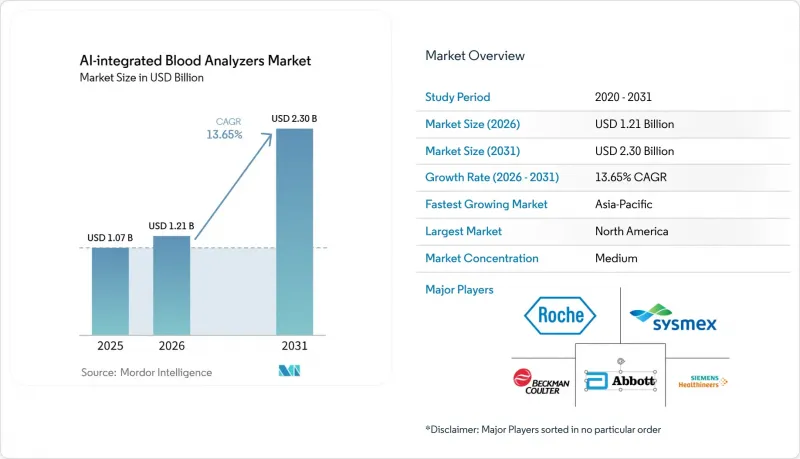
AI 통합 혈액 분석기 시장 규모는 2025년 10억 7,000만 달러로 평가되었습니다. 2026년에는 12억 1,000만 달러로 확대되어 2031년까지 23억 달러에 이를 것으로 예상되고 2026년부터 2031년에 걸쳐 CAGR 13.65%로 성장할 전망입니다.
본 보고서는 모달리티별(전자동 시스템, POC 시스템 등), 제품 유형별(AI 통합 혈액 분석기, AI 통합형 POC 혈액 분석기 등), 용도별(CBC 검사 등), 최종 사용자별(병원, 진단실험실 등), 지역별(북미, 유럽 등)로 분류되어 있습니다. 시장 전망은 금액(달러) 기준으로 제시되어 있습니다.
세계의 AI 통합 혈액 분석기 시장 동향 및 인사이트
AI를 활용한 형태학적 평가에 대한 수요 증가
말초혈 도말 검체의 수동 평가는 여전히 훈련된 직원과 신중한 육안 판단에 크게 의존하고 있기 때문에 검사실 내 혈액학 검사 중 가장 시간이 많이 소요되는 공정 중 하나입니다. 연구에 따르면, 수동 평가에서는 이 과정에 슬라이드 1장당 10-20분이 소요되는 반면, AI를 활용한 형태학적 평가 플랫폼을 사용하면 적절한 워크플로우 하에서 이를 5분 미만으로 단축할 수 있는 것으로 나타났습니다. 동일한 정보원에 따르면, CellaVision DM 시리즈는 92%의 사전 분류 정확도를 유지하면서 도말 검체 분석의 총 시간을 50% 단축했으며, 시스멕스의 DI-60은 전향적 연구에서 슬라이드 1장당 실제 작업 시간을 144초 이상 단축한 것으로 보고되었습니다. AI 통합 혈액 분석기 시장에서 이러한 시간 단축은 귀중한 형태학 전문가를 추가하지 않고도 처리 능력을 향상시키기 때문에 매우 중요합니다. 또한 이를 통해 병리학자나 수석 심사 담당자가 한 곳에서 여러 거점을 감독할 수 있게 되어, 대규모 의료 시스템에서 보편화되고 있는 ‘허브 앤 스포크(hub-and-spoke)’형 검사실 모델을 지원합니다. 이것이 바로 AI 통합 혈액 분석기 시장이 주요 병원뿐만 아니라, 도시와 지방 거점 간에 일관된 심사 품질을 필요로 하는 검사실 네트워크로부터도 수요를 모으고 있는 이유입니다.
완전 자동화 고처리량 검사실의 확대
완전 자동화된 검사 워크셀로의 전환은 AI 통합 혈액 분석기 시장을 지속적으로 견인하고 있습니다. 이는 중앙 검사실에서 더 높은 처리 능력, 일관성 향상, 그리고 수작업 감축이 요구되고 있기 때문입니다. 시스멕스 아메리카는 2026년 5월, 고복잡도 및 대량 처리 실험실을 위한 차세대 XR 시리즈를 발표했습니다. 이 플랫폼은 정평이 나 있는 XN 시리즈를 기반으로 하여, 더 높은 처리 능력, 강화된 AI 분석 기능, 그리고 자동화 시스템과의 보다 용이한 통합을 실현하고 있습니다. 유사한 추세는 중규모 시장의 자동화 분야에서도 나타나고 있으며, 2024년 6월에는 마인드레이(Mindray)사와 임페코(Impeco)사가 전략적 제휴 계약을 체결하여 혈액학 솔루션을 종합 검사실 자동화 시스템 및 보다 광범위한 체외 진단 데이터 아키텍처와 연동하기로 했습니다. 병원 시스템이 위성 검사실을 대규모 참조 시설로 통합하는 움직임이 진행되고 있어, AI 통합 혈액 분석기 시장은 이러한 추세로부터 혜택을 받고 있습니다. 이러한 시설에서는 중단을 최소화하면서 더 많은 일일 검체를 처리할 수 있는 분석기군이 필요합니다. 이러한 모델 하에서는 검사 정보 시스템(LIS)과의 연동이 점점 더 중요해집니다. 이는 검사량이 많은 시설이 검체 처리, 분석기 출력, 디지털 형태학 및 결과 공개를 연동하는 단일 워크플로우를 요구하고 있기 때문입니다. 통합된 자동화 스택을 중심으로 표준화를 추진하는 검사실이 늘어남에 따라, AI 통합 혈액 분석기 시장은 교체 수요, 소프트웨어의 추가 기능, 그리고 장기적인 서비스 관계로부터 혜택을 받고 있습니다.
장비 가격 및 검사 단가의 높음으로 인한 부담
AI 통합 혈액 분석기 시장은 여전히 명확한 가격적 장벽에 직면해 있습니다. 완전한 디지털 형태 진단 기능, 영상 처리 하드웨어, 소프트웨어 및 통합에는 많은 소규모 시설이 감당하기 어려운 수준의 지출이 필요한 경우가 많기 때문입니다. 본 보고서는 고해상도 디지털 이미징 및 의사결정 지원 소프트웨어를 갖춘 검증된 AI 형태학 플랫폼의 정가가 종종 10만 달러를 초과한다고 지적합니다. 동시에, 시약비 및 검사 1회당 비용이 이미 빠듯한 검사실 예산에 지속적인 압박을 가하고 있습니다. 이는 보상 구조가 AI 지원 첨단 워크플로가 아닌, 기존의 혈액학 검사에 기반하여 구축된 공공 의료 시스템이나 지방 시설에서 특히 큰 문제가 되고 있습니다. 따라서 AI 통합 혈액 분석기 시장은 도입 속도가 양극화될 위험이 있습니다. 대규모 참조 실험실은 도입을 급속히 추진하는 반면, 소규모이고 가격에 민감한 의료 기관은 더 오랜 기간 동안 구식 시스템을 계속 사용하게 될 것입니다. 이러한 양극화는 자동화의 임상적 근거가 강력하더라도 잠재적 총 수요(TAD)의 성장을 둔화시킬 가능성이 있습니다. 또한, AI 통합 혈액 분석기 시장공급업체를 대상으로 초기 도입 장벽을 낮추기 위한 리스, 모듈식 업그레이드, 혹은 소프트웨어 오버레이 제공을 요구하는 압력이 강화될 것으로 보입니다.
부문별 분석
2025년, AI 통합형 혈액 검사 시장에서 완전 자동화 시스템이 61.38%의 점유율을 차지했습니다. 이는 대규모 병원 검사실과 참조 센터가 하루에 대량의 검체를 처리하는 데 이미 이러한 플랫폼에 의존하고 있기 때문입니다. 검사실 통합이 진행됨에 따라, 대규모 중앙 집중식 시설에서는 수작업 공정과 중단을 최소화하면서 수천 건의 검체를 처리할 수 있는 워크셀을 선호하기 때문에 완전 자동화 시스템의 입지는 더욱 공고해지고 있습니다. 또한, 이러한 시스템은 이미 투입된 자본과 확립된 운영 루틴이라는 이점도 누리고 있어, 이로 인해 교체 주기가 느려지고, 일단 자동화 체제가 갖춰지면 전환 비용이 높아집니다. AI 통합 혈액 분석기 시장에서 기존 도입 기반은 주요 공급업체에 분석기, 시약, 유지보수 및 소프트웨어 업그레이드를 통한 안정적인 수익 기반을 제공합니다.
반자동 시스템은 신뢰성이 높은 5가지 백혈구 분획 기능이 필요한 곳, 완전한 워크셀 구축을 정당화할 수 없는 중규모 검사실에서 계속해서 사용되고 있습니다. 이 부문은 저가의 소형 기기가 하위 시장에서 압박을 가하는 한편, 리스 및 스케일링 프로그램이 처리량이 많은 시설을 완전 자동화로 유도하고 있어 양쪽에서 점차 시장 점유율을 잃어가고 있습니다. 포인트 오브 케어(PoC) 시스템은 2031년까지 연평균 성장률(CAGR)이 16.63%로 가장 빠르게 성장하는 분야이며, 이러한 성장 속도는 단순히 기기의 소형화 때문만은 아닙니다. 따라서 AI 통합 혈액 분석기 시장은 대규모 검사실뿐만 아니라, 환자 곁에서 검사를 통해 임상적 판단까지 걸리는 시간을 단축할 수 있는 응급 의료, 외래 진료, 원격 의료 현장에서도 확대되고 있습니다. 이러한 추세로 인해, 높은 처리량을 자랑하는 중앙 검사 시설의 운영상 중요성을 훼손하지 않으면서도 AI 통합 혈액 분석기 시장의 잠재적 수요가 확대되고 있습니다.
2025년, AI 통합 혈액 분석기는 제품 유형별 매출의 47.14%를 차지했으며, 이에 따라 핵심인 분석기 하드웨어가 AI 통합 혈액 분석기 시장의 중심적인 위치를 계속 차지했습니다. 이러한 압도적인 점유율은 시스멕스, 벡만 콜터, 지멘스 헬스인어즈와 같은 대형 제조업체들이 쌓아온 전 세계적인 도입 실적에 기인합니다. 이 제조업체들의 고처리량 분석기 시리즈는 일상적인 전혈구 계수 검사의 기반으로서 여전히 중요한 역할을 수행하고 있습니다. 하드웨어가 여전히 중요하게 여겨지는 이유는 분석기 계약이 대규모 검사 기관에서의 시약 구매, 서비스 계약 및 워크플로우 표준화의 기반이 되는 경우가 많기 때문입니다. AI 디지털 형태학 분석기는 혈액 검사에서 가장 많은 노력이 필요한 공정 중 하나를 처리하고, 미세한 이상을 보다 체계적인 방법으로 평가할 수 있기 때문에 여전히 가장 차별화된 하드웨어 카테고리로 자리 잡고 있습니다. 또한, AI 통합형 현장 진단(POC) 혈액 분석기도 주목을 받고 있습니다. 컴팩트한 설계 덕분에 본격적인 검사실 인프라가 갖춰지지 않은 환경에서도 검사 접근성을 확대할 수 있기 때문입니다.
AI 혈액 분석 소프트웨어는 가장 빠르게 성장하는 제품 유형이며, 이 부문에서 AI 통합형 혈액 분석 장치 시장 규모는 2031년까지 연평균 성장률(CAGR) 17.16%로 확대될 것으로 예측됩니다. 이러한 성장은 중요한 의미를 지닙니다. 소프트웨어는 서비스 계층으로 전개될 수 있고, 하드웨어보다 빈번하게 업데이트가 가능하며, 기존 장비군에 추가함으로써 장비의 전면적인 교체 주기를 강요하지 않고도 도입할 수 있기 때문입니다. 시장에서 주요한 가치 창출의 전환점으로는 소프트웨어의 수익화가 꼽힙니다. 이는 수익원이 장비의 일괄 구매에서 지속적인 분석, 의사결정 지원, 워크플로우 모듈로 전환되고 있음을 의미합니다. AI 통합 혈액 분석기 업계에서 이로 인해 이미 도입된 기기에 대한 접근 권한이 단순한 기기 출하 대수보다 더 큰 가치를 가지게 됩니다. 또한, 이것이 공급업체들이 기존 분석기 위에 구축 가능한 디지털 형태학적 분석, 연결성, 원격 검토 기능에 투자하고 있는 이유이기도 합니다. 이러한 추세가 심화됨에 따라, AI 통합 혈액 분석기 시장에서는 분석기의 기계적 기능 그 자체보다 영상 분석, 플래그 설정 알고리즘 및 서비스 계약을 둘러싼 경쟁이 격화될 가능성이 있습니다.
지역별 분석
2025년, 북미는 AI 통합 혈액 분석기 시장 점유율의 42.36%를 차지하며 계속해서 가장 규모가 큰 지역 기여자로 자리매김했습니다. 이 지역은 고처리량의 기준 검사실이 밀집해 있고, 체외 진단 약물에 대한 확립된 환급 제도, 그리고 AI 탑재 혈액학 기기에 대한 이해가 깊어지고 있는 규제 경로와 같은 이점을 누리고 있습니다. 미국에서는 검사실 통합과 인력 부족이 자동화에 대한 수요를 지속적으로 부추기고 있습니다. 이는 대규모 네트워크가 더 적은 전문 인력으로 더 높은 처리 능력과 더 일관된 검사 품질을 요구하고 있기 때문입니다. 또한 FDA 승인 절차의 양상도 공급업체의 동향에 영향을 미치고 있으며, 시스멕스의 XR 시리즈가 관련 자동 혈액 분석기 분류에 따라 승인된 점과, 더욱 통합된 분석 기능을 갖춘 차세대 시스템으로의 꾸준한 전환이 그 예입니다. 캐나다와 멕시코는 여전히 규모는 작지만 중요한 기여국이며, 캐나다에서는 네트워크화된 디지털 판정 모델이 선호되는 반면, 멕시코에서는 지속적으로 성장하는 민간 진단실험실 기반을 통해 중급 분석 장치의 도입 여지가 확대되고 있습니다.
아시아태평양은 가장 빠르게 성장하는 지역이며, 이 지역의 AI 통합 혈액 분석기 시장 규모는 2031년까지 연평균 성장률(CAGR) 15.32%로 확대될 것으로 예측됩니다. 이 지역은 다양성이 풍부하며, 중국은 막대한 수입 수요와 강력한 국내 제조 능력을 겸비하고 있는 반면, 일본과 한국은 첨단 검사 장비 및 프리미엄 임상 워크플로우 분야에서 더 깊은 기술력을 유지하고 있습니다. Mindray사의 혈액학 분야에 대한 집중과 Inpeco사와의 검사실 완전 자동화(TLA) 제휴는 현지 및 지역 공급업체들이 분석 장비뿐만 아니라 연계된 검사실 생태계를 통해 자신들의 입지를 강화하고자 하고 있음을 보여줍니다. 인도 수요 동향은 진단실험실의 확대 및 혈액 질환에 대한 선별 검사 수요 증가와 밀접한 관련이 있어, 주요 병원 시스템 이외의 분야에서 확장 가능한 분석 장비를 도입하는 것이 특히 중요해지고 있습니다. 2026년 7월, ASUS Blade사는 싱가포르 보건과학청(HSA)으로부터 AI를 활용한 말초혈 도말 검체 분석 소프트웨어에 대한 승인을 획득했습니다. 이는 동남아시아가 AI 형태학 도구의 유용한 초기 도입 및 검증 거점으로 부상하고 있음을 시사합니다.
유럽은 AI 통합 혈액 분석기 시장에 있어 여전히 중요한 수익 기반이 되고 있습니다. 이는 특히 독일, 프랑스, 영국, 북유럽 국가에서 인증 기준과 디지털 실험실 관행이 AI를 활용한 검사의 도입을 뒷받침하고 있기 때문입니다. 이 지역의 더욱 엄격해진 규제 및 규정 준수 환경은 공급업체에게는 부담이 되는 반면, 성능, 감독, 품질 관리를 체계적으로 문서화할 수 있는 공급업체에게는 유리하게 작용합니다.
기타 혜택 :
- 엑셀 형식 시장 예측(ME) 시트
- 3개월간의 애널리스트 지원
자주 묻는 질문
목차
제1장 서론
제2장 조사 방법
제3장 개요
제4장 시장 구도
제5장 시장 규모 및 성장 예측
제6장 경쟁 구도
제7장 시장 기회 및 향후 전망
KTH 26.09.02According to Mordor Intelligence, the AI-integrated blood analyzers market size is expected to increase from USD 1.07 billion in 2025 to USD 1.21 billion in 2026 and reach USD 2.30 billion by 2031, growing at a CAGR of 13.65% over 2026-2031.
This report is Segmented by Modality (Fully Automated Systems, POC Systems, and More), by Product Type (AI-Integrated Hematology Analyzers, AI-Integrated POC Blood Analyzers, and More), by Application (CBC Testing, and More), by End User (Hospitals, Diagnostic Laboratories, and More), and Geography (North America, Europe, and More). Market Forecasts are Provided in Terms of Value (USD).
Global AI-integrated Blood Analyzers Market Trends and Insights
Rising Demand for AI-Assisted Morphology Review
Manual peripheral blood smear review remains one of the slowest steps in laboratory hematology because it still depends heavily on trained staff and careful visual judgment. The studies indicated that this step can take 10-20 minutes per slide under manual review, while AI-assisted morphology platforms can cut that to under 5 minutes in suitable workflows. The same source reported that the CellaVision DM series delivered a 50% reduction in total smear analysis time with 92% preclassification accuracy, and the Sysmex DI-60 reduced hands-on time by more than 144 seconds per slide in prospective studies. In the AI-integrated blood analyzers market, time gain matters because it improves throughput without asking labs to add scarce morphology specialists. It also allows a pathologist or senior reviewer to oversee several sites from one location, which supports hub-and-spoke laboratory models that are becoming more common in large health systems. This is why the AI-integrated blood analyzers market is finding demand not only in major hospitals, but also in laboratory networks that need consistent review quality across urban and rural locations.
Expansion of Fully Automated High-Throughput Labs
The shift toward fully automated laboratory workcells continues to support the AI-integrated blood analyzers market because central laboratories need more throughput, better consistency, and fewer manual steps. Sysmex America introduced the next-generation XR-Series in May 2026 for high-complexity and high-volume laboratories, and the platform builds on the established XN-Series with higher throughput, enhanced AI analytics, and easier automation integration. The same direction is visible in mid-market automation, where Mindray and Inpeco signed a strategic cooperation agreement in June 2024 to connect hematology solutions with total laboratory automation systems and a broader in vitro diagnostics data architecture. The AI-integrated blood analyzers market benefits from this pattern because hospital systems are consolidating satellite laboratories into larger reference sites, and those sites need analyzer fleets that can handle more daily samples with fewer interruptions. Laboratory information system connectivity becomes more important under this model because high-volume sites want one workflow that links sample handling, analyzer output, digital morphology, and result release. As more laboratories standardize around integrated automation stacks, the AI-integrated blood analyzers market gains from replacement demand, software add-ons, and longer service relationships.
High Instrument and Per-Test Cost Burden
The AI-integrated blood analyzers market still faces a clear affordability barrier because full digital morphology capability, imaging hardware, software, and integration often require a level of spending that many smaller facilities cannot justify. The input notes that validated AI morphology platforms with high-resolution digital imaging and decision support software often carry list prices above USD 100,000. At the same time, reagent and per-test costs add recurring pressure on already tight laboratory budgets. This matters most in public systems and lower-tier facilities where reimbursement structures were built around conventional hematology testing rather than premium AI-enabled workflows. The AI-integrated blood analyzers market, therefore, risks splitting into two adoption tracks, with large reference laboratories moving faster while smaller and price-sensitive providers remain on older systems for longer. That split can slow total addressable demand even when the clinical case for automation is strong. It also increases pressure on vendors in the AI-integrated blood analyzer market to offer leasing, modular upgrades, or software overlays that lower the upfront hurdle.
Other drivers and restraints analyzed in the detailed report include:
- Rising Blood Disorder Screening Volumes
- Decentralized Testing Needs in Acute and Urgent Care
- Validation Gaps Versus Central Laboratory Standards
For complete list of drivers and restraints, kindly check the Table Of Contents.
Segment Analysis
Fully Automated Systems held 61.38% of the AI-integrated hematology blood market share in 2025 because large hospital laboratories and reference centers already depend on these platforms for high daily sample volumes. Their position is reinforced by laboratory consolidation, because larger centralized sites prefer workcells that can process thousands of samples with fewer manual steps and fewer interruptions. These systems also benefit from sunk capital and established operating routines, which makes replacement cycles more gradual and raises switching costs once automation tracks are in place. In the AI-integrated blood analyzers market, the installed foundation gives leading suppliers a stable revenue base from analyzers, reagents, maintenance, and software upgrades.
Semi-Automated Systems continue to serve mid-volume laboratories that need dependable 5-part differential capability but cannot justify a full workcell buildout. The segment is gradually losing ground from both sides because affordable compact devices pressure it at the lower end, while leasing and scaling programs pull higher-volume sites toward full automation. Point-of-Care Systems are the fastest-growing modality with a 16.63% CAGR through 2031, and that pace reflects more than instrument miniaturization. The AI-integrated blood analyzers market is therefore widening not only across large laboratories, but also across urgent care, ambulatory, and remote settings where near-patient testing can shorten clinical decision time. This dynamic broadens the addressable need of the AI-integrated blood analyzers market without removing the operational importance of high-throughput central sites.
AI-integrated Blood Analyzers controlled 47.14% of product-type revenue in 2025, which kept core analyzer hardware at the center of the AI-integrated blood analyzers market. That leading share came from the global installed base built by large manufacturers such as Sysmex, Beckman Coulter, and Siemens Healthineers, whose high-throughput analyzer lines remain the base layer for routine complete blood count testing. Hardware still matters because analyzer contracts often anchor reagent pull-through, service agreements, and workflow standardization inside large laboratory accounts. AI Digital Morphology Analyzers remain the most differentiated hardware category because they address one of the most labor-intensive parts of blood review and allow subtle abnormalities to be reviewed in a more structured way. AI-Integrated Point-of-Care Blood Analyzers are also gaining visibility because compact formats can extend testing access into settings that do not have full laboratory infrastructure.
AI Blood Analysis Software is the fastest-growing product type, and the AI-integrated blood analyzers market size for this segment is projected to expand at a 17.16% CAGR through 2031. That growth is important because software can be deployed as a service layer, updated more often than hardware, and added to existing instrument fleets without forcing a full replacement cycle. Software monetization as the main value creation shift in the market, which means the revenue center is moving from one-time equipment purchase toward recurring analytics, decision support, and workflow modules. Within the AI-integrated blood analyzers industry, this makes installed-base access more valuable than pure instrument shipment volume. It also explains why suppliers are investing in digital morphology, connectivity, and remote review functions that can sit on top of existing analyzer footprints. As this pattern deepens, the AI-integrated blood analyzers market is likely to see stronger competition around image interpretation, flagging algorithms, and service contracts than around analyzer mechanics alone.
Complete Report Scope:
- By Modality
- Fully Automated Systems
- Semi-Automated Systems
- Point-of-Care Systems
- By Product Type
- AI-Integrated Hematology Analyzers
- AI-Integrated Point-of-Care Blood Analyzers
- AI-Based Digital Morphology Analyzers
- AI Blood Analysis Software
- By Application
- Complete Blood Count Testing
- Anemia Screening and Triage
- Blood Cancer Diagnostics
- Infection Detection
- Hemorrhagic Condition Monitoring
- Digital Morphology and Peripheral Smear Review
- Others (Prenatal and Neonatal Testing, Wellness & Preventive Health, etc.)
- By End User
- Hospitals
- Diagnostic Laboratories
- Blood Banks and Transfusion Centers
- Ambulatory and Urgent Care Centers
- Research and Academic Institutes
- Others (Mobile Diagnostic Units, Dialysis Centers, etc.)
- By Geography
- North America
- United States
- Canada
- Mexico
- Europe
- Germany
- United Kingdom
- France
- Italy
- Spain
- Rest of Europe
- Asia-Pacific
- China
- Japan
- India
- Australia
- South Korea
- Rest of Asia-Pacific
- Middle East and Africa
- GCC
- South Africa
- Rest of Middle East and Africa
- South America
- Brazil
- Argentina
- Rest of South America
- North America
Geography Analysis
North America accounted for 42.36% of the AI-integrated blood analyzers market share in 2025, which kept it as the largest regional contributor. The region benefits from a dense base of high-throughput reference laboratories, established reimbursement structures for in vitro diagnostics, and a regulatory pathway that is increasingly familiar with AI-enabled hematology devices. In the United States, laboratory consolidation and staff shortages continue to support demand for automation because larger networks want more throughput and more consistent review quality from fewer specialized personnel. The FDA clearance pathway is also shaping supplier behavior, as shown by the Sysmex XR-Series clearance under the relevant automated blood analyzer classification and the steady push toward next-generation systems with more integrated analytics. Canada and Mexico remain smaller but important contributors, with Canada favoring networked digital review models and Mexico offering room for mid-tier analyzer uptake through its growing private diagnostic laboratory base.
Asia-Pacific is the fastest-growing region, and the AI-integrated blood analyzers market size in the region is forecast to expand at a 15.32% CAGR through 2031. The region is diverse because China combines large import demand with stronger domestic manufacturing, while Japan and South Korea maintain deeper capability in advanced laboratory instrumentation and premium clinical workflows. Mindray's hematology push and its total laboratory automation cooperation with Inpeco show how local and regional suppliers are trying to deepen their position not only through analyzers, but also through connected laboratory ecosystems. India's demand profile is tied closely to diagnostic laboratory expansion and higher screening needs for blood disorders, which makes scalable analyzer deployment especially relevant outside major hospital systems. In July 2026, ASUS Blade received Health Sciences Authority approval in Singapore for AI-powered peripheral blood film analysis software, which signals that Southeast Asia is becoming a useful early-adoption and validation point for AI morphology tools.
Europe remains an important revenue base for the AI-integrated blood analyzers market because accreditation expectations and digital laboratory practices support the adoption of AI-assisted review, especially in Germany, France, the United Kingdom, and the Nordic countries. The region's stricter regulatory and compliance environment creates more work for vendors, but it also favors suppliers that can document performance, oversight, and quality control in a structured way.
- Abbott Laboratories
- Beckton Dickinson
- Bio-Rad Laboratories
- Boule Diagnostics
- CellaVision AB
- Danaher
- Diatron MI PLC
- EKF Diagnostics Holdings plc
- Roche
- HemoCue AB
- HORIBA
- Mindray
- Nihon Kohden
- Ortho Clinical Diagnostics
- PixCell Medical Technologies Ltd.
- Scopio Labs Ltd.
- Siemens Healthineers
- Sight Diagnostics Ltd.
- Sysmex
- Transasia Bio-Medicals Ltd.
Additional Benefits:
- The market estimate (ME) sheet in Excel format
- 3 months of analyst support
TABLE OF CONTENTS
1 INTRODUCTION
- 1.1 Study Assumptions and Market Definition
- 1.2 Scope of the Study
2 RESEARCH METHODOLOGY
3 EXECUTIVE SUMMARY
4 MARKET LANDSCAPE
- 4.1 Market Overview
- 4.2 Market Drivers
- 4.2.1 Rising Demand for AI-Assisted Morphology Review
- 4.2.2 Expansion of Fully Automated High-Throughput Labs
- 4.2.3 Rising Blood Disorder Screening Volumes
- 4.2.4 Decentralized Testing Needs in Acute and Urgent Care
- 4.2.5 Increasing LIS and Digital Workflow Integration
- 4.3 Restraints
- 4.3.1 High Instrument and Per-Test Cost Burden
- 4.3.2 Validation Gaps Versus Central Laboratory Standards
- 4.3.3 Data Privacy and Cybersecurity Compliance Complexity
- 4.3.4 Shortage of Skilled Hematology Review Personnel
- 4.4 Value Chain Analysis
- 4.5 Regulatory Landscape
- 4.6 Technological Outlook
- 4.7 Porter's Five Forces Analysis
- 4.7.1 Threat of New Entrants
- 4.7.2 Bargaining Power of Suppliers
- 4.7.3 Bargaining Power of Buyers
- 4.7.4 Threat of Substitutes
- 4.7.5 Competitive Rivalry
5 MARKET SIZE AND GROWTH FORECASTS (VALUE, USD)
- 5.1 By Modality
- 5.1.1 Fully Automated Systems
- 5.1.2 Semi-Automated Systems
- 5.1.3 Point-of-Care Systems
- 5.2 By Product Type
- 5.2.1 AI-Integrated Hematology Analyzers
- 5.2.2 AI-Integrated Point-of-Care Blood Analyzers
- 5.2.3 AI-Based Digital Morphology Analyzers
- 5.2.4 AI Blood Analysis Software
- 5.3 By Application
- 5.3.1 Complete Blood Count Testing
- 5.3.2 Anemia Screening and Triage
- 5.3.3 Blood Cancer Diagnostics
- 5.3.4 Infection Detection
- 5.3.5 Hemorrhagic Condition Monitoring
- 5.3.6 Digital Morphology and Peripheral Smear Review
- 5.3.7 Others (Prenatal and Neonatal Testing, Wellness & Preventive Health, etc.)
- 5.4 By End User
- 5.4.1 Hospitals
- 5.4.2 Diagnostic Laboratories
- 5.4.3 Blood Banks and Transfusion Centers
- 5.4.4 Ambulatory and Urgent Care Centers
- 5.4.5 Research and Academic Institutes
- 5.4.6 Others (Mobile Diagnostic Units, Dialysis Centers, etc.)
- 5.5 By Geography
- 5.5.1 North America
- 5.5.1.1 United States
- 5.5.1.2 Canada
- 5.5.1.3 Mexico
- 5.5.2 Europe
- 5.5.2.1 Germany
- 5.5.2.2 United Kingdom
- 5.5.2.3 France
- 5.5.2.4 Italy
- 5.5.2.5 Spain
- 5.5.2.6 Rest of Europe
- 5.5.3 Asia-Pacific
- 5.5.3.1 China
- 5.5.3.2 Japan
- 5.5.3.3 India
- 5.5.3.4 Australia
- 5.5.3.5 South Korea
- 5.5.3.6 Rest of Asia-Pacific
- 5.5.4 Middle East and Africa
- 5.5.4.1 GCC
- 5.5.4.2 South Africa
- 5.5.4.3 Rest of Middle East and Africa
- 5.5.5 South America
- 5.5.5.1 Brazil
- 5.5.5.2 Argentina
- 5.5.5.3 Rest of South America
- 5.5.1 North America
6 COMPETITIVE LANDSCAPE
- 6.1 Market Concentration
- 6.2 Market Share Analysis
- 6.3 Company Profiles (includes Global Level Overview, Market Level Overview, Core Segments, Financials as available, Strategic Information, Market Rank/Share, Products and Services, Recent Developments)
- 6.3.1 Abbott Laboratories
- 6.3.2 Beckman Coulter, Inc.
- 6.3.3 Bio-Rad Laboratories, Inc.
- 6.3.4 Boule Diagnostics AB
- 6.3.5 CellaVision AB
- 6.3.6 Danaher Corporation
- 6.3.7 Diatron MI PLC
- 6.3.8 EKF Diagnostics Holdings plc
- 6.3.9 F. Hoffmann-La Roche Ltd
- 6.3.10 HemoCue AB
- 6.3.11 HORIBA, Ltd.
- 6.3.12 Mindray Medical International Limited
- 6.3.13 Nihon Kohden Corporation
- 6.3.14 Ortho Clinical Diagnostics
- 6.3.15 PixCell Medical Technologies Ltd.
- 6.3.16 Scopio Labs Ltd.
- 6.3.17 Siemens Healthineers AG
- 6.3.18 Sight Diagnostics Ltd.
- 6.3.19 Sysmex Corporation
- 6.3.20 Transasia Bio-Medicals Ltd.
7 MARKET OPPORTUNITIES AND FUTURE OUTLOOK
- 7.1 White-Space and Unmet-Need Assessment


