

|
시장보고서
상품코드
2115086
자동차용 공기청정기 시장 : 시장 점유율 분석, 업계 동향 및 통계, 성장 예측(2026-2031년)Automotive Air Purifier - Market Share Analysis, Industry Trends & Statistics, Growth Forecasts (2026 - 2031) |
||||||
 Mordor Intelligence
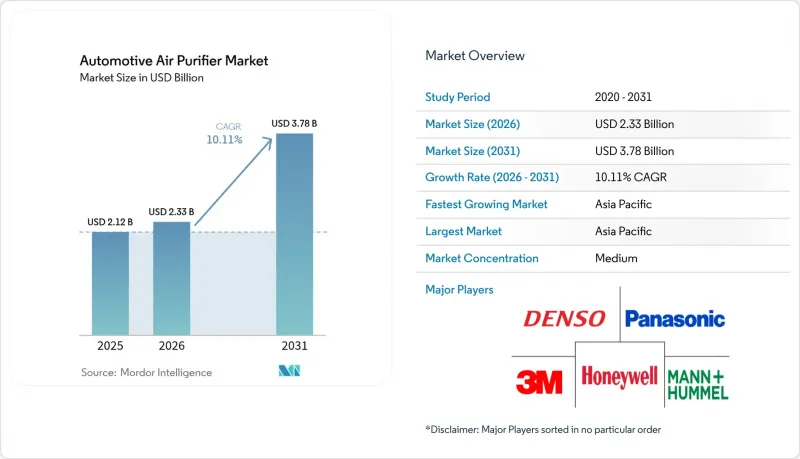
Mordor Intelligence에 의하면, 2026년 자동차용 공기청정기 시장 규모는 23억 3,000만 달러로 추정되고, 2025년 21억 2,000만 달러에서 성장하여 2031년에는 37억 8,000만 달러에 이를 것으로 예측됩니다.
2026-2031년 연평균 성장률(CAGR) 10.11%로 성장할 것으로 전망됩니다.
본 보고서는 차종별(승용차, 소형 상용차 등), 기술별(HEPA, 활성탄 등), 설치 유형별(HVAC 통합형·공장 장착, 독립형·플러그인 등), 판매 채널별(OEM 및 애프터마켓), 차량 구동 방식별(내연기관 차량 등), 그리고 지역별로 분류되어 있습니다. 시장 전망은 금액(달러) 기준으로 제시되어 있습니다.
세계의 자동차용 공기청정기 시장 동향 및 인사이트
대도시권에서 차량 내 PM2.5에 대한 우려 증가
급속한 도시화로 인해 교통 노출이 일상적인 건강 위험이 되고 있으며, 통근자들은 차량을 ‘보호의 거품’으로 인식하게 되었습니다. 2024년 ‘IQAir 세계 대기질 보고서’에 따르면, 조사 대상 도시 중 세계보건기구(WHO)의 지침을 충족하는 도시는 불과 17%에 그쳐, 차량용 공기청정기의 필요성이 부각되고 있습니다. 한국의 국립 연구개발 기관은 공공 공간에서 초미세먼지의 90% 이상을 제거하는 필터리스 정전탑을 도입함으로써 규제의 시급성을 보여주었습니다. 이 개념은 머지않아 차량 내부에도 적용될 예정입니다. 이에 현대자동차는 ‘애프터블로우’ 및 ‘미세먼지 표시기’ 소프트웨어를 탑재했습니다. 이를 통해 PM2.5가 급증할 때 자동으로 재순환 모드가 작동하여, 공기 청정이 ‘눈에 보이지 않는 안전 기능’으로 기능하게 되었습니다. 아시아태평양의 메가시티에서는 가정이 파워트레인의 효율과 동등하게 차량 내 쾌적성을 중시하게 됨에 따라, 차량용 공기청정기 시장은 지속적인 성장을 이루고 있습니다.
더욱 엄격해진 중국 VI-B 및 유로 7 차량 내 공기질 규제
규제 당국은 현재 차량 내 배출 가스를 배기가스 규제와 일체화하여 다루고 있어, 필터 탑재가 ‘선택 사항’이었던 상황은 해소되었습니다. 유로 7은 2026년 11월부터 승용차, 밴, 대형 트럭에 걸쳐 준수가 의무화되는 반면, 중국의 VI-B 규제에서는 이미 모든 신형 경차에 대해 알데히드 및 미세먼지 상한치가 적용되고 있습니다. NGK 인슐레이터즈와 같은 공급업체들은 거시적인 수요 변동에도 불구하고, 규제에 따라 장비가 의무화됨으로써 구매량이 보장되므로 매출이 안정될 것이라고 공개적으로 예측했습니다. 표준화의 효과로 설계 주기가 단축됩니다. 두 규제 블록에서 인증된 단일 정화 스택이 전 세계 대량 생산 플랫폼의 대부분을 커버할 수 있기 때문에 규모의 경제가 실현되어 자동차용 공기 정화기 시장을 확대하게 될 것입니다.
세계적인 성능 기준 및 시험 주기의 부재
Euro-NCAP이나 WLTP와 달리, 자동차용으로 보편적으로 인정받는 청정 공기 프로토콜은 존재하지 않습니다. Aerosol Science and Technology사의 조사에 따르면, 다양한 실험실 환경에서 이온화기를 통한 청정 공기 공급률은 5-10 cfm 범위에 그치고 있어 브랜드 간 비교가 불가능합니다. 각 OEM 업체는 중국, 유럽연합, 일본을 아우르는 최소 3가지의 서로 다른 차량 내 공기 시험 주기를 준수해야 하며, 이로 인해 비용이 증가하고 출시가 지연됩니다. 표준화 지연으로 인해 중소 공급업체들이 시험의 통일화가 실현될 때까지 투자를 미루고 있어, 차량용 공기청정기 시장의 성장이 둔화되고 있습니다.
부문 분석
승용차는 2025년 매출의 65.02%를 차지했으며, 이는 매일 출퇴근하는 습관으로 인해 차량 내 청결에 대한 가치 인식이 높아지고 있는 것이 배경입니다. 승용차용 차량용 공기청정기 시장 규모는 탑재율 상승에 힘입어 2031년까지 연평균 성장률(CAGR) 11.34%로 확대될 것으로 예측되며, 이는 전 세계 경차 생산 대수 증가율을 웃도는 속도입니다. 렉서스 등의 제조업체는 UX, RZ, ES, LC, LS, LX 각 모델에 파나소닉의 ‘nanoe X’ 발생 장치를 채택하고 있으며, 과거에는 옵션 사양이었던 것이 브랜드 전체의 기본 사양으로 변화하고 있습니다.
물류 기업들이 운전자의 건강 상태가 생산성에 미치는 영향을 평가함에 따라 상용차 분야에서도 관심이 높아지고 있습니다. 중형 및 대형 트럭은 하루 가동 시간이 길기 때문에 미미한 여과 효과라도 결근 비용 절감으로 이어집니다. 상하이에서 진행된 차량 도입 시험에서는 HEPA+활성탄 카트리지 탑재로 인해 OEM의 내부 지표상 운전자 만족도 점수가 향상된 것으로 나타났습니다. 이 부문은 초기 기반이 작았으나, 2030년까지의 견조한 성장률로 인해 절대 수량이 증가하여 필터 공급업체의 규모의 경제가 강화될 전망입니다.
HEPA 미디어는 0.3미크론의 포집 효율이 인증되어 지지를 받고 있으며, 2025년 매출의 47.12%를 차지했습니다. 그러나 UV-LED 모듈은 가장 빠른 성장세를 보이고 있으며, 다이오드 비용 곡선이 광전자 공학의 학습 곡선을 따라 변화함에 따라 연평균 성장률(CAGR)은 11.94%로 예측됩니다. UVC LED와 HEPA를 결합한 다이킨의 자동차용 유닛은 10분 이내에 SARS-CoV-2를 99.9% 불활성화시키는 것으로 입증되어, 기계적 기공을 통과하는 병원체에 대한 대책이 되고 있습니다.
이온화 필터의 점유율이 하락하고 있는 이유는 장치가 최대 출력으로 가동될 때 오존 농도가 최대 702 ppb에 달하고, 일부 국가의 직업적 노출 기준치를 초과한다는 연구 결과가 보고되었기 때문입니다. 그 결과, 각 제조업체들은 하이브리드 방식으로 전환하고 있습니다. 즉, 입자상 물질에는 HEPA, 가스에는 활성탄, 미생물에는 UV-LED를 채택함으로써 Euro 7의 차량 내 요건을 충족하고, 소비자의 신뢰를 얻을 수 있는 성능 범위를 실현하고 있습니다.
지역별 분석
아시아태평양은 2025년에 매출 점유율 39.04%로 지역별 순위 1위를 차지했으며, 2031년까지 연평균 성장률(CAGR) 10.87%로 성장할 전망입니다. 중국은 신에너지 차량에 대한 차량 내 알데히드 농도 규제 도입과 여과 기능 업그레이드에 100-200달러의 추가 비용을 지불하려는 소비자의 의지에 힘입어 지역 수요의 절반 이상을 차지하고 있습니다. 일본 및 한국의 자동차 제조업체들은 특허를 취득한 ‘nano-e’ 및 ‘플라즈마 클러스터’ 기술을 제공하고 있으며, 이를 통해 국내 시장이 조기에 이러한 기술을 활용할 수 있게 되어 수출 경쟁력도 강화되고 있습니다.
유럽은 이에 이어, 2026년 말까지 승용차와 상용차 모두 통일된 실내 공기질 기준을 충족하도록 의무화하는 ‘유로 7’의 시한에 힘입고 있습니다. 독일의 자동차 제조업체들은 2025년형 신차 출시의 80%에 2단계식 HEPA·활성탄 필터 구성을 채택할 것을 이미 약속했습니다. 차량의 평균 사용 연수가 11년을 넘는 남유럽 국가들에서는 공중 보건 캠페인을 통해 인지도가 높아지면 대규모 사후 장착 시장의 가능성이 기대됩니다.
북미에서는 도입 속도가 완만합니다. 미국의 연방 규제는 배기가스에 중점을 두고 있지만, 캘리포니아주 의회는 2027년에 차량 실내 공기질 공개 스티커에 관한 규정을 제정할 계획이며, 이는 시장 촉진제 역할을 할 가능성이 있습니다. 이는 타이어 공기압 모니터링 시스템의 의무화와 유사한 효과를 가져올 가능성이 있습니다. 기타 지역인 중동 및 아프리카, 남미는 여전히 도입 초기 단계에 있지만, 라고스, 카이로, 상파울루, 리야드에서의 급속한 도시화로 인해 고오염 지역이 형성되고 있습니다. 자유무역지대를 통해 필터 수입이 간소화되면, 현지 조립 제조업체들은 원래 아시아의 양산 모델을 위해 설계된 비용 최적화된 HEPA 카트리지를 채택하게 되어, 장기적인 규격 통합이 촉진될 것입니다.
기타 혜택 :
- 엑셀 형식 시장 예측(ME) 시트
- 3개월간의 애널리스트 지원
자주 묻는 질문
목차
제1장 서론
제2장 조사 방법
제3장 주요 요약
제4장 시장 구도
제5장 시장 규모 및 성장 예측
제6장 경쟁 구도
제7장 시장 기회 및 향후 전망
AJY 26.08.28According to Mordor Intelligence, the automotive air purifier market size in 2026 is estimated at USD 2.33 billion, growing from 2025 value of USD 2.12 billion with 2031 projections showing USD 3.78 billion, growing at 10.11% CAGR over 2026-2031.
This report is Segmented by Vehicle Type (Passenger Cars, Light Commercial Vehicles, and More), Technology (HEPA, Activated Carbon, and More), Installation Type (HVAC-Integrated Factory-Fit, Stand-Alone Plug-In, and More), Sales Channel (OEM and Aftermarket), Vehicle Propulsion (Internal Combustion Engine Vehicles, and More), and Geography. The Market Forecasts are Provided in Terms of Value (USD).
Global Automotive Air Purifier Market Trends and Insights
Rising In-Cabin PM2.5 Concerns in Megacities
Rapid urbanization makes traffic exposure a daily health risk, pushing commuters to treat vehicles as protective bubbles. The 2024 IQAir World Air Quality Report showed only 17% of monitored cities meeting World Health Organization guidelines, underscoring the necessity for onboard filtration. Korea's national R&D institutes illustrated regulatory urgency by rolling out filter-free electrostatic towers that eliminate over 90% of ultrafine particles in public spaces, a concept soon mirrored inside vehicles . Hyundai therefore embedded After-Blow and Fine-Dust Indicator software that auto-activates recirculation when PM2.5 spikes, turning air cleaning into an invisible safety function. In Asia-Pacific megacities, the automotive air purifier market gains an enduring uplift as households prioritize cabin wellness equal to powertrain efficiency.
Stricter China VI-B and Euro 7 Interior Air-Quality Rules
Regulators now bundle cabin emissions with exhaust limits, erasing the optional status of filtration. Euro 7 compels compliance across passenger cars, vans, and heavy trucks beginning November 2026, while China's VI-B regime already enforces aldehyde and particulate caps for every new light vehicle. Suppliers such as NGK Insulators have publicly forecast stable revenue despite macro-demand swings because mandated equipment levels create guaranteed purchase volumes . The standardization effect shortens design cycles: a single purification stack certified for both regulatory blocs can cover most high-volume global platforms, delivering scale economies that widen the automotive air purifier market.
Lack of Global Performance Standards and Test Cycles
Unlike Euro-NCAP or WLTP, no universally accepted clean-air protocol exists for cars. An Aerosol Science and Technology study logged ionizer clean-air delivery rates between 5 and 10 cfm under varying lab setups, making cross-brand comparisons impossible. OEMs must navigate at least three separate cabin-air test cycles spanning China, the European Union, and Japan, adding cost and delaying launches. Standardization gaps slow the automotive air purifier market as smaller suppliers defer investment until test harmonization materializes.
Other drivers and restraints analyzed in the detailed report include:
- Automaker Push for Wellness-Oriented Cabin Features
- HEPA Cost Decline from Melt-Blown Capacity Additions
- Limited Consumer Awareness Outside North Asia
For complete list of drivers and restraints, kindly check the Table Of Contents.
Segment Analysis
Passenger cars commanded 65.02% of 2025 revenue, supported by daily commuting patterns that heighten value perceptions for clean interiors. The automotive air purifier market size for passenger cars is forecast to expand to grow at an 11.34% CAGR by 2031, outpacing global light-vehicle production, due to rising installation rates. Manufacturers like Lexus use Panasonic nanoe X generators across UX, RZ, ES, LC, LS, and LX lines, converting what was once an optional extra into brand-wide default hardware.
Commercial-vehicle interest follows as logistics firms evaluate driver health effects on productivity. Medium and heavy trucks log longer daily operating hours, so even marginal filtration benefits translate into reduced absenteeism costs. Fleet pilots in Shanghai show that installing HEPA-plus-carbon cartridges raises driver satisfaction scores on OEM internal indices. Although this segment started from a smaller base, a healthy growth rate through 2030 will lift absolute volume, reinforcing economies of scale for filter suppliers.
HEPA media led 2025 revenue at 47.12%, favored for certified 0.3-micron capture efficiency. Yet UV-LED modules post the fastest rise, with a 11.94% CAGR projected as diode cost curves track the optoelectronics learning curve. Combining UVC LEDs with HEPA, Daikin's automotive unit validates 99.9% SARS-CoV-2 inactivation in under 10 minutes, answering pathogens that slip through mechanical pores.
Ionizing filters lose share because studies record ozone peaks up to 702 ppb when devices operate at full output, exceeding several national occupational limits. Consequently, manufacturers shift toward hybrid layouts-HEPA for particulates, carbon for gases, and UV-LED for microbes-creating a performance envelope that satisfies Euro 7 interior requirements and builds consumer trust.
Complete Report Scope:
- By Vehicle Type
- Passenger Cars
- Light Commercial Vehicles
- Medium and Heavy Commercial Vehicles
- By Technology
- HEPA
- Activated Carbon
- Ionic Filter
- Photo-Catalytic
- Plasma Cluster
- Hybrid/Multistage
- UV-LED Purification
- By Installation Type
- HVAC-Integrated Factory-Fit
- Stand-Alone Plug-in
- Roof-Mounted Cartridge
- Cup-Holder/Portable
- By Sales Channel
- OEM
- Aftermarket
- By Vehicle Propulsion
- Internal Combustion Engine Vehicles
- Hybrid and Plug-in Hybrid Vehicles
- Battery Electric Vehicles
- By Geography
- North America
- United States
- Canada
- Rest of North America
- South America
- Brazil
- Argentina
- Rest of South America
- Europe
- Germany
- United Kingdom
- France
- Italy
- Spain
- Russia
- Rest of Europe
- Asia-Pacific
- China
- Japan
- India
- South Korea
- Australia and New Zealand
- Rest of Asia-Pacific
- Middle East and Africa
- Saudi Arabia
- United Arab Emirates
- Turkey
- South Africa
- Rest of Middle East and Africa
- North America
Geography Analysis
Asia-Pacific heads the regional league table with a 39.04% revenue share in 2025 and will compound at 10.87% CAGR through 2031. China accounts for more than half of regional demand thanks to mandatory in-cabin aldehyde limits for new-energy vehicles and consumer readiness to pay USD 100-200 premiums for filtration upgrades. Japanese and South Korean OEMs contribute patented nano-e and plasma-cluster technologies, giving domestic markets early access and reinforcing export competitiveness.
Europe follows, driven by Euro 7 deadlines that oblige both passenger and commercial vehicles to meet unified interior-air benchmarks by late 2026 . German automakers have already committed to dual-stage HEPA-carbon layouts across 80% of new launches in the 2025 model year. Southern European countries, where fleet ages average more than 11 years, offer sizable retrofit potential once awareness climbs through public health campaigns.
North America posts a moderate uptake. United States federal regulations focus on tailpipe emissions, yet Californian legislators plan a 2027 rulemaking agenda for cabin air-quality disclosure stickers, which could mirror tire-pressure-monitoring mandates in their market-catalyst effect. Elsewhere, the Middle East, Africa, and South America remain nascent, but rapid urbanization of Lagos, Cairo, Sao Paulo, and Riyadh creates high-pollution corridors. Once free-trade zones simplify filter imports, local assemblers are likely to adopt cost-optimized HEPA cartridges originally engineered for Asian mass-market models, fostering long-run convergence.
- Panasonic Corporation
- 3M
- Honeywell International Inc.
- Denso Corporation
- Marelli Corporation
- MANN+HUMMEL
- MAHLE GmbH
- Koninklijke Philips N.V.
- Sharp Corporation
- Blueair AB
- Eureka Forbes Limited
- IQAir AG
Additional Benefits:
- The market estimate (ME) sheet in Excel format
- 3 months of analyst support
TABLE OF CONTENTS
1 Introduction
- 1.1 Study Assumptions & Market Definition
- 1.2 Scope of the Study
2 Research Methodology
3 Executive Summary
4 Market Landscape
- 4.1 Market Overview
- 4.2 Market Drivers
- 4.2.1 Rising in-cabin PM2.5 concerns in megacities
- 4.2.2 Stricter China VI-B and Euro 7 interior air-quality rules
- 4.2.3 Automaker push for wellness-oriented cabin features
- 4.2.4 HEPA cost decline due to melt-blown capacity additions
- 4.2.5 AI-enabled smart scent and pathogen sensing modules
- 4.2.6 Mandatory filtration for robotaxis and shared-mobility fleets
- 4.3 Market Restraints
- 4.3.1 Lack of global performance standards and test cycles
- 4.3.2 Limited consumer awareness outside North Asia
- 4.3.3 Automaker cost-down pressure in entry-level EVs
- 4.3.4 Micro-ozone emission risks from ionizers
- 4.4 Value/Supply-Chain Analysis
- 4.5 Regulatory Landscape
- 4.6 Technological Outlook
- 4.7 Porter's Five Forces
- 4.7.1 Threat of New Entrants
- 4.7.2 Bargaining Power of Buyers
- 4.7.3 Bargaining Power of Suppliers
- 4.7.4 Threat of Substitutes
- 4.7.5 Intensity of Competitive Rivalry
5 Market Size & Growth Forecasts (Value (USD))
- 5.1 By Vehicle Type
- 5.1.1 Passenger Cars
- 5.1.2 Light Commercial Vehicles
- 5.1.3 Medium and Heavy Commercial Vehicles
- 5.2 By Technology
- 5.2.1 HEPA
- 5.2.2 Activated Carbon
- 5.2.3 Ionic Filter
- 5.2.4 Photo-Catalytic
- 5.2.5 Plasma Cluster
- 5.2.6 Hybrid/Multistage
- 5.2.7 UV-LED Purification
- 5.3 By Installation Type
- 5.3.1 HVAC-Integrated Factory-Fit
- 5.3.2 Stand-Alone Plug-in
- 5.3.3 Roof-Mounted Cartridge
- 5.3.4 Cup-Holder/Portable
- 5.4 By Sales Channel
- 5.4.1 OEM
- 5.4.2 Aftermarket
- 5.5 By Vehicle Propulsion
- 5.5.1 Internal Combustion Engine Vehicles
- 5.5.2 Hybrid and Plug-in Hybrid Vehicles
- 5.5.3 Battery Electric Vehicles
- 5.6 By Geography
- 5.6.1 North America
- 5.6.1.1 United States
- 5.6.1.2 Canada
- 5.6.1.3 Rest of North America
- 5.6.2 South America
- 5.6.2.1 Brazil
- 5.6.2.2 Argentina
- 5.6.2.3 Rest of South America
- 5.6.3 Europe
- 5.6.3.1 Germany
- 5.6.3.2 United Kingdom
- 5.6.3.3 France
- 5.6.3.4 Italy
- 5.6.3.5 Spain
- 5.6.3.6 Russia
- 5.6.3.7 Rest of Europe
- 5.6.4 Asia-Pacific
- 5.6.4.1 China
- 5.6.4.2 Japan
- 5.6.4.3 India
- 5.6.4.4 South Korea
- 5.6.4.5 Australia and New Zealand
- 5.6.4.6 Rest of Asia-Pacific
- 5.6.5 Middle East and Africa
- 5.6.5.1 Saudi Arabia
- 5.6.5.2 United Arab Emirates
- 5.6.5.3 Turkey
- 5.6.5.4 South Africa
- 5.6.5.5 Rest of Middle East and Africa
- 5.6.1 North America
6 Competitive Landscape
- 6.1 Market Concentration
- 6.2 Strategic Moves
- 6.3 Market Share Analysis
- 6.4 Company Profiles (includes Global Level Overview, Market Level Overview, Core Segments, Financials as Available, Strategic Information, Market Rank/Share for Key Companies, Products and Services, SWOT Analysis, and Recent Developments)
- 6.4.1 Panasonic Corporation
- 6.4.2 3M
- 6.4.3 Honeywell International Inc.
- 6.4.4 Denso Corporation
- 6.4.5 Marelli Corporation
- 6.4.6 MANN+HUMMEL
- 6.4.7 MAHLE GmbH
- 6.4.8 Koninklijke Philips N.V.
- 6.4.9 Sharp Corporation
- 6.4.10 Blueair AB
- 6.4.11 Eureka Forbes Limited
- 6.4.12 IQAir AG
7 Market Opportunities & Future Outlook
- 7.1 White-space & Unmet-Need Assessment


