

|
시장보고서
상품코드
2115101
스마트 알약 박스 및 병 시장 : 시장 점유율 분석, 업계 동향 및 통계, 성장 예측(2026-2031년)Smart Pills Boxes And Bottles - Market Share Analysis, Industry Trends & Statistics, Growth Forecasts (2026 - 2031) |
||||||
 Mordor Intelligence
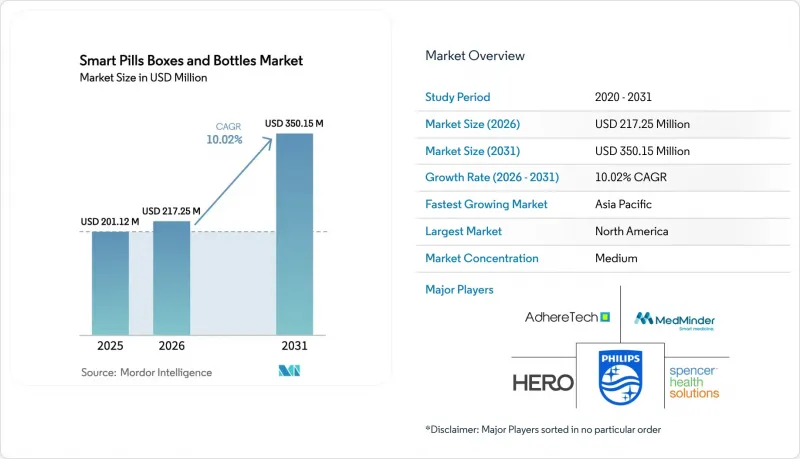
Mordor Intelligence에 의하면, 스마트 알약 박스 및 병 시장 규모는 2025년 2억 112만 달러로 평가되었고, 2026년에는 2억 1,725만 달러로 추정되고, 2026-2031년 CAGR 10.02%로 성장을 지속할 전망이며, 2031년에는 3억 5,015만 달러에 이를 것으로 예측됩니다.
본 보고서는 제품 유형별(연결형 약통, 연결형 약병, 자동 약 분배기, 스마트 블리스터 팩), 연결 기술별(블루투스 저에너지, Wi-Fi, 셀룰러/NB-IoT, NFC), 유통 채널별(소매 약국, 온라인 약국 등), 최종 사용자별(재택 치료 등), 지역별로 분류되어 있습니다. 시장 예측은 금액(달러) 기준으로 제시되어 있습니다.
세계의 스마트 알약 박스 및 병 시장 동향 및 인사이트
만성 질환 유병률 및 다제병용(폴리파마시)의 급격한 증가
현재 비전염성 질환은 전 세계 사망 원인의 74%를 차지하고 있으며, 고소득 국가에서는 65세 이상 성인의 40%가 매일 5유형 이상의 약을 복용하고 있습니다. 복용하는 약이 1유형 늘어날 때마다 복용을 잊을 위험이 12% 증가하지만, 커넥티드 알약 상자는 원격 진료 시 확인되는 타임스탬프가 포함된 알림을 통해 이러한 격차를 메워줍니다. 미국의 보험사들은 복약 순응도 부족으로 인한 예방 가능한 입원에 연간 3,000억 달러를 지출하고 있기 때문에 메디케어 어드밴티지 플랜에서는 고위험 가입자를 대상으로 이 기기에 대한 보조금을 지급하고 있습니다. 치료 범위가 좁은 암 치료 요법에서는 실시간 복약 기록의 필요성이 더욱 높아지고 있습니다. 이러한 요인들로 인해 스마트 알약 케이스 및 병 시장은 지속적인 성장 궤도를 유지하고 있습니다.
복약 순응도와 연계된 보상 제도에 대한 보험사의 추진
미국 CMS의 2024년 규정에 따라 파트 D 플랜은 디지털 복약 순응도 평가 지표를 평가 대상에 포함할 수 있게 되었으며, 일부 유럽 보험사는 인증된 기기 데이터를 공유하는 가입자에게 보험료의 5%-10% 할인을 제공합니다. 환자 1인당 5만 달러를 초과하는 전문 의약품의 경우, 복약 순응도가 80%를 넘으면 순수익이 증가하기 때문에 제약사는 스마트 병을 번들로 제공하여 처방약 목록에 포함되도록 노력하고 있습니다. Philips(Philips)의 파일럿 조사에 따르면, 연결형 병을 사용할 때의 복약 순응도는 87%였던 반면, 표준 포장의 경우 62%에 그쳐 보험사 측의 ROI(투자 수익률)에 대한 주장을 뒷받침하고 있습니다. 2025년 유럽의약품청(EMA)의 지침 초안에서는 시판 후 조사에서 스마트 기기의 데이터를 부차적 평가 항목으로 사용하는 것이 허용되고 있습니다.
GDPR(EU 개인정보보호규정) 및 HIPAA에 따른 데이터 개인정보 보호 규정 준수 비용
디지털 헬스 기업은 감사, 데이터 보호 책임자(DPO), 정보 유출 보험에 연간 약 52만 달러를 지출하고 있으며, 이러한 고정 비용은 스타트업 기업에게 큰 부담이 되고 있습니다. 2025년, EU 규제 당국은 헬스테크 업계 전체에 12억 유로의 벌금을 부과했습니다. 공급업체는 FDA의 ‘MyStudies’와 유럽의 ‘Health Data Space’를 모두 지원하는 병행 시스템을 유지해야 하며, 이로 인해 여러 지역으로의 확장이 지연되고 있습니다.
부문 분석
2025년 매출의 44.67%는 커넥티드 알약통이 차지했으나, 온라인 약국의 정기 구매 서비스가 확대됨에 따라 스마트 블리스터 팩 시장은 연평균 성장률(CAGR) 8.26%를 나타낼 것으로 예측됩니다. NFC 태그가 내장된 사전 충전 팩은 환자의 부담을 줄여주고, 약국이 재고가 소진되기 5일 전에 자동 재주문을 할 수 있게 해줍니다. 스마트 블리스터의 단가는 개당 3-5유로로, 40-80달러인 재사용 가능한 약통보다 저렴하기 때문에 보험사의 지원을 받아 보급이 가능해집니다. 자동 디스펜서는 이중 투약을 방지하는 캐러셀식 회전 기구를 갖추고 있어 장기 요양 시설에서 활용되고 있습니다. 2024년 FDA 지침안에서는 새로운 ‘복약 순응도 시스템’이라는 분류가 제안되었으며, 이를 통해 510(k) 심사 기간이 단축되고 통합형 블리스터 솔루션이 우대받을 전망입니다. 유럽의 MDR에서는 현재 결과 증거가 의무화되어 있어, 실제 환경에서의 복약 순응도 데이터를 보유한 벤더가 선점 우위를 차지하게 될 것입니다. 따라서 전자 약국의 확대에 따라 스마트 약통 및 병 시장은 일회용 사전 충전형 형식으로 전환될 것입니다.
블루투스 저에너지(BLE)는 저전력 소비와 스마트폰과의 네이티브 페어링 덕분에 2025년에는 53.26%의 점유율을 차지했지만, 환자용 기기에 대한 의존도가 높기 때문에 데이터에 결함이 발생할 수 있습니다. 연간 7.23%의 성장이 예상되는 셀룰러 및 NB-IoT 모듈은 복약 기록을 클라우드에 직접 전송하여, 끊김 없는 데이터를 필요로 하는 임상시험 후원사의 요건을 충족시킵니다. GSMA 보고서에 따르면, 2025년에는 NB-IoT 모듈 가격이 5달러 미만으로 떨어질 것으로 예상되어, 비용 효율성 측면에서 임베디드 SIM 설계가 유리해질 것으로 보입니다. Wi-Fi 지원 디스펜서는 광대역 허브를 설치하는 재택 간호 기관에 적합하며, 반면 NFC 지원 블리스터 팩은 태그 비용이 가장 낮지만 환자의 능동적인 스캔이 필요합니다. FDA의 분산형 임상시험에 관한 지침에서는 셀룰러 기기가 권장되는 실시간 데이터 수집 방법으로 지지되고 있으므로, 연결 방식의 구성은 양극화될 것입니다. 즉, BLE는 소비자 대상 소매 분야에서 계속해서 주류를 이루는 반면, 셀룰러는 기관에서의 도입에서 우위를 차지하게 될 것입니다.
지역별 분석
북미는 메디케어 보조금과 FDA의 명확한 510(k) 승인 절차에 힘입어 2025년 매출의 36.52%를 차지했습니다. 2025년 중반까지 약 420만 명의 메디케어 어드밴티지 가입자가 연결형 기기를 이용하고 있었습니다. 캐나다 온타리오주의 시범 사업은 주 전역으로의 도입 확대를 시사하고 있는 반면, 멕시코의 민간 보험사들은 차별화 요소로 스마트 박스 제공을 시작했습니다. 높은 스마트폰 보급률과 성숙한 전자 약국 인프라가 추가 성장을 가속화하고 있습니다.
아시아태평양은 연평균 성장률(CAGR) 6.34%를 나타낼 것으로 예측되며, 지역별로는 가장 높은 성장률을 기록할 전망입니다. 일본에서는 5유형 이상의 약물을 복용하는 환자에게 기기 지원이 이루어지고 있으며, 한국의 ‘실버테크’ 프로그램에서는 2027년까지 50만 대를 도입할 계획입니다. 또한 중국의 각 성에서는 만성 질환용 약 상자에 대한 비용 상환 제도가 마련되어 있습니다. 호주의 의약품 급여 제도(Pharmaceutical Benefits Scheme)에서는 복약 순응도를 지원하는 디지털 도구에 대해 환자 1인당 연간 최대 100호주달러를 지급하고 있으며, 이를 통해 일반의들의 도입이 촉진되고 있습니다. 인도 및 동남아시아에서는 아직 도입 초기 단계이지만, 도시 지역의 민간 병원에서 보급의 조짐이 보입니다.
독일의 공적 보험은 복약 순응도 기준을 충족하는 만성 질환 환자에 대한 기기 비용을 환급하고 있으며, 프랑스에서는 암 치료 및 항응고 요법을 위한 3종의 커넥티드 기기가 승인되었습니다. 또한, 영국에서는 NHS의 시범 사업을 통해 투약과 관련된 입원 건수가 19% 감소했습니다. 남유럽 및 동유럽은 뒤처져 있지만, 카탈루냐 지방에서 당뇨병 환자를 대상으로 한 시범 사업이 탄력을 받기 시작하고 있습니다. 중동 및 아프리카, 남미의 합산 매출 비중은 10% 미만이지만, 브라질과 남아프리카공화국이 지역별 시범 사업을 주도하고 있습니다.
기타 혜택 :
- 엑셀 형식 시장 예측(ME) 시트
- 3개월간의 애널리스트 지원
자주 묻는 질문
목차
제1장 서론
제2장 조사 방법
제3장 주요 요약
제4장 시장 구도
제5장 시장 규모 및 성장 예측
제6장 경쟁 구도
제7장 시장 기회 및 향후 전망
AJY 26.08.28According to Mordor Intelligence, the smart pills boxes and bottles market size is expected to grow from USD 201.12 million in 2025 to USD 217.25 million in 2026 and is forecast to reach USD 350.15 million by 2031 at 10.02% CAGR over 2026-2031.
This report is Segmented by Product Type (Connected Pill Boxes, Connected Pill Bottles, Automatic Pill Dispensers, Smart Blister Packs), Connectivity Technology (Bluetooth Low-Energy, Wi-Fi, Cellular/NB-IoT, NFC), Distribution Channel (Retail Pharmacies, Online Pharmacies, and More), End User (Home Healthcare, and More), and Geography. The Market Forecasts are Provided in Terms of Value (USD).
Global Smart Pills Boxes And Bottles Market Trends and Insights
Rapid Rise in Chronic Disease Prevalence and Poly-Pharmacy
Non-communicable diseases now account for 74% of global deaths, and 40% of adults over 65 in high-income countries take five or more medications daily. Each added drug increases missed-dose risk by 12%, a gap that connected pill boxes close through time-stamped reminders reviewed during telehealth visits. U.S. payers spend USD 300 billion annually on avoidable hospitalizations tied to non-adherence, so Medicare Advantage plans subsidize devices for high-risk enrollees. Oncology regimens with narrow therapeutic windows intensify the need for real-time dosing logs. These forces keep the smart pills boxes and bottles market on a durable upward path.
Push by Payers for Medication-Adherence-Linked Reimbursements
The U.S. CMS 2024 rule lets Part D plans count digital adherence endpoints, and some European insurers now offer 5%-10% premium discounts for members who share certified device data. Specialty drugs exceeding USD 50,000 per patient gain higher net revenue when adherence tops 80%, so manufacturers bundle smart bottles to strengthen formulary bids. A Philips pilot showed 87% adherence with connected bottles versus 62% for standard packaging, supporting payer ROI arguments. EMA draft guidance in 2025 allows smart-device data as secondary endpoints in post-marketing studies.
Data-Privacy Compliance Costs Under GDPR and HIPAA
Digital-health companies spend about USD 520,000 a year on audits, data-protection officers, and breach insurance, a fixed cost that weighs on startups. EU regulators issued EUR 1.2 billion in fines across health tech during 2025. Vendors must maintain parallel systems for FDA's MyStudies and Europe's Health Data Space, slowing multi-region roll-outs.
Other drivers and restraints analyzed in the detailed report include:
- Integration of Smart Packaging into Digital Therapeutics Ecosystems
- Ageing Population in High-Income Asia Driving Home-Care Tech Uptake
- Low Margins in the Retail Pharmacy Channel
For complete list of drivers and restraints, kindly check the Table Of Contents.
Segment Analysis
Connected pill boxes generated 44.67% of 2025 revenue, yet smart blister packs are projected to grow at an 8.26% CAGR as e-pharmacy subscriptions scale. Pre-filled packs with embedded NFC tags reduce patient effort and enable pharmacies to trigger auto-refills five days before depletion. Smart blister pricing of EUR 3-5 per unit undercuts the USD 40-80 reusable pill box, enabling payer-subsidized roll-outs. Automatic dispensers serve long-term care facilities with carousel rotation that prevents double-dosing. In 2024, FDA draft guidance proposed a new "medication adherence system" classification, which is likely to shorten 510(k) timelines and favor integrated blister solutions. Europe's MDR now requires outcome evidence, so vendors with real-world adherence data gain a head start. The smart pills boxes and bottles market will therefore shift toward disposable, pre-filled formats as e-pharmacies expand.
Bluetooth Low-Energy held a 53.26% share in 2025 thanks to low power draw and native smartphone pairing, but its reliance on patient devices leaves data gaps. Cellular and NB-IoT modules, forecast to grow at 7.23% annually, transmit dose logs directly to the cloud and satisfy trial sponsors that need uninterrupted data. GSMA reported NB-IoT modules fell below USD 5 in 2025, tipping cost-benefit calculus toward embedded SIM designs. Wi-Fi dispensers cover home-care agencies that install broadband hubs, while NFC blister packs deliver the lowest tag cost but require active patient scanning. FDA decentralized-trial guidance endorses cellular devices as a preferred real-time capture method, so connectivity mix will bifurcate: BLE remains dominant in consumer retail, while cellular wins institutional deployments.
Complete Report Scope:
- By Product Type
- Connected Pill Boxes
- Connected Pill Bottles
- Automatic Pill Dispensers
- Smart Blister Packs
- By Connectivity Technology
- Bluetooth Low-Energy (BLE)
- Wi-Fi
- Cellular / NB-IoT
- Near-Field Communication (NFC)
- By Distribution Channel
- Retail Pharmacies
- Online Pharmacies
- Hospital & Clinic Pharmacies
- Direct-to-Consumer Subscriptions
- By End User
- Home Healthcare
- Hospitals
- Long-term Care Facilities
- Clinical Trial Sponsors
- By Geography
- North America
- United States
- Canada
- Mexico
- Europe
- Germany
- France
- United Kingdom
- Italy
- Spain
- Rest of Europe
- Asia-Pacific
- China
- Japan
- India
- South Korea
- Australia
- Rest of Asia-Pacific
- Middle East & Africa
- GCC
- South Africa
- Rest of Middle East & Africa
- South America
- Brazil
- Argentina
- Rest of South America
- North America
Geography Analysis
North America captured 36.52% of 2025 revenue, propelled by Medicare subsidies and FDA's clear 510(k) pathway. Roughly 4.2 million Medicare Advantage members used connected devices by mid-2025. Canada's Ontario pilot hints at broader provincial adoption, while Mexican private insurers begin offering smart boxes as differentiators. High smartphone penetration and mature e-pharmacy infrastructure further accelerate growth.
Asia-Pacific is forecast to grow at a 6.34% CAGR, the strongest regional rate. Japan subsidizes devices for patients managing five or more medications, South Korea's Silver Tech program deploys 500,000 units by 2027, and China's provincial schemes reimburse pill boxes for chronic conditions. Australia's Pharmaceutical Benefits Scheme covers up to AUD 100 per patient annually for digital adherence support, stimulating general-practitioner uptake. India and Southeast Asia remain nascent but show traction in urban private hospitals.
Germany's statutory insurers reimburse devices for chronic patients who meet adherence thresholds, France approved three connected devices for oncology and anticoagulation, and the UK cut medication-related admissions by 19% during NHS pilots. Southern and Eastern Europe lag, but Catalonia's diabetic pilot signals momentum. Middle East, Africa, and South America together account for under 10% of revenue, with Brazil and South Africa leading regional pilots.
- AdhereTech Inc.
- Amiko Digital Health
- Baxter's DoseEdge Pharmacy Workflow
- Beckton Dickinson
- CareOS Health, Inc.
- Dose Health LLC
- E-pill, LLC
- Hero Health Inc.
- iRxReminder LLC
- Koninklijke Philips
- MedAdvisor Ltd.
- Medisafe Ltd.
- MedMinder Systems Inc.
- Omnicell
- Pillsy
- Popit Ltd.
- Shenzhen Kangwei Smart Pharm Tech
- SMRxT, Inc.
- Spencer Health Solutions
Additional Benefits:
- The market estimate (ME) sheet in Excel format
- 3 months of analyst support
TABLE OF CONTENTS
1 Introduction
- 1.1 Study Assumptions & Market Definition
- 1.2 Scope of the Study
2 Research Methodology
3 Executive Summary
4 Market Landscape
- 4.1 Market Overview
- 4.2 Market Drivers
- 4.2.1 Rapid Rise in Chronic Disease Prevalence & Poly-Pharmacy
- 4.2.2 Push By Payers for Medication-Adherence Linked Reimbursements
- 4.2.3 Integration of Smart Packaging into Digital Therapeutics Ecosystems (DTx)
- 4.2.4 Ageing Population in High-Income Asia Driving Home-Care Tech Uptake
- 4.2.5 Smart Blister Refill Programs From E-Pharmacies
- 4.2.6 Emergence of "Track-And-Trace as a Service" for Clinical Trials
- 4.3 Market Restraints
- 4.3.1 Data-Privacy Compliance Costs (GDPR/HIPAA)
- 4.3.2 Low Margins in the Retail Pharmacy Channel
- 4.3.3 Battery-Life & Electronic Waste Concerns
- 4.3.4 IC Shortages Delaying IoT Component Supply
- 4.4 Value / Supply-Chain Analysis
- 4.5 Regulatory Landscape
- 4.6 Technological Outlook
- 4.7 Porter's Five Forces Analysis
- 4.7.1 Threat of New Entrants
- 4.7.2 Bargaining Power of Suppliers
- 4.7.3 Bargaining Power of Buyers
- 4.7.4 Threat of Substitutes
- 4.7.5 Competitive Rivalry
5 Market Size & Growth Forecasts (Value in USD)
- 5.1 By Product Type
- 5.1.1 Connected Pill Boxes
- 5.1.2 Connected Pill Bottles
- 5.1.3 Automatic Pill Dispensers
- 5.1.4 Smart Blister Packs
- 5.2 By Connectivity Technology
- 5.2.1 Bluetooth Low-Energy (BLE)
- 5.2.2 Wi-Fi
- 5.2.3 Cellular / NB-IoT
- 5.2.4 Near-Field Communication (NFC)
- 5.3 By Distribution Channel
- 5.3.1 Retail Pharmacies
- 5.3.2 Online Pharmacies
- 5.3.3 Hospital & Clinic Pharmacies
- 5.3.4 Direct-to-Consumer Subscriptions
- 5.4 By End User
- 5.4.1 Home Healthcare
- 5.4.2 Hospitals
- 5.4.3 Long-term Care Facilities
- 5.4.4 Clinical Trial Sponsors
- 5.5 By Geography
- 5.5.1 North America
- 5.5.1.1 United States
- 5.5.1.2 Canada
- 5.5.1.3 Mexico
- 5.5.2 Europe
- 5.5.2.1 Germany
- 5.5.2.2 France
- 5.5.2.3 United Kingdom
- 5.5.2.4 Italy
- 5.5.2.5 Spain
- 5.5.2.6 Rest of Europe
- 5.5.3 Asia-Pacific
- 5.5.3.1 China
- 5.5.3.2 Japan
- 5.5.3.3 India
- 5.5.3.4 South Korea
- 5.5.3.5 Australia
- 5.5.3.6 Rest of Asia-Pacific
- 5.5.4 Middle East & Africa
- 5.5.4.1 GCC
- 5.5.4.2 South Africa
- 5.5.4.3 Rest of Middle East & Africa
- 5.5.5 South America
- 5.5.5.1 Brazil
- 5.5.5.2 Argentina
- 5.5.5.3 Rest of South America
- 5.5.1 North America
6 Competitive Landscape
- 6.1 Market Concentration
- 6.2 Market Share Analysis
- 6.3 Company Profiles (includes Global level Overview, Market level overview, Core Segments, Financials as available, Strategic Information, Market Rank/Share for key companies, Products and Services, and Recent Developments)
- 6.3.1 AdhereTech Inc.
- 6.3.2 Amiko Digital Health
- 6.3.3 Baxter's DoseEdge Pharmacy Workflow
- 6.3.4 BD
- 6.3.5 CareOS Health, Inc.
- 6.3.6 Dose Health LLC
- 6.3.7 E-pill, LLC
- 6.3.8 Hero Health Inc.
- 6.3.9 iRxReminder LLC
- 6.3.10 Koninklijke Philips N.V.
- 6.3.11 MedAdvisor Ltd.
- 6.3.12 Medisafe Ltd.
- 6.3.13 MedMinder Systems Inc.
- 6.3.14 Omnicell, Inc.
- 6.3.15 Pillsy
- 6.3.16 Popit Ltd.
- 6.3.17 Shenzhen Kangwei Smart Pharm Tech
- 6.3.18 SMRxT, Inc.
- 6.3.19 Spencer Health Solutions
7 Market Opportunities & Future Outlook
- 7.1 White-space & Unmet-Need Assessment


