

|
시장보고서
상품코드
2115200
메틸 에스테르 에톡실레이트 시장 : 점유율 분석, 업계 동향과 통계, 성장 예측(2026-2031년)Methyl Ester Ethoxylate - Market Share Analysis, Industry Trends & Statistics, Growth Forecasts (2026 - 2031) |
||||||
 Mordor Intelligence
Mordor Intelligence에 의하면, 메틸 에스테르 에톡실레이트 시장 규모는 2026년에 1억 5,190만 달러로 추정되고 있어 예측 기간(2026-2031년)에서 CAGR 3.68%로 성장을 지속하여, 2031년까지 1억 8,198만 달러에 이를 전망입니다.
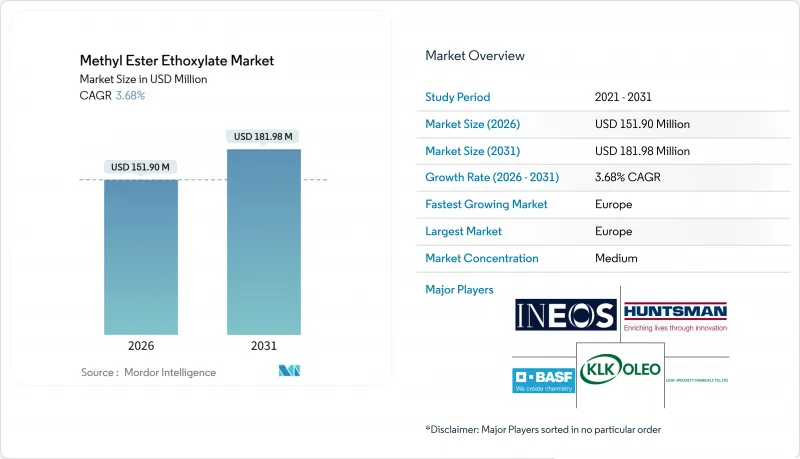
본 보고서는 용도별(세제 및 산업용 세정제, 퍼스널케어 및 화장품, 기타) 및 지역별(아시아태평양, 북미, 유럽, 남미, 중동 및 아프리카)로 분류되어 있습니다. 시장 전망은 금액(달러) 기준으로 제시되어 있습니다.
세계 메틸 에스테르 에톡실레이트 시장 동향 및 인사이트
퍼스널케어 및 화장품 분야 수요 증가
메틸 에스테르 에톡실레이트는 음이온성 계면활성제에 흔히 수반되는 자극 없이 거품 안정성을 제공합니다. 이러한 특성 덕분에, 특히 클린 뷰티를 지향하는 소비자층 사이에서 황산염 무첨가 샴푸, 바디워시 및 헹굼이 필요 없는 트리트먼트에 선호되어 채택되고 있습니다. 이러한 동향이 중기적으로 미치는 영향은 비용, 사용감, 그리고 친환경 라벨 기준 준수의 균형을 맞추려는 제형 개발자들의 노력에서 비롯된 것으로 보입니다. 메틸 에스테르 에톡실레이트는 대중용 헤어케어 제품이나 바디워시 제품에서는 비용 경쟁력이 있지만, 초고급 스킨케어 라인에서는 아미노산 계면활성제나 알킬 폴리글루코사이드(APG) 블렌드와의 경쟁에 직면해 있습니다.
저거품·원워시형 세제의 성장
동남아시아 전역에서 상업용 세탁소 및 컨베이어식 식기 세척기에서는 1회 세척형·저거품 시스템의 도입이 확대되고 있으며, 이를 통해 물 사용량 절감과 세척 주기 단축이 실현되고 있습니다. 카오(Kao)는 해당 지역에서 업소용 세제의 매출이 급증했다고 보고하며, 그 요인으로 새로운 처방을 꼽고 있습니다. 메틸 에스테르 에톡실레이트, 효소, 킬레이트제를 배합하여 강화된 이 처방은 한 번의 세척으로 오염을 효과적으로 제거함을 보장합니다. 인도처럼 수자원이 부족한 국가에서는 가전제품의 에너지 효율 라벨 도입이 저거품 계면활성제 패키지 사용을 간접적으로 촉진하여 그 보급을 가속화하고 있습니다. 이러한 저거품 시스템의 급속한 보급은 현재 중동의 호텔 및 레스토랑 업계로도 파급되고 있으며, 수도 요금 급등으로 인해 호텔 운영자들은 세탁 업무를 재검토해야 하는 상황에 직면해 있습니다.
보다 효율적인 대체 계면활성제와의 경쟁
2024년, 에보닉은 슬로바키아에 람노리피드 생산 공장을 가동했습니다. 이곳에서 생산되는 바이오 계면활성제는 혐기성 조건에서 기존의 메틸 에스테르 엑소틸레이트보다 빠르게 생분해되며, 사용량을 줄여도 동등한 습윤 효과를 발휘합니다. 또한 2024년, BASF는 APG의 생산 능력을 확대하고, 냉수에서의 세정력과 거품 억제 성능 양면에서 메틸 에스테르 에톡실레이트를 능가하는 포도당을 원료로 하는 비이온성 계면활성제를 추진했습니다. 소포롤리피드를 전문으로 하는 엘레반스(Elevance)와 같은 제조업체들은 더 낮은 표면 장력을 실현하여, 이를 통해 계면활성제의 총 사용량을 줄일 수 있게 되었습니다. 대량 수요가 주를 이루는 기관용 시장에서는 메틸 에스테르 에톡실레이트가 가격 면에서 우위를 점하고 있지만, 발효 수율 향상과 설비 투자 비용 감소로 인해 유럽 및 북미에서는 경쟁 압력이 강해지고 있습니다.
부문 분석
세제 및 산업용 세정제 부문은 2025년 매출의 65.18%를 차지하고 있으며, 메틸 에스테르 에톡실레이트 시장 규모에서 이 부문의 점유율은 2031년까지 연평균 성장률(CAGR) 3.98%로 확대될 것으로 예측됩니다. 이러한 성장은 처리 용량이 큰 터널식 세척기에서 한 번의 통과만으로 오염을 제거할 수 있는 저발포성이며 경수에 강한 계면활성제 시스템을 중시하는 상업용 세탁소 및 컨베이어식 식기 세척기에 의해 뒷받침되고 있습니다. 메틸 에스테르 에톡실레이트는 알칼리성 빌더, 효소, 염소계 살균제와 호환성이 뛰어나 아시아태평양 및 중동 전역에서 상업용 식기 세척, 호텔·리조트 업계의 세탁, 외식 산업의 바닥 청소 분야에서 그대로 사용할 수 있는 주력 제품으로서의 역할을 유지하고 있습니다.
가정용 세탁 시장 수요는 여전히 크지만, 성숙한 시장에서는 농축 포드나 1회용 세제 봉지가 APG나 선형 알킬벤젠설포네이트의 고활성 혼합물을 선호하는 경향이 있어 수요 증가세는 둔화되고 있습니다. 그럼에도 불구하고, 기계식 세탁소용 초저용량 분말 세제 등 부가가치가 높은 제품 형태가 수익성이 높은 틈새 시장을 개척하고 있으며, 메틸 에스테르 에톡실레이트가 가진 거품 억제 특성이 세탁 주기 단축이라는 이점을 가져다주고 있습니다. 효소계 전처리 농축제의 채택으로 인해, 계면활성제는 백색도를 손상시키지 않으면서 화학 물질 사용량을 줄이는 보다 광범위한 세정 패키지에 더욱 통합되고 있습니다.
퍼스널케어 및 화장품 분야는 판매량 면에서는 뒤처지고 있지만, 지속적으로 높은 이익률을 유지하고 있으며, 대부분의 경우 세제 등급의 동등 제품보다 높은 가격으로 책정되고 있습니다. 이 부문에서 메틸 에스테르 에톡실레이트 시장은 민감한 피부를 가진 소비자들에게 어필하는 “황산염 무첨가”나 “순한 계면활성제”와 같은 광고 문구에 힘입어 성장이 예상됩니다. 비이온성 골격은 투명한 샴푸나 바디워시에서 거품을 안정화하고 점도를 유지할 뿐만 아니라, 음이온성 계면활성제에 일반적으로 수반되는 자극에 대한 우려를 줄여줍니다. 고급 화장품 제조업체들은 COSMOS 인증을 획득한 공급망을 확보하고 있지만, 더욱 저자극적인 피부학적 특성과 높은 바이오 함유율을 자랑하는 아미노산 계면활성제나 APG 블렌드와의 경쟁에 직면해 있습니다.
지역별 분석
2025년 매출의 37.53%를 차지하는 유럽은 메틸 에스테르 에톡실레이트 시장 점유율에서 선두를 달리고 있으며, 지역별 가장 높은 연평균 성장률(CAGR)인 4.39%를 나타낼 것으로 예측됩니다. 수요는 독일, 영국, 프랑스에 의해 뒷받침되고 있으며, 이들 국가에서는 ‘블루 엔젤’이나 ‘노르딕 스완’과 같은 친환경 라벨이 제형 개발자들을 생분해성이 높은 비이온성 계면활성제로 이끌고 있습니다. 남유럽, 특히 스페인과 이탈리아에서는 호스피탈리티 산업의 호황에 따라 잔류물이 적은 세정제에 대한 수요가 증가하고 있습니다. 동유럽에서는 여전히 시장 침투율이 낮은 상황이지만, 위생 기준의 향상과 EU 규정의 단계적 도입으로 인해 분산된 유통업체 네트워크를 효과적으로 활용할 수 있는 공급업체에게는 중기적인 성장 여지가 예상됩니다.
2025년까지 아시아태평양은 전 세계 매출에서 상당한 점유율을 차지하며, 견조한 성장이 예상됩니다. 2025년, 중국의 상업용 청소 서비스는 소매업체와 호텔이 청소 업무를 외주화함에 따라 표준화되었으며, 표면에 자극이 적고 저발포성 세정제로의 전환이 진행되면서 강력한 성장을 보였습니다. 한편, 인도에서는 물 절약형 세탁 주기를 우선시하는 에너지 절약 라벨의 시범 도입이 진행되고 있어, 의도치 않게 메틸 에스테르 에톡실레이트의 사용이 촉진되고 있습니다. 일본과 한국에서는 퍼스널케어 및 전자기기용 세정 제품에 초점을 맞추며 꾸준한 성장을 보이고 있습니다. 아세안(ASEAN) 지역의 호텔 및 레스토랑 업계는 팬데믹에서 회복세를 보이고 있으며, 바닥 및 경질 표면용 세정제 수요가 증가하고 있습니다. 동시에 교육 기관 및 의료 기관에 대한 정부의 위생 규제도 수요를 끌어올리고 있습니다.
북미는 꾸준한 성장을 이어가며, 2025년 매출에서 큰 비중을 차지할 것으로 예측됩니다. 미국 환경보호청(EPA)의 ‘세이퍼 초이스(Safer Choice)’ 이니셔티브에 따라, 제형 개발자들은 생분해성 계면활성제로의 전환을 추진하고 있습니다. 그러나 가정용 세제 시장의 성숙화로 인해 성장 가능성은 제한되고 있습니다. 캐나다와 멕시코에서는 규정 준수를 간소화하는 국경을 초월한 공급망에 힘입어, 기관에서의 친환경 라벨이 부착된 세정제 도입이 급속히 진행되고 있습니다. 남미는 중동 및 아프리카과 함께 2025년 매출에서 상당한 점유율을 차지할 것으로 예측됩니다. 주요 시장으로는 남미의 브라질과 아르헨티나, 중동 및 아프리카의 사우디아라비아와 남아프리카공화국이 꼽힙니다. 환율 변동, 관세 변경, 미비한 규제 등이 변동 요인으로 작용하는 반면, 도시화와 위생 기준 향상과 같은 동향은 보다 선진화된 시장 수요와 장기적으로 부합해 나갈 것임을 시사합니다.
기타 혜택:
- 엑셀 형식 시장 예측(ME) 시트
- 3개월간의 애널리스트 지원
자주 묻는 질문
목차
제1장 서론
제2장 조사 방법
제3장 주요 요약
제4장 시장 구도
제5장 시장 규모와 성장 예측
제6장 경쟁 구도
제7장 시장 기회와 향후 전망
JHS 26.08.26According to Mordor Intelligence, the methyl ester ethoxylate market size is estimated at USD 151.90 million in 2026, and is expected to reach USD 181.98 million by 2031, at a CAGR of 3.68% during the forecast period (2026-2031).
This report is Segmented by Application (Detergents and Industrial Cleaning Agents, Personal Care and Cosmetics, and Others) and Geography (Asia-Pacific, North America, Europe, South America, and Middle-East and Africa). The Market Forecasts are Provided in Terms of Value (USD).
Global Methyl Ester Ethoxylate Market Trends and Insights
Rising Demand from Personal Care and Cosmetics
Methyl ester ethoxylates provide foam stability without the irritation often associated with anionic surfactants. This quality makes them a preferred choice for sulfate-free shampoos, body washes, and leave-on treatments, especially among clean-beauty consumers. The medium-term influence of this trend can be attributed to formulators striving to balance cost, sensory attributes, and eco-label compliance. While methyl ester ethoxylates are cost-competitive in mass-market hair-care and body-wash products, they find themselves in competition with amino-acid surfactants and alkyl polyglucoside (APG) blends in ultra-luxury skincare lines.
Growth of Low-Foam, Single-Wash Detergent Formats
Across Southeast Asia, institutional laundries and conveyor dishwashers are increasingly adopting single-wash, low-foam systems, leading to reduced water consumption and shorter cycle times. Kao reported a surge in sales of institutional detergents in the region, attributing the boost to their new formulation. This formulation, enhanced with methyl ester ethoxylates, enzymes, and chelants, ensures effective one-pass soil removal. In water-scarce nations like India, the introduction of appliance-efficiency labels is indirectly incentivizing the use of low-foam surfactant packages, hastening their adoption. This rapid embrace of low-foam systems is now making waves in the Middle East's hospitality sector, where soaring water tariffs are pushing hotel operators to overhaul their laundry practices.
Competition from More Efficient Alternative Surfactants
In 2024, Evonik launched a rhamnolipid plant in Slovakia. The biosurfactant produced there biodegrades faster than traditional methyl ester ethoxylates in anaerobic conditions and achieves the same wetting effect at reduced dosage. Also in 2024, BASF boosted its APG capacity, promoting a glucose-based nonionic that surpasses methyl ester ethoxylates in both cold-water detergency and foam control. Producers like Elevance, specializing in sophorolipids, achieve lower surface tensions, allowing for a reduction in total surfactant load. Despite price advantages for methyl ester ethoxylates in volume-driven institutional markets, rising fermentation yields and decreasing capital costs are heightening competitive pressures in Europe and North America.
Other drivers and restraints analyzed in the detailed report include:
- Regulatory Push for Biodegradable Surfactants
- Expansion of Industrial and Institutional Cleaning in Asia-Pacific
- Oleochemical Feedstock Price Volatility
For complete list of drivers and restraints, kindly check the Table Of Contents.
Segment Analysis
The detergents and industrial-cleaning segment captured 65.18% of 2025 revenue, and its share of the methyl ester ethoxylate market size is projected to expand at a 3.98% CAGR through 2031. Growth rests on institutional laundries and conveyor dishwashers that prize low-foam, hard-water-tolerant surfactant systems capable of one-pass soil removal in high-throughput tunnels. Methyl ester ethoxylates pair well with alkaline builders, enzymes, and chlorine sanitizers, sustaining their role as drop-in workhorses for commercial dishwashing, hospitality laundering, and food-service floor cleaning across Asia-Pacific and the Middle East.
Demand in household laundry remains sizable yet moderating in mature markets as concentrated pods and unit-dose sachets favor higher-activity blends of APG and linear alkylbenzene sulfonates. Nevertheless, value-added formats such as ultra-low-dose powders for mechanized laundries are opening margin-rich niches where methyl ester ethoxylates' foam control provides cycle-time advantages. Adoption of enzymatic pre-treatment concentrates further integrates the surfactant into broader cleaning packages that cut chemical load without sacrificing whiteness.
While personal care and cosmetics lag in volume, they consistently command premium margins, often pricing above their detergent-grade counterparts. The methyl ester ethoxylate market for this segment is projected to grow, buoyed by sulfate-free and mild-surfactant claims that appeal to consumers with sensitive skin. Nonionic backbones not only stabilize foam and maintain viscosity in clear shampoos and body washes, but they also mitigate irritation concerns commonly associated with anionic surfactants. Prestige beauty houses are securing COSMOS-certified supply chains, yet they grapple with competition from amino-acid surfactants and APG blends, which boast even milder dermatological profiles and a higher bio-based content.
Complete Report Scope:
- By Application
- Detergents and Industrial Cleaning Agents
- Personal Care and Cosmetics
- Others
- By Geography
- Asia-Pacific
- China
- India
- Japan
- South Korea
- ASEAN Countries
- Rest of Asia-Pacific
- North America
- United States
- Canada
- Mexico
- Europe
- Germany
- United Kingdom
- France
- Italy
- Spain
- Rest of Europe
- South America
- Brazil
- Argentina
- Rest of South America
- Middle-East and Africa
- Saudi Arabia
- South Africa
- Rest of Middle-East and Africa
- Asia-Pacific
Geography Analysis
Europe, accounting for 37.53% of 2025 revenue, leads the methyl ester ethoxylate market share and is forecast to grow at a 4.39% CAGR, the highest regional rate. Demand is anchored in Germany, the United Kingdom, and France, where Blue Angel and Nordic Swan eco-labels steer formulators toward readily biodegradable nonionics. Southern European hospitality booms are elevating low-residue cleaning requisites, notably in Spain and Italy. Eastern Europe remains underpenetrated, yet rising hygiene standards and the gradual rollout of EU-aligned regulations signal medium-term upside for suppliers prepared to navigate fragmented distributors.
By 2025, the Asia-Pacific region is set to account for a significant share of global revenue, boasting a projected growth. In 2025, China's commercial cleaning services saw robust growth, driven by retailers and hotels opting for outsourced custodial services, with a shift towards standardized, surface-friendly, low-foam cleansers. Meanwhile, India is testing energy-efficiency labels that prioritize water-saving laundry cycles, inadvertently promoting the use of methyl ester ethoxylate. Japan and South Korea are witnessing steady growth, focusing on cleaning products for personal care and electronics. The hospitality sector in ASEAN is rebounding from the pandemic, leading to increased demand for floor-care and hard-surface cleaners. Simultaneously, government hygiene mandates in educational and healthcare institutions are driving up demand.
North America is projected to account for a significant share of the 2025 revenue, with steady growth. The EPA's Safer Choice initiative is steering formulators towards biodegradable surfactants. However, the growth potential is tempered by the maturity of the household detergent market. In Canada and Mexico, there's a swift adoption of eco-labeled cleaners in institutions, bolstered by cross-border supply chains that simplify compliance. South America, along with the Middle East and Africa, is expected to capture a notable portion of the 2025 turnover. Key players include Brazil and Argentina in South America, and Saudi Arabia and South Africa in the Middle East and Africa. While currency fluctuations, tariff changes, and underdeveloped regulations introduce volatility, the trends of urbanization and heightened hygiene standards suggest a long-term alignment with the demands of more developed markets.
- BASF SE
- Clariant AG
- Croda International
- Dow
- Elevance Renewable Sciences Inc.
- Evonik Industries
- Galaxy Surfactants
- Huntsman Corporation
- India Glycols Ltd
- INEOS
- Jet Technologies
- Kao Corporation
- KLK OLEO
- Lion Specialty Chemicals Co. Ltd
- Sasol Ltd
- Shell Chemicals
- Sino-Japan Chemical Co. Ltd
- Solvay SA
- Stepan Company
- Venus Ethoxyethers Pvt Ltd
Additional Benefits:
- The market estimate (ME) sheet in Excel format
- 3 months of analyst support
TABLE OF CONTENTS
1 Introduction
- 1.1 Study Assumptions and Market Definition
- 1.2 Scope of the Study
2 Research Methodology
3 Executive Summary
4 Market Landscape
- 4.1 Market Overview
- 4.2 Market Drivers
- 4.2.1 Rising demand from personal care and cosmetics
- 4.2.2 Growth of low-foam, single-wash detergent formats
- 4.2.3 Regulatory push for biodegradable surfactants
- 4.2.4 Expansion of industrial and institutional cleaning in Asia-Pacific
- 4.2.5 Enzymatic ethoxylation lowering carbon footprint
- 4.3 Market Restraints
- 4.3.1 Competition from more efficient alternative surfactants
- 4.3.2 Oleochemical feedstock price volatility
- 4.3.3 Supply-chain certification (RSPO, traceability) costs
- 4.4 Value Chain Analysis
- 4.5 Porter's Five Forces Analysis
- 4.5.1 Bargaining Power of Suppliers
- 4.5.2 Bargaining Power of Buyers
- 4.5.3 Threat of New Entrants
- 4.5.4 Threat of Substitutes
- 4.5.5 Degree of Competitive Rivalry
5 Market Size and Growth Forecasts (Value)
- 5.1 By Application
- 5.1.1 Detergents and Industrial Cleaning Agents
- 5.1.2 Personal Care and Cosmetics
- 5.1.3 Others
- 5.2 By Geography
- 5.2.1 Asia-Pacific
- 5.2.1.1 China
- 5.2.1.2 India
- 5.2.1.3 Japan
- 5.2.1.4 South Korea
- 5.2.1.5 ASEAN Countries
- 5.2.1.6 Rest of Asia-Pacific
- 5.2.2 North America
- 5.2.2.1 United States
- 5.2.2.2 Canada
- 5.2.2.3 Mexico
- 5.2.3 Europe
- 5.2.3.1 Germany
- 5.2.3.2 United Kingdom
- 5.2.3.3 France
- 5.2.3.4 Italy
- 5.2.3.5 Spain
- 5.2.3.6 Rest of Europe
- 5.2.4 South America
- 5.2.4.1 Brazil
- 5.2.4.2 Argentina
- 5.2.4.3 Rest of South America
- 5.2.5 Middle-East and Africa
- 5.2.5.1 Saudi Arabia
- 5.2.5.2 South Africa
- 5.2.5.3 Rest of Middle-East and Africa
- 5.2.1 Asia-Pacific
6 Competitive Landscape
- 6.1 Market Concentration
- 6.2 Strategic Moves
- 6.3 Market Share(%)/Ranking Analysis
- 6.4 Company Profiles (includes Global level Overview, Market level overview, Core Segments, Financials as available, Strategic Information, Market Rank/Share for key companies, Products and Services, and Recent Developments)
- 6.4.1 BASF SE
- 6.4.2 Clariant AG
- 6.4.3 Croda International
- 6.4.4 Dow
- 6.4.5 Elevance Renewable Sciences Inc.
- 6.4.6 Evonik Industries
- 6.4.7 Galaxy Surfactants
- 6.4.8 Huntsman Corporation
- 6.4.9 India Glycols Ltd
- 6.4.10 INEOS
- 6.4.11 Jet Technologies
- 6.4.12 Kao Corporation
- 6.4.13 KLK OLEO
- 6.4.14 Lion Specialty Chemicals Co. Ltd
- 6.4.15 Sasol Ltd
- 6.4.16 Shell Chemicals
- 6.4.17 Sino-Japan Chemical Co. Ltd
- 6.4.18 Solvay SA
- 6.4.19 Stepan Company
- 6.4.20 Venus Ethoxyethers Pvt Ltd
7 Market Opportunities and Future Outlook
- 7.1 White-space and Unmet-Need Assessment


