|
시장보고서
상품코드
2115207
전기 트랙션 모터 시장 : 시장 점유율 분석, 업계 동향 및 통계, 성장 예측(2026-2031년)Electric Traction Motor - Market Share Analysis, Industry Trends & Statistics, Growth Forecasts (2026 - 2031) |
||||||
 Mordor Intelligence
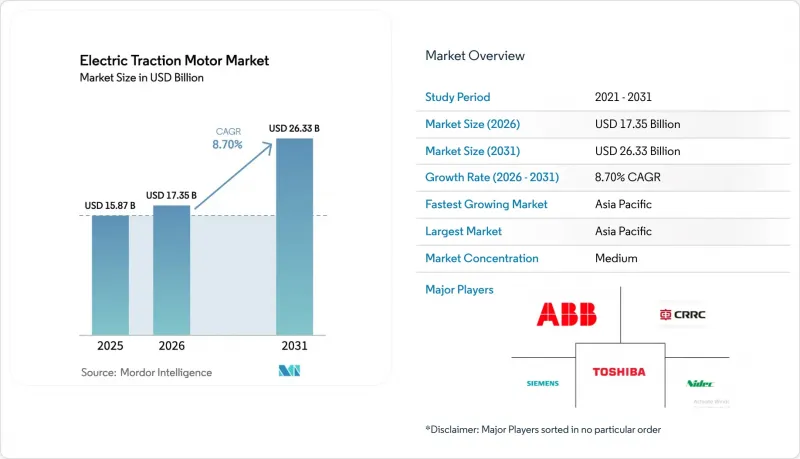
Mordor Intelligence에 의하면, 전기 트랙션 모터 시장 규모는 2025년에 158억 7,000만 달러로 평가되었고, 2026년 173억 5,000만 달러에서 2031년까지 263억 3,000만 달러에 이를 것으로 예측되며, 예측 기간(2026-2031년) CAGR은 8.70%를 나타낼 전망입니다.
본 보고서는 유형별(교류·직류), 정격 출력별(200kW 이하, 200-400kW, 400kW 이상), 냉각 방식별(공랭식, 수랭식, 자연대류식), 전압 등급별(1kV 이하, 1-3kV, 3kV 이상), 용도별(철도, 전기자동차, 기타), 지역별(북미, 유럽, 아시아태평양, 남미, 중동 및 아프리카)로 분류되어 있습니다.
세계의 전기 트랙션 모터 시장 동향 및 인사이트
아시아 전역의 고속철도 전철화 프로젝트 급증
중국, 인도, 동남아시아 각국 정부는 항공기 배기가스를 줄이고 고속도로 정체를 완화하기 위해 고속철도 노선 확충을 가속화하고 있습니다. 중국의 CR450 시제차는 2025년에 시속 400km로 시운전을 시작했습니다. 이 차량은 CR400 플랫폼에 비해 22MW의 연속 출력을 추가하는 영구자석 모터를 채택하고 있습니다. 인도의 뭄바이-아메다바드 노선에서는 차축당 305kW의 모터를 탑재한 열차 24편성을 발주했으며, 2028년까지 납품될 예정입니다. 일본의 N700S 확장 계획에서는 기존 시스템에 비해 견인 에너지를 7% 절감하는 실리콘 카바이드 인버터가 채택되었습니다. 태국, 말레이시아, 인도네시아에서는 IEC 60349 규격에 따라 현지 조립이 가능한 공급업체를 우대하는 공개 입찰이 진행되고 있습니다.
프리미엄 전기차 분야에서 각 OEM 업체들이 800V e-액슬의 자체 통합으로 전환
고급차 제조업체들은 열 관리, 소프트웨어 최적화, 부품 비용 절감을 도모하기 위해 e-액슬 설계를 채택하고 있습니다. BMW의 6세대 eDrive는 2024년에 출시된 모델에서 시스템 중량을 30kg 줄이고, 전체 주행 주기 동안 효율을 93%로 향상시켰습니다. 카셀과 잘츠기터에서 생산되는 폭스바겐의 통합 e-액슬 플랫폼은 15%의 비용 절감을 목표로 하고 있으며, 여러 브랜드에 걸쳐 OTA(무선)를 통한 캘리브레이션 업데이트를 추진하고 있습니다. 스텔란티스는 2027년까지 프랑스에서 연간 100만 대의 800V 모터를 생산하기 위해 5억 유로를 투자하기로 결정했습니다.
희토류 재활용 인프라 부족으로 인한 유럽의 영구자석 모터 공급 제약
유럽의 재활용 시설에서 처리되는 사용 후 모터용 자석은 전체의 2% 이하에 그치고 있습니다. 솔베이(Solvay)가 프랑스에 보유한 시범 시설에서는 2024년에 고작 50톤만 처리하는 데 그쳤습니다. ‘중요 원료법’은 2030년까지 재활용 재료 비율을 15%로 높일 것을 요구하고 있지만, 회수 및 선별 네트워크는 여전히 분절된 상태입니다. 메트레아(Metrea)사는 2025년 벨기에에 연간 처리 능력 1,200톤 규모의 공장을 개설했으나, 원료 품질의 편차가 있어 생산 확대 속도는 완만합니다.
부문 분석
2025년, 교류 모터는 전기 트랙션 모터 시장 점유율의 65.3%를 차지했으며, 피크 효율 96% 이상의 영구 자석 동기식 설계를 바탕으로 연평균 성장률(CAGR) 12.1%로 성장을 이어가고 있습니다. 모델 3, BYD 시얼, 많은 철도 차량은 이러한 고밀도 로터를 채택하고 있습니다. 유도 모터는 전압 과도 현상에 강하고 유지보수가 거의 필요하지 않기 때문에 여전히 산업용 호이스트나 화물 기관차에 채택되고 있습니다. 스위치드 릴랙턴스 모터는 자석을 배제함으로써 비용을 중시하는 구매자들을 끌어들이고 있지만, 토크 리플 문제로 인해 고급 모델에는 채택되지 않고 있습니다.
직류 모터는 효율 저하보다 제어의 간편성이 중시되는 구형 지하철 차량이나 틈새 시장용 드론에 채택되고 있습니다. 델리 메트로의 초기 단계에 도입된 브러시형 모터는 2027년까지 교류 구동 장치로 교체될 예정입니다. 브러쉬리스 직류 추진 장치는 경량화와 부드러운 추력이 중요한 Joby의 S4와 같은 eVTOL 항공기에 동력을 공급하고 있습니다. 노후화된 차량을 가변 주파수 구동 장치로 개조하는 사업자가 늘어남에 따라, 교류 부문의 선두 격차는 더욱 확대될 전망입니다.
2025년 시점에서 200kW 이하의 모터는 전기 트랙션 모터 시장 규모의 55.2%를 차지했습니다. 승용차나 경전철의 경우 비용과 탑재 공간이 우선시되기 때문에 이 출력 범위가 선호됩니다. 규모의 경제는 연간 1,000만 대를 넘는 자동차 생산 대수에서 비롯됩니다. 배송용 밴, 버스, 중형 트럭의 전동화가 진행됨에 따라 200kW에서 400kW 범위는 연평균 성장률(CAGR) 10.2%로 성장할 전망입니다. 볼보의 ‘FH Electric’은 디젤 차량과 동등한 적재량을 실현하기 위해 250kW 유닛 2개를 조합하고 있습니다.
400kW를 초과하는 모터는 여전히 프리미엄 틈새 시장으로, 출하 대수의 10% 이하에 그치고 있지만, IEC 60349 인증 규정에 따라 높은 이익률을 확보하고 있습니다. CRRC의 CR400 열차는 시속 350km 운행을 실현하기 위해 550kW 모터 8기를 탑재하고 있습니다. 정격 출력을 낮추지 않고 지속적으로 고출력을 유지해야 하는 수요로 인해, 상용 차량은 단일 초고출력 유닛이 아닌 듀얼 모터 구성으로 전환되고 있습니다.
지역별 분석
아시아태평양은 2025년에 49.5%의 점유율로 전기 트랙션 모터 시장을 주도했으며, 연평균 성장률(CAGR) 10.0%를 기록할 전망입니다. 중국의 CR450 시험 운행에서는 축당 정격 550kW의 영구자석 모터가 채택되었으며, 2025년 하반기에는 베이징-상하이 노선에서 영업 운행 시험으로 전환되었습니다. 인도는 PLI 계획에 따라 첨단 부품에 35억 달러를 투자하여 국내 생산 능력을 대폭 확대했습니다. 일본의 철도 사업자들은 에너지 소비를 최대 10% 절감하기 위해 실리콘 카바이드 인버터로 교체 작업을 진행하고 있습니다. 아세안(ASEAN)의 지하철 입찰에는 현재 현지 조립 조항이 명시되어 있어 합작 사업의 길이 열리고 있습니다.
유럽은 여전히 세계 2위 시장 점유율을 유지하고 있습니다. 2026년에 전면 시행되는 ‘탄소 국경 조정 메커니즘’에 따라, EU 역외에서 출하되는 모터에는 8-12%의 추가 비용이 발생합니다. 폭스바겐(Volkswagen)은 2025년 말까지 자사의 생산 능력을 연간 120만 대의 모터로 확대했습니다. 독일, 프랑스, 이탈리아에서는 지선용 디젤 기관차를 배터리식 전기 기관차로 전환하고 있으며, 이에 따라 모듈식 개조 키트에 대한 수요가 증가하고 있습니다.
북미에서는 멕시코와 미국 남부에 공장이 신설되고 있습니다. GM과 LG의 합작 사업은 2027년까지 연간 100만 대의 모터 생산을 목표로 하고 있습니다. 테슬라의 텍사스 공장은 2024년에 180만 대를 출하했습니다. 화물 열차의 시험 운행에서는 Wabtec의 FLXdrive 기관차에 500kW 모터 4기가 탑재되어 있습니다. 남미 수요는 여전히 경기 순환의 영향을 받기 쉽고, 중동 및 아프리카 수요량은 여전히 소규모에 그치고 있지만, 사우디아라비아의 리야드 메트로가 단기적인 수요 증가의 주요 원동력이 되고 있습니다.
기타 혜택
- 엑셀 형식 시장 예측(ME) 시트
- 3개월간의 애널리스트 지원
자주 묻는 질문
목차
제1장 서론
제2장 조사 방법
제3장 주요 요약
제4장 시장 구도
제5장 시장 규모 및 성장 예측
제6장 경쟁 구도
제7장 시장 기회 및 향후 전망
AJY 26.08.28According to Mordor Intelligence, the electric traction motor market size was valued at USD 15.87 billion in 2025 and is estimated to grow from USD 17.35 billion in 2026 to reach USD 26.33 billion by 2031, at a CAGR of 8.70% during the forecast period (2026-2031).
This report is Segmented by Type (Alternating Current and Direct Current), Power Rating (Below 200kW, 200 To 400kW, and Above 400kW), Cooling Type (Air-Cooled, Liquid-Cooled, and Self-Ventilated), Voltage Class (Below 1 KV, 1 To 3 KV, and Above 3 KV), Application (Railway, Electric Vehicle, and Others), and Geography (North America, Europe, Asia-Pacific, South America, and Middle East and Africa).
Global Electric Traction Motor Market Trends and Insights
Surge in High-Speed Rail Electrification Projects Across Asia
Governments in China, India, and Southeast Asia are accelerating high-speed rail corridors to lower aviation emissions and ease highway congestion. China's CR450 prototype entered trial runs in 2025 at 400 kilometers per hour using permanent-magnet motors that add 22 megawatts of continuous power over the CR400 platform. India's Mumbai-Ahmedabad corridor is ordering 24 trainsets that carry 305-kilowatt motors per axle for delivery by 2028. Japan's N700S expansion uses silicon-carbide inverters that trim traction energy by 7% relative to legacy systems. Thailand, Malaysia, and Indonesia have open tenders that reward suppliers able to localize assembly under IEC 60349 rules.
OEM Shift Toward In-House 800-V E-Axle Integration in Premium EVs
Premium automakers are adopting e-axle design to secure thermal control, software optimization, and bill-of-materials savings. BMW's Gen6 eDrive reduced system mass by 30 kilograms and lifted efficiency to 93% across the duty cycle in models launched during 2024. Volkswagen's unified e-axle platform, produced at Kassel and Salzgitter, targets a 15% cost cut and pushes over-the-air calibration updates across multiple brands. Stellantis committed EUR 500 million to produce 800-volt motors in France for 1 million units yearly by 2027.
Limited Rare-Earth Recycling Infrastructure Constraining Permanent-Magnet Motor Supply in Europe
Recycling plants in Europe process less than 2% of end-of-life motor magnets. Solvay's pilot facility in France handled only 50 tons in 2024. The Critical Raw Materials Act calls for 15% recycled content by 2030, yet collection and sorting networks remain fragmented. Metrea opened a 1,200-ton plant in Belgium in 2025, but is ramping slowly due to inconsistent feedstock quality.
Other drivers and restraints analyzed in the detailed report include:
- Adoption of Silicon-Carbide Inverters for Sub-70 kg Motors
- Government-Backed Localization Mandates in India and EU CBAM
- Thermal Management Challenges Above 400 kW in Compact EV Platforms
For complete list of drivers and restraints, kindly check the Table Of Contents.
Segment Analysis
Alternating-current machines held 65.3% of the electric traction motor market share in 2025 and are advancing at a 12.1% CAGR on the back of permanent-magnet synchronous designs that exceed 96% peak efficiency. Model 3, BYD Seal, and many rail sets rely on these high-density rotors. Induction units still serve industrial hoists and freight locomotives because they shrug off voltage transients and need little maintenance. Switched-reluctance motors attract cost-sensitive buyers by removing magnets, although torque ripple keeps them out of luxury models.
Direct-current machines fill legacy metro cars and niche drones where simple control outweighs efficiency loss. Brushed units in Delhi Metro's early phases will be swapped for AC drives by 2027. Brushless DC propulsors power eVTOL aircraft such as Joby's S4, where low weight and smooth thrust are critical. As more operators retrofit aging fleets with variable-frequency drives, the AC segment is slated to widen its lead.
Sub-200-kilowatt motors commanded a 55.2% share of the electric traction motor market size in 2025. Passenger cars and light rail favor this range because cost and packaging take priority. Economies of scale stem from annual automotive volumes above 10 million units. The 200-kilowatt to 400-kilowatt bracket is set to rise at a 10.2% CAGR as delivery vans, buses, and medium trucks electrify. Volvo's FH Electric combines twin 250-kilowatt units to match diesel payloads.
Motors above 400 kilowatts remain a premium niche, under 10% of shipments, yet command high margins under IEC 60349 certification rules. CRRC's CR400 trainset uses eight 550-kilowatt motors for 350 kilometers per hour service. Demand for continuous high power without derating is steering commercial fleets toward dual-motor layouts rather than single ultra-high-power units.
Complete Report Scope:
- By Type
- Alternating Current (Induction, Permanent-Magnet Synchronous, Switched Reluctance)
- Direct Current (Brushed, Brushless DC)
- By Power Rating
- Below 200 kW
- 200 to 400 kW
- Above 400 kW
- By Cooling Type
- Air-Cooled
- Liquid-Cooled
- Self-Ventilated
- By Voltage Class
- Below 1 kV
- 1 to 3 kV
- Above 3 kV
- By Application
- Railway
- Electric Vehicles
- Industrial Machinery
- Other Applications (Drones, eVTOL)
- By Geography
- North America
- United States
- Canada
- Mexico
- Europe
- Germany
- France
- United Kingdom
- Italy
- Spain
- Netherlands
- Rest of Europe
- Asia-Pacific
- China
- Japan
- South Korea
- India
- ASEAN Countries
- Rest of Asia-Pacific
- South America
- Brazil
- Argentina
- Rest of South America
- Middle East and Africa
- Saudi Arabia
- United Arab Emirates
- South Africa
- Egypt
- Rest of Middle East and Africa
- North America
Geography Analysis
Asia-Pacific led the electric traction motor market with 49.5% share in 2025 and is on track for a 10.0% CAGR. China's CR450 testing employed permanent-magnet motors rated at 550 kilowatts per axle and moved into revenue trials on the Beijing-Shanghai line in late 2025. India reserved USD 3.5 billion for advanced components under its PLI plan, unlocking large domestic capacity additions. Japan's rail operators are retrofitting silicon-carbide inverters to cut energy by up to 10%. ASEAN metro tenders now specify local assembly clauses, opening room for joint ventures.
Europe keeps the second-largest share. The Carbon Border Adjustment Mechanism, which starts full enforcement in 2026, adds 8-12% cost on motors shipped from outside the bloc. Volkswagen ramped in-house capacity to 1.2 million motors per year by the end of 2025. Germany, France, and Italy are converting diesel loco fleets to battery-electric for branch lines, giving traction to modular retrofit kits.
North America is adding plants in Mexico and the southern United States. GM's joint venture with LG is targeting 1 million motors a year by 2027. Tesla's Texas factory shipped 1.8 million units in 2024. Freight rail trials use four 500-kilowatt motors in Wabtec's FLXdrive locomotive. South American demand remains cyclical, and the Middle East and Africa still account for modest volume, with Saudi Arabia's Riyadh Metro providing the main near-term lift.
- ABB Ltd
- Siemens AG
- CRRC Corporation Limited
- Toshiba Corporation
- Nidec Corporation
- WEG SA
- Mitsubishi Electric Corporation
- General Electric Company
- Robert Bosch GmbH
- Hitachi Ltd
- TECO Electric & Machinery Co. Ltd
- Bharat Heavy Electricals Limited (BHEL)
- CG Power & Industrial Solutions Ltd
- Kirloskar Electric Company Ltd
- Traktionssysteme Austria GmbH
- Alstom SA
- Skoda Transportation a.s.
- Dana TM4 Inc.
- Magnetek (Columbus McKinnon)
- Valeo SA
- Yaskawa Electric Corporation
- Brook Crompton Holdings
Additional Benefits:
- The market estimate (ME) sheet in Excel format
- 3 months of analyst support
TABLE OF CONTENTS
1 Introduction
- 1.1 Study Assumptions & Market Definition
- 1.2 Scope of the Study
2 Research Methodology
3 Executive Summary
4 Market Landscape
- 4.1 Market Overview
- 4.2 Market Drivers
- 4.2.1 Surge in High-Speed Rail Electrification Projects Across Asia
- 4.2.2 OEM Shift Toward In-House e-Axle Integration Using 800-V Traction Motors in Premium EVs
- 4.2.3 Adoption of Silicon Carbide (SiC) Inverters Enabling Higher-Frequency Motors Below 70 kg
- 4.2.4 Government-Backed Localisation Mandates for Motor Manufacturing in India and EU CBAM
- 4.2.5 Rapid Decline in NdFeB Magnet Prices Post-China Supply Diversification
- 4.3 Market Restraints
- 4.3.1 Limited Rare-Earth Recycling Infrastructure Constraining Permanent-Magnet Motor Supply in Europe
- 4.3.2 Thermal Management Challenges Above 400 kW in Compact EV Platforms
- 4.3.3 Fragmented Rail Procurement Cycles Causing Lumpy Demand in South America
- 4.3.4 High Certification Costs under EN 45545-2 Fire Safety for Rail Traction Motors
- 4.4 Supply-Chain Analysis
- 4.5 Regulatory Outlook
- 4.6 Technological Outlook
- 4.7 Porter's Five Forces
- 4.7.1 Bargaining Power of Suppliers
- 4.7.2 Bargaining Power of Consumers
- 4.7.3 Threat of New Entrants
- 4.7.4 Threat of Substitute Products and Services
- 4.7.5 Intensity of Competitive Rivalry
5 Market Size & Growth Forecasts
- 5.1 By Type
- 5.1.1 Alternating Current (Induction, Permanent-Magnet Synchronous, Switched Reluctance)
- 5.1.2 Direct Current (Brushed, Brushless DC)
- 5.2 By Power Rating
- 5.2.1 Below 200 kW
- 5.2.2 200 to 400 kW
- 5.2.3 Above 400 kW
- 5.3 By Cooling Type
- 5.3.1 Air-Cooled
- 5.3.2 Liquid-Cooled
- 5.3.3 Self-Ventilated
- 5.4 By Voltage Class
- 5.4.1 Below 1 kV
- 5.4.2 1 to 3 kV
- 5.4.3 Above 3 kV
- 5.5 By Application
- 5.5.1 Railway
- 5.5.2 Electric Vehicles
- 5.5.3 Industrial Machinery
- 5.5.4 Other Applications (Drones, eVTOL)
- 5.6 By Geography
- 5.6.1 North America
- 5.6.1.1 United States
- 5.6.1.2 Canada
- 5.6.1.3 Mexico
- 5.6.2 Europe
- 5.6.2.1 Germany
- 5.6.2.2 France
- 5.6.2.3 United Kingdom
- 5.6.2.4 Italy
- 5.6.2.5 Spain
- 5.6.2.6 Netherlands
- 5.6.2.7 Rest of Europe
- 5.6.3 Asia-Pacific
- 5.6.3.1 China
- 5.6.3.2 Japan
- 5.6.3.3 South Korea
- 5.6.3.4 India
- 5.6.3.5 ASEAN Countries
- 5.6.3.6 Rest of Asia-Pacific
- 5.6.4 South America
- 5.6.4.1 Brazil
- 5.6.4.2 Argentina
- 5.6.4.3 Rest of South America
- 5.6.5 Middle East and Africa
- 5.6.5.1 Saudi Arabia
- 5.6.5.2 United Arab Emirates
- 5.6.5.3 South Africa
- 5.6.5.4 Egypt
- 5.6.5.5 Rest of Middle East and Africa
- 5.6.1 North America
6 Competitive Landscape
- 6.1 Market Concentration
- 6.2 Strategic Moves (M&A, Partnerships, PPAs)
- 6.3 Market Share Analysis (Market Rank/Share for key companies)
- 6.4 Company Profiles (includes Global level Overview, Market level overview, Core Segments, Financials as available, Strategic Information, Products & Services, and Recent Developments)
- 6.4.1 ABB Ltd
- 6.4.2 Siemens AG
- 6.4.3 CRRC Corporation Limited
- 6.4.4 Toshiba Corporation
- 6.4.5 Nidec Corporation
- 6.4.6 WEG SA
- 6.4.7 Mitsubishi Electric Corporation
- 6.4.8 General Electric Company
- 6.4.9 Robert Bosch GmbH
- 6.4.10 Hitachi Ltd
- 6.4.11 TECO Electric & Machinery Co. Ltd
- 6.4.12 Bharat Heavy Electricals Limited (BHEL)
- 6.4.13 CG Power & Industrial Solutions Ltd
- 6.4.14 Kirloskar Electric Company Ltd
- 6.4.15 Traktionssysteme Austria GmbH
- 6.4.16 Alstom SA
- 6.4.17 Skoda Transportation a.s.
- 6.4.18 Dana TM4 Inc.
- 6.4.19 Magnetek (Columbus McKinnon)
- 6.4.20 Valeo SA
- 6.4.21 Yaskawa Electric Corporation
- 6.4.22 Brook Crompton Holdings
7 Market Opportunities & Future Outlook
- 7.1 White-space & Unmet-Need Assessment