

|
시장보고서
상품코드
2115243
리치 스태커 시장 : 점유율 분석, 업계 동향과 통계, 성장 예측(2026-2031년)Reach Stacker - Market Share Analysis, Industry Trends & Statistics, Growth Forecasts (2026 - 2031) |
||||||
 Mordor Intelligence
Mordor Intelligence에 의하면, 리치 스태커 시장 규모는 2025년에 27억 6,000만 달러로 평가되었고 2026년 29억 달러에서 2031년까지 37억 4,000만 달러에 이를 것으로 예측되며, 예측 기간(2026-2031년) CAGR은 5.19%를 나타낼 전망입니다.
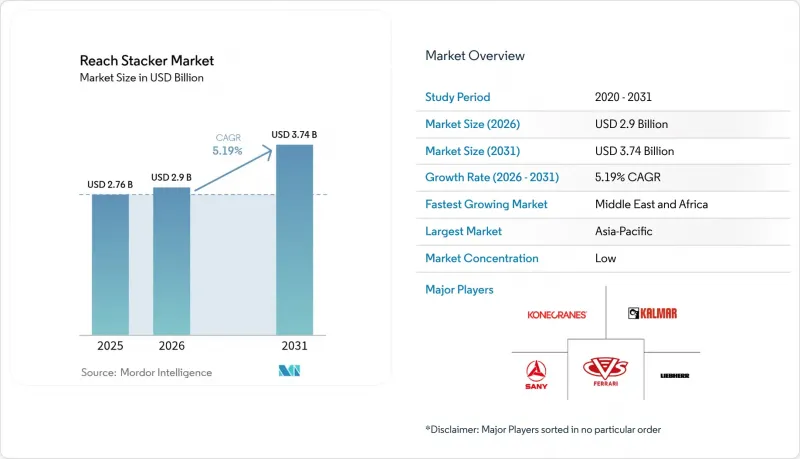
본 보고서는 용도별(항만, 내륙 컨테이너 창고/드라이포트, 복합운송 철도 야드, 산업용 등), 적재량(30톤 미만, 30-45톤, 45-100톤, 기타),파워트레인 유형(내연기관, 하이브리드, 순수 전기식, 기타), 지역(북미, 남미, 기타)별로 분류되어 있습니다. 시장 예측은 금액(미 달러)으로 제시되어 있습니다.
전 세계 리치 스태커 시장 동향 및 인사이트
해항에서의 컨테이너 취급량 급증
2024년, 전 세계 컨테이너 처리량이 급증했고, 홍해 우회 경로로 인해 항로가 연장되며 설비 가동률이 상승함에 따라 TEU 마일 수요가 증가했습니다. 상하이항은 2025년 1월 사상 최대인 500만 개의 컨테이너를 처리했으며, 중국의 주요 8개 컨테이너 항만의 총 처리량은 2억 2,400만 TEU에 달하고, 전년 대비 7% 성장하며 세계 평균을 상회했습니다. 이러한 화물량의 집중으로 인해 주요 허브에서 장비 병목 현상이 발생하고 있으며, 터미널이 고정식 크레인 설비에 의존하지 않는 유연한 컨테이너 처리 솔루션을 모색함에 따라 리치 스태커에 대한 수요가 증가하고 있습니다. 지정학적 혼란에도 불구하고 아시아-유럽 간 무역 루트가 견조한 모습을 유지하고 있는 것은 화물 흐름의 모멘텀이 지속되고 있음을 보여줍니다. 동시에 아프리카 등 신흥 시장에서는 우회된 화물량을 흡수하기 위해 지역 항만들이 처리 능력을 확대함에 따라 장비 수요가 66.71% 증가했습니다. 항만의 혼잡 상황을 살펴보면, 이용 가능한 선석 수가 제한된 가운데 터미널이 야드 운영을 최적화해 감에 따라 리치 스태커의 기동성 이점이 점점 더 중요해지고 있음을 시사합니다.
IMO 2030 목표 달성을 위한 선단 전기화 가속화
국제해사기구(IMO)가 제시한 2030년까지 CO2 배출량을 40% 감축하겠다는 목표는 선박의 배출량에 그치지 않고 터미널 운영에 이르기까지 항만 장비의 전기화 프로그램을 촉진하고 있습니다. ‘제로 에미션 포트 얼라이언스(ZEPA)’의 조사에 따르면, 2031년부터 2035년까지 신규 구매되는 컨테이너 하역 장비의 94% 이상이 배터리식 전기 구동기가 될 전망이며, 터미널 운영사들은 탈탄소화 공약을 달성하기 위해 장비 교체 주기를 가속화하고 있습니다. APM 터미널스가 남미 최초의 100% 전기 터미널을 위해 전기 터미널 트랙터를 포함한 240대의 새로운 컨테이너 하역 장비를 도입한 것은 현재 진행 중인 인프라 변혁의 규모를 여실히 보여줍니다. 로스앤젤레스 항은 2024년, 미국 최초로 상용 전기식 카고 탑 핸들러를 도입하여 대형 용도에서의 제로 에미션 기술의 유효성을 입증했습니다. 한편, 캘리포니아주의 배출 규제에 따르면 2027년까지 선박의 규격 준수가 의무화되어 있습니다. 그러나 이러한 전환 일정은 전력망 인프라의 정비 상황에 크게 좌우됩니다. 유럽의 전력망은 전기화 수요에 대응하기 위해 2040년까지 20-50%의 용량 확대가 필요할 가능성이 있기 때문입니다.
부채 위기에 직면한 신흥 시장 항만의 설비 투자 동결
신흥 시장 항만에서는 금리 상승에 따라 부채 상환 비용이 증가하면서, 설비 조달 주기에 큰 역풍이 되는 자본 지출 제약이 심화되고 있습니다. 세계은행의 이집트 인프라 자금 조달 분석에 따르면, 운송 부문의 현대화를 위한 민간 투자를 저해하는 복잡한 제도 구조와 규제상의 장벽이 부각되고 있으며, 이러한 경향은 많은 신흥 경제국에 공통적으로 나타나고 있습니다. DP 월드는 2029년까지 30억 달러 규모의 아프리카 투자를 약속하고 있지만, 이 회사는 물류 비용의 높음과 인프라 격차를 인정하며, 업무 효율성 목표를 달성하기 위해서는 지속적인 자본 투자가 필요하다고 지적하고 있습니다. 부채 문제를 안고 있는 시장의 항만 운영사들은 신규 구매보다 기존 설비의 유지 관리를 우선시하는 경향이 강해지고 있으며, 그 결과 갱신 주기가 장기화되어 본래라면 리치 스태커 수요를 견인해야 할 기술 업그레이드가 미뤄지고 있습니다. 이러한 제약은 국제 자본 시장 접근성이 제한된 소규모 지역 항만에 특히 큰 영향을 미치고 있으며, 주요 허브 항만은 투자를 지속하는 반면 2차 항만 시설은 현대화 프로그램을 연기하는 양극화된 시장 상황을 초래하고 있습니다.
부문 분석
2025년, 해상 항만은 리치 스태커 시장에서 67.92%의 점유율을 차지하고 있으며, 이는 리치 스태커가 야드 작업 및 선박 적재 순서에서 필수적인 유연성을 제공하는 주요 컨테이너 처리 허브로서의 역할을 반영한 것입니다. 이 부문이 시장을 독점하고 있는 배경에는 선박의 대형화가 진행되고 있다는 점이 있습니다. 이로 인해, 특히 컨테이너 처리량이 부두 크레인의 처리 능력을 초과하는 피크 시간대의 접안 기간 동안, 고정식 크레인 인프라를 보완할 수 있는 다목적 육상 설비가 필요해지고 있습니다. 바지선 및 하천 터미널은 2031년까지 연평균 성장률(CAGR)이 10.15%로, 가장 빠르게 성장하고 있는 용도 부문입니다. 이는 내륙 수로 개발 프로그램과 연안 항구와 내륙 물류 센터를 연결하는 복합 운송의 확대에 힘입은 것입니다. 내륙 컨테이너 창고 및 드라이포트는 유타주에서 계획 중인 내륙 터미널이나 버지니아주의 항만 확장 프로그램과 같은 인프라 투자의 혜택을 받고 있으며, 이는 내륙 지역에서 새로운 장비 도입 기회를 창출하고 있습니다.
철강, 목재, 제지 취급 등을 포함하는 산업용 분야에서는 제조 시설이 원자재 물류 및 완제품 유통을 위해 특수한 컨테이너 취급 능력을 필요로 하기 때문에 수요가 견조한 추세를 보이고 있습니다. 유니온 퍼시픽(Union Pacific)의 캔자스시티 터미널이나 BNSF의 버스토 프로젝트에서 볼 수 있듯이, 내륙 인프라 개발 규모가 확대됨에 따라 인터모달 철도 야드의 성장이 가속화되고 있습니다. 이러한 시설에서는 철도 차량과 트럭 섀시 사이에서 컨테이너를 효율적으로 환적할 수 있는 리치 스태커가 필요합니다. 이러한 용도별 분류는 연안 항만의 혼잡을 완화하는 동시에, 지금까지 서비스가 미치지 못했던 내륙 시장에 새로운 장비 수요 거점을 창출하는 분산형 물류 네트워크로공급망의 광범위한 진화를 반영하고 있습니다.
지역별 분석
2025년, 아시아태평양은 리치 스태커 시장에서 42.08%의 점유율을 차지했습니다. 이는 중국의 주요 8개 항구에서 2억 2,400만 TEU의 처리량과 인도네시아, 인도, 베트남 전역에서 지속되는 처리 능력 확충에 힘입은 결과입니다. 상하이의 야드 로봇이 주도하는 이 지역의 조기 항만 자동화 도입은 게이트에서 부두까지의 디지털 워크플로우와 조화를 이루는 다수의 센서를 탑재하고 경우에 따라 운전자가 필요 없는 리치 스태커로의 업그레이드를 가속화하고 있습니다. 일본 항만에서는 고무 타이어식 갠트리 크레인을 위한 수소 연료전지 시범 프로그램이 시작되어, 아시아 전역에서 대체 동력원으로의 광범위한 생태계 전환을 뒷받침하고 있습니다.
중동 및 아프리카는 사우디아라비아의 ‘비전 2030’에 따른 1,066억 달러 이상의 물류 투자와 DP 월드의 30억 달러 규모 아프리카 항만 확장 계획에 힘입어 8.73%라는 가장 높은 연평균 성장률(CAGR)을 나타낼 전망입니다. NEOM의 완전 자동화 크레인 도입이나 제다 이슬람 항구의 2억 4,000만 달러 규모 물류 단지 같은 프로젝트는 해당 지역이 기존의 야드 설계를 뛰어넘어 계획 단계부터 대용량 전동 또는 하이브리드식 리치 스태커를 지정하고 있음을 여실히 보여줍니다. 송전망 인프라의 용량 부족이나 인증된 운영자 부족이 도입 속도를 늦출 가능성은 있지만, 단기적인 재정적 제약에도 불구하고 정부계 금융기관의 자금 지원이 설비 조달을 가속화하고 있습니다.
북미에서는 인터모달 철도에 대한 투자와 엄격한 배출 규제에 힘입어, 성숙해 가면서도 기술 집약적인 시장 환경이 형성되고 있습니다. 유니온 퍼시픽(Union Pacific)과 BNSF의 메가 허브가 내륙 지역 수요를 뒷받침하는 한편, 캘리포니아주 항만 당국은 2035년까지 터미널 설비의 제로 배출을 의무화하고 있어, 전기식 리치 스태커에 대한 대규모 교체 수요가 예상됩니다. ‘Fit-for-55’ 및 항만 자동화 요구에 의해 형성되고 있는 유럽 시장은 배터리 교환 시스템 및 원격 조작형 차량으로 전환되고 있으며, 높아지는 성능 기준을 충족하기 위해 OEM과 소프트웨어 기업 간의 협력이 촉진되고 있습니다. 이러한 선진 지역이 사양 기준에 미치는 시너지 효과는 전 세계로 파급되며, 많은 경우 신흥 시장까지 영향을 미치는 제품 설계 기준을 결정짓고 있습니다.
기타 혜택:
- 엑셀 형식 시장 예측(ME) 시트
- 3개월간의 애널리스트 지원
자주 묻는 질문
목차
제1장 서론
제2장 조사 방법
제3장 주요 요약
제4장 시장 구도
제5장 시장 규모와 성장 예측
제6장 경쟁 구도
제7장 시장 기회와 향후 전망
JHS 26.08.26According to Mordor Intelligence, the reach stacker market size was valued at USD 2.76 billion in 2025 and estimated to grow from USD 2.9 billion in 2026 to reach USD 3.74 billion by 2031, at a CAGR of 5.19% during the forecast period (2026-2031).
This report is Segmented by Application (Sea Ports, Inland Container Depots/Dry Ports, Intermodal Rail Yards, Industrial, and More), Tonnage (Less Than 30 Ton, 30 To 45 Ton, 45 To 100 Ton, and More), Powertrain Type (Internal-Combustion Engine, Hybrid, Full-Electric, and More) and Geography (North America, South America and More). The Market Forecasts are Provided in Terms of Value (USD).
Global Reach Stacker Market Trends and Insights
Rapid Container-Traffic Growth at Seaports
Global container volumes surged in 2024, with TEU-mile demand rising as Red Sea diversions extended shipping routes and intensified equipment utilization rates. Shanghai Port processed a record 5 million containers in January 2025, while China's top 8 container ports collectively handled 224 million TEU, representing 7% year-over-year growth that outpaced global averages. This traffic concentration creates equipment bottlenecks at major hubs, driving reach stacker demand as terminals seek flexible container handling solutions that operate independently of fixed crane infrastructure. The Asia-Europe trade lane's resilience despite geopolitical disruptions demonstrates sustained cargo flow momentum. At the same time, emerging markets like Africa show 66.71% growth in equipment demand as regional ports expand capacity to capture diverted volumes. Port congestion patterns suggest that reach stackers' mobility advantage becomes increasingly valuable as terminals optimize yard operations under constrained berth availability.
Accelerated Fleet Electrification to Meet IMO 2030 Targets
The International Maritime Organization's 40% CO2 reduction target by 2030 catalyzes port equipment electrification programs extending beyond ship emissions to encompass terminal operations. Zero Emission Port Alliance (ZEPA) research indicates that battery-electric container handling equipment will comprise over 94% of new purchases from 2031 to 2035, with terminal operators accelerating replacement cycles to meet decarbonization commitments. APM Terminals' deployment of 240 pieces of new container handling equipment, including electric terminal tractors for its first 100% electric terminal in South America, demonstrates the scale of infrastructure transformation underway. The Port of Los Angeles launched the nation's first commercial electric cargo top handlers in 2024, validating zero-emission technology for heavy-duty applications while California's emissions controls require vessel compliance by 2027. However, the transition timeline depends critically on grid infrastructure upgrades, as European transmission networks may require 20-50% capacity expansion by 2040 to support electrification demands.
Cap-ex Freeze at Emerging-Market Ports Amid Debt Distress
Emerging market ports face mounting capital expenditure constraints as debt servicing costs rise amid elevated interest rates, creating a significant headwind for equipment procurement cycles. The World Bank's infrastructure financing analysis for Egypt highlights complex institutional structures and regulatory barriers that impede private investment in transport sector modernization, patterns that extend across multiple emerging economies. Despite DP World's USD 3 billion African investment commitment through 2029, the company acknowledges high logistics costs and infrastructure gaps that require sustained capital deployment to achieve operational efficiency targets. Port operators in debt-distressed markets increasingly prioritize maintenance of existing equipment over new acquisitions, extending replacement cycles, and deferring technology upgrades that would otherwise drive reach stacker demand. The constraint particularly affects smaller regional ports that lack access to international capital markets, creating a bifurcated market where major hub ports continue investing while secondary facilities postpone modernization programs.
Other drivers and restraints analyzed in the detailed report include:
- Intermodal Rail Expansion in Land-locked Regions
- AI-driven Predictive Maintenance Lowering TCO
- Volatile Steel Prices Inflating OEM Costs
For complete list of drivers and restraints, kindly check the Table Of Contents.
Segment Analysis
Seaports command 67.92% market share of the reach stacker market in 2025, reflecting their role as primary container handling hubs where reach stackers provide essential flexibility for yard operations and vessel loading sequences. The segment's dominance stems from increasing vessel sizes that require versatile ground-based equipment to complement fixed crane infrastructure, particularly during peak berthing periods when container throughput demands exceed quay crane capacity. Barge and river terminals represent the fastest-growing application segment at 10.15% CAGR through 2031, driven by inland waterway development programs and intermodal transport expansion that connects coastal ports with interior distribution centers. Inland container depots and dry ports benefit from infrastructure investments like Utah's planned inland terminal and Virginia's port expansion programs, which create new equipment deployment opportunities in landlocked regions.
Industrial applications, including steel, timber, and paper handling, maintain steady demand as manufacturing facilities require specialized container handling capabilities for raw material logistics and finished goods distribution. Intermodal rail yards show accelerating growth as Union Pacific's Kansas City terminal and BNSF's Barstow project demonstrate the scale of inland infrastructure development, with these facilities requiring reach stackers that can efficiently transfer containers between rail cars and truck chassis. The application segmentation reflects broader supply chain evolution toward distributed logistics networks that reduce coastal port congestion while creating new equipment demand centers in previously underserved inland markets.
Complete Report Scope:
- By Application
- Sea Ports
- Inland Container Depots/Dry Ports
- Intermodal Rail Yards
- Barge and River Terminals
- Industrial (Steel, Timber, Paper, Etc.)
- By Tonnage
- Less Than 30 Ton (Low)
- 30 to 45 Ton (Medium)
- 45 to 100 Ton (High)
- More Than 100 Ton (Super-Heavy)
- By Powertrain Type
- Internal-Combustion Engine
- Hybrid (Diesel-Electric)
- Full-Electric
- Hydrogen Fuel Cell
- By Geography
- North America
- United States
- Canada
- Rest of North America
- South America
- Brazil
- Argentina
- Rest of South America
- Europe
- Germany
- United Kingdom
- France
- Italy
- Spain
- Netherlands
- Rest of Europe
- Asia-Pacific
- China
- India
- Japan
- South Korea
- Rest of Asia-Pacific
- Middle East and Africa
- Saudi Arabia
- United Arab Emirates
- Egypt
- Turkey
- South Africa
- Rest of Middle East and Africa
- North America
Geography Analysis
Asia-Pacific carried a 42.08% share of the reach stacker market in 2025, anchored by China's 224 million TEU throughput at its top eight ports and continuing capacity additions across Indonesia, India, and Vietnam. The region's early adoption of port automation, led by Shanghai's yard robots, accelerates upgrades toward sensor-rich and sometimes driver-optional reach stackers that harmonize with gate-to-quay digital workflows. Japanese ports have begun hydrogen fuel-cell pilot programs for rubber-tired gantries, reinforcing a broader ecosystem shift toward alternative power sources in Asia.
The Middle East and Africa will post the fastest 8.73% CAGR, underwritten by Saudi Arabia's Vision 2030 logistics outlay exceeding USD 106.6 billion and DP World's USD 3 billion African port expansion drive. Projects such as NEOM's fully automated crane installation and Jeddah Islamic Port's USD 240 million logistics park exemplify how the region is leap-frogging legacy yard designs and specifying high-capacity electric or hybrid reach stackers from inception. Capacity gaps in grid infrastructure and shortages of certified operators could temper the adoption slope, yet state-backed financing vehicles are helping expedite equipment procurement despite near-term fiscal constraints.
North America presents a mature yet tech-intensive landscape driven by intermodal rail spending and strict emissions regulations. Union Pacific's and BNSF's mega-hubs are set to anchor inland demand, while California's port authorities mandate zero-emission terminal equipment by 2035, foreshadowing large replacement orders for electric reach stackers. Europe's market, shaped by Fit-for-55 and port automation imperatives, is shifting toward battery swap systems and remote-driven fleets, fostering collaboration between OEMs and software firms to meet escalating performance benchmarks. The combined influence of these developed regions on specification standards reverberates globally, often dictating product design norms that cascade into emerging markets.
- Kalmar Corporation
- Konecranes Inc.
- Hyster-Yale, Inc.
- Liebherr Group
- SANY Group
- CVS FERRARI S.P.A.
- Terex Corporation
- Toyota Material Handling International
- Shanghai Zhenhua Heavy Industries Company Limited (ZPMC)
- Dalian forklift Co., Ltd.
- Hoist Material Handling, Inc.
- Valla Cranes
- Taylor Group
- FTMH S.P.A.
- SENNEBOGEN
- Linde Material Handling
- Anhui Heli Co., Ltd.
- SVETRUCK AB
- Komatsu Utility Co., Ltd.
Additional Benefits:
- The market estimate (ME) sheet in Excel format
- 3 months of analyst support
TABLE OF CONTENTS
1 Introduction
- 1.1 Study Assumptions and Market Definition
- 1.2 Scope of the Study
2 Research Methodology
3 Executive Summary
4 Market Landscape
- 4.1 Market Overview
- 4.2 Market Drivers
- 4.2.1 Rapid container-traffic growth at seaports
- 4.2.2 Accelerated fleet electrification to meet IMO 2030 targets
- 4.2.3 Intermodal rail expansion in land-locked regions
- 4.2.4 Port automation mandates in EU Fit-for-55 package
- 4.2.5 AI-driven predictive maintenance lowering TCO
- 4.2.6 Emergence of hydrogen fuel-cell powertrains in heavy-duty handling
- 4.3 Market Restraints
- 4.3.1 Cap-ex freeze at emerging-market ports amid debt distress
- 4.3.2 Grid-capacity bottlenecks for large-scale electric chargers
- 4.3.3 Volatile steel prices inflating OEM costs
- 4.3.4 Skilled-operator shortages slowing adoption in Africa
- 4.4 Value / Supply-Chain Analysis
- 4.5 Regulatory Landscape
- 4.6 Technological Outlook
- 4.7 Porter's Five Forces
- 4.7.1 Threat of New Entrants
- 4.7.2 Bargaining Power of Buyers
- 4.7.3 Bargaining Power of Suppliers
- 4.7.4 Threat of Substitutes
- 4.7.5 Intensity of Competitive Rivalry
5 Market Size and Growth Forecasts (Value (USD))
- 5.1 By Application
- 5.1.1 Sea Ports
- 5.1.2 Inland Container Depots/Dry Ports
- 5.1.3 Intermodal Rail Yards
- 5.1.4 Barge and River Terminals
- 5.1.5 Industrial (Steel, Timber, Paper, Etc.)
- 5.2 By Tonnage
- 5.2.1 Less Than 30 Ton (Low)
- 5.2.2 30 to 45 Ton (Medium)
- 5.2.3 45 to 100 Ton (High)
- 5.2.4 More Than 100 Ton (Super-Heavy)
- 5.3 By Powertrain Type
- 5.3.1 Internal-Combustion Engine
- 5.3.2 Hybrid (Diesel-Electric)
- 5.3.3 Full-Electric
- 5.3.4 Hydrogen Fuel Cell
- 5.4 By Geography
- 5.4.1 North America
- 5.4.1.1 United States
- 5.4.1.2 Canada
- 5.4.1.3 Rest of North America
- 5.4.2 South America
- 5.4.2.1 Brazil
- 5.4.2.2 Argentina
- 5.4.2.3 Rest of South America
- 5.4.3 Europe
- 5.4.3.1 Germany
- 5.4.3.2 United Kingdom
- 5.4.3.3 France
- 5.4.3.4 Italy
- 5.4.3.5 Spain
- 5.4.3.6 Netherlands
- 5.4.3.7 Rest of Europe
- 5.4.4 Asia-Pacific
- 5.4.4.1 China
- 5.4.4.2 India
- 5.4.4.3 Japan
- 5.4.4.4 South Korea
- 5.4.4.5 Rest of Asia-Pacific
- 5.4.5 Middle East and Africa
- 5.4.5.1 Saudi Arabia
- 5.4.5.2 United Arab Emirates
- 5.4.5.3 Egypt
- 5.4.5.4 Turkey
- 5.4.5.5 South Africa
- 5.4.5.6 Rest of Middle East and Africa
- 5.4.1 North America
6 Competitive Landscape
- 6.1 Market Concentration
- 6.2 Strategic Moves
- 6.3 Market Share Analysis
- 6.4 Company Profiles (Includes Global level Overview, Market level overview, Core Segments, Financials as available, Strategic Information, Market Rank/Share for key companies, Products and Services, and Recent Developments)
- 6.4.1 Kalmar Corporation
- 6.4.2 Konecranes Inc.
- 6.4.3 Hyster-Yale, Inc.
- 6.4.4 Liebherr Group
- 6.4.5 SANY Group
- 6.4.6 CVS FERRARI S.P.A.
- 6.4.7 Terex Corporation
- 6.4.8 Toyota Material Handling International
- 6.4.9 Shanghai Zhenhua Heavy Industries Company Limited (ZPMC)
- 6.4.10 Dalian forklift Co., Ltd.
- 6.4.11 Hoist Material Handling, Inc.
- 6.4.12 Valla Cranes
- 6.4.13 Taylor Group
- 6.4.14 FTMH S.P.A.
- 6.4.15 SENNEBOGEN
- 6.4.16 Linde Material Handling
- 6.4.17 Anhui Heli Co., Ltd.
- 6.4.18 SVETRUCK AB
- 6.4.19 Komatsu Utility Co., Ltd.
7 Market Opportunities and Future Outlook
- 7.1 White-space and Unmet-Need Assessment


