
|
시장보고서
상품코드
2140420
항만용 리치 스태커 시장 규모, 점유율, 성장 분석 : 제품 유형별, 동력원별, 적재 능력별, 최종사용자별, 지역별 - 산업 예측(2026-2033년)Port Reach Stacker Market Size, Share, and Growth Analysis, By Product Type (Empty Container Reach Stackers, Loaded Container Reach Stackers), By Power Source, By Lifting Capacity, By End User, By Region - Industry Forecast 2026-2033 |
||||||

세계의 항만용 리치 스태커 시장 규모는 2024년에 27억 6,000만 달러로 평가되며, 2025년 29억 4,000만 달러에서 2033년까지 48억 3,000만 달러로 확대하며, 예측 기간(2026-2033년)에 CAGR 6.4%로 성장할 것으로 전망되고 있습니다.
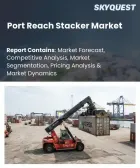
전 세계 항만용 리치 스태커 시장은 터미널 환경에서 효율적인 운영에 필수적인 컨테이너 취급 기계의 개발과 활용에 초점을 맞추고 있습니다. 국제 해상 무역이 확대됨에 따라 항만에서는 처리 능력의 최적화와 야드 공간 절약이 요구되고 있습니다. 기존의 디젤 모델에서 첨단 하이브리드 전기식 리치 스태커로의 전환은 기술적 진화를 여실히 보여주고 있으며, 그 일례로 효율 향상을 위해 자동화된 차량군으로의 전환을 추진하는 초기 도입자들을 들 수 있습니다. 컨테이너선의 대형화에 따라 적재 능력 향상과 하역 사이클의 신속화가 요구되고 있으며, 이에 따라 터미널에서는 기존 크레인보다 기동성이 높은 리치 스태커가 선호되고 있습니다. 또한 AI를 활용한 자동화는 첨단 센서와 예측 알고리즘을 통합함으로써 운영 효율을 높이고, 사이클 타임 단축, 에너지 절약, 그리고 원활한 작업자 교육을 실현하며, 궁극적으로는 견고한 시장 성장을 촉진함과 동시에 항만 물류의 현대화를 지원하고 있습니다.
전 세계 항만용 리치 스태커 시장 촉진요인
항만내 컨테이너 취급의 완전 자동화 추세가 강화되는 가운데, 첨단 터미널 관리 시스템과 효과적으로 연동할 수 있는 리치 스태커에 대한 수요가 높아지고 있습니다. 항만 운영자들은 인건비와 인적 오류 가능성을 줄이면서 다양한 크기의 화물을 유연하게 처리할 수 있는 장비를 점점 더 요구하고 있습니다. 첨단 안전 기능과 원격 진단 기능을 갖춘 리치 스태커는 조달 담당자에게 특히 매력적이며, 이러한 범용성이 높고 고성능인 기계에 대한 관심이 급증하고 있습니다. 그 결과, 각 항만 기업은 경쟁을 피하기 위해 효율성 향상, 처리 시간 단축, 그리고 높은 서비스 수준 유지에 주력하고 있습니다.
전 세계 항만용 리치 스태커 시장의 제약 요인
일반적으로 복잡한 유압 시스템이나 전자 시스템을 갖춘 첨단 리치 스태커를 구입하는 데 필요한 초기 투자는 많은 항만 당국에게 큰 재정적 과제가 되고 있습니다. 특히 신흥 시장에서는 예산 제약으로 인해 대규모 설비 현대화에 충분한 자원을 할당하는 능력이 저해되고 있습니다. 그 결과, 사업자들은 구매를 미루거나 구형 기계의 사용 기간을 연장할 가능성이 있으며, 당분간 시장 수요가 감소하게 됩니다. 이러한 경제적 장벽은 신기술의 신속한 도입을 방해하며, 궁극적으로 시장 성장을 둔화시킵니다. 비록 그러한 혁신이 장기적인 효율 향상을 약속하고 있다 하더라도 말입니다. 또한 새로운 장비를 도입하려면 추가적인 교육 및 지원 비용이 필요합니다.
세계 항만용 리치 스태커 시장 동향
전 세계 항만용 리치 스태커 시장에서는 자동화의 고도화와 디지털 통합을 향한 뚜렷한 추세가 나타나고 있습니다. 항만 운영 사업자들이 AI 기반 제어 시스템, IoT 센서, 원격 모니터링 솔루션 등의 첨단 기술을 점점 더 많이 도입함에 따라 리치 스태커는 업무 효율 향상에 필수적인 요소로 자리 잡고 있습니다. 이러한 동향으로 인해 실시간 성능 분석 및 예측 유지보수가 가능해져 설비 가동률 향상과 사이클 타임 단축으로 이어지는 동시에, 다양한 컨테이너 구성에도 유연하게 대응할 수 있게 됩니다. 업계가 스마트 항만 구상으로 방향을 전환하는 가운데, 자동화된 리치 스태커는 야드의 처리 능력 향상과 자원 관리 최적화를 추진하는 필수적인 자산으로 부상하며, 항만 물류의 미래를 재구축하고 있습니다.
자주 묻는 질문
목차
서론
조사 방법
개요
시장 역학과 전망
주요 시장 인사이트
세계의 항만용 리치 스태커 시장 규모 : 제품 유형별
세계의 항만용 리치 스태커 시장 규모 : 동력원별
세계의 항만용 리치 스태커 시장 규모 : 적재 능력별
세계의 항만용 리치 스태커 시장 규모 : 최종사용자별
세계의 항만용 리치 스태커 시장 규모 : 지역별
경쟁 정보
주요 기업 개요
결론과 제안
KSA 26.10.15Global Port Reach Stacker Market size was valued at USD 2.76 Billion in 2024 and is poised to grow from USD 2.94 Billion in 2025 to USD 4.83 Billion by 2033, growing at a CAGR of 6.4% during the forecast period (2026-2033).
The global port reach stacker market focuses on the development and use of container-handling machines essential for efficient operation within terminal environments. As international maritime trade expands, ports are urged to optimize throughput and conserve yard space. The transition from traditional diesel models to advanced hybrid-electric reach stackers denotes significant technological evolution, exemplified by early adopters moving to automated fleets for improved efficiency. The increase in container vessel size necessitates enhanced stacking capabilities and expedited turnover, driving terminals to favor agile reach stackers over traditional cranes. Additionally, AI-driven automation enhances operational efficiency by integrating advanced sensors and predictive algorithms, leading to reduced cycle times, energy savings, and seamless operator training, ultimately fostering a strong market trajectory and encouraging modernization in port logistics.
Top-down and bottom-up approaches were used to estimate and validate the size of the Global Port Reach Stacker market and to estimate the size of various other dependent submarkets. The research methodology used to estimate the market size includes the following details: The key players in the market were identified through secondary research, and their market shares in the respective regions were determined through primary and secondary research. This entire procedure includes the study of the annual and financial reports of the top market players and extensive interviews for key insights from industry leaders such as CEOs, VPs, directors, and marketing executives. All percentage shares split, and breakdowns were determined using secondary sources and verified through Primary sources. All possible parameters that affect the markets covered in this research study have been accounted for, viewed in extensive detail, verified through primary research, and analyzed to get the final quantitative and qualitative data.
Global Port Reach Stacker Market Segments Analysis
Global port reach stacker market is segmented by product type, power source, lifting capacity, end user and region. Based on product type, the market is segmented into Empty Container Reach Stackers and Loaded Container Reach Stackers. Based on power source, the market is segmented into Diesel, Hybrid and Electric. Based on lifting capacity, the market is segmented into Below 30 Tons, 30-45 Tons and Above 45 Tons. Based on end user, the market is segmented into Seaports, Inland Container Depots and Logistics & Freight Operators. Based on region, the market is segmented into North America, Europe, Asia Pacific, Latin America and Middle East & Africa.
Driver of the Global Port Reach Stacker Market
The growing trend towards full automation in container handling at ports is driving the demand for reach stackers that can effectively integrate with sophisticated terminal management systems. Port operators are increasingly looking for equipment that provides agility in handling varying load sizes while reducing labor costs and the potential for human error. Reach stackers that come equipped with advanced safety features and remote diagnostic capabilities are particularly appealing to procurement teams, leading to a surge in interest for these versatile and high-performance machines. As a result, ports are focusing on increasing efficiency, enhancing turnaround times, and sustaining high service standards to remain competitive.
Restraints in the Global Port Reach Stacker Market
The initial investment required to purchase advanced reach stackers, which typically feature complex hydraulic and electronic systems, poses a considerable financial challenge for many port authorities. Due to budget limitations, particularly in emerging markets, the capacity to allocate adequate resources for extensive equipment modernization is hindered. As a result, operators may postpone acquisitions or prolong the usage of outdated machinery, leading to a decline in immediate demand within the market. This economic obstacle hampers the swift uptake of new technology, ultimately decelerating market growth, even though such innovations promise long-term efficiency improvements. Additionally, the introduction of new equipment necessitates supplementary training and support expenses.
Market Trends of the Global Port Reach Stacker Market
The Global Port Reach Stacker market is witnessing a significant trend towards enhanced automation and digital integration. With port operators increasingly adopting advanced technologies like AI-driven control systems, IoT sensors, and remote monitoring solutions, reach stackers are becoming integral to achieving operational efficiencies. This trend facilitates real-time performance analytics and predictive maintenance, leading to improved equipment uptime and reduced cycle times, all while managing diverse container mixes with agility. As the industry pivots towards smart port initiatives, automated reach stackers emerge as essential assets that drive higher yard throughput and optimize resource management, thus reshaping the future of port logistics.
Table of Contents
Introduction
- Objectives of the Study
- Market Definition & Scope
Research Methodology
- Research Process
- Secondary & Primary Data Methods
- Market Size Estimation Methods
Executive Summary
- Global Market Outlook
- Key Market Highlights
- Segmental Overview
- Competition Overview
Market Dynamics & Outlook
- Macro-Economic Indicators
- Drivers & Opportunities
- Restraints & Challenges
- Supply Side Trends
- Demand Side Trends
- Porters Analysis & Impact
- Competitive Rivalry
- Threat of Substitute
- Bargaining Power of Buyers
- Threat of New Entrants
- Bargaining Power of Suppliers
Key Market Insights
- Key Success Factors
- Market Impacting Factors
- Top Investment Pockets
- Ecosystem Mapping
- Market Attractiveness Index 2025
- PESTEL Analysis
- Regulatory Landscape
Global Port Reach Stacker Market Size by Product Type & CAGR (2026-2033)
- Market Overview
- Empty Container Reach Stackers
- Loaded Container Reach Stackers
Global Port Reach Stacker Market Size by Power Source & CAGR (2026-2033)
- Market Overview
- Diesel
- Hybrid
- Electric
Global Port Reach Stacker Market Size by Lifting Capacity & CAGR (2026-2033)
- Market Overview
- Below 30 Tons
- 30-45 Tons
- Above 45 Tons
Global Port Reach Stacker Market Size by End User & CAGR (2026-2033)
- Market Overview
- Seaports
- Inland Container Depots
- Logistics & Freight Operators
Global Port Reach Stacker Market Size & CAGR (2026-2033)
- North America (Product Type, Power Source, Lifting Capacity, End User)
- US
- Canada
- Europe (Product Type, Power Source, Lifting Capacity, End User)
- Germany
- Spain
- France
- UK
- Italy
- Rest of Europe
- Asia Pacific (Product Type, Power Source, Lifting Capacity, End User)
- China
- India
- Japan
- South Korea
- Rest of Asia-Pacific
- Latin America (Product Type, Power Source, Lifting Capacity, End User)
- Mexico
- Brazil
- Rest of Latin America
- Middle East & Africa (Product Type, Power Source, Lifting Capacity, End User)
- GCC Countries
- South Africa
- Rest of Middle East & Africa
Competitive Intelligence
- Top 5 Player Comparison
- Market Positioning of Key Players, 2025
- Strategies Adopted by Key Market Players
- Recent Developments in the Market
- Company Market Share Analysis, 2025
- Company Profiles of All Key Players
- Company Details
- Product Portfolio Analysis
- Company's Segmental Share Analysis
- Revenue Y-O-Y Comparison (2023-2025)
Key Company Profiles
- Konecranes Plc
- Company Overview
- Business Segment Overview
- Financial Updates
- Key Developments
- Kalmar Corporation
- Company Overview
- Business Segment Overview
- Financial Updates
- Key Developments
- SANY Heavy Industry Co., Ltd.
- Company Overview
- Business Segment Overview
- Financial Updates
- Key Developments
- Hyster-Yale, Inc.
- Company Overview
- Business Segment Overview
- Financial Updates
- Key Developments
- Toyota Industries Corporation
- Company Overview
- Business Segment Overview
- Financial Updates
- Key Developments
- Mitsubishi Logisnext Co., Ltd.
- Company Overview
- Business Segment Overview
- Financial Updates
- Key Developments
- CVS Ferrari S.p.A.
- Company Overview
- Business Segment Overview
- Financial Updates
- Key Developments
- Liebherr-International AG
- Company Overview
- Business Segment Overview
- Financial Updates
- Key Developments
- Taylor Machine Works, Inc.
- Company Overview
- Business Segment Overview
- Financial Updates
- Key Developments
- Terex Corporation
- Company Overview
- Business Segment Overview
- Financial Updates
- Key Developments
- Combilift Unlimited Company
- Company Overview
- Business Segment Overview
- Financial Updates
- Key Developments
- Omega Forklift Pty Ltd.
- Company Overview
- Business Segment Overview
- Financial Updates
- Key Developments
- Hoist Material Handling, Inc.
- Company Overview
- Business Segment Overview
- Financial Updates
- Key Developments
- Anhui Heli Co., Ltd.
- Company Overview
- Business Segment Overview
- Financial Updates
- Key Developments
- Hangcha Group Co., Ltd.
- Company Overview
- Business Segment Overview
- Financial Updates
- Key Developments
- Linde Material Handling GmbH
- Company Overview
- Business Segment Overview
- Financial Updates
- Key Developments
- Doosan Bobcat Inc.
- Company Overview
- Business Segment Overview
- Financial Updates
- Key Developments
- EP Equipment Co., Ltd.
- Company Overview
- Business Segment Overview
- Financial Updates
- Key Developments
- Gaussin SA
- Company Overview
- Business Segment Overview
- Financial Updates
- Key Developments
- Fantuzzi Team Material Handling S.r.l.
- Company Overview
- Business Segment Overview
- Financial Updates
- Key Developments


