|
시장보고서
상품코드
2115789
근위축성 측삭경화증 치료 시장 : 시장 점유율 분석, 업계 동향 및 통계, 성장 예측(2026-2031년)Global Amyotrophic Lateral Sclerosis Treatment - Market Share Analysis, Industry Trends & Statistics, Growth Forecasts (2026 - 2031) |
||||||
 Mordor Intelligence
Mordor Intelligence에 의하면, 근위축성 측삭경화증 치료 시장 규모는 2025년에 9억 달러로 평가되었고, 2026년 9억 5,274만 달러에서 2031년까지 12억 7,000만 달러에 이를 것으로 추정되며, 예측 기간(2026-2031년) CAGR은 5.86%를 나타낼 전망입니다.
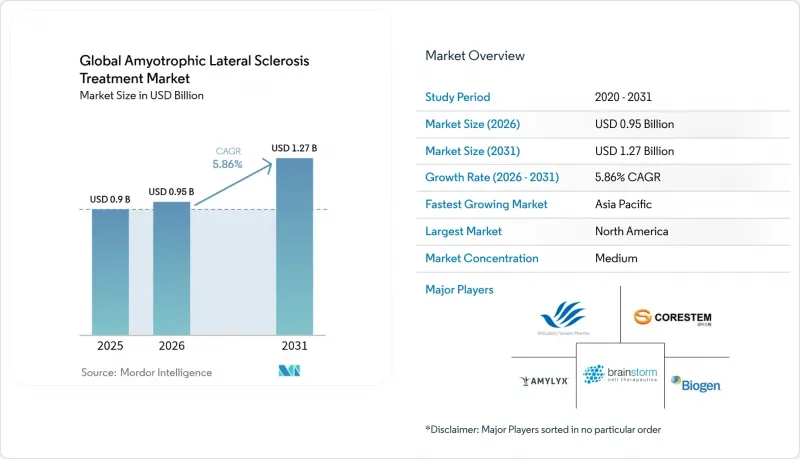
본 보고서는 치료 유형별(약물 요법, 기타), 유통 채널별(병원 약국, 소매 약국, 기타), 지역별(북미, 유럽, 아시아태평양, 중동 및 아프리카, 남미)로 분류되어 있습니다. 본 보고서에서는 상기 각 부문 시장 규모(100만 달러)를 제시하고 있습니다.
세계의 근위축성 측삭경화증(ALS) 치료 시장 동향 및 인사이트
ALS 발병률 및 유병률 증가
역학 연구에 따르면, 특히 고령화가 진행되고 있는 서유럽 국가에서 ALS 발병 건수가 증가하고 있는 것으로 보고되고 있습니다. 이러한 지역에서는 신경 진단 도구의 고도화로 인해 진단까지의 지연 기간이 16개월에서 12개월 이하로 단축되었습니다. 조기 발견으로 인해 무증상 보균자에게 최대의 효능을 보이는 ASO(안티센스 올리고뉴클레오티드)의 치료 가능 기간이 확대되었으며, 그 결과 수요가 증가하고 높은 가격 책정이 뒷받침되고 있습니다. 신흥 경제국에서도 전문 신경과 의사 및 유전자 검사 이용이 확대됨에 따라 유병률이 증가하고 있습니다. 이러한 인구 통계학적 변화와 정밀 의학의 발전이 맞물려, 근위축성 측삭 경화증 치료 시장의 지속적인 판매량 성장을 뒷받침하고 있습니다.
희귀질환 치료제에 대한 규제상의 호재
FDA의 바이오마커 종결점을 통한 토펠센의 신속 승인 및 EMA의 2024년 ‘예외적 상황’ 지위에 따른 승인은 신속하고 증거 기반의 심사를 향한 대서양을 가로지르는 재편을 부각시켰습니다. 수수료 면제, 우선 심사 바우처, 독점권 연장 등의 병행 인센티브는 벤처 자금을 유치하고 평균 개발 기간을 3-5년 단축시키고 있습니다. 의료기술평가기관은 대체 평가 지표에 대한 수용성을 높이고 있으며, 검증된 바이오마커 기반 제품에 대한 보험 급여 기준이 완화되고 있습니다.
고액의 치료비·제한된 보험 환급
승인된 ASO(안티센스 올리고뉴클레오티드)의 연간 치료비는 45만 달러를 초과하며, 실세계 데이터에 기반한 분석에 따르면 보충적인 보험 적용이 없는 경우 본인 부담금은 3만 6,000달러 이상에 달하는 것으로 나타났습니다. 유럽의 보험사들은 엄격한 비용 대비 효과 기준을 적용하고 있어, 이로 인해 시장 출시가 1-2회의 보험 급여 주기만큼 지연되고 있습니다. 중소득 국가에서는 정가가 1인당 소득을 상회하여 도입이 현저히 억제되고 있습니다. 이러한 경제적 접근성 격차로 인해 임상적 수요는 견조함에도 불구하고 전반적인 매출 성장은 둔화되고 있습니다.
부문 분석
2025년에도 의약품은 매출의 66.50%를 차지하며 시장을 계속 주도했습니다. 이는 확립된 제형 패턴과 광범위한 접근성을 반영한 것입니다. 그러나 유전자 치료와 ASO 치료는 연평균 성장률(CAGR) 6.55%로 확대되고 있어, 2031년까지 그 격차를 좁혀갈 것으로 전망됩니다. 근위축성 측삭경화증(ALS) 치료 시장에서 유전자 기반 치료법 시장 규모는 확대될 것으로 예측됩니다. 이는 임상적 진행 지연과 바이오마커 간의 일관된 상관관계가 확인됨에 따라, 병원 약제 선정 위원회가 척수강내 ASO 프로토콜을 점점 더 많이 승인하고 있기 때문입니다. 자가 세포 제조에 있어 생산 능력의 병목 현상은 여전히 존재하지만, 유전자 편집 플랫폼은 이러한 제약의 상당 부분을 회피할 수 있기 때문에 상업적 규모로의 확장이 가속화되고 있습니다.
줄기세포 치료는 한국의 ‘Neuronata-R’ 승인을 기반으로 세심한 관리가 필요한 틈새 시장을 점유하고 있는 반면, BrainStorm의 ‘NurOwn’은 FDA의 특별 프로토콜 승인을 목표로 하고 있습니다. 제조 규모의 제약으로 인해 단기적인 공급량은 정체되어 있지만, 이러한 진전은 지속적인 투자를 뒷받침하고 있습니다. 증상 관리의 주축은 여전히 경구용 약물이지만, 보험사의 관심은 질병의 경과를 뚜렷이 바꾸는 고부가가치 치료법으로 이동하고 있어, 모든 부문에서 경쟁이 심화되고 있습니다.
릴졸의 37.40%라는 시장 점유율은 제네릭 의약품의 보급과 신경과 전문의들의 높은 인지도라는 혜택을 받고 있지만, 진단 시 유전자 검사가 일상화되고 있는 만큼,ASO(안티센스 올리고뉴클레오티드)는 2031년까지 연평균 5.45%의 성장률을 보이고 있습니다. 추가적인 돌연변이 특이적 ASO가 파이프라인에서 임상 현장으로 전환됨에 따라, 근위축성 측삭 경화증(ALS) 치료 시장에서 릴졸의 점유율은 하락할 것으로 예측됩니다. 에달라본은 정맥 내 투여 제제로서 시장 점유율을 유지하고 있지만, 장기적인 간 손상에 대한 안전성 모니터링 대상에 포함되어 있어 일부 보험사가 치료 기간을 제한하는 움직임이 나타나고 있습니다. 신경 보호 작용과 항염증 작용을 통합한 병용 제제가 후기 임상시험 단계로 진입하고 있어, 향후에는 단일 요법이 아닌 다제 병용 요법으로 구성된 시장이 될 것으로 시사되고 있습니다.
지역별 분석
북미는 2025년에 전 세계 매출의 42.05%를 차지했습니다. 이는 ALS 환자에 대한 메디케어의 즉시 적용 자격 및 혁신적인 치료법에 대한 조기 접근을 허용하는 FDA의 조기 승인이 뒷받침한 결과입니다. ‘ACT for ALS’ 프로그램과 같은 입법 조치를 통해 임상시험 인프라 확충이 재정적으로 지원되고 있으며, ‘시용권(right-to-try)’ 규정이 인도적 사용의 확산을 가속화하고 있습니다. 종합적인 보험 제도가 있음에도 불구하고, 급여 상한선이나 주별 보충 보험 정책의 차이로 인해, 특히 가격이 40만 달러를 초과하는 ASO(알카이드아미드)의 경우 소득에 따른 치료 접근성 격차가 드러나고 있습니다.
유럽은 성숙한 환급 네트워크와 2024년에 최초의 ASO를 승인한 EMA(유럽의약품청)의 조정된 승인 절차를 갖추고 있습니다. EU 전역에서의 판매 승인은 일원화되어 있지만, 각국 고유의 의료기술평가로 인해 출시 시기가 6-12개월 정도 지연되는 현상이 발생하고 있습니다. 독일의 AMNOG 체계나 영국의 NICE 평가에서는 많은 경우 초기 가격 및 수량 합의가 요구되며, 이는 상업적 예측에 영향을 미치고 있습니다. 독일, 프랑스, 영국을 거점으로 하는 연구 컨소시엄은 해외 스폰서를 유치하는 견고한 임상시험 생태계를 뒷받침하고 있습니다.
아시아태평양은 막대한 미충족 의료 수요와 신경학 센터의 급속한 확장이 맞물려, 2031년까지 연평균 성장률(CAGR)이 6.98%로 가장 높습니다. 일본은 에달라본의 선행 도입 실적과 신경퇴행성 질환 연구 개발에 대한 정부 자금을 활용하여 상업적 보급을 주도하고 있습니다. 한국은 줄기세포 치료 분야의 규제 측면에서의 선점 우위를 활용하여, 지역 수요에 대응하는 제조·수출 거점으로서의 입지를 확립하고 있습니다. 중국은 시장 규모의 잠재력이 막대하지만, 성별 보험 환급 제도의 불균일성과 장기화되는 약가 협상이 수익화의 완전한 실현을 지연시키고 있습니다. 호주, 싱가포르, 인도는 다국적 임상시험 네트워크의 신흥 거점으로 부상하고 있으며, 대규모 피험자 모집과 높은 비용 효율성을 제공합니다.
기타 혜택
- 엑셀 형식 시장 예측(ME) 시트
- 3개월간의 애널리스트 지원
자주 묻는 질문
목차
제1장 서론
제2장 조사 방법
제3장 주요 요약
제4장 시장 구도
제5장 시장 규모 및 성장 예측
제6장 경쟁 구도
제7장 시장 기회 및 향후 전망
AJY 26.08.28According to Mordor Intelligence, the amyotrophic lateral sclerosis treatment market size was valued at USD 0.9 billion in 2025 and estimated to grow from USD 952.74 million in 2026 to reach USD 1.27 billion by 2031, at a CAGR of 5.86% during the forecast period (2026-2031).
This report is Segmented by Treatment Type (Medication and Others), Distribution Channel (Hospital Pharmacies, Retail Pharmacies, and Others), and Geography (North America, Europe, Asia-Pacific, Middle East and Africa, and South America). The Report Offers the Value (in USD Million) for the Above Segments.
Global Amyotrophic Lateral Sclerosis Treatment Market Trends and Insights
Growing Incidence and Prevalence of ALS
Epidemiologic studies record rising ALS incidence, especially in aging Western populations, where enhanced neurodiagnostic tools have trimmed diagnostic delay from 16 months to under 12 months.Earlier detection widens the therapeutic window for ASOs that show greatest efficacy in presymptomatic carriers, thereby boosting unit demand and supporting premium pricing. Emerging economies post parallel prevalence gains as specialist neurologists and genetic testing become more available. The demographic surge combines with precision medicine momentum to reinforce sustained volume growth in the Amyotrophic lateral sclerosis treatment market.
Regulatory Tailwinds for Orphan / Rare-Disease Drugs
The FDA's accelerated approval of tofersen on biomarker endpoints and the EMA's 2024 endorsement under exceptional-circumstances status underscored a transatlantic realignment toward expedited, evidence-adaptive reviews. Parallel incentives such as fee waivers, priority vouchers, and extended exclusivity, among others, attract venture financing and shorten average development timelines by 3-5 years. Health technology agencies are increasingly receptive to surrogate endpoints, easing reimbursement hurdles for validated biomarker-directed products.
High Treatment Costs and Limited Reimbursement
Annual therapy costs for approved ASOs exceed USD 450,000, and real-world analyses show out-of-pocket spending topping USD 36,000 when supplemental coverage is absent. European payers apply stringent cost-effectiveness thresholds, delaying launches by one to two reimbursement cycles. In middle-income countries, list prices surpass per-capita income, severely curtailing uptake. These affordability gaps temper overall revenue growth despite robust clinical demand.
Other drivers and restraints analyzed in the detailed report include:
- Breakthroughs in Gene and Antisense-Oligonucleotide Therapies
- AI-Driven Drug-Repurposing Accelerating Pipeline Diversity
- Limited Efficacy of Current Disease-Modifying Drugs
For complete list of drivers and restraints, kindly check the Table Of Contents.
Segment Analysis
Medication retained 66.50% revenue leadership in 2025, reflecting entrenched prescribing patterns and widespread availability. Gene & ASO therapies, however, are advancing at a 6.55% CAGR that will narrow the gap through 2031. The Amyotrophic lateral sclerosis treatment market size for gene-based modalities is forecast to rise as hospital formulary committees increasingly endorse intrathecal ASO protocols following consistent biomarker correlation with slowed clinical decline. Capacity bottlenecks in autologous cell manufacturing persist, yet gene-editing platforms avoid many of these constraints, accelerating commercial scale-up.
Stem cell therapy occupies a high-touch niche anchored by South Korea's Neuronata-R approval, while BrainStorm's NurOwn pursues an FDA special protocol. Their progress reinforces sustained investment even as manufacturing scale limitations cap near-term volumes. Oral medications remain the mainstay for symptom control, but payer focus is migrating toward high-value therapies that demonstrably alter disease trajectory, sharpening competitive dynamics across all categories.
Riluzole's 37.40% share benefits from generic penetration and favorable neurologist familiarity, yet ASOs are growing 5.45% annually through 2031 as genetic testing becomes routine at diagnosis. The Amyotrophic lateral sclerosis treatment market share for riluzole is projected to erode once additional mutation-specific ASOs transition from the pipeline to the bedside. Edaravone retains intravenous share but faces safety surveillance over long-term hepatic events, prompting some payers to restrict the duration of therapy. Combination products integrating neuroprotection and anti-inflammatory action are progressing in late-phase trials, signaling a future market composed of multimodal regimens rather than single-agent therapies.
Complete Report Scope:
- By Treatment Type
- Medication
- Stem Cell Therapy
- Gene / ASO Therapy
- Others
- By Drug Class
- Riluzole
- Edaravone
- Antisense Oligonucleotides
- Combination / Multi-target
- Symptomatic Modifiers
- By Route of Administration
- Oral
- Intravenous
- Intrathecal
- Sub-cutaneous
- By End-user
- Hospitals
- Specialty Clinics / ALS Centers
- Home-care Settings
- By Distribution Channel
- Hospital Pharmacies
- Retail Pharmacies
- Online Pharmacies
- By Geography
- North America
- United States
- Canada
- Mexico
- Europe
- Germany
- United Kingdom
- France
- Italy
- Spain
- Rest of Europe
- Asia Pacific
- China
- Japan
- India
- South Korea
- Australia
- Rest of Asia Pacific
- Middle East & Africa
- GCC
- South Africa
- Rest of Middle East & Africa
- South America
- Brazil
- Argentina
- Rest of South America
- North America
Geography Analysis
North America held 42.05% of global revenue in 2025, propelled by immediate Medicare eligibility for ALS patients and early FDA approvals that grant first access to innovative treatments. Legislation such as the ACT for ALS program finances expanded clinical-trial infrastructure, and right-to-try provisions accelerate compassionate-use uptake. Despite comprehensive insurance, coverage caps and variable state supplemental policies expose income-linked disparities in therapy access, especially for ASOs priced beyond USD 400,000.
Europe follows with mature reimbursement networks and the EMA's coordinated authorization pathway that endorsed the first ASO in 2024. Although pan-EU marketing approval is centralized, country-specific health technology appraisals produce launch stagger delays of 6-12 months. Germany's AMNOG framework and the United Kingdom's NICE evaluations often impose early price-volume agreements that shape commercial forecasts. Research consortia anchored in Germany, France, and the United Kingdom underpin a robust clinical-trial ecosystem that draws foreign sponsors.
Asia Pacific posts the highest 6.98% CAGR through 2031 as large unmet need intersects with rapid neurology-center expansion. Japan leads commercial uptake, leveraging prior edaravone familiarity and government funding for neurodegeneration R&D. South Korea's regulatory head start on stem cell therapy positions the country as a manufacturing exporter for regional demand. China's volume opportunity is vast, but provincial reimbursement heterogeneity and lengthy drug-price negotiations delay full monetization. Australia, Singapore, and India are emerging nodes in multinational trial networks, offering enrollment scale and cost efficiencies.
List of Companies Covered in this Report:
- Mitsubishi Tanabe Pharma
- Amylyx Pharmaceuticals
- Sun Pharmaceuticals Industries
- Biogen
- Ionis Pharmaceuticals
- BrainStorm Cell Therapeutics Inc.
- CORESTEM Inc.
- AB Science SA
- Boehringer Ingelheim
- Annexon Biosciences Inc.
- CRISPR Therapeutics AG
- Biohaven Ltd.
- Cytokinetics
- QurAlis Corporation
- MediciNova Inc.
- Takeda Pharmaceuticals
- Neuvivo Inc.
- Acorda Therapeutics
- Cyclerion Therapeutics Inc.
- ALS Biopharma LLC
Additional Benefits:
- The market estimate (ME) sheet in Excel format
- 3 months of analyst support
TABLE OF CONTENTS
1 Introduction
- 1.1 Study Assumptions & Market Definition
- 1.2 Scope of the Study
2 Research Methodology
3 Executive Summary
4 Market Landscape
- 4.1 Market Overview
- 4.2 Market Drivers
- 4.2.1 Growing Incidence And Prevalence Of ALS
- 4.2.2 Regulatory Tailwinds For Orphan / Rare-Disease Drugs
- 4.2.3 Breakthroughs In Gene And Antisense-Oligonucleotide Therapies
- 4.2.4 AI-Driven Drug-Repurposing Accelerating Pipeline Diversity
- 4.2.5 Right-To-Try And Expanded-Access Laws Boosting Early Uptake
- 4.2.6 Adoption Of Digital Biomarkers And Remote Patient Monitoring
- 4.3 Market Restraints
- 4.3.1 High Treatment Costs And Limited Reimbursement
- 4.3.2 Limited Efficacy Of Current Disease-Modifying Drugs
- 4.3.3 Biologics / Autologous-Cell CMC Capacity Bottlenecks
- 4.3.4 Emerging Safety Signals For Long-Term Edaravone Use
- 4.4 Supply Chain Analysis
- 4.5 Regulatory Landscape
- 4.6 Technological Outlook
- 4.7 Porter's Five Forces Analysis
- 4.7.1 Threat of New Entrants
- 4.7.2 Bargaining Power of Buyers
- 4.7.3 Bargaining Power of Suppliers
- 4.7.4 Threat of Substitutes
- 4.7.5 Intensity of Competitive Rivalry
5 Market Size & Growth Forecasts (Value, USD)
- 5.1 By Treatment Type
- 5.1.1 Medication
- 5.1.2 Stem Cell Therapy
- 5.1.3 Gene / ASO Therapy
- 5.1.4 Others
- 5.2 By Drug Class
- 5.2.1 Riluzole
- 5.2.2 Edaravone
- 5.2.3 Antisense Oligonucleotides
- 5.2.4 Combination / Multi-target
- 5.2.5 Symptomatic Modifiers
- 5.3 By Route of Administration
- 5.3.1 Oral
- 5.3.2 Intravenous
- 5.3.3 Intrathecal
- 5.3.4 Sub-cutaneous
- 5.4 By End-user
- 5.4.1 Hospitals
- 5.4.2 Specialty Clinics / ALS Centers
- 5.4.3 Home-care Settings
- 5.5 By Distribution Channel
- 5.5.1 Hospital Pharmacies
- 5.5.2 Retail Pharmacies
- 5.5.3 Online Pharmacies
- 5.6 By Geography
- 5.6.1 North America
- 5.6.1.1 United States
- 5.6.1.2 Canada
- 5.6.1.3 Mexico
- 5.6.2 Europe
- 5.6.2.1 Germany
- 5.6.2.2 United Kingdom
- 5.6.2.3 France
- 5.6.2.4 Italy
- 5.6.2.5 Spain
- 5.6.2.6 Rest of Europe
- 5.6.3 Asia Pacific
- 5.6.3.1 China
- 5.6.3.2 Japan
- 5.6.3.3 India
- 5.6.3.4 South Korea
- 5.6.3.5 Australia
- 5.6.3.6 Rest of Asia Pacific
- 5.6.4 Middle East & Africa
- 5.6.4.1 GCC
- 5.6.4.2 South Africa
- 5.6.4.3 Rest of Middle East & Africa
- 5.6.5 South America
- 5.6.5.1 Brazil
- 5.6.5.2 Argentina
- 5.6.5.3 Rest of South America
- 5.6.1 North America
6 Competitive Landscape
- 6.1 Market Concentration
- 6.2 Market Share Analysis
- 6.3 Company Profiles (includes Global-level Overview, Market-level Overview, Core Segments, Financials, Strategic Info, Market Rank/Share, Products & Services, Recent Developments)
- 6.3.1 Mitsubishi Tanabe Pharma Corporation
- 6.3.2 Amylyx Pharmaceuticals Inc.
- 6.3.3 Sun Pharmaceutical Industries Ltd.
- 6.3.4 Biogen Inc.
- 6.3.5 Ionis Pharmaceuticals Inc.
- 6.3.6 BrainStorm Cell Therapeutics Inc.
- 6.3.7 CORESTEM Inc.
- 6.3.8 AB Science SA
- 6.3.9 Boehringer Ingelheim International GmbH
- 6.3.10 Annexon Biosciences Inc.
- 6.3.11 CRISPR Therapeutics AG
- 6.3.12 Biohaven Ltd.
- 6.3.13 Cytokinetics Inc.
- 6.3.14 QurAlis Corporation
- 6.3.15 MediciNova Inc.
- 6.3.16 Takeda Pharmaceutical Company Ltd.
- 6.3.17 Neuvivo Inc.
- 6.3.18 Acorda Therapeutics Inc.
- 6.3.19 Cyclerion Therapeutics Inc.
- 6.3.20 ALS Biopharma LLC
7 Market Opportunities & Future Outlook
- 7.1 White-space & Unmet-need Assessment