|
시장보고서
상품코드
2115798
수면 기술 기기 시장 : 시장 점유율 분석, 업계 동향 및 통계, 성장 예측(2026-2031년)Sleep Tech Devices - Market Share Analysis, Industry Trends & Statistics, Growth Forecasts (2026 - 2031) |
||||||
 Mordor Intelligence
Mordor Intelligence에 의하면, 수면 기술 기기 시장 규모는 2025년에 295억 8,000만 달러로 평가되었고, 2026년에 347억 4,000만 달러로 추정되고, 2031년까지 798억 8,000만 달러에 이를 것으로 예측되며, 2026-2031년 CAGR 18.12%로 성장할 전망입니다.
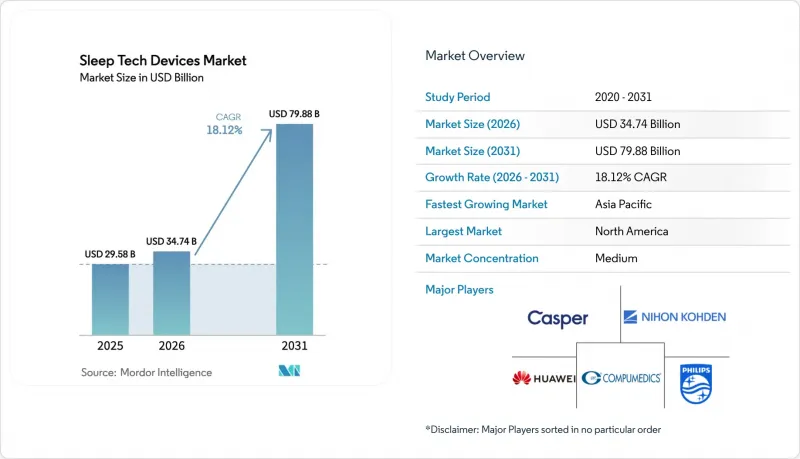
본 보고서는 제품 유형별(웨어러블 및 비웨어러블), 용도별(불면증, 폐쇄성 수면무호흡증, 기타), 최종 사용자별(병원, 기타), 유통 채널별(온라인 전자상거래 및 D2C, 오프라인 소매 및 전문점), 지역별(북미, 유럽, 아시아태평양, 중동 및 아프리카, 남미)로 분류되어 있습니다. 시장 예측은 금액(달러) 기준으로 제시되어 있습니다.
세계의 수면 기술 기기 시장 동향 및 인사이트
수면장애 유병률 증가
2024년에는 약 8억 5,200만 명의 성인이 불면증 증상을 경험한 것으로 보고되었으며, 이는 전 세계 성인 인구의 16.2%에 해당합니다. 폐쇄성 수면 무호흡증 진단 건수는 9억 3,600만 건에 달했으나, 클리닉의 수용 능력이 수요를 따라가지 못해 80%가 미진단 상태로 남아 있습니다. 미국에서는 2024년에 성인의 36%가 수면장애 진단을 받았다고 응답했으며, 이는 재택 검사를 통해 메워야 할 의료 격차가 뚜렷이 드러난 것입니다. 소아 기면증 치료제 ‘Wakix’가 FDA 승인을 받음에 따라 치료 대상 환자층이 확대되면서, 젊은 층을 대상으로 한 모니터링용 웨어러블 기기에 대한 수요가 증가하고 있습니다. 특히 인도와 중국의 고령화 및 비만율 상승으로 인해 전 세계 수면 호흡 장애 발생률은 더욱 높아지고 있습니다.
웨어러블 기기, 센서, AI 분야의 기술적 진보
‘Oura Ring’ 4세대는 이전 모델에 비해 움직임으로 인한 아티팩트를 30% 줄였으며, 개인 맞춤형 코칭을 제공하는 ‘Advisor AI’를 도입했습니다. Apple Watch Series 10은 가속도 센서와 심박수 데이터를 활용해 85%가 넘는 감도로 수면 무호흡증을 감지합니다. SleepViT의 초저전력 ASIC은 수면 단계 분류를 로컬에서 수행하여 지연 시간과 클라우드 사용 비용을 최소화합니다. Samsung Galaxy Watch7은 수면 단계 일치율을 78%까지 높여 임상용 액티그래프와의 격차를 좁혔습니다. 이러한 개선을 통해 소비자용 웨어러블과 실험실 등급 기기 간의 성능 격차가 줄어들면서, 의료진의 지지와 보험 적용이 촉진되고 있습니다.
첨단 수면 기술 기기의 높은 비용
Eight Sleep의 ‘Pod 4 Ultra’ 소매 가격은 2,000-3,000달러로, 대중용 건강 기기라기보다는 고급 제품으로 자리매김하고 있습니다. Sleep Number의 ‘Climate360’ 침대는 10,000-13,500달러의 가격대에 속하며, 그 보급은 소득 상위 10% 가구에 한정되어 있습니다. ‘Oura Ring’의 가격은 299-399 달러이지만, 프리미엄 분석 기능을 이용하려면 월 5.99 달러의 구독료가 필요하며, 이로 인해 첫해 총 소유 비용은 370 달러를 초과합니다. CPAP 치료는 진단을 위한 수면 다원 검사(polysomnography)가 필요한 경우 3,000달러를 초과할 수도 있어, 보험에 가입하지 않은 사용자에게는 치료 시작이 지연되는 요인이 되고 있습니다. 구독 모델은 특히 1인당 연간 의료비가 200달러 이하인 시장에서 가격이 합리적인지에 대한 우려를 높이고 있습니다.
부문 분석
웨어러블 기기는 2025년 매출의 65.43%를 차지했으며, 엣지 분석과 대규모 도입 기반이 네트워크 효과를 강화함에 따라 이 부문은 2031년까지 연평균 20.43%의 성장이 예상됩니다. Oura는 2024년에 5억 달러의 매출을 기록했으며, 소유자의 30% 이상을 월간 구독 사용자로 전환시켰습니다. 이 모델을 통해 하드웨어 판매만 할 때보다 더 높은 이익률을 실현하고 있습니다. Apple Watch Series 10은 2억 대가 넘는 활성 기기를 활용하여, 추가적인 부품 원가를 발생시키지 않고도 기존 사용자를 수면 무호흡증 환자로 전환시키고 있습니다. Samsung Galaxy Watch7은 이전 모델에 비해 수면 단계 정확도를 12% 포인트 향상시켜, 임상적 타당성에 한 걸음 더 다가섰습니다.
웨어러블 이외의 제품은 수동적인 접근 방식이나 친환경적인 개입을 선호하는 소비자를 대상으로 합니다. Eight Sleep의 ‘Pod 4 Ultra’는 듀얼 존 온도 제어 기능을 통해 자가 보고 기준 수면의 질을 32% 향상시킵니다. Sleep Number의 ‘Climate360’은 1만 달러가 넘는 가격대에 반응성이 뛰어난 에어 챔버를 통합하여, 부유층 웰니스 애호가층을 대상으로 하고 있습니다. ResMed의 ‘NightOwl’ 일회용 검사 키트는 149달러라는 가격으로 진단을 접근하기 쉽게 만들어, 검사실 검사를 피하려는 사용자를 유치하고 있습니다. Withings의 ‘Sleep Mat’은 매트리스 아래의 감지 기능을 제공하지만, 다중 센서로 인한 정확도가 부족하여 임상 활용에는 한계가 있습니다.
2025년에는 웨어러블 기기에 내장된 인지행동치료 모듈이 보급되면서 불면증 관련 앱 매출이 전체의 42.45%를 차지했습니다. Apple의 호흡 운동 프로그램은 임상 검사에서 입면 잠복 시간을 12분 단축시켜, 정신 건강 부문과의 융합을 부각시켰습니다. CPAP 및 관련 수면 무호흡증 치료 기기는 진단을 받은 9억 3,600만 명의 환자층을 대상으로 하고 있지만, 여전히 대다수의 사례가 치료되지 않은 상태이며, 방대한 진단 대상층이 남아 있습니다. ResMed의 ‘AirSense 11’은 적응형 알고리즘을 채택하여 고정 압력 시스템에 비해 치료 중단률을 18% 감소시켰습니다.
나르코레프시 치료 기기는 6세 이상의 소아 환자도 대상에 포함하도록 한 FDA 승인의 호재에 힘입어 연평균 성장률(CAGR) 20.55%로 성장하고 있으며, 가장 빠르게 성장하는 부문으로 자리매김하고 있습니다. 서방형 옥시버트 나트륨 제제 ‘LUMRYZ’는 2024년 9월에 승인을 획득했으며, 웨어러블 기기가 객관적인 복약 순응도 측정 지표를 제공합니다. 가속도 센서를 이용한 다리 저림 증후군 모니터링은 사지 움직임에 관한 데이터가 임상적 판단의 근거로서 유효성이 인정됨에 따라 추가적인 수익원을 창출하고 있습니다. 실시간 데이터에 대한 접근이 가능해짐에 따라, 치료는 간헐적인 외래 진료에서 지속적인 투여량 조정으로 전환될 가능성이 있습니다.
지역별 분석
북미는 높은 보험 적용률과 조기 FDA 승인이 보급을 뒷받침함에 따라 2025년 매출의 42.87%를 차지했습니다. ResMed는 2024년 북미 및 남미에서 23억 달러의 매출을 기록했으며, 이는 CPAP의 견실한 보급과 클라우드 구독 서비스의 성장을 반영한 것입니다. 캐나다에서는 가정용 검사에 대한 주 차원의 보험 적용이 확대되어, 도시 지역의 수면 검사 시설 이외의 곳에서도 이용이 가능해졌습니다.
아시아태평양은 연평균 성장률(CAGR) 19.43%로 가장 빠른 성장 궤적을 기록하고 있습니다. 중국의 수면 기술 기기 시장은 전자상거래 보급률이 50%를 넘고, 정부가 예방 의학을 중시하는 것을 배경으로 2024년에 12억 달러를 돌파했습니다. 2024년 3억 달러로 추정되는 인도 시장은 평균 소매 가격을 낮추는 현지 생산 전환의 혜택을 받고 있습니다. 50달러에 판매되는 샤오미의 ‘Mi Band 8 Pro’는 가격에 민감한 소비자들에게 건강 추적을 친숙하게 만들어 주고 있습니다. 화웨이는 ‘Watch GT 4’에 TruSleep 알고리즘을 통합함으로써 중국 웨어러블 시장에서 15%의 점유율을 확보했습니다.
유럽의 성장은 GDPR(EU 개인정보보호규정)(일반 데이터 보호 규정) 준수 비용과 각국별 보험 환급 관련 장벽으로 인해 다른 지역에 비해 뒤처지고 있습니다. 영국 NICE(국가의료기술평가기구)의 지침에 따라, 실험실 검사보다 훨씬 저렴한 6가지 유형의 자가 검사가 승인되었으며, 보험사 측이 저비용 진단법에 대해 긍정적인 태도를 보이고 있습니다. 독일의 공적 의료보험에서는 CBT-I(인지행동치료를 통한 불면증 치료)와 동등한 효과가 입증된 것을 조건으로, 불면증 치료용 CE 마크가 부착된 웨어러블 기기의 비용을 현재 부담하고 있습니다. 중동 및 아프리카는 시장 규모는 작지만, 걸프 국가들이 디지털 헬스 전략에 투자하고 있어 두 자릿수 성장률로 확대되고 있습니다. 남미에서는 기기의 평균 가격이 가구 월소득의 20% 이상에 해당하기 때문에 도입이 진전되지 않고 있으며, 부유층의 도시 지역 사용자로 한정되어 있습니다.
기타 혜택
- 엑셀 형식 시장 예측(ME) 시트
- 3개월간 애널리스트 지원
자주 묻는 질문
목차
제1장 서론
제2장 조사 방법
제3장 주요 요약
제4장 시장 구도
제5장 시장 규모 및 성장 예측
제6장 경쟁 구도
제7장 시장 기회 및 향후 전망
AJY 26.08.28According to Mordor Intelligence, the sleep tech devices market size is projected to be USD 29.58 billion in 2025, USD 34.74 billion in 2026, and reach USD 79.88 billion by 2031, growing at a CAGR of 18.12% from 2026 to 2031.
This report is Segmented by Product Type (Wearables and Non-Wearables), Application (Insomnia, Obstructive Sleep Apnea, and More), End User (Hospitals, and More), Distribution Channel (Online E-Commerce & D2C, and Offline Retail & Specialty Stores), and Geography (North America, Europe, Asia-Pacific, Middle East and Africa, and South America). The Market Forecasts are Provided in Terms of Value (USD).
Global Sleep Tech Devices Market Trends and Insights
Increasing Prevalence of Sleep Disorders
An estimated 852 million adults reported experiencing insomnia symptoms in 2024, representing 16.2% of the global adult population. Obstructive sleep apnea diagnoses reached 936 million, yet 80% remain undiagnosed because clinic capacity cannot meet demand. In the United States, 36% of adults disclosed a diagnosed sleep disorder in 2024, underscoring a care gap that home testing can fill. FDA approval of Wakix for pediatric narcolepsy broadened the treated population, elevating demand for monitoring wearables in younger cohorts. Aging populations and rising obesity rates, notably in India and China, further intensify the worldwide incidence of sleep-disordered breathing.
Technological Advancements in Wearables, Sensors & AI
The Oura Ring Generation 4 reduced motion artifacts by 30% compared to its earlier model and introduced Advisor AI for personalized coaching. The Apple Watch Series 10 detects sleep apnea with a sensitivity above 85% using accelerometer and heart rate data. SleepViT's ultra-low-power ASIC executes sleep-stage classification locally, minimizing latency and cloud fees. Samsung Galaxy Watch7 raised sleep-stage concordance to 78%, narrowing the gap with clinical actigraphy. These improvements narrow the performance gap between consumer wearables and lab-grade devices, fostering physician endorsement and insurance reimbursement.
High Cost of Advanced Sleep Tech Devices
Eight Sleep's Pod 4 Ultra retails for between USD 2,000 and USD 3,000, positioning it as a luxury purchase rather than a mass-market health tool. Sleep Number's Climate360 bed ranges from USD 10,000 to USD 13,500, which limits its uptake to households in the highest income decile. The Oura Ring costs between USD 299 and USD 399 and requires a monthly subscription of USD 5.99 for premium analytics, which raises the total first-year ownership cost above USD 370. CPAP therapy can exceed USD 3,000 when diagnostic polysomnography is needed, delaying initiation for uninsured users. Subscription models heighten affordability concerns, especially in markets where the annual per-capita healthcare expenditure is below USD 200.
Other drivers and restraints analyzed in the detailed report include:
- Growing Adoption of Smart-Home Ecosystems for Sleep Optimization
- Regulatory Support for Home Sleep Testing & Reimbursement Expansion
- Data Privacy and Security Concerns
For complete list of drivers and restraints, kindly check the Table Of Contents.
Segment Analysis
Wearables accounted for 65.43% of 2025 revenue, with the segment on track to grow at 20.43% through 2031, as edge analytics and large installed bases reinforce network effects. Oura generated USD 500 million in revenue in 2024 and converted more than 30% of owners into monthly subscribers, a model that lifts margins beyond hardware sales. Apple Watch Series 10 capitalizes on over 200 million active devices, transforming existing users into sleep-apnea patients without incremental bill-of-materials costs. The Samsung Galaxy Watch7 improved sleep-stage accuracy by 12 percentage points over the prior model, bringing the device closer to clinical relevance.
Non-wearables cater to consumers who prefer passive or environmentally friendly interventions. Eight Sleep's Pod 4 Ultra delivers 32% gains in self-reported sleep quality via dual-zone thermal control. Sleep Number's Climate360 integrates responsive air chambers at price points beyond USD 10,000, catering to affluent wellness adopters. ResMed's NightOwl disposable test democratizes diagnostics at USD 149, capturing users who avoid lab studies. The Withings Sleep Mat offers under-mattress sensing but lacks multi-sensor fidelity, which limits its clinical use.
Insomnia accounted for 42.45% of application revenue in 2025, as cognitive behavioral therapy modules embedded in wearables gained traction. Apple's breathing-exercise sequences reduced sleep-onset latency by 12 minutes in trials, highlighting the convergence of mental health. CPAP and related sleep-apnea devices target a diagnosed base of 936 million, yet most cases remain untreated, leaving a vast diagnostic pool. ResMed's AirSense 11 utilizes adaptive algorithms that reduce abandonment by 18% compared to fixed-pressure systems.
Narcolepsy devices are advancing at a 20.55% CAGR, the fastest-growing segment, driven by FDA approvals that now include pediatric patients aged six and above. LUMRYZ extended-release sodium oxybate gained clearance in September 2024, with wearables offering objective adherence metrics. Restless-leg monitoring through accelerometers generates an ancillary revenue stream as limb-movement data are validated for clinical decision-making. As real-time data becomes accessible, treatment can shift from episodic office visits to continuous titration.
Complete Report Scope:
- By Product Type
- Wearables
- Smart Watches & Bands
- Smart Rings
- Other Wearable Devices
- Non-Wearables
- Sleep Monitors (Under-Mattress / Bedside)
- Smart Beds & Mattresses
- Other Non-Wearable Devices
- Wearables
- By Application
- Insomnia
- Obstructive Sleep Apnea
- Narcolepsy
- Restless Leg Syndrome & Other Disorders
- By End User
- Hospitals
- Sleep Labs & Clinics
- Homecare Settings
- Wellness Centers & Corporate Programs
- By Distribution Channel
- Online (E-Commerce & D2C)
- Offline Retail & Specialty Stores
- Geography
- North America
- United States
- Canada
- Mexico
- Europe
- Germany
- United Kingdom
- France
- Italy
- Spain
- Rest Of Europe
- Asia-Pacific
- China
- Japan
- India
- Australia
- South Korea
- Rest Of Asia-Pacific
- Middle East And Africa
- GCC
- South Africa
- Rest Of Middle East And Africa
- South America
- Brazil
- Argentina
- GCC
- Rest Of South America
- Turkey
- North America
Geography Analysis
North America retained 42.87% of revenue in 2025 as high insurance coverage and early FDA clearances fostered adoption. ResMed generated USD 2.3 billion in 2024 Americas revenue, reflecting robust CPAP uptake and growth in cloud subscriptions. Canada expanded provincial reimbursement for home testing, extending access beyond urban sleep labs.
The Asia-Pacific region records the fastest trajectory, with a 19.43% CAGR. China's sleep tech devices market surpassed USD 1.2 billion in 2024, driven by e-commerce penetration exceeding 50% and the government's emphasis on preventive health. India's market, estimated at USD 300 million in 2024, benefits from a shift to local manufacturing that lowers average retail prices. Xiaomi's Mi Band 8 Pro, selling for USD 50, democratizes tracking for cost-sensitive buyers. Huawei captured a 15% share of China's wearables segment by integrating TruSleep algorithms into the Watch GT 4.
Europe's growth lags due to GDPR compliance costs and country-specific reimbursement hurdles. NICE guidance in the United Kingdom approved six home tests priced well below lab studies, signaling payer openness to lower-cost diagnostics. Germany's statutory insurance now funds CE-marked wearables for insomnia, provided there is evidence of equivalence to CBT-I. The Middle East and Africa, while smaller, are expanding in double digits as Gulf states invest in digital health strategies. South America's adoption trails because average device prices equal more than 20% of monthly household income, restricting uptake to affluent urban users.
- Apple
- Casper Sleep Inc.
- Compumedics
- Dreem SAS
- Eight Sleep
- Fitbit (Google LLC)
- Garmin
- Huawei Technologies Co. Ltd.
- Koninklijke Philips
- Nihon Kohden
- Oura Health Oy
- Resmed
- Samsung Group
- Sleep Number Corporation
- Sleepace
- Withings SA
- Xiaomi Corporation
- Zepp Health Corp.
Additional Benefits:
- The market estimate (ME) sheet in Excel format
- 3 months of analyst support
TABLE OF CONTENTS
1 Introduction
- 1.1 Study Assumptions & Market Definition
- 1.2 Scope Of The Study
2 Research Methodology
3 Executive Summary
4 Market Landscape
- 4.1 Market Overview
- 4.2 Market Drivers
- 4.2.1 Increasing Prevalence of Sleep Disorders
- 4.2.2 Technological Advancements in Wearables, Sensors & AI
- 4.2.3 Growing Adoption of Smart-Home Ecosystems for Sleep Optimization
- 4.2.4 Regulatory Support for Home Sleep Testing & Reimbursement Expansion
- 4.2.5 Integration of Sleep Data Into Insurance Wellness Programs
- 4.2.6 Edge AI Chips Enabling Real-Time, On-Device Sleep Analytics
- 4.3 Market Restraints
- 4.3.1 High Cost of Advanced Sleep Tech Devices
- 4.3.2 Data Privacy and Security Concerns
- 4.3.3 Lack of Standardized Clinical Validation Protocols
- 4.3.4 Supply-Chain Volatility in Sensor Components
- 4.4 Value / Supply-Chain Analysis
- 4.5 Regulatory Landscape
- 4.6 Technological Outlook
- 4.7 Porter's Five Forces Analysis
- 4.7.1 Threat Of New Entrants
- 4.7.2 Bargaining Power Of Buyers
- 4.7.3 Bargaining Power Of Suppliers
- 4.7.4 Threat Of Substitute Products
- 4.7.5 Intensity Of Competitive Rivalry
5 Market Size & Growth Forecasts (Value, USD)
- 5.1 By Product Type
- 5.1.1 Wearables
- 5.1.1.1 Smart Watches & Bands
- 5.1.1.2 Smart Rings
- 5.1.1.3 Other Wearable Devices
- 5.1.2 Non-Wearables
- 5.1.2.1 Sleep Monitors (Under-Mattress / Bedside)
- 5.1.2.2 Smart Beds & Mattresses
- 5.1.2.3 Other Non-Wearable Devices
- 5.1.1 Wearables
- 5.2 By Application
- 5.2.1 Insomnia
- 5.2.2 Obstructive Sleep Apnea
- 5.2.3 Narcolepsy
- 5.2.4 Restless Leg Syndrome & Other Disorders
- 5.3 By End User
- 5.3.1 Hospitals
- 5.3.2 Sleep Labs & Clinics
- 5.3.3 Homecare Settings
- 5.3.4 Wellness Centers & Corporate Programs
- 5.4 By Distribution Channel
- 5.4.1 Online (E-Commerce & D2C)
- 5.4.2 Offline Retail & Specialty Stores
- 5.5 Geography
- 5.5.1 North America
- 5.5.1.1 United States
- 5.5.1.2 Canada
- 5.5.1.3 Mexico
- 5.5.2 Europe
- 5.5.2.1 Germany
- 5.5.2.2 United Kingdom
- 5.5.2.3 France
- 5.5.2.4 Italy
- 5.5.2.5 Spain
- 5.5.2.6 Rest Of Europe
- 5.5.3 Asia-Pacific
- 5.5.3.1 China
- 5.5.3.2 Japan
- 5.5.3.3 India
- 5.5.3.4 Australia
- 5.5.3.5 South Korea
- 5.5.3.6 Rest Of Asia-Pacific
- 5.5.4 Middle East And Africa
- 5.5.4.1 GCC
- 5.5.4.2 South Africa
- 5.5.4.3 Rest Of Middle East And Africa
- 5.5.5 South America
- 5.5.5.1 Brazil
- 5.5.5.2 Argentina
- 5.5.5.2.1 GCC
- 5.5.5.3 Rest Of South America
- 5.5.5.3.1 Turkey
- 5.5.1 North America
6 Competitive Landscape
- 6.1 Market Concentration
- 6.2 Market Share Analysis
- 6.3 Company Profiles {(Includes Global Level Overview, Market Level Overview, Core Segments, Financials as Available, Strategic Information, Market Rank/Share for Key Companies, Products & Services, and Recent Developments)}
- 6.3.1 Apple Inc.
- 6.3.2 Casper Sleep Inc.
- 6.3.3 Compumedics Limited
- 6.3.4 Dreem SAS
- 6.3.5 Eight Sleep
- 6.3.6 Fitbit (Google LLC)
- 6.3.7 Garmin Ltd.
- 6.3.8 Huawei Technologies Co. Ltd.
- 6.3.9 Koninklijke Philips N.V.
- 6.3.10 Nihon Kohden Corporation
- 6.3.11 Oura Health Oy
- 6.3.12 ResMed Inc.
- 6.3.13 Samsung Electronics Co. Ltd.
- 6.3.14 Sleep Number Corporation
- 6.3.15 Sleepace
- 6.3.16 Withings SA
- 6.3.17 Xiaomi Corporation
- 6.3.18 Zepp Health Corp.
7 Market Opportunities & Future Outlook
- 7.1 White-Space & Unmet-Need Assessment