

|
시장보고서
상품코드
2115830
유럽의 ADAS : 시장 점유율 분석, 업계 동향 및 통계, 성장 예측(2026-2031년)Europe ADAS - Market Share Analysis, Industry Trends & Statistics, Growth Forecasts (2026 - 2031) |
||||||
 Mordor Intelligence
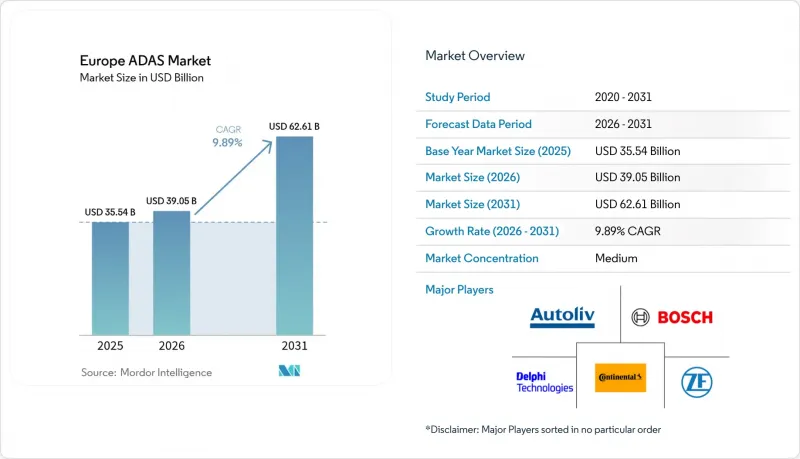
Mordor Intelligence에 의하면, 유럽의 ADAS 시장 규모는 2025년에 355억 4,000만 달러로 평가되었습니다. 2026년 390억 5,000만 달러에서 2031년까지 626억 1,000만 달러에 이를 것으로 예상되며, 예측 기간(2026-2031년) CAGR은 9.89%를 나타낼 전망입니다.
본 보고서는 시스템 유형(주차 보조 시스템 등), 센서 유형(레이더, 라이다, 카메라, 초음파, 적외선),차량 유형(이륜차, 승용차 등), 자율주행 레벨(레벨 1, 레벨 2, 레벨 3, 레벨 4, 레벨 5), 판매 채널(OEM 순정, 애프터마켓용 개조), 국가별로 분류되어 있습니다. 시장 예측은 금액(미 달러) 기준으로 제시되어 있습니다.
유럽의 ADAS 시장 동향 및 인사이트
EU 일반 안전 규정(2024년)의 의무화
이 규정에 따라 EU 지역 내에서 판매되는 모든 신형 차량 카테고리에 대해 자동 긴급 제동, 차선 이탈 경고 및 운전자 졸음 감지가 의무화됩니다. 엔트리 레벨 승용차, 오토바이 및 농업 기계는 동일한 기준 안전 사양을 충족해야 하며, 이로 인해 각 OEM 업체들은 2026년까지 Tier 1 공급업체의 수주 잔고가 이미 가득 찬 상황에서 조달 일정을 앞당길 수밖에 없는 상황에 처해 있습니다. 규정을 준수하지 않는 모델은 형식 승인을 상실하게 되어 지역 시장 진출이 완전히 차단되는 반면, 조기에 인증을 받은 공급업체에게는 확실한 수주량 가시성이 확보됩니다.
EURO NCAP 2030 비전 및 로드맵과의 일관성
Euro NCAP의 단계적 로드맵에서는 법규의 최저 기준보다 높은 성능 기준이 설정되어 있으며, 각 OEM사는 복잡한 혼합 교통 상황 하에서 자전거 이용자, 보행자 및 오토바이 이용자를 인식하는 능력을 입증해야 합니다. 이러한 프로토콜에서는 악천후, 야간, 공사 구간에 대응하기 위해 레이더,카메라, LiDAR의 입력을 융합하는 시스템이 평가됩니다. 평가 결과는 차량 조달 및 보험료 산정에 직접적인 영향을 미치므로, 제조업체는 센서 및 소프트웨어의 지속적인 업그레이드를 강요받게 되며, 반복적인 검증 능력을 갖춘 공급업체가 우위를 점하게 됩니다.
엔트리 레벨 차종에서의 높은 추가 비용
시티카 플랫폼은 현재 ADAS 하드웨어 및 전자 장비의 통합으로 인해 추가 비용에 직면해 있습니다. 이러한 상황으로 인해 각 OEM 업체는 이익률 압박을 감수할지, 아니면 동유럽 및 남유럽 시장의 가격에 민감한 구매자들을 외면하게 될 위험을 감수할지 선택의 기로에 서 있습니다. 한편, 세계 규모의 이점을 갖추지 못한 중소 제조업체들에게는 엔지니어링에 드는 간접비를 분산시키는 것이 어렵습니다. 그 결과, 반도체 가격의 대폭적인 하락을 기다리는 동안 가격 면에서의 격차가 장기화될 것입니다.
부문별 분석
자동 긴급 제동 시스템은 2025년 유럽의 ADAS 시장 점유율의 22.74%를 차지했습니다. 이러한 입지는 2024년 일반 안전 규정에 따라 신규 등록 차량에 해당 기능의 탑재가 의무화됨에 따라 확고해졌습니다. 유럽의 ADAS 시장에서 야간 시야 솔루션 시장 규모는 2031년까지 비약적으로 확대될 것으로 예측되며, 열화상 카메라가 안개나 어둠의 영향을 완화하고 프리미엄 부문에서 각 브랜드의 차별화에 기여함에 따라 연평균 성장률(CAGR)은 10.04%를 나타낼 것으로 전망됩니다. 전방 충돌 경고, 차선 이탈 경고, 어댑티브 크루즈 컨트롤은 계속해서 대량으로 번들로 출하되고 있으며, 이에 따라 운전자의 의도를 예측하는 예측형 기능으로의 전환이 가속화되고 있습니다.
OEM의 로드맵에서는 주차 보조, 사각지대 감지, 졸음 감지 모듈을 통합 도메인 컨트롤러에 통합하는 움직임이 가속화되고 있으며, 이를 통해 ECU를 집약하고 배선의 복잡성을 줄이고 있습니다. GDPR(EU 개인정보보호규정)을 준수한 졸음 감지 기능은 개인정보 보호 관점에서 보급 속도가 완만하지만, Euro NCAP 평가에서는 여전히 중요한 요소로 남아 있습니다. 어댑티브 조명 시스템에는 마주 오는 차량을 눈부시게 하지 않으면서 빔 패턴을 최적화하는 매트릭스 LED 기능이 추가되어, 조명 제어는 안전성과 에너지 효율 양면에서 중요한 역할을 담당하게 되었습니다. 이러한 수렴 추세는 유럽의 ADAS 시장이 하드웨어와 소프트웨어의 생태계이며, 모듈식 안전 구성 요소가 차량의 수명 주기 전반에 걸쳐 업그레이드 가능한 펌웨어 기능으로 자리 잡고 있음을 뒷받침합니다.
레이더 센서는 32달러라는 중저가 모듈 가격, 견고한 전천후 성능, 그리고 규제 측면에서의 정착도를 바탕으로 2025년 유럽의 ADAS 시장 점유율 37.10%를 유지했습니다. 라이더(LiDAR) 시장 규모는 단가가 500달러대로 하락하고, 유로 NCAP(Euro NCAP)이 취약한 도로 이용자 보호를 중시하게 됨에 따라 2031년까지 연평균 성장률(CAGR) 10.06%로 크게 확대될 것으로 예측됩니다. 카메라는 차선 및 교통 표지판 인식에 필수적이지만, 눈으로 인한 시야 차단 문제에 직면하고 있어, 이로 인해 열화상 카메라 및 레이더와의 융합 기술의 가치가 높아지고 있습니다.
Continental의 77GHz MIMO 레이더 어레이는 패키지 공간을 절약하면서도 더 높은 해상도를 실현하여, 고속도로에서 레이더의 핵심적인 역할을 지키고 있습니다. 동시에, Valeo의 솔리드 스테이트 LiDAR 가격 인하로 인해 이 센서는 대량 생산되는 C부문 크로스오버 차량에도 채택되기 시작했으며, 이는 센서 계층 구조에 새로운 균형을 가져오는 획기적인 사건입니다. 통합된 지각 스택은 레이더의 속도 정보, 카메라의 의미 정보, LiDAR의 깊이 정보를 단일 ECU에 통합하여 지연 시간을 줄이는 동시에 레벨 3 인증에 요구되는 중복성을 실현합니다. 이러한 통합으로 인해 유럽의 ADAS 시장공급업체 재편이 가속화되고 있으며, 각 OEM 업체들은 검증 주기를 최소화할 수 있는 턴키 방식의 센서 제품군을 선호하는 경향을 보이고 있습니다.
기타 혜택 :
- 엑셀 형식 시장 예측(ME) 시트
- 3개월간의 애널리스트 지원
자주 묻는 질문
목차
제1장 서론
제2장 조사 방법
제3장 개요
제4장 시장 구도
제5장 시장 규모 및 성장 예측
제6장 경쟁 구도
제7장 시장 기회 및 향후 전망
KTH 26.08.31According to Mordor Intelligence, the Europe ADAS market size was valued at USD 35.54 billion in 2025 and estimated to grow from USD 39.05 billion in 2026 to reach USD 62.61 billion by 2031, at a CAGR of 9.89% during the forecast period (2026-2031).
This report is Segmented by System Type (Parking Assist Systems and More), Sensor Type (Radar, Lidar, Camera, Ultrasonic, and Infra-Red), Vehicle Type (Two-Wheelers, Passenger Cars, and More), Level of Autonomy (Level 1, Level 2, Level 3, Level 4, and Level 5), Sales Channel (OEM-Fitted and Aftermarket Retrofit), and Country. The Market Forecasts are Provided in Terms of Value (USD).
Europe ADAS Market Trends and Insights
EU General Safety Regulation 2024 Mandate
The regulation requires automatic emergency braking, lane departure warning, and driver drowsiness detection across every new vehicle category sold in the bloc. Entry-level passenger cars, motorcycles, and agricultural machinery must meet identical baseline safety specifications, forcing OEMs to accelerate procurement schedules that have already filled Tier 1 order books through 2026. Non-compliant models lose type approval, creating a hard stop on regional market access and giving early certified suppliers guaranteed volume visibility .
EURO NCAP 2030 Vision Roadmap Alignment
Euro NCAP's staged roadmap sets performance thresholds higher than legislative minima, requiring OEMs to demonstrate cyclist, pedestrian, and motorcyclist recognition in complex mixed-traffic conditions. These protocols reward systems that fuse radar, camera, and LiDAR inputs to handle adverse weather, nighttime, and construction zones. Ratings directly influence fleet procurement and insurance pricing, pushing manufacturers toward continuous sensor and software upgrades that favor suppliers with iterative validation capacity.
High Incremental Cost For Entry-Level Vehicles
City-car platforms now face an added cost due to the integration of ADAS hardware and electronics. This development forces OEMs to either absorb the margin pressure or potentially alienate budget-conscious buyers in Eastern Europe and southern markets. Meanwhile, smaller manufacturers, without the advantage of global scale, find it challenging to distribute engineering overheads. As a result, they face an extended affordability gap, awaiting a significant drop in semiconductor prices.
Other drivers and restraints analyzed in the detailed report include:
- Mass-Market Level 2 Feature Bundling Surge
- 77 GHz Radar Cost Decline & Platform Standardization
- Sensor Performance Loss In Snow/Fog Conditions
For complete list of drivers and restraints, kindly check the Table Of Contents.
Segment Analysis
Automatic emergency braking held 22.74% of the European ADAS market share in 2025, a position cemented when the 2024 General Safety Regulation made the feature mandatory across new registrations. The Europe ADAS market size for night-vision solutions is forecast to grow exponentially by 2031, translating into a 10.04% CAGR as thermal cameras mitigate fog and darkness and help brands differentiate in premium tiers. Forward-collision warning, lane-departure warning, and adaptive cruise control continue to ship in volume bundles, reinforcing pathway migration from reactive to predictive functions that anticipate driver intent.
OEM roadmaps increasingly fuse parking, blind-spot, and drowsiness modules into unified domain controllers that consolidate ECUs and cut wiring complexity. GDPR-compliant drowsiness monitoring expands slowly due to privacy safeguards, yet remains critical for Euro NCAP scoring. Adaptive lighting systems add matrix-LED capabilities that optimize beam patterns without blinding oncoming traffic, positioning illumination control as a safety and energy efficiency play. These converging trends confirm the European ADAS market as a hardware-software ecosystem in which modular safety building blocks become firmware features upgradeable over a vehicle's lifetime.
Radar sensors retained 37.10% of the European ADAS market share in 2025, benefiting from USD 32 mid-range module pricing, robust all-weather performance, and regulatory familiarity. The Europe ADAS market size for LiDAR is projected to grow significantly by 2031, riding a 10.06% CAGR once unit pricing falls toward USD 500 and Euro NCAP stresses vulnerable road-user protection. Cameras remain indispensable for lane-line and traffic-sign recognition, yet face snow occlusion issues that elevate the value proposition of thermal and radar fusion.
Continental's 77 GHz MIMO radar arrays deliver finer resolution while conserving package space, protecting the radar's core highway role. Simultaneously, Valeo's solid-state LiDAR price cuts push the sensor into high-volume C-segment crossovers, a milestone that rebalances sensory hierarchies. Integrated perception stacks merge radar velocity, camera semantics, and LiDAR depth into single ECUs, lowering latency and creating redundancy demanded for Level 3 approvals. This integration accelerates supplier consolidation inside the European ADAS market, with OEMs favoring turnkey sensor suites that minimize validation loops.
Complete Report Scope:
- By System Type
- Parking Assist Systems
- Adaptive Front-Lighting
- Night Vision Systems
- Blind-Spot Detection
- Automatic Emergency Braking
- Forward Collision Warning
- Driver Drowsiness Alert
- Traffic Sign Recognition
- Lane Departure Warning
- Adaptive Cruise Control
- By Sensor Type
- Radar
- LiDAR
- Camera
- Ultrasonic
- Infra-red
- By Vehicle Type
- Two-Wheelers
- Passenger Cars
- Medium & Heavy Commercial Vehicles
- By Level of Autonomy
- Level 1
- Level 2
- Level 3
- Level 4
- Level 5
- By Sales Channel
- OEM-Fitted
- Aftermarket Retrofit
- By Geography
- Germany
- United Kingdom
- France
- Italy
- Spain
- Russia
- Rest of Europe
List of Companies Covered in this Report:
- Robert Bosch GmbH
- Continental AG
- ZF Friedrichshafen AG
- Valeo SA
- Aptiv PLC
- Autoliv Inc.
- Denso Corporation
- Hella KGaA Hueck & Co.
- Mobileye (NXP/Intel)
- Infineon Technologies AG
- Magna International Inc.
- NXP Semiconductors NV
- STMicroelectronics N.V.
- Panasonic Corp.
- Renesas Electronics Corp.
- Hyundai Mobis Co. Ltd.
- Veoneer AB
- Texas Instruments Inc.
- Innoviz Technologies Ltd.
- Ibeo Automotive Systems GmbH
Additional Benefits:
- The market estimate (ME) sheet in Excel format
- 3 months of analyst support
TABLE OF CONTENTS
1 Introduction
- 1.1 Study Assumptions & Market Definition
- 1.2 Scope of the Study
2 Research Methodology
3 Executive Summary
4 Market Landscape
- 4.1 Market Overview
- 4.2 Market Drivers
- 4.2.1 EU General Safety Regulation 2024 Mandate
- 4.2.2 EURO NCAP 2030 Vision Roadmap Alignment
- 4.2.3 Mass-Market Level 2 Feature Bundling Surge
- 4.2.4 77 GHZ Radar Cost Decline & Platform Standardization
- 4.2.5 OTA-Based Adas Feature Monetization Models
- 4.2.6 Digital-Twin Homologation Frameworks
- 4.3 Market Restraints
- 4.3.1 High Incremental Cost For Entry-Level Vehicles
- 4.3.2 Sensor Performance Loss In Snow/Fog Conditions
- 4.3.3 GDPR Compliance Cost For Driver-Monitoring Cameras
- 4.3.4 Gallium Export Controls Hitting Lidar Supply
- 4.4 Value / Supply-Chain Analysis
- 4.5 Regulatory Landscape
- 4.6 Technological Outlook
- 4.7 Porter's Five Forces
- 4.7.1 Threat of New Entrants
- 4.7.2 Bargaining Power of Suppliers
- 4.7.3 Bargaining Power of Buyers
- 4.7.4 Threat of Substitutes
- 4.7.5 Competitive Rivalry
5 Market Size & Growth Forecasts (Value (USD))
- 5.1 By System Type
- 5.1.1 Parking Assist Systems
- 5.1.2 Adaptive Front-Lighting
- 5.1.3 Night Vision Systems
- 5.1.4 Blind-Spot Detection
- 5.1.5 Automatic Emergency Braking
- 5.1.6 Forward Collision Warning
- 5.1.7 Driver Drowsiness Alert
- 5.1.8 Traffic Sign Recognition
- 5.1.9 Lane Departure Warning
- 5.1.10 Adaptive Cruise Control
- 5.2 By Sensor Type
- 5.2.1 Radar
- 5.2.2 LiDAR
- 5.2.3 Camera
- 5.2.4 Ultrasonic
- 5.2.5 Infra-red
- 5.3 By Vehicle Type
- 5.3.1 Two-Wheelers
- 5.3.2 Passenger Cars
- 5.3.3 Medium & Heavy Commercial Vehicles
- 5.4 By Level of Autonomy
- 5.4.1 Level 1
- 5.4.2 Level 2
- 5.4.3 Level 3
- 5.4.4 Level 4
- 5.4.5 Level 5
- 5.5 By Sales Channel
- 5.5.1 OEM-Fitted
- 5.5.2 Aftermarket Retrofit
- 5.6 By Geography
- 5.6.1 Germany
- 5.6.2 United Kingdom
- 5.6.3 France
- 5.6.4 Italy
- 5.6.5 Spain
- 5.6.6 Russia
- 5.6.7 Rest of Europe
6 Competitive Landscape
- 6.1 Market Concentration
- 6.2 Strategic Moves
- 6.3 Market Share Analysis
- 6.4 Company Profiles (Includes Global Level Overview, Market Level Overview, Core Segments, Financials as Available, Strategic Information, Market Rank/Share for Key Companies, Products and Services, SWOT Analysis, and Recent Developments)
- 6.4.1 Robert Bosch GmbH
- 6.4.2 Continental AG
- 6.4.3 ZF Friedrichshafen AG
- 6.4.4 Valeo SA
- 6.4.5 Aptiv PLC
- 6.4.6 Autoliv Inc.
- 6.4.7 Denso Corporation
- 6.4.8 Hella KGaA Hueck & Co.
- 6.4.9 Mobileye (NXP/Intel)
- 6.4.10 Infineon Technologies AG
- 6.4.11 Magna International Inc.
- 6.4.12 NXP Semiconductors NV
- 6.4.13 STMicroelectronics N.V.
- 6.4.14 Panasonic Corp.
- 6.4.15 Renesas Electronics Corp.
- 6.4.16 Hyundai Mobis Co. Ltd.
- 6.4.17 Veoneer AB
- 6.4.18 Texas Instruments Inc.
- 6.4.19 Innoviz Technologies Ltd.
- 6.4.20 Ibeo Automotive Systems GmbH
7 Market Opportunities & Future Outlook
- 7.1 White-space & Unmet-Need Assessment


