

|
시장보고서
상품코드
2115864
아메리카의 항공기 조명 시장 : 시장 점유율 분석, 업계 동향 및 통계, 성장 예측(2026-2031년)Americas Aircraft Lighting - Market Share Analysis, Industry Trends & Statistics, Growth Forecasts (2026 - 2031) |
||||||
 Mordor Intelligence
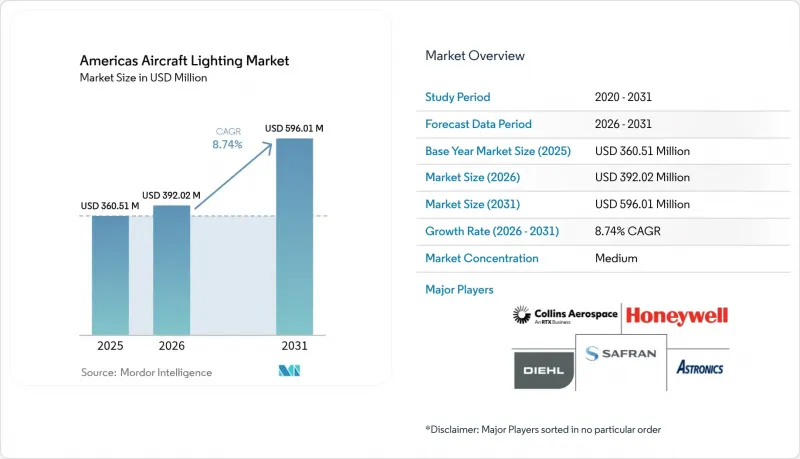
Mordor Intelligence에 의하면, 2026년 아메리카의 항공기 조명 시장 규모는 3억 9,202만 달러로 추정되고, 2025년 3억 6,051만 달러에서 확대해, 2031년의 예측 값은 5억 9,601만 달러로 예상되며, 2026-2031년 CAGR 8.74%로 성장할 전망입니다.
본 보고서는 조명 유형별(기내 조명, 실외 조명), 항공기 유형별(협폭기, 광폭기, 지역 제트기, 비즈니스 제트기 등), 탑재 형태별(라인 핏, 개조), 기술별(LED, 형광등 등), 지역별(미국, 캐나다, 멕시코, 브라질,아르헨티나, 기타)로 분류되어 있습니다. 시장 전망은 금액(달러) 기준으로 제시되어 있습니다.
남미 및 북미의 항공기 조명 시장 동향과 인사이트
전체 기단을 대상으로 한 LED 개조 프로그램이 규제 측면의 지원을 받고 있습니다.
캐나다 교통부가 정한 2025년 12월 31일 수은 사용 금지 기한은 유럽연합(EU)의 2024년 금지 조치와 일치하며, 노선별 허점을 제거하고 항공사들에게 LED로의 전환을 가속화하도록 압박했습니다. 항공사는 전력 소비가 85% 감소하는 혜택을 누리게 되어, 장거리 노선에서 측정 가능한 연료 절감 효과를 얻을 수 있습니다. FAA의 TSO-C30c 승인 절차가 간소화되어 기존 인증 주기가 24개월에서 12개월 미만으로 단축됨에 따라, 규제 유예 기간이 만료되기 전에 규정 준수 프로그램을 완료할 수 있게 되었습니다. 조기 도입 기업은 비용 측면에서 우위를 확보하고 탄소 발자국을 줄일 수 있으므로, 투자자 및 환경 의식이 높은 여행객의 공감을 얻을 수 있는 ESG 공시를 강화할 수 있습니다.
프리미엄 승객 경험을 실현하기 위한 항공사의 기내 리모델링
델타 항공이 2024년에 실시한 객실 인테리어 개편에서는 비행의 모든 단계에 걸쳐 색온도를 조절하는 동적 생체리듬 조명을 활용하여 도착 시의 쾌적성을 향상시키는 동시에, 프리미엄 요금에 대한 지불 의향을 높였습니다. LED 아키텍처를 통해 하드웨어 교체 대신 소프트웨어를 통해 조명 장면을 변경할 수 있게 되어, 항공기의 높은 가동률을 뒷받침하고 있습니다. 비즈니스 항공 분야에서 이와 유사한 업그레이드를 실시할 경우 15-20%의 가격 프리미엄이 발생하지만, 전세 요금 및 순추천지수(NPS) 측면에서 입증 가능한 성과를 가져옵니다. 기내 엔터테인먼트와 조명의 동기화는 분위기를 한층 높여주며, 객실 조명을 단순한 비용 센터가 아닌 수익을 창출하는 편의 시설로 변화시킵니다. 이러한 추세는 라인 핏 및 레트로핏 양쪽 채널에서 구성 가능한 LED 시스템에 대한 고수익률 수요를 뒷받침하고 있습니다.
인증된 LED 드라이버 공급망의 병목 현상
Wolfspeed의 실리콘 카바이드 생산 지연으로 인해 항공우주 등급 드라이버의 부족이 심화되고 리드 타임이 52주로 늘어남에 따라, 조명 OEM 업체들은 대체 칩을 사용한 재설계를 강요받고 있습니다. 고출력 외부 조명에는 매우 높은 내열성 및 EMI 내성이 요구되기 때문에 공급업체 선택의 폭이 좁아지고 있습니다. 이에 대응하여 항공사들은 드라이버 비축을 추진하고 있지만, 이로 인해 운전자금이 묶이게 되어 특히 재무 기반이 취약한 지역 항공사의 경우 총 설치 비용이 상승하고 있습니다. 2026년에는 생산 능력 확대가 예정되어 있으나, 간헐적인 공급 부족으로 인해 단기적인 설치 대수가 제한될 가능성이 있습니다.
부문 분석
2025년 시장 매출의 57.76%는 기내 조명 솔루션이 차지했습니다. 이는 비상구 경로 조명의 의무화와 부가가치가 높은 무드 조명이 주도한 결과입니다. 각 항공사는 프로그래밍 가능한 LED를 활용하여 기내 분위기를 브랜드 색상이나 제휴 기업의 광고에 맞추어 조정함으로써 부가 수익 창출과 고객 경험 향상을 실현하고 있습니다. 평균 8-12년이라는 긴 개조 주기로 인해 예측 가능한 애프터마켓 수익원이 확보되어, OEM 시장의 변동을 완화하는 역할을 하고 있습니다.
실외 조명은 항공사들이 할로겐 스트로브를 LED로 교체함으로써 유지보수 횟수를 90% 줄인 덕분에 7.12%의 연평균 성장률(CAGR)을 기록하며 우위를 점하고 있습니다. 새로운 충돌 방지 및 항법용 유닛은 엄격한 휘도 규제를 충족하면서도 전력 소비를 10분의 1로 억제하여, 운항 사업자에게 즉각적인 투자 회수를 가져다주고 있습니다.
지역 노선 및 국내 노선의 주력을 이루는 협폭기(narrow-body)는 하루 운항 횟수가 많아 램프의 마모가 가속화되어, 2025년에는 북미 및 남미 항공기 조명 시장 점유율의 56.03%를 차지했습니다. 와이드바디 항공기는 장거리 노선에서 프리미엄 객실의 차별화를 꾀하기 위해 멀티존 무드 조명 패키지를 채택하는 경향이 있어, 항공기 1대당 높은 수준의 장비를 확보하고 있습니다.
비즈니스 제트는 소유자가 완전히 맞춤 설정할 수 있는 색상 팔레트, 광섬유를 활용한 액센트 조명, 앱을 통해 제어 가능한 조명 장면을 지정하는 경향이 있어 2031년까지 연평균 성장률(CAGR) 8.96%를 기록할 전망입니다. 해양 에너지에서 응급 의료 서비스(EMS)에 이르기까지, 헬리콥터 운항 사업자들은 진동과 염수 분무에 견디는 밀폐형 LED로 계속 전환하고 있습니다.
기타 혜택 :
- 엑셀 형식 시장 예측(ME) 시트
- 3개월간의 애널리스트 지원
자주 묻는 질문
목차
제1장 서론
제2장 조사 방법
제3장 개요
제4장 시장 구도
제5장 시장 규모 및 성장 예측
제6장 경쟁 구도
제7장 시장 기회 및 향후 전망
AJY 26.09.01According to Mordor Intelligence, Americas aircraft lighting market size in 2026 is estimated at USD 392.02 million, growing from 2025 value of USD 360.51 million with 2031 projections showing USD 596.01 million, growing at 8.74% CAGR over 2026-2031.
This report is Segmented by Lighting Type (Interior Lighting and Exterior Lighting), Aircraft Type (Narrowbody Aircraft, Widebody Aircraft, Regional Jets, Business Jets, and More), Fit (Linefit and Retrofit), Technology (LED, Fluorescent, and More), and Geography (United States, Canada, Mexico, Brazil, Argentina, and the Rest of Americas). The Market Forecasts are Provided in Terms of Value (USD).
Americas Aircraft Lighting Market Trends and Insights
Fleet-wide LED retrofit programs gaining regulatory push
Transport Canada's mercury-free deadline of December 31, 2025, aligns with the European Union's (EU's) 2024 ban, eliminating route-based loopholes and compelling carriers to accelerate LED conversions. Airlines benefit from 85% lower power draw, translating into measurable fuel savings on long-haul missions. Streamlined FAA TSO-C30c approvals now cut typical certification cycles from 24 months to under 12, allowing compliance programs to conclude before regulatory grace periods expire. Early adopters gain cost leadership and lower carbon footprints, strengthening ESG disclosures that resonate with investors and eco-conscious travelers.
Airlines' cabin revamp for premium passenger experience
Delta's 2024 interior refresh leveraged dynamic circadian lighting that modulates color temperature through all flight phases, improving arrival comfort and willingness to pay premium fares. LED architecture enables scene changes via software rather than hardware swaps, supporting high aircraft utilization. Comparable upgrades in business aviation command 15-20% price premiums but yield demonstrable gains in charter rates and net promoter scores. Lighting synchronization with in-flight entertainment elevates ambience, making cabin illumination a revenue-generating amenity rather than a pure cost center. The trend reinforces high-margin demand for configurable LED systems across linefit and retrofit channels.
Supply-chain bottlenecks of qualified LED drivers
Wolfspeed's silicon-carbide production delays magnified a scarcity of aerospace-grade drivers, stretching lead times to 52 weeks and forcing lighting OEMs to redesign around alternate chips. High-power exterior lights demand extreme thermal and EMI tolerances, narrowing the supplier pool. Airlines respond by stockpiling drivers, tying up working capital, and raising total installed costs, especially for regional operators with thinner balance sheets. Although capacity expansions are slated for 2026, intermittent shortages may crimp near-term installation volumes.
Other drivers and restraints analyzed in the detailed report include:
- Surging narrowbody aircraft orders in Latin America
- Airline ESG and sustainability targets accelerating shift to low-power, mercury-free lighting
- Certification costs and multi-year design-approval cycles
For complete list of drivers and restraints, kindly check the Table Of Contents.
Segment Analysis
Interior solutions provided 57.76% of 2025 revenue for the Americas aircraft lighting market, driven by mandatory exit-path illumination and value-added mood scenes. Airlines use programmable LEDs to align cabin ambience with brand colors and partner advertising, unlocking ancillary revenue and customer-experience gains. Longer refurbishment cycles, averaging 8-12 years, secure a predictable aftermarket stream that cushions OEM fluctuations.
Exterior lighting posts the 7.12% CAGR edge as carriers replace halogen strobes with LEDs that slash maintenance events by 90%. New anti-collision and navigation units meet stringent luminosity rules while consuming one-tenth the power, giving operators immediate payback.
Narrowbody platforms, the backbone of regional and domestic routes, commanded 56.03% of the Americas aircraft lighting market share in 2025 as high daily cycles accelerate lamp wear. Widebodies gravitate toward multi-zone mood packages to differentiate premium cabins on long-haul corridors, ensuring high content per tail.
Business jets capture a 8.96% CAGR through 2031 as owners specify fully customizable color palettes, fiber-optic accents, and app-controlled scenes. Helicopter operators, from offshore energy to EMS, continue migrating to sealed-beam LEDs that withstand vibration and salt spray.
Complete Report Scope:
- By Lighting Type
- Interior Lighting
- Cabin Lighting
- Cockpit Lighting
- Emergency and Exit Lighting
- Cargo/Baggage Lighting
- Exterior Lighting
- Navigation and Position Lights
- Landing and Taxi Lights
- Anti-Collision and Strobe Lights
- Logo and Wing Inspection Lights
- Interior Lighting
- By Aircraft Type
- Narrowbody Aircraft
- Widebody Aircraft
- Regional Jets
- Business Jets
- Helicopters
- Unmanned Aerial Vehicles (UAVs)
- By Fit
- Linefit
- Retrofit
- By Technology
- Light-Emitting Diode (LED)
- Fluorescent
- Incandescent/Halogen
- By Geography
- United States
- Canada
- Mexico
- Brazil
- Argentina
- Rest of Americas
List of Companies Covered in this Report:
- ACR Electronics, Inc.
- AeroLEDs LLC (Whelen Engineering, Inc.)
- Astronics Corporation
- Aveo Engineering Group, s.r.o.
- Bruce Aerospace Inc.
- Collins Aerospace (RTX Corporation)
- Diehl Stiftung & Co. KG
- Heads Up Technologies, Inc.
- Honeywell International Inc.
- Luminator Technology Group
- Oxley Group
- Precise Flight, Inc.
- Safran SA
- S.E.L.A. Lighting Systems
- Soderberg Manufacturing Company, Inc.
- Aircraft Spruce (R) (Irwin International Inc.)
- AvioLights
Additional Benefits:
- The market estimate (ME) sheet in Excel format
- 3 months of analyst support
TABLE OF CONTENTS
1 INTRODUCTION
- 1.1 Study Assumptions and Market Definition
- 1.2 Scope of the Study
2 RESEARCH METHODOLOGY
3 EXECUTIVE SUMMARY
4 MARKET LANDSCAPE
- 4.1 Market Overview
- 4.2 Market Drivers
- 4.2.1 Fleet-wide LED retrofit programs gaining regulatory push
- 4.2.2 Airlines' cabin revamp for premium passenger experience
- 4.2.3 Surging narrowbody aircraft orders in Latin America
- 4.2.4 Airline ESG and sustainability targets accelerating shift to low-power, mercury-free lighting
- 4.2.5 Increasing adoption of mood-lighting and circadian systems
- 4.2.6 Integrated cockpit-display backlighting in next-gen avionic suites
- 4.3 Market Restraints
- 4.3.1 Supply-chain bottlenecks of qualified LED drivers
- 4.3.2 Certification costs and multi-year design-approval cycles
- 4.3.3 Volatility in raw-material prices (rare-earth phosphors)
- 4.3.4 Cabin weight-saving mandates limiting power budgets
- 4.4 Value Chain Analysis
- 4.5 Regulatory Landscape
- 4.6 Technological Outlook
- 4.7 Porter's Five Forces Analysis
- 4.7.1 Threat of New Entrants
- 4.7.2 Bargaining Power of Buyers
- 4.7.3 Bargaining Power of Suppliers
- 4.7.4 Threat of Substitute Products
- 4.7.5 Intensity of Competitive Rivalry
5 MARKET SIZE AND GROWTH FORECASTS (VALUE)
- 5.1 By Lighting Type
- 5.1.1 Interior Lighting
- 5.1.1.1 Cabin Lighting
- 5.1.1.2 Cockpit Lighting
- 5.1.1.3 Emergency and Exit Lighting
- 5.1.1.4 Cargo/Baggage Lighting
- 5.1.2 Exterior Lighting
- 5.1.2.1 Navigation and Position Lights
- 5.1.2.2 Landing and Taxi Lights
- 5.1.2.3 Anti-Collision and Strobe Lights
- 5.1.2.4 Logo and Wing Inspection Lights
- 5.1.1 Interior Lighting
- 5.2 By Aircraft Type
- 5.2.1 Narrowbody Aircraft
- 5.2.2 Widebody Aircraft
- 5.2.3 Regional Jets
- 5.2.4 Business Jets
- 5.2.5 Helicopters
- 5.2.6 Unmanned Aerial Vehicles (UAVs)
- 5.3 By Fit
- 5.3.1 Linefit
- 5.3.2 Retrofit
- 5.4 By Technology
- 5.4.1 Light-Emitting Diode (LED)
- 5.4.2 Fluorescent
- 5.4.3 Incandescent/Halogen
- 5.5 By Geography
- 5.5.1 United States
- 5.5.2 Canada
- 5.5.3 Mexico
- 5.5.4 Brazil
- 5.5.5 Argentina
- 5.5.6 Rest of Americas
6 COMPETITIVE LANDSCAPE
- 6.1 Market Concentration
- 6.2 Strategic Moves
- 6.3 Market Share Analysis
- 6.4 Company Profiles (includes Global level Overview, Market level overview, Core Segments, Financials as available, Strategic Information, Market Rank/Share for key companies, Products and Services, and Recent Developments)
- 6.4.1 ACR Electronics, Inc.
- 6.4.2 AeroLEDs LLC (Whelen Engineering, Inc.)
- 6.4.3 Astronics Corporation
- 6.4.4 Aveo Engineering Group, s.r.o.
- 6.4.5 Bruce Aerospace Inc.
- 6.4.6 Collins Aerospace (RTX Corporation)
- 6.4.7 Diehl Stiftung & Co. KG
- 6.4.8 Heads Up Technologies, Inc.
- 6.4.9 Honeywell International Inc.
- 6.4.10 Luminator Technology Group
- 6.4.11 Oxley Group
- 6.4.12 Precise Flight, Inc.
- 6.4.13 Safran SA
- 6.4.14 S.E.L.A. Lighting Systems
- 6.4.15 Soderberg Manufacturing Company, Inc.
- 6.4.16 Aircraft Spruce (R) (Irwin International Inc.)
- 6.4.17 AvioLights
7 MARKET OPPORTUNITIES AND FUTURE OUTLOOK
- 7.1 White-space and Unmet-Need Assessment


