|
시장보고서
상품코드
2115927
두개내 동맥류 : 시장 점유율 분석, 업계 동향과 통계, 성장 예측(2026-2031년)Intracranial Aneurysm - Market Share Analysis, Industry Trends & Statistics, Growth Forecasts (2026 - 2031) |
||||||
 Mordor Intelligence
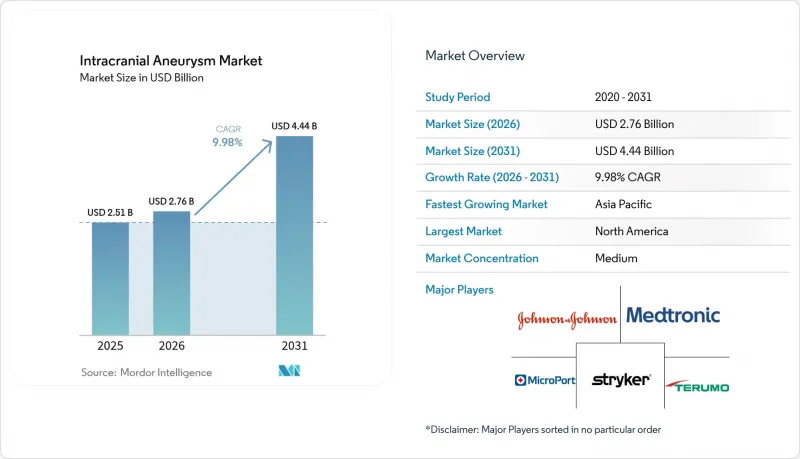
Mordor Intelligence에 따르면 두개내 동맥류 시장 규모는 2025년 25억 1,000만 달러에서 2026년에는 27억 6,000만 달러로 확대되고, 2026년부터 2031년까지 CAGR 9.98%를 기록하며 2031년에는 44억 4,000만 달러에 달할 것으로 예측됩니다.
본 보고서는 치료법(혈관내 코일 색전술 등), 진단법(CT 혈관조영술 등), 최종사용자(병원, 외래 수술 센터, 전문 뇌신경외과 센터), 및 지역(북미, 유럽, 아시아태평양, 라틴아메리카, 중동 및 아프리카)별로 분류되어 있습니다. 시장 예측은 금액(달러) 기준으로 제시되어 있습니다.
세계 두개내 동맥류 시장의 동향 및 인사이트
최소침습적 혈관내 치료에 대한 수요 증가
혈관 내 코일링은 파열된 병변에 대한 적용에서 미파열 동맥류에 대한 광범위한 사용으로 전환되고 있으며, 각 의료 기관이 카테터 기반 워크플로우를 최적화함에 따라 치료 기준이 낮아지고 조기 개입이 권장되고 있습니다. 개두술을 피하고 수술 전후의 위험이 감소함에 따라, 환자는 개두술에 비해 입원 기간이 단축되고 일상 활동으로의 복귀가 빨라집니다. 플로우 다이버터는 혈류를 경부 쪽으로 우회시켜 주머니 내 혈전 형성을 촉진함으로써, 복잡하고 대형 동맥류에 대해서도 최소침습 치료의 개념을 확장하고 있으며, 이를 통해 사용되는 기기의 수를 줄이고 보조 스텐트의 필요성을 감소시킵니다. 생명을 위협하는 상태에 대처하는 기기를 우선시하는 미국의 규제 프로그램은 차세대 플로우 다이버터 및 주머니 내 치료 시스템의 심사를 신속하게 처리하고 있으며, 이는 치료법 혁신의 속도를 가속화하고 있습니다. 시술 건수의 증가로 인해 병원 및 전문 센터는 바이플레인 혈관조영실과 고해상도 영상 진단 장비에 대한 투자를 촉진하고 있으며, 그 결과 치료 가능한 해부학적 범위가 확대되어 이전에는 치료 대상이 아니었던 환자군에서도 치료 대상자가 늘어나고 있습니다. 자격 인증 및 연수 요건이 도입 속도에 영향을 미치기는 하지만, 전반적인 추세로는 선택적 치료와 급성기 치료 모두에서 카테터 기반 치료법이 주류를 이루고 있습니다.
뇌 영상 검사에서 우연히 발견되는 소견에 따른 미파열 뇌동맥류의 검출 증가
비특이적인 신경 증상이나 외상에 대한 일상적인 CT 및 MRI 검사의 활용으로 인해, 스캐너의 해상도와 이용률이 향상됨에 따라 무증상 개인의 2-3%에서 동맥류가 발견되고 있습니다. 이러한 우발적 소견의 증가로 인해 더 많은 분류 판단이 전문 클리닉에 맡겨지고 있으며, 그곳에서 의사는 작은 동맥류의 연간 파열 위험이 낮다는 점과 환자의 불안 및 의료법적 고려 사항을 저울질하여 판단하고 있습니다. 풍부한 영상 진단 능력을 갖춘 고소득국의 의료 시스템에서는 가장 높은 검출률이 기록되고 있으며, OECD 국가 중에서는 일본의 스캔 실시 빈도가 벤치마크로 자리 잡고 있습니다. 일원화된 뇌졸중 네트워크는 24시간 체제로 혈관내 치료에 대한 접근성을 유지하는 인증 센터에 신경 중재술 전문 지식을 집중시킴으로써, 의뢰 환자의 급증에 대응하고 있습니다. 현재, 방사선과 워크플로우에 통합된 AI 알고리즘이 검토가 필요한 병변에 플래그를 지정하고 있으며, 이를 통해 민감도는 향상되지만, 한편으로는 작업 목록이 길어지거나 더 많은 환자가 경과 관찰이나 치료 경로로 분류될 가능성도 있습니다. 이러한 시너지 효과로 인해 미파열 동맥류 환자의 유입이 지속적으로 이어지고 있으며, 이는 두개내 동맥류 시장의 시술 기반을 강화하고 있습니다.
신흥 시장에서 이중 전문 훈련을 받은 혈관 내 신경외과 전문의의 부족
혈관 내 동맥류 치료에는 뇌신경외과와 중재술 기술, 두 가지 모두의 기술 세트가 필요하며, 이를 습득하는 데는 수년이 소요됩니다. 선진 지역에서는 훈련 체계가 잘 갖춰져 있어 수술 건수를 유지하기에 충분한 수술 전문의가 공급되고 있지만, 신흥 지역에서는 현재의 유병률과 검출률로 예상되는 수에 비해 훨씬 적은 수의 전문의만 양성되고 있습니다. 이러한 불일치로 인해 주요 도시 이외의 지역에서는 지역별 접근성 격차가 발생하여, 환자들이 먼 곳까지 이동해야 하거나, 선택적 수술의 경우 치료가 지연되는 결과로 이어지고 있습니다. 종합적인 뇌졸중 센터를 구축하기 위해서는 혈관조영술, 신경 중환자실(Neuro-ICU), 그리고 당직 체제를 갖춘 신경외과 의사에 대한 투자가 필요하며, 이로 인해 자원이 제한된 환경에서 시스템 구축이 지연되고 있습니다. 뇌졸중 센터 인증이나 치료 성과와 보험 환급을 연계하는 정책 이니셔티브를 통해 일부 국가에서는 치료 보장 범위가 개선되었지만, 인력의 규모는 여전히 큰 제약요인으로 남아 있습니다. 원격 지도 시범 사업은 기술 이전과 규모 확대를 위한 길을 제시하고 있지만, 법적 책임 및 자격 인증에 관한 모호함이 여전히 보급을 저해하고 있습니다.
부문 분석
2025년 시점에서 혈관 내 코일 색전술은 22.36%의 점유율을 차지하고 있으며, 파열 여부와 동맥류 크기에 관계없이 그 내구성이 유지되고 있어 여전히 기본적인 치료법으로 자리 잡고 있습니다. 한편, 광경부 병변에 대해서는 단일 기기를 이용한 치료법이 부상하고 있습니다. 플로우 다이버터는 2031년까지 연평균 성장률(CAGR) 12.34%를 기록하며 가장 빠르게 성장하는 카테고리입니다. 이는 기존에는 여러 개의 기기를 겹쳐서 삽입해야 했던 대형 또는 방추형 해부학적 구조에 대해 시술자가 보조적인 스텐트 삽입이나 코일 개수를 줄이고 있기 때문입니다. 낭내 플로우 디스라프터는 코일 고정이 어렵고 모혈관의 보호가 필수적인 분기부에서 사용이 확대되고 있습니다. 혈관의 형태나 경부 구성에 따라 추가적인 안정화가 필요한 해부학적 구조에서는 풍선이나 스텐트를 병용한 코일링이 여전히 중요한 역할을 하고 있습니다. 현미경 수술을 통한 클리핑은 특정 분지부를 가진 젊은 환자나 종양에 의한 압박으로 인해 감압이 필수적인 증례로 제한되는 경향이 강해지고 있으며, 규모는 작지만 필수적인 외과적 틈새 시장을 유지하고 있습니다. 특정 임플란트의 경우, 시판 후 등록 자료를 통해 지연성 허혈성 사건이 확인됨에 따라 자격 인증 및 연수 요건이 강화되었습니다. 이에 따라 사용을 표준화하기 위해 추가적인 지도와 기관 차원의 심사가 요구되고 있습니다.
기기의 소형화로 인해, 새로운 플로우 다이버터는 0.017인치 마이크로카테터를 이용한 원위부 내비게이션이 가능해졌으며, 1세대 시스템을 뛰어넘는 도달 범위를 실현하여 치료 가능한 사례의 비율을 높이고 있습니다. 표면 처리가 적용된 임플란트는 이중 항혈소판 요법의 기간 단축을 목적으로 하며, 초기 임상 경험에 따르면 전달성을 저해하지 않으면서 더 신속한 내피화가 이루어지는 것으로 나타났습니다. 시술자 및 의료 기관의 경우, 1건당 기기 사용 수가 줄어들고 시술 시간이 단축됨에 따라 자원을 효율적으로 활용하고 처리 능력이 향상됩니다. 규제 당국의 감시가 추적 가능성과 품질을 중시하는 가운데, 의료기기 제조업체들은 ISO 13485 및 MDR 기준을 준수하며, 규정 준수에 부합하는 생산 및 감시 체제를 유지하고 있습니다. 두개내 동맥류 시장은 이러한 기술적·공정상의 개선의 혜택을 받고 있습니다. 이는 예측 가능한 프로토콜에 따라 더 광범위한 의료 기관에서 복잡한 사례를 치료할 수 있게 되기 때문입니다. 두개내 동맥류 시장에서 플로우 다이버터의 시장 규모는 2026년부터 2031년까지 연평균 성장률(CAGR) 12.34%로 확대될 것으로 예측되며, 치료법 구성을 재편하는 데 있어 그 역할이 더욱 강화될 전망입니다.
지역별 분석
북미는 2025년에 매출의 43.14%를 차지했으나, 검출률 및 치료 보급률이 성숙 단계에 도달함에 따라 성장률은 7-8% 범위로 안정될 전망입니다. 이 지역의 체계는 24시간 365일 신경 중재 능력을 갖추고 견고한 품질 관리를 유지하는, 인증을 받은 종합적인 뇌졸중 센터의 광범위한 기반에 의해 뒷받침되고 있습니다. 캐나다에서는 신경 중재술이 주(州)의 거점에 집중되어 있어 전문 지식이 유지되는 반면, 미국의 민간 센터에 비해 긴급성이 낮은 환자의 대기 시간이 길어지고 있습니다. 마이크로카테터, 표면 처리가 된 플로우 다이버터, 그리고 영상 진단 소프트웨어 분야의 혁신 주기가 공급업체 간의 차별화를 가져오며, 이미 선진적인 의료기기를 지원하는 환급 제도가 마련된 시장에서 구매 위원회의 판단에 영향을 미치고 있습니다. 지급 기관은 효율성과 합병증 발생률이 낮은 점을 평가하는 DRG(진단 관련 그룹) 체계와 협상을 통한 요금 체계에 의존하고 있기 때문에 각 의료 기관은 투시 노출 감소, 지혈까지 걸리는 시간 단축, 그리고 퇴원 절차의 최적화에 주력하고 있습니다. 북미의 두개내 동맥류 시장은 여전히 경쟁이 치열하며, 각 벤더들은 병원의 가치 분석 위원회를 설득하기 위해 임상적·경제적 우위를 추구하고 있습니다.
유럽에서는 유사한 임상 치료 기준 하에서도 국가별로 차이가 나타나며, 환급 및 평가 기관이 플로우 다이버터와 같은 첨단 임플란트에 대한 접근성을 결정하고 있습니다. 독일과 같은 시장에서는 사회보험 제도에 따라 기기 비용이 사례당 단가에 포함되는 경우가 많은 반면, 다른 시장에서는 중앙 집중식 HTA(의료기술평가) 프로세스로 인해 적응증이 제한되거나 더 큰 동맥류에만 적용 범위가 한정되기도 합니다. 유럽의 일부 지역에서는 레지스트리 문화가 뿌리내리고 있으며, 이를 통해 얻은 비교 결과 증거가 진료에 영향을 미치고 프로토콜의 표준화를 뒷받침하고 있습니다. MDR 체계 하에서 의료기기 제조업체는 추적 가능한 품질 관리 체계를 유지하고 시판 후 조사를 통해 보다 광범위한 임상 근거를 창출하고 있으며, 이는 확립된 규제 인프라를 갖춘 기업에게 유리하게 작용합니다. 유럽 전역의 학술 기관들은 신경혈관용 의료기기의 주요 임상시험에 적극적으로 참여하고 있으며, 새로운 적응증에 대한 근거 창출 속도를 높이고 있습니다. 유럽의 두개내 동맥류 시장은 가치 평가 및 임상 데이터 생성 주기에 따라 도입이 좌우되는 측면이 있지만, 여전히 안정적이며 증거 중심의 경향을 보이고 있습니다.
아시아태평양은 정부 및 민간 기관이 영상 진단에 대한 접근성을 확대하고 더 많은 도시에 뇌졸중 센터를 지정하고 있기 때문에 2031년까지 연평균 성장률(CAGR) 11.19%로 가장 빠르게 성장하는 지역입니다. 중국의 정책은 뇌졸중 센터 확충과 중재 시술 교육을 우선시하고 있으며, 이에 따라 2급 도시 시장의 치료 건수가 증가하고 주변 지역으로의 단계적인 확산이 진행되고 있습니다. 일본에서는 확립된 중재 시술 의료 생태계 덕분에 높은 치료율이 달성되고 있으며, 규제 제도는 엄격한 국내 심사 절차를 유지하고 있습니다. 이로 인해 수입 의료기기의 승인이 지연되는 반면, 국내 제조사에게는 시장 진입의 여지가 생기고 있습니다. 인도에서는 지불 주체의 구성과 의료 시설 분포의 불균형으로 인해 양극화된 상황이 발생하고 있습니다. 대도시권의 사립 병원에서는 최신 신경혈관용 의료기기가 도입되고 있는 반면, 많은 지방 도시에서는 여전히 혈관조영실이 부족합니다. 동남아시아 국가들에서는 외부 기관과의 연수 제휴나, 개발도상인 인근 국가에서 환자를 유치하는 의료 관광 프로그램을 통해 의료 제공 능력을 확대하고 있습니다. 각 지역의 규제 체계는 미국 기준을 밀접하게 따르는 싱가포르부터 국내 승인을 가속화하고 있는 중국에 이르기까지 다양하며, 이러한 요소들이 두개내 동맥류 시장에서 의료기기 도입의 순서와 범위를 형성하고 있습니다.
기타 혜택:
- 엑셀 형식의 시장 예측(ME) 시트
- 3개월간의 애널리스트 지원
자주 묻는 질문
목차
제1장 소개
제2장 조사 방법
제3장 주요 요약
제4장 시장 구도
제5장 시장 규모와 성장 예측
제6장 경쟁 구도
제7장 시장 기회와 향후 전망
KSM 26.08.26According to Mordor Intelligence, the intracranial aneurysm market size is expected to grow from USD 2.51 billion in 2025 to USD 2.76 billion in 2026 and is forecast to reach USD 4.44 billion by 2031 at 9.98% CAGR over 2026-2031.
This report is Segmented by Treatment Type (Endovascular Coiling, and More), Diagnosis (Computed Tomography Angiography, and More), End-User (Hospitals, Ambulatory Surgical Centers, Specialty Neurosurgical Centers), and Geography (North America, Europe, Asia-Pacific, Latin America, and Middle East & Africa). Market Forecasts are Provided in Terms of Value (USD).
Global Intracranial Aneurysm Market Trends and Insights
Rising Demand for Minimally Invasive Endovascular Procedures
Endovascular coiling has moved from a focus on ruptured lesions to broad use in unruptured aneurysms, setting lower treatment thresholds and favoring earlier intervention as centers optimize catheter-based workflows. Patients see shorter hospital stays and faster returns to normal activity compared with open surgery because craniotomy is avoided and perioperative risk is reduced. Flow diverters extend minimally invasive logic to complex and large aneurysms by redirecting blood flow across the neck and encouraging sac thrombosis, which streamlines device counts and reduces need for adjunctive stents. U.S. regulatory programs that prioritize devices addressing life-threatening conditions support faster review of next-generation flow-diverter and intrasaccular systems, which accelerates the cadence of therapeutic innovation. Increased procedural volumes motivate hospitals and specialized centers to invest in biplane angiography suites and higher resolution imaging, which in turn expands treatable anatomy and broadens the candidate pool among patients previously deemed unsuitable. Credentialing and training requirements shape adoption curves, but the cumulative direction of travel favors catheter-based modalities in both elective and acute settings.
Growing Detection of Unruptured IA Through Incidental Brain Imaging
Routine CT and MRI use for non-specific neurologic symptoms and trauma is identifying aneurysms in 2-3% of asymptomatic individuals as scanner resolution and utilization rise. The increase in incidental findings pushes more triage decisions into specialty clinics, where physicians weigh the low annual rupture risk of small aneurysms against patient anxiety and medico-legal considerations. High-income health systems with abundant imaging capacity register the highest detection rates, with Japan's scanning intensity serving as a benchmark among OECD countries. Centralized stroke networks help absorb referral surges by consolidating neuro-intervention expertise in accredited centers that maintain round-the-clock access to endovascular care. AI algorithms now embedded in radiology workflows flag candidate lesions for review, which lifts sensitivity but can also lengthen worklists and channel more patients into surveillance or treatment pathways. The combined effect is a sustained pipeline of unruptured aneurysm referrals that strengthens the procedure base for the intracranial aneurysm market.
Shortage of Dual-Trained Endovascular Neurosurgeons in Emerging Markets
Endovascular aneurysm care requires combined skill sets in neurosurgery and interventional techniques that take years to develop. Training pipelines in developed regions supply enough operators to sustain volumes, but emerging geographies train far fewer specialists than current prevalence and detection would suggest. This mismatch creates geographic access gaps outside major cities and leads to patient travel or delayed treatment for elective cases. Building comprehensive stroke centers involves investments in angiography, neuro-ICU, and on-call neurosurgery, which slows ramp-up in resource-constrained environments. Policy initiatives that tie reimbursement to stroke center accreditation and outcomes have improved coverage in select countries, yet workforce scale remains a binding constraint. Tele-proctoring pilots indicate avenues for skill transfer and scale, but liability and credentialing ambiguity still limit reach.
Other drivers and restraints analyzed in the detailed report include:
- Aging-Linked Hypertension and Smoking Prevalence in Developing Economies
- Regulatory Fast-Tracks Compressing Approval Timelines
- High Device and Procedural Costs With Uneven Reimbursement Coverage
For complete list of drivers and restraints, kindly check the Table Of Contents.
Segment Analysis
Endovascular coiling held a 22.36% share in 2025, and its durability across rupture status and aneurysm sizes keeps it foundational, while single-device architectures are rising for wide-necked lesions. Flow diverters are the fastest-growing category at a 12.34% CAGR to 2031 as operators reduce adjunctive stenting and coil counts for large and fusiform anatomies that previously demanded multi-device stacks. Intrasaccular flow disruptors attract use at bifurcations where coil retention is challenging and parent-vessel protection is essential. Adjunctive balloon- and stent-assisted coiling still contribute in anatomies where vessel geometry or neck configuration requires additional stabilization. Microsurgical clipping is increasingly reserved for younger patients with select bifurcations or cases where mass effect compels decompression, which sustains a smaller but essential surgical niche. Credentialing and training requirements have tightened after delayed ischemic events were observed in post-market registries for certain implants, prompting additional proctoring and center-level reviews to standardize use.
Device profile miniaturization now enables distal navigation through 0.017-inch microcatheters for newer flow diverters, extending reach beyond first-generation systems and increasing the proportion of treatable cases. Surface-engineered implants aim to cut the duration of dual antiplatelet therapy, and early clinical experience suggests faster endothelialization without compromising deliverability. For operators and centers, fewer devices per case and shorter procedure times improve resource utilization and throughput. As regulatory oversight emphasizes traceability and quality, device makers align with ISO 13485 and MDR standards to maintain compliant production and surveillance systems. The intracranial aneurysm market benefits from these engineering and process improvements because complex cases can be treated in a broader set of facilities with predictable protocols. The intracranial aneurysm market size for flow diverters is projected to expand at 12.34% CAGR between 2026-2031, reinforcing their role in reshaping therapy mix.
Complete Report Scope:
- By Treatment Type
- Endovascular Coiling
- Stent-Assisted Coiling
- Balloon-Assisted Coiling
- Flow Diverter Stents
- Intrasaccular Flow Disruptors (e.g., WEB, Contour)
- Microsurgical Clipping
- By Diagnosis
- Computed Tomography Angiography (CTA)
- Magnetic Resonance Angiography (MRA)
- Digital Subtraction Angiography (DSA; incl. biplane, 3DRA)
- 3D Rotational Angiography / 4D CTA
- High-Resolution Vessel Wall MRI
- By End-user
- Hospitals
- Ambulatory Surgical Centers
- Specialty Neurosurgical Centers
Geography Analysis
North America represented 43.14% of revenue in 2025, with growth normalizing to the 7-8% range as detection and treatment penetration reach mature levels. The region's structure relies on a large base of accredited comprehensive stroke centers that maintain 24/7 neuro-interventional capabilities and robust quality management. Canada centralizes neuro-intervention in provincial hubs, which sustains expertise while increasing wait times for non-urgent cases compared with private U.S. centers. Innovation cycles in microcatheters, surface-engineered flow diverters, and imaging software differentiate vendors and shape purchasing committees in a market where reimbursement already supports advanced devices. Payers rely on DRG frameworks and negotiated rates that reward efficiency and low complications, so centers focus on reducing fluoroscopy exposure, shortening time to hemostasis, and optimizing discharge. The intracranial aneurysm market remains competitive in North America as vendors seek clinical and economic advantages that sway hospital value analysis committees.
Europe shows country-level variability around similar clinical care standards, with reimbursement and assessment bodies determining access to advanced implants such as flow diverters. Social insurance systems in markets like Germany often bundle device costs in case rates, while centralized HTA processes in others constrain indications or restrict coverage to larger aneurysms. Strong registry cultures in parts of Europe generate comparative outcomes evidence that influences practice and supports protocol standardization. Under the MDR framework, device makers maintain traceable quality systems and generate more extensive clinical evidence in post-market surveillance, which favors firms with established regulatory infrastructure. Academic centers across the region enroll heavily in pivotal neurovascular device trials, improving speed of evidence generation for new indications. The intracranial aneurysm market in Europe remains stable and evidence-led, with adoption gated by value assessments and clinical data production cycles.
Asia-Pacific is the fastest-growing region at an 11.19% CAGR through 2031 as governments and private systems expand imaging access and designate stroke centers in more cities. China's policies prioritize stroke-center expansion and interventional training, contributing to higher volumes in tier-two urban markets and gradual diffusion into surrounding regions. Japan's established interventional ecosystem achieves high treatment rates, and its regulatory system maintains rigorous local review processes that can delay imported devices while creating room for domestic players. India's payer mix and uneven facility distribution create a two-speed pattern, with metropolitan private hospitals adopting the latest neurovascular devices while many secondary cities still lack angiography suites. Southeast Asian countries expand capacity with external training partnerships and medical tourism programs that attract patients from less developed neighbors. Regional regulatory frameworks range from Singapore's close alignment with U.S. standards to China's acceleration of domestic approvals, shaping the sequence and breadth of device introductions in the intracranial aneurysm market.
- Acandis
- ASAHI INTECC
- B. Braun (Aesculap)
- Balt
- Cerus Endovascular
- Evasc Neurovascular
- GE HealthCare (angiography/CT)
- Integra LifeSciences (Codman Specialty Surgical)
- Johnson & Johnson (CERENOVUS)
- Kaneka
- Medtronic
- MicroPort
- Penumbra
- Perflow Medical
- Philips (angiography/CT/MR)
- Rapid Medical
- Route 92 Medical
- Siemens Healthineers (angiography/CT/MR)
- Stryker
- Terumo (MicroVention)
- United Imaging (CT/MR/angiography)
- Wallaby Medical
Additional Benefits:
- The market estimate (ME) sheet in Excel format
- 3 months of analyst support
TABLE OF CONTENTS
1 Introduction
- 1.1 Study Assumptions & Market Definition
- 1.2 Scope of the Study
2 Research Methodology
3 Executive Summary
4 Market Landscape
- 4.1 Market Overview
- 4.2 Market Drivers
- 4.2.1 Rising Demand for Minimally Invasive Endovascular Procedures
- 4.2.2 Growing Detection of Unruptured IA Through Incidental Brain Imaging
- 4.2.3 Aging-Linked Hypertension and Smoking Prevalence in Developing Economies
- 4.2.4 Regulatory Fast-Tracks Compressing Approval Timelines
- 4.2.5 Emergence of AI-Guided Robotic Neuro-Intervention Platforms
- 4.2.6 Venture Funding into Nano-Engineered Coil/Implant Surface Technologies
- 4.3 Market Restraints
- 4.3.1 High Device and Procedural Costs with Uneven Reimbursement Coverage
- 4.3.2 Shortage of Dual-Trained Endovascular Neurosurgeons in Emerging Markets
- 4.3.3 Device-Related Thrombo-Embolic Risks and DAPT Adherence Challenges
- 4.3.4 Exposure to Platinum/Cobalt Price Volatility Across the Supply Chain
- 4.4 Value / Supply-Chain Analysis
- 4.5 Regulatory Landscape
- 4.6 Technological Outlook
- 4.7 Porter's Five Forces
- 4.7.1 Threat of New Entrants
- 4.7.2 Bargaining Power of Buyers/Consumers
- 4.7.3 Bargaining Power of Suppliers
- 4.7.4 Threat of Substitute Products
- 4.7.5 Intensity of Competitive Rivalry
5 Market Size & Growth Forecasts (Value, in USD)
- 5.1 By Treatment Type
- 5.1.1 Endovascular Coiling
- 5.1.2 Stent-Assisted Coiling
- 5.1.3 Balloon-Assisted Coiling
- 5.1.4 Flow Diverter Stents
- 5.1.5 Intrasaccular Flow Disruptors (e.g., WEB, Contour)
- 5.1.6 Microsurgical Clipping
- 5.2 By Diagnosis
- 5.2.1 Computed Tomography Angiography (CTA)
- 5.2.2 Magnetic Resonance Angiography (MRA)
- 5.2.3 Digital Subtraction Angiography (DSA; incl. biplane, 3DRA)
- 5.2.4 3D Rotational Angiography / 4D CTA
- 5.2.5 High-Resolution Vessel Wall MRI
- 5.3 By End-user
- 5.3.1 Hospitals
- 5.3.2 Ambulatory Surgical Centers
- 5.3.3 Specialty Neurosurgical Centers
6 Competitive Landscape
- 6.1 Market Concentration
- 6.2 Market Share Analysis
- 6.3 Company Profiles (includes Global level Overview, Market level overview, Core Segments, Financials as available, Strategic Information, Market Rank/Share for key companies, Products & Services, and Recent Developments)
- 6.3.1 Acandis GmbH
- 6.3.2 ASAHI INTECC
- 6.3.3 B. Braun (Aesculap)
- 6.3.4 Balt
- 6.3.5 Cerus Endovascular
- 6.3.6 Evasc Neurovascular
- 6.3.7 GE HealthCare (angiography/CT)
- 6.3.8 Integra LifeSciences (Codman Specialty Surgical)
- 6.3.9 Johnson & Johnson (CERENOVUS)
- 6.3.10 Kaneka Corporation
- 6.3.11 Medtronic
- 6.3.12 MicroPort Scientific
- 6.3.13 Penumbra Inc.
- 6.3.14 Perflow Medical
- 6.3.15 Philips (angiography/CT/MR)
- 6.3.16 Rapid Medical
- 6.3.17 Route 92 Medical
- 6.3.18 Siemens Healthineers (angiography/CT/MR)
- 6.3.19 Stryker
- 6.3.20 Terumo (MicroVention)
- 6.3.21 United Imaging (CT/MR/angiography)
- 6.3.22 Wallaby Medical
7 Market Opportunities & Future Outlook
- 7.1 White-space & Unmet-need Assessment