

|
시장보고서
상품코드
2116003
유럽의 팬 및 블로어 : 시장 점유율 분석, 업계 동향 및 통계, 성장 예측(2026-2031년)Europe Fans And Blowers - Market Share Analysis, Industry Trends & Statistics, Growth Forecasts (2026 - 2031) |
||||||
 Mordor Intelligence
유럽의 팬 및 블로어 시장 규모는 2026년에 63억 4,000만 달러로 추정되고 예측 기간(2026-2031년) CAGR 3.94%로 성장을 지속하여, 2031년까지 76억 9,000만 달러에 이를 전망입니다.
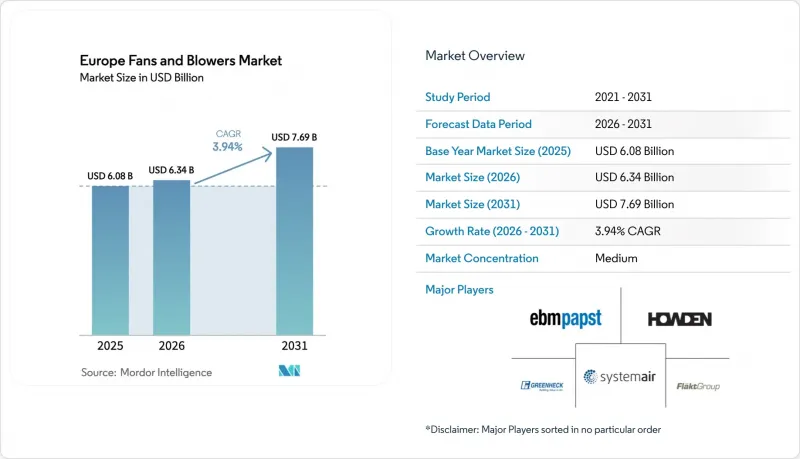
본 보고서는 기술별(원심식, 축류식, 기타), 압력 범위별(저압, 중압, 고압), 최종 용도 부문별(산업용 및 상업용), 지역별(독일, 영국, 프랑스, 이탈리아, 스페인, 북유럽 국가, 네덜란드 및 기타 유럽)로 분류되어 있습니다. 시장 규모 및 전망은 금액(미 달러) 기준으로 제시되어 있습니다.
유럽의 팬 및 블로어 시장 동향 및 인사이트
팬 시스템에 관한 EU의 에코디자인 에너지 효율 규정
유럽연합 집행위원회 규정 2024/1834에 따라 2026년 7월부터 자발적인 노력 대신 법적 구속력이 있는 최소 에너지 효율 기준이 도입됩니다. 이 규정은 125W에서 500kW 범위의 팬을 대상으로 하며, 대부분의 상업용 HVAC 및 경공업 분야에서 단일 속도 AC 유도 전동기의 사용이 즉시 금지됩니다. 독일 경제부는 2030년까지 EU의 전력 사용량이 8 TWh 감소할 것으로 예측하고 있으며, 이는 중규모 석탄 화력 발전소 1기 분량의 발전량에 거의 해당합니다. 제조업체에게는 단계적인 이행 기간이 주어지며, 2026년에 1단계, 2029년에 2단계가 시행됩니다. 이로 인해 금형 비용의 급격한 상승은 완화되겠지만, 이미 설치된 장비의 교체 주기는 단축될 것입니다. 2025/26 회계연도 2분기에 Systemair의 서유럽 내 유기적 매출이 11.1% 증가한 것에서도 알 수 있듯이, 계약업체들은 규정을 준수하기 위해 재고를 늘리기 시작했습니다. 따라서 이 규제로 인해 개보수 예산이 앞당겨지면서, 새로운 지표 기준을 여유 있게 충족하는 EC 모터가 탑재된 축류 팬에 대한 수요가 증가하고 있습니다.
유럽 데이터센터의 급속한 용량 확대
하이퍼스케일 및 코로케이션 사업자들은 2024년에 742 MW 규모의 시설을 가동했으며, 1.7 GW가 건설 중이고, 2.5GW가 계획 단계에 있습니다. 아마존 웹 서비스(Amazon Web Services)가 아라곤 캠퍼스에 157억 유로를 투자하기로 결정함에 따라, 스페인이 주목받는 거점으로 부상하고 있습니다. 프랑크푸르트와 런던의 가동 중인 용량은 합계 1.7 GW를 초과하며, 두 시장 모두 500 MW가 넘는 파이프라인을 보유하고 있습니다. 랙 밀도가 2020년 8 kW에서 AI 워크로드를 위해 15 kW 이상으로 상승함에 따라, 사업자들은 기류를 실시간으로 조정하고 엄격한 소음 규제를 충족하는 저압 축류 팬 어레이를 도입할 수밖에 없게 되었습니다. 독일의 ‘건축에너지법’ 제71a조에서는 290 kW를 초과하는 HVAC 시스템에 대해 디지털 모니터링을 의무화하고 있으며, 이로 인해 구매자들은 IoT 지원 팬 플랫폼으로 더욱 유도되고 있습니다.
철강·알루미늄 가격 변동이 BOM 비용을 상승시켜
2024년, 북서유럽의 열간 압연 코일은 톤당 550유로에서 720유로 사이에서 거래되었으며, 에너지 비용 및 반덤핑 조치의 영향으로 전 분기 대비 15%의 변동이 나타났습니다. 알루미늄 빌렛은 전력 가격 급등으로 인해 제련소가 생산을 축소함에 따라 톤당 2,400-2,800달러 사이에서 변동했습니다. 팬 하우징, 임펠러, 모터 프레임은 원심 팬 단가의 최대 45%를 차지하고 있어, 고정 가격 계약과 원자재 가격 급등이 겹치면 공급업체는 큰 위험에 노출될 수 있습니다. EBM-Papst사의 2024/25 회계연도 매출액은 기존 가격 책정 방식으로는 투입 비용 상승을 상쇄할 수 없었기 때문에 13.1% 감소했습니다. 2026년에는 건설업의 완만한 회복에 따라 철강 수요는 안정될 전망이지만, 탄소 국경 조정 메커니즘이 본격화되기 전까지는 알루미늄 가격의 변동은 계속될 것입니다.
부문별 분석
2025년 매출액 중 원심 팬이 60.1%를 차지했습니다. 이는 자재관리 및 열 제어를 위해 70 kPa를 초과하는 높은 정압이 필요한 공정 산업 수요에 힘입은 결과입니다. 한편, 축류 팬은 연평균 성장률(CAGR) 4.9%로 성장하고 있습니다. 이는 EC 모터가 단속 유도 모터에 비해 에너지 소비를 최대 70% 절감하고, 2026년에 시행될 에코디자인 기준을 충족하기 때문입니다. 유럽의 팬 및 블로어 시장에서 축류식 제품과 관련된 시장 규모는 데이터센터 냉각 및 상업용 HVAC 개조 분야에서 가장 빠르게 확대되고 있습니다. 이러한 분야에서는 설치 면적, 소음, 가변 속도 성능이 최대 압력 요구 사항보다 더 중요하게 여겨지기 때문입니다.
원심식 기술은 중·고압 분야에서 계속해서 확고한 입지를 유지할 전망입니다. 이는 후방 곡면 날개나 방사형 날개가 미세 입자가 포함된 기류나 부식성 가스를 처리할 수 있기 때문입니다. 그러나 현재 전체 수요의 55.5%를 차지하는 저압 환기 분야에서는 빌딩 관리 소프트웨어로 제어되는 축류식 어레이로의 전환이 진행되고 있어, 15 kPa 미만 영역에서 원심식 시장 점유율을 서서히 잠식하고 있습니다. 이러한 추세는 데이터 홀이나 사무실 리모델링 시, 기존의 정압이 높은 집중형 설비를 랙별로 확장 가능한 모듈식 팬월로 대체하는 분산형 공기 경로로 광범위하게 전환되는 현상과 병행하고 있습니다.
기타 혜택 :
- 엑셀 형식 시장 예측(ME) 시트
- 3개월간의 애널리스트 지원
자주 묻는 질문
목차
제1장 서론
제2장 조사 방법
제3장 개요
제4장 시장 구도
제5장 시장 규모 및 성장 예측
제6장 경쟁 구도
제7장 시장 기회 및 향후 전망
KTH 26.08.31According to Mordor Intelligence, the Europe fans and blowers market size is estimated at USD 6.34 billion in 2026, and is expected to reach USD 7.69 billion by 2031, at a CAGR of 3.94% during the forecast period (2026-2031).
This report is Segmented by Technology (Centrifugal, Axial, and Others), Pressure Range (Low, Medium, and High), End-Use Sector (Industrial and Commercial), and Geography (Germany, United Kingdom, France, Italy, Spain, NORDIC Countries, Netherlands, and Rest of Europe). The Market Sizes and Forecasts are Provided in Terms of Value (USD).
Europe Fans And Blowers Market Trends and Insights
EU Ecodesign Energy-Efficiency Mandates for Fan Systems
Commission Regulation 2024/1834 replaces voluntary schemes with binding minimum energy-efficiency indexes from July 2026. The rule covers fans between 125 W and 500 kW, instantly outlawing single-speed AC induction motors in most commercial HVAC and light-industrial settings. Germany's economic ministry projects an 8 TWh cut in EU electricity use by 2030, roughly equal to the output of a mid-sized coal plant. Manufacturers gain a staggered path, Tier 1 in 2026 and Tier 2 in 2029, which softens tooling-cost shocks but shortens the replacement cycle for installed units. Contractors have begun stockpiling compliant inventory, as evidenced by Systemair's 11.1% organic sales jump in Western Europe during Q2 2025/26. The regulation, therefore, pulls forward retrofit budgets and lifts demand for EC-motor axial fans that comfortably meet the new index thresholds.
Rapid Capacity Build-Out of European Data Centers
Hyperscale and colocation operators commissioned 742 MW in 2024 and have 1.7 GW under construction, with a further 2.5 GW in planning. Spain has emerged as a hot spot after Amazon Web Services committed EUR 15.7 billion for its Aragon campus. Frankfurt and London jointly exceed 1.7 GW of live capacity, and both markets carry pipelines above 500 MW. Rack densities are climbing from 8 kW in 2020 to 15 kW and higher for AI workloads, forcing operators to specify low-pressure axial arrays that modulate airflow in real time and meet stringent acoustic rules. Germany's Section 71a of the Building Energy Act requires digital monitoring for HVAC systems above 290 kW, further steering buyers toward IoT-ready fan platforms.
Volatile Steel & Aluminum Prices Inflating BOM Costs
North-west European hot-rolled coil traded between EUR 550 and EUR 720 per t in 2024, with 15% quarter-on-quarter swings driven by energy costs and anti-dumping measures. Aluminum billet fluctuated between USD 2,400 and USD 2,800 per t as smelters curtailed output amid high electricity prices. Fan housings, impellers, and motor frames account for up to 45% of centrifugal unit cost, leaving suppliers exposed when fixed-price contracts collide with raw-material spikes. EBM-Papst's revenue fell 13.1% in fiscal 2024/25 as legacy quotes failed to absorb input-cost inflation. Steel demand is likely to stabilize alongside a mild construction rebound in 2026, yet aluminum volatility will linger until the Carbon Border Adjustment Mechanism reaches full force.
Other drivers and restraints analyzed in the detailed report include:
- HVAC Green-Building Retrofits in Commercial Real Estate
- Integration of IoT Sensors Enabling Predictive Maintenance
- Price Pressure from Low-Cost Asian Imports
For complete list of drivers and restraints, kindly check the Table Of Contents.
Segment Analysis
Centrifugal fans held 60.1% of 2025 revenue, underpinned by process industries that need high static pressures beyond 70 kPa for material handling and thermal control. Axial designs, however, are advancing at 4.9% CAGR because EC motors cut energy use by as much as 70% compared with single-speed induction units and meet Ecodesign thresholds coming into force in 2026. The Europe fans and blowers market size attached to axial products is expanding fastest within data-center cooling and commercial-HVAC retrofits, where footprint, noise, and variable-speed capability outweigh peak-pressure requirements.
Centrifugal technology will keep its foothold in medium- and high-pressure slots because backward-curved and radial wheels handle particulate-laden flows and corrosive gases. Yet low-pressure ventilation, currently 55.5% of total demand, now gravitates toward axial arrays controlled through building-management software, chipping away at centrifugal share below 15 kPa. The trend parallels a broader shift toward distributed air paths in data halls and office retrofits, replacing legacy high-static central plants with modular fan walls that scale rack by rack.
Complete Report Scope:
- By Technology
- Centrifugal
- Axial
- Others
- By Pressure Range
- Low (Below 15 kPa)
- Medium (15 to 70 kPa)
- High (Above 70 kPa)
- By End-use Sector
- Industrial
- Power Generation
- Oil and Gas
- Iron and Steel
- Chemical and Petrochemical
- Mining and Metals
- Construction and Cement
- HVAC and Cleanrooms
- Others
- Commercial
- Industrial
- By Geography
- Germany
- United Kingdom
- France
- Italy
- Spain
- NORDIC Countries
- Netherlands
- Rest of Europe
List of Companies Covered in this Report:
- ebm-papst Group
- Howden Group Ltd
- FlaktGroup Holding GmbH
- Systemair AB
- Greenheck Fan Corp.
- Trane Technologies plc
- Halifax Fan Ltd
- Rosenberg Ventilatoren GmbH
- Ventilatorenfabrik Oelde GmbH
- Continental Blower LLC
- CG Power & Industrial Solutions Ltd
- Loren Cook Company
- Pollrich DLK Fan Factories GmbH
- Aerzener Maschinenfabrik GmbH
- CBI Europe S.p.A.
- Comefri Group
- VTS Group
- Soler & Palau Ventilation Group
- Nadi Airtechnics Pvt Ltd
- Zhejiang Shangfeng Fan Co., Ltd
Additional Benefits:
- The market estimate (ME) sheet in Excel format
- 3 months of analyst support
TABLE OF CONTENTS
1 Introduction
- 1.1 Study Assumptions & Market Definition
- 1.2 Scope of the Study
2 Research Methodology
3 Executive Summary
4 Market Landscape
- 4.1 Market Overview
- 4.2 Market Drivers
- 4.2.1 EU Ecodesign energy-efficiency mandates for fan systems
- 4.2.2 HVAC green-building retrofits in commercial real estate
- 4.2.3 Expansion of hygienic air-handling demand in F&B and pharma
- 4.2.4 Rapid capacity build-out of European data centers
- 4.2.5 Additive-manufactured impeller designs boosting replacement cycle
- 4.2.6 Integration of IoT sensors enabling predictive maintenance
- 4.3 Market Restraints
- 4.3.1 Volatile steel & aluminum prices inflating BOM costs
- 4.3.2 Price pressure from low-cost Asian imports
- 4.3.3 Urban noise-emission limits curbing large-fan installations
- 4.3.4 Supply risks for rare-earth magnets in high-efficiency motors
- 4.4 Supply-Chain Analysis
- 4.5 Regulatory Landscape
- 4.6 Technological Outlook
- 4.7 Porter's Five Forces
- 4.7.1 Bargaining Power of Suppliers
- 4.7.2 Bargaining Power of Consumers
- 4.7.3 Threat of New Entrants
- 4.7.4 Threat of Substitute Products & Services
- 4.7.5 Intensity of Competitive Rivalry
5 Market Size & Growth Forecasts
- 5.1 By Technology
- 5.1.1 Centrifugal
- 5.1.2 Axial
- 5.1.3 Others
- 5.2 By Pressure Range
- 5.2.1 Low (Below 15 kPa)
- 5.2.2 Medium (15 to 70 kPa)
- 5.2.3 High (Above 70 kPa)
- 5.3 By End-use Sector
- 5.3.1 Industrial
- 5.3.1.1 Power Generation
- 5.3.1.2 Oil and Gas
- 5.3.1.3 Iron and Steel
- 5.3.1.4 Chemical and Petrochemical
- 5.3.1.5 Mining and Metals
- 5.3.1.6 Construction and Cement
- 5.3.1.7 HVAC and Cleanrooms
- 5.3.1.8 Others
- 5.3.2 Commercial
- 5.3.1 Industrial
- 5.4 By Geography
- 5.4.1 Germany
- 5.4.2 United Kingdom
- 5.4.3 France
- 5.4.4 Italy
- 5.4.5 Spain
- 5.4.6 NORDIC Countries
- 5.4.7 Netherlands
- 5.4.8 Rest of Europe
6 Competitive Landscape
- 6.1 Market Concentration
- 6.2 Strategic Moves (M&A, Partnerships, PPAs)
- 6.3 Market Share Analysis (Market Rank/Share for key companies)
- 6.4 Company Profiles (includes Global level Overview, Market level overview, Core Segments, Financials as available, Strategic Information, Products & Services, and Recent Developments)
- 6.4.1 ebm-papst Group
- 6.4.2 Howden Group Ltd
- 6.4.3 FlaktGroup Holding GmbH
- 6.4.4 Systemair AB
- 6.4.5 Greenheck Fan Corp.
- 6.4.6 Trane Technologies plc
- 6.4.7 Halifax Fan Ltd
- 6.4.8 Rosenberg Ventilatoren GmbH
- 6.4.9 Ventilatorenfabrik Oelde GmbH
- 6.4.10 Continental Blower LLC
- 6.4.11 CG Power & Industrial Solutions Ltd
- 6.4.12 Loren Cook Company
- 6.4.13 Pollrich DLK Fan Factories GmbH
- 6.4.14 Aerzener Maschinenfabrik GmbH
- 6.4.15 CBI Europe S.p.A.
- 6.4.16 Comefri Group
- 6.4.17 VTS Group
- 6.4.18 Soler & Palau Ventilation Group
- 6.4.19 Nadi Airtechnics Pvt Ltd
- 6.4.20 Zhejiang Shangfeng Fan Co., Ltd
7 Market Opportunities & Future Outlook
- 7.1 White-space & Unmet-Need Assessment


