|
시장보고서
상품코드
2119307
HVAC 용도 산업 및 상업용 팬 : 시장 점유율 분석, 업계 동향 및 통계, 성장 예측(2026-2031년)Industrial and Commercial Fan For HVAC Applications - Market Share Analysis, Industry Trends & Statistics, Growth Forecasts (2026 - 2031) |
||||||
 Mordor Intelligence
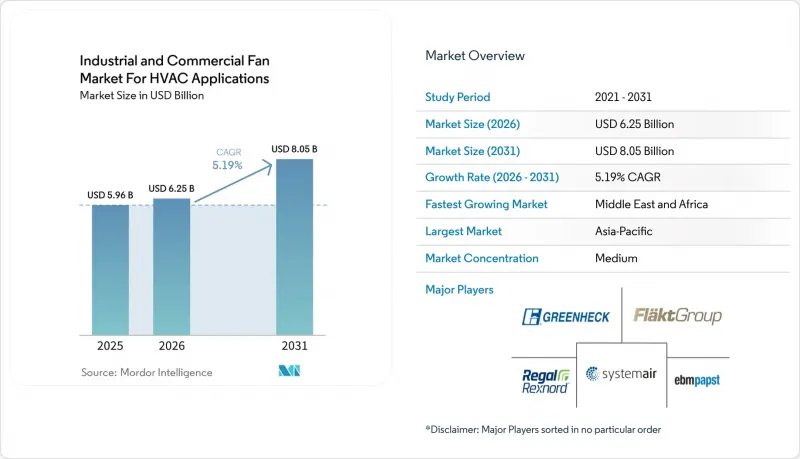
Mordor Intelligence에 의하면, HVAC 용도 산업 및 상업용 팬 시장 규모는 2025년 59억 6,000만 달러로 평가되었습니다. 2026년에는 62억 5,000만 달러로 확대되어 2026년부터 2031년에 걸쳐 CAGR 5.19%로 성장을 지속하여, 2031년에는 80억 5,000만 달러에 이를 것으로 예측됩니다.
본 보고서는 팬 유형(축류 팬, 원심 팬, 혼합류 팬), HVAC 용도(환기, 공조, 난방), 최종 사용자(상업, 산업) 및 지역(북미, 유럽, 아시아태평양, 남미, 중동 및 아프리카)별로 분류되어 있습니다. 시장 예측은 금액(미 달러)으로 표시되어 있습니다.
HVAC 용도 산업 및 상업용 팬 시장에 대한 인사이트 및 동향
에너지 효율이 높은 HVAC의 현대화
건물의 탈탄소화 정책에 따라, HVAC 용도 산업 및 상업용 팬은 상업시설 및 산업 시설 전반에서 규제 준수를 목적으로 한 교체 활동으로 전환되고 있습니다. 규정(EU) 2024/1834에서는 팬의 구성 부품을 개별 효율 항목으로 취급하지 않고, 모터, 임펠러,스테이터를 포함한 팬 어셈블리 전체를 평가 대상으로 삼고 있습니다. 이러한 접근 방식에 따라, 이전의 부품 기반 요건은 충족했으나 시스템 전체의 시험 기준을 충족하지 못하는 구형 AC 모터식 원심 팬은 기준을 충족하지 않는 것으로 간주될 수 있습니다. 유럽 집행위원회는 이 규정을 통해 정책이 없는 경우의 기준선과 비교하여, 2030년까지 산업용 팬의 전력 사용량을 연간 31 TWh 감축하고, 연간 40억 유로를 절감할 수 있을 것으로 전망하고 있습니다. 일체형 EC 모터 모듈은 그 운전 효율이 규제 방향과 부합하기 때문에 유리한 입장에 있습니다. 2025년 개정안 및 2026년 5월 Eurovent, AMCA, EVIA가 발표한 FAQ 가이드를 통해 조달 팀이 직면한 기술적 과제와 전환 관련 과제가 명확해졌습니다.
데이터센터 및 AI 인프라의 냉각 수요
데이터센터의 개발은 HVAC 용도 산업 및 상업용 팬에 대한 고성능 수요를 창출하고 있습니다. 하이퍼스케일 사업자들은 2.5 mm H2O를 초과하는 정압에서 연속 운전이 가능한 CRAH 및 팬월 시스템을 필요로 하며, 이로 인해 범용 제품의 역할은 제한됩니다. 이러한 요구 사항은 폭넓은 제품 라인업으로 인증된 시스템을 제공하고 대규모 프로젝트 수주에 대응할 수 있는 공급업체에게 유리하게 작용합니다. 대형 기술 기업들의 AI 인프라 투자는 정밀 냉각 및 고부하용 기류 시스템에 대한 수요를 뒷받침하고 있습니다. 송전망의 용량 제약으로 인해 계획된 데이터센터 프로젝트 중 일부가 지연될 가능성이 있으며, 그 결과 전력 공급이 안정적인 지역에 단기적인 수요가 집중될 우려가 있습니다.
고성능 팬 시스템의 높은 초기 비용
높은 초기 투자 비용은 HVAC 용도 산업용 및 상업용 팬에 있어 여전히 제약 요인으로 작용하고 있습니다. 특히 건물 소유주가 당면한 조달 예산을 중시하는 경우에 두드러집니다. 가변 속도 드라이브와 네트워크 연결형 제어 기능을 갖춘 EC 모터 시스템의 도입 비용은 동등한 기존의 AC 모터 유닛에 비해 2-3배 더 비쌀 수 있습니다. 표준 상업용 건물의 투자 회수 기간은 4-6년으로 예상되며, 일반적인 재융자 조건 하에서는 많은 중규모 소유주가 이를 수용하지 못할 가능성이 있습니다. 중동 및 남아시아 일부 지역에서는 전력 가격에 대한 보조금이 에너지 절약으로 인한 경제적 가치를 저하시키고 있기 때문에 이 격차는 더욱 커집니다. 에너지 성과 계약(EPC)이나 ‘Fan-as-a-Service’ 모델은 이러한 장벽 중 일부를 해소해 주지만, 그 도입은 여전히 서유럽과 북미에 집중되어 있습니다. 유럽과 미국의 규제 준수 요건은 이러한 제약을 극복할 수 있지만, 유사한 규정이 없는 시장에서는 자발적인 비즈니스 사례에 의존할 수밖에 없으며, 숙련된 서비스 및 시운전 역량의 부족에 직면하게 됩니다.
부문 분석
2025년 HVAC 용도 산업 및 상업용 팬 중 원심 팬이 58.1%를 차지했습니다. 이는 원심 팬이 높은 정압을 제공할 수 있고, 오래된 상업 및 산업용 건물에서 흔히 볼 수 있는 좁은 덕트 배열에 적합하기 때문입니다. 기존 덕트 시스템은 원심 팬의 성능 곡선을 기반으로 설계되었기 때문에 팬 교체 시기가 되었더라도 시스템 전체를 변경하는 데는 막대한 비용이 소요됩니다. 이러한 기존 설비의 효과로 인해 단기 및 중기적으로는 원심 팬의 판매량이 유지될 것입니다. 축류 팬은 컴팩트한 직접 드라이브 설계 덕분에 옥상 환기, 주차장, 터널 배기 등 대풍량·저압 용도에 적합합니다.
혼합류 팬은 2031년까지 연평균 6.2%의 성장이 예상되며, HVAC 용도 산업 및 상업용 팬 중 가장 높은 성장률을 보일 것으로 전망됩니다. 이 팬은 축류식 팬과 같은 풍량과 원심식 팬과 같은 정압 성능을 겸비하고 있습니다. 이러한 임펠러를 EC 모터와 결합함으로써 정격 속도의 30%에서 50% 범위에서도 효율을 유지하여 부분 부하 시 에너지 소비를 절감할 수 있습니다. 그린헥(Greenheck)사는 2024년 9월, 믹스 플로우 휠 기술을 채택한 RSQ 후드형 옥상 팬을 출시했습니다. 이 제품은 팬 에너지 지수(FEE), 공기 성능 및 소음 성능에 대해 AMCA 인증을 획득했습니다. 데이터센터 및 상업시설의 개보수 사양서에는 AMCA 인증 요건이 점점 더 많이 포함되고 있으며, 이로 인해 신규 공급업체에 대한 자격 요건도 높아지고 있습니다.
지역별 분석
2025년, 아시아태평양은 매출의 33.4%를 차지했습니다. 이러한 규모는 몇몇 주요 경제권의 도시 개발 및 제조업 활동에 기인합니다. 중국은 ‘이산화탄소 배출 정점 달성 및 탄소 중립’ 목표와 GB 에너지 효율 기준을 통해 상업용 HVAC 사양을 추진하고 있습니다. 한편, 인도는 데이터센터에 대한 투자, ‘스마트 시티 미션’ 건설, 그리고 여름철 기온 상승으로 인해 이 지역의 주요 성장 영역으로 부상하고 있습니다. 시스템에어(System Air)는 2025년 8월, 첸나이에 본사를 둔 NADI Airtechnics의 인수를 완료하고, 산업용 송풍기 및 철도용 팬을 제조하는 인도 기업을 자사 포트폴리오에 추가했습니다.
일본과 한국은 성숙한 시장으로, 신규 상업시설의 디지털화 및 BACnet 호환 팬 관리에 대해 엄격한 요건이 요구되고 있습니다. 북미와 유럽은 성숙한 교체 시장이며, 규제 준수를 목적으로 한 개보수 공사는 신축 공사보다 수요 예측이 용이합니다. 규정(EU) 2024/1834에 따라, 개정된 효율 기준을 충족하지 못하는 125W에서 500kW까지의 팬 교체가 추진되고 있습니다. 북미에서는 팬 효율 지수(FEI) 요건과 ASHRAE 90.1을 참조하는 에너지 규제가 유사한 효율 향상 주기를 뒷받침하고 있습니다. HVAC 용도 산업 및 상업용 팬의 경우, 2025년부터 2026년에 걸쳐 양 지역에서 하이퍼스케일 조달이 수익성 높은 수입원이 되어, 다양한 공급업체들에게 주거용 HVAC 판매량 부진을 상쇄하는 데 도움이 되었습니다.
HVAC 용도 산업 및 상업용 팬 시장 중 중동 및 아프리카는 2031년까지 연평균 성장률(CAGR) 5.8%를 나타낼 것으로 예측되며, 이는 지역별 성장률 중 가장 높은 수치입니다. 걸프협력회의(GCC) 국가들의 정부 주도 인프라 프로젝트에서는 기후의 영향을 받기 쉬운 건물을 위한 정밀한 기류 제어 장비가 요구되고 있습니다. 아랍에미리트(UAE)의 지역 냉방 확대와 두바이 및 아부다비의 병원 건설 프로젝트가 고급 상업용 HVAC 수요를 뒷받침하고 있습니다. 또한 사우디아라비아의 기준과 아랍에미리트의 에너지 효율 요건도 기존 상업용 건물의 교체 수요를 촉진하고 있습니다. 남아프리카공화국의 SANS 10400-XA 요건에 따라 건물의 에너지 성능에 대한 기대치가 점차 높아지고 있으며, 요하네스버그와 케이프타운의 상업 입찰에서는 팬의 최소 효율 기준이 참조되기 시작했습니다.
기타 혜택 :
- 엑셀 형식 시장 예측(ME) 시트
- 3개월간의 애널리스트 지원
자주 묻는 질문
목차
제1장 서론
제2장 조사 방법
제3장 주요 요약
제4장 시장 구도
제5장 시장 규모 및 성장 예측
제6장 경쟁 구도
제7장 시장 기회 및 향후 전망
KTH 26.09.10According to Mordor Intelligence, the industrial and Commercial Fan Market For HVAC Applications Industry size is expected to grow from USD 5.96 billion in 2025 to USD 6.25 billion in 2026 and is forecast to reach USD 8.05 billion by 2031 at 5.19% CAGR over 2026-2031.
This report is Segmented by Fan Type (Axial Fans, Centrifugal Fans, Mixed Flow Fans), HVAC Application (Ventilation, Air Conditioning, Heating), End User (Commercial, Industrial), and Geography (North America, Europe, Asia-Pacific, South America, and Middle East and Africa). The Market Forecasts are Provided in Terms of Value (USD).
Insights and Trends of Industrial and Commercial Fan Market For HVAC Applications
Energy-Efficient HVAC Modernization
Building decarbonization policies are moving the industrial fans for the HVAC market toward compliance-led replacement activity across commercial and industrial sites. Regulation (EU) 2024/1834 assesses the full fan assembly, including the motor, impeller, and stator, instead of treating its components as separate efficiency items. This approach can disqualify older AC-motor centrifugal fans that met earlier component-based requirements but do not meet the full-system test. The European Commission expects the rules to lower electricity use from industrial fans by 31 TWh annually by 2030 against a no-policy baseline and to deliver EUR 4 billion in annual savings. Integrated EC-motor modules are well-positioned because their operating efficiency aligns with the direction of the regulation. The 2025 amendment and the May 2026 FAQ guide from Eurovent, AMCA, and EVIA clarified technical and transition issues for procurement teams.
Data Center and AI Infrastructure Cooling Demand
Data center development has created a high-performance source of demand for industrial fans for the HVAC market. Hyperscale operators require CRAH and fan-wall systems that can operate continuously at static pressures above 2.5 mm H2O, which limits the role of commodity products. These requirements favor suppliers that can provide qualified systems across a broad product range and support large project orders. Large technology companies' investment in AI infrastructure is sustaining demand for precision cooling and higher-duty airflow systems. Grid capacity constraints could delay some planned data center projects, concentrating near-term demand in locations with stronger power availability.
High Upfront Cost of Advanced Fan Systems
High capital costs remain a constraint on the industrial fans for the HVAC market, particularly where building owners focus on immediate procurement budgets. EC-motor systems with variable-speed drives and connected controls can cost 2 to 3 times more to install than comparable legacy AC-motor units. Their payback period in standard commercial buildings can range from 4 to 6 years, which many mid-sized owners may not accept under normal financing conditions. The difference is bigger in parts of the Middle East and South Asia where subsidized power prices reduce the financial value of energy savings. Energy-performance contracts and fan-as-a-service models address part of the barrier, but their adoption remains concentrated in Western Europe and North America. Compliance requirements in Europe and the United States can overcome this constraint, while markets without similar rules must rely on a voluntary business case and face a shortage of skilled service and commissioning capacity.
Other drivers and restraints analyzed in the detailed report include:
- Indoor Air Quality and Ventilation Compliance
- Fan-Wall Adoption in High-Density Facilities
- Retrofit Integration Complexity in Legacy HVAC Systems
For complete list of drivers and restraints, kindly check the Table Of Contents.
Segment Analysis
Centrifugal fans accounted for 58.1% of the industrial fans for the HVAC market size in 2025 because they can provide high static pressure and fit the narrow duct layouts common in older commercial and industrial buildings. Existing duct systems were designed around centrifugal performance curves, which makes a full system change costly, even when the fan is due for replacement. This installed-base effect supports centrifugal fan volumes in the near and medium term. Axial fans remain suited to high-volume, low-pressure work in roof ventilation, parking structures, and tunnel extraction because of their compact direct-drive design.
Mixed flow fans are forecast to grow at 6.2% through 2031, making them the fastest-growing fan type in the industrial fans for HVAC market. They combine axial-style airflow volume with centrifugal-style static-pressure capability. Pairing these impellers with EC motors can preserve efficiency at 30% to 50% of rated speed and reduce part-load energy use. Greenheck introduced its RSQ hooded rooftop fan with mixed-flow wheel technology in September 2024, with AMCA licensing for Fan Energy Index, air, and sound performance. AMCA credentials are increasingly included in data center and commercial renovation specifications, which raises qualification requirements for new suppliers.
Complete Report Scope:
- By Fan Type
- Axial Fans
- Centrifugal Fans
- Mixed Flow Fans
- By HVAC Application
- Ventilation
- Air Conditioning
- Heating
- By End User
- Commercial
- Industrial
- By Geography
- North America
- United States
- Canada
- Mexico
- Europe
- United Kingdom
- Germany
- France
- Spain
- Nordic Countries
- Russia
- Rest of Europe
- Asia-Pacific
- China
- India
- Japan
- South Korea
- ASEAN Countries
- Rest of Asia-Pacific
- South America
- Brazil
- Argentina
- Colombia
- Rest of South America
- Middle East and Africa
- Saudi Arabia
- United Arab Emirates
- South Africa
- Rest of Middle East and Africa
- North America
Geography Analysis
Asia-Pacific held 33.4% of revenue in 2025. Its scale comes from urban development and manufacturing activity across several large economies. China is advancing commercial HVAC specifications through dual-carbon objectives and GB energy-efficiency standards, while India is a key regional growth area because of data center investment, Smart Cities Mission construction, and hotter summer conditions. Systemair completed its acquisition of Chennai-based NADI Airtechnics in August 2025, adding an Indian manufacturer of industrial blowers and railway fans to its portfolio.
Japan and South Korea are mature markets with demanding requirements for digital, BACnet-compatible fan management in new commercial installations. North America and Europe are mature replacement markets where compliance-led retrofits offer more predictable demand than new construction. Regulation (EU) 2024/1834 is driving upgrades of fans from 125 W to 500 kW that do not meet revised efficiency thresholds. In North America, Fan Efficiency Index requirements and energy codes referring to ASHRAE 90.1 support a similar efficiency upgrade cycle. For the industrial fans for the HVAC market, hyperscale procurement became a high-value revenue source in both regions during 2025 and 2026, helping offset weaker residential HVAC volumes for broader suppliers.
The Middle East and Africa segment of the industrial fans for HVAC market is forecast to record a 5.8% CAGR through 2031, the fastest regional rate. State-backed infrastructure projects in Gulf Cooperation Council countries require precision airflow equipment for climate-sensitive buildings. District cooling growth in the United Arab Emirates and hospital projects in Dubai and Abu Dhabi support premium commercial HVAC demand. Saudi standards and United Arab Emirates energy-efficiency requirements also support replacement demand in existing commercial buildings. South Africa's SANS 10400-XA requirements are progressively tightening building energy performance expectations, with commercial tenders in Johannesburg and Cape Town beginning to reference minimum fan efficiency standards.
- Aerovent, Inc.
- Chicago Blower Corporation
- Continental Fan Manufacturing Inc.
- ebm-papst Group
- FlaktGroup Holding GmbH
- Greenheck Fan Corporation
- Hartzell Air Movement
- Howden Group Ltd.
- Kruger Ventilation Industries Pte Ltd
- Loren Cook Company
- New York Blower Company
- Regal Rexnord Corporation
- Rosenberg Ventilatoren GmbH
- Soler & Palau Ventilation Group
- Systemair AB
- Twin City Fan Companies, Ltd.
- Vent-Axia Group Limited
- Ziehl-Abegg SE
Additional Benefits:
- The market estimate (ME) sheet in Excel format
- 3 months of analyst support
TABLE OF CONTENTS
1 INTRODUCTION
- 1.1 Study Assumptions and Market Definition
- 1.2 Scope of the Study
2 RESEARCH METHODOLOGY
3 EXECUTIVE SUMMARY
4 MARKET LANDSCAPE
- 4.1 Market Overview
- 4.2 Market Drivers
- 4.2.1 Energy-Efficient HVAC Modernization
- 4.2.2 Data Center and AI Infrastructure Cooling Demand
- 4.2.3 Indoor Air Quality and Ventilation Compliance
- 4.2.4 Industrial Automation and Process-Cooling Expansion
- 4.2.5 Fan-Wall Adoption in High-Density Facilities
- 4.2.6 Lifecycle Energy Savings from EC Motors and Variable-Speed Operation
- 4.3 Market Restraints
- 4.3.1 High Upfront Cost of Advanced Fan Systems
- 4.3.2 Maintenance and Skilled-Service Constraints
- 4.3.3 Retrofit Integration Complexity in Legacy HVAC Systems
- 4.3.4 Specification Fragmentation and Project-Level Customization
- 4.4 Supply-Chain Analysis
- 4.5 Porter's Five Forces Analysis
- 4.5.1 Bargaining Power of Suppliers
- 4.5.2 Bargaining Power of Buyers
- 4.5.3 Threat of New Entrants
- 4.5.4 Threat of Substitutes
- 4.5.5 Competitive Rivalry
- 4.6 Regulatory Landscape
- 4.7 Technology Outlook
- 4.8 Investment Analysis
5 MARKET SIZE AND GROWTH FORECASTS
- 5.1 By Fan Type
- 5.1.1 Axial Fans
- 5.1.2 Centrifugal Fans
- 5.1.3 Mixed Flow Fans
- 5.2 By HVAC Application
- 5.2.1 Ventilation
- 5.2.2 Air Conditioning
- 5.2.3 Heating
- 5.3 By End User
- 5.3.1 Commercial
- 5.3.2 Industrial
- 5.4 By Geography
- 5.4.1 North America
- 5.4.1.1 United States
- 5.4.1.2 Canada
- 5.4.1.3 Mexico
- 5.4.2 Europe
- 5.4.2.1 United Kingdom
- 5.4.2.2 Germany
- 5.4.2.3 France
- 5.4.2.4 Spain
- 5.4.2.5 Nordic Countries
- 5.4.2.6 Russia
- 5.4.2.7 Rest of Europe
- 5.4.3 Asia-Pacific
- 5.4.3.1 China
- 5.4.3.2 India
- 5.4.3.3 Japan
- 5.4.3.4 South Korea
- 5.4.3.5 ASEAN Countries
- 5.4.3.6 Rest of Asia-Pacific
- 5.4.4 South America
- 5.4.4.1 Brazil
- 5.4.4.2 Argentina
- 5.4.4.3 Colombia
- 5.4.4.4 Rest of South America
- 5.4.5 Middle East and Africa
- 5.4.5.1 Saudi Arabia
- 5.4.5.2 United Arab Emirates
- 5.4.5.3 South Africa
- 5.4.5.4 Rest of Middle East and Africa
- 5.4.1 North America
6 COMPETITIVE LANDSCAPE
- 6.1 Market Concentration
- 6.2 Strategic Moves
- 6.3 Market Share Analysis
- 6.4 Company Profiles (includes Global Level Overview, Market Level Overview, Core Segments, Financials as available, Strategic Information, Market Rank/Share, Products and Services, Recent Developments)
- 6.4.1 Aerovent, Inc.
- 6.4.2 Chicago Blower Corporation
- 6.4.3 Continental Fan Manufacturing Inc.
- 6.4.4 ebm-papst Group
- 6.4.5 FlaktGroup Holding GmbH
- 6.4.6 Greenheck Fan Corporation
- 6.4.7 Hartzell Air Movement
- 6.4.8 Howden Group Ltd.
- 6.4.9 Kruger Ventilation Industries Pte Ltd
- 6.4.10 Loren Cook Company
- 6.4.11 New York Blower Company
- 6.4.12 Regal Rexnord Corporation
- 6.4.13 Rosenberg Ventilatoren GmbH
- 6.4.14 Soler & Palau Ventilation Group
- 6.4.15 Systemair AB
- 6.4.16 Twin City Fan Companies, Ltd.
- 6.4.17 Vent-Axia Group Limited
- 6.4.18 Ziehl-Abegg SE
7 MARKET OPPORTUNITIES AND FUTURE OUTLOOK
- 7.1 White-Space and Unmet-Need Assessment