
|
시장보고서
상품코드
2116016
클라우드 워크로드 보호 : 시장 점유율 분석, 업계 동향과 통계, 성장 예측(2026-2031년)Cloud Workload Protection - Market Share Analysis, Industry Trends & Statistics, Growth Forecasts (2026 - 2031) |
||||||
 Mordor Intelligence
Mordor Intelligence에 따르면 클라우드 워크로드 보호 시장 규모는 2025년 78억 4,000만 달러에서 2026년에는 96억 3,000만 달러로 확대되고, 2026년부터 2031년까지 CAGR 22.78%를 기록하며 2031년에는 268억 4,000만 달러에 달할 것으로 예측됩니다.
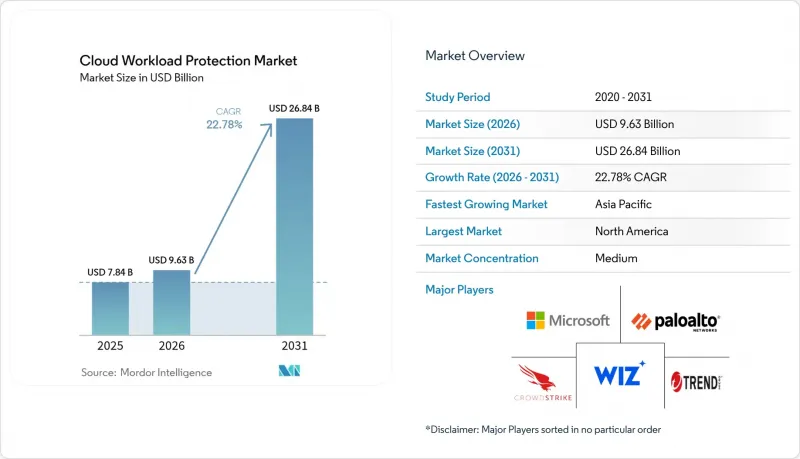
본 보고서는 구성요소별(솔루션, 서비스), 보안 아키텍처별(에이전트형, 기타), 도입 형태별(프라이빗, 퍼블릭, 하이브리드), 클라우드 워크로드 유형별(가상 머신(VM), 기타), 조직 규모별(대기업, 기타), 최종사용자별(BFSI, 헬스케어, 기타), 및 지역별로 분류되어 있습니다. 시장 예측은 금액(달러) 기준으로 제시되어 있습니다.
세계 클라우드 워크로드 보호 시장의 동향 및 인사이트
멀티 클라우드 도입의 급증
여러 하이퍼스케일러에 워크로드를 분산시키는 기업의 전략은 보안 아키텍처를 재구축하고, 에이전트 없는 가시성에 대한 수요를 높이고 있습니다. 미국 국방부의 ‘클라우드 보안 플레이북’은 이종 환경에 걸친 통합된 보안 체계를 제안하고 있으며, 플랫폼 중심의 구매 경향을 뒷받침하고 있습니다. 금융 기관은 관할 구역을 초월한 규정 준수 대응 및 벤더 종속성을 피하면서 운영 복원력을 확보할 수 있다는 점에서 멀티 클라우드를 중시하고 있습니다. CNAPP 제품군은 보안 태세 관리, 런타임 보호, 사고 대응을 단일 제어 평면 내에 통합하기 때문에 주목받고 있습니다. 벤더의 로드맵에서는 수천 개에 달하는 일시적인 자산에 에이전트를 배포하고 업데이트해야 하는 관리상의 부담을 없애는 API 기반 탐지가 점점 더 중요시되고 있습니다.
DevSecOps로의 전환이 CNAPP 도입을 가속화
지속적 통합 및 배포 파이프라인에 보안 제어를 통합함으로써, 워크로드가 프로덕션 환경에 도달하기 전에 취약점을 더 빠르게 탐지할 수 있습니다. 클라우드 네이티브 애플리케이션 보호에 관한 마이크로소프트의 지침은 빌드 프로세스 내의 자동 검사가 수정 주기를 단축하고 개발자와 보안 목표 간의 일관성을 높이는 방법을 보여줍니다. 이 접근 방식은 거버넌스 요구 사항을 유지하면서 릴리스 속도를 향상시킵니다. Kubernetes와 같은 컨테이너 오케스트레이션 플랫폼은 기존의 엔드포인트 에이전트로는 쉽게 모니터링할 수 없는 런타임의 복잡성을 초래하며, 통합된 ‘스캔 투 프로텍트(Scan-to-Protect)’ 워크플로 채택을 촉진하고 있습니다. DevSecOps 문화가 성숙해짐에 따라 조달 정책은 개발자 친화적인 API, 정책-as-코드 템플릿, 통합 개발 환경 내의 실용적인 피드백 루프를 제공하는 솔루션으로 전환되고 있습니다.
복잡한 다중 지역 데이터 상주 요건
데이터 주권에 관한 규정 차이로 인해 기업은 지역별 클라우드 인스턴스를 유지하고 텔레메트리 전송을 제한할 수밖에 없어, 통합적인 위협 탐지가 복잡해지고 있습니다. 'Impossible Cloud'는 현지화 법규가 보안 아키텍처의 분열을 초래하고 운영 비용을 증가시키고 있는 실태를 여실히 드러내고 있습니다. 금융 기업은 GDPR, 바젤 III 및 각국의 은행법을 준수해야 하며, 공급자에게 국내 내 로그 처리, 암호화 키 소유권, 그리고 현지에서 인증된 데이터센터 제공을 요구하고 있습니다. 벤더들은 규정 준수 인증을 획득하기 위해 막대한 연구개발 자원을 투입하고 있으며, 이는 기능 혁신을 지연시키고 신생 업체의 시장 진입 장벽을 높일 가능성이 있습니다.
부문 분석
2025년에는 솔루션이 매출의 67.35%를 차지했으며, 이는 포지션 관리에서 사고 대응에 이르기까지를 포괄하는 통합 플랫폼에 대한 시장의 수요를 반영합니다. 런타임 분석이 필수 요건이 됨에 따라 위협 탐지 및 대응 도구의 연평균 성장률(CAGR)이 27.29%에 달하는 가운데, 솔루션 제공에 있어 클라우드 워크로드 보호 시장의 규모도 확대될 전망입니다. 종합적인 제품군에는 취약성 평가, 규정 준수 보고 및 암호화 기능이 통합되어 있어 플랫폼에 대한 채택률을 높이고 총 소유 비용(TCO)을 절감합니다.
나머지 32.65%의 매출은 서비스 부문이 차지하고 있으며, 인력 부족을 보완하는 관리형 탐지 기능이 이를 주도하고 있습니다. 전문 서비스는 아키텍처 설계 및 마이그레이션을 지원하는 반면, 관리형 서비스는 정규직 직원을 고용하지 않고 운영 노하우를 필요로 하는 중소기업으로부터 지지를 받고 있습니다. 기술과 서비스의 긴밀한 연계를 통해 가치 실현까지 걸리는 시간이 단축되고, 자문 업무로의 업셀링 경로가 마련되어 클라우드 워크로드 보호 시장 전체에서 지속적인 매출 성장이 유지되고 있습니다.
2025년, 에이전트 기반 도입은 클라우드 워크로드 보호 시장 점유율의 63.25%를 차지했습니다. 이는 커널 상주 모듈이 패킷에 대한 상세한 가시성과 프로세스 제어를 제공하기 때문입니다. 이러한 기능은 고빈도 거래나 결정론적 모니터링이 필요한 기타 지연 시간에 민감한 워크로드에 있어 여전히 필수적입니다. 그러나 하이퍼스케일러의 API가 성숙해지고 고객이 운영 부담이 적은 솔루션을 선호하게 됨에 따라, 에이전트리스형 시장은 연평균 성장률(CAGR) 31.15%로 확대되고 있습니다.
에이전트리스 모델과 관련된 클라우드 워크로드 보호 시장 규모는 ARM 서버의 채택과 서버리스화의 확대에 힘입어 성장하고 있으며, 이 두 가지 모두 기존 에이전트에 있어 과제로 작용하고 있습니다. 미션 크리티컬 자산을 위한 게스트 내 센서와 일시적인 워크로드를 위한 API 텔레메트리를 결합한 하이브리드 전략은 기능상의 격차를 메우고 있습니다. 마이크로소프트의 Azure Monitor Agent로의 전환은 CPU 오버헤드를 최소화하면서 데이터 세분화를 확대하는 통합형 수집기로의 업계 전환을 상징합니다.
지역별 분석
북미는 2025년에 37.70%의 점유율을 차지했으며, 성숙한 클라우드 보급률, 견조한 벤처 자금 조달, 그리고 FedRAMP와 같은 규제적 촉진요인에 힘입고 있습니다. 주목받는 인증은 민간 기관 및 국방 프로그램 전반에 걸친 채택을 촉진하고, 벤더의 신뢰도를 높이고 있습니다. 캐나다와 멕시코도 유사한 추세를 보이며, 미국의 프레임워크를 현지 개인정보 보호법에 부합하도록 조정하여 시장 도달 범위를 확대하고 있습니다.
아시아태평양은 인도의 ‘디지털 퍼스트(Digital First)’ 뱅킹, 중국의 제조업 디지털화, 그리고 호주와 일본의 공공 부문 클라우드 도입 의무화에 힘입어 연평균 성장률(CAGR) 28.9%로 성장하고 있습니다. 아카마이(Akamai)의 기록에 따르면, 이 지역 전체의 웹 공격은 73% 증가했으며, 2024년에는 금융 서비스 업계가 270억 건 이상의 악의적인 요청을 처리했습니다. 이러한 위협 상황으로 인해 런타임 보호의 급속한 확산이 진행되고 있으며, 특히 싱가포르와 한국에서는 규제 당국이 제로 트러스트 준수를 요구하고 있어 이러한 경향이 두드러집니다.
유럽은 2025년에도 매출 점유율 27.95%를 유지하고 있으며, GDPR이 여전히 주요 규정 준수 동력으로 작용하고 있습니다. 유럽 데이터 보호 위원회는 국경을 넘는 데이터 관리를 중시하고 있으며, 다국적 기업들에게 지역별 맞춤형 텔레메트리 파이프라인 도입을 촉구하고 있습니다. 각 벤더들은 현지화된 데이터센터, 암호화 키 소유권, 그리고 모델의 설명 가능성과 데이터 보존을 규정하는 새로운 AI 관련 법규 준수를 둘러싸고 경쟁을 펼치고 있습니다. 클라우드 도입이 제조업 및 에너지 부문으로 확대됨에 따라 동유럽 및 북유럽 시장이 추가적인 성장에 기여하고 있습니다.
기타 혜택:
- 엑셀 형식의 시장 예측(ME) 시트
- 3개월간의 애널리스트 지원
자주 묻는 질문
목차
제1장 소개
제2장 조사 방법
제3장 주요 요약
제4장 시장 구도
제5장 시장 규모와 성장 예측
제6장 경쟁 구도
제7장 시장 기회와 향후 전망
KSM 26.08.26According to Mordor Intelligence, the cloud workload protection market size is expected to grow from USD 7.84 billion in 2025 to USD 9.63 billion in 2026 and is forecast to reach USD 26.84 billion by 2031 at 22.78% CAGR over 2026-2031.
This report is Segmented by Component (Solutions, and Services), by Security Architecture (Agent-Based, and More), by Deployment (Private, Public, Hybrid), by Cloud Workload Type (Virtual Machines (VMs), and More), by Organization Size (Large Enterprises, and More), by End-User (BFSI, Healthcare, and More), and Geography. The Market Forecasts are Provided in Terms of Value (USD).
Global Cloud Workload Protection Market Trends and Insights
Multi-cloud Adoption Surge
Enterprise strategies that distribute workloads across several hyperscalers reshape security architectures and elevate demand for agentless visibility. The Department of Defense Cloud Security Playbook advocates a unified security posture across heterogeneous environments, reinforcing platform-centric buying preferences. Financial institutions value multi-cloud for compliance across jurisdictions, ensuring operational resilience while avoiding vendor lock-in. CNAPP suites gain traction because they consolidate posture management, runtime protection, and incident response inside a single control plane. Vendor roadmaps increasingly emphasize API-based discovery that eliminates the administrative burden of deploying and updating agents across thousands of ephemeral assets.
DevSecOps Shift Accelerating CNAPP Roll-outs
Embedding security controls within continuous integration and deployment pipelines accelerates detection of vulnerabilities before workloads reach production. Microsoft's guidance on cloud-native application protection illustrates how automated checks inside build processes shorten remediation cycles and align developers with security objectives. The approach boosts release velocity while sustaining governance requirements. Container orchestration platforms such as Kubernetes bring runtime complexity that traditional endpoint agents cannot easily monitor, spurring adoption of integrated scan-to-protect workflows. As DevSecOps culture matures, procurement pivots toward solutions that expose developer-friendly APIs, policy-as-code templates, and actionable feedback loops inside integrated development environments.
Complex Multi-regime Data-Residency Mandates
Divergent data-sovereignty rules force enterprises to maintain region-specific cloud instances and limit telemetry transfer, complicating unified threat detection. Impossible Cloud highlights how localization laws prompt fragmented security architectures and inflate operating costs. Financial firms must comply with GDPR, Basel III, and national banking statutes, requiring providers to offer in-country log processing, encryption key ownership, and locally certified data centers. Vendors allocate significant R&D resources to achieve compliance accreditations, which can slow feature innovation and increase barriers to entry for emerging players.
Other drivers and restraints analyzed in the detailed report include:
- Rising Cloud-Native Ransomware and Compliance Fines
- eBPF-Powered Deep-Telemetry Unlocks Runtime Trust
- Tool Sprawl and Agent Fatigue Among SecOps Teams
For complete list of drivers and restraints, kindly check the Table Of Contents.
Segment Analysis
Solutions generated a 67.35% revenue contribution in 2025, reflecting the market's preference for converged platforms that stretch from posture management to incident response. The cloud workload protection market size for solution offerings is poised to climb alongside a 27.29% CAGR in threat detection and response tooling as runtime analytics become table stakes. Comprehensive suites bundle vulnerability assessment, compliance reporting, and encryption, which drives platform stickiness and reduces total cost of ownership.
Services delivered the remaining 32.65% revenue, led by managed detection capabilities that offset talent shortages. Professional services support architectural design and migration, while managed offerings appeal to small and medium enterprises seeking operational expertise without hiring full-time staff. Tight integration between technology and services ensures faster time-to-value and creates up-sell pathways for advisory engagements, sustaining recurring revenue growth across the cloud workload protection market.
Agent-based deployments accounted for 63.25% of the cloud workload protection market share in 2025 because kernel-resident modules provide deep packet visibility and process control. They remain indispensable for high-frequency trading and other latency-sensitive workloads that demand deterministic monitoring. However, the agentless cohort is scaling at 31.15% CAGR as hyperscaler APIs mature and customers gravitate toward lighter operational footprints.
The cloud workload protection market size attached to agentless models benefits from ARM server adoption and serverless expansion, both of which challenge legacy agents. Hybrid strategies that combine in-guest sensors for mission-critical assets with API telemetry for ephemeral workloads bridge capability gaps. Microsoft's transition to Azure Monitor Agent exemplifies the industry's pivot to consolidated collectors that minimize CPU overhead while expanding data granularity
Complete Report Scope:
- By Component
- Solutions
- Monitoring and Logging
- Policy and Compliance Management
- Vulnerability Assessment
- Threat Detection and Incident Response
- Encryption, Tokenisation and Key Management
- Services
- Managed Services
- Professional Services
- Solutions
- By Security Architecture
- Agent-based
- Agentless
- Hybrid
- By Deployment Model
- Public Cloud
- Private Cloud
- Hybrid Cloud
- By Cloud Workload Type
- Virtual Machines (VMs)
- Containers
- Serverless / FaaS
- By Organization Size
- Large Enterprises
- Small and Mid-size Enterprises (SMEs)
- By End-User Vertical
- BFSI
- Healthcare and Life Sciences
- IT and Telecommunications
- Retail and Consumer Goods
- Media and Entertainment
- Energy and Utilities
- Government and Defense
- Other End-User Vertical
- By Geography
- North America
- United States
- Canada
- Mexico
- South America
- Brazil
- Argentina
- Rest of South America
- Europe
- United Kingdom
- Germany
- France
- Russia
- Rest of Europe
- Asia-Pacific
- China
- Japan
- India
- Australia and New Zealand
- South Korea
- Rest of Asia-Pacific
- Middle East and Africa
- Middle East
- GCC (Saudi Arabia, UAE, Qatar, Kuwait, Bahrain, Oman)
- Turkey
- Rest of Middle East
- Africa
- South Africa
- Nigeria
- Kenya
- Rest of Africa
- Middle East
- North America
Geography Analysis
North America held 37.70% share in 2025, anchored by mature cloud penetration, strong venture funding, and regulatory drivers such as FedRAMP. High-profile authorizations fuel adoption across civilian agencies and defense programs, reinforcing vendor legitimacy. Canada and Mexico mirror these trends, adapting U.S. frameworks to local privacy statutes and extending market reach.
Asia-Pacific is advancing at 28.9% CAGR, powered by digital-first banking in India, manufacturing digitization in China, and public-sector cloud mandates in Australia and Japan. Akamai recorded a 73% rise in web attacks across the region, with financial services absorbing more than 27 billion malicious requests in 2024. This threat landscape fosters rapid uptake of runtime protection, particularly in Singapore and South Korea, where regulators expect zero-trust adherence.
Europe maintained 27.95% revenue share in 2025, and GDPR remains the principal compliance engine. The European Data Protection Board stresses cross-border data controls, compelling multinationals to deploy region-specific telemetry pipelines. Vendors compete on localized data centers, encryption key ownership, and adherence to emerging AI Acts that govern model explainability and data retention. Eastern European and Nordic markets contribute incremental growth as cloud adoption extends into manufacturing and energy sectors.
- Orca Security
- CrowdStrike (Falcon Cloud Security)
- Palo Alto Networks (Prisma Cloud)
- Microsoft (Defender for Cloud)
- Wiz, Inc.
- Trend Micro Inc.
- Check Point Software Tech.
- McAfee LLC
- Broadcom Inc. (Symantec)
- Sophos Group plc
- Upwind
- SentinelOne
- Cisco (Protect Cloud Workload)
- Guardicore (Rapid7)
- Wiz
- Aqua Security
- Tenable (Cloud Security)
- Qualys, Inc.
- Tripwire Inc.
- LogRhythm Inc.
- Snyk Ltd.
Additional Benefits:
- The market estimate (ME) sheet in Excel format
- 3 months of analyst support
TABLE OF CONTENTS
1 INTRODUCTION
- 1.1 Study Assumptions and Market Definition
- 1.2 Scope of the Study
2 RESEARCH METHODOLOGY
3 EXECUTIVE SUMMARY
4 MARKET LANDSCAPE
- 4.1 Market Overview
- 4.2 Market Drivers
- 4.2.1 Multi-cloud adoption surge
- 4.2.2 DevSecOps shift accelerating CNAPP roll-outs
- 4.2.3 Rising cloud-native ransomware and compliance fines
- 4.2.4 Operational-cost advantage vs. on-prem tooling
- 4.2.5 eBPF-powered deep-telemetry unlocks runtime trust
- 4.2.6 Cloud insurance underwriters mandating CWPP proof
- 4.3 Market Restraints
- 4.3.1 Complex multi-regime data-residency mandates
- 4.3.2 Tool sprawl and agent fatigue among SecOps teams
- 4.3.3 Shortage of cloud-security skillsets
- 4.3.4 Rising ARM-based server adoption breaking legacy agents
- 4.4 Industry Value Chain Analysis
- 4.5 Regulatory Landscape
- 4.6 Technological Outlook
- 4.7 Porters Five Forces
- 4.7.1 Bargaining Power of Suppliers
- 4.7.2 Bargaining Power of Buyers
- 4.7.3 Threat of New Entrants
- 4.7.4 Threat of Substitutes
- 4.7.5 Intensity of Competitive Rivalry
5 MARKET SIZE AND GROWTH FORECASTS (VALUE)
- 5.1 By Component
- 5.1.1 Solutions
- 5.1.1.1 Monitoring and Logging
- 5.1.1.2 Policy and Compliance Management
- 5.1.1.3 Vulnerability Assessment
- 5.1.1.4 Threat Detection and Incident Response
- 5.1.1.5 Encryption, Tokenisation and Key Management
- 5.1.2 Services
- 5.1.2.1 Managed Services
- 5.1.2.2 Professional Services
- 5.1.1 Solutions
- 5.2 By Security Architecture
- 5.2.1 Agent-based
- 5.2.2 Agentless
- 5.2.3 Hybrid
- 5.3 By Deployment Model
- 5.3.1 Public Cloud
- 5.3.2 Private Cloud
- 5.3.3 Hybrid Cloud
- 5.4 By Cloud Workload Type
- 5.4.1 Virtual Machines (VMs)
- 5.4.2 Containers
- 5.4.3 Serverless / FaaS
- 5.5 By Organization Size
- 5.5.1 Large Enterprises
- 5.5.2 Small and Mid-size Enterprises (SMEs)
- 5.6 By End-User Vertical
- 5.6.1 BFSI
- 5.6.2 Healthcare and Life Sciences
- 5.6.3 IT and Telecommunications
- 5.6.4 Retail and Consumer Goods
- 5.6.5 Media and Entertainment
- 5.6.6 Energy and Utilities
- 5.6.7 Government and Defense
- 5.6.8 Other End-User Vertical
- 5.7 By Geography
- 5.7.1 North America
- 5.7.1.1 United States
- 5.7.1.2 Canada
- 5.7.1.3 Mexico
- 5.7.2 South America
- 5.7.2.1 Brazil
- 5.7.2.2 Argentina
- 5.7.2.3 Rest of South America
- 5.7.3 Europe
- 5.7.3.1 United Kingdom
- 5.7.3.2 Germany
- 5.7.3.3 France
- 5.7.3.4 Russia
- 5.7.3.5 Rest of Europe
- 5.7.4 Asia-Pacific
- 5.7.4.1 China
- 5.7.4.2 Japan
- 5.7.4.3 India
- 5.7.4.4 Australia and New Zealand
- 5.7.4.5 South Korea
- 5.7.4.6 Rest of Asia-Pacific
- 5.7.5 Middle East and Africa
- 5.7.5.1 Middle East
- 5.7.5.1.1 GCC (Saudi Arabia, UAE, Qatar, Kuwait, Bahrain, Oman)
- 5.7.5.1.2 Turkey
- 5.7.5.1.3 Rest of Middle East
- 5.7.5.2 Africa
- 5.7.5.2.1 South Africa
- 5.7.5.2.2 Nigeria
- 5.7.5.2.3 Kenya
- 5.7.5.2.4 Rest of Africa
- 5.7.5.1 Middle East
- 5.7.1 North America
6 COMPETITIVE LANDSCAPE
- 6.1 Market Concentration
- 6.2 Strategic Moves
- 6.3 Market Share Analysis
- 6.4 Company Profiles (includes Global level Overview, Market level overview, Core Segments, Financials as available, Strategic Information, Market Rank/Share for key companies, Products and Services, and Recent Developments)
- 6.4.1 Orca Security
- 6.4.2 CrowdStrike (Falcon Cloud Security)
- 6.4.3 Palo Alto Networks (Prisma Cloud)
- 6.4.4 Microsoft (Defender for Cloud)
- 6.4.5 Wiz, Inc.
- 6.4.6 Trend Micro Inc.
- 6.4.7 Check Point Software Tech.
- 6.4.8 McAfee LLC
- 6.4.9 Broadcom Inc. (Symantec)
- 6.4.10 Sophos Group plc
- 6.4.11 Upwind
- 6.4.12 SentinelOne
- 6.4.13 Cisco (Protect Cloud Workload)
- 6.4.14 Guardicore (Rapid7)
- 6.4.15 Wiz
- 6.4.16 Aqua Security
- 6.4.17 Tenable (Cloud Security)
- 6.4.18 Qualys, Inc.
- 6.4.19 Tripwire Inc.
- 6.4.20 LogRhythm Inc.
- 6.4.21 Snyk Ltd.
7 MARKET OPPORTUNITIES AND FUTURE OUTLOOK
- 7.1 White-space and Unmet-need Assessment