

|
시장보고서
상품코드
2116018
바이오디젤 : 시장 점유율 분석, 업계 동향과 통계, 성장 예측(2026-2031년)Biodiesel - Market Share Analysis, Industry Trends & Statistics, Growth Forecasts (2026 - 2031) |
||||||
 Mordor Intelligence
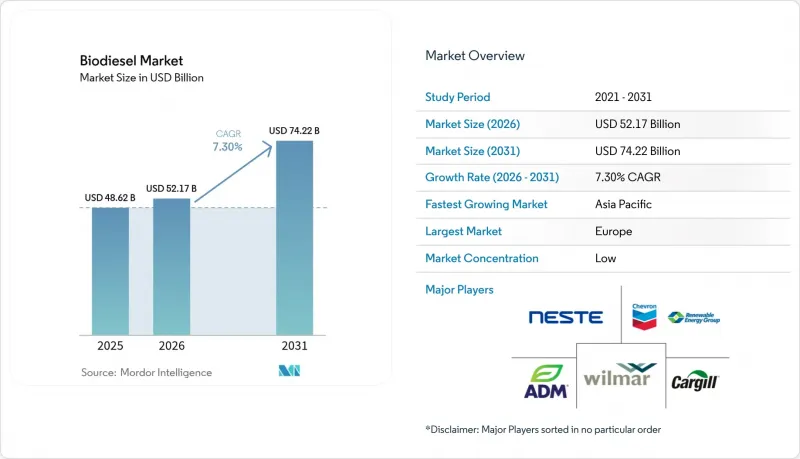
Mordor Intelligence에 따르면 바이오디젤 시장 규모는 2025년에 486억 2,000만 달러로 평가되며, 2026년 521억 7,000만 달러에서 2031년까지 742억 2,000만 달러에 달할 것으로 예측되며, 예측 기간(2026-2031년) 동안 CAGR은 7.30%가 될 전망입니다.
본 보고서는 원료(식물성 기름, 사용 후 식용유 및 동물성 지방 등), 제조 공정(에스테르 교환, 수소화 식물성 기름, 공동 처리/공동 정제 디젤), 혼합 비율(B5 이하, B6-B20, B100), 용도(운송·도로, 산업용 및 기타 등), 그리고 지역(북미, 유럽, 아시아태평양, 남미, 중동 및 아프리카)별로 분류되어 있습니다.
세계 바이오디젤 시장 동향 및 인사이트
재생 가능 연료 혼합 의무 확대
각국의 혼합 의무화 프로그램이 급속히 확대되고 있으며, 이를 통해 상당한 양의 수요가 확보되어 바이오디젤 시장 전체의 장기적인 자금 조달 기반이 마련되고 있습니다. 브라질의 ‘미래 연료법’에서는 2027년까지 의무화되는 혼합 비율을 B14에서 B17으로 상향 조정하고,2020년대 후반에는 B25로 전환될 것으로 예상되며, 이에 따라 국내 바이오디젤 사용량은 2024년 93억 리터에서 2027년까지 123억 리터로 증가할 전망입니다. 인도네시아에서는 B40 프로그램이 전개되고 있는 반면, EU 회원국들은 모두 RED-III에 따라 더 높은 수준의 첨단 바이오연료 할당 기준을 준수해야 합니다. 브리티시컬럼비아주에서는 2025년 4월 이후 디젤 연료의 재생 가능 성분 중 8%를 국내에서 생산하도록 의무화하고 있으며, 이는 규제가 점점 더 지역 공급을 우선시하는 경향을 보이고 있음을 보여줍니다. 미국에서는 재생 가능 연료 기준(RFS) 의무가 계속 유효하며, 신뢰할 수 있는 규정 준수 기준을 제공하고 있습니다. 이러한 규정은 가격 하한선을 설정함으로써 생산자가 생산능력을 확대하고 효율 향상 기술을 도입할 수 있도록 하고 있습니다.
탈탄소화가 어려운 부문에서의 ‘드롭인’ 방식 탈탄소화 추구
전기화 진전이 더딘 광업, 해운, 철도 사업자 등 각 부문에서는 인프라를 근본적으로 개조하지 않고도 단기적인 탄소 감축 목표를 달성하기 위해 바이오디젤 혼합 연료 도입이 추진되고 있습니다. 전 세계 광업 기업들은 디젤 장비에 연간 약 70억 달러를 지출하고 있지만, B20이나 재생 디젤로 전환함으로써 수명주기 배출량을 50-85% 감축하는 동시에 미세먼지 배출량을 대폭 줄일 수 있습니다. 유럽에서는 셰브론 리뉴어블 에너지 그룹(REG)이 광산 내 미세먼지 배출량을 300-800µg/m³에서 50-200µg/m³로 줄이는 EN 14214 규격의 연료를 공급하고 있습니다. 해운 분야에서는 REG와 벙커 홀딩스의 제휴를 통해 B30 도입이 진행되고 있으며, 화물 철도에서의 시범 운영을 통해 엔진과의 호환성에 문제가 없음이 입증되었습니다. 이러한 부문에서 탈탄소화를 위한 추가 비용을 지불하려는 의지가 높아지고 있는 것이 바이오디젤 시장의 높은 수익률 판매를 뒷받침하고 있습니다.
원료 가격 변동
2024년 한 해 동안 대두유 시세는 격렬하게 변동했습니다. 이는 브라질에서 고비율 블렌딩이 보급되면서 수요가 증가하고 생산자의 이익률이 압박을 받았기 때문이며, 그 결과 여러 공장에서 생산량 최적화가 진행되었습니다. LCFS 크레딧이 반영됨에 따라, 사용 후 식용유(UCO)의 가격은 버진 오일과 비슷한 수준에 가까워져, 기대되었던 비용 측면의 우위가 약화되었습니다. 네스테(Neste)사는 디젤 가격의 벤치마크가 횡보했음에도 불구하고, 2024년 이익률 부진의 주요 요인으로 원료 비용의 급등을 꼽고 있습니다. 기후 변화로 인한 혼란과 식량 및 연료를 둘러싼 갈등이 지속되면서 가격 불확실성이 더욱 커지고 있으며, 바이오디젤 시장의 각 기업은 가능한 한 원료 다각화와 헤지 전략 채택을 피할 수 없는 상황에 처해 있습니다.
부문별 분석
식물성 기름은 2025년 공급량의 63.45%를 차지하며 바이오디젤 시장의 기본 공급량을 유지하고 있지만, 정책 입안자와 구매자들이 저탄소 강도 점수를 추구함에 따라 그 성장 속도는 둔화되고 있습니다. 동남아시아에서는 팜유가, 남미에서는 대두유가 주류를 이루고 있지만, 두 원료 모두 토지 이용 위험에 대해 엄격한 시선이 쏠리고 있습니다.
폐식용유와 동물성 지방은 프리미엄 LCFS 크레딧과 새롭게 등장한 선진 바이오연료 할당량 덕분에 식용유를 크게 웃도는 연평균 성장률(CAGR) 10.15%로 확대될 것으로 전망됩니다. 브라질의 소기름 수출이 전년 대비 144% 증가한 것은 전 세계적인 차익 거래가 확대되고 있음을 시사합니다. 네스테와 바이엘의 제휴를 통한 조류 유래 유지 및 겨울용 카놀라 파일럿 프로젝트는 원료 연구 개발 분야의 선구적인 노력을 보여줍니다. 잔여물을 둘러싼 경쟁은 현재 격화되고 있으며, 이는 새로운 가격 변동을 초래하는 한편 바이오디젤 시장 전반에 걸쳐 지속가능성 기준을 꾸준히 향상시키고 있습니다.
잘 알려진 에스테르 교환법은 비교적 가벼운 자본 부담과 확립된 공급망과의 호환성 덕분에 2025년 바이오디젤 시장 규모에서 70.35%의 점유율을 유지했습니다. 이는 특히 정제 시설의 통합이 제한적인 개발도상국에서 많은 중소 규모 생산자들에게 여전히 주력 공법이 되고 있습니다.
그러나 대형 석유 회사들이 기존의 수소화 처리 설비를 활용하여 일반 디젤, SAF, 나프타 생산 라인을 구축함에 따라 HVO의 생산능력은 연평균 성장률(CAGR) 11.74%로 확대될 것으로 예측됩니다. HVO는 화석 디젤과 동등한 인프라 호환성을 갖추고 있으며, 저온 유동성 문제 없이 B100에 상응하는 연료를 생산할 수 있어 바이오디젤 시장에 큰 이점이 됩니다. 고부가가치의 산업용 글리세린과 유연한 원료 대응 범위로 인해 플랜트의 수익성이 더욱 향상되어, 유럽, 북미, 아시아태평양 전반에서 기존 설비의 전환 및 신규 건설 계획이 잇따르고 있습니다.
지역별 분석
2025년, 유럽은 전 세계 매출의 37.62%를 차지하며, RED-III 할당량, 각국의 탄소세, 그리고 폐기물 유래 원료에 대한 보조금 제도를 통해 저탄소 바이오디젤의 이용을 지속적으로 뒷받침하고 있습니다. 독일, 프랑스, 영국은 각각 2025년에 혼합 의무를 강화할 예정이며, 북유럽 국가들은 지역 내 처리를 위한 도시 쓰레기에서 유래한 사용 후 식용유(UCO) 회수에서 선구적인 역할을 수행하며, 지역의 순환 경제 목표를 뒷받침하고 있습니다. 그러나 지속가능성에 관한 인증 기준은 여전히 엄격하여 원료 선택의 폭을 제한하고 관리상의 부담을 가중시키고 있습니다.
아시아태평양은 가장 빠른 성장이 예상되며, 인도네시아가 B40을 목표로 단계적으로 비율을 높이고, 인도가 생산능력 확대를 위한 보조금을 배정하며, 중국이 바이오디젤을 ‘이산화탄소 배출 정점 및 탄소 중립’ 로드맵에 포함시킨 점 등을 고려할 때, 2031년까지 연평균 성장률(CAGR)은 10.02%로 예측됩니다. 손쉽게 구할 수 있는 팜유 공급, 도시 지역의 디젤 수요 증가, 그리고 지원적인 재정적 인센티브 덕분에 이 지역은 바이오디젤 시장에서 전략적인 성장 동력이 되고 있습니다. 그러나 유럽으로의 수출 가능성은 산림 파괴와 관련된 규제로 인해 제약을 받고 있으며, 생산자들은 추적성 프로토콜을 강화할 수밖에 없는 상황에 처해 있습니다.
북미에서는 미국 재생 가능 연료 기준(RFS)과 주 차원에서 확대되고 있는 저탄소 연료 기준(LCFS)의 모자이크형 체계를 통해 성숙한 인프라와 정책의 안정성이 유지되고 있습니다. 고도화된 크레딧 거래를 통해 수익원은 확대되고 있지만, 최근에는 LCFS 크레딧의 공급 과잉으로 인해 가격이 압박받고 있습니다. 브라질의 B25 도입을 주도하는 남미는 원료 공급 거점인 동시에 주요 국내 시장이기도 합니다. 아르헨티나 생산자들은 수출 관세라는 과제에 직면해 있지만, 대두유 생산 규모와 확립된 에스테르화 기술 덕분에 지역 내 경쟁력을 유지하고 있습니다.
기타 혜택:
- 엑셀 형식의 시장 예측(ME) 시트
- 3개월간의 애널리스트 지원
자주 묻는 질문
목차
제1장 소개
제2장 조사 방법
제3장 주요 요약
제4장 시장 구도
제5장 시장 규모와 성장 예측
제6장 경쟁 구도
제7장 시장 기회와 향후 전망
KSM 26.08.26According to Mordor Intelligence, the biodiesel market size was valued at USD 48.62 billion in 2025 and estimated to grow from USD 52.17 billion in 2026 to reach USD 74.22 billion by 2031, at a CAGR of 7.30% during the forecast period (2026-2031).
This report is Segmented by Feedstock (Vegetable Oils, Waste Cooking Oil and Tallow, and More), Production Process (Trans-Esterification, Hydro-Treated Vegetable Oil, and Co-processed/Co-refined Diesel), Blend Level (B5 and Below, B6 To B20, and B100), Application (Transportation-Road, Industrial and Others, and More), and Geography (North America, Europe, Asia-Pacific, South America, and Middle East and Africa).
Global Biodiesel Market Trends and Insights
Renewable-fuel Blend Mandates Expanding
National blend programmes are scaling rapidly, guaranteeing sizeable offtake volumes and underpinning long-term financing across the biodiesel market. Brazil's Fuel-of-the-Future law raises the obligatory blend from B14 to B17 by 2027 and foresees B25 later in the decade, lifting domestic biodiesel use from 9.3 billion litres in 2024 to 12.3 billion litres by 2027. Indonesia is rolling out its B40 programme, while all EU member states must align with higher advanced biofuel quotas under RED-III. British Columbia now insists that 8% of diesel renewable content be produced domestically from April 2025, signalling how mandates increasingly favour local supply. Renewable Fuel Standard obligations remain in force in the United States and provide a dependable compliance baseline. These rules establish price floors, enabling producers to expand capacity and adopt efficiency-enhancing technologies.
Hard-to-Abate Sectors Seeking Drop-in Decarbonisation
Mining, marine, and rail operators' segments, where electrification lags, are adopting biodiesel blends to meet near-term carbon-reduction goals without infrastructure overhauls. Global mining firms spend roughly USD 7 billion annually on diesel equipment; switching to B20 or renewable diesel delivers 50-85% lifecycle emission cuts while lowering particulate outputs sharply. In Europe, Chevron Renewable Energy Group supplies EN 14214-grade fuel that cuts particulate matter in mines from 300-800 µg m3 to 50-200 µg m3. Marine uptake is growing through REG-Bunker Holding alliances to deploy B30, and freight rail trials show seamless engine compatibility. Willingness to pay decarbonisation premiums in these sectors supports higher-margin sales within the biodiesel market.
Feedstock Price Volatility
Soybean-oil quotations oscillated sharply through 2024 as Brazil's higher blends drew more volumes, eroding producer margins and prompting output optimisation at several plants. UCO values approached virgin-oil parity once LCFS credits were incorporated, diluting expected cost advantages. Neste cited elevated feedstock costs as a principal factor behind depressed margins in 2024 despite flat diesel benchmarks. Climatic disruptions and ongoing food-versus-fuel tensions compound price uncertainty, compelling firms across the biodiesel market to diversify inputs or adopt hedging strategies where possible.
Other drivers and restraints analyzed in the detailed report include:
- HVO and SAF Capacity Build-outs
- Waste- & Residue-based Feedstock Credits
- Land-use Change Scrutiny
For complete list of drivers and restraints, kindly check the Table Of Contents.
Segment Analysis
Vegetable oils still delivered 63.45% of the 2025 supply, sustaining baseline volumes for the biodiesel market, yet their growth tempo is flattening as policymakers and buyers chase lower carbon-intensity scores. Palm oil dominates South-East Asia, whereas soybean oil prevails in the Americas, but each faces scrutiny over land-use risks.
Waste cooking oil and tallow are projected to expand at a 10.15% CAGR, well ahead of edible oils, thanks to premium LCFS credits and emerging advanced-biofuel quotas. Brazil's beef-tallow exports, rising 144% year-on-year, signal widening global arbitrage. Algae-based oils and winter-canola pilots from the Neste-Bayer alliance illustrate the exploratory edge of feedstock R&D. Competition for residues is now sharpening, inserting new price volatility while steadily raising the sustainability bar across the biodiesel market.
The familiar trans-esterification route retained 70.35% share of the biodiesel market size in 2025 by virtue of its comparatively light capital burden and well-established supply chain compatibility. It remains the mainstay for many small-to-mid producers, particularly in developing economies with limited refinery integration.
However, HVO capacity is forecast to clock a 11.74% CAGR as oil majors leverage existing hydrotreaters to create fungible diesel, SAF, and naphtha streams. The biodiesel market benefits because HVO commands infrastructure parity with fossil diesel, enabling B100 equivalents without cold-flow problems. Higher-value technical-grade glycerin and flexible feedstock windows further enhance plant returns, spurring a pipeline of conversions and greenfields across Europe, North America, and Asia-Pacific.
Complete Report Scope:
- By Feedstock
- Vegetable Oils
- Waste Cooking Oil and Tallow
- Animal Fat
- Algae and Novel Feedstocks
- By Production Process
- Trans-esterification (FAME)
- Hydro-treated Vegetable Oil (HVO)
- Co-processed/Co-refined Diesel
- By Blend Level
- B5 and Below
- B6 to B20
- B100
- By Application
- Transportation-Road
- Transportation-Marine and Rail
- Power Generation
- Industrial and Others
- By Geography
- North America
- United States
- Canada
- Mexico
- Europe
- Germany
- United Kingdom
- France
- Italy
- NORDIC Countries
- Russia
- Rest of Europe
- Asia-Pacific
- China
- India
- Japan
- South Korea
- ASEAN Countries
- Australia & New Zealand
- Rest of Asia-Pacific
- South America
- Brazil
- Argentina
- Rest of South America
- Middle East and Africa
- Saudi Arabia
- United Arab Emirates
- South Africa
- Egypt
- Rest of Middle East and Africa
- North America
Geography Analysis
Europe delivered 37.62% of global sales in 2025 and continues to reward low-carbon biodiesel through RED-III quotas, national carbon taxes, and subsidy schemes for waste-based feedstocks. Germany, France, and the United Kingdom each tightened blend obligations in 2025, and the Nordics are frontrunners in collecting municipal UCO for local processing, reinforcing regional circular-economy objectives. Sustainability certification remains stringent however, limiting feedstock choice and raising administrative overhead.
Asia-Pacific offers the fastest expansion path, showing a 10.02% CAGR projection to 2031 as Indonesia escalates toward B40, India allocates grants for capacity, and China integrates biodiesel into its dual-carbon roadmap. Accessible palm-oil supply, rising urban diesel demand, and supportive fiscal incentives make the region a strategic growth engine inside the biodiesel market. Nonetheless, export potential to Europe is checked by deforestation-linked rulings, compelling producers to upgrade traceability protocols.
North America holds mature infrastructure and policy stability via the U.S. Renewable Fuel Standard and an expanding patchwork of state-level Low Carbon Fuel Standards. Advanced credit trading deepens revenue pools, yet LCFS credit oversupply recently squeezed pricing. South America, led by Brazil's trajectory toward B25, is simultaneously a feedstock powerhouse and a major internal market. Argentina's producers navigate export tariffs but maintain competitiveness regionally through soybean-oil scale and established esterification expertise.
- Neste Oyj
- Chevron Renewable Energy Group
- Archer Daniels Midland (ADM)
- Cargill
- Bangchak Corp.
- Wilmar International
- Valero Energy
- TotalEnergies
- BP Biofuels
- Shell Renewables & Energy Solutions
- Marathon Petroleum (Green Bison)
- Louis Dreyfus Company
- Be8 Energy
- Incobrasa
- Pacific Biodiesel
- AG Processing Inc.
- Bunge Bioenergia
- Green Plains Inc.
- Eni Biofuels
- Petrobras BioRefino
Additional Benefits:
- The market estimate (ME) sheet in Excel format
- 3 months of analyst support
TABLE OF CONTENTS
1 Introduction
- 1.1 Study Assumptions & Market Definition
- 1.2 Scope of the Study
2 Research Methodology
3 Executive Summary
4 Market Landscape
- 4.1 Market Overview
- 4.2 Market Drivers
- 4.2.1 Renewable-fuel blend mandates expanding (B5 to B20) in U.S., Brazil, Indonesia, EU
- 4.2.2 Demand from hard-to-abate sectors (mining, marine, rail) seeking drop-in low-carbon fuels
- 4.2.3 HVO/SAF capacity build-outs by oil majors (TotalEnergies, BP, Shell) drive glycerin off-take
- 4.2.4 Waste- & residue-based feedstock credits (UCO, tallow) widen biodiesel-diesel margin
- 4.2.5 Co-processing tech lowering CAPEX via existing refineries
- 4.2.6 Carbon-intensity (CI) score premiums on LCFS & EU ETS
- 4.3 Market Restraints
- 4.3.1 Feedstock price volatility (soy-oil, tallow) squeezes margins
- 4.3.2 Land-use change scrutiny & EU RED-II cap on food-crop biofuels
- 4.3.3 Oversupply of low-CI credits in U.S. LCFS depresses biodiesel prices
- 4.3.4 Electrification of light-duty fleets slows on-road diesel pool
- 4.4 Supply-Chain Analysis
- 4.5 Regulatory Landscape & Government Policies
- 4.6 Technological Outlook (FAME, HVO, co-processing, algae)
- 4.7 Porter's Five Forces
- 4.7.1 Bargaining Power of Suppliers
- 4.7.2 Bargaining Power of Buyers
- 4.7.3 Threat of New Entrants
- 4.7.4 Threat of Substitutes
- 4.7.5 Intensity of Competitive Rivalry
- 4.8 Investment Analysis
5 Market Size & Growth Forecasts
- 5.1 By Feedstock
- 5.1.1 Vegetable Oils
- 5.1.2 Waste Cooking Oil and Tallow
- 5.1.3 Animal Fat
- 5.1.4 Algae and Novel Feedstocks
- 5.2 By Production Process
- 5.2.1 Trans-esterification (FAME)
- 5.2.2 Hydro-treated Vegetable Oil (HVO)
- 5.2.3 Co-processed/Co-refined Diesel
- 5.3 By Blend Level
- 5.3.1 B5 and Below
- 5.3.2 B6 to B20
- 5.3.3 B100
- 5.4 By Application
- 5.4.1 Transportation-Road
- 5.4.2 Transportation-Marine and Rail
- 5.4.3 Power Generation
- 5.4.4 Industrial and Others
- 5.5 By Geography
- 5.5.1 North America
- 5.5.1.1 United States
- 5.5.1.2 Canada
- 5.5.1.3 Mexico
- 5.5.2 Europe
- 5.5.2.1 Germany
- 5.5.2.2 United Kingdom
- 5.5.2.3 France
- 5.5.2.4 Italy
- 5.5.2.5 NORDIC Countries
- 5.5.2.6 Russia
- 5.5.2.7 Rest of Europe
- 5.5.3 Asia-Pacific
- 5.5.3.1 China
- 5.5.3.2 India
- 5.5.3.3 Japan
- 5.5.3.4 South Korea
- 5.5.3.5 ASEAN Countries
- 5.5.3.6 Australia & New Zealand
- 5.5.3.7 Rest of Asia-Pacific
- 5.5.4 South America
- 5.5.4.1 Brazil
- 5.5.4.2 Argentina
- 5.5.4.3 Rest of South America
- 5.5.5 Middle East and Africa
- 5.5.5.1 Saudi Arabia
- 5.5.5.2 United Arab Emirates
- 5.5.5.3 South Africa
- 5.5.5.4 Egypt
- 5.5.5.5 Rest of Middle East and Africa
- 5.5.1 North America
6 Competitive Landscape
- 6.1 Market Concentration
- 6.2 Strategic Moves (M&A, Partnerships, PPAs)
- 6.3 Market Share Analysis (Market Rank/Share for key companies)
- 6.4 Company Profiles (includes Global level Overview, Market level overview, Core Segments, Financials as available, Strategic Information, Products & Services, and Recent Developments)
- 6.4.1 Neste Oyj
- 6.4.2 Chevron Renewable Energy Group
- 6.4.3 Archer Daniels Midland (ADM)
- 6.4.4 Cargill
- 6.4.5 Bangchak Corp.
- 6.4.6 Wilmar International
- 6.4.7 Valero Energy
- 6.4.8 TotalEnergies
- 6.4.9 BP Biofuels
- 6.4.10 Shell Renewables & Energy Solutions
- 6.4.11 Marathon Petroleum (Green Bison)
- 6.4.12 Louis Dreyfus Company
- 6.4.13 Be8 Energy
- 6.4.14 Incobrasa
- 6.4.15 Pacific Biodiesel
- 6.4.16 AG Processing Inc.
- 6.4.17 Bunge Bioenergia
- 6.4.18 Green Plains Inc.
- 6.4.19 Eni Biofuels
- 6.4.20 Petrobras BioRefino
7 Market Opportunities & Future Outlook
- 7.1 White-space & Unmet-need Assessment


