|
시장보고서
상품코드
2116021
인도네시아의 배터리 : 시장 점유율 분석, 업계 동향과 통계, 성장 예측(2026-2031년)Indonesia Battery - Market Share Analysis, Industry Trends & Statistics, Growth Forecasts (2026 - 2031) |
||||||
 Mordor Intelligence
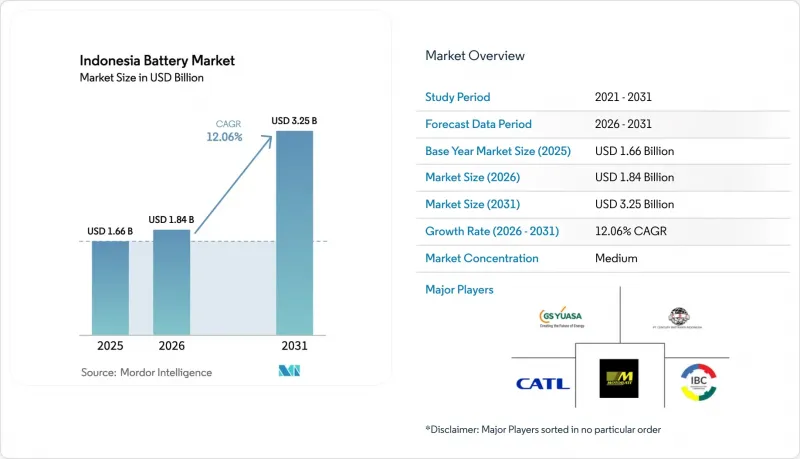
Mordor Intelligence에 따르면 인도네시아의 배터리 시장 규모는 2025년에 16억 6,000만 달러로 평가되며, 2026년 18억 4,000만 달러에서 성장하여 예측 기간(2026-2031년) 동안 CAGR 12.06%를 기록하며 2031년에는 32억 5,000만 달러에 달할 것으로 추정됩니다.
본 보고서는 배터리 종류(1차 전지 및 2차 전지), 기술(납산, 리튬 이온, 니켈 수소, 니켈 카드뮴, 나트륨 황, 전고체, 흐름 전지 및 신흥 화학 기술), 용도(자동차, 산업용, 휴대용, 전동 공구, SLI 및 기타 용도)별로 분류되어 있습니다. 시장 규모 및 전망은 금액(달러) 기준으로 제시되어 있습니다.
인도네시아 배터리 시장의 동향 및 인사이트
풍부한 국내 니켈 자원이 다운스트림 산업 육성 정책을 뒷받침
인도네시아는 2024년에 220만 톤의 니켈을 생산했으며, 이는 세계 생산량의 59%에 해당합니다. 한편, 2020년 광석 수출 금지 조치로 인해 국내 가공이 의무화되면서 8년 만에 제련소 수가 2곳에서 44곳으로 확대되었습니다. 이 정책으로 인해 배터리 산업 체인에 대한 투자 약정액은 320억 달러에 달했으나, 정제 능력의 61%가 중국 기업에 집중되면서 해외 기술에 대한 의존도가 높아지고 있습니다. HPAL(고압 산 침출법)의 CO2 환산 20-25kg에 달하는 배출 프로필을 둘러싼 ESG상의 압력으로 인해, 현재는 재생에너지 도입이 시급해졌으며, 프로젝트의 설비 투자가 증가하고 있습니다. CATL이 60억 달러를 투자한 카라왕 복합 단지는 이러한 전환을 상징하는 사례로, 폐쇄형 재활용을 통해 니켈 원료를 공급함으로써 수출 시장의 엄격한 추적성 규제를 충족하고 있습니다.
재정적 인센티브에 힘입은 전기자동차 및 전기 오토바이 투자 급증
자카르타 정부는 7조 루피아의 보조금을 지원하고, 부가가치세(VAT)를 11%에서 1%로 인하하며, 대상 모델에 대한 수입 관세를 면제한 결과, 2024년 전기자동차 판매 대수는 전년 대비 73% 증가한 4만 4,557대에 달했습니다. 그러나 총 소유 비용(TCO)이 가솔린 차량과 동등해지기 위해서는 현재 평균 주행 거리인 34km에 비해 하루 84km를 주행해야 하므로, 초기 단계에서는 보조금이 여전히 필수적입니다. TKDN(국내 부품 사용률) 기준은 2027년에 60%, 2030년에 80%로 상향 조정되어, 각 OEM 업체들은 배터리 팩과 모터의 현지 생산을 서둘러야 하는 상황입니다. 현대·LG의 10GWh 생산 라인과 BYD의 연간 15만 대 규모 공장이 이러한 움직임의 선봉에 서 있습니다. 라이드셰어링 차량군은 배터리 교환의 실현 가능성을 입증하고 있으며, Grab과 Gojek은 8개 도시에서 1만 대 이상의 전기이륜차를 운영하고 있고, 1,200곳의 교환 스테이션이 이를 뒷받침하고 있습니다.
수입 리튬 염 및 전구체 화학제품에 대한 의존
경제적으로 수익성이 있는 리튬 매장량을 보유하고 있지 않기 때문에각 제조사들은 탄산리튬과 수산화리튬을 주로 중국에서, 2025년 8월 이후부터는 호주에서도 수입하고 있으며, 2020년부터 2024년까지 톤당 6,000-8만 3,000달러 범위에서 변동한 가격 변동의 영향을 받아 비용 구조가 불안정해지고 있습니다. CATL의 카라완 사업장에서는 연간 3만 톤의 양극재를 처리할 수 있지만, 여전히 수입 원료가 필요하며, 이로 인해 이익률이 압박받고 있습니다. 중국의 흑연 수출 규제는 공급망의 취약성을 더욱 높이고 있으며, 이에 따라 유엔 프로젝트 서비스 기구(UNOPS)는 비축 및 재활용 의무화를 요청하고 있으나, 현재로서는 어느 쪽도 법제화되지 않았습니다.
부문별 분석
2025년, 인도네시아 배터리 시장 점유율의 91.3%를 충전식 배터리가 차지했으며, 전기자동차 도입 의무 및 재생에너지의 균형 조정을 위한 축전 수요에 힘입어 2031년까지 연평균 성장률(CAGR) 13.1%로 확대될 전망입니다. 한편, 소비자들이 USB 충전식 기기로 전환함에 따라 1차 전지는 구조적인 감소에 직면해 있습니다. CATL, 현대·LG, BYD의 설비 도입으로 인도네시아의 2차 배터리 시장 규모는 정부가 제시한 2030년 목표인 140 GWh에 가까워지고 있지만, 리튬 수입에 대한 의존도는 여전히 지속되고 있습니다. 정령 제69/2024호에 따라 1차 전지의 안전 기준이 강화되면서, 저비용 수입업체들 간의 업계 재편이 가속화되고 있습니다.
기존 건배터리 시장의 선두주자인 PT Intercallin사는 리튬 생산을 추가하여 리스크 헤지를 도모하고 있지만, 리모컨이나 의료기기 등에서는 여전히 틈새 시장인 1차 전지 용도가 남아 있습니다. 그러나 오프그리드 태양광 랜턴이나 농촌 지역 기기에서의 충전식 제품 보급으로 인해 이러한 틈새 시장조차 잠식당하고 있습니다. 또한, 고급차 부문에서 리튬이온 SLI로의 대체가 진행됨에 따라, 납산 시동용 배터리 제품 라인에 대한 압박도 커지고 있습니다.
기타 혜택:
- 엑셀 형식의 시장 예측(ME) 시트
- 3개월간의 애널리스트 지원
자주 묻는 질문
목차
제1장 소개
제2장 조사 방법
제3장 주요 요약
제4장 시장 구도
제5장 시장 규모와 성장 예측
제6장 경쟁 구도
제7장 시장 기회와 향후 전망
KSM 26.08.26According to Mordor Intelligence, the Indonesia battery market size was valued at USD 1.66 billion in 2025 and is estimated to grow from USD 1.84 billion in 2026 to reach USD 3.25 billion by 2031, at a CAGR of 12.06% during the forecast period (2026-2031).
This report is Segmented by Battery Type (Primary Batteries and Secondary Batteries), Technology (Lead-Acid, Li-Ion, Nickel-Metal Hydride, Nickel-Cadmium, Sodium-Sulfur, Solid-State, Flow Battery, and Emerging Chemistries), and Application (Automotive, Industrial, Portable, Power Tools, SLI, and Other Applications). The Market Sizes and Forecasts are Provided in Terms of Value (USD).
Indonesia Battery Market Trends and Insights
Abundant Domestic Nickel Resources Enabling Downstreaming Policy
Indonesia produced 2.2 million t of nickel in 2024, equal to 59% of global output, while its 2020 ore-export ban forced in-country processing, expanding smelter count from 2 to 44 within eight years. The policy attracted USD 32 billion in pledged battery-chain capital but concentrated 61% of refining capacity with Chinese firms, creating dependency on foreign know-how. ESG pressure around HPAL's 20-25 kg CO2-equivalent profile now compels renewable power integration, increasing project capex. CATL's USD 6 billion Karawang complex illustrates the shift, linking nickel feed through closed-loop recycling to meet strict export-market traceability rules.
Surge in EV & e-Motorcycle Investments Backed by Fiscal Incentives
Jakarta allocated IDR 7 trillion subsidies, cut VAT from 11% to 1%, and waived import duties for qualifying models, lifting 2024 EV sales 73% year-over-year to 44,557 units. Yet total cost-of-ownership parity still needs 84 km daily mileage versus the current 34 km average, so up-front subsidies stay critical. TKDN thresholds jump to 60% in 2027 and 80% in 2030, pushing OEMs to localize packs and motors; Hyundai-LG's 10 GWh line and BYD's 150,000-unit plant are early movers. Ride-hailing fleets showcase battery-swap viability, with Grab and Gojek fielding 10,000+ two-wheel EVs across eight cities, supported by 1,200 swap stations.
Dependence on Imported Lithium Salt & Precursor Chemicals
With no economic lithium reserves, manufacturers import carbonate and hydroxide mainly from China and, since August 2025, Australia, exposing cost bases to price swings that ranged USD 6,000-83,000 t between 2020 and 2024. CATL's Karawang hub can process 30,000 t cathode annually but still needs imported feed, limiting margins. China's graphite export controls add another layer of supply-chain fragility, prompting UNOPS to urge stockpiling and recycling mandates, none legislated yet.
Other drivers and restraints analyzed in the detailed report include:
- Rapid Uptake of Consumer Electronics and IoT Devices
- Utility-Scale Energy-Storage Tenders to Balance Renewables
- Patchy Charging / Swap Infrastructure Outside Java Corridor
For complete list of drivers and restraints, kindly check the Table Of Contents.
Segment Analysis
Rechargeable cells secured 91.3% of the Indonesian battery market share in 2025 and will expand at a 13.1% CAGR to 2031, lifted by EV mandates and renewable-balancing storage. Primary formats face structural decline as consumers migrate to USB-rechargeable devices. CATL, Hyundai-LG, and BYD installations bring Indonesia's battery market size for secondary cells toward the government's 140 GWh 2030 target, though lithium-import exposure endures. Regulation No. 69/2024 raises safety hurdles for primary cells, accelerating consolidation among low-cost importers.
Legacy dry-cell leader PT Intercallin hedged by adding lithium output, while niche primary use persists in remote controls and medical devices. Yet rechargeable uptake in off-grid solar lanterns and rural devices erodes even these pockets. Pressure on lead-acid starter-battery lines also rises as premium car segments adopt lithium-ion SLI replacements.
Complete Report Scope:
- By Battery Type
- Primary Batteries
- Secondary Batteries
- By Technology
- Lead-acid
- Li-ion
- Nickel-metal hydride
- Nickel-cadmium
- Sodium-sulfur
- Solid-state
- Flow Battery
- Emerging chemistries
- By Application
- Automotive (HEV, PHEV, and EV)
- Industrial (Motive, Stationary (Telecom, UPS, ESS), etc.)
- Portable (Consumer Electronics, etc.)
- Power Tools
- SLI
- Other Applications
List of Companies Covered in this Report:
- GS Yuasa Corporation
- Contemporary Amperex Technology Ltd (CATL)
- PT Century Batteries Indonesia (Nipress)
- PT Indonesia Battery Corporation (IBC)
- PT Motobatt Indonesia
- The Furukawa Battery Co Ltd
- FDK Corporation
- Energizer Holdings Inc.
- BYD Company Ltd
- LG Energy Solution
- Samsung SDI Co Ltd
- Panasonic Energy Co Ltd
- VARTA AG
- Murata Manufacturing Co Ltd
- CALB Co Ltd
- SVOLT Energy Technology
- PT New Indobatt Energy Nusantara
- PT Hartono Istana Technology (Polytron)
- PT HLI Green Power (Hyundai-LG JV)
- PT International Chemitech Battery (ABC)
Additional Benefits:
- The market estimate (ME) sheet in Excel format
- 3 months of analyst support
TABLE OF CONTENTS
1 Introduction
- 1.1 Study Assumptions & Market Definition
- 1.2 Scope of the Study
2 Research Methodology
3 Executive Summary
4 Market Landscape
- 4.1 Market Overview
- 4.2 Market Drivers
- 4.2.1 Abundant domestic nickel resources enabling downstreaming policy
- 4.2.2 Surge in EV & e-motorcycle investments backed by fiscal incentives
- 4.2.3 Rapid uptake of consumer electronics and IoT devices
- 4.2.4 Utility-scale energy-storage tenders to balance renewables
- 4.2.5 Battery-as-a-Service swap-station roll-outs by ride-hailing firms
- 4.3 Market Restraints
- 4.3.1 Dependence on imported lithium salt & precursor chemicals
- 4.3.2 Patchy charging/swap infrastructure outside Java corridor
- 4.3.3 ESG scrutiny of HPAL nickel processing raising financing risk
- 4.3.4 Commodity-price volatility eroding margin planning
- 4.4 Supply-Chain Analysis
- 4.5 Regulatory & Standards Landscape
- 4.6 Technological Outlook
- 4.7 Porter's Five Forces
- 4.7.1 Threat of New Entrants
- 4.7.2 Bargaining Power of Suppliers
- 4.7.3 Bargaining Power of Buyers
- 4.7.4 Threat of Substitutes
- 4.7.5 Industry Rivalry
- 4.8 PESTLE Analysis
5 Market Size & Growth Forecasts
- 5.1 By Battery Type
- 5.1.1 Primary Batteries
- 5.1.2 Secondary Batteries
- 5.2 By Technology
- 5.2.1 Lead-acid
- 5.2.2 Li-ion
- 5.2.3 Nickel-metal hydride
- 5.2.4 Nickel-cadmium
- 5.2.5 Sodium-sulfur
- 5.2.6 Solid-state
- 5.2.7 Flow Battery
- 5.2.8 Emerging chemistries
- 5.3 By Application
- 5.3.1 Automotive (HEV, PHEV, and EV)
- 5.3.2 Industrial (Motive, Stationary (Telecom, UPS, ESS), etc.)
- 5.3.3 Portable (Consumer Electronics, etc.)
- 5.3.4 Power Tools
- 5.3.5 SLI
- 5.3.6 Other Applications
6 Competitive Landscape
- 6.1 Market Concentration
- 6.2 Strategic Moves (M&A, Partnerships, PPAs)
- 6.3 Market Share Analysis (Market Rank/Share for key companies)
- 6.4 Company Profiles (includes Global level Overview, Market level overview, Core Segments, Financials as available, Strategic Information, Products & Services, and Recent Developments)
- 6.4.1 GS Yuasa Corporation
- 6.4.2 Contemporary Amperex Technology Ltd (CATL)
- 6.4.3 PT Century Batteries Indonesia (Nipress)
- 6.4.4 PT Indonesia Battery Corporation (IBC)
- 6.4.5 PT Motobatt Indonesia
- 6.4.6 The Furukawa Battery Co Ltd
- 6.4.7 FDK Corporation
- 6.4.8 Energizer Holdings Inc.
- 6.4.9 BYD Company Ltd
- 6.4.10 LG Energy Solution
- 6.4.11 Samsung SDI Co Ltd
- 6.4.12 Panasonic Energy Co Ltd
- 6.4.13 VARTA AG
- 6.4.14 Murata Manufacturing Co Ltd
- 6.4.15 CALB Co Ltd
- 6.4.16 SVOLT Energy Technology
- 6.4.17 PT New Indobatt Energy Nusantara
- 6.4.18 PT Hartono Istana Technology (Polytron)
- 6.4.19 PT HLI Green Power (Hyundai-LG JV)
- 6.4.20 PT International Chemitech Battery (ABC)
7 Market Opportunities & Future Outlook
- 7.1 White-space & Unmet-Need Assessment