

|
시장보고서
상품코드
2116866
선박용 배터리 시장 : 시장 점유율 분석, 업계 동향 및 통계, 성장 예측(2026-2031년)Global Marine Battery - Market Share Analysis, Industry Trends & Statistics, Growth Forecasts (2026 - 2031) |
||||||
 Mordor Intelligence
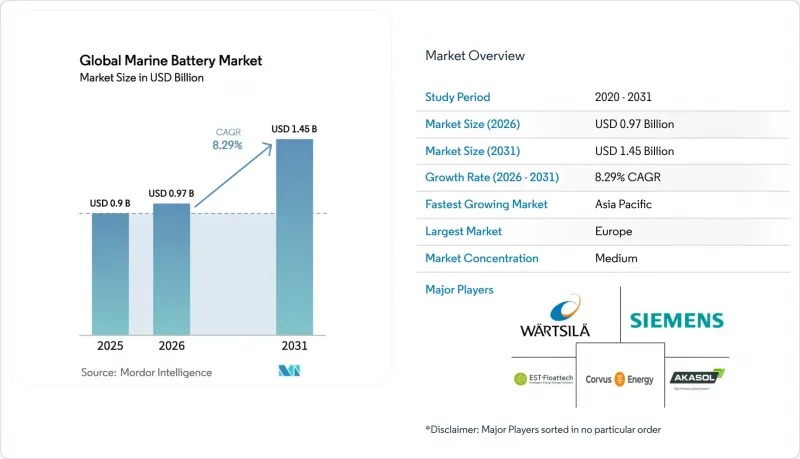
선박용 배터리 시장 규모는 2025년 9억 달러로 평가되었고, 2026년에는 9억 7,000만 달러로 추정되고, 2026-2031년 CAGR 8.29%로 성장을 지속할 전망이며, 2031년까지 14억 5,000만 달러에 이를 것으로 예측됩니다.
본 보고서는 배터리 유형별(리튬이온, 납산 등), 추진 방식별(하이브리드 전기, 완전 전기 등), 선박 유형별(상업용 및 국방용), 기능별(딥 사이클, 듀얼 퍼포스 등), 용량 범위 및 지역별로 분류되어 있습니다. 시장 전망은 금액(달러) 기준으로 제시되어 있습니다.
세계의 선박용 배터리 시장 동향 및 인사이트
IMO 2020 및 EU의 ‘Fit-for-55’ 배출 규제가 전기화를 가속화
세계 및 각 지역의 기후 정책이 조화를 이루면서, 선박용 배터리는 규제 준수에 필수적인 수단이 되었습니다. 2025년부터는 ‘FuelEU Maritime’에 따라 정박 중인 선박은 육상 전원에 연결하거나 제로 배출 기술을 사용해야 하며, IMO는 2030년까지 온실가스를 20% 감축하는 목표를 설정하고 있습니다. 따라서 운항 사업자들은 배터리 팩을 치솟는 탄소 배출 과징금을 피하고, 항만 접근성을 확보하며, 선박의 수명 기간 동안 운영 비용을 절감하기 위한 직접적인 수단으로 인식하고 있습니다.
LFP/LTO 계열 배터리의 급격한 비용 하락이 근해 항로 선박의 TCO를 개선
금속 가격 변동에도 불구하고, 인산철리튬 및 티타네이트리튬 셀 가격은 계속 하락하고 있으며, 2030년까지 40-50% 하락할 것으로 예측됩니다. 실제 페리 데이터에 따르면, 전기 선박의 연간 운항 비용은 600-800유로인 반면, 동급 디젤 선박은 3,000-4,000유로로, 운항 비용을 최대 80% 절감하고 있습니다. LFP 기반 배터리 팩이 가진 긴 사이클 수명, 고유한 안전성, 그리고 유지보수의 용이성은 100해리 미만의 항로에서 매우 매력적인 경제성을 제공합니다.
개조를 위한 조선소의 가동 능력 부족이 설치의 병목 현상을 초래하고 있습니다.
해상 풍력 발전 설비 및 LNG 운반선 수주를 담당하는 조선소는 가동률 한계에 다다르고 있으며, 특수 선박의 일당 비용이 35만 달러까지 치솟아 예약 대기 기간도 길어지고 있습니다. 페리 운항사는 현재 배터리 교체 공사를 위해 수년을 기다려야 하는 상황이며, 이는 해양 배터리 시장의 단기적인 수요를 미루는 요인이 되고 있습니다.
부문 분석
리튬 이온 배터리는 2025년에 매출 점유율의 65.62%를 차지했으며, 페리 및 근해 노선의 전기화에서 계속해서 표준 기술로 자리 잡고 있습니다. 리튬이온 시스템용 해양 배터리 시장 규모는 팩 가격 하락과 사이클 수명 향상에 따라 2031년까지 한 자릿수 후반의 높은 성장률로 확대될 것으로 예측됩니다. 한편, 고체 배터리는 에너지 밀도를 최대 3배까지 높이고 본질적으로 안전한 고체 전해질을 채택함으로써 연평균 성장률(CAGR) 9.14%의 성장 기회를 가져올 것입니다. 15분 이내에 80%까지 충전 가능한 실증용 모듈이 현재 시험 운항 중인 페리에 도입되기 시작했으며, 이는 해양 배터리 시장의 전환점을 시사합니다.
온도 변동에 대한 내성 향상과 액체 전해질의 제거로 인해, 좁은 기관실에서 부피가 큰 냉각 장치의 필요성이 줄어듭니다. 일부 주요 조선소는 양산 규모의 고체 배터리 팩 가격이 2029년경 kWh당 100달러에 달할 것으로 전망하고 있으며, 이로 인해 초기 비용의 부담감이 줄어들 것으로 보입니다. 납산 시스템은 무게 증가라는 단점보다 비용 효율이 우선시되는 백업 용도로 계속해서 채택되고 있는 반면, 니켈 카드뮴 배터리는 틈새 시장인 국방 프로그램에 국한되어 있습니다. 연료전지 하이브리드는 대양 횡단 항로에서는 유망한 것으로 평가되지만, 1,000해리 미만의 운항에서는 자본 효율 측면에서 여전히 배터리에 뒤처지고 있습니다.
하이브리드 전기 구동 방식은 디젤 항속 거리를 유지하면서 연료 소비를 최대 25%까지 줄일 수 있기 때문에 2025년에는 해양 배터리 시장 점유율의 63.72%를 차지했습니다. 선단 데이터에 따르면, 내연 기관을 계속 탑재하는 편이 승무원의 숙련도, 선급 협회의 승인 절차, 그리고 항만에서의 충전 시간 확보 면에서 더 간편한 것으로 나타났습니다. 그럼에도 불구하고, 육상 인프라의 급속한 확대와 대용량 배터리 팩의 비용 감소로 인해 완전 전기식 신조선은 연평균 성장률(CAGR) 10.39%로 성장을 지속하고, 있습니다. 따라서 해양 배터리 시장은 양극화된 양상을 보이고 있으며, 개조 선박에서는 하이브리드가 주류를 이루는 반면, 고정 페리 노선의 신조 선박에서는 완전 전기식 설계가 주도적인 위치를 차지하고 있습니다.
현재, 에너지 관리 소프트웨어가 배터리, 발전기 및 선내 부하를 실시간으로 조정함으로써 자산 가동률을 높이고 유지보수 비용을 절감하고 있습니다. 북유럽의 개조 프로젝트에 따르면, 항구에 메가와트급 충전기가 설치되면 선주들은 첫 번째 드라이독 입도 주기 내에 하이브리드 방식에서 완전 전기식으로 전환할 계획을 세우는 경우가 많은 것으로 나타났습니다. 모듈식 DC 허브 아키텍처를 통해 대규모 배선 변경 없이도 추가 랙을 통합할 수 있어 전환 과정이 더욱 간소화되고 있습니다.
지역별 분석
유럽은 법적으로 구속력 있는 온실가스 배출 상한선과 넉넉한 항만 보조금 덕분에 2025년에 매출 점유율의 42.20%를 차지했습니다. 이 지역의 선박용 배터리 시장은 페리와 피더선이 하루에 여러 번 항구에 기항하는 밀집된 근해 항로망의 혜택을 받고 있어, 육상 충전의 실용화가 진행되고 있습니다. 북유럽이 조기 도입을 주도하고 있지만, 지중해 지역의 조선소들도 현재 2030년 부두 배출 규제에 대응하기 위해 크루즈 페리 신조선에 배터리실을 설치하기 시작했습니다.
아시아태평양은 중국의 ‘탄소 제로 양쯔강 계획’과 50 MWh급 전기 컨테이너선의 취항에 힘입어, 선박용 배터리 시장에서 11.36%라는 가장 높은 연평균 성장률(CAGR)을 기록하고 있습니다. 한국 및 일본의 조선소는 설계 노하우와 국내 리튬 공급을 제공합니다. 아세안(ASEAN) 국가들도 이에 뒤이어, 말레이시아가 계획 중인 조호르 공장은 어선, 예인선, 섬 간 페리에 대한 지역 수요를 목표로 하고 있습니다.
북미에서는 방위 관련 계약과 워싱턴주, 알래스카주, 뉴욕주의 주영 페리 현대화를 배경으로 꾸준한 성장이 나타나고 있습니다. 내륙 수로에서도 바지선 운항 사업자들이 곡물 및 석탄 고정 항로에서 배터리식 푸시보트의 시범 운행을 진행하고 있어, 이에 더욱 탄력이 붙고 있습니다. 라틴아메리카와 아프리카는 현재 시장 규모가 작지만, 리튬 자원을 보유하고 있으며 새로운 항만 현대화 계획도 추진되고 있어 장기적으로는 수요가 확대될 가능성이 있습니다. 중동의 해양 개발 사업자들도 시추 장비 인근의 배출량을 줄이기 위해 배터리 하이브리드 방식의 서비스 선박 도입을 검토하고 있습니다.
기타 혜택 :
- 엑셀 형식 시장 예측(ME) 시트
- 3개월간의 애널리스트 지원
자주 묻는 질문
목차
제1장 시동
제2장 조사 방법
제3장 개요
제4장 시장 구도
제5장 시장 규모 및 성장 예측
제6장 경쟁 구도
제7장 시장 기회 및 향후 전망
AJY 26.09.01According to Mordor Intelligence, the marine battery market size is expected to grow from USD 0.90 billion in 2025 to USD 0.97 billion in 2026 and is forecast to reach USD 1.45 billion by 2031 at 8.29% CAGR over 2026-2031.
This report is Segmented by Battery Type (Lithium-Ion, Lead-Acid, and More), Propulsion Type (Hybrid Electric, Fully Electric, and More), Ship Type (Commercial and Defense), Function (Deep-Cycle, Dual-Purpose, and More), Capacity Range, and Geography. The Market Forecasts are Provided in Terms of Value (USD).
Global Marine Battery Market Trends and Insights
IMO 2020 & EU Fit-for-55 Emission Mandates Accelerating Electrification
Global and regional climate policies have aligned, making marine batteries an essential compliance tool. From 2025, FuelEU Maritime forces ships at berth to connect to shore power or use zero-emission technologies, and the IMO sets a 20% greenhouse-gas reduction target by 2030 . Operators, therefore, see battery packs as a direct route to avoid escalating carbon penalties, protect port access, and unlock lower running costs over the vessel's life.
Rapid Cost Decline of LFP/LTO Chemistries Improves TCO for Short-Sea Vessels
Cell prices for lithium iron phosphate and lithium titanate oxide continue to fall despite metal volatility, with a 40-50% drop expected by 2030. Real-world ferry data shows electric boats run for EUR 600-800 per year versus EUR 3,000-4,000 for similar diesel craft, cutting operating costs by up to 80%. The long cycle life, inherent safety, and lower maintenance of LFP-based packs deliver compelling economics on routes below 100 nautical miles.
Scarce Shipyard Capacity for Retrofits Causing Installation Bottlenecks
Yards that handle offshore wind and LNG carrier orders are close to capacity, pushing day rates up to USD 350,000 for specialized vessels and lengthening booking windows. Ferry operators now face multi-year waits for battery conversions, which defers near-term demand for the marine battery market .
Other drivers and restraints analyzed in the detailed report include:
- European Green-Port Incentives for Zero-Emission Berthing
- Expansion of Inland-Waterway Logistics Corridors in China & U.S. Pushes Battery Barges
- Thermal-Runaway Safety Concerns for Large Battery Rooms
For complete list of drivers and restraints, kindly check the Table Of Contents.
Segment Analysis
Lithium-ion chemistry held 65.62% revenue share in 2025 and remains the baseline for ferry and short-sea electrification. The marine battery market size for lithium-ion systems is projected to expand at high single-digit rates through 2031 as pack prices decline and cycle life improves. Solid-state variants, however, present a 9.14% CAGR opportunity by delivering up to triple energy density and an inherently safer solid electrolyte. Demonstrator modules charging to 80% in under 15 minutes are now entering pilot ferries, signaling an inflection point for the marine battery market.
Greater tolerance to temperature swings and elimination of liquid electrolytes reduce the need for bulky cooling gear in tight engine rooms. Several large shipyards expect production-scale solid-state packs to reach USD 100 per kWh around 2029, which should narrow the upfront premium. Lead-acid systems persist in backup roles where cost sensitivity outweighs weight penalties, while nickel-cadmium remains limited to niche defense programs. Fuel-cell hybrids, although promising for trans-ocean routes, continue to trail batteries in capital efficiency for sub-1,000 nautical-mile operations.
Hybrid-electric configurations captured 63.72% marine battery market share in 2025 because they cut fuel burn by up to 25% while retaining diesel range. Fleet data shows crew familiarization, class-approval processes, and port-charging windows are simpler when combustion engines remain on board. Still, fully electric newbuilds post a 10.39% CAGR thanks to rapidly expanding shore infrastructure and the falling cost of high-capacity packs. The marine battery market, therefore, follows a two-speed path where hybrids dominate retrofits and fully electric designs lead newbuilds on fixed ferry routes.
Energy-management software now orchestrates battery, generator, and hotel loads in real time, improving asset utilization and reducing maintenance. Conversion projects in Northern Europe demonstrate that once ports install megawatt-scale chargers, owners often plan to switch from hybrid to full electric within the first dry-dock cycle. Modular DC-hub architecture further simplifies the transition by allowing extra racks to be slotted in without major rewiring.
Complete Report Scope:
- By Battery Type
- Lithium-ion
- LFP
- NMC/NCA
- LTO
- Lead-acid
- Nickel-cadmium
- Fuel Cell (PEM, SOFC)
- Solid-state
- Lithium-ion
- By Propulsion Type
- Hybrid Electric
- Fully Electric
- Auxiliary / Hotel Loads
- By Ship Type
- Commercial
- Ferries & RoPax
- Cargo & Container
- Offshore Support & Wind SOV
- Inland Waterway & Barges
- Passenger & Leisure Craft
- Defense
- Naval Surface Combatants
- Submarines & UUVs
- Commercial
- By Function
- Starting
- Deep-cycle
- Dual-purpose
- By Capacity Range
- Less than 1 MWh
- 1 - 5 MWh
- Greater than 5 MWh
- By Geography
- North America
- United States
- Canada
- Rest of North America
- South America
- Brazil
- Chile
- Rest of South America
- Europe
- Germany
- United Kingdom
- France
- Italy
- Spain
- Rest of Europe
- Asia-Pacific
- China
- Japan
- South Korea
- India
- Australia
- Rest of Asia-Pacific
- Middle East and Africa
- United Arab Emirates
- Saudi Arabia
- Israel
- South Africa
- Rest of Middle East and Africa
- North America
Geography Analysis
Europe commanded 42.20% revenue share in 2025 owing to legally binding greenhouse-gas caps and generous port subsidies. The marine battery market in the bloc benefits from a dense short-sea network where ferries and feeders call at ports several times a day, making shore-charging practical. Northern Europe tops early adoption, yet Mediterranean yards are now inserting battery rooms into cruise-ferry newbuilds to meet the 2030 berth-emission rule.
Asia-Pacific posts the fastest 11.36% CAGR for the marine battery market, led by China's zero-carbon Yangtze program and the launch of a 50 MWh electric container ship. South Korean and Japanese yards contribute design know-how and domestic lithium supply. ASEAN countries follow, with Malaysia's planned Johor plant targeting regional demand for fishing boats, tugs, and inter-island ferries.
North America shows steady growth on the back of defense contracts and state ferry upgrades in Washington, Alaska, and New York. Inland waterways add further momentum, as barge operators trial battery push-boats on fixed grain and coal routes. Latin America and Africa remain small today but possess lithium resources and new port modernization plans that could lift long-term uptake. Middle Eastern offshore operators also explore battery-hybrid service craft to cut emissions near rigs.
- Corvus Energy
- Siemens AG
- EST-Floattech B.V
- Wartsila Corporation
- Akasol AG
- Saft Batteries
- EnerSys
- Tesvolt Ocean GmbH
- AYK Energy
- Leclanche SA
- Shift Clean Energy (PBES)
- Echandia Marine
- CATL Marine
- Kokam (SolarEdge)
- Rolls-Royce Power Systems (MTU)
- ABB Ltd
Additional Benefits:
- The market estimate (ME) sheet in Excel format
- 3 months of analyst support
TABLE OF CONTENTS
1 Introduction
- 1.1 Study Assumptions & Market Definition
- 1.2 Scope of the Study
2 Research Methodology
3 Executive Summary
4 Market Landscape
- 4.1 Market Overview
- 4.2 Market Drivers
- 4.2.1 IMO 2020 & EU Fit-for-55 Emission Mandates Accelerating Electrification
- 4.2.2 Rapid Cost Decline of LFP/LTO Chemistries Improves TCO for Short-Sea Vessels
- 4.2.3 European Green-Port Incentives for Zero-Emission Berthing
- 4.2.4 Expansion of Inland-Waterway Logistics Corridors in China & U.S. Pushes Battery Barges
- 4.2.5 Defense Navies Investing in Silent-Running Battery Submarines
- 4.2.6 Offshore-Wind Service Vessels Adopting Battery-Hybrid Propulsion for Dynamic Positioning
- 4.3 Market Restraints
- 4.3.1 Scarce Shipyard Capacity for Retrofits Causing Installation Bottlenecks
- 4.3.2 Thermal-Runaway Safety Concerns for Large Battery Rooms
- 4.3.3 High Capex of Marine-Certified Battery-Management Systems
- 4.3.4 Lithium Supply-Chain Exposure to South-American Geopolitical Risks
- 4.4 Value / Supply-Chain Analysis
- 4.5 Regulatory Landscape
- 4.6 Technological Outlook
- 4.7 Porter's Five Forces
- 4.7.1 Threat of New Entrants
- 4.7.2 Bargaining Power of Buyers
- 4.7.3 Bargaining Power of Suppliers
- 4.7.4 Threat of Substitute Products
- 4.7.5 Intensity of Competitive Rivalry
5 Market Size & Growth Forecasts (Value, USD)
- 5.1 By Battery Type
- 5.1.1 Lithium-ion
- 5.1.1.1 LFP
- 5.1.1.2 NMC/NCA
- 5.1.1.3 LTO
- 5.1.2 Lead-acid
- 5.1.3 Nickel-cadmium
- 5.1.4 Fuel Cell (PEM, SOFC)
- 5.1.5 Solid-state
- 5.1.1 Lithium-ion
- 5.2 By Propulsion Type
- 5.2.1 Hybrid Electric
- 5.2.2 Fully Electric
- 5.2.3 Auxiliary / Hotel Loads
- 5.3 By Ship Type
- 5.3.1 Commercial
- 5.3.1.1 Ferries & RoPax
- 5.3.1.2 Cargo & Container
- 5.3.1.3 Offshore Support & Wind SOV
- 5.3.1.4 Inland Waterway & Barges
- 5.3.1.5 Passenger & Leisure Craft
- 5.3.2 Defense
- 5.3.2.1 Naval Surface Combatants
- 5.3.2.2 Submarines & UUVs
- 5.3.1 Commercial
- 5.4 By Function
- 5.4.1 Starting
- 5.4.2 Deep-cycle
- 5.4.3 Dual-purpose
- 5.5 By Capacity Range
- 5.5.1 Less than 1 MWh
- 5.5.2 1 - 5 MWh
- 5.5.3 Greater than 5 MWh
- 5.6 By Geography
- 5.6.1 North America
- 5.6.1.1 United States
- 5.6.1.2 Canada
- 5.6.1.3 Rest of North America
- 5.6.2 South America
- 5.6.2.1 Brazil
- 5.6.2.2 Chile
- 5.6.2.3 Rest of South America
- 5.6.3 Europe
- 5.6.3.1 Germany
- 5.6.3.2 United Kingdom
- 5.6.3.3 France
- 5.6.3.4 Italy
- 5.6.3.5 Spain
- 5.6.3.6 Rest of Europe
- 5.6.4 Asia-Pacific
- 5.6.4.1 China
- 5.6.4.2 Japan
- 5.6.4.3 South Korea
- 5.6.4.4 India
- 5.6.4.5 Australia
- 5.6.4.6 Rest of Asia-Pacific
- 5.6.5 Middle East and Africa
- 5.6.5.1 United Arab Emirates
- 5.6.5.2 Saudi Arabia
- 5.6.5.3 Israel
- 5.6.5.4 South Africa
- 5.6.5.5 Rest of Middle East and Africa
- 5.6.1 North America
6 Competitive Landscape
- 6.1 Market Concentration
- 6.2 Strategic Moves
- 6.3 Market Share Analysis
- 6.4 Company Profiles (Includes Global Level Overview, Market Level Overview, Core Segments, Financials as Available, Strategic Information, Market Rank/Share for Key Companies, Products & Services, and Recent Developments)
- 6.4.1 Corvus Energy
- 6.4.2 Siemens AG
- 6.4.3 EST-Floattech B.V
- 6.4.4 Wartsila Corporation
- 6.4.5 Akasol AG
- 6.4.6 Saft Batteries
- 6.4.7 EnerSys
- 6.4.8 Tesvolt Ocean GmbH
- 6.4.9 AYK Energy
- 6.4.10 Leclanche SA
- 6.4.11 Shift Clean Energy (PBES)
- 6.4.12 Echandia Marine
- 6.4.13 CATL Marine
- 6.4.14 Kokam (SolarEdge)
- 6.4.15 Rolls-Royce Power Systems (MTU)
- 6.4.16 ABB Ltd
7 Market Opportunities & Future Outlook
- 7.1 White-space & Unmet-need Assessment


