|
시장보고서
상품코드
2116022
중국의 배터리 시장 : 시장 점유율 분석, 업계 동향 및 통계, 성장 예측(2026-2031년)China Battery - Market Share Analysis, Industry Trends & Statistics, Growth Forecasts (2026 - 2031) |
||||||
 Mordor Intelligence
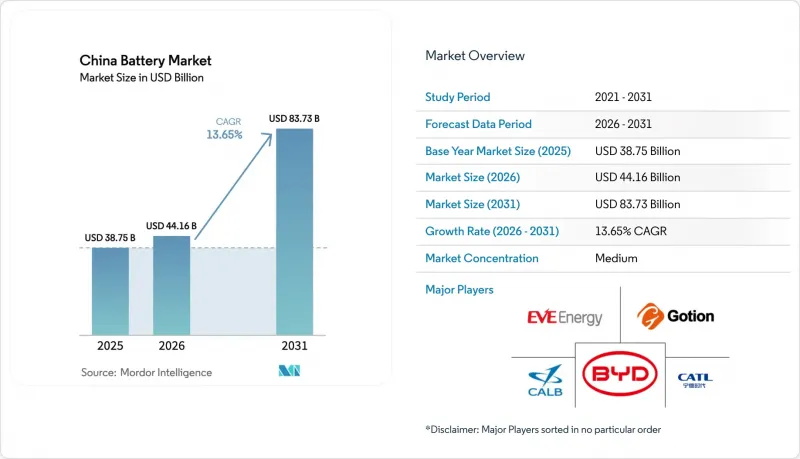
중국의 배터리 시장 규모는 2025년에 387억 5,000만 달러로 평가되었습니다. 2026년 441억 6,000만 달러에서 2031년까지 837억 3,000만 달러에 이를 것으로 예상되며, 예측 기간(2026-2031년) CAGR은 13.65%를 나타낼 전망입니다.
본 보고서는 유형(1차 전지 및 2차 전지), 기술(납축전지, 리튬이온전지, 기타 기술), 형태(원통형, 각형, 파우치형), 용도(자동차, 에너지 저장 시스템, 산업용 배터리, 휴대용 전자기기, 기타)별로 분류되어 있습니다. 시장 규모 및 전망은 금액(달러) 기준으로 제시되어 있습니다.
중국의 배터리 시장 동향 및 인사이트
전국적인 신에너지차(NEV) 의무화가 2급 및 3급 도시의 리튬 이온 배터리 수요 급증을 견인
2급 및 3급 지자체에서는 배터리 팩 비용의 최대 15%를 지원하는 2024년 보조금 제도의 뒷받침을 받아 연안 지역과 동등한 EV 보급 목표를 달성하고 있습니다. 중국 자동차 판매의 60%는 이러한 도시에서 차지하고 있어 인프라 구축이 매우 중요해졌습니다. 2025년에 12만 곳의 공공 급속 충전소가 설치됨에 따라 주행 거리 불안이 해소되었고, 약 50GWh의 새로운 배터리 수요가 창출되었습니다. 이에 자동차 제조업체들은 40-50kWh 용량의 LFP 배터리 팩을 탑재하고 1만 5,000달러 미만의 모델을 출시하여 내연기관 차량과의 총 소유 비용(TCO) 경쟁력을 확보했습니다. 배터리 제조업체들은 현지 조립 라인 근처에 기가팩토리를 전략적으로 배치하여 물류 비용을 절감하고 납기 기간을 단축하고 있습니다. 이러한 현지화를 통해 시장 점유율이 세분화되어 중소 공급업체들이 독점 계약을 확보하고, 해안가의 주요 도시 이외 지역에서도 기존 기업들과 경쟁할 수 있게 되었습니다.
재생에너지 30% 의무화 목표가 촉발한 대규모 전력 저장 붐
2024년, 재생에너지 자원이 풍부한 성에서는 출력 억제율이 30%에 달하고, 100 MW를 초과하는 프로젝트에 대해 발전소에 에너지 저장 설비를 병설하는 것이 의무화되었습니다. 2024년 유틸리티 규모의 배터리 도입량은 73.76GW에 달했으며, 2027년까지 180 GW에 이를 전망입니다. CATL의 ‘Tener’ LFP 시스템은 6,000사이클의 수명을 실현하여 15년간의 전력구매계약(PPA)을 충족하는 동시에 석탄 화력 피크 발전에 대한 의존도를 낮춥니다. 파우치형 셀을 채택함으로써 열 관리가 개선되어, 프리즘형 셀에 비해 컨테이너의 설치 면적을 20% 줄일 수 있습니다. 2025년 8월 안전 기준 ‘GB 44240-2024’가 시행됨에 따라 기존 설비가 전파 시험을 통과하지 못하게 되어 최신 시스템 도입이 가속화될 것입니다.
1.3 TWh 규모의 셀 공장으로 인한 임박한 공급 과잉 위험이 이익률을 압박하고 있습니다.
계획된 생산 능력은 2026년 수요인 600GWh를 초과하고 있으며, 이는 가동률이 50% 미만으로 떨어지고 가격 상한선이 1kWh당 70달러에 가까워질 것임을 의미하여, 자본력이 취약한 생산 업체에 경영난을 초래할 우려가 있습니다. 정책적 장벽이 수출을 통한 부담 완화를 제한하고 있으며, 미국 및 유럽의 반덤핑 관세로 인해 잉여 셀의 판매처가 좁아지고 있습니다. 대형 기존 기업들은 일시적으로 적자를 감수할 수 있지만, 중소기업들은 2027년까지 유동성 위기에 빠질 위험이 있습니다. 이러한 상황은 과잉 생산으로 인해 업계 재편이 불가피했던 2010년대 태양광 발전 업계의 구조조정을 연상시킵니다. 채권자가 계약 조항의 이행을 요구할 경우, 자산 매각이나 사업 재편이 이루어질 가능성이 높습니다.
부문별 분석
2025년, 2차 전지는 중국의 배터리 시장 점유율의 92.1%를 차지했으며, NEV 보급률이 승용차 판매의 38%에 달함에 따라 연평균 성장률(CAGR) 13.9%로 확대될 것으로 전망됩니다. 1차 전지는 규제에 따른 폐기 비용과 에너지 수확 장치의 소형화에 제약을 받아 여전히 틈새 시장에 머물러 있습니다. CATL의 ‘Qilin’ 셀은 150만 km의 보증을 제공하여 차량의 수명을 15년으로 연장하고 총 소유 비용의 효율성을 향상시킵니다. 세컨드 라이프 프로그램을 통해 사용 후 자동차 배터리 팩이 고정 자산으로 전환됨에 따라, 각 셀에서 회수되는 1kW시당 수익이 2배로 증가합니다.
납산 배터리의 쇠퇴는 가속화되고 있으며, LFP의 사이클 수명 우위로 인해 남아 있던 비용 측면의 우위는 점차 해소되고 있습니다. 전기 이륜차에 리튬 배터리 팩을 사후 장착하는 경우 18개월 이내에 투자 회수가 가능하며, 산업용 배터리 공급업체는 2025년에 25%의 매출 감소를 기록했습니다. 따라서 2차 전지 부문의 연평균 성장률(CAGR)은 순수한 수요 증가라기보다는 기존 화학 계열 배터리로부터의 대체에 의해 주도되고 있으며, 기존 화학 계열 배터리가 쇠퇴하는 가운데 전략적 포지셔닝의 필요성이 부각되고 있습니다.
리튬 이온 배터리는 2025년에 75.5%의 점유율을 유지했으며 2031년까지 연평균 14.8% 성장할 것으로 예측되어, 중국의 배터리 시장에서의 주도적 입지를 더욱 공고히 하고 있습니다. 리튬 이온 배터리 중에서는 LFP가 자동차용 셀 출하량의 약 70%를 차지했습니다. 이는 저렴한 비용과 코발트를 포함하지 않는 구성 성분에 힘입은 결과입니다. Blade 및 M3P의 변형 모델로 인해 LFP의 적용 범위가 확대되면서, 니켈 함량이 높은 화학 조성 시장 점유율을 잠식하고 있습니다.
나트륨 이온 배터리의 상용 출하는 2025년에 160 Wh/kg으로 시작되었으며, 이 화학계는 1만 달러 미만의 차량이나 체적 에너지 밀도가 그리 중요하지 않은 고정형 에너지 저장 시스템 시장을 공략하는 입지를 확립했습니다. 전고체 배터리는 지적 재산권 분쟁 및 제조 수율 문제로 인해 여전히 시범 단계에 머물러 있습니다. 이러한 신흥 화학계 배터리는 공급 리스크 분산에 기여하고 있지만, 리튬 이온 배터리의 경제적 우위는 2031년까지 견고하게 유지될 전망입니다.
기타 혜택 :
- 엑셀 형식 시장 예측(ME) 시트
- 3개월간의 애널리스트 지원
자주 묻는 질문
목차
제1장 서론
제2장 조사 방법
제3장 개요
제4장 시장 구도
제5장 시장 규모 및 성장 예측
제6장 경쟁 구도
제7장 시장 기회 및 향후 전망
KTH 26.08.31According to Mordor Intelligence, the China battery market was valued at USD 38.75 billion in 2025 and expected to grow from USD 44.16 billion in 2026 to reach USD 83.73 billion by 2031, at a CAGR of 13.65% during the forecast period (2026-2031).
This report is Segmented by Type (Primary Battery and Secondary Battery), Technology (Lead-Acid Battery, Lithium-Ion Battery, and Other Technologies), Form Factor (Cylindrical, Prismatic, and Pouch), and Application (Automotive, Energy Storage Systems, Industrial Batteries, Portable Electronics, and Others). The Market Sizes and Forecasts are Provided in Terms of Value (USD).
China Battery Market Trends and Insights
Nationwide NEV Mandates Driving Lithium-Ion Demand Surge In Tier-2 And Tier-3 Cities
Tier-2 and Tier-3 municipalities now match coastal EV adoption targets, propelled by 2024 subsidies that cover up to 15% of battery pack costs. Sixty percent of China's vehicle sales occur in these cities, making infrastructure pivotal; 120,000 public fast-charging stations deployed in 2025 eliminated range anxiety and unlocked an estimated 50 GWh of new cell demand. Automakers responded with sub-USD 15,000 models fitted with 40-50 kWh LFP packs, delivering total-cost-of-ownership parity with internal-combustion cars. Battery makers strategically position gigafactories near local assembly lines, shrinking logistics costs and compressing delivery cycles. This localization fragments market share, allowing smaller suppliers to secure captive contracts and challenge incumbents outside coastal hubs.
Grid-Scale Storage Boom Triggered By 30% Renewable Curtailment Targets
Curtailment rates reached 30% in renewable-rich provinces during 2024, prompting mandatory co-located storage for projects above 100 MW. Utility-scale battery installations hit 73.76 GW in 2024 and are on course for 180 GW by 2027. CATL's Tener LFP system delivers 6,000 cycles, matching 15-year power-purchase agreements and lowering coal-peaking reliance. Adoption of pouch cells improves thermal management and shrinks container footprint by 20% compared with prismatic equivalents. Enforcement of GB 44240-2024 safety norms in August 2025 accelerates modern system uptake, as legacy installations failed propagation tests.
Imminent overcapacity risk from 1.3 TWh cell plants depressing margins
Planned capacity outstrips 2026 demand of 600 GWh, implying sub-50% utilization and a price ceiling near USD 70/kWh that could trigger distress among thinly capitalized producers. Policy barriers restrict export relief, and anti-dumping tariffs in the United States and Europe narrow outlets for surplus cells. Larger incumbents can carry negative margins temporarily, but smaller firms risk liquidity crunches by 2027. The dynamic echoes the solar shakeout of the 2010s, where overbuild forced consolidation. Asset sales and restructurings are likely once creditors enforce covenants.
Other drivers and restraints analyzed in the detailed report include:
- Price Parity Of LFP Packs Accelerating Lead-Acid Replacement
- Vertical Integration By CATL And BYD Reducing Supply-Chain Bottlenecks And Costs
- Regulatory Cap On New Coal-Power For Cathode Processing Limiting Energy Cost Advantage
For complete list of drivers and restraints, kindly check the Table Of Contents.
Segment Analysis
Secondary batteries occupied 92.1% of the Chinese battery market share in 2025, expanding at a projected 13.9% CAGR as NEV penetration hit 38% of passenger-car sales. Primary batteries remain niche, constrained by regulatory disposal costs and miniaturization of energy-harvesting devices. CATL's Qilin cell guarantees 1.5 million km, extending vehicle service life to 15 years and improving total ownership economics. Second-life programs turn retired automotive packs into stationary assets, doubling revenue per kilowatt-hour harvested from each cell.
Lead-acid's decline accelerates as LFP cycle life multiples erase remaining cost advantages. Electric two-wheelers retrofit lithium packs that pay back within 18 months, and industrial battery suppliers recorded 25% sales falls in 2025. The secondary segment's CAGR is therefore chemistry-substitution driven rather than pure demand growth, underscoring the need for strategic positioning as legacy chemistries fade.
Lithium-ion retained 75.5% share in 2025 and is forecast to grow at 14.8% through 2031, reinforcing its leadership in the Chinese battery market. Within lithium-ion, LFP captured roughly 70% of automotive cell shipments, buoyed by lower costs and cobalt-free bills of material. Blade and M3P variants extend LFP's range applicability, eroding the nickel-rich chemistry share.
Sodium-ion commercial shipments started in 2025 at 160 Wh/kg, positioning the chemistry for sub-USD 10,000 vehicles and stationary storage where volumetric density is less critical. Solid-state remains pilot-scale due to IP disputes and manufacturing yields. Together, emerging chemistries diversify supply risk, though lithium-ion's economic moat holds firm through 2031.
Complete Report Scope:
- By Type
- Primary Battery
- Secondary Battery
- By Technology
- Lead-acid Battery
- Lithium-ion Battery
- Other Technologies (Ni-MH, Zinc-air, Sodium-ion, Solid-State Prototype)
- By Form Factor
- Cylindrical
- Prismatic
- Pouch
- By Application
- Automotive (Passenger Electric Vehicles and Commercial Electric Vehicles)
- Energy Storage Systems (Utility-Scale and Commercial and Industrial)
- Industrial Batteries
- Portable Electronics
- Others (Medical Devices, Defence, Marine)
List of Companies Covered in this Report:
- Contemporary Amperex Technology Co. Limited (CATL)
- BYD Co. Ltd.
- CALB Group Co. Ltd.
- EVE Energy Co. Ltd.
- Gotion High-Tech Co. Ltd.
- SVOLT Energy Technology Co. Ltd.
- Farasis Energy Inc.
- Sunwoda Electronic Co. Ltd.
- Guoxuan High-Tech Power Energy Co. Ltd.
- Tianjin Lishen Battery Joint-Stock Co. Ltd.
- Hithium Energy Storage Technology Co. Ltd.
- REPT Battero Energy Co. Ltd.
- Great Power Energy & Technology Co. Ltd.
- Narada Power Source Co. Ltd.
- Tianneng Power International Ltd.
- Panasonic Energy Co. Ltd.
- LG Energy Solution Ltd.
- Samsung SDI Co. Ltd.
- Tesla Inc. (Shanghai Gigafactory Battery Operations)
- COSMX Battery Co. Ltd.
- Microvast Holdings Inc.
- Ampace Technology Ltd.
Additional Benefits:
- The market estimate (ME) sheet in Excel format
- 3 months of analyst support
TABLE OF CONTENTS
1 Introduction
- 1.1 Study Assumptions & Market Definition
- 1.2 Scope of the Study
2 Research Methodology
3 Executive Summary
4 Market Landscape
- 4.1 Market Overview
- 4.2 Market Drivers
- 4.2.1 Nationwide NEV Mandates Driving Lithium-Ion Demand Surge in Tier-2 & 3 Cities
- 4.2.2 Grid-Scale Storage Boom Triggered by 30 % Renewable Curtailment Targets
- 4.2.3 Price Parity of LFP Packs (Below USD 80/kWh) Accelerating Lead-acid Replacement
- 4.2.4 Vertical Integration by CATL & BYD Reducing Supply-Chain Bottlenecks and Costs
- 4.2.5 Provincial Recycling Quotas Creating Secondary Raw-Material Stream for New Cells
- 4.2.6 Preferential VAT Rebate on Domestic Battery Materials Boosting Local Production
- 4.3 Market Restraints
- 4.3.1 Imminent Overcapacity Risk from 1.3 TWh Announced Cell Plants Depressing Margins
- 4.3.2 Regulatory Cap on New Coal-Power for Cathode Processing Limiting Energy Cost Advantage
- 4.3.3 Critical Mineral Import Volatility amid Indonesia & DRC Export Policy Shifts
- 4.3.4 Intensifying IP Litigation on Solid-State Electrolyte Patents Delaying Commercialization
- 4.4 Supply-Chain Analysis
- 4.5 Regulatory Outlook
- 4.6 Technological Outlook
- 4.7 Porters Five Forces
- 4.7.1 Threat of New Entrants
- 4.7.2 Bargaining Power of Suppliers
- 4.7.3 Bargaining Power of Buyers
- 4.7.4 Threat of Substitutes
- 4.7.5 Competitive Rivalry
- 4.8 PESTLE Analysis
5 Market Size & Growth Forecasts
- 5.1 By Type
- 5.1.1 Primary Battery
- 5.1.2 Secondary Battery
- 5.2 By Technology
- 5.2.1 Lead-acid Battery
- 5.2.2 Lithium-ion Battery
- 5.2.3 Other Technologies (Ni-MH, Zinc-air, Sodium-ion, Solid-State Prototype)
- 5.3 By Form Factor
- 5.3.1 Cylindrical
- 5.3.2 Prismatic
- 5.3.3 Pouch
- 5.4 By Application
- 5.4.1 Automotive (Passenger Electric Vehicles and Commercial Electric Vehicles)
- 5.4.2 Energy Storage Systems (Utility-Scale and Commercial and Industrial)
- 5.4.3 Industrial Batteries
- 5.4.4 Portable Electronics
- 5.4.5 Others (Medical Devices, Defence, Marine)
6 Competitive Landscape
- 6.1 Market Concentration
- 6.2 Strategic Moves (M&A, JVs, Funding, PPAs)
- 6.3 Market Share Analysis (Market Rank/Share for key companies)
- 6.4 Company Profiles (includes Global-level Overview, Market-level Overview, Core Segments, Financials, Strategic Information, Products & Services, Recent Developments)
- 6.4.1 Contemporary Amperex Technology Co. Limited (CATL)
- 6.4.2 BYD Co. Ltd.
- 6.4.3 CALB Group Co. Ltd.
- 6.4.4 EVE Energy Co. Ltd.
- 6.4.5 Gotion High-Tech Co. Ltd.
- 6.4.6 SVOLT Energy Technology Co. Ltd.
- 6.4.7 Farasis Energy Inc.
- 6.4.8 Sunwoda Electronic Co. Ltd.
- 6.4.9 Guoxuan High-Tech Power Energy Co. Ltd.
- 6.4.10 Tianjin Lishen Battery Joint-Stock Co. Ltd.
- 6.4.11 Hithium Energy Storage Technology Co. Ltd.
- 6.4.12 REPT Battero Energy Co. Ltd.
- 6.4.13 Great Power Energy & Technology Co. Ltd.
- 6.4.14 Narada Power Source Co. Ltd.
- 6.4.15 Tianneng Power International Ltd.
- 6.4.16 Panasonic Energy Co. Ltd.
- 6.4.17 LG Energy Solution Ltd.
- 6.4.18 Samsung SDI Co. Ltd.
- 6.4.19 Tesla Inc. (Shanghai Gigafactory Battery Operations)
- 6.4.20 COSMX Battery Co. Ltd.
- 6.4.21 Microvast Holdings Inc.
- 6.4.22 Ampace Technology Ltd.
7 Market Opportunities & Future Outlook
- 7.1 White-space & Unmet-Need Assessment