|
시장보고서
상품코드
2116025
액체 충전기 : 시장 점유율 분석, 업계 동향과 통계, 성장 예측(2026-2031년)Liquid Filling Machines - Market Share Analysis, Industry Trends & Statistics, Growth Forecasts (2026 - 2031) |
||||||
 Mordor Intelligence
Mordor Intelligence에 따르면 액체 충전기 시장 규모는 2025년 55억 5,000만 달러에서 2026년에는 58억 3,000만 달러로 확대되고, 2026년부터 2031년까지 CAGR 5.11%를 기록하며 2031년에는 74억 9,000만 달러에 달할 것으로 예측됩니다.
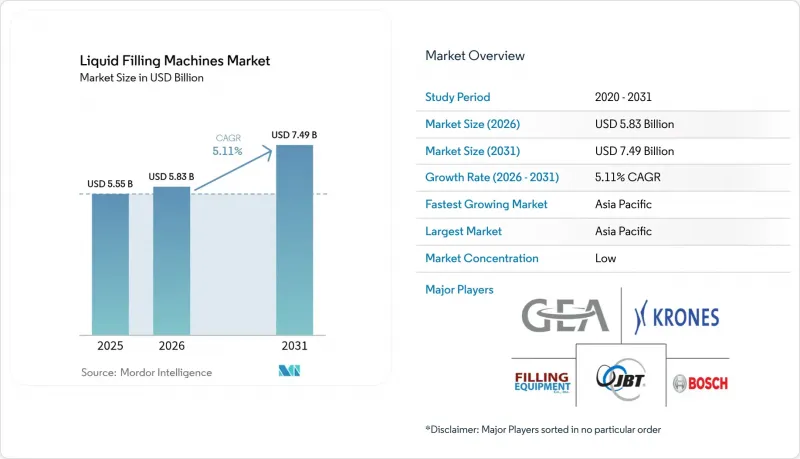
본 보고서는 액체의 종류(음료용 액체 등), 장비의 종류(자동식, 반자동식), 충전 기술(중력식 등), 최종사용자 산업(식품·음료, 헬스케어·제약 등) 및 지역(북미, 유럽, 아시아태평양, 남미, 중동 및 아프리카)별로 분류되어 있습니다. 시장 전망은 금액(달러) 기준으로 제시되어 있습니다.
세계 액체 충전기 시장의 동향 및 인사이트
포장 음료 및 유제품 수요 증가
액체 유제품, 즉석 음용 차 및 커피, 식물성 대체품으로 인해 충전 라인은 항상 풀가동 상태입니다. 유제품만 해도 2027년까지 연평균 2.2%의 성장이 예상되어, 다양한 점도와 핫 필 조건에 대응 가능한 기계에 대한 수주를 끌어올리고 있습니다. 테트라팩의 ‘A1 1100’과 같은 설비는 직접 UHT 처리와 효율적인 전환을 결합하여 에너지 소비와 제품 손실을 줄입니다. 아시아의 가공업체들은 편리한 1회용 포장을 선호하는 소비자의 요구에 부응하기 위해 이와 유사한 고속 라인을 도입하고 있으며, 지역 보틀러들은 향이 첨가된 우유, 주스, 물을 하나의 프레임에서 처리할 수 있는 멀티 레인 충전기를 지정하는 경우가 많습니다. 정밀한 온도 제어와 위생적인 설계에 대한 수요가 증가함에 따라, 광범위한 액체 충전기 시장 내에서 프리미엄 부문이 형성되고 있습니다.
제약 분야의 무균 가공 급성장
바이오의약품과 맞춤형 의료에는 무균 및 소용량 충진이 요구됩니다. 최근 북미에 도입된 Syntegon사의 ‘Versynta microBatch’는 5ml 미만의 용기에 충진할 때 제품 손실을 최소화하므로, 고비용의 mRNA 제제에 최적입니다. EU GMP 부속서 1의 개정에 따라 배리어 아이솔레이터 및 자동 생균 공기 모니터링 시스템의 도입이 가속화되고 있습니다. 그 결과, 특히 유럽과 미국에서 틈새시장을 겨냥한 고수익률 기계에 대한 수주가 지속적으로 예상되며, 아시아태평양의 수탁 제조업체들도 빠르게 뒤를 따르고 있습니다. 이러한 동향에 힘입어 액체 충전기 시장은 혁신의 선순환을 유지하고 있으며, 오염 관리와 유연한 로트 규모가 연구개발(R&D) 예산을 견인하고 있습니다.
높은 설비 투자
금리는 2023년 이전 평균을 크게 상회하고 있어, 가공업체들이 생산 라인 업그레이드를 계획하는 바로 그 시점에 차입 비용을 상승시키고 있습니다. 알루미늄 및 PET 원자재 가격 급등이 예산 부담을 가중시켜 일부 그린필드 프로젝트를 지연시키고 있습니다. 그럼에도 불구하고, 조사 대상 식품 가공업체의 66%는 이번 주기 동안 주요 설비를 구매할 전망이며, 인도의 생산 연계형 인센티브가 현지 구매자들의 자금 조달 격차를 메워주고 있습니다. 이러한 압박과 정책 지원이 뒤섞여 있기는 하지만, 이는 액체 충전기 시장의 성장 궤도를 제한하거나 그 흐름을 저해하는 요인은 아닙니다.
부문 분석
2025년 매출의 44.82%를 음료 부문이 차지하고 있으며, 이는 고속 PET 및 HDPE 병 생산 라인을 가동하는 음료 제조업체가 주요 원인입니다. 동남아시아에서 RTD(즉석 음용) 차 및 향이 첨가된 우유의 판매량 증가가 새로운 설비 투자를 뒷받침하고 있습니다. 같은 해, 액체 화학약품은 연평균 성장률(CAGR) 8.29%로 성장하여 다른 모든 액체 카테고리를 상회했습니다. 새롭게 등장하고 있는 무용제 화장품 제형 및 특수 수지로 인해 내식성 액체 접촉 부품, 드립 방지 노즐, CIP(정지 세척) 대응 설계에 대한 수요가 증가하고 있습니다.
틈새 시장인 화장품, 농약, 자동차용 유체 분야에서 소량 생산 및 레시피 기반 충전기에 대한 수요가 증가함에 따라, 액체 화학제품용 액체 충전기 시장 규모는 확대될 것으로 전망됩니다. FRICKE Abfulltechnik과 같은 전문 OEM 제조사들은 현재 안전 기준을 충족하기 위해 방폭 하우징에 중량식 제어 기능을 통합하고 있습니다. 소모품 부문은 여전히 광범위하지만, 화학 제조업체들은 용도에 특화된 투여 정밀도에 대해 프리미엄 마진을 지불할 의향이 있으며, 이에 따라 공급업체의 연구 개발 우선순위도 변화하고 있습니다.
2025년에 59.62%의 점유율을 차지한 자동 시스템은 대량 생산 공장의 기반이 되고 있습니다. Pacific Packaging사의 ‘Intelli-Fil C’는 분당 200개의 용기를 처리하면서도 편차를 0.5ml 미만으로 억제하고 있으며, 이는 이 회사의 연평균 성장률(CAGR) 6.38% 전망을 뒷받침하는 처리량 우위를 입증하고 있습니다. 또한, 전력 비용과 인건비 급등으로 인해 CFO(최고재무책임자) 등은 장기적인 비용 곡선을 안정화하기 위해 완전 자동화 플랫폼으로의 전환을 추진하고 있습니다.
반자동 기계는 임상시험용 충전, 크래프트 화장품, 그리고 로트가 다양한 지역 한정 음료 분야에서 여전히 중요한 역할을 하고 있습니다. 액체 충전기 업계는 생산량이 일정 수준에 도달했을 때, 향후 더 높은 자동화 수준으로 단계적으로 확장할 수 있는 모듈식 프레임을 지속적으로 제공하고 있습니다. 이러한 하이브리드 접근 방식은 도입을 용이하게 하고, 설비 투자 주기에 따른 시장 변동을 완화합니다.
지역별 분석
아시아태평양은 2025년 전 세계 매출의 39.88%를 차지하며, 2031년까지 연평균 성장률(CAGR) 9.31%로 계속해서 모든 지역을 능가하는 성장을 이루고 있습니다. 중국의 제조업에 대한 25%의 설비 투자 확대와 인도로 유입된 1,651억 달러 규모의 제조업 외국인 직접 투자(FDI)가 풍부한 수요원을 형성하고 있습니다. 다국적 기업들이 새로운 공장을 건설하는 한편, 국내 OEM 업체들이 중급 자동 충전기를 공급하고 있으며, 이들이 힘을 합쳐 액체 충전기 시장을 견인하고 있습니다.
북미는 2위를 차지하고 있습니다. 포장기계 출하대수는 2023년에 5.8% 증가할 것으로 예상되며, 2027년까지의 평균 성장률은 8.0%가 될 것으로 전망됩니다. 의약품 및 기능성 식품 분야의 규제 강화로 인해 고급 기계의 수주는 견조한 추세를 보이고 있지만, 최근 알루미늄 관세로 인해 통조림 제조 비용이 상승하고 있습니다. 기업들은 이에 대응하기 위해 가동 중단 시간을 최소화하면서 병, 캔, 카톤 간 전환이 가능한 충전기를 요구하며, 가격 변동이 심한 포장 시장에서 ROI를 확보하고자 하고 있습니다.
유럽에서는 지속가능성에 관한 규제와 탄소발자국 목표를 배경으로 꾸준한 교체 수요가 나타나고 있습니다. 에너지 효율이 높은 서보 드라이브와 절수형 CIP 사이클이 구매 결정의 결정적인 요인이 되고 있습니다. 한편, 남미 및 중동 및 아프리카에서는 환율 변동과 인프라 부족으로 인한 제약이 있음에도 불구하고, 도시 중산층의 소비 확대에 힘입어 한 자릿수 중반의 성장률을 기록하고 있습니다. 유럽 및 아시아의 OEM 업체들이 설립한 서비스 거점을 통해 리드타임이 단축되고 경쟁력이 향상되고 있습니다.
기타 혜택:
- 엑셀 형식의 시장 예측(ME) 시트
- 3개월간의 애널리스트 지원
자주 묻는 질문
목차
제1장 소개
제2장 조사 방법
제3장 주요 요약
제4장 시장 구도
제5장 시장 규모와 성장 예측
제6장 경쟁 구도
제7장 시장 기회와 향후 전망
KSM 26.08.26According to Mordor Intelligence, the liquid filling machines market size is expected to grow from USD 5.55 billion in 2025 to USD 5.83 billion in 2026 and is forecast to reach USD 7.49 billion by 2031 at 5.11% CAGR over 2026-2031.
This report is Segmented by Liquid Type (Consumable Liquids, and More), Equipment Type (Automatic, and Semi-Automatic), Filling Technology (Gravity, and More) End-User Industry (Food and Beverage, Healthcare and Pharmaceutical, and More), and Geography (North America, Europe, Asia-Pacific, South America, and Middle East and Africa). The Market Forecasts are Provided in Terms of Value (USD).
Global Liquid Filling Machines Market Trends and Insights
Rising Demand for Packaged Beverages and Dairy
Liquid dairy, ready-to-drink tea and coffee, and plant-based alternatives keep bottling halls busy. Dairy alone is expanding 2.2% annually through 2027, lifting orders for machines capable of handling varying viscosities and hot-fill conditions. Equipment such as Tetra Pak's A1 1100 combines direct UHT processing with efficient changeover, reducing energy consumption and product waste. Asian processors deploy similar high-speed lines to meet consumer preference for convenient single-serve formats, and regional bottlers often specify multi-lane fillers to run flavored milk, juices and water on one frame. Demand for accurate temperature control and hygienic design is creating a premium segment within the broader liquid filling machines market.
Pharmaceutical Aseptic-Processing Boom
Biologics and personalized medicine require sterile, low-volume filling. Syntegon's Versynta microBatch, recently installed in North America, fills sub-5 ml containers with minimal product loss, making it ideal for costly mRNA formulations. EU GMP Annex 1 revisions accelerate adoption of barrier isolators and automated viable-air monitoring. The result is a sustained order pipeline for niche, high-margin machinery, especially in Europe and the United States, with Asia-Pacific contract manufacturers fast following. These dynamics keep the liquid filling machines market on an innovation treadmill where contamination control and flexible lot sizes drive R&D budgets.
High Capital Expenditure
Interest rates sit well above pre-2023 averages, lifting borrowing costs just as processors plan line upgrades. Aluminum and PET input inflation amplifies budget stress, delaying some greenfield projects. Yet 66% of surveyed food processors still expect to buy primary equipment this cycle, with India's production-linked incentives offsetting financing gaps for local buyers. This mix of pressure and policy support limits, but does not derail, the liquid filling machines market trajectory.
Other drivers and restraints analyzed in the detailed report include:
- Industry 4.0 Drives Automated, Smart Fillers
- Surge in Single-Serve Functional and Nutraceutical Drinks
- Skilled-Operator Shortage
For complete list of drivers and restraints, kindly check the Table Of Contents.
Segment Analysis
Consumable liquids held 44.82% of 2025 revenue, anchored by beverage producers that run high-speed PET and HDPE bottle lines. Rising RTD tea and flavored-milk volumes in Southeast Asia sustain fresh capex. Within the same year, liquid chemicals advanced at 8.29% CAGR, outpacing every other fluid class. Emerging solvent-free cosmetic formulations and specialty resins elevate demand for corrosion-resistant wetted parts, drip-free nozzles and CIP-ready designs.
The liquid filling machines market size for liquid chemicals is projected to widen as niche cosmetics, agrochemicals and automotive fluids require short-run, recipe-driven fillers. Specialty OEMs such as FRICKE Abfulltechnik now integrate gravimetric controls with explosion-proof housings to meet safety norms. Consumable segments remain vast, yet chemical producers are willing to pay premium margins for application-specific dosing accuracy, tilting supplier R&D priorities accordingly.
Automatic systems, at 59.62% share in 2025, form the backbone of large-volume plants. Pacific Packaging's Intelli-Fil C handles 200 containers per minute while keeping deviation below 0.5 ml, evidence of the throughput advantage that secures its 6.38% CAGR outlook. Rising electricity and labor costs also push CFOs toward fully automatic platforms to lock in longer-term cost curves.
Semi-automatic machinery retains relevance in clinical trial filling, craft cosmetics and regional beverages where batch diversity is high. The liquid filling machines industry continues to supply modular frames that allow a future bolt-on to higher automation when volumes justify. This hybrid pathway eases adoption and cushions market volatility linked to capex cycles.
Complete Report Scope:
- By Liquid Type
- Consumable liquids
- Liquid drugs
- Industrial liquids
- Liquid chemicals
- Other liquid Types
- By Equipment Type
- Automatic
- Semi-automatic
- By Filling Technology
- Gravity
- Piston
- Pump / Peristaltic
- Vacuum
- Pressure
- By End-user Industry
- Food and Beverage
- Healthcare and Pharmaceutical
- Cosmetics and Personal Care
- Chemicals
- Other End-User Industry
- By Container Type
- Bottles
- Pouches
- Cans
- Other Container Types
- By Geography
- North America
- United States
- Canada
- Mexico
- Europe
- Germany
- France
- Italy
- United Kingdom
- Spain
- Rest of Europe
- Asia-Pacific
- China
- Japan
- India
- South Korea
- ASEAN
- Rest of Asia-Pacific
- South America
- Brazil
- Argentina
- Rest of South America
- Middle East and Africa
- Middle East
- Saudi Arabia
- United Arab Emirates
- Turkey
- Rest of Middle East
- Africa
- South Africa
- Kenya
- Rest of Africa
- Middle East
- North America
Geography Analysis
Asia-Pacific, owning 39.88% of 2025 global revenue, continues to outpace all regions with a 9.31% CAGR to 2031. China's 25% capital investment push in manufacturing and India's USD 165.1 billion inbound manufacturing FDI provide deep pools of demand. Multinationals install new plants while domestic OEMs supply mid-tier automatics, collectively lifting the liquid filling machines market.
North America ranks second. Packaging machinery shipments rose 5.8% in 2023 and projections point to 8.0% average growth through 2027. Regulatory stringency in pharma and functional foods sustains premium machine orders, although recent aluminum tariffs raise canning costs. Companies respond by seeking fillers that switch among bottle, can and carton with minimal downtime, protecting ROI in a price-volatile packaging landscape.
Europe shows steady replacement demand, fuelled by sustainability mandates and carbon-footprint targets. Energy-efficient servo drives and water-saving CIP cycles sway purchase decisions. Meanwhile South America and Middle East & Africa log mid-single digit growth, constrained by currency swings and infrastructure gaps but buoyed by rising urban middle-class consumption. Service hubs set up by European and Asian OEMs are reducing lead times, improving competitiveness.
- Syntegon Technology (Bosch)
- GEA Group AG
- Krones AG
- JBT Corporation
- Tetra Laval Int'l
- KHS GmbH
- Coesia SpA
- Ronchi Mario SpA
- E-PAK Machinery
- Filling Equipment Co
- Scholle IPN
- OPTIMA Group
- IMA Group
- Serac Group
- Accutek Packaging
- ProMach
- APACKS
- Shemesh Automation
- Yundu BFS
- Universal Filling
- Sidel Group
Additional Benefits:
- The market estimate (ME) sheet in Excel format
- 3 months of analyst support
TABLE OF CONTENTS
1 INTRODUCTION
- 1.1 Study Assumptions and Market Definition
- 1.2 Scope of the Study
2 RESEARCH METHODOLOGY
3 EXECUTIVE SUMMARY
4 MARKET LANDSCAPE
- 4.1 Market Overview
- 4.2 Market Drivers
- 4.2.1 Rising demand for packaged beverages and dairy
- 4.2.2 Pharmaceutical aseptic-processing boom
- 4.2.3 Industry 4.0 drives automated, smart fillers
- 4.2.4 Surge in single-serve functional and nutraceutical drinks
- 4.2.5 Metred-dose rules for cannabis beverages
- 4.2.6 Retail "zero-waste" refill stations require in-store fillers
- 4.3 Market Restraints
- 4.3.1 High capital expenditure
- 4.3.2 Skilled-operator shortage
- 4.3.3 Food-grade lubricant supply volatility hits OEE
- 4.3.4 Cyber-security risk in connected fillers delays adoption
- 4.4 Supply-Chain Analysis
- 4.5 Regulatory Landscape
- 4.6 Technological Outlook
- 4.7 Porter's Five Forces Analysis
- 4.7.1 Threat of New Entrants
- 4.7.2 Bargaining Power of Suppliers
- 4.7.3 Bargaining Power of Buyers
- 4.7.4 Threat of Substitutes
- 4.7.5 Competitive Rivalry
5 MARKET SIZE AND GROWTH FORECASTS (VALUE)
- 5.1 By Liquid Type
- 5.1.1 Consumable liquids
- 5.1.2 Liquid drugs
- 5.1.3 Industrial liquids
- 5.1.4 Liquid chemicals
- 5.1.5 Other liquid Types
- 5.2 By Equipment Type
- 5.2.1 Automatic
- 5.2.2 Semi-automatic
- 5.3 By Filling Technology
- 5.3.1 Gravity
- 5.3.2 Piston
- 5.3.3 Pump / Peristaltic
- 5.3.4 Vacuum
- 5.3.5 Pressure
- 5.4 By End-user Industry
- 5.4.1 Food and Beverage
- 5.4.2 Healthcare and Pharmaceutical
- 5.4.3 Cosmetics and Personal Care
- 5.4.4 Chemicals
- 5.4.5 Other End-User Industry
- 5.5 By Container Type
- 5.5.1 Bottles
- 5.5.2 Pouches
- 5.5.3 Cans
- 5.5.4 Other Container Types
- 5.6 By Geography
- 5.6.1 North America
- 5.6.1.1 United States
- 5.6.1.2 Canada
- 5.6.1.3 Mexico
- 5.6.2 Europe
- 5.6.2.1 Germany
- 5.6.2.2 France
- 5.6.2.3 Italy
- 5.6.2.4 United Kingdom
- 5.6.2.5 Spain
- 5.6.2.6 Rest of Europe
- 5.6.3 Asia-Pacific
- 5.6.3.1 China
- 5.6.3.2 Japan
- 5.6.3.3 India
- 5.6.3.4 South Korea
- 5.6.3.5 ASEAN
- 5.6.3.6 Rest of Asia-Pacific
- 5.6.4 South America
- 5.6.4.1 Brazil
- 5.6.4.2 Argentina
- 5.6.4.3 Rest of South America
- 5.6.5 Middle East and Africa
- 5.6.5.1 Middle East
- 5.6.5.1.1 Saudi Arabia
- 5.6.5.1.2 United Arab Emirates
- 5.6.5.1.3 Turkey
- 5.6.5.1.4 Rest of Middle East
- 5.6.5.2 Africa
- 5.6.5.2.1 South Africa
- 5.6.5.2.2 Kenya
- 5.6.5.2.3 Rest of Africa
- 5.6.5.1 Middle East
- 5.6.1 North America
6 COMPETITIVE LANDSCAPE
- 6.1 Market Concentration
- 6.2 Strategic Moves
- 6.3 Market Share Analysis
- 6.4 Company Profiles (includes Global level Overview, Market level overview, Core Segments, Financials as available, Strategic Information, Market Rank/Share for key companies, Products and Services, and Recent Developments)
- 6.4.1 Syntegon Technology (Bosch)
- 6.4.2 GEA Group AG
- 6.4.3 Krones AG
- 6.4.4 JBT Corporation
- 6.4.5 Tetra Laval Int'l
- 6.4.6 KHS GmbH
- 6.4.7 Coesia SpA
- 6.4.8 Ronchi Mario SpA
- 6.4.9 E-PAK Machinery
- 6.4.10 Filling Equipment Co
- 6.4.11 Scholle IPN
- 6.4.12 OPTIMA Group
- 6.4.13 IMA Group
- 6.4.14 Serac Group
- 6.4.15 Accutek Packaging
- 6.4.16 ProMach
- 6.4.17 APACKS
- 6.4.18 Shemesh Automation
- 6.4.19 Yundu BFS
- 6.4.20 Universal Filling
- 6.4.21 Sidel Group
7 MARKET OPPORTUNITIES AND FUTURE OUTLOOK
- 7.1 White-space and Unmet-need Assessment