|
시장보고서
상품코드
2116100
수의용 X선 : 시장 점유율 분석, 업계 동향 및 통계, 성장 예측(2026-2031년)Global Veterinary X-Ray - Market Share Analysis, Industry Trends & Statistics, Growth Forecasts (2026 - 2031) |
||||||
 Mordor Intelligence
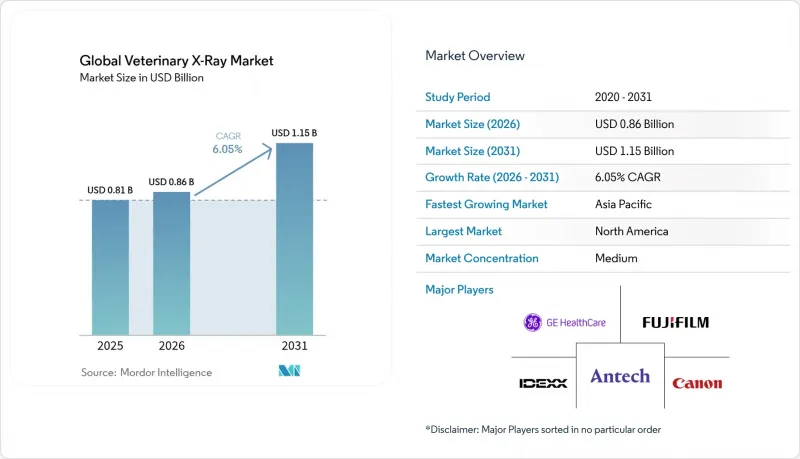
Mordor Intelligence에 의하면, 2026년 수의용 X선 시장 규모는 8억 6,000만 달러로 추정되고 2025년 8억 1,000만 달러에서 확대해, 2031년에는 11억 5,000만 달러에 이를 것으로 예측됩니다.
2026-2031년 동안 연평균 성장률(CAGR) 6.05%로 성장할 것으로 전망됩니다.
본 보고서는 기술별(직접 방사선 촬영(DR) 시스템, 기타), 시스템 유형별(디지털 X선, 아날로그 X선), 이동성별(고정형 시스템, 기타), 동물 유형별(소형 반려동물, 기타),용도별(정형외과, 기타), 최종 사용자별(동물병원, 기타), 지역별(북미, 유럽, 아시아태평양, 기타)로 분류되어 있습니다. 시장 예측은 금액(달러) 기준으로 제시되어 있습니다.
세계의 수의용 X선 시장 동향 및 인사이트
반려동물 사육 마릿수 증가와 동물 의료비 지출 확대
2025년에는 반려동물을 기르는 미국 가구 수가 9,400만 가구에 달했으며, Z세대에서는 여러 유형의 동물을 기르는 경향이 특히 두드러져 고부가가치 서비스에 대한 수의학 분야의 관심이 높아지고 있습니다. 2024년 평균 진료비는 190달러에 달했으나, 가구당 지출이 4% 감소함에 따라 부수적 비용을 절감할 수 있는 효율적인 진단법이 선호되는 가격 민감성을 엿볼 수 있습니다. 예방 접종 및 영양 관리의 개선으로 동물의 수명이 연장되고 있으며, 그 결과 만성 질환을 앓는 기간이 길어지면서 반복적인 영상 검사가 필요한 사례가 증가하고 있습니다. 예를 들어, 개의 정형외과적 손상이나 고양이의 만성 신장병의 경우, 경과 관찰을 위해 지속적인 엑스레이 촬영이 필수적입니다. 수의학 분야의 고용은 19% 증가했으며, 품질을 유지하면서 진료 처리 속도를 향상시키는 기기에 대한 수요가 높아지고 있습니다. 이러한 요인들이 복합적으로 작용하여 대상 수의용 X선 시장 규모가 확대되고 있으며, 유연하고 미래 지향적인 플랫폼에 대한 투자가 촉진되고 있습니다.
아날로그 X선 촬영에서 디지털 X선 촬영으로의 전환
필름 현상 약품, 암실 공간, 노출부터 영상 표시까지 걸리는 긴 소요 시간으로 인해 아날로그 시스템은 비용이 높고 다루기 어려운 임베디드니다. 직접 라디오그래피(DR)는 5초 이내에 이미지를 제공하며, 많은 동물병원에서 워크플로우 프로세스를 50% 단축하는 동시에 1회 검사당 방사선 피폭량을 줄여줍니다. 개조 설치 키트를 활용하면 동물병원은 시스템 전체를 교체하는 것보다 적은 비용으로 기존 X선 촬영 장비를 DR로 전환할 수 있어, 설비 투자에 대한 부담이 줄어듭니다. 클라우드 PACS를 통한 즉각적인 영상 공유는 원격 진료를 촉진하고, 즉시 소견을 알고 싶어 하는 반려인의 요구에도 부응합니다. 그 결과, 수의용 X선 시장에서는 10년 전 인간용 방사선 진단 부문에서 일어났던 전환과 마찬가지로, CR에서 DR로의 전환 곡선이 관찰되고 있습니다.
디지털 X선 장치의 높은 초기 비용
검출기, 영상 획득 소프트웨어, 방사선 안전 기능이 세트로 구성된 하이엔드 DR 시스템은 10만 달러에 육박하기 때문에 수의사 1명이 운영하는 동물병원에게는 업그레이드의 장벽이 되고 있습니다. 현재 수의학 진료비를 ‘만족스럽다’고 평가하는 반려동물 주인은 고작 28.2%에 그치고 있어, 클리닉이 장비 비용을 진료비에 전가할 여지는 제한적입니다. 금융 프로그램이나 제조업체가 제공하는 ‘리스 투 오너(Lease-to-Own)’ 모델을 통해 고액의 초기 비용에 대한 부담은 완화되고 있지만, 개발도상국에서는 장비 교체 주기가 길어 도입이 더딘 실정입니다. 그 결과, 수의용 X선 시장에서는 최적의 사용 수명을 초과한 구형 CR 장비가 장기간 사용되는 사례가 나타나고 있어, 디지털화로의 광범위한 전환이 저해되고 있습니다.
부문별 분석
2025년, CR 플랫폼은 수의용 X선 시장 점유율의 54.22%를 차지했으며, 이는 그 확고한 입지와 비교적 낮은 초기 투자를 반영한 것입니다. 그러나 선명한 화질과 촬영 후 5초 이내에 이미지를 확인할 수 있는 속도를 무기로 DR 시스템이 연평균 성장률(CAGR) 6.78%로 시장 점유율을 확대하고 있어, 이 부문은 점차 포화 상태로 접어들고 있습니다. 많은 동물병원에서는 개조용 카세트를 구입하여 CR의 수명을 연장하고 있지만, 부품 비용의 하락으로 인해 2028년까지는 DR로의 전환이 완전히 이루어질 것으로 예측됩니다. DR용 수의학 X선 시장 규모는 2031년까지 6억 9,000만 달러를 넘어설 것으로 예측되어, 직접 캡처 기술의 부상이 두드러지고 있습니다.
무선 평판 검출기의 감도 향상으로 인해 해상도 저하 없이 피폭 선량을 줄일 수 있게 되어, 더욱 엄격해진 방사선 안전 지침을 충족할 수 있게 되었습니다. 축사 환경에 적합한 견고한 검출기 하우징과 결합된 이러한 혁신 기술은 클리닉 내 고정식 DR과 현장 촬영 간의 성능 격차를 점차 해소하며, 전 세계적으로 CR을 대체하는 속도를 가속화하고 있습니다.
2025년, 디지털 장비는 수의용 X선 시장 규모의 72.35%를 차지했으며, 2031년까지 연평균 성장률(CAGR) 6.25%를 나타낼 것으로 예측됩니다. 이러한 우위는 클라우드 PACS와의 통합을 통한 즉각적인 결과 제공 기능과 AI 오버레이와의 호환성 덕분입니다. 아날로그 시스템은 주로 가격에 민감한 지역에서 여전히 남아 있지만, 예비 부품 부족과 화학 물질 폐기 규제로 인해 운영 비용이 증가하고 있습니다. 2025년, 미국 동물병원 체인의 신규 도입 사례 중 약 85%를 디지털 솔루션이 차지하고 있으며, 대부분의 시설 업그레이드에서 디지털이 기본 선택지로 자리매김하고 있습니다. 고해상도 데이터 세트를 기반으로 하는 원격 진료 플랫폼으로의 자본 유입으로 인해, 수의용 X선 시장에서 디지털 제품의 점유율은 더욱 확대되고 있습니다.
앞으로 무선으로 다운로드 가능한 이미지 보정 펌웨어 업데이트를 통해 장비의 수명이 연장되고, 미래를 내다본 투자가 가능해집니다. 이는 기존 아날로그 하드웨어에는 없는 강점입니다. 검출기 판매에 AI 트라이아지 구독 서비스를 묶어 제공하는 공급업체는 고객 유지를 강화하고 지속적인 수익원을 창출합니다. 이를 통해 주주들에게 수의용 X선 시장의 총 규모에 대한 전망이 안정화됩니다.
지역별 분석
북미는 반려동물 건강보험의 보급과 3만 2,000곳에 달하는 반려동물 클리닉의 촘촘한 네트워크에 힘입어, 2025년 수의용 X선 시장 규모의 39.35%를 차지했습니다. 미국에서는 의료 서비스가 미치지 않는 지방 카운티에 수의사를 유치하기 위해 버지니아주가 11만 달러의 인센티브 프로그램을 비롯한 지원 제도를 시행하고 있으며, 이는 간접적으로 휴대용 검출기의 매출을 끌어올리고 있습니다. 캐나다에서도 유사한 추세가 관찰되는 반면, 멕시코에서는 다국적 체인점이 NAFTA 시장 전체에서 장비 표준화를 추진함에 따라 도입이 확대되고 있습니다. 이 지역은 2031년까지 연평균 성장률(CAGR) 5.55%로 꾸준히 성장할 것으로 예상되며, 신규 도입보다 교체 구매가 더 많을 것으로 전망됩니다.
유럽은 독일, 영국, 프랑스를 필두로 연평균 성장률(CAGR) 5.9%로 성장하고 있습니다. 엄격한 동물 복지 지침과 통일된 CE 마크 규정에 따라 규제 관련 리드타임이 단축되어 차세대 DR의 신속한 보급이 촉진되고 있습니다. EU의 ‘호라이즌(Horizon)’ 연구 프로젝트로부터의 자금 지원은 다양한 동물을 대상으로 한 X선 촬영용 AI 알고리즘 개발을 더욱 뒷받침하고 있으며, 이는 수의용 X선 시장에 추가적인 호재가 되고 있습니다. 남유럽 및 동유럽 회원국에서는 1인당 GDP가 상승하고 반려동물 수가 증가함에 따라 미개척 시장 기회가 창출되고 있습니다.
아시아태평양은 성장 속도 면에서 두드러지며, 중국, 인도, 동남아시아의 도시 지역에서 일어나고 있는 반려동물 사육 붐에 힘입어 2031년까지 연평균 성장률(CAGR) 6.86%를 나타낼 것으로 전망됩니다. 중국의 규제 현대화로 인해 장비 승인 주기가 20% 단축되었으나, 희토류 수출 규제는 여전히 전략적 불확실성 요인으로 남아 있습니다. 인도에서는 대형 동물과 부상하는 소형 동물 부문이 혼재되어 있어, 두 용도 모두에 대응하는 장비에 대한 수요가 높아지면서 판매 대수 증가로 이어지고 있습니다. 이미 포화 상태에 이른 일본과 한국은 AI를 통한 기능 향상 및 투여량 추적 소프트웨어로의 전환을 추진하고 있어, 이 지역의 기술적 다양성을 보여주고 있습니다. 따라서 현재의 성장세가 지속된다면, 아시아태평양의 수의용 X선 시장 규모는 2031년 초까지 북미 시장을 추월할 것으로 예측됩니다.
기타 혜택
- 엑셀 형식 시장 예측(ME) 시트
- 3개월간의 애널리스트 지원
자주 묻는 질문
목차
제1장 서론
제2장 조사 방법
제3장 개요
제4장 시장 구도
제5장 시장 규모 및 성장 예측
제6장 경쟁 구도
제7장 시장 기회 및 향후 전망
KTH 26.08.31According to Mordor Intelligence, the veterinary X-ray market size in 2026 is estimated at USD 0.86 billion, growing from 2025 value of USD 0.81 billion with 2031 projections showing USD 1.15 billion, growing at 6.05% CAGR over 2026-2031.
This report is Segmented by Technology (Direct Radiography Systems, and More), System Type (Digital X-Ray and Analog X-Ray), Mobility (Stationary Systems and More), Animal Type (Small Companion Animals and More), Application (Orthopedics and More), End-User (Veterinary Hospitals and More), and Geography (North America, Europe, Asia-Pacific, and More). The Market Forecasts are Provided in Terms of Value (USD).
Global Veterinary X-Ray Market Trends and Insights
Increasing pet adoption and animal-health spend
U.S. households owning pets climbed to 94 million in 2025, with Generation Z over-indexing on multispecies ownership, capturing veterinary mindshare for high-value services. Average visit fees reached USD 190 during 2024, yet a 4% dip in per-household spend revealed price-sensitivity that favors efficient diagnostics able to trim ancillary costs. Animal lifespans are lengthening through better vaccination and nutrition, prolonging exposure to chronic conditions that often require repeat imaging. Canine orthopedic injuries and feline chronic kidney disease, for instance, mandate serial radiographs for monitoring. Employment in the veterinary profession is growing 19% and adds pressure for equipment that speeds case throughput while maintaining quality. Together these forces enlarge the addressable veterinary X-ray market and reinforce investment in flexible, future-proof platforms.
Shift from analog to digital radiography
Film processing chemicals, dark-room real estate, and lengthy exposure-to-image times make analog systems costly and cumbersome. Direct Radiography delivers images in less than 5 seconds, trimming workflow steps by 50% in many clinics and lowering per-study radiation dose. Retrofit kits let practices convert existing buckys to DR at a smaller outlay than full system replacement, softening the cap-ex hurdle. Instant image sharing through cloud PACS boosts teleconsultation and satisfies owners expecting immediate findings. As a result, the veterinary X-ray market is witnessing a CR-to-DR migration curve comparable to human radiology's transition a decade earlier.
High upfront cost of digital X-ray equipment
Premium DR suites approach USD 100,000 when detectors, acquisition software, and radiation-safety features are bundled, deterring single-doctor practices from upgrading. Only 28.2% of pet owners regard current veterinary prices as satisfactory, limiting clinics' ability to pass equipment costs through service fees. Financing programs and manufacturer lease-to-own models soften sticker shock, but slower equipment turnover in developing economies drags adoption. As a result, the veterinary X-ray market occasionally sees extended use of legacy CR units beyond their optimal life, constraining the broader digital transition.
Other drivers and restraints analyzed in the detailed report include:
- Growing number of veterinary hospitals and clinics
- AI-enabled image-analysis workflows
- Shortage of trained veterinary radiologists
For complete list of drivers and restraints, kindly check the Table Of Contents.
Segment Analysis
In 2025, CR platforms commanded 54.22% of the veterinary X-ray market share in 2025, reflecting their entrenched presence and relatively low capital outlay. The segment nevertheless inches toward saturation as DR systems gain 6.78% CAGR on image clarity and sub-5-second exposure-to-review cycles. Many clinics extend CR service life by buying retrofit cassettes, but decreasing component costs are expected to swing preference fully toward DR by 2028. The veterinary X-ray market size for DR is projected to exceed USD 0.69 billion by 2031, underscoring the ascendant trajectory of direct capture technology.
Advances in wireless flat-panel sensitivity now allow dose reductions without granularity loss, satisfying tightened radiation-safety guidelines. Combined with rugged detector housings suitable for barn environments, these innovations progressively eliminate the performance gap between stationary clinic DR and field imaging, accelerating CR displacement worldwide.
Digital units held 72.35% of the veterinary X-ray market size in 2025 and are tracking a 6.25% CAGR through 2031. That dominance stems from cloud PACS integration, enabling instant referrals and AI overlay compatibility. Analog systems linger mainly in price-sensitive geographies; however, spare-part scarcity and chemical disposal rules compound their operating costs. In 2025, digital solutions make up roughly 85% of new installations across corporate clinic chains in the United States, solidifying their status as the default choice for most facility upgrades. Capital inflows into tele-consult platforms that hinge on high-resolution datasets further enlarge digital's slice of the veterinary X-ray market.
Looking forward, image-enhancement firmware updates-downloadable over-the-air-extend equipment life and future-proof investments, a selling point unmatched by legacy analog hardware. Vendors bundling AI triage subscriptions with detector sales deepen customer lock-in and generate recurring revenue streams that stabilize total veterinary X-ray market size visibility for shareholders.
Complete Report Scope:
- By Technology
- Direct Radiography (DR) Systems
- Computed Radiography (CR) Systems
- Film-based Radiography Systems
- By System Type
- Digital X-ray
- Analog X-ray
- By Mobility
- Stationary Systems
- Portable Systems
- By Animal Type
- Small Companion Animals
- Large Animals
- Exotic & Zoo Animals
- By Application
- Orthopedics
- Neurology
- Oncology
- Cardiology
- Dental
- Other Applications
- By End-User
- Veterinary Hospitals
- Veterinary Clinics
- Mobile/Field Practices
- By Geography
- North America
- United States
- Canada
- Mexico
- Europe
- Germany
- United Kingdom
- France
- Italy
- Spain
- Rest of Europe
- Asia-Pacific
- China
- India
- Japan
- Australia
- South Korea
- Rest of Asia-Pacific
- Middle East and Africa
- GCC
- South Africa
- Rest of Middle East and Africa
- South America
- Brazil
- Argentina
- Rest of South America
- North America
Geography Analysis
North America captured 39.35% of the veterinary X-ray market size in 2025, backed by widespread pet health insurance and a dense network of 32,000 companion-animal clinics. The United States supports grant programs such as Virginia's USD 110,000 incentive to lure veterinarians to underserved rural counties, indirectly boosting portable detector sales. Canada mirrors these patterns, while Mexico shows rising adoption as multinational chains standardize equipment across NAFTA markets. The region is expected to log a steady 5.55% CAGR to 2031, with replacement purchases outweighing first-time installs.
Europe advances at a 5.9% CAGR, led by Germany, the United Kingdom, and France. Strict animal-welfare directives and uniform CE marking rules shorten regulatory lead-times, promoting quick uptake of next-gen DR. Funding from EU Horizon research projects further spurs AI algorithm development for multi-species radiography, adding incremental lift to the veterinary X-ray market. Southern and Eastern member states present white-space opportunities as GDP per capita climbs and companion-animal populations increase.
Asia-Pacific stands out for velocity: a 6.86% CAGR is projected through 2031, propelled by urban pet ownership booms in China, India, and Southeast Asia. China's regulatory modernization has trimmed device approval cycles by 20%, though rare-earth export restrictions remain a strategic variable. India's mix of large-animal and rising small-animal segments warrants dual-purpose equipment, boosting unit volumes. Japan and South Korea, already saturated, are pivoting toward AI upgrades and dose-tracking software, illustrating the region's technological heterogeneity. The veterinary X-ray market size in Asia-Pacific is therefore expected to surpass North America by early 2031 if current momentum persists.
- Agfa-Gevaert
- Antech Diagnostics
- Canon
- Control-X Medical cPlc
- Cuattro LLC
- Diagnostic Imaging Systems Inc.
- EponaTech LLC
- Examion GmbH
- Fujifilm Holdings Corp.
- Ganim Medical LLC (DRE)
- GE Healthcare
- Guangzhou MeCan Animal Medical Limited
- IDEXX
- JPI Healthcare Solutions
- Konica Minolta
- MinXray
- Oehm und Rehbein GmbH
- Sedecal
- Siemens Healthineers
- Varex Imaging Corp.
Additional Benefits:
- The market estimate (ME) sheet in Excel format
- 3 months of analyst support
TABLE OF CONTENTS
1 Introduction
- 1.1 Study Assumptions & Market Definition
- 1.2 Scope of the Study
2 Research Methodology
3 Executive Summary
4 Market Landscape
- 4.1 Market Overview
- 4.2 Market Drivers
- 4.2.1 Increasing pet adoption & animal-health spend
- 4.2.2 Shift from analog to digital radiography
- 4.2.3 Growing number of veterinary hospitals & clinics
- 4.2.4 Rising orthopedic injury incidence in companion animals
- 4.2.5 AI-enabled image-analysis workflows
- 4.2.6 Expansion of mobile/field veterinary X-ray services
- 4.3 Market Restraints
- 4.3.1 High upfront cost of digital X-ray equipment
- 4.3.2 Absence of reimbursement for imaging procedures
- 4.3.3 Shortage of trained veterinary radiologists
- 4.3.4 Dependency on rare-earth flat-panel components
- 4.4 Supply Chain Analysis
- 4.5 Regulatory Landscape
- 4.6 Technological Outlook
- 4.7 Porter's Five Forces Analysis
- 4.7.1 Threat of New Entrants
- 4.7.2 Bargaining Power of Buyers
- 4.7.3 Bargaining Power of Suppliers
- 4.7.4 Threat of Substitutes
- 4.7.5 Competitive Rivalry
5 Market Size & Growth Forecasts (Value)
- 5.1 By Technology
- 5.1.1 Direct Radiography (DR) Systems
- 5.1.2 Computed Radiography (CR) Systems
- 5.1.3 Film-based Radiography Systems
- 5.2 By System Type
- 5.2.1 Digital X-ray
- 5.2.2 Analog X-ray
- 5.3 By Mobility
- 5.3.1 Stationary Systems
- 5.3.2 Portable Systems
- 5.4 By Animal Type
- 5.4.1 Small Companion Animals
- 5.4.2 Large Animals
- 5.4.3 Exotic & Zoo Animals
- 5.5 By Application
- 5.5.1 Orthopedics
- 5.5.2 Neurology
- 5.5.3 Oncology
- 5.5.4 Cardiology
- 5.5.5 Dental
- 5.5.6 Other Applications
- 5.6 By End-User
- 5.6.1 Veterinary Hospitals
- 5.6.2 Veterinary Clinics
- 5.6.3 Mobile/Field Practices
- 5.7 By Geography
- 5.7.1 North America
- 5.7.1.1 United States
- 5.7.1.2 Canada
- 5.7.1.3 Mexico
- 5.7.2 Europe
- 5.7.2.1 Germany
- 5.7.2.2 United Kingdom
- 5.7.2.3 France
- 5.7.2.4 Italy
- 5.7.2.5 Spain
- 5.7.2.6 Rest of Europe
- 5.7.3 Asia-Pacific
- 5.7.3.1 China
- 5.7.3.2 India
- 5.7.3.3 Japan
- 5.7.3.4 Australia
- 5.7.3.5 South Korea
- 5.7.3.6 Rest of Asia-Pacific
- 5.7.4 Middle East and Africa
- 5.7.4.1 GCC
- 5.7.4.2 South Africa
- 5.7.4.3 Rest of Middle East and Africa
- 5.7.5 South America
- 5.7.5.1 Brazil
- 5.7.5.2 Argentina
- 5.7.5.3 Rest of South America
- 5.7.1 North America
6 Competitive Landscape
- 6.1 Market Concentration
- 6.2 Competitive Benchmarking
- 6.3 Market Share Analysis
- 6.4 Company Profiles (includes Global level Overview, Market level overview, Core Segments, Financials as available, Strategic Information, Market Rank/Share for key companies, Products & Services, and Recent Developments)
- 6.4.1 Agfa-Gevaert NV
- 6.4.2 Antech Diagnostics, Inc.
- 6.4.3 Canon Inc.
- 6.4.4 Control-X Medical cPlc
- 6.4.5 Cuattro LLC
- 6.4.6 Diagnostic Imaging Systems Inc.
- 6.4.7 EponaTech LLC
- 6.4.8 Examion GmbH
- 6.4.9 Fujifilm Holdings Corp.
- 6.4.10 Ganim Medical LLC (DRE)
- 6.4.11 GE HealthCare
- 6.4.12 Guangzhou MeCan Animal Medical Limited
- 6.4.13 IDEXX Laboratories Inc.
- 6.4.14 JPI Healthcare Solutions
- 6.4.15 Konica Minolta Inc.
- 6.4.16 MinXray Inc.
- 6.4.17 Oehm und Rehbein GmbH
- 6.4.18 Sedecal
- 6.4.19 Siemens Healthineers AG
- 6.4.20 Varex Imaging Corp.
7 Market Opportunities & Future Outlook
- 7.1 White-space & Unmet-need Assessment