

|
시장보고서
상품코드
2116109
희귀질환 유전자 검사 : 시장 점유율 분석, 업계 동향과 통계, 성장 예측(2026-2031년)Rare Disease Genetic Testing - Market Share Analysis, Industry Trends & Statistics, Growth Forecasts (2026 - 2031) |
||||||
 Mordor Intelligence
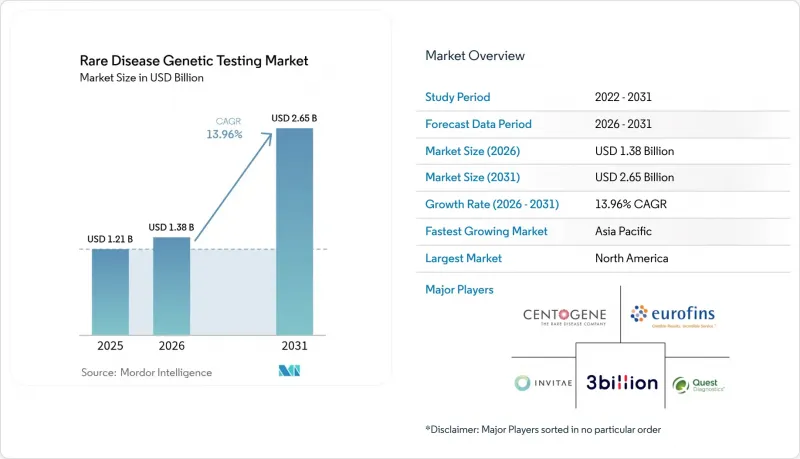
Mordor Intelligence에 따르면 2026년 희귀질환 유전자 검사 시장 규모는 13억 8,000만 달러로 추정되며, 2025년 12억 1,000만 달러에서 확대되어 2031년에는 26억 5,000만 달러에 달할 것으로 예측됩니다. 2026년부터 2031년까지 CAGR은 13.96%가 될 전망입니다.
본 보고서에서는 시장을 검사 유형(단일 유전자 검사, 유전자 패널 등), 기술(차세대 염기서열 분석, PCR 기반 검사 등), 검체 유형(혈액, 타액/구강 점막 면봉 등), 적응증(신경 질환, 대사 질환 등), 및 지역(북미, 유럽 등)별로 분류하고 있습니다. 시장 전망은 금액(달러) 기준으로 제시되어 있습니다.
세계 희귀질환 유전자 검사 시장의 동향 및 인사이트
차세대 염기서열 분석(NGS) 비용 감소
NGS용 시약 및 장비의 비용이 대폭 하락함에 따라, 2024년 말까지 전체 유전체 시퀀싱 비용은 검체 1개당 600달러 미만으로 떨어졌습니다. 이는 많은 다유전자 패널의 가격보다 낮은 수준입니다. 비용의 균등화로 인해 병원들은 순차적인 단일 유전자 검사를 대체하는 ‘유전체 퍼스트(Genome First)’ 프로토콜을 도입하여 진단까지 걸리는 시간을 단축하도록 권장받고 있습니다. 실제 환경에서의 경제 분석에 따르면, 신생아 집중 치료실(NICU)에서 신속한 유전체 시퀀싱을 도입할 경우 환자 1인당 평균 10만 440달러의 비용 절감이 예상됩니다. 일루미나(Illumina)사의 ‘NovaSeq X’나 옥스포드 나노포어(Oxford Nanopore)사의 ‘PromethION 2 Integrated’와 같은 기기의 처리 능력 향상으로 염기당 단가는 더욱 낮아지고, 자동화를 통해 인건비도 절감됩니다. 검사실 규모가 확대됨에 따라 희귀질환 유전자 검사 시장은 예측 가능한 가격 탄력성을 확보하게 되었으며, 그동안 복잡한 검사를 제한해 왔던 임상의들 사이에서 억눌려 있던 수요가 해방되고 있습니다.
희귀질환 진단에 대한 전국적인 보험 적용 확대
현재 일부 고소득 지역에서는 공공 및 민간 보험사가 종합적인 시퀀싱 검사 비용을 보상하고 있습니다. 텍사스주의 메디케이드는 2024년 하반기에 전장 엑솜 시퀀싱 및 전체 유전체 시퀀싱에 대한 급여를 도입하여, 각각 3,728.40달러 및 3,924.34달러를 적용했습니다. 노스캐롤라이나주 메디케이드도 곧 이를 따라 듀센형 근이영양증 및 린치 증후군 검사를 보장 대상으로 포함시켰습니다. 메디케어는 유전성 트랜스사이레틴 아밀로이드증 시퀀싱을 추가함으로써 다른 보험사들에게 임상적 선례를 마련했습니다. 이러한 정책으로 인해 환자의 본인 부담금이 경감되고, 의료 기관이 일상적인 유전체 검사를 실시하도록 장려되고 있습니다. 이러한 추세는 중국과 인도에서 막 시작된 지원 프로그램에도 반영되고 있습니다. 보험 급여의 확실성으로 인해 검사 기관의 수익 확보가 가속화되고, 희귀질환 유전자 검사 시장의 총 잠재 규모가 확대될 것입니다.
높은 본인 부담 비용과 제한적인 보험 적용 범위
보험 적용 범위는 확대되고 있지만, 보험 청구가 기각될 경우 많은 환자는 여전히 300-5,000달러의 비용을 부담해야 합니다. 사전 승인 등 행정적 장벽은 검사를 의뢰하는 임상의의 의욕을 꺾고, 결과가 나오기까지의 기간을 길게 만들고 있습니다. 소비자 직접 판매(DTC) 기업들은월 99달러의 구독 서비스를 통해 이러한 격차를 메우려 하고 있지만, 오락 목적으로 작성된 검사 보고서가 임상적 유용성 기준을 충족하는 경우는 거의 없습니다. 신흥 경제국에서는 본인 부담금이 평균 가구 소득의 몇 달 분에 달할 수 있는데, 이는 보급을 저해하며, 근친혼과 관련된 질병의 부담이 가장 큰 지역에서 희귀질환 유전자 검사 시장의 확장을 제한하고 있습니다.
부문 분석
2025년에는 전장 엑솜 시퀀싱이 희귀질환 유전자 검사 시장의 36.12%를 차지하며 매출을 주도했습니다. 이는 단백질 코딩 변이의 비용과 진단 수율의 균형이 잘 잡혀 있기 때문입니다. 연평균 성장률(CAGR) 15.08%로 성장하고 있는 전체 유전체 시퀀싱은 엑솜 시퀀싱에서는 간과되기 쉬운 비코딩 변이 및 구조적 변이를 포착하여 패널 기반 검사의 점유율을 꾸준히 잠식하고 있습니다. 가족 내에서 명확한 병인성 변이가 확인되는 경우, 단일 유전자 검사는 확인 도구로 계속해서 활용되고 있습니다. 이러한 전환을 뒷받침하는 것은 임상적 증거입니다. 신경 발달 장애 코호트에서 유전체 시퀀싱은 염색체 마이크로어레이보다 23% 더 높은 진단 수율을 달성하는 동시에, 2년에 걸친 누적 비용을 절감합니다. 옥스포드 나노포어(Oxford Nanopore)의 롱 리드 워크플로는 기존의 숏 리드로는 감지할 수 없었던 탠덤 반복의 확장을 규명하여, 롱 리드 유전체 분석을 미래의 골드 스탠다드로 자리매김하고 있습니다. 12시간 이내에 분석을 완료하는 신속한 신생아용 프로토콜은 유전체 검사를 응급 의료의 표준으로 더욱 공고히 하며, 지속적으로 진화하는 희귀질환 유전자 검사 시장에서 그 역할을 확고히 하고 있습니다.
2025년에는 쇼트 리드 NGS가 매출의 71.58%를 차지했으나, 구조적 변이에 대한 높은 민감도로 인해 롱 리드 플랫폼의 성장세는 연평균 성장률(CAGR) 15.92%로 상승하고 있습니다. 샌거 시퀀싱은 특히 실험실에서 교차 검증이 필요한 경우, 변이 확인 수단으로서 여전히 유용성을 유지하고 있습니다. 기술의 융합이 가속화되고 있습니다. 일루미나(Illumina)사의 NovaSeq X는 단일 플로우셀 칩과 AI 기반 염기 판독 기능을 통합하여, 샘플당 실행 시간을 단축하는 동시에 원시 데이터의 정확도를 향상시키고 있습니다. MinION과 같은 휴대용 장치는 현장에 실험실 수준의 품질을 제공하여 지리적 적용 범위를 확대하고 있습니다. 정확도 격차가 줄어들면서 비용 면에서도 종합적인 멀티오믹스 플랫폼이 유리해짐에 따라, 병원 규모나 지역 검사 기관에 관계없이 희귀질환 유전자 검사 시장 규모가 확대되고 있습니다.
지역별 분석
2025년에 42.76%의 점유율을 차지할 북미는 광범위한 보험 적용 범위, 보험사 부담에 의한 NICU(신생아 집중 치료실) 내 시퀀싱, 그리고 최근 승인된 유전자 치료와 진단을 연결하는 명확한 FDA 승인 경로의 혜택을 받고 있습니다. 중증 상태의 영아에 대한 전장 유전체 분석의 보험 적용은 각 주의 메디케이드 프로그램 내 장벽을 낮추고, 지역 참조 검사실로 안정적인 검사 건수를 이끌고 있습니다. 아시아태평양은 가장 높은 성장률을 보이고 있으며, 인도와 중국의 국가 등록 제도 및 보조금 지원 검사를 배경으로 연평균 성장률(CAGR) 16.02%로 확대되고 있습니다(ijbscience.in). 현지 제조사들이 비용 대비 효율이 높은 시약을 개발하는 한편, 휴대용 시퀀서가 인프라 격차를 해소하고 있습니다. 정부 컨소시엄이 대량 구매를 통한 가격 협상을 진행함으로써 지방 병원에서도 유전체 검사를 이용할 수 있게 되었고, 희귀질환 유전자 검사 시장의 규모가 확대되고 있습니다. 유럽에서는 상호 운용 가능한 의료 기록을 의무화하는 ‘유럽 헬스 데이터 스페이스(European Health Data Space)’ 체제 하에서 10%대 중반의 성장률을 유지하고 있습니다. 독일의 ‘디지털법’은 국경을 넘는 데이터 전송을 간소화하여 다국간 임상시험의 피험자 모집을 촉진하고 있습니다. 환급 제도에는 편차가 있지만, EU 전역에서의 데이터 공유를 통해 극히 희귀한 변이의 진단 확률이 향상되고 있습니다. 라틴아메리카와 중동은 여전히 발전 단계에 있지만, 브라질의 ‘희귀 유전체 프로젝트(Rare Genomes Project)’와 같은 시범 프로그램을 활용하여 미충족된 수요를 부각시키는 동시에 새로운 자금원 확보의 정당성을 입증하고 있습니다.
기타 혜택:
- 엑셀 형식의 시장 예측(ME) 시트
- 3개월간의 애널리스트 지원
자주 묻는 질문
목차
제1장 소개
제2장 조사 방법
제3장 주요 요약
제4장 시장 구도
제5장 시장 규모와 성장 예측
제6장 경쟁 구도
제7장 시장 기회와 향후 전망
KSM 26.08.26According to Mordor Intelligence, rare disease genetic testing market size in 2026 is estimated at USD 1.38 billion, growing from 2025 value of USD 1.21 billion with 2031 projections showing USD 2.65 billion, growing at 13.96% CAGR over 2026-2031.
This report Segments the Industry Into by Test Type (Single-Gene Tests, Gene Panels and More), by Technology (Next-Generation Sequencing, PCR-Based Testing and More), by Sample Type (Blood, Saliva/Buccal Swab and More), by Indication (Neurological Disorders, Metabolic Disorders and More), and Geography (North America, Europe and More). The Market Forecasts are Provided in Terms of Value (USD).
Global Rare Disease Genetic Testing Market Trends and Insights
Declining Cost of Next-Generation Sequencing
NGS reagent and instrument costs fell sharply, pushing whole-genome sequencing below USD 600 per sample by late 2024, a threshold that undercuts many multi-gene panels. Cost parity encourages hospitals to deploy genome-first protocols that replace sequential single-gene tests and shorten diagnostic odysseys. Real-world economic studies show mean savings of USD 100,440 per patient when rapid genome sequencing is used in neonatal intensive care units. Throughput gains from instruments such as Illumina's NovaSeq X and Oxford Nanopore's PromethION 2 Integrated further suppress per-base prices, while automation trims personnel expenses. As laboratories scale, the rare disease genetic testing market gains predictable price elasticity, unlocking pent-up demand among clinicians who previously rationed complex testing.
National Reimbursement Expansion for Rare-Disease Diagnostics
Public and private payers now reimburse comprehensive sequencing in several high-income regions. Texas Medicaid introduced coverage for whole-exome and whole-genome sequencing at USD 3,728.40 and USD 3,924.34 respectively in late 2024. North Carolina Medicaid soon followed, covering tests for Duchenne muscular dystrophy and Lynch syndrome. Medicare added hereditary transthyretin amyloidosis sequencing, setting clinical precedent for other payers. These policies reduce patient out-of-pocket exposure and nudge institutions toward routine genomic work-ups, a trend mirrored by nascent subsidy programs in China and India. Reimbursement certainty accelerates revenue capture for laboratories and magnifies the total addressable rare disease genetic testing market.
High Out-of-Pocket Costs & Limited Payer Coverage
Although coverage is expanding, many patients still shoulder fees between USD 300 and USD 5,000 when insurance declines claims. Administrative hurdles such as prior authorization deter ordering clinicians and lengthen turnaround times. Direct-to-consumer firms attempt to bridge gaps with USD 99 monthly subscriptions, yet their recreational reports rarely meet clinical utility standards. In emerging economies, private pay may equal several months of average household income, limiting adoption and constraining the rare disease genetic testing market in regions most burdened by consanguinity-linked disorders.
Other drivers and restraints analyzed in the detailed report include:
- AI-Enhanced Variant-Interpretation Platforms
- Biopharma Trial Recruitment via Rare-Disease Gene Databases
- Shortage of Certified Genetic Counsellors
For complete list of drivers and restraints, kindly check the Table Of Contents.
Segment Analysis
Whole-exome sequencing led revenue with 36.12% of rare disease genetic testing market share in 2025, balancing cost and diagnostic yield for protein-coding mutations. Whole-genome sequencing, growing at 15.08% CAGR, captures non-coding and structural variants that exomes overlook, steadily eroding panel-based testing. Single-gene assays persist as confirmatory tools when a clear pathogenic variant runs in families.Clinical evidence underpins the transition. Genome sequencing delivers 23% higher yields than chromosomal microarray in neurodevelopmental cohorts while lowering cumulative costs across two years. Long-read workflows from Oxford Nanopore resolve tandem repeat expansions historically invisible to short-reads, positioning long-read genomes as the future gold standard. Rapid neonatal protocols that finish analysis inside 12 hours further reinforce genome testing as an urgent-care staple, cementing its role in the evolving rare disease genetic testing market.
Short-read NGS captured 71.58% revenue during 2025, but long-read platforms are trending up at 15.92% CAGR thanks to structural-variant sensitivity. Sanger sequencing retains utility for variant confirmation, especially when laboratories require orthogonal validation.Technology convergence accelerates. Illumina's NovaSeq X now integrates single-flow-cell chips and AI-driven base-calling, cutting per-sample run time while lifting raw accuracy. Portable devices such as MinION bring near-lab quality to field sites, broadening geographic reach. As accuracy gaps narrow, cost curves favor holistic multi-omic platforms, expanding the rare disease genetic testing market size across hospital tiers and regional laboratories.
Complete Report Scope:
- By Test Type (Value)
- Single-Gene Tests
- Gene Panels
- Whole-Exome Sequencing
- Whole-Genome Sequencing
- By Technology (Value)
- Next-Generation Sequencing
- Sanger Sequencing
- PCR-Based Testing
- By Sample Type (Value)
- Blood
- Saliva/Buccal Swab
- Amniotic/Chorionic (Prenatal)
- By Indication (Value)
- Neurological Disorders
- Metabolic Disorders
- Immunological & Hematological Disorders
- Others
- By Geography (Value)
- North America
- United States
- Canada
- Mexico
- Europe
- Germany
- United Kingdom
- France
- Italy
- Spain
- Rest of Europe
- Asia-Pacific
- China
- India
- Japan
- South Korea
- Australia
- Rest of Asia-Pacific
- South America
- Brazil
- Argentina
- Rest of South America
- Middle East and Africa
- GCC
- South Africa
- Rest of Middle East and Africa
- North America
Geography Analysis
North America, with 42.76% share in 2025, benefits from broad payer coverage, payer-funded NICU sequencing, and clear FDA pathways that tie diagnostics to recently approved gene therapies. Whole-genome reimbursement for critically ill infants lowers barriers across state Medicaid programs and drives steady case volumes into regional reference labs.Asia-Pacific posts the highest growth, advancing at 16.02% CAGR on national registries and subsidized testing in India and China ijbscience.in. Local manufacturers develop cost-effective reagents, while portable sequencers circumvent infrastructure gaps. Government consortiums negotiate bulk pricing, making genome tests affordable for provincial hospitals and amplifying the rare disease genetic testing market footprint.Europe sustains mid-teen growth under the European Health Data Space, which mandates interoperable health records. Germany's Digital Act simplifies cross-border data transfers, enhancing multi-country trial recruitment. Although reimbursement varies, pan-EU data pooling increases diagnostic odds for ultra-rare variants. Latin America and the Middle East remain nascent but leverage pilot programs such as Brazil's Rare Genomes Project to highlight unmet need and justify new funding streams.
- Illumina
- Thermo Fisher Scientific
- Roche
- QIAGEN
- Agilent Technologies
- Invitae
- GeneDx
- Centogene
- PerkinElmer
- Eurofins
- BGI
- Myriad Genetics
- 23andMe
- Oxford Nanopore Technologies
- Natera
- Color Health
- Blueprint Genetics
- Baylor Genetics
- ARUP Laboratories
- BioReference Laboratories
Additional Benefits:
- The market estimate (ME) sheet in Excel format
- 3 months of analyst support
TABLE OF CONTENTS
1 Introduction
- 1.1 Study Assumptions & Market Definition
- 1.2 Scope of the Study
2 Research Methodology
3 Executive Summary
4 Market Landscape
- 4.1 Market Overview
- 4.2 Market Drivers
- 4.2.1 Declining cost of next-generation sequencing
- 4.2.2 National reimbursement expansion for rare-disease diagnostics
- 4.2.3 AI-enhanced variant-interpretation platforms
- 4.2.4 Biopharma trial recruitment via rare-disease gene databases
- 4.2.5 Newborn genomic-screening pilots
- 4.2.6 Portable long-read sequencers in emerging markets
- 4.3 Market Restraints
- 4.3.1 High out-of-pocket costs & limited payer coverage
- 4.3.2 Shortage of certified genetic counsellors
- 4.3.3 Fragmented genomic-privacy regulations
- 4.3.4 Low diagnostic yield for non-coding/ultra-rare variants
- 4.4 Value / Supply-Chain Analysis
- 4.5 Regulatory Landscape
- 4.6 Technological Outlook
- 4.7 Porter's Five Forces
- 4.7.1 Threat of New Entrants
- 4.7.2 Bargaining Power of Suppliers
- 4.7.3 Bargaining Power of Buyers
- 4.7.4 Threat of Substitutes
- 4.7.5 Competitive Rivalry
5 Market Size & Growth Forecasts
- 5.1 By Test Type (Value)
- 5.1.1 Single-Gene Tests
- 5.1.2 Gene Panels
- 5.1.3 Whole-Exome Sequencing
- 5.1.4 Whole-Genome Sequencing
- 5.2 By Technology (Value)
- 5.2.1 Next-Generation Sequencing
- 5.2.2 Sanger Sequencing
- 5.2.3 PCR-Based Testing
- 5.3 By Sample Type (Value)
- 5.3.1 Blood
- 5.3.2 Saliva/Buccal Swab
- 5.3.3 Amniotic/Chorionic (Prenatal)
- 5.4 By Indication (Value)
- 5.4.1 Neurological Disorders
- 5.4.2 Metabolic Disorders
- 5.4.3 Immunological & Hematological Disorders
- 5.4.4 Others
- 5.5 By Geography (Value)
- 5.5.1 North America
- 5.5.1.1 United States
- 5.5.1.2 Canada
- 5.5.1.3 Mexico
- 5.5.2 Europe
- 5.5.2.1 Germany
- 5.5.2.2 United Kingdom
- 5.5.2.3 France
- 5.5.2.4 Italy
- 5.5.2.5 Spain
- 5.5.2.6 Rest of Europe
- 5.5.3 Asia-Pacific
- 5.5.3.1 China
- 5.5.3.2 India
- 5.5.3.3 Japan
- 5.5.3.4 South Korea
- 5.5.3.5 Australia
- 5.5.3.6 Rest of Asia-Pacific
- 5.5.4 South America
- 5.5.4.1 Brazil
- 5.5.4.2 Argentina
- 5.5.4.3 Rest of South America
- 5.5.5 Middle East and Africa
- 5.5.5.1 GCC
- 5.5.5.2 South Africa
- 5.5.5.3 Rest of Middle East and Africa
- 5.5.1 North America
6 Competitive Landscape
- 6.1 Market Concentration
- 6.2 Market Share Analysis
- 6.3 Company Profiles (includes Global level Overview, Market level overview, Core Segments, Financials as available, Strategic Information, Market Rank/Share for key companies, Products & Services, and Recent Developments)
- 6.3.1 Illumina
- 6.3.2 Thermo Fisher Scientific
- 6.3.3 F. Hoffmann-La Roche
- 6.3.4 Qiagen
- 6.3.5 Agilent Technologies
- 6.3.6 Invitae
- 6.3.7 GeneDx
- 6.3.8 Centogene
- 6.3.9 PerkinElmer
- 6.3.10 Eurofins Scientific
- 6.3.11 BGI Genomics
- 6.3.12 Myriad Genetics
- 6.3.13 23andMe
- 6.3.14 Oxford Nanopore Technologies
- 6.3.15 Natera
- 6.3.16 Color Health
- 6.3.17 Blueprint Genetics
- 6.3.18 Baylor Genetics
- 6.3.19 ARUP Laboratories
- 6.3.20 BioReference Laboratories
7 Market Opportunities & Future Outlook
- 7.1 White-space & Unmet-Need Assessment


