

|
시장보고서
상품코드
2118145
모야모야병 시장 : 시장 점유율 분석, 업계 동향 및 통계, 성장 예측(2026-2031년)Moyamoya Disease - Market Share Analysis, Industry Trends & Statistics, Growth Forecasts (2026 - 2031) |
||||||
 Mordor Intelligence
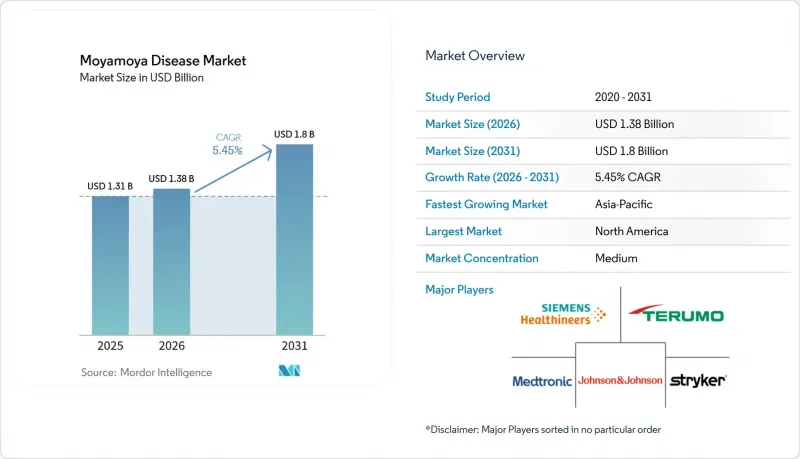
Mordor Intelligence에 의하면, 모야모야병 시장 규모는 2025년 13억 1,000만 달러로 평가되었고, 2026년 13억 8,000만 달러에서 2031년까지 18억 달러로 확대될 것으로 예측되며, 2026-2031년 연평균 복합 성장률(CAGR)은 5.45%를 나타낼 전망입니다.
본 보고서는 제공 서비스별(진단(자기공명혈관조영술 등), 치료(외과적 혈류 재건 등)), 환자군별(소아, 성인, 기타), 임상 양상별(허혈성, 출혈성, 기타), 최종 사용자별(병원, 외래수술센터(ASC), 기타), 지역별(북미, 유럽, 기타)로 분류되어 있습니다. 예측치는 금액(달러)으로 표시되어 있습니다.
세계의 모야모야병 시장 동향 및 인사이트
첨단 신경혈관 영상 진단을 통한 진단 건수 증가
모야모야병 시장에서 영상의 질은 임상의가 의심되는 증상에서 확정 진단에 이르기까지의 속도를 좌우합니다. GE Healthcare는 2026년 2월, 모야모야병에 사용되는 MRA 및 관류 영상 프로토콜을 지원하는 ‘SIGNA Sprint with Freelium’, ‘SIGNA Bolt’, 워크플로우 플랫폼 ‘SIGNA One’에 대해 FDA의 510(k) 승인을 획득했습니다. Philips는 2025년 11월, 신경 영상 워크플로우용 임상 AI 기능을 갖춘 헬륨 프리 3.0T MRI 플랫폼 ‘BlueSeal Horizon’을 발표했습니다. 이러한 시스템은 혈관의 가시성을 향상시키고, 스캔 시간을 단축하며, 고도의 영상 진단이 필요한 병원의 인프라적 제약을 완화할 수 있습니다. 일본의 가이드라인에서는 1.5T 이상의 MRA를 통한 양측성 확정 진단이 인정되고 있으며, 이를 통해 침습적인 DSA로의 의뢰 의존도가 낮아지고, 더 폭넓은 병원 기반에서 MRI 이용이 확대되고 있습니다. 조기 발견을 통해 수술이나 장기 경과 관찰이 필요한 환자 수가 증가할 가능성이 있습니다. 이는 전문의의 판독이라는 핵심적인 역할을 변경하지 않으면서도, 모야모야병 시장 전체의 진단 활동을 뒷받침하는 것입니다. 주요 의뢰 의료기관 이외에서도 고품질 영상 촬영을 이용할 수 있게 된다면, 모야모야병 시장에 큰 이점이 될 것입니다.
소아 및 성인 뇌졸중 표현형에 대한 인식 제고
소아 모야모야병에서는 일과성 뇌허혈 발작, 뇌경색, 인지 기능 저하 등의 허혈성 증상이 일반적으로 관찰되지만, 성인 발병 사례, 특히 40세 이후에는 출혈성 병변이 더 많이 나타납니다. 이 연령대와 관련된 양상에 대한 인식은 그동안 제한적이었으며, 두 집단 모두에서 진료 의뢰 지연을 초래했습니다. 중국의 2025년 전문가 합의문과 일본의 2025년 지침에서는 조기 평가를 지원할 수 있는 증상 기반 선별 경로가 공식적으로 정해졌습니다. 2026년 총설에 따르면, 무증상 사례의 경우에도 2년간의 추적 기간 동안 허혈성 또는 출혈성 뇌졸중, 영상 소견상 진행 위험이 여전히 존재하는 것으로 밝혀졌습니다. 모니터링 범위의 확대는 모야모야병 시장에서 영상 진단 및 예방적 혈관 재건술에 대한 수요를 증가시킬 가능성이 있습니다. 또한, 이로 인해 기존의 진단 사례 수는 모니터링이 필요한 전체 환자 집단을 충분히 대표하지 못하게 될 것입니다.
제한된 고수준의 근거와 불균일한 치료 지침
모야모야병에 대해서는 보험사가 표준적인 보험 적용 결정에 종종 사용하는 무작위 대조 시험에 기반한 근거가 부족합니다. 북미의 다기관 공동 후향적 연구에 따르면, 직접 혈관 재건술 후 증상성 뇌졸중 발생률은 11.6%, 간접 혈관 재건술 후에는 9.6%였으며, 통계적으로 유의미한 차이는 나타나지 않았습니다. 유럽 뇌졸중 기구(ESO)는 다른 뇌혈관 질환에 비해 외과적 시술에 관한 근거의 질이 제한적이라고 지적하고 있습니다. 미국에서는 혈관 재건술에 관한 전국적 또는 지역적인 보험 적용 기준이 존재하지 않기 때문에 보험사는 독자적인 심사 기준을 적용할 수밖에 없습니다. 이러한 불일치로 인해 치료가 지연될 가능성이 있으며, 환자 의뢰 패턴을 예측하기 어려워집니다. 또한, 보조 약물에 대한 접근이 제한되어 모야모야병 시장에서 대규모 약물 요법 임상시험을 수행하려는 의욕도 저하시키고 있습니다.
부문 분석
2025년, 모야모야병 시장 점유율의 68.31%를 치료가 차지했으며, 이는 증상성 질환에 대한 확립된 치료법인 외과적 혈관 재건술에 힘입은 결과입니다. 직접적인 STA-MCA 우회술은 복잡한 외과적 시술과 보조 영상 검사가 필요하기 때문에 시술당 수익성이 높은 것이 특징입니다. 2026년 코호트 연구에 따르면, 허혈성 질환을 가진 성인 환자에서 수정형 두개외·두개내 복합 우회술은 간접 우회술보다 더 높은 기능적 자립도와 혈역학적 회복을 가져오는 것으로 밝혀졌습니다. 약물 요법에는 아스피린이나 실로스타졸 등의 항혈소판 요법이 포함되며, 중증도가 낮은 환자나 수술 후 환자를 대상으로 하기 때문에 환자 1인당 수익은 낮은 임베디드니다. 치료 후 잔존하는 신경학적 또는 인지적 후유증에 대한 관리가 필요한 환자에게는 재활 및 지지 요법이 여전히 중요합니다.
진단 시장은 2026-2031년 연평균 성장률(CAGR) 6.38%로 확대될 것으로 예측되며, 가장 빠르게 성장하는 부문이 될 전망입니다. DSA는 복잡한 사례나 일측성 사례에서 여전히 표준 검사로 사용되지만, 영상 분석 기술의 발전에 따라 MRA 및 CT 혈관조영술의 이용도 증가하고 있습니다. SPECT, PET, ASL-MRI, 경두개 도플러 초음파 검사는 수술 전 혈역학적 평가 및 수술 후 경과 관찰을 지원합니다. 이러한 다층적인 워크플로우로 인해, 장기간에 걸친 경과 관찰 기간 동안 반복적인 영상 검사 수요가 발생할 가능성이 있습니다. CTA 및 DSA에서 발생하는 방사선 피폭에 대한 우려, 특히 소아 환자의 경우 이러한 우려가 MRI 기반 기법의 이용 확대를 촉진하고 있습니다. 이로 인해 상세한 혈관 평가가 필요한 사례에서는 DSA를 유지하면서도 모야모야병 시장의 진단 측면이 뒷받침되고 있습니다. 따라서 모야모야병 시장은 첨단 MRI와 저자기장 MRI 양쪽 접근 방식 모두로부터 혜택을 받을 수 있습니다.
2025년에는 성인 환자가 매출의 55.44%를 차지했습니다. 이러한 상황은 40세 이후에 많이 나타나는 출혈성 증상을 포함하여, 성인에서 이 질환으로 인한 입원 빈도가 높다는 점을 반영합니다. 성인의 연령 분포는 동아시아에서는 35세에서 39세 사이, 서유럽 국가에서는 60대에서 정점을 이룹니다. 이러한 경향은 모야모야병 시장에서 앞으로도 성인 환자에 의한 매출이 계속 집중될 것임을 시사합니다. 임신 중 및 산후 환자 역시 임신 기간 동안 허혈 위험이 높기 때문에 개별화된 항혈소판 요법 및 혈관 재건 요법 계획이 필요합니다. 이러한 환자들은 3차 의료 수준의 산부인과·신경과 센터에서 특정한 수요를 창출하고 있습니다.
소아 환자 수는 2026-2031년 연평균 성장률(CAGR) 7.52%로 증가할 것으로 예측됩니다. 일본의 2025년 지침에서는 소아 뇌졸중에 대한 증상 기반 선별 검사가 공식적으로 규정되었으며, 초발 시 조기 평가가 권장되고 있습니다. 2024년 무작위 대조 시험에서는 소아 질환에서 혈관 재건술 전 원격 허혈 컨디셔닝이 유익하다는 사실이 보고되었습니다. 조기 개입을 통해 환자 개개인의 영상 검사 및 경과 관찰 기간이 연장됩니다. ‘기타’ 범주에는 겸상적혈구증, 다운증후군, 제1형 신경섬유종증과 관련된 이차성 질환이 포함됩니다. RNF213 검사를 포함한 유전자 선별 프로그램을 통해 이러한 환자군 중 일부를 조기에 식별할 수 있습니다.
지역별 분석
2025년, 북미는 매출의 38.61%를 차지했습니다. 이 지역의 위상은 건당 치료비가 높은 데 기인하며, 미국에서는 1건당 평균 입원 비용이 13만 3,754달러로 보고되었습니다. 2026 회계연도의 ICD-10-CM 분류 코드 I67.5는 모야모야병에 대한 청구 가능한 코드를 제공하여 진단 코드의 일관성을 높입니다. 캐나다의 국민건강보험 제도는 주 정부 프로그램을 통해 적격 환자에 대한 혈관 재건술을 지원하고 있습니다. 멕시코에서는 공공 인프라가 제한적이어서 지역에 따라 양극화된 상황이 발생하고 있습니다. 밴더빌트 대학의 전향적 바이오마커 연구 역시 치료 프로토콜에 영향을 미칠 수 있는 데이터를 생성하는 데 있어 북미가 수행하는 역할을 반영하고 있습니다. 이 지역의 모야모야병 시장은 이러한 임상 및 보험 환급 인프라가 집중되어 있다는 점에서 혜택을 보고 있습니다.
아시아태평양은 2026-2031년 연평균 성장률(CAGR) 7.65%를 나타낼 것으로 예측되며, 이 지역은 가장 높은 질병 부담을 안고 있습니다. 일본에서는 10만 명당 10.5명의 유병률이 보고되었고, 한국은 10만 명당 16.1명인 반면, 중국은 훨씬 더 큰 인구 규모에서 10만 명당 3.92명이 보고되었습니다. 일본의 2025년 지침에서는 양측성 사례의 경우 DSA를 필수로 하지 않고 MRA를 통한 진단을 허용하고 있습니다. 중국의 2025년 전문가 합의안 역시 지속적으로 확대되고 있는 3차 의료 기관 네트워크 전반에 걸친 표준화된 진료를 지지하고 있습니다. 인도, 한국, 호주에서는 신경외과 수련 및 첨단 영상 진단 능력의 향상에 따라 이로부터 혜택을 볼 것으로 기대됩니다. 한국의 연구에 따르면, 건강한 피험자에서 RNF213 p.Arg4810Lys 대립유전자 빈도가 1.08%인 것으로 밝혀졌으며, 이는 체계적인 선별 검사를 통해 식별할 수 있는 사람들이 존재할 가능성을 시사합니다.
유럽, 중동 및 아프리카, 남미는 여전히 모야모야병 시장의 새로운 성장 영역으로 남아 있습니다. 유럽 뇌졸중 기구(ESO)의 조사에 따르면, 동아시아 이외의 지역에서는 이 질환의 진단이 과소평가될 가능성이 높으며, 서유럽의 유병률은 10만 명당 0.047-0.086명입니다. 독일, 프랑스, 영국이 유럽 내 주요 전문 의료 거점인 반면, 이탈리아와 스페인에서는 의뢰 네트워크 구축이 진행되고 있습니다. 사우디아라비아와 아랍에미리트에서는 첨단 뇌신경외과 의료 체계 확충이 진행되고 있으며, 남아프리카공화국은 여전히 복잡한 뇌혈관외과 수술의 지역 거점으로서의 지위를 유지하고 있습니다. 사하라 이남 아프리카와 남미의 많은 지역에서는 전문의 수가 제한적이라는 점이 여전히 의료 규모 확대를 제약하고 있습니다. Wipro GE Healthcare는 가격에 민감한 환경에서 영상 진단에 대한 접근성을 확대하기 위해 2026년 1월, 인도산 AI 탑재 MRI 시스템 ‘SIGNA Prime Elite’를 출시했습니다.
기타 혜택
- 엑셀 형식 시장 예측(ME) 시트
- 3개월간의 애널리스트 지원
자주 묻는 질문
목차
제1장 서론
제2장 조사 방법
제3장 주요 요약
제4장 시장 구도
제5장 시장 규모 및 성장 예측
제6장 경쟁 구도
제7장 시장 기회 및 향후 전망
AJY 26.09.03According to Mordor Intelligence, the moyamoya disease market size is projected to expand from USD 1.31 billion in 2025 and USD 1.38 billion in 2026 to USD 1.8 billion by 2031, registering a CAGR of 5.45% between 2026 to 2031.
This report is Segmented by Offering (Diagnosis [Magnetic Resonance Angiography and More], Treatment [Surgical Revascularization and More]), Patient Demographic (Pediatric, Adult, and More), Clinical Presentation (Ischemic, Hemorrhagic, and More), End User (Hospitals, Ambulatory Surgical Centers, and More), and Geography (North America, Europe, and More). Forecasts are in Terms of Value (USD).
Global Moyamoya Disease Market Trends and Insights
Rising Diagnosis Through Advanced Neurovascular Imaging
Imaging quality determines how quickly clinicians can move from suspected symptoms to a confirmed diagnosis in the Moyamoya disease market. GE HealthCare received FDA 510(k) clearance in February 2026 for SIGNA Sprint with Freelium, SIGNA Bolt, and the SIGNA One workflow platform, which can support MRA and perfusion imaging protocols used for moyamoya disease. Philips introduced the BlueSeal Horizon helium-free 3.0T MRI platform in November 2025 with clinical AI capabilities for neuroimaging workflows. These systems can improve vessel visualization, shorten scans, and reduce infrastructure constraints for hospitals that need advanced imaging. Japan's guidelines allow 1.5T or higher MRA to support bilateral definitive diagnosis, reducing reliance on invasive DSA referrals and increasing MRI use across a broader hospital base. Earlier identification can increase the number of patients assessed for surgery and long-term surveillance. This supports diagnostic activity across the Moyamoya disease market without changing the central role of specialist interpretation. The Moyamoya disease market benefits when high-quality imaging becomes available beyond major referral centers.
Higher Recognition of Pediatric and Adult Stroke Phenotypes
Pediatric moyamoya disease commonly presents with ischemic events, including transient ischemic attacks, infarcts, and cognitive decline, while adult onset is more often hemorrhagic, particularly after age 40. Recognition of this age-related pattern had been limited, which delayed referrals in both populations. China's 2025 expert consensus and Japan's 2025 guidelines formalized symptom-based screening pathways that can support earlier evaluation. A 2026 review found that asymptomatic disease still carried a risk of ischemic or hemorrhagic stroke and radiological progression during 2 years of follow-up. Broader surveillance can expand demand for imaging and preventive revascularization in the Moyamoya disease market. It also makes existing diagnosed-case counts less representative of the full population requiring monitoring.
Limited High-Level Evidence and Heterogeneous Treatment Guidelines
Moyamoya disease lacks the randomized controlled trial base that payers often use for standard reimbursement decisions. A multicenter North American retrospective study found symptomatic stroke rates of 11.6% after direct revascularization and 9.6% after indirect revascularization, without a statistically significant difference. The European Stroke Organisation noted that the quality of evidence for surgical decisions is limited compared with other cerebrovascular conditions. In the United States, there is no national or local coverage determination for revascularization, which leaves insurers to apply their own review criteria. This inconsistency can delay treatment and make referral patterns less predictable. It also limits access to adjunctive drugs and weakens incentives for large medical-management trials in the Moyamoya disease market.
Other drivers and restraints analyzed in the detailed report include:
- Expansion of Specialist Revascularization Capacity
- AI-Assisted MRA and Retinal Screening for Case Finding
- High Surgical Complexity and Concentration of Expertise
For complete list of drivers and restraints, kindly check the Table Of Contents.
Segment Analysis
Treatment held 68.31% of the Moyamoya disease market share in 2025, supported by surgical revascularization as the established approach for symptomatic disease. Direct STA-MCA bypass has high procedural revenue intensity because it requires complex surgical care and supporting imaging. A 2026 cohort study found that modified extracranial-intracranial combined bypass produced stronger functional independence and hemodynamic restoration than indirect bypass in adults with ischemic disease. Medical management includes antiplatelet treatment, such as aspirin and cilostazol, and serves lower-acuity and postoperative populations at lower per-patient revenue. Rehabilitation and supportive care remain relevant for patients who require care for residual neurological or cognitive effects after treatment.
Diagnosis is projected to grow at a 6.38% CAGR from 2026 to 2031, making it the fastest-growing offering. DSA remains the reference test for complex or unilateral cases, while MRA and CT angiography are gaining use as image interpretation improves. SPECT, PET, ASL-MRI, and transcranial Doppler ultrasound support preoperative hemodynamic evaluation and postoperative surveillance. This layered workflow can create repeat imaging demand over extended follow-up periods. Radiation concerns for CTA and DSA, especially in children, are encouraging greater use of MRI-based options. This supports the diagnostic side of the Moyamoya disease industry while preserving DSA for cases that require detailed vascular assessment. The Moyamoya disease market can therefore gain from both advanced and lower-field MRI pathways.
Adult patients accounted for 55.44% of revenue in 2025. Their position reflects the higher hospitalization intensity of adult disease, including hemorrhagic presentations that are more common after age 40. The adult age distribution peaks between 35 and 39 years in East Asia and in the sixth decade in Western populations. This pattern supports continued adult revenue concentration in the Moyamoya disease market. Pregnant and postpartum patients also require individualized antiplatelet and revascularization planning because of their elevated ischemic risk during gestation. These patients create focused demand at tertiary obstetric-neurology centers.
Pediatric patients are forecast to grow at a 7.52% CAGR from 2026 to 2031. Japan's 2025 guidelines formalized symptom-based screening for childhood stroke, supporting earlier assessment at first presentation. A 2024 randomized trial reported benefit from remote ischemic conditioning before revascularization in pediatric disease. Earlier intervention extends the duration of imaging and follow-up monitoring for each patient. The others category includes secondary disease associated with sickle cell disease, Down syndrome, and neurofibromatosis type 1. Genetic screening programs that include RNF213 testing can identify some of these populations earlier.
Complete Report Scope:
- By Offering
- Diagnosis
- Digital Subtraction Angiography / Cerebral Angiography
- Magnetic Resonance Angiography
- Computed Tomography Angiography
- Magnetic Resonance Imaging
- Transcranial Doppler Ultrasound
- SPECT and PET
- Others
- Treatment
- Surgical Revascularization
- Medical Management
- Rehabilitation and Supportive Care
- Diagnosis
- By Patient Demographic
- Pediatric Patients
- Adult Patients
- Pregnant and Postpartum Patients
- Others
- By Clinical Presentation
- Ischemic Presentation
- Hemorrhagic Presentation
- Transient Ischemic Attacks and Seizures
- Cognitive and Neurodevelopmental Impairment
- By End User
- Hospitals
- Specialized Neurology and Neurosurgery Centers
- Ambulatory Surgical Centers
- Diagnostic Imaging Centers
- Rehabilitation Centers
- By Geography
- North America
- United States
- Canada
- Mexico
- Europe
- Germany
- United Kingdom
- France
- Italy
- Spain
- Rest of Europe
- Asia-Pacific
- China
- Japan
- India
- Australia
- South Korea
- Rest of Asia-Pacific
- Middle East and Africa
- GCC
- South Africa
- Rest of Middle East and Africa
- South America
- Brazil
- Argentina
- Rest of South America
- North America
Geography Analysis
North America held 38.61% of revenue in 2025. The region's position is supported by high per-procedure spending, with average hospitalization costs of USD 133,754 per case reported in the United States. The FY2026 ICD-10-CM designation I67.5 provides a billable code for moyamoya disease, which supports more consistent diagnostic coding. Canada's universal coverage supports revascularization for qualifying patients through provincial programs. Mexico has more limited public infrastructure, creating a two-tier regional pattern. Vanderbilt's prospective biomarker study also reflects North America's role in generating data that can influence care protocols. The Moyamoya disease market in the region benefits from this concentration of clinical and reimbursement infrastructure.
Asia-Pacific is forecast to grow at a 7.65% CAGR from 2026 to 2031 and has the highest disease burden. Japan reported prevalence of 10.5 per 100,000 and South Korea reported 16.1 per 100,000, while China reported 3.92 per 100,000 across a much larger population. Japan's 2025 guidelines allow MRA-based diagnosis without mandatory DSA in bilateral cases. China's 2025 expert consensus similarly supports standardized care across its expanding tertiary hospital network. India, South Korea, and Australia can benefit as neurosurgical training and advanced imaging capacity increase. A Korean study found a 1.08% RNF213 p.Arg4810Lys allele frequency in healthy participants, indicating a pool of people who may be identified through systematic screening.
Europe, the Middle East and Africa, and South America remain the emerging edge of the Moyamoya disease market. The European Stroke Organisation found that disease is likely underdiagnosed outside East Asia, with Western European incidence of 0.047 to 0.086 per 100,000. Germany, France, and the United Kingdom are the main European specialist hubs, while Italy and Spain are developing referral networks. Saudi Arabia and the United Arab Emirates are expanding advanced neurosurgical capacity, and South Africa remains the regional hub for complex cerebrovascular surgery. Limited specialist density continues to constrain scale across much of sub-Saharan Africa and South America. Wipro GE HealthCare launched the SIGNA Prime Elite, an AI-powered MRI system made in India, in January 2026 to expand imaging access in price-sensitive settings.
- B. Braun
- Bayer
- Canon
- Carl Zeiss
- Chugai Pharmaceutical
- Fujifilm Healthcare Corporation
- GE HealthCare Technologies Inc.
- Integra LifeSciences
- iRegene Therapeutics Co., Ltd.
- Johnson & Johnson
- KLS Martin Group
- Koninklijke Philips
- Danaher
- Medtronic
- MicroVention
- NeuroVasc Technologies
- Novartis
- Penumbra
- Siemens Healthineers
- Stryker
- Takeda Pharmaceuticals
- Terumo
Additional Benefits:
- The market estimate (ME) sheet in Excel format
- 3 months of analyst support
TABLE OF CONTENTS
1 Introduction
- 1.1 Study Assumptions and Market Definition
- 1.2 Scope of the Study
2 Research Methodology
3 Executive Summary
4 Market Landscape
- 4.1 Market Overview
- 4.2 Market Drivers
- 4.2.1 Rising Diagnosis Through Advanced Neurovascular Imaging
- 4.2.2 Higher Recognition of Pediatric and Adult Stroke Phenotypes
- 4.2.3 Expansion of Specialist Revascularization Capacity
- 4.2.4 Increasing Rare-Disease Research and Reimbursement Support
- 4.2.5 AI-Assisted MRA and Retinal Screening for Case Finding
- 4.2.6 Collateral-Promotion Therapies Creating an Adjunctive Treatment Category
- 4.3 Market Restraints
- 4.3.1 Limited High-Level Evidence and Heterogeneous Treatment Guidelines
- 4.3.2 High Surgical Complexity and Concentration of Expertise
- 4.3.3 Perioperative Ischemia, Hyperperfusion and Hemorrhagic Risk
- 4.3.4 Delayed Collateral Formation and Uncertain Commercial Path for Disease-Modifying Therapies
- 4.4 Value Chain Analysis
- 4.5 Regulatory Landscape
- 4.6 Technological Outlook
- 4.7 Porter's Five Forces Analysis
- 4.7.1 Bargaining Power of Suppliers
- 4.7.2 Bargaining Power of Buyers
- 4.7.3 Threat of New Entrants
- 4.7.4 Threat of Substitutes
- 4.7.5 Competitive Rivalry
5 Market Size & Growth Forecasts (Value, USD)
- 5.1 By Offering
- 5.1.1 Diagnosis
- 5.1.1.1 Digital Subtraction Angiography / Cerebral Angiography
- 5.1.1.2 Magnetic Resonance Angiography
- 5.1.1.3 Computed Tomography Angiography
- 5.1.1.4 Magnetic Resonance Imaging
- 5.1.1.5 Transcranial Doppler Ultrasound
- 5.1.1.6 SPECT and PET
- 5.1.1.7 Others
- 5.1.2 Treatment
- 5.1.2.1 Surgical Revascularization
- 5.1.2.2 Medical Management
- 5.1.2.3 Rehabilitation and Supportive Care
- 5.1.1 Diagnosis
- 5.2 By Patient Demographic
- 5.2.1 Pediatric Patients
- 5.2.2 Adult Patients
- 5.2.3 Pregnant and Postpartum Patients
- 5.2.4 Others
- 5.3 By Clinical Presentation
- 5.3.1 Ischemic Presentation
- 5.3.2 Hemorrhagic Presentation
- 5.3.3 Transient Ischemic Attacks and Seizures
- 5.3.4 Cognitive and Neurodevelopmental Impairment
- 5.4 By End User
- 5.4.1 Hospitals
- 5.4.2 Specialized Neurology and Neurosurgery Centers
- 5.4.3 Ambulatory Surgical Centers
- 5.4.4 Diagnostic Imaging Centers
- 5.4.5 Rehabilitation Centers
- 5.5 By Geography
- 5.5.1 North America
- 5.5.1.1 United States
- 5.5.1.2 Canada
- 5.5.1.3 Mexico
- 5.5.2 Europe
- 5.5.2.1 Germany
- 5.5.2.2 United Kingdom
- 5.5.2.3 France
- 5.5.2.4 Italy
- 5.5.2.5 Spain
- 5.5.2.6 Rest of Europe
- 5.5.3 Asia-Pacific
- 5.5.3.1 China
- 5.5.3.2 Japan
- 5.5.3.3 India
- 5.5.3.4 Australia
- 5.5.3.5 South Korea
- 5.5.3.6 Rest of Asia-Pacific
- 5.5.4 Middle East and Africa
- 5.5.4.1 GCC
- 5.5.4.2 South Africa
- 5.5.4.3 Rest of Middle East and Africa
- 5.5.5 South America
- 5.5.5.1 Brazil
- 5.5.5.2 Argentina
- 5.5.5.3 Rest of South America
- 5.5.1 North America
6 Competitive Landscape
- 6.1 Market Concentration
- 6.2 Market Share Analysis
- 6.3 Company Profiles (includes Global Level Overview, Market Level Overview, Core Segments, Financials as available, Strategic Information, Market Rank/Share, Products and Services, Recent Developments)
- 6.3.1 B. Braun SE
- 6.3.2 Bayer AG
- 6.3.3 Canon Medical Systems Corporation
- 6.3.4 Carl Zeiss Meditec AG
- 6.3.5 Chugai Pharmaceutical Co., Ltd.
- 6.3.6 Fujifilm Healthcare Corporation
- 6.3.7 GE HealthCare Technologies Inc.
- 6.3.8 Integra LifeSciences Holdings Corporation
- 6.3.9 iRegene Therapeutics Co., Ltd.
- 6.3.10 Johnson & Johnson
- 6.3.11 KLS Martin Group
- 6.3.12 Koninklijke Philips N.V.
- 6.3.13 Leica Microsystems GmbH
- 6.3.14 Medtronic plc
- 6.3.15 MicroVention, Inc.
- 6.3.16 NeuroVasc Technologies, Inc.
- 6.3.17 Novartis AG
- 6.3.18 Penumbra, Inc.
- 6.3.19 Siemens Healthineers AG
- 6.3.20 Stryker Corporation
- 6.3.21 Takeda Pharmaceutical Company Limited
- 6.3.22 Terumo Corporation
7 Market Opportunities and Future Outlook
- 7.1 White-Space and Unmet-Need Assessment


