

|
시장보고서
상품코드
2116115
유럽의 장거리 운송 : 시장 점유율 분석, 업계 동향과 통계, 성장 예측(2026-2031년)Europe Long Haul Transport - Market Share Analysis, Industry Trends & Statistics, Growth Forecasts (2026 - 2031) |
||||||
 Mordor Intelligence
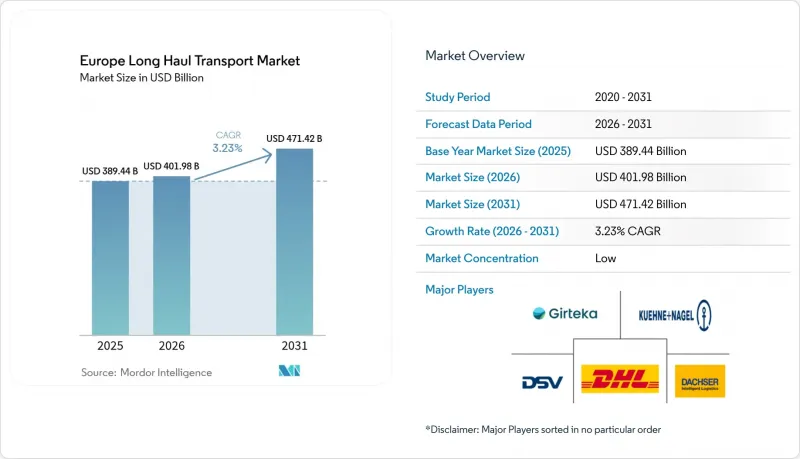
Mordor Intelligence에 따르면 유럽의 장거리 운송 시장 규모는 2025년에 3,894억 4,000만 달러로 평가되며, 2026년 4,019억 8,000만 달러에서 2031년까지 4,714억 2,000만 달러에 달할 것으로 예측되며, 예측 기간(2026-2031년) 동안 CAGR은 3.23%가 될 전망입니다.
본 보고서는 운송 수단(도로, 철도, 해상 및 내륙수로, 항공), 최종사용자 산업(농업, 어업, 임업; 건설; 제조업; 석유·가스, 광업·채석업; 도매·소매업; 기타), 및 지역(독일, 영국, 스페인,이탈리아, 네덜란드, 프랑스, 폴란드 등)별로 분류되어 있습니다. 시장 예측은 금액(달러) 기준으로 제시되어 있습니다.
유럽 장거리 운송 시장의 동향 및 인사이트
EU 그린딜 및 ‘Fit-for-55’의 운송 수단 전환 목표
‘Fit-for-55’ 패키지는 법적 구속력이 있는 CO2 감축 목표를 설정하고 있으며, 이에 따라 화주들은 장거리 운송 화물을 도로에서 철도나 내륙수로로 우회시켜야 하는 압박을 받고 있습니다. 그러나 터미널 내 화물 정체 및 라스트 마일 제약으로 인해 일일 수요는 여전히 트럭에 쏠려 있습니다. 철도는 톤킬로미터당 배출량이 80% 낮아 환경적 측면에서 분명한 우위를 가지고 있지만, 주요 회랑의 가동률은 85% 이상으로 유지되고 있어 급증하는 수요에 대응할 여지가 거의 없습니다. 탄소 국경 조정 메커니즘은 물류 분야의 배출량을 수입 규정 준수 감사 대상에 포함시킴으로써 이러한 압박을 더욱 가중시키고 있습니다. 그 결과, 조달 팀은 현재 과거에는 비용 평가에만 적용되던 것과 동일한 엄격함으로 화물의 탄소 배출 데이터를 평가하고 있습니다. ISO 14083과 같은 인증 제도는 사실상 입찰 요건이 되어, 중소 운송업체들로 하여금 오랫동안 미루어 왔던 텔레매틱스 및 데이터 보고 도구의 도입을 불가피하게 만들고 있습니다. 그 결과, 모달 시프트의 진척도가 정책 의도에 미치지 못하고 있기는 하지만, 차량 교체 및 디지털 가시화 프로젝트는 예상보다 빠른 속도로 진행되고 있습니다.
TEN-T 메가 프로젝트의 확대
EU로부터 14억 유로의 공동 자금 지원을 받은 ‘레일 발티카’의 870km에 달하는 표준궤 선로는 탈린과 바르샤바를 연결하는 원활한 노선을 실현할 전망이지만, 인허가 절차 지연으로 인해 개통은 2030년 이후로 미뤄질 것으로 보입니다. 페마룬 해협 철도 터널은 2029년 개통 시 코펜하겐에서 함부르크까지의 소요 시간을 3시간 미만으로 단축하여, 현재 페리의 병목 현상으로 어려움을 겪고 있는 화물 물동량을 해소하게 될 것입니다. 이와 병행하여 진행되고 있는 독일 국내 철도망 개선에는 연간 25억 유로의 자금이 투입되고 있지만, 지역별 토지 매입을 둘러싼 분쟁으로 인해 현장 굴착 작업이 지연되고 있습니다. 이러한 지연이 발생할 때마다 유럽 장거리 운송 시장에서 철도의 점유율 확대가 저해되며, 탄소 배출 감축 목표가 있음에도 불구하고 운송량의 상당 부분이 여전히 도로 운송업자에 의존하는 상황이 지속되고 있습니다. 인터모달 야드나 전철화에 대한 2차 투자는 간선 노선의 완공에 의존하고 있기 때문에 마일스톤 달성이 지연될 때마다 그 파급 효과는 더욱 커집니다. 장기적으로, 이러한 노선들은 네트워크에 고속 및 저탄소 간선 노선을 통합함으로써 대륙 전체의 화물 운송 구조를 재구축하게 될 것입니다.
철도 선로, 항만 및 복합 운송의 용량 병목 현상
2024년, 라인강-알프스 회랑 및 북해-지중해 회랑의 철도 화물 이용률은 85%를 초과하여, 추가 열차를 수용할 여지가 최소한으로 제한되고, 운행 시간표의 신뢰성이 저하되고 있습니다. 로테르담, 앤트워프, 함부르크의 각 터미널은 피크 주간에는 포화 상태에 가까운 가동률을 보이며, 컨테이너 체류 시간이 48시간을 초과하여 철도가 가진 이론상의 도어 투 도어 속도 우위가 훼손되고 있습니다. 터미널 자동화 프로젝트는 진행 중이지만, 부지 확보 및 인허가 절차에 3년에서 5년이 소요되는 경우가 많아 2027년까지 실질적인 개선을 기대하기 어렵습니다. 유럽 철도의 46%에서는 여전히 디젤 기관차가 사용되고 있으며, 이는 모달 시프트를 통한 배기가스 감축 효과를 제한할 뿐만 아니라, 사업자에게는 연료 가격 변동 위험에도 노출되고 있습니다. 이러한 병목 현상이 복합적으로 작용하여, 새로운 수송 능력이 가동되기 전까지는 유럽 장거리 수송 시장에서 철도의 점유율이 정체 상태를 이어갈 것으로 보입니다.
부문 분석
2025년, 유럽 장거리 운송 시장에서 도로 운송은 59.10%의 점유율을 유지했습니다. 이는 유럽의 치밀한 고속도로망이 정시 배송을 뒷받침하고 있기 때문이지만, 디젤 연료비 급등과 운전자 부족이 사업자의 이익률을 압박하고 있습니다. 항공 화물은 E-Commerce 소포 운송량과 프리미엄 요금이 적용되는 GDP 기준 콜드체인 의약품의 증가에 힘입어, 2031년까지 연평균 성장률(CAGR) 4.75%라는 가장 높은 성장 전망을 보이고 있습니다. 철도의 톤킬로미터당 배출량은 ‘Fit-for-55’ 정책에 부합하는 낮은 수준이지만, 수송 능력의 병목 현상과 퍼스트 마일/라스트 마일에서의 환적이 당분간 시장 점유율 확대를 억제하고 있습니다. 연간 3억 톤의 라인강 화물을 수송하는 내륙수로는 기후 변화에 따른 저수위로 인한 혼란에 직면해 있으며, 이로 인해 화물이 철도나 도로로 이동하고 있습니다. 이는 기후 변화에 대한 회복력 강화가 필수적임을 여실히 보여주고 있습니다.
디지털 화물 플랫폼을 통해 주요 도로 회랑의 공차 운행률은 25%에서 18% 미만으로 감소했으며, 소규모 차량군의 경쟁력이 향상됨과 동시에 배출 강도가 감소했습니다. 철도 복합운송 사업자들은 위치 정보와 충격을 추적하는 IoT 센서를 도입하여 도로 운송 수준의 투명성을 실현함으로써, 오랫동안 지속되어 온 정보 격차를 줄이고 있습니다. 한편, 5억 유로의 EU 자금은 라인강 및 다뉴브강 유역의 수문 현대화에 투입되고 있으며, 이는 가뭄 위험에 대비해 수로의 경쟁력을 확보하기 위한 조치입니다. 항공 화물과 관련된 유럽의 장거리 운송 시장 규모는 소포 밀도가 높아짐에 따라 꾸준히 확대될 것으로 예상되며, 기업의 운송 전략에서 운송 수단의 다양화가 강조되고 있습니다.
기타 혜택:
- 엑셀 형식의 시장 예측(ME) 시트
- 3개월간의 애널리스트 지원
자주 묻는 질문
목차
제1장 소개
제2장 조사 방법
제3장 주요 요약
제4장 시장 구도
제5장 시장 규모 및 성장 예측(금액, 2019-2030년)
제6장 경쟁 구도
제7장 시장 기회와 향후 전망
KSM 26.08.26According to Mordor Intelligence, the Europe long haul transport market size was valued at USD 389.44 billion in 2025 and estimated to grow from USD 401.98 billion in 2026 to reach USD 471.42 billion by 2031, at a CAGR of 3.23% during the forecast period (2026-2031).
This report is Segmented by Mode of Transport (Road, Rail, Sea and Inland Waterways, Air), End-User Industry (Agriculture, Fishing, and Forestry; Construction; Manufacturing; Oil and Gas, Mining and Quarrying; Wholesale and Retail Trade; Others), and Geography (Germany, United Kingdom, Spain, Italy, Netherlands, France, Poland, and More). The Market Forecasts are Provided in Terms of Value (USD).
Europe Long Haul Transport Market Trends and Insights
EU Green Deal & Fit-for-55 Modal-Shift Targets
The Fit-for-55 package fixes legally binding CO2 cuts that push shippers to reroute long-haul volume from road toward rail or inland waterways, yet terminal backlogs and last-mile constraints still tilt day-to-day demand toward trucks. Rail's 80% lower emissions per tonne-kilometer give it a clear environmental edge, but capacity on core corridors hovers above 85%, leaving little surge headroom. The carbon-border adjustment mechanism extends the pressure by inserting logistics emissions into import compliance audits, so procurement teams now assess freight carbon data with the same rigor once reserved for cost. Certification schemes such as ISO 14083 have become de facto tender prerequisites, compelling smaller carriers to buy telematics and data-reporting tools they had long deferred. Consequently, fleet renewal and digital visibility projects are pacing quicker than anticipated, even if modal shifts lag policy intent.
Expansion of TEN-T Megaprojects
Rail Baltica's 870 km of standard-gauge track, supported by EUR 1.4 billion in EU co-financing, promises a seamless Tallinn-Warsaw route, yet permitting delays push commissioning beyond 2030. The Fehmarn Belt rail tunnel slashes Copenhagen-Hamburg transit to under three hours when operational in 2029, unlocking freight flows that today navigate ferry bottlenecks. Parallel German network upgrades receive EUR 2.5 billion of annual funding, but localized land-acquisition disputes slow diggers on the ground. Each delay holds back the rail share of Europe Long Haul Transport market growth, leaving road hauliers to soak up volume despite carbon targets. Secondary investments in intermodal yards and electrification hinge on main-line completion, amplifying the knock-on effect of every missed milestone. Long-term, these links still reshape continental freight geometry by embedding a high-speed, low-carbon spine into the network.
Rail-Line, Port & Intermodal Capacity Bottlenecks
Rail freight utilization on Rhine-Alpine and North Sea-Mediterranean corridors exceeded 85% in 2024, leaving minimal headroom for extra trains and increasing schedule unreliability. Rotterdam, Antwerp, and Hamburg terminals ran near saturation during peak weeks, extending container dwell times beyond 48 hours and eroding rail's theoretical door-to-door speed advantage. Terminal automation projects are underway, yet land acquisition and permitting often span three to five years, so meaningful relief is not expected before 2027. Diesel motive power still covers 46% of European track, limiting the emissions benefit of modal shift and exposing operators to fuel-price volatility. These bottlenecks collectively cap the rail share of the Europe Long Haul Transport market until new capacity comes online.
Other drivers and restraints analyzed in the detailed report include:
- Explosive E-commerce
- Consolidation & 4PL Integration
- Driver & Skills Shortages
For complete list of drivers and restraints, kindly check the Table Of Contents.
Segment Analysis
Road transport maintained a 59.10% Europe Long Haul Transport market share in 2025 as the continent's dense highway network underpins time-critical deliveries, yet escalating diesel costs and driver scarcity compress operator margins. Air freight carries the fastest growth outlook at a 4.75% CAGR through 2031, fueled by e-commerce parcel volume and GDP-compliant cold-chain pharmaceuticals that command premium rates. Rail's lower emissions per tonne-kilometer align with Fit-for-55 policy, but capacity bottlenecks and first-mile/last-mile transfers temper its immediate share gains. Inland waterways, moving 300 million t of Rhine traffic annually, face climate-linked low-water disruptions that shift cargo onto rail and road, highlighting the climate resilience imperative.
Digital freight platforms reduced empty running on primary road corridors from 25% to under 18%, boosting small-fleet competitiveness and lowering emissions intensity. Rail intermodal operators deploy IoT sensors that track location and shock to mimic road-level transparency, narrowing a historic information gap. Meanwhile, EU funds of EUR 500 million target lock modernization on Rhine and Danube stretches, a step meant to safeguard waterway competitiveness against drought risk. The Europe Long Haul Transport market size attached to air freight is forecast to climb steadily as parcel density rises, underscoring modal diversification in corporate shipping strategies.
Complete Report Scope:
- By Mode of Transport
- Road
- Rail
- Sea and Inlandwaterways
- Air
- By End-user Industry
- Agriculture, Fishing, and Forestry
- Construction
- Manufacturing
- Oil and Gas, Mining and Quarrying
- Wholesale and Retail Trade
- Others
- By Country
- Germany
- United Kingdom
- Spain
- Italy
- Netherlands
- France
- Poland
- Rest of Europe
List of Companies Covered in this Report:
- DHL Group
- Kuehne + Nagel
- DSV A/S
- Dachser
- Girteka Logistics
- Waberer's International
- Raben Group
- H. Essers
- Primafrio
- Turners (Soham) Ltd
- DFDS Logistics
- SNCF
- GXO Logistics
- Culina Group
- CMA CGM
- ROHLIG SUUS Logistics SA
- GRUBER Logistics SpA
- Hapag-Lloyd
- Rail Cargo Group
- InterRail Group
Additional Benefits:
- The market estimate (ME) sheet in Excel format
- 3 months of analyst support
TABLE OF CONTENTS
1 Introduction
- 1.1 Study Assumptions & Market Definition
- 1.2 Scope of the Study
2 Research Methodology
3 Executive Summary
4 Market Landscape
- 4.1 Market Overview
- 4.2 Market Drivers
- 4.2.1 EU Green Deal & Fit-for-55 modal-shift targets
- 4.2.2 Expansion of TEN-T megaprojects (Rail Baltica, Fehmarn Belt, etc.)
- 4.2.3 Explosive e-commerce boosting parcel & air-cargo lane demand
- 4.2.4 Consolidation & 4PL integration across modes
- 4.2.5 Roll-out of zero-carbon fuel & shore-power infrastructure
- 4.2.6 Post-pandemic resilience & near-shoring strategies
- 4.3 Market Restraints
- 4.3.1 Rail-line, port & intermodal terminal capacity bottlenecks
- 4.3.2 Heavier-truck Directive risk of reverse modal shift
- 4.3.3 Driver & skills shortages across road, rail & maritime
- 4.3.4 Energy & bunker-fuel price volatility
- 4.4 Value / Supply-Chain Analysis
- 4.5 Regulatory Landscape
- 4.6 Technological Outlook
- 4.7 Porter's Five Forces
- 4.7.1 Threat of New Entrants
- 4.7.2 Bargaining Power of Suppliers
- 4.7.3 Bargaining Power of Buyers
- 4.7.4 Threat of Substitutes
- 4.7.5 Competitive Rivalry
5 Market Size & Growth Forecasts (Value, 2019 - 2030)
- 5.1 By Mode of Transport
- 5.1.1 Road
- 5.1.2 Rail
- 5.1.3 Sea and Inlandwaterways
- 5.1.4 Air
- 5.2 By End-user Industry
- 5.2.1 Agriculture, Fishing, and Forestry
- 5.2.2 Construction
- 5.2.3 Manufacturing
- 5.2.4 Oil and Gas, Mining and Quarrying
- 5.2.5 Wholesale and Retail Trade
- 5.2.6 Others
- 5.3 By Country
- 5.3.1 Germany
- 5.3.2 United Kingdom
- 5.3.3 Spain
- 5.3.4 Italy
- 5.3.5 Netherlands
- 5.3.6 France
- 5.3.7 Poland
- 5.3.8 Rest of Europe
6 Competitive Landscape
- 6.1 Market Concentration
- 6.2 Strategic Moves
- 6.3 Market Share Analysis
- 6.4 Company Profiles (includes Global level Overview, Market level overview, Core Segments, Financials as available, Strategic Information, Market Rank/Share for key companies, Products & Services, and Recent Developments)
- 6.4.1 DHL Group
- 6.4.2 Kuehne + Nagel
- 6.4.3 DSV A/S
- 6.4.4 Dachser
- 6.4.5 Girteka Logistics
- 6.4.6 Waberer's International
- 6.4.7 Raben Group
- 6.4.8 H. Essers
- 6.4.9 Primafrio
- 6.4.10 Turners (Soham) Ltd
- 6.4.11 DFDS Logistics
- 6.4.12 SNCF
- 6.4.13 GXO Logistics
- 6.4.14 Culina Group
- 6.4.15 CMA CGM
- 6.4.16 ROHLIG SUUS Logistics SA
- 6.4.17 GRUBER Logistics SpA
- 6.4.18 Hapag-Lloyd
- 6.4.19 Rail Cargo Group
- 6.4.20 InterRail Group
7 Market Opportunities & Future Outlook
- 7.1 White-space & Unmet-need Assessment


