

|
시장보고서
상품코드
2116117
아프리카의 국경 간 도로 화물 운송 : 시장 점유율 분석, 업계 동향과 통계, 성장 예측(2026-2031년)Africa Cross Border Road Freight Transport - Market Share Analysis, Industry Trends & Statistics, Growth Forecasts (2026 - 2031) |
||||||
 Mordor Intelligence
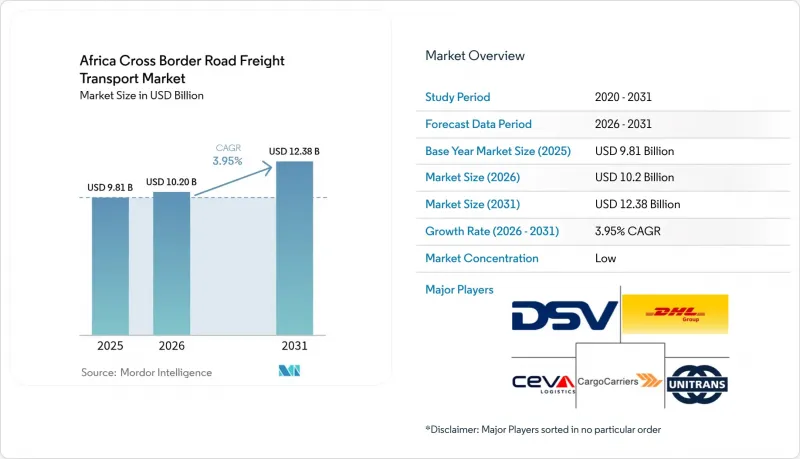
Mordor Intelligence에 따르면 아프리카의 국경 간 도로 화물 운송 시장 규모는 2025년 98억 1,000만 달러에서 2026년에는 102억 달러로 확대되고, 2026년부터 2031년까지 CAGR 3.95%를 기록하며 2031년에는 123억 8,000만 달러에 달할 것으로 예측됩니다.
본 보고서는 최종사용자 산업(건설업 등), 트럭 적재 사양(트럭 전체 적재 등), 컨테이너화(컨테이너 운송 등), 운송 거리(장거리 운송, 단거리 운송), 화물 형태(액체 화물, 고체 화물), 온도 관리(온도 관리 화물 등) 및 지역별로 분류되어 있습니다. 시장 전망은 금액(달러) 기준으로 제시되어 있습니다.
아프리카 국경 간 도로 화물 운송 시장의 동향 및 인사이트
AfCFTA의 관세 단계적 인하로 인해 아프리카 지역 내 육상 무역이 가속화되고 있습니다
54개 서명국의 관세 자유화로 인해 도착 비용이 낮아지고, 회랑 간 화물 운송이 활성화되고 있습니다. UNCTAD의 2024년 벤치마크 조사에 따르면, 관세 인하와 디지털 싱글 윈도우 시스템을 병행하고 있는 국가들은 관세 경감만 시행하고 있는 국가들에 비해 22% 더 높은 무역 성장률을 기록하고 있습니다. 축중 제한을 통일한 동아프리카 공동체(EAC) 회원국들은 타국보다 더 큰 혜택을 누리고 있는 반면, 나이지리아의 SIGMAT 도입으로 서아프리카 최대 경제 대국도 유사한 이익을 얻을 수 있는 기반이 마련되었습니다. 원산지 규정 준수로 인해 혼합 화물 허브에 대한 수요가 증가하고 있으며, 국경 검문소 인근에서 통관 절차가 용이한 창고에 대한 투자가 촉진되고 있습니다. 2027년에 예정된 최종 관세 철폐 라운드는 화물 수요를 뒷받침하며, 아프리카의 국경을 넘는 도로 화물 운송 시장에 호조를 공고히 하고 있습니다.
E-Commerce 주문 처리: 신속한 국경 간 라스트 마일 배송에 대한 수요
온라인 소매 시장은 2029년까지 560억 달러에 달할 것으로 예측되며, 각 플랫폼은 배송 속도를 희생하지 않으면서 여러 통관 관할 구역을 통과할 수 있는 트럭 운송업체를 필요로 하고 있습니다. 아마존이 2024년 남아프리카 시장에 진출한 것은 세계 브랜드들이 국경을 넘는 배송 기간을 2-3일로 재정의하고 있음을 보여주는 좋은 예입니다. CloudFret과 같은 스타트업 기업들은 화물 매칭 및 서류 절차의 디지털화를 위한 새로운 자금을 조달했습니다. 이는 신뢰성을 높이는 기술에 대한 투자자들의 높은 관심을 보여줍니다. 2024년 소말리아에서 시작된 것과 같은 국내 결제 스위치는 대금 상환 방식에 대한 의존도를 낮추고 반품 위험을 줄여줍니다. 의약품 및 식료품 E-Commerce가 확대됨에 따라 콜드체인의 중요성이 부각되고 있으며, 퀵 인터내셔널 쿠리어(Quick International Courier)는 엄격한 취급 요건을 충족하기 위해 온도 관리 설비에 투자하고 있습니다.
국경 검문소의 뿌리 깊은 부패와 비공식 수수료
교통량이 많은 통로에서는 국경에서의 평균 체류 시간이 여전히 48시간을 초과하는 경우가 있습니다. 세계은행의 2024년 통로 감사 보고서에 따르면, 비공식 수수료가 AfCFTA의 원활화 목표 달성에 있어 가장 큰 장애물이라고 지적되었습니다. ASYCUDA 도입은 효과적이었으며, 감비아에서 전면 도입된 결과 관세 수입이 23% 증가하고 현금 징수가 억제되었습니다. 그러나 전력 및 인터넷 인프라 부족으로 인해 일부 검문소에서는 여전히 수작업이 이루어지고 있으며, 렌트시킹이 뿌리 깊게 남아 있습니다. 원스톱 국경 검문소는 유망한 시도입니다. 무와미/무친지에서는 2024년에 처리 시간을 60% 단축했으나, 뿌리 깊은 관행을 해소하기 위해서는 지역적 동료 평가 체계를 확대할 필요가 있습니다.
부문별 분석
도매·소매업은 2025년 수익의 29.12%를 차지하며 연평균 성장률(CAGR) 4.62%로 가장 빠르게 성장하는 분야로, 이 부문이 거래량과 혁신 양측면에 미치는 영향이 크다는 것을 보여줍니다. 빈번한 E-Commerce 화물 운송으로 인해 정밀하고 온도가 관리되는 도시 지역으로의 배송 수요가 가속화되고 있으며, 운송 사업자들은 실시간 추적 및 유연한 경로 설정을 통합하고 있습니다. 제조업은 특히 모로코, 남아프리카공화국, 에티오피아의 자동차 산업 클러스터에서 지역 밸류체인이 성숙해짐에 따라 성장하고 있습니다. 중요 광물에 대한 수요를 배경으로 광물 수출이 회복되고 있으며, 콩고민주공화국과 잠비아의 구리 벨트 지대와 연안 항구를 연결하는 전용 FTL(전체 트럭 적재) 노선이 확대되고 있습니다. 농업 분야에서는 디지털 식물 검역 증명서 도입으로 거부율이 낮아지면서 운송 톤수가 대폭 증가하고 있습니다. 한편, 건설자재의 운송량은 경제 회랑과 연계된 인프라 정비의 활황을 반영하고 있습니다. 의약품 및 전자기기의 물류는 ‘기타’로 분류되며, 엄격한 규정 준수 대응 및 안전한 취급 서비스에 대한 프리미엄이 발생하고 있습니다.
풀 트럭 적재(FTL)는 보안 측면이나 광물의 대량 운송에 적합하기 때문에 52.78%의 점유율을 차지하고 있습니다. 반면, 소량 화물(LTL)은 기술 플랫폼을 통해 화물 집적 및 서류 절차가 간소화됨에 따라 2031년까지 연평균 성장률(CAGR) 4.05%를 기록할 것으로 전망됩니다. Kobo360의 모델은 연료비 융자와 예측 유지보수를 결합한 것으로, 과거 비공식적으로 화물을 운송하던 중소기업에게도 LTL 이용을 현실적인 선택지로 만들어 주고 있습니다. 따라서 아프리카의 국경 간 도로 화물 운송 시장은 보다 성숙한 지역에서 흔히 볼 수 있는 네트워크형 모델에 가까워지고 있습니다.
기타 혜택:
- 엑셀 형식의 시장 예측(ME) 시트
- 3개월간의 애널리스트 지원
자주 묻는 질문
목차
제1장 소개
제2장 조사 방법
제3장 주요 요약
제4장 시장 구도
제5장 시장 규모와 성장 예측
제6장 경쟁 구도
제7장 시장 기회와 향후 전망
KSM 26.08.26According to Mordor Intelligence, the Africa cross border road freight transport market size is expected to grow from USD 9.81 billion in 2025 to USD 10.2 billion in 2026 and is forecast to reach USD 12.38 billion by 2031 at 3.95% CAGR over 2026-2031.
This report is Segmented by End User Industry (Construction, and More), Truckload Specification (Full-Truck-Load, and More), Containerization (Containerized, and More), Distance (Long-Haul, Short-Haul), Good Configuration (Fluid Goods, Solid Goods), Temperature Control (Temperature Controlled, and More), and Geography. The Market Forecasts are Provided in Terms of Value (USD).
Africa Cross Border Road Freight Transport Market Trends and Insights
AfCFTA Tariff Phase-Down Accelerates Intra-African Over-the-Road Trade
Tariff liberalization across 54 signatory states is lowering landed costs and stimulating corridor traffic. UNCTAD's 2024 benchmarking shows countries that pair tariff cuts with digital single-window systems record 22% higher trade growth than those applying tariff relief alone. East African Community (EAC) members with harmonized axle-load limits capture outsized benefits, while Nigeria's SIGMAT rollout positions West Africa's largest economy for similar gains. Rules-of-origin compliance drives up demand for consolidation hubs, catalyzing investment in documentation-ready warehouses near border posts. The final tariff dismantling round scheduled for 2027 sustains freight demand, embedding a positive trajectory for the Africa Cross-Border Road Freight Transport market.
E-commerce Fulfilment Demand for Fast Cross-Border Last-Mile
Online retail is forecast to reach USD 56 billion by 2029, and platforms require truck operators capable of clearing multiple customs jurisdictions without sacrificing delivery speed. Amazon's 2024 South Africa entry exemplifies how global brands re-shape freight expectations toward two- to three-day cross-border delivery windows. Start-ups such as CloudFret secured fresh capital to digitize load matching and paperwork, evidence of investor appetite for technology that improves reliability. National payment switches like Somalia's 2024 launch reduce cash-on-delivery dependencies and shrink reversal risk. Cold chain capability gains prominence as pharmaceutical and grocery e-commerce expand, with Quick International Courier investing in temperature-controlled assets to meet stringent handling requirements.
Persistent Border-Post Corruption and Informal Fees
Average border dwell times can still exceed 48 hours on high-traffic corridors. The World Bank's 2024 corridor audit names informal fees as the chief impediment to AfCFTA facilitation targets. ASYCUDA installations help; Gambia's full rollout drove a 23% customs revenue jump and curbed cash-based collections. Yet electricity and internet gaps keep several posts manual, perpetuating rent-seeking. One-Stop Border Posts show promise-Mwami/Mchinji cut processing times 60% in 2024but regional peer-review mechanisms must scale to neutralize entrenched practices.
Other drivers and restraints analyzed in the detailed report include:
- Emerging Regional Value Chains in Automotive & FMCG Manufacturing
- Multilateral Corridor Programs Unlock Infrastructure Finance
- Cabotage and Axle-Load Policy Fragmentation by Country
For complete list of drivers and restraints, kindly check the Table Of Contents.
Segment Analysis
Wholesale and Retail Trade makes up 29.12% of 2025 revenue and is the fastest-growing slice at 4.62% CAGR, signaling the segment's dual influence over volume and innovation. High-frequency e-commerce shipments accelerate demand for precise, temperature-controlled urban deliveries, prompting carriers to integrate real-time tracking and flexible routing. Manufacturing follows as regional value chains mature, especially in automotive clusters across Morocco, South Africa, and Ethiopia. Mineral exports rally on critical-minerals demand, pushing dedicated FTL lanes between the DRC-Zambia copper belt and coastal ports. Agriculture tallies sizeable tons as digital phytosanitary certification trims rejection rates, while construction freight mirrors corridor-linked infrastructure booms. Pharmaceutical and electronics flows sit in the "Others" bucket, bringing stringent compliance and secure-handling service premiums.
Full-Truck-Load holds 52.78% share, favored for security and bulk minerals. Yet Less-than-Truck-Load posts a 4.05% CAGR to 2031 as tech platforms simplify load aggregation and documentation. Kobo360's model, which bundles fuel financing and predictive maintenance, makes LTL viable for SMEs whose freight once moved informally. The Africa Cross-Border Road Freight Transport market is, therefore, drawing nearer to network-based models common in more mature geographies.
Complete Report Scope:
- By End User Industry
- Agriculture, Fishing, and Forestry
- Construction
- Manufacturing
- Oil and Gas, Mining and Quarrying
- Wholesale and Retail Trade
- Others
- By Truckload Specification
- Full-Truck-Load (FTL)
- Less-than-Truck-Load (LTL)
- By Containerization
- Containerized
- Non-Containerized
- By Distance
- Long-Haul
- Short-Haul
- By Good Configuration
- Fluid Goods
- Solid Goods
- By Temperature Control
- Non-Temperature Controlled
- Temperature Controlled
List of Companies Covered in this Report:
- DSV
- DHL Group
- Unitrans Supply Chain Solutions
- CEVA Logistics
- Cargo Carriers
- Value Logistics
- Rhenus Logistics
- Super Group
- Bidvest Freight
- Grindrod Logistics
- Kuehne + Nagel
- OML Africa Logistics
- Megafreight Services Pty (Ltd)
- BAC Logistics
- Rangel Logistics Solutions
- Unidel Carriers
- OneLogix Cargo Solutions
- Atrax Logistics
- RDM Logistics
- Aeromarine Capital
Additional Benefits:
- The market estimate (ME) sheet in Excel format
- 3 months of analyst support
TABLE OF CONTENTS
1 Introduction
- 1.1 Study Assumptions and Market Definition
- 1.2 Scope of the Study
2 Research Methodology
3 Executive Summary
4 Market Landscape
- 4.1 Market Overview
- 4.2 Market Drivers
- 4.2.1 AfCFTA tariff phase-down accelerates intra-African over-the-road trade
- 4.2.2 E-commerce fulfilment demand for fast cross-border last-mile
- 4.2.3 Emerging regional value chains in automotive and FMCG manufacturing
- 4.2.4 Multilateral corridor programmes unlocking infrastructure finance
- 4.2.5 Digital freight-matching platforms cutting empty-backhaul rates
- 4.2.6 Mining-led "critical-minerals corridor" projects
- 4.3 Market Restraints
- 4.3.1 Persistent border-post corruption and informal fees
- 4.3.2 Cabotage and axle-load policy fragmentation by country
- 4.3.3 Diesel price volatility with weak regional hedging instruments
- 4.3.4 Climate-driven road-surface failures on key north-south arterials
- 4.4 Value / Supply-Chain Analysis
- 4.5 Regulatory Landscape (Govt. Regulations, Trade Agreements, Initiatives)
- 4.6 Technological Outlook
- 4.7 Cross-Border E-commerce Insights
- 4.8 Key Transport Corridors Analysis
- 4.9 Manufacturing Hubs and Special Economic Zones (SEZs)
- 4.10 Porter's Five Forces
- 4.10.1 Supplier Power
- 4.10.2 Buyer Power
- 4.10.3 Threat of New Entrants
- 4.10.4 Threat of Substitutes (Rail, Coastal Ro-Ro)
- 4.10.5 Competitive Rivalry
- 4.11 Impact of COVID-19 and Geopolitical Events
5 Market Size and Growth Forecasts (Value)
- 5.1 By End User Industry
- 5.1.1 Agriculture, Fishing, and Forestry
- 5.1.2 Construction
- 5.1.3 Manufacturing
- 5.1.4 Oil and Gas, Mining and Quarrying
- 5.1.5 Wholesale and Retail Trade
- 5.1.6 Others
- 5.2 By Truckload Specification
- 5.2.1 Full-Truck-Load (FTL)
- 5.2.2 Less-than-Truck-Load (LTL)
- 5.3 By Containerization
- 5.3.1 Containerized
- 5.3.2 Non-Containerized
- 5.4 By Distance
- 5.4.1 Long-Haul
- 5.4.2 Short-Haul
- 5.5 By Good Configuration
- 5.5.1 Fluid Goods
- 5.5.2 Solid Goods
- 5.6 By Temperature Control
- 5.6.1 Non-Temperature Controlled
- 5.6.2 Temperature Controlled
6 Competitive Landscape
- 6.1 Market Concentration
- 6.2 Strategic Moves
- 6.3 Market Share Analysis
- 6.4 Company Profiles (includes Global level Overview, Market level overview, Core Segments, Financials as available, Strategic Information, Market Rank/Share for key companies, Products and Services, and Recent Developments)
- 6.4.1 DSV
- 6.4.2 DHL Group
- 6.4.3 Unitrans Supply Chain Solutions
- 6.4.4 CEVA Logistics
- 6.4.5 Cargo Carriers
- 6.4.6 Value Logistics
- 6.4.7 Rhenus Logistics
- 6.4.8 Super Group
- 6.4.9 Bidvest Freight
- 6.4.10 Grindrod Logistics
- 6.4.11 Kuehne + Nagel
- 6.4.12 OML Africa Logistics
- 6.4.13 Megafreight Services Pty (Ltd)
- 6.4.14 BAC Logistics
- 6.4.15 Rangel Logistics Solutions
- 6.4.16 Unidel Carriers
- 6.4.17 OneLogix Cargo Solutions
- 6.4.18 Atrax Logistics
- 6.4.19 RDM Logistics
- 6.4.20 Aeromarine Capital
7 Market Opportunities and Future Outlook
- 7.1 White-space and Unmet-Need Assessment


