

|
시장보고서
상품코드
2116123
단일클론항체 : 시장 점유율 분석, 업계 동향 및 통계, 성장 예측(2026-2031년)Monoclonal Antibodies - Market Share Analysis, Industry Trends & Statistics, Growth Forecasts (2026 - 2031) |
||||||
 Mordor Intelligence
Mordor Intelligence에 의하면, 단일클론항체 시장 규모는 2025년에 2,866억 5,000만 달러로 평가되었습니다. 2026년 3,238억 9,000만 달러에서 2031년까지 5,961억 2,000만 달러에 이를 것으로 추정되고 예측 기간(2026-2031년) CAGR은 12.99%를 나타낼 전망입니다.
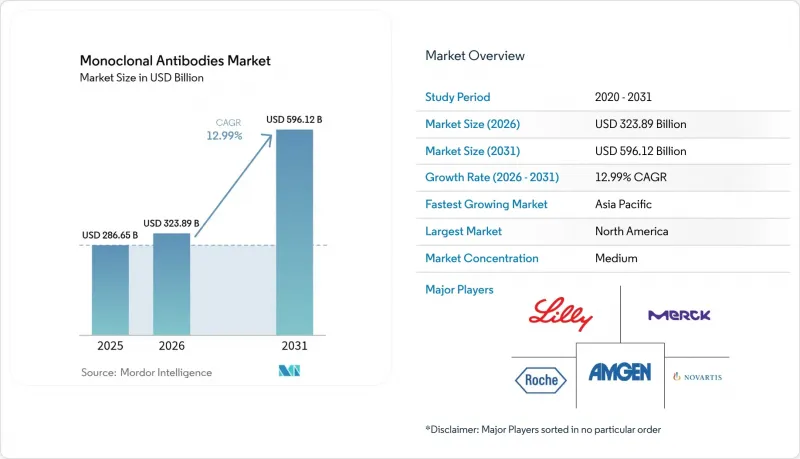
본 보고서에서는 산업을 생산 방식(인비보, 인비트로), 공급원(인간, 인간화, 키메라, 마우스), 적응증(종양학, 자가면역질환, 기타), 최종 사용자(병원, 학술 연구 기관, 기타),지역(북미, 유럽, 아시아태평양, 중동 및 아프리카, 남미)별로 분류하고 있습니다. 시장 예측은 금액(미 달러) 기준으로 제시되어 있습니다.
세계의 단일클론항체 시장 동향 및 인사이트
항체 공학 플랫폼의 기술 발전
고성능 마이크로플루이딕스 기술과 단일 B세포 스크리닝을 통해 신약 개발 주기가 수개월에서 수주로 단축되었으며, 개발자는 희귀한 고친화성 클론을 높은 정확도로 식별할 수 있게 되었습니다. 삼성바이오로직스가 2024년에 출시한 ‘S-HiCon’ 플랫폼을 통해 200mg/mL를 초과하는 액상 제형이 가능해졌으며, 피하 투여 시 점도 및 안정성 문제가 해소되었습니다. 현재, 부위 특이적 결합 기술이 항체-약물 복합체(ADC) 파이프라인을 주도하고 있으며, 배치 간 편차를 줄이고 규제 당국의 심사를 원활하게 하고 있습니다. 2024년 기준에서 이미 14종의 이중 특이성 항체가 전 세계 각국에서 승인되었습니다. 이러한 확장성이 높고 표준화된 툴킷 덕분에, 플랫폼에 대한 투자를 여러 프로그램에서 상각할 수 있는 CDMO(위탁 개발·제조 기관)로 협상 우위가 이동하면서, 대규모 제조업체에 경쟁 우위가 쏠리고 있습니다.
전 세계적으로 증가하는 암 및 만성 질환 유병률
2050년까지 전 세계 암 환자 수가 77% 증가할 것으로 예측되며, 자가면역 질환의 진단 건수도 급증하고 있어 치료에 대한 수요는 견조한 추세를 보이고 있습니다. 체크포인트 억제제는 이러한 융합을 여실히 보여주고 있습니다. 종양학에서 얻은 작용기전에 대한 지식이 자가면역 질환의 치료 프로토콜에 응용되어, 개발 기간 단축과 대상 환자층 확대로 이어지고 있습니다. 단일클론항체는 독립형 생물학적 제제로서, 또한 ADC(항체-약물 복합체)에서 정밀한 유효 성분의 운반체로서 이중의 역할을 수행하고 있으며, 다양한 질환군에서 그 필수성이 더욱 강화되고 있습니다. 북미, 유럽, 아시아태평양의 인구 고령화는 유병률을 더욱 높여, 치료 수요의 지속적인 확대를 확실히 하고 있습니다.
고액의 치료비 및 제조 비용
2024년, 전문 생물학적 제제의 출시 시 가격 중앙값은 1코스당 30만 달러에 달하여 지불 주체의 예산을 압박했습니다. 비용 대비 효과 연구에 따르면, 에크리주맙이 QALY 기준치를 충족하려면 93%의 가격 인하가 필요하며, 이는 합리적인 가격과의 격차를 여실히 드러내고 있습니다. 복잡한 ADC 봉입, 광범위한 품질 관리(QC) 프로토콜, 프로테인 A 수지의 비용은 일회용 바이오리액터의 도입에도 불구하고 높은 비용 구조를 유지하고 있습니다. 칠레에서는 릿룩시맙의 바이오시밀러 도입으로 연간 20만 8,553달러의 비용 절감 효과를 거두었으나, 미국에서는 도입이 지연되면서 가격 인하로 인한 이점이 줄어들고 있습니다.
부문별 분석
2025년, 인비트로 시스템은 단일클론항체 시장의 54.68%를 차지했으며, 2031년까지 연평균 성장률(CAGR) 13.95%로 성장할 전망입니다. 이 부문의 생산성 우위가 2025년 매출 우위를 뒷받침하고 있으며, 중국 햄스터 난소 세포주를 통해 역가가 11.5G/L를 초과하고, 페드배치(fed-batch) 방식에 의한 생산량이 3배로 증가했습니다. 연속 관류 및 다중 컬럼 크로마토그래피를 통해 프로테인 A 수지 사용량이 40% 감소하여 원료 비용을 절감하는 동시에 회수율을 87%까지 향상시켰습니다. 체외 플랫폼용 단일클론항체 시장 규모는 한국과 중국의 CDMO 생산 능력 확대에 발맞추어 성장할 것으로 예측됩니다.
바이러스 벡터나 당사슬 변형을 적용한 In Vivo 방식은 현재 특이적인 번역 후 변형 패턴이 필요한 틈새 용도로만 제한되어 있습니다. 일회용 벤치탑 시스템이 보급됨에 따라 소규모 생명공학 기업들도 자본 부담이 적은 제조 수단을 이용할 수 있게 되어, 단일클론항체 시장의 아웃소싱 경향이 더욱 강화되고 있습니다. 업스트림 및 다운스트림 공정의 연속 흐름을 통합한 CDMO는 대규모 설비 개조를 하지 않고도 표준 IgG와 복잡한 ADC의 생산을 유연하게 전환할 수 있습니다. 이러한 유연성이라는 강점이 풍부한 파이프라인을 보유한 스폰서 기업들을 끌어들이고 있습니다.
2025년에도 인간 항체는 매출 점유율 59.02%를 유지했으나, 휴마나이즈드 구조체는 우수한 면역원성 프로파일에 힘입어 연평균 성장률(CAGR) 18.02%로 급속히 확대되고 있습니다. 파지 디스플레이, 효모 디스플레이, 트랜스제닉 마우스와 같은 플랫폼이 융합되어 항약제 항체를 회피하는 준생식세포계열 서열의 생성이 가능해졌으며, 이는 만성 투여 요법에서 매우 중요합니다. 단일클론항체 시장 점유율 1위는 여전히 완전 인간형 제품이 차지하고 있지만, 자가면역 질환 파이프라인의 확대에 따라 휴마나이즈드 변이체에 기인한 단일클론항체 시장 규모는 급격히 확대될 것으로 예측됩니다.
현재, 컴퓨터를 이용한 에피토프 스크리닝을 통해 IND 신청 전에 면역원성 핫스팟을 특정할 수 있게 되어, 반복적인 재설계 주기가 단축되고 있습니다. 특히 후기 단계의 종양학 임상시험에서 내약성보다 속도가 우선시되는 상황에서는 여전히 키메라 형태가 채택되고 있습니다. 그러나 다양한 인간 중쇄와 경쇄를 생산할 수 있는 3세대 트랜스제닉 마우스의 등장으로 그 격차는 점차 좁혀지고 있으며, 향후 휴머니제이드 제제 시장 점유율을 위협하는 존재가 될 것으로 보입니다.
지역별 분석
북미는 밀집된 혁신 허브, 폭넓은 보험 적용 범위, 신속 승인을 위한 지원적인 규제 환경의 뒷받침을 받아 2025년 매출의 40.62%를 차지했습니다. 이 지역의 PHEMCE(공중보건 비상사태 대응법)에 따른 다년간의 예산 배정은 항체 제제에 대한 기초적인 수요를 보장하고 있으며, 캐나다의 ‘보건 비상사태 대응 프로그램’은 국내의 급증하는 수요에 대응할 수 있는 능력을 더욱 강화하고 있습니다. 그러나 ‘스텔라라’와 ‘프로리아/X게바’의 독점권 만료가 임박함에 따라 바이오시밀러를 둘러싼 경쟁이 격화될 것으로 예상되며, 가치 기반 계약 및 실세계 데이터(RWE) 요건으로의 전환이 촉진되고 있습니다. 의료기술평가(HTA)에 의한 면밀한 검토는 이미 처방약 목록 등재에 영향을 미치고 있으며, 제조업체들을 차별화된 가격 책정으로 유도하고 있습니다.
아시아태평양은 예측 연평균 성장률(CAGR) 13.11%로 가장 빠른 성장을 보이고 있습니다. 생산 능력의 우위가 결정적인 요인이 될 것입니다. 삼성바이오로직스는 2025년 4월까지 총 생산량을 784kL로 확대될 전망이며, 우시바이오로직스의 206억 달러에 달하는 수주 잔고는 전 세계 스폰서 기업들의 신뢰를 보여줍니다. 중국, 한국, 싱가포르의 정책 입안자들은 세제 혜택과 GMP 승인 절차를 신속화하는 방안을 결합하여, 유럽 및 미국의 생명공학 기업들로부터 개발 파이프라인 자산을 유치하고 있습니다. 그러나 지역 내 공장에 대한 과도한 의존은 지정학적 및 물류적 취약성을 초래하고 있으며, 북미와 유럽에서는 듀얼 소싱 및 니어쇼어링 전략에 대한 논의가 활발해지고 있습니다.
유럽은 뿌리 깊은 제약 클러스터와 정교한 규제 당국 덕분에 여전히 혁신의 중추로서의 지위를 유지하고 있습니다. 바이오시밀러 채택률은 미국을 상회하며, 가격 경쟁을 격화시키는 한편 승인 절차의 예측 가능성도 입증하고 있습니다. 피하 투여 방식의 혁신은 해당 지역의 비용 절감 이념과 부합합니다. 로슈의 ‘페스고’ 도입 데이터에 따르면, 조사 대상 환자의 91%가 자택 투약을 선호하고 있어 성과 연계형 보상 제도를 뒷받침하고 있습니다. 라틴아메리카, 중동 및 아프리카의 신흥 시장에서는 각국의 예방접종 프로그램 및 암 치료 프로그램이 성숙해짐에 따라 처방량이 증가하고 있지만, 보험 급여 제한으로 인해 단기적인 시장 침투에는 한계가 있습니다.
기타 혜택
- 엑셀 형식 시장 예측(ME) 시트
- 3개월간의 애널리스트 지원
자주 묻는 질문
목차
제1장 서론
제2장 조사 방법
제3장 개요
제4장 시장 구도
제5장 시장 규모 및 성장 예측
제6장 경쟁 구도
제7장 시장 기회 및 향후 전망
KTH 26.08.31According to Mordor Intelligence, the monoclonal antibodies market size was valued at USD 286.65 billion in 2025 and estimated to grow from USD 323.89 billion in 2026 to reach USD 596.12 billion by 2031, at a CAGR of 12.99% during the forecast period (2026-2031).
This report Segments the Industry Into by Production Method (In Vivo, and in Vitro), Source (Human, Humanized, Chimeric, and Murine), Indication (Oncology, Autoimmune Diseases, and More), End User (Hospitals, Academic Research Institutes, and More), and Geography (North America, Europe, Asia-Pacific, Middle East and Africa, South America). The Market Forecasts are Provided in Terms of Value (USD).
Global Monoclonal Antibodies Market Trends and Insights
Rising Technological Advancements in Antibody-Engineering Platforms
High-throughput microfluidics and single-B-cell screening have condensed discovery cycles from months to weeks, enabling developers to locate rare, high-affinity clones with precision. Samsung Biologics' 2024 launch of the S-HiCon platform allows liquid formulations exceeding 200 mg/mL, resolving viscosity and stability barriers for subcutaneous delivery. Site-specific conjugation techniques now dominate antibody-drug conjugate (ADC) pipelines, cutting batch variability and smoothing regulatory reviews; 14 bispecific antibodies already hold global approvals as of 2024. These scalable, standardized toolkits shift negotiating leverage to CDMOs that can amortize platform investments over multiple programs, tilting competitive advantage toward large-scale manufacturers.
Escalating Global Cancer & Chronic-Disease Incidence
Projected 77% growth in worldwide cancer cases by 2050 and surging autoimmune diagnoses keep therapeutic demand robust. Checkpoint inhibitors illustrate convergence: mechanistic insights gained in oncology are migrating into autoimmune protocols, shrinking development timelines and enlarging patient pools. Monoclonal antibodies serve dual roles-as independent biologics and as precision payload carriers in ADCs-reinforcing their indispensability across disease clusters. Demographic aging in North America, Europe, and Asia-Pacific further raises prevalence, ensuring sustained therapy volumes.
High Therapy & Manufacturing Costs
Median launch prices for specialty biologics reached USD 300,000 per course in 2024, straining payer budgets. Cost-effectiveness studies indicate eculizumab requires a 93% discount to meet QALY thresholds, underscoring affordability gaps. Complex ADC containment, extensive QC protocols, and Protein A resin expenses sustain high cost bases despite single-use bioreactor adoption. Although rituximab biosimilars generated annual savings of USD 208,553 in Chile, uptake lags in the United States, muting price-compression benefits.
Other drivers and restraints analyzed in the detailed report include:
- Expanding Government & VC Funding for mAb R&D
- AI-Driven De-Novo Antibody Design Accelerates Discovery Cycles
- Patent Expiries & Biosimilar Pricing Pressure
For complete list of drivers and restraints, kindly check the Table Of Contents.
Segment Analysis
In Vitro systems controlled 54.68% of the monoclonal antibodies market in 2025 and are set to advance at a 13.95% CAGR through 2031. This segment's productivity edge underpins 2025 revenue dominance as Chinese hamster ovary cell lines push titers above 11.5 g/L, tripling fed-batch output. Continuous perfusion and multicolumn chromatography lower Protein A resin use by 40%, shaving raw-material costs while boosting recovery to 87%. The monoclonal antibodies market size for In Vitro platforms is forecast to widen in lockstep with CDMO capacity rollouts across South Korea and China.
Viral-vector or glycoengineered In Vivo methods now occupy niche applications requiring exotic post-translational patterns. As single-use benchtop systems proliferate, smaller biotech firms gain capital-light manufacturing access, reinforcing the monoclonal antibodies market's outsourcing narrative. CDMOs integrating continuous upstream and downstream flows can pivot capacity between standard IgG and complex ADC runs without extensive retrofits, a flexibility premium that attracts pipeline-heavy sponsors.
Human antibodies maintained 59.02% revenue share in 2025, yet humanized constructs are accelerating at an 18.02% CAGR on the strength of better immunogenicity profiles. Phage display, yeast display, and transgenic mouse platforms converge to produce quasi-germline sequences that evade anti-drug antibodies, critical for chronic dosing regimens. The monoclonal antibodies market share leadership remains with fully human assets, but the monoclonal antibodies market size attributable to humanized variants is projected to climb sharply alongside autoimmune pipeline expansions.
Computational epitope screening now flags immunogenic hot spots before IND filing, shortening iterative redesign cycles. Chimeric formats persist where speed outweighs tolerability, particularly in late-stage oncology trials. However, third-generation transgenic mice capable of producing diversified human heavy and light chains promise to close the gap, challenging humanized constructs for future mindshare.
Complete Report Scope:
- By Production Method
- In Vitro
- In Vivo
- By Source
- Human
- Humanized
- Chimeric
- Murine
- By Indication
- Oncology
- Autoimmune Diseases
- Infectious Diseases
- Inflammatory Diseases
- Other Indications
- By End User
- Hospitals
- Academic Research Institutes
- Specialty & Ambulatory Centers
- Other End Users
- By Geography
- North America
- United States
- Canada
- Mexico
- Europe
- Germany
- United Kingdom
- France
- Italy
- Spain
- Rest of Europe
- Asia-Pacific
- China
- Japan
- India
- Australia
- South Korea
- Rest of Asia-Pacific
- Middle East & Africa
- GCC
- South Africa
- Rest of Middle East & Africa
- South America
- Brazil
- Argentina
- Rest of South America
- North America
Geography Analysis
North America controlled 40.62% of 2025 revenue, underpinned by dense innovation hubs, generous insurance coverage, and a supportive regulatory highway for expedited designations. The region's multi-year PHEMCE appropriation guarantees baseline demand for antibody countermeasures, while Canada's Health Emergency Readiness program adds domestic surge capacity. Yet exclusivity cliffs for Stelara and Prolia/Xgeva foreshadow intensifying biosimilar jockeying, prompting a pivot toward value-based contracts and real-world evidence requirements. Health-technology assessment scrutiny already influences formulary adoption, nudging manufacturers toward differential pricing.
Asia-Pacific is the fastest climber at a projected 13.11% CAGR. Capacity supremacy is decisive: Samsung Biologics will bring total volume to 784 kL by April 2025, and WuXi Biologics' USD 20.6 billion backlog testifies to global sponsor reliance. Policymakers in China, South Korea, and Singapore bundle tax incentives with expedited GMP clearances, luring pipeline assets from Western biotech firms. However, overdependence on regional factories presents geopolitical and logistics fragility, spurring conversations about dual-sourcing and near-shoring strategies in North America and Europe.
Europe remains an innovation heavyweight thanks to entrenched pharmaceutical clusters and sophisticated regulators. Biosimilar adoption rates outpace the United States, sharpening price competition but also validating pathway predictability. Subcutaneous delivery innovation resonates with the region's cost-containment ethos; Roche's Phesgo adoption data show 91% of surveyed patients preferring home administration, bolstering pay-for-performance schemes. Emerging markets in Latin America, the Middle East, and Africa contribute incremental volumes as national immunization and oncology programs mature, although reimbursement constraints cap near-term penetration.
- Abbvie
- Amgen
- AstraZeneca
- BeiGene Ltd.
- Bristol-Myers Squibb
- Eli Lilly and Company
- Roche
- GlaxoSmithKline
- Johnson & Johnson
- Merck
- Novartis
- Pfizer
- Regeneron Pharmaceuticals
- Sanofi
- Seagen
- Samsung Bioepis Co. Ltd.
- Sinopharm Group Co. Ltd.
- Thermo Fisher Scientific
- Wuxi Biologics
- Zai Lab Ltd.
Additional Benefits:
- The market estimate (ME) sheet in Excel format
- 3 months of analyst support
TABLE OF CONTENTS
1 Introduction
- 1.1 Study Assumptions & Market Definition
- 1.2 Scope of the Study
2 Research Methodology
3 Executive Summary
4 Market Landscape
- 4.1 Market Overview
- 4.2 Market Drivers
- 4.2.1 Rising Technological Advancements in Antibody-Engineering Platforms
- 4.2.2 Escalating Global Cancer & Chronic-Disease Incidence
- 4.2.3 Expanding Government & VC Funding for mAb R&D
- 4.2.4 AI-Driven De-Novo Antibody Design Accelerates Discovery Cycles
- 4.2.5 Demand For Highly Potent Single-Use ADC Bioreactors
- 4.2.6 Pandemic-Preparedness Stockpiling Initiatives
- 4.3 Market Restraints
- 4.3.1 High Therapy & Manufacturing Costs
- 4.3.2 Patent Expiries & Biosimilar Pricing Pressure
- 4.3.3 Biomanufacturing-Capacity Crunch Vs. Cell-&-Gene Therapies
- 4.3.4 HTA Reimbursement Push-Back on Real-World Cost-Effectiveness
- 4.4 Regulatory Landscape
- 4.5 Porter's Five Forces Analysis
- 4.5.1 Bargaining Power of Buyers/Consumers
- 4.5.2 Bargaining Power of Suppliers
- 4.5.3 Threat of New Entrants
- 4.5.4 Threat of Substitute Products
- 4.5.5 Intensity of Competitive Rivalry
5 Market Size & Growth Forecasts (Value in USD)
- 5.1 By Production Method
- 5.1.1 In Vitro
- 5.1.2 In Vivo
- 5.2 By Source
- 5.2.1 Human
- 5.2.2 Humanized
- 5.2.3 Chimeric
- 5.2.4 Murine
- 5.3 By Indication
- 5.3.1 Oncology
- 5.3.2 Autoimmune Diseases
- 5.3.3 Infectious Diseases
- 5.3.4 Inflammatory Diseases
- 5.3.5 Other Indications
- 5.4 By End User
- 5.4.1 Hospitals
- 5.4.2 Academic Research Institutes
- 5.4.3 Specialty & Ambulatory Centers
- 5.4.4 Other End Users
- 5.5 By Geography
- 5.5.1 North America
- 5.5.1.1 United States
- 5.5.1.2 Canada
- 5.5.1.3 Mexico
- 5.5.2 Europe
- 5.5.2.1 Germany
- 5.5.2.2 United Kingdom
- 5.5.2.3 France
- 5.5.2.4 Italy
- 5.5.2.5 Spain
- 5.5.2.6 Rest of Europe
- 5.5.3 Asia-Pacific
- 5.5.3.1 China
- 5.5.3.2 Japan
- 5.5.3.3 India
- 5.5.3.4 Australia
- 5.5.3.5 South Korea
- 5.5.3.6 Rest of Asia-Pacific
- 5.5.4 Middle East & Africa
- 5.5.4.1 GCC
- 5.5.4.2 South Africa
- 5.5.4.3 Rest of Middle East & Africa
- 5.5.5 South America
- 5.5.5.1 Brazil
- 5.5.5.2 Argentina
- 5.5.5.3 Rest of South America
- 5.5.1 North America
6 Competitive Landscape
- 6.1 Market Concentration
- 6.2 Market Share Analysis
- 6.3 Company Profiles (includes Global Level Overview, Market Level Overview, Core Segments, Financials as Available, Strategic Information, Market Rank/Share, Products & Services, Recent Developments)
- 6.3.1 AbbVie Inc.
- 6.3.2 Amgen Inc.
- 6.3.3 AstraZeneca PLC
- 6.3.4 BeiGene Ltd.
- 6.3.5 Bristol Myers Squibb Co.
- 6.3.6 Eli Lilly and Company
- 6.3.7 F. Hoffmann-La Roche Ltd.
- 6.3.8 GSK plc
- 6.3.9 Johnson & Johnson (Janssen)
- 6.3.10 Merck & Co., Inc.
- 6.3.11 Novartis AG
- 6.3.12 Pfizer Inc.
- 6.3.13 Regeneron Pharmaceuticals Inc.
- 6.3.14 Sanofi SA
- 6.3.15 Seagen Inc.
- 6.3.16 Samsung Bioepis Co. Ltd.
- 6.3.17 Sinopharm Group Co. Ltd.
- 6.3.18 Thermo Fisher Scientific Inc.
- 6.3.19 WuXi Biologics
- 6.3.20 Zai Lab Ltd.
7 Market Opportunities & Future Outlook
- 7.1 White-space & Unmet-Need Assessment


