

|
시장보고서
상품코드
2116128
수의 원격의료 시장 : 점유율 분석, 업계 동향과 통계, 성장 예측(2026-2031년)Veterinary Telehealth - Market Share Analysis, Industry Trends & Statistics, Growth Forecasts (2026 - 2031) |
||||||
 Mordor Intelligence
Mordor Intelligence에 의하면, 수의 원격의료 시장 규모는 2025년 2억 8,213만 달러에서 2026년에는 3억 3,573만 달러로 확대되어 2030년까지 8억 253만 달러에 이를 것으로 예상되고 있어 2026년부터 2030년까지 CAGR 19.04%로 성장할 전망입니다.
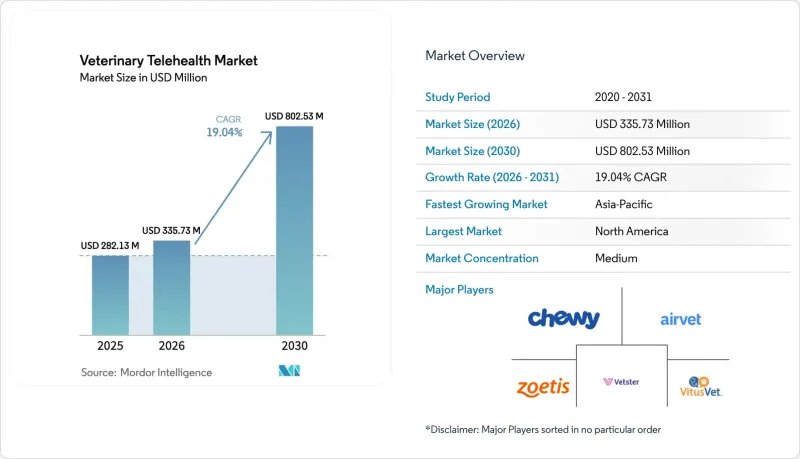
본 보고서는 동물 종(반려동물 및 가축), 제공 형태(On-Premise,클라우드/앱 기반), 서비스 유형(원격의료 등), 상담 형태(동기식, 비동기식, 원격 환자 모니터링), 최종 사용자(동물병원 및 진료소 등), 지역(북미, 유럽, 아시아태평양 등)별로 분류되어 있습니다. 시장 예측은 금액(달러) 기준으로 제시되어 있습니다.
전 세계 수의 원격의료 시장 동향 및 인사이트
반려동물 사육률 상승과 ‘반려동물의 인간화’ 흐름
2025년에는 미국의 9,400만 가구가 반려동물을 키우고 있으며, 이는 밀레니얼 세대와 Z세대의 반려동물 사육 경향에 힘입어 사상 최고치를 기록했습니다. 젊은 세대는 반려동물을 가족의 일원으로 여기며, 가처분 소득을 프리미엄 수의학 서비스에 투자하고, 디지털 우선 라이프스타일에 부합하는 가상 진료를 선호합니다. 중국의 1억 2,000만 가구에 달하는 반려동물 가구와 인도에서 확대되고 있는 중산층은 현지화에 대응할 수 있는 플랫폼의 잠재 고객 기반을 더욱 확대되고 있습니다. 원격 모니터링에 적합한 예방 의료 및 만성 질환 관리는 반려인들이 간헐적인 동물병원 방문 대신 지속적인 경과 관찰을 점점 더 요구함에 따라 그 기세를 더해가고 있습니다. 이러한 수요의 급증은 편의성과 임상적으로 검증된 조언을 겸비한 플랫폼의 가격 결정력을 뒷받침하고 있습니다.
AI 탑재 웨어러블 기기와 원격 진단: 임상에서의 활용 사례 확대
심박수, 호흡수, 활동 데이터를 수집하는 스마트 칼라를 통해 임상의는 증상이 나타나기 전에 이상을 감지할 수 있게 됩니다. 2024년에 출시된 PetPace의 V3.0 센서 제품군은 머신러닝 알고리즘을 활용하여 반려인과 수의사 모두에게 실시간으로 알림을 전송합니다. 정밀 축산 분야에서는 현재 소와 돼지에게 원격 측정 태그를 부착하여 발정기나 질병의 초기 단계를 감지함으로써, 농장 내 발병률과 운송 비용을 억제하고 있습니다. 데이터 세트의 확대에 따라 알고리즘의 정확도가 향상됨에 따라, 수의사의 원격 진단에 대한 신뢰도가 높아지고, 도입을 가속화하는 피드백 루프가 형성되고 있습니다. 지속적인 모니터링과 연계된 구독 수익은 플랫폼의 해지율을 낮추고 평생 가치를 높입니다.
높은 서비스 비용과 제한된 비용 상환 경로
1회 원격 진료 비용은 30-75달러로, 저소득 지역의 보험 미가입 반려인에게는 여전히 고액입니다. 2024년 미국에서 625만 마리의 반려동물이 보험에 가입해 있었으나, 이는 국내 반려동물 총수의 7% 미만에 불과하여 대부분의 반려인은 본인 부담금을 지불할 수밖에 없습니다. 보험사마다 본인 부담금, 기저 질환, 기기 비용 환급에 관한 정책이 달라 소비자에게 제시되는 가치 제안이 복잡해지고 있습니다. 반려동물 보험 보급률이 2% 미만인 시장에서는 플랫폼이 동물병원 치료보다 저렴한 가격을 책정할 수밖에 없어, 이익률이 압박받고 사업 확장 속도가 둔화되고 있습니다.
부문 분석
2025년에는 반려동물이 수의 원격의료 시장의 69.32%를 차지하며, 2031년까지의 연평균 성장률(CAGR)은 20.22%로 예측됩니다. 반려동물 부문의 우위는 개와 고양이에 대한 가정의 높은 친화도를 반영한 것으로, 이 두 종만으로도 가상 진료 총 이용 건수의 90% 이상을 차지하고 있습니다. 동 기간 동안 농촌 지역의 광대역 환경과 센서의 경제성이 개선됨에 따라 소 및 돼지를 대상으로 한 도입은 증가하겠지만, 가축 분야의 수익 기여도는 여전히 낮은 수준에 머물고 있습니다.
기본적인 접속 장벽이 해소되면 가격 경쟁이 격화되므로, 플랫폼 전략은 사용자 경험과 보험과의 연계를 중심으로 전개되고 있습니다. 말의 원격 수의학은 여전히 틈새 분야에 머물러 있습니다. 보행 분석을 통한 동영상 평가가 주목을 받고 있지만, 촉진(촉진)이 필요하기 때문에 많은 말 주인들은 여전히 기존의 병원 방문에 의존하고 있습니다. ‘기타’ 카테고리(조류, 파충류, 이국적인 동물)는 전문 수의사가 원격지의 고객을 대상으로 전문 지식을 어필함으로써 성장하고 있지만, 수의 원격 의료 시장 전체 규모에 미치는 영향은 여전히 미미한 수준입니다.
2025년에는 클라우드 및 앱 기반 시스템이 매출의 71.23%를 차지하고, 2031년까지 연평균 성장률(CAGR) 21.22%를 나타낼 것으로 예측되며, 이는 진료소에 IT 관련 부담을 주는 On-Premise형 서버로부터의 전환이 진행되고 있음을 여실히 보여주고 있습니다. SaaS형 진료 관리 패키지는 예약, 전자 건강 기록(EHR), 청구, 원격 진료를 단일 인터페이스로 통합하여 처음 도입하는 동물병원의 부담을 덜어주고 있습니다.
여러 동물병원의 데이터를 집약함으로써 알고리즘 학습을 촉진하고, 예측형 트라이아지 도구를 개발하여 플랫폼에 대한 충성도(retention rate)를 높이고 가격 책정의 정당성을 뒷받침하고 있습니다. On-Premise형 시스템은 데이터 주권을 중시하는 대규모 병원 체인 내에서 여전히 중요성을 유지하고 있지만, 클라우드 보안 인증이 증가하고 규제 측면에서의 신뢰도가 높아짐에 따라 수의 원격의료 시장에서 이 분야의 점유율은 축소될 전망입니다.
지역별 분석
북미는 반려동물 사육 밀도가 높고, 보험 제도가 성숙하며, 2024년부터 2025년까지 VCPR(수의사·환자·소유자 간 관계) 규정을 완화한 5개의 주요 주 법안에 힘입어 2025년 매출의 45.3%를 차지했습니다. 캐나다는 각 주의 규제 체계를 신속하게 조율하여 양국 간 플랫폼이 원활하게 운영될 수 있도록 했습니다. 그러나 AVMA 데이터에 따르면, 팬데믹으로 인한 규제가 완화되면서 일부 반려인이 동물병원 방문을 재개함에 따라 수의사의 원격의료 이용률은 2023년 38%에서 2024년 29.2%로 하락했습니다.
아시아태평양은 2031년까지 연평균 성장률(CAGR) 20.99%로 성장할 전망입니다. 중국의 1억 2,000만 가구에 달하는 반려동물 가구와 인도에서 급증하는 도시 지역의 반려동물 사육이, 대형 전자상거래 기업들이 지원하는 ‘모바일 퍼스트’형 플랫폼의 성장을 뒷받침하고 있습니다. 일본과 한국은 고령 반려동물의 원격 모니터링에 주력하고 있는 반면, 호주에서는 ‘버추얼 퍼스트’ 진료 경로에 대한 보험 인센티브의 시범 도입이 진행되고 있습니다. 동남아시아 일부 지역에서는 규제 불일치와 보험 적용 범위의 협소함이 사업 확장 속도를 둔화시키고 있습니다.
유럽은 중간 수준에 위치해 있습니다. 영국, 독일, 프랑스는 확립된 보험 문화 덕분에 선두를 달리고 있지만, 국경을 넘는 라이선스 취득이 여전히 걸림돌이 되고 있습니다. GDPR(EU 개인정보보호규정)로 인해 규정 준수 비용이 증가함에 따라 많은 플랫폼이 사업을 단일 국가로 제한하고 있습니다. 중동 및 아프리카 및 남미는 신흥 시장으로, 상파울루나 두바이에서는 고소득층 수요가 나타나고 있지만, 환율 변동과 광대역 환경의 불균형으로 인해 더 광범위한 확장이 지연되고 있습니다.
기타 혜택:
- 엑셀 형식 시장 예측(ME) 시트
- 3개월간의 애널리스트 지원
자주 묻는 질문
목차
제1장 서론
제2장 조사 방법
제3장 주요 요약
제4장 시장 구도
제5장 시장 규모와 성장 예측
제6장 경쟁 구도
제7장 시장 기회와 향후 전망
JHS 26.08.28According to Mordor Intelligence, the veterinary telehealth market size is expected to increase from USD 282.13 million in 2025 to USD 335.73 million in 2026 and reach USD 802.53 million by 2030, growing at a CAGR of 19.04% over 2026-2030.
This report is Segmented by Animal (Companion Animals and Livestock), Delivery Mode (On Premise, Cloud/App Based), Service Type (Telemedicine, and More), Consultation Modality (Synchronous, Asynchronous, Remote Patient Monitoring), End User (Veterinary Clinics & Hospitals, and More), and Geography (North America, Europe, Asia-Pacific, and More). The Market Forecasts are Provided in Terms of Value (USD).
Global Veterinary Telehealth Market Trends and Insights
Increasing Pet Ownership & Humanization Wave
Ninety-four million U.S. households owned a pet in 2025, an all-time peak fueled by millennial and Gen Z adoption patterns . Younger cohorts treat pets as family, channel discretionary income into premium veterinary services, and favor virtual care that aligns with digital-first lifestyles. China's 120 million pet-owning households and India's expanding middle class multiply the addressable base for localization-ready platforms. Preventive care and chronic-disease management, well-suited to telemonitoring gain momentum as owners increasingly demand continuous oversight rather than episodic clinic visits. This demand spike sustains pricing power for platforms that pair convenience with clinically validated advice.
AI-Enabled Wearables & Remote Diagnostics Expanding Clinical Use-Cases
Smart collars capturing heart rate, respiration, and activity streams let clinicians flag anomalies before symptoms surface. PetPace's V3.0 sensor suite, launched in 2024, applies machine-learning algorithms to alert both owner and veterinarian in real time . Precision livestock farming now equips cattle and swine with telemetry tags that detect estrus or early disease, curbing on-farm morbidity and travel costs. As algorithm accuracy improves with larger datasets, veterinarian trust in remote diagnostics rises, closing a feedback loop that accelerates adoption. Subscription revenue tied to continuous monitoring lowers platform churn and deepens lifetime value.
High Service Costs & Limited Reimbursement Pathways
Single teleconsultations cost USD 30-75, still steep for uninsured owners in lower-income regions. Although 6.25 million U.S. pets carried coverage in 2024, that equals under 7% of the national pet population, leaving most owners to pay out-of-pocket. Insurer policies vary on co-pays, pre-existing conditions, and device reimbursements, complicating the consumer value proposition. In markets where pet insurance penetration sits below 2%, platforms must underprice in-clinic alternatives, compress margins and slowing expansion.
Other drivers and restraints analyzed in the detailed report include:
- Usage-Based Pet-Insurance Models Rewarding Virtual-First Care
- Regulatory Flexibility Post-COVID Accelerating Telehealth Adoption
- Licensing-Law Variability Restricting Cross-Border Care
For complete list of drivers and restraints, kindly check the Table Of Contents.
Segment Analysis
Companion species captured 69.32% of the veterinary telehealth market share in 2025, and growth is projected at 20.22% CAGR through 2031. The companion segment's dominance reflects high household affinity for dogs and cats, which together exceed 90% of virtual-care volumes. Over the same horizon, bovine and swine deployments rise as rural broadband and sensor economics improve, but livestock still trails in revenue contribution.
Platform strategies revolve around user experience and insurance tie-ins because price competition escalates once basic connectivity hurdles fall. Equine telehealth remains niche; gait-analysis video assessments gain traction, yet tactile examinations keep many owners reliant on traditional visits. The other category-avian, reptile, exotic grows as specialty veterinarians market their expertise to dispersed clients, though its influence on the overall veterinary telehealth market size remains small.
Cloud and app-based systems held 71.23% of revenue in 2025 and are expected to post a 21.22% CAGR to 2031, underscoring the shift away from on-premise servers that burden clinics with IT overhead. SaaS practice-management bundles combine scheduling, EHR, billing, and teleconsultation into one interface, reducing friction for first-time adopters.
Data aggregation across multiple practices fuels algorithm training, creating predictive triage tools that strengthen platform stickiness and defend pricing. On-premise systems maintain relevance within large hospital chains, prioritizing data sovereignty, but this slice of the veterinary telehealth market is set to recede as cloud security certifications multiply and regulatory comfort rises.
Complete Report Scope:
- By Animal
- Companion Animals
- Livestock
- By Delevery Mode
- On Premise
- Cloud/App Based
- By Service Type
- Telemedicine
- Teleconsulting
- Telemonitoring
- Other Service Types
- By Consultation Modality
- Synchronous (Real-time Video/Chat)
- Asynchronous (Store-and-Forward)
- Remote Patient Monitoring
- By End User
- Veterinary Clinics & Hospitals
- Telehealth Platform Providers
- Others
- By Geography
- North America
- United States
- Canada
- Mexico
- Europe
- Germany
- United Kingdom
- France
- Italy
- Spain
- Rest of Europe
- Asia-Pacific
- China
- India
- Japan
- South Korea
- Australia
- Rest of Asia-Pacific
- Middle East and Africa
- GCC
- South Africa
- Rest of Middle East and Africa
- South America
- Brazil
- Argentina
- Rest of South America
- North America
Geography Analysis
North America delivered 45.3% of 2025 revenue, buoyed by dense pet ownership, mature insurance, and five key state bills that eased VCPR rules between 2024 and 2025. Canada quickly aligned its provincial frameworks, letting binational platforms operate smoothly. Yet AVMA data show that veterinarian telehealth usage slid from 38% in 2023 to 29.2% in 2024 as some owners reverted to clinics once pandemic restrictions eased.
Asia-Pacific is poised for a 20.99% CAGR through 2031. China's 120 million pet homes and India's surging urban pet adoption catalyze mobile-first platforms backed by e-commerce titans. Japan and South Korea focus on geriatric-care telemonitoring, while Australia pilots insurance incentives for virtual-first pathways. Regulatory heterogeneity and low insurance coverage in segments of Southeast Asia temper the speed of scale.
Europe occupies a middle tier. The United Kingdom, Germany, and France lead thanks to established insurance cultures, but cross-border licensing remains a drag. GDPR raises compliance spend, prompting many platforms to limit operations to a single country. Middle East & Africa and South America represent emerging nodes; Sao Paulo and Dubai show pockets of high-income demand, though currency volatility and patchy broadband slow broader rollout.
- Activ4Pets
- AirVet
- BabelBark
- Chewy inc.
- FirstVet
- GuardianVets
- PetCoach
- Petriage
- Pets at Home Group Plc
- TeleVet
- VetCT
- Vetlive
- VetRad
- Vetster
- VitusVet
- whiskerDocs Llc.
- Zoetis
Additional Benefits:
- The market estimate (ME) sheet in Excel format
- 3 months of analyst support
TABLE OF CONTENTS
1 Introduction
- 1.1 Study Assumptions & Market Definition
- 1.2 Scope of the Study
2 Research Methodology
3 Executive Summary
4 Market Landscape
- 4.1 Market Overview
- 4.2 Market Drivers
- 4.2.1 Increasing Pet Ownership & Humanization Wave
- 4.2.2 Rising Veterinary Healthcare Spending and Insurance Coverage
- 4.2.3 Regulatory Flexibility Post-COVID Accelerating Telehealth Adoption
- 4.2.4 Growing Prevalence of Zoonotic Diseases Elevating Remote Triage Demand
- 4.2.5 AI-Enabled Wearables & Remote Diagnostics Expanding Clinical Use-Cases
- 4.2.6 Usage-Based Pet-Insurance Models Rewarding Virtual-First Care
- 4.3 Market Restraints
- 4.3.1 High Service Costs & Limited Reimbursement Pathways
- 4.3.2 Licensing-Law Variability Restricting Cross-Border Care
- 4.3.3 Fragmented Data Interoperability Hindering AI Triage Accuracy
- 4.3.4 Post-Pandemic Owner Preference Swings Back To In-Clinic Exams
- 4.4 Supply-Chain Analysis
- 4.5 Regulatory Landscape
- 4.6 Technological Outlook
- 4.7 Porter's Five Forces
- 4.7.1 Bargaining Power of Buyers
- 4.7.2 Bargaining Power of Suppliers
- 4.7.3 Threat of New Entrants
- 4.7.4 Threat of Substitute Products
- 4.7.5 Intensity of Competitive Rivalry
5 Market Size & Growth Forecasts (Value, USD)
- 5.1 By Animal
- 5.1.1 Companion Animals
- 5.1.2 Livestock
- 5.2 By Delevery Mode
- 5.2.1 On Premise
- 5.2.2 Cloud/App Based
- 5.3 By Service Type
- 5.3.1 Telemedicine
- 5.3.2 Teleconsulting
- 5.3.3 Telemonitoring
- 5.3.4 Other Service Types
- 5.4 By Consultation Modality
- 5.4.1 Synchronous (Real-time Video/Chat)
- 5.4.2 Asynchronous (Store-and-Forward)
- 5.4.3 Remote Patient Monitoring
- 5.5 By End User
- 5.5.1 Veterinary Clinics & Hospitals
- 5.5.2 Telehealth Platform Providers
- 5.5.3 Others
- 5.6 By Geography
- 5.6.1 North America
- 5.6.1.1 United States
- 5.6.1.2 Canada
- 5.6.1.3 Mexico
- 5.6.2 Europe
- 5.6.2.1 Germany
- 5.6.2.2 United Kingdom
- 5.6.2.3 France
- 5.6.2.4 Italy
- 5.6.2.5 Spain
- 5.6.2.6 Rest of Europe
- 5.6.3 Asia-Pacific
- 5.6.3.1 China
- 5.6.3.2 India
- 5.6.3.3 Japan
- 5.6.3.4 South Korea
- 5.6.3.5 Australia
- 5.6.3.6 Rest of Asia-Pacific
- 5.6.4 Middle East and Africa
- 5.6.4.1 GCC
- 5.6.4.2 South Africa
- 5.6.4.3 Rest of Middle East and Africa
- 5.6.5 South America
- 5.6.5.1 Brazil
- 5.6.5.2 Argentina
- 5.6.5.3 Rest of South America
- 5.6.1 North America
6 Competitive Landscape
- 6.1 Market Concentration
- 6.2 Market Share Analysis
- 6.3 Company Profiles (includes Global-level Overview, Market-level Overview, Core Segments, Financials as available, Strategic Information, Market Rank/Share for key companies, Products & Services, Recent Developments)
- 6.3.1 Activ4Pets
- 6.3.2 AirVet
- 6.3.3 BabelBark
- 6.3.4 Chewy inc.
- 6.3.5 FirstVet
- 6.3.6 GuardianVets
- 6.3.7 PetCoach
- 6.3.8 Petriage
- 6.3.9 Pets at Home Group Plc
- 6.3.10 TeleVet
- 6.3.11 VetCT
- 6.3.12 Vetlive
- 6.3.13 VetRad
- 6.3.14 Vetster
- 6.3.15 VitusVet
- 6.3.16 whiskerDocs Llc.
- 6.3.17 Zoetis
7 Market Opportunities & Future Outlook
- 7.1 White-space & Unmet-Need Assessment


