

|
시장보고서
상품코드
2116131
탄저균 백신 시장 : 점유율 분석, 업계 동향과 통계, 성장 예측(2026-2031년)Anthrax Vaccine - Market Share Analysis, Industry Trends & Statistics, Growth Forecasts (2026 - 2031) |
||||||
 Mordor Intelligence
Mordor Intelligence에 의하면, 탄저균 백신 시장 규모는 2025년 59억 8,000만 달러에서 2026년에는 63억 9,000만 달러로 확대되어 2026년부터 2031년까지 CAGR 6.84%로 성장을 지속하여, 2031년까지 88억 8,000만 달러에 이를 것으로 예측됩니다.
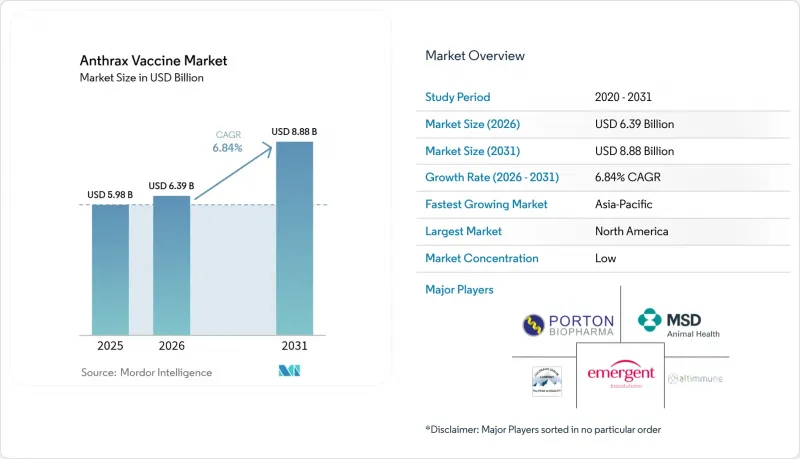
본 보고서는 백신의 유형(무세포 흡착형 탄저균 백신(AVA),아쥬반트 함유 탄저균 백신 등), 용도(노출 전 예방 및 노출 후 예방), 유통 채널(정부의 직접 조달, 병원 및 진료소 약국 등), 지역(북미, 유럽, 아시아태평양 등)별로 분류되어 있습니다. 시장 예측은 금액(미 달러)으로 표시되어 있습니다.
전 세계 탄저균 백신 시장 동향 및 인사이트
COVID-19 이후, 정부의 생물방어 비축 예산이 증가하고 있습니다.
각국의 예산에서 탄저균 대책이 핵심적인 안보 자산으로 재분류되었습니다. 미국의 전략적 국가 비축(Strategic National Stockpile)은 팬데믹 당시공급 병목 현상에서 얻은 교훈을 바탕으로, CYFENDUS를 대상으로 한 2억 5,000만 달러 규모의 계약 변경을 포함하는 다년 계약을 확대했습니다. 캐나다의 ‘Health Emergency Readiness Canada(캐나다 보건 비상사태 대응)’ 이니셔티브는 국내 제조 능력과의 지역적 연계를 강화하고 있습니다. 국방위협감축국(DTRA)의 2,630만 달러 보조금은 연구 개발(R&D) 파이프라인을 유지하고, 탄저균 백신 시장이 더 광범위한 화학·생물 방어 자금에 통합된 상태를 유지하도록 보장하고 있습니다.
군 및 고위험 연구소 직원을 대상으로 한 백신 접종 의무화 프로그램
강제 접종 프로토콜은 군뿐만 아니라 연구소 및 긴급 대응 요원에게도 확대되어, 확립된 구매 거점 내 탄저균 백신 시장을 강화하고 있습니다. CDC의 2023년 지침 개정에 따라 접종 대상 근로자가 확대된 한편, FDA가 승인한 5회 접종 일정에 따라 규정 준수를 위한 물류 체계가 개선되었습니다. 마찬가지로, NATO의 상호 운용성 기준도 동맹군 전체에 걸친 도입을 촉진하고 있습니다.
부작용 프로파일과 소송 위험이 민간 부문 접종을 억제
주사 부위 반응 및 과거의 법적 분쟁이 광범위한 수요를 억제하고 있습니다. 민간 보험사가 예방접종 비용을 보상하는 경우는 거의 없으며, 소아에 대한 적응증도 존재하지 않기 때문에 탄저균 백신 시장은 정부 관련 경로 외에는 축소되고 있습니다.
부문 분석
2025년에는 오랜 기간 동안의 높은 인지도가 조달을 뒷받침하여, 무세포 제제가 탄저균 백신 시장 점유율의 48.12%를 차지했습니다. CYFENDUS가 주도하는 보조제 배합 AV7909는 긴급 상황 일정에 대응할 수 있는 신속한 혈청 전환을 통해 연평균 성장률(CAGR) 8.01%로 성장하고 있습니다. GC-1109의 승인이 보여주듯이, 제조 전략은 재조합 항원으로 전환되고 있으며, 이를 통해 배양 기반 생산에 내재된 생물학적 안전성상의 제약이 완화되고 있습니다. 내열성 분무 건조 제제에 대한 특허 출원은 콜드체인 비용을 절감하고, 자원이 부족한 시장에서 보급 범위를 확대하는 것을 목표로 하고 있습니다.
mRNA 및 바이러스 벡터를 개념으로 하는 향후 파이프라인은 여전히 전임상 단계에 있지만, 단회 투여로 유효성 목표가 달성된다면 탄저균 백신 업계에 큰 변혁을 가져올 가능성이 있습니다. COVID-19를 통해 얻은 분야를 초월한 교훈을 바탕으로, 보조제를 이용한 투여량 감소 프레임워크가 입증되어 플랫폼의 다양화가 가속화될 전망입니다.
2025년 현재, 군 및 방위 부문은 탄저균 백신 시장 규모의 55.02%를 차지하고 있으며, 이는 확정 계약 및 배치 프로토콜에 의해 뒷받침되고 있습니다. 민간 부문은 실험실 종사자 및 1차 대응자를 대상으로 한 CDC의 지침에 힘입어 연평균 성장률(CAGR) 8.32%로 확대되고 있습니다. 수의학 및 ‘원 헬스(One Health)’ 프로그램은 가축의 풍토병적 집단 발병이 발생하는 지역에서 성장하고 있으며, 동물 건강 예산과 인간 대응 자금을 연계하고 있습니다.
인도의 BioThrax사와 Biological E.사와의 제휴와 같은 국제적 협력 관계를 통해 공급이 지역 민간 구매자에게 가까워지고, 수입 의존도가 감소하는 동시에 남아시아 투자자 전반에 걸친 기초 수요가 증가하고 있습니다. emergentbiosolutions.com. 또한, 연구 기관들도 탄저균 관련 실험에 필요한 생물안전 승인을 충족하기 위해 주문량을 늘리고 있습니다.
지역별 분석
북미는 2025년, 전략적 국가 비축(Strategic National Stockpile)을 통한 지속적인 보충과 FDA의 일관된 승인을 바탕으로 탄저균 백신 시장 점유율 58.05%를 유지했습니다. BioMaP 컨소시엄의 20억 달러 규모의 국내 제조 촉진 정책이 지역의 자립성을 강화하는 한편, 캐나다의 HERC 프로그램은 국경을 초월한 생산 능력 연계를 도모하고 있습니다.
아시아태평양은 2031년까지 연평균 성장률(CAGR) 9.35%로 가장 높은 성장세를 보이고 있습니다. 한국의 GC-1109에 의한 획기적인 진전과 인도에서의 BioThrax 승인으로 현지 생산이 정착되면서, 미국에 대한 단독 의존도가 완화되는 동시에 지역 내 주문량이 증가하고 있습니다. 2025년 태국에서 발생한 탄저균 집단 감염에 대한 대응은 가축 및 인간용 백신 공급 확대의 시급성을 부각시켰으며, 아세안(ASEAN) 규제 당국이 조화롭고 신속한 승인 절차 도입에 대해 협의하는 계기가 되었습니다.
유럽에서는 EU의 의료기술평가규정(HTA)이 중요한 백신에 관한 회원국 간의 의사결정 통일을 목적으로 하고 있기 때문에 완만한 성장이 지속되고 있습니다. 아프리카에서는 최근 발생한 사례를 배경으로 기부자 자금을 통한 조달이 진행되고 있지만, 예산 제약으로 인해 당분간 조달량은 제한적입니다. 라틴아메리카에서는 지역 개발 은행을 활용할 수 있는 체계적인 자금 조달 메커니즘의 확립을 기다리는 가운데, 관심이 서서히 높아지고 있습니다.
기타 혜택:
- 엑셀 형식 시장 예측(ME) 시트
- 3개월간 애널리스트 지원
자주 묻는 질문
목차
제1장 서론
제2장 조사 방법
제3장 주요 요약
제4장 시장 구도
제5장 시장 규모와 성장 예측
제6장 경쟁 구도
제7장 시장 기회와 향후 전망
JHS 26.08.28According to Mordor Intelligence, the anthrax vaccine market size is expected to grow from USD 5.98 billion in 2025 to USD 6.39 billion in 2026 and is forecast to reach USD 8.88 billion by 2031 at 6.84% CAGR over 2026-2031.
This report is Segmented by Vaccine Type (Cell-Free Anthrax Vaccine Adsorbed (AVA), Adjuvanted Anthrax Vaccine and More), by Application Type (Pre-Exposure Prophylaxis and Post-Exposure Prophylaxis), by Distribution Channel (Direct Government Procurement, Hospital & Clinic Pharmacies and More), and Geography (North America, Europe, Asia Pacific and More). The Market Forecasts are Provided in Terms of Value (USD).
Global Anthrax Vaccine Market Trends and Insights
Government Biodefense Stockpiling Budgets Increasing Post-COVID
National budgets reclassified anthrax countermeasures as core security assets. The U.S. Strategic National Stockpile expanded multi-year contracts, including a USD 250 million modification covering CYFENDUS, highlighting lessons from pandemic supply bottlenecks. Canada's Health Emergency Readiness Canada initiative adds regional alignment with domestic manufacturing capacity. Defense Threat Reduction Agency grants of USD 26.3 million sustain R&D pipelines, ensuring that the anthrax vaccine market remains integrated into broader chemical-biological defense funding.
Mandatory Vaccination Programs for Military & High-Risk Lab Personnel
Compulsory protocols broaden beyond troops to laboratory and emergency response staff, reinforcing the anthrax vaccine market in established buying centers. The CDC's 2023 guideline update enlarges the eligible workforce, while an FDA-approved five-dose schedule improves adherence logistics. NATO interoperability standards likewise push adoption across allied forces.
Adverse-Event Profile & Litigation Risk Limits Civilian Uptake
Injection-site reactions and past legal disputes dampen broad-based demand. Civilian insurers seldom reimburse preventive doses, and no pediatric indication exists, narrowing the anthrax vaccine market beyond government channels.
Other drivers and restraints analyzed in the detailed report include:
- Regulatory Approvals of Next-Generation Vaccines (e.g., CYFENDUS)
- Rising Geopolitical Bioterrorism Threat Perception Globally
- Dependence on a Single Dominant Supplier Creates Supply Risk
For complete list of drivers and restraints, kindly check the Table Of Contents.
Segment Analysis
Cell-free formulations commanded 48.12% anthrax vaccine market share in 2025 as longstanding familiarity drove procurement. Adjuvanted AV7909, led by CYFENDUS, grows at 8.01% CAGR on faster seroconversion that meets emergency timelines. Manufacturing strategies pivot toward recombinant antigens, evidenced by GC-1109's licensure, easing biosafety constraints inherent in culture-based production. Patent filings for thermostable spray-dried doses aim to remove cold-chain costs and widen reach in low-resource markets.
A future pipeline that includes mRNA and viral-vector concepts remains preclinical but could disrupt the anthrax vaccine industry if single-dose efficacy targets are met. Cross-sector lessons from COVID-19 have validated adjuvant dose-sparing frameworks, likely accelerating platform diversification.
Military & Defense held 55.02% of the anthrax vaccine market size in 2025, anchored by locked-in contracts and deployment protocols. Civilian agencies expand at 8.32% CAGR, propelled by CDC guidance encompassing lab workers and first responders. Veterinary and One Health programs grow where endemic livestock outbreaks occur, linking animal health budgets to human countermeasure funding.
International collaborations, such as India's BioThrax partnership with Biological E., bring supply closer to regional civilian buyers, easing import reliance and raising baseline demand across South Asia investors.emergentbiosolutions.com. Research institutions also raise call-off volumes to satisfy biosafety clearances for anthrax-related experimentation.
Complete Report Scope:
- By Vaccine Type (Value)
- Cell-free Anthrax Vaccine Adsorbed (AVA)
- Adjuvanted Anthrax Vaccine (AV7909/CYFENDUS)
- Recombinant Protective Antigen Vaccine
- Others
- By End User (Value)
- Military & Defense
- Government Civilian Agencies
- Healthcare Workers & First Responders
- Veterinary Sector
- General Population High-risk Travelers
- By Application (Value)
- Pre-Exposure Prophylaxis
- Post-Exposure Prophylaxis
- By Distribution Channel (Value)
- Direct Government Procurement
- Hospital & Clinic Pharmacies
- Direct Order Suppliers
- By Geography (Value)
- North America
- United States
- Canada
- Mexico
- Europe
- Germany
- United Kingdom
- France
- Italy
- Spain
- Rest of Europe
- Asia-Pacific
- China
- India
- Japan
- South Korea
- Australia
- Rest of Asia-Pacific
- South America
- Brazil
- Argentina
- Rest of South America
- Middle East and Africa
- GCC
- South Africa
- Rest of Middle East and Africa
- North America
Geography Analysis
North America retained 58.05% anthrax vaccine market share in 2025, supported by the Strategic National Stockpile's rolling replenishments and consistent FDA approvals. A USD 2 billion domestic manufacturing drive under the BioMaP-Consortium strengthens regional self-reliance, while Canada's HERC program aligns cross-border capacity.
Asia-Pacific posts the fastest CAGR at 9.35% to 2031. South Korea's GC-1109 breakthrough and India's BioThrax approval embed local production, diminishing sole dependence on U.S. supply and amplifying regional orders. Thailand's 2025 anthrax outbreak response highlighted the urgency for wider livestock and human vaccine availability, prompting ASEAN regulators to discuss harmonized fast-track pathways.
Europe sustains moderate growth as the EU's Health Technology Assessment Regulation targets synchronized member-state decisions on critical vaccines. Recent African outbreaks drive donor-funded procurements, although constrained budgets limit immediate volume. Latin American interest rises slowly, awaiting structured financing mechanisms that could tap into regional development banks.
- Emergent Bio Solutions
- Altimmune (Pharmathene Inc.)
- Proton Biopharma
- Colondo Serum Company
- Merck
- Bayer
- Zoetis
- Indian Immunologicals
- Agrovet
- Biogenesis Bago
- Tiankang
- GC Biopharma
- Sparhawk Laboratories
- Elusys Therapeutics
Additional Benefits:
- The market estimate (ME) sheet in Excel format
- 3 months of analyst support
TABLE OF CONTENTS
1 Introduction
- 1.1 Study Assumptions & Market Definition
- 1.2 Scope of the Study
2 Research Methodology
3 Executive Summary
4 Market Landscape
- 4.1 Market Overview
- 4.2 Market Drivers
- 4.2.1 Government biodefense stockpiling budgets increasing post-COVID
- 4.2.2 Mandatory vaccination programs for military & high-risk lab personnel
- 4.2.3 Regulatory approvals of next-generation vaccines (e.g., CYFENDUS)
- 4.2.4 Rising geopolitical bioterrorism threat perception globally
- 4.2.5 Thermostable dry-powder vaccines enabling LMIC procurement
- 4.2.6 Synthetic-biology platforms cutting cost & lead-time
- 4.3 Market Restraints
- 4.3.1 Adverse-event profile & litigation risk limits civilian uptake
- 4.3.2 Dependence on a single dominant supplier creates supply risk
- 4.3.3 Limited commercial demand outside government contracts
- 4.3.4 Emerging mAb & small-molecule alternatives divert funding
- 4.4 Value / Supply-Chain Analysis
- 4.5 Regulatory Landscape
- 4.6 Technological Outlook
- 4.7 Porter's Five Forces
- 4.7.1 Threat of New Entrants
- 4.7.2 Bargaining Power of Suppliers
- 4.7.3 Bargaining Power of Buyers
- 4.7.4 Threat of Substitutes
- 4.7.5 Competitive Rivalry
5 Market Size & Growth Forecasts
- 5.1 By Vaccine Type (Value)
- 5.1.1 Cell-free Anthrax Vaccine Adsorbed (AVA)
- 5.1.2 Adjuvanted Anthrax Vaccine (AV7909/CYFENDUS)
- 5.1.3 Recombinant Protective Antigen Vaccine
- 5.1.4 Others
- 5.2 By End User (Value)
- 5.2.1 Military & Defense
- 5.2.2 Government Civilian Agencies
- 5.2.3 Healthcare Workers & First Responders
- 5.2.4 Veterinary Sector
- 5.2.5 General Population High-risk Travelers
- 5.3 By Application (Value)
- 5.3.1 Pre-Exposure Prophylaxis
- 5.3.2 Post-Exposure Prophylaxis
- 5.4 By Distribution Channel (Value)
- 5.4.1 Direct Government Procurement
- 5.4.2 Hospital & Clinic Pharmacies
- 5.4.3 Direct Order Suppliers
- 5.5 By Geography (Value)
- 5.5.1 North America
- 5.5.1.1 United States
- 5.5.1.2 Canada
- 5.5.1.3 Mexico
- 5.5.2 Europe
- 5.5.2.1 Germany
- 5.5.2.2 United Kingdom
- 5.5.2.3 France
- 5.5.2.4 Italy
- 5.5.2.5 Spain
- 5.5.2.6 Rest of Europe
- 5.5.3 Asia-Pacific
- 5.5.3.1 China
- 5.5.3.2 India
- 5.5.3.3 Japan
- 5.5.3.4 South Korea
- 5.5.3.5 Australia
- 5.5.3.6 Rest of Asia-Pacific
- 5.5.4 South America
- 5.5.4.1 Brazil
- 5.5.4.2 Argentina
- 5.5.4.3 Rest of South America
- 5.5.5 Middle East and Africa
- 5.5.5.1 GCC
- 5.5.5.2 South Africa
- 5.5.5.3 Rest of Middle East and Africa
- 5.5.1 North America
6 Competitive Landscape
- 6.1 Market Concentration
- 6.2 Market Share Analysis
- 6.3 Company Profiles {(includes Global level Overview, Market level overview, Core Segments, Financials as available, Strategic Information, Market Rank/Share for key companies, Products & Services, and Recent Developments)}
- 6.3.1 Emergent Bio Solutions
- 6.3.2 Altimmune (Pharmathene Inc.)
- 6.3.3 Proton Biopharma Ltd
- 6.3.4 Colondo Serum Company
- 6.3.5 Merck Co, Inc. (MSD Animal Health)
- 6.3.6 Bayer AG
- 6.3.7 Zoetis Inc.
- 6.3.8 Indian Immunologics
- 6.3.9 Agrovet
- 6.3.10 Biogenesis Bago
- 6.3.11 Tiankang
- 6.3.12 GC Biopharma
- 6.3.13 Sparhawk Laboratories
- 6.3.14 Elusys Therapeutics
7 Market Opportunities & Future Outlook
- 7.1 White-space & Unmet-Need Assessment


