

|
시장보고서
상품코드
2123339
탄저균 치료 시장 : 점유율 분석, 업계 동향과 통계, 성장 예측(2026-2031년)Anthrax Treatment - Market Share Analysis, Industry Trends & Statistics, Growth Forecasts (2026 - 2031) |
||||||
 Mordor Intelligence
Mordor Intelligence에 의하면, 탄저균 치료 시장 규모는 2025년 4억 717만 달러에서 2026년에는 4억 3,791만 달러로 확대되어 2026년부터 2031년까지 CAGR 7.55%로 성장을 지속하여, 2031년에는 6억 2,968만 달러에 이를 것으로 예측됩니다.
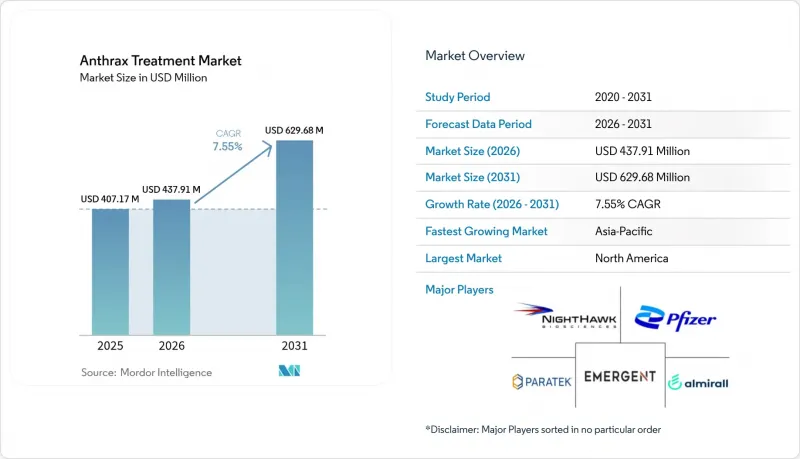
본 보고서에서는 업계를 제품 유형(항생제, 항독소 등), 투여 경로(경구, 주사제 등), 최종 사용자(군 및 방위 관계자, 민간 비상 비축 등), 유통 채널(정부 조달 기관, 병원 등), 지역(북미, 유럽, 아시아태평양 등)별로 분류하고 있습니다.
전 세계 탄저균 치료 시장 동향 및 인사이트
정부의 생물 방어 자금 지원 및 비축 프로그램
수년에 걸친 꾸준한 공공 자금 투입으로 탄저균 치료 시장은 준국가적 조달 분야로 변모하고 있습니다. BARDA의 NUZYRA에 대한 추가 계약 및 67억 달러 규모의 전략적 국가 비축 확대는 단발적인 구매에서 수명 주기 관리로의 전환을 나타내며, 수요가 급증할 때도 대응할 수 있는 생산 능력을 유지하는 제조업체에 보상을 제공하는 구조로 되어 있습니다. NIH가 자금을 지원한 에페트라보롤 등의 신약 개발은 공공 자금이 초기 단계의 연구 개발을 지원하고, 기업을 상업적 수요 위험으로부터 보호하고 있음을 보여줍니다. 유럽연합(EU)과 호주에서의 유사한 체계도 이 모델을 반영하고 있으며, 제조의 경제성을 안정시키는 전 세계적인 수요의 동기화를 창출하고 있습니다. 그 결과, 전문 시설과 탄탄한 공급망을 뒷받침하는 예측 가능한 생산 파이프라인이 형성되어 탄저균 치료 시장의 장기적인 성장이 강화되고 있습니다.
고조되는 생물테러 위협과 국가 안보에 대한 집중
지정학적 긴장이 고조됨에 따라 생물무기는 틈새 우려 사항에서 주요 국방 우선 과제로 그 위상이 변화하고 있습니다. 국방위협감축국(DTRA)의 1,220만 달러 규모의 위험 예측 프로그램과 NATO의 통합 CBRN(화학·생물·방사성 물질·핵) 대응 훈련은 각국 정부가 정보 평가와 실제 조달 계획을 어떻게 연계하고 있는지를 보여줍니다. 법 집행 기관은 가혹한 환경에서도 안정성을 유지하며 신속하게 투여할 수 있고 효과적인 치료제를 요구하고 있으며, 이로 인해 기존의 병원 환경을 넘어선 제제 연구가 촉진되고 있습니다. 군사 교리의 틀 안에서 정해진 이러한 운용 요건 덕분에, 자금 조달은 경기 침체나 선거 주기의 영향을 덜 받게 됩니다. 그 결과, 탄저균 치료 시장은 재량적 의료 지출이 아닌 국가 안보와 연계된 지속 가능한 수익 기반을 확보하고 있습니다.
제한된 상업적 수익성이 민간 연구 개발을 저해함
탄저균 치료의 수익은 지속적인 시장 수요가 아닌 비축 재고 보충 일정에 따른 일괄 구매에 의존하고 있습니다. 에머전트 바이오솔루션즈(Emergent BioSolutions)의 2023년 4분기부터 2024년 4분기에 걸친 수익이 71%나 변동했다는 사실은 계약 시기가 재무적 변동성을 초래하며 순수 바이오기술 투자자들이 종종 이를 회피하려 한다는 점을 여실히 보여줍니다. 저분자 항생제의 경우 개발 비용이 1억 달러를 초과할 가능성이 있지만, 탄저균 치료의 총 시장 규모는 정부의 배분에 의해 제한되어 있어 수익 상승 여지는 제한적입니다. 이러한 구조적 요인으로 인해 개발에 적극적으로 나서는 기업의 수가 줄어들고, 파이프라인의 다각화가 지연되며, 예측 기간 동안 공급망 집중 위험이 높아집니다.
부문 분석
항생제를 이용한 탄저균 치료 시장 규모는 노출 후 예방 및 치료 요법에서 오랫동안 확립된 역할 덕분에 2025년에 정점을 찍었습니다. 비축 관리자들은 비용 효율성 측면에서 시프로플록사신과 독시사이클린을 선호하지만, 유효성에 대한 논란과 내성 동향으로 인해 포트폴리오의 다양화가 진행되고 있습니다. 항독소는 매출 규모가 작지만, 박테리아의 내성과 무관하게 독소를 중화시키는 능력을 가지고 있어 가장 강력한 성장을 보이고 있습니다. 락시바크맙과 오빌톡사크시맙은 미국 전략 국가 비축 계획에 표준으로 포함되어 있는 반면, 안스라실은 혈장 유래의 다양성을 제공하여 단일 공급원에 대한 의존으로 인한 취약성을 완화하고 있습니다. UPMC의 2025년 획기적인 성과는 치료의 창을 기존의 ‘손쓸 수 없는 시점’을 넘어 확장시켜 임상적 적용 범위를 넓힐 것으로 기대됩니다. 컴퓨터 시뮬레이션을 통한 적응증 외 사용 검토를 통해 부종 및 치사 인자에 대한 몇 가지 저분자 억제제가 확인되었으며, 이는 향후 보조 요법으로서 탄저균 치료 시장을 더욱 재편할 가능성이 있음을 시사합니다.
정부 계약에서는 다단계 대응 프로토콜에서 각 약물군이 수행하는 상호 보완적인 역할이 인정되어, 항생제와 항독소를 세트로 포함하는 사례가 증가하고 있습니다. 따라서 항독소의 탄저균 치료 시장 점유율은 순수한 임상 수요라기보다는 정책 전환에 따른 혜택을 받고 있습니다. 백신은 군사 작전 등 노출 전 예방을 주된 목적으로 하고 있으나, 한국의 재조합 플랫폼 승인으로 인해 민간인을 대상으로 한 예방 적응증이 확대될 가능성이 있습니다. 응고 장애나 전신성 염증에 대처하는 보조 요법은 여전히 매출 규모가 미미하지만, 중증 사례에서 매우 중요한 가치를 제공하며, 현재 탄저균 치료 시장을 특징짓는 종합적인 치료 패러다임을 강화하고 있습니다.
주사제는 체내에 신속하게 흡수되기 때문에 비축품으로서 주류를 이루고 있습니다. 특히 치료 시작까지의 시간이 결정적인 요인이 되는 중증 흡입성 탄저의 경우, 이러한 경향이 두드러집니다. 락시바쿠맙과 오빌토크사크시맙은 여전히 정맥 내 투여만 가능하여 이러한 경향을 뒷받침하고 있습니다. 하지만 제한된 시간 내에 대량 배포가 요구되는 노출 후 예방 캠페인에서는 경구용 항생제가 지지를 얻고 있습니다. 전임상시험에서는 노출 후 24시간 이내에 투여를 시작한 경우의 치료 효과가 확인되었으며, 현장 환경에서 정제의 물류상 이점이 입증되었습니다. 업데이트된 CDC 지침에서는 60일간의 예방 투여 과정으로 경구용 독시사이클린 또는 레보플록사신을 권장하고 있으며, 이는 정책이 발전하는 증거와 일치합니다.
캡슐 제제의 온도 안정성 시험은 백신의 열 안정성 조사와 유사하며, 열대 지역에서의 보급을 제약하고 있는 콜드체인에 대한 의존도를 해소하는 것을 목표로 하고 있습니다. 낙하산이나 드론을 통한 투하에 적합한 스트립 포장 항생제의 채택은 의약품 설계와 국방 물류를 융합하는 미래의 혁신을 시사합니다. 현재 연구가 진행 중인 흡입용 분말 제제를 포함한 다른 투여 경로도 궁극적으로는 현재의 선택지를 보완할 가능성이 있지만, 경구 및 주사제 투여 경로에 대한 규제 당국의 이해가 깊어지고 있는 만큼, 예측 기간 동안 이 두 가지 투여 경로가 탄저균 치료 시장을 계속 주도할 것입니다.
지역별 분석
2025년, 북미는 탄저균 치료 시장을 독점하며, 세계 최대의 생물 방어 지출과 효율화된 FDA 승인 절차를 배경으로 매출의 51.64%를 차지했습니다. BARDA(미국 생물방어고등연구청)의 다년 계약이 현지 생산 능력을 뒷받침하는 한편, ‘프로젝트 바이오쉴드’의 예측 가능한 보충 주기가 공급업체의 현금 흐름을 안정시키고 있습니다. 캐나다와 멕시코는 3개국 간의 국방 협력과 공유된 공급망 물류를 통해 수요를 점진적으로 확대하고 있으며, 공급 중단에 대한 지역의 회복력을 확보하고 있습니다.
유럽은 매출액 기준으로 2위를 차지하고 있지만, 각국의 조달 전략이 제각각이어서 미국에 비해 구매력이 약화되고 있습니다. 보건안보위원회가 주도하는 EU 차원의 노력을 통해 비축 규격의 조화가 점진적으로 진행되고 있으며, 팬데믹 백신 모델을 본뜬 공동 구매가 모색되고 있습니다. NATO의 훈련은 국경을 초월한 상호 운용성을 강화하고 있으며, 회원국들은 조달 로드맵을 업데이트하고 있어, 이로 인해 2026년부터 2030년까지 지역 수요가 증가할 가능성이 있습니다. 유럽의약품청(EMA)과의 규제 조화가 진행됨에 따라 이중 제출 전략이 가속화되고 있으며, 유럽은 미국에서 승인된 탄저균 대응 제품에 있어 매력적인 보완 시장이 되고 있습니다.
아시아태평양은 가장 빠르게 성장하는 지역으로, 한국의 2025년 재조합 백신 승인, 일본의 QUAD에 따른 생물 방어 투자, 그리고 호주의 확대되는 의료 대책 이니셔티브에 힘입어 연평균 성장률(CAGR) 9.02%가 예상됩니다. 방위 동맹은 협력적인 조달로 이어지며, 대량 구매를 통해 더 광범위한 균주 커버리지와 열 안정성 향상을 약속하는 차세대 플랫폼이 우대받고 있습니다. 중국과 인도는 국산 백신 개발 시범 프로젝트 및 BSL-4 연구센터 확장에서 드러나듯이 관심이 높아지고 있으나, 불투명한 규제 체제가 단기적인 수익 전망을 억제하고 있습니다. 이러한 동향들이 맞물려 아시아태평양의 성장세를 뒷받침하며, 2031년까지 해당 지역의 탄저균 치료 시장 점유율을 유럽에 필적하는 수준으로 끌어올릴 가능성이 있습니다.
기타 혜택:
- 엑셀 형식 시장 예측(ME) 시트
- 3개월간의 애널리스트 지원
자주 묻는 질문
목차
제1장 서론
제2장 조사 방법
제3장 주요 요약
제4장 시장 구도
제5장 시장 규모와 성장 예측
제6장 경쟁 구도
제7장 시장 기회와 향후 전망
JHS 26.09.07According to Mordor Intelligence, the anthrax therapeutics market size is expected to grow from USD 407.17 million in 2025 to USD 437.91 million in 2026 and is forecast to reach USD 629.68 million by 2031 at 7.55% CAGR over 2026-2031.
This report Segments the Industry Into by Product Type (Antibiotics, Antitoxinx and More), Rouet of Administration (Oral, Injectabales and More), by End User (Military & Defense Personnel, Civilian Emergency Stockpiles and More), by Distribution Channel (Government Procurement Agencies, Hospitals and More) and Geography (North America, Europe, Asia Pacific and More).
Global Anthrax Treatment Market Trends and Insights
Government Biodefense Funding & Stockpiling Programs
Steady, multi-year public funding converts the anthrax therapeutics market into a quasi-sovereign procurement arena. BARDA's replenishment contracts for NUZYRA and its USD 6.7 billion Strategic National Stockpile expansion demonstrate a move from episodic purchasing to life-cycle management that rewards manufacturers able to sustain surge capacity. NIH-funded development of novel agents such as epetraborole illustrates how public capital underwrites early-stage R&D, insulating companies from commercial demand risk. Similar frameworks in the European Union and Australia mirror this model, creating synchronized global demand that stabilizes manufacturing economics. The result is a predictable production pipeline that supports specialized facilities and a resilient supply chain, reinforcing long-run growth for the anthrax therapeutics market.
Rising Bioterrorism Threat & National Security Focus
Escalating geopolitical tensions elevate biological weapons from niche concerns to mainstream defense priorities. The Defense Threat Reduction Agency's USD 12.2 million hazard-prediction program and NATO's integrated CBRN preparedness exercises show how governments couple intelligence assessments with real procurement commitments. Security agencies demand therapies that remain stable, deployable, and effective in austere environments, encouraging formulation research that stretches beyond traditional hospital settings. These operational requirements, framed within military doctrine, ensure that funding remains insulated from economic downturns and electoral cycles. Consequently, the anthrax therapeutics market gains a durable revenue base tied to national security rather than discretionary healthcare spending.
Limited Commercial Profitability Discouraging Private R&D
Revenue for anthrax therapeutics hinges on batch purchases that follow stockpile replenishment calendars rather than continuous market pull. Emergent BioSolutions' 71% revenue swing between Q4 2023 and Q4 2024 underscores how contract timing creates financial volatility that pure-play biotech investors often avoid. For small-molecule antibiotics, development costs can exceed USD 100 million, yet the total accessible anthrax therapeutics market size is constrained by government allocations, capping upside returns. This structural dynamic narrows the field of active developers, slows pipeline diversification, and elevates supply-chain concentration risk over the forecast horizon.
Other drivers and restraints analyzed in the detailed report include:
- Regulatory Fast-Track Incentives for CBRN Countermeasures
- Monoclonal-Antibody Platform Scale Efficiencies
- Escalating Antimicrobial Resistance Reducing Antibiotic Utility
For complete list of drivers and restraints, kindly check the Table Of Contents.
Segment Analysis
The anthrax therapeutics market size for antibiotics stood highest in 2025 thanks to their long-established role in post-exposure prophylaxis and treatment regimens. Stockpile managers favor ciprofloxacin and doxycycline for cost-efficiency, but efficacy debates and resistance trends stimulate portfolio diversification. Antitoxins, while holding a smaller revenue base, exhibit the strongest growth owing to their toxin-neutralizing capacity independent of bacterial resistance. Raxibacumab and Obiltoxaximab are standard inclusions in U.S. Strategic National Stockpile planning, while Anthrasil contributes plasma-derived diversity that mitigates single-source vulnerability. UPMC's 2025 breakthrough extending therapeutic windows beyond the historical "point of no return" promises to widen clinical applicability. Computational repurposing has flagged several small-molecule inhibitors of edema and lethal factors, suggesting future adjunct therapies that may further reshape the anthrax therapeutics market.
Government contracts increasingly package antibiotics and antitoxins together, acknowledging the complementary roles each class plays in multi-phase response protocols. The anthrax therapeutics market share for antitoxins thus benefits from policy shifts rather than pure clinical demand. Vaccines remain primarily preventive for pre-exposure settings such as military deployments, yet South Korea's recombinant platform approval could broaden indications toward civilian prophylaxis. Adjunctive therapies addressing coagulopathies and systemic inflammation still command modest revenue but provide critical value in severe cases, reinforcing the holistic treatment paradigm that now defines the anthrax therapeutics market.
Injectable formats dominate stockpiles due to rapid systemic availability, especially for severe inhalational anthrax where time-to-treatment is decisive. Raxibacumab and Obiltoxaximab remain intravenous only, anchoring this preference. Nonetheless, oral antibiotics are gaining favor for post-exposure prophylaxis campaigns where mass distribution is required within narrow windows. Preclinical studies confirm therapeutic efficacy when dosing commences within 24 hours of exposure, validating the logistical appeal of tablets in field conditions. Updated CDC guidelines recommend oral doxycycline or levofloxacin for 60-day prophylaxis courses, aligning policy with evolving evidence.
Temperature stability trials for capsule formulations mirror vaccine thermostability research, seeking to eliminate cold-chain dependence that constrains tropical deployments. Adoption of strip-packaged antibiotics suitable for parachute or drone delivery hints at future innovations that meld pharmaceutical design with defense logistics. Other routes, including inhalational powder formulations under investigation, could eventually complement current options, yet regulatory familiarity with oral and injectable pathways means these two will continue shaping the anthrax therapeutics market over the forecast horizon.
Complete Report Scope:
- By Product Type
- Antibiotics
- Antitoxins
- Vaccines
- Adjunctive & Supportive Therapies
- By Route of Administration
- Oral
- Injectable
- Others
- By End User
- Military & Defense Personnel
- Civilian Emergency Stockpiles
- Hospitals & Specialty Clinics
- By Distribution Channel
- Government Procurement Agencies
- Hospital Pharmacies
- Retail & Online Pharmacies
- By Geography
- North America
- United States
- Canada
- Mexico
- Europe
- Germany
- United Kingdom
- France
- Italy
- Spain
- Rest of Europe
- Asia-Pacific
- China
- India
- Japan
- South Korea
- Australia
- Rest of Asia-Pacific
- South America
- Brazil
- Argentina
- Rest of South America
- Middle East and Africa
- GCC
- South Africa
- Rest of Middle East and Africa
- North America
Geography Analysis
North America dominated the anthrax therapeutics market in 2025, accounting for 51.64% revenue on the back of the world's largest biodefense outlays and streamlined FDA approval processes. BARDA's multi-year contracts underpin local manufacturing capacity, while Project BioShield's predictable replenishment cycles stabilize supplier cash flows. Canada and Mexico contribute incremental demand through trilateral defense cooperation and shared supply-chain logistics, ensuring regional resilience against supply disruptions.
Europe ranks second in revenue, though fragmentation among national procurement strategies dilutes buying power relative to the United States. EU-level initiatives led by the Health Security Committee are gradually harmonizing stockpile specifications and exploring joint purchasing akin to pandemic vaccine models. NATO exercises reinforce cross-border interoperability, prompting member states to update procurement roadmaps that could lift regional demand during 2026-2030. Regulatory alignment with EMA accelerates dual filing strategies, making Europe an attractive supplementary market for U.S.-approved anthrax countermeasures.
Asia-Pacific is the fastest growing geography, set for a 9.02% CAGR driven by South Korea's 2025 recombinant vaccine approval, Japan's QUAD-aligned biodefense investments, and Australia's expanding Medical Countermeasures Initiative. Defense alliances translate into coordinated procurement, with bulk buys favoring next-generation platforms that promise broader strain coverage and improved thermostability. China and India signal rising interest, evidenced by pilot projects in indigenous vaccine development and BSL-4 research center expansion, although opaque regulatory systems temper near-term revenue prospects. Collectively, these trends propel regional momentum that could raise Asia-Pacific's anthrax therapeutics market share to rival Europe by 2031.
- Emergent Bio Solutions
- GlaxoSmithKline (GSK)
- Elusys Therapeutics
- Altimmune
- Soligenix
- Bavarian Nordic
- Pfizer
- Roche
- DynPort Vaccine Company
- SIGA Technologies
- Tonix Pharmaceuticals
- AN2 Therapeutics
- GC Biopharma
- Emergent Product Development (Raxibacumab)
Additional Benefits:
- The market estimate (ME) sheet in Excel format
- 3 months of analyst support
TABLE OF CONTENTS
1 Introduction
- 1.1 Study Assumptions & Market Definition
- 1.2 Scope of the Study
2 Research Methodology
3 Executive Summary
4 Market Landscape
- 4.1 Market Overview
- 4.2 Market Drivers
- 4.2.1 Government biodefense funding & stockpiling programs
- 4.2.2 Rising bioterrorism threat & national security focus
- 4.2.3 Regulatory fast-track incentives for CBRN counter-measures
- 4.2.4 Monoclonal-antibody platform scale efficiencies
- 4.2.5 AI-driven drug-repurposing pipelines for B. anthracis
- 4.2.6 APAC defence alliances boosting joint procurement
- 4.3 Market Restraints
- 4.3.1 Limited commercial profitability discouraging private R&D
- 4.3.2 Escalating antimicrobial resistance reducing antibiotic utility
- 4.3.3 Cold-chain gaps for antitoxin/vaccine deployment in tropics
- 4.3.4 Public skepticism over emergency-use authorizations
- 4.4 Value / Supply-Chain Analysis
- 4.5 Regulatory Landscape
- 4.6 Technological Outlook
- 4.7 Porter's Five Forces
- 4.7.1 Threat of New Entrants
- 4.7.2 Bargaining Power of Suppliers
- 4.7.3 Bargaining Power of Buyers
- 4.7.4 Threat of Substitutes
- 4.7.5 Competitive Rivalry
5 Market Size & Growth Forecasts (Value, USD)
- 5.1 By Product Type
- 5.1.1 Antibiotics
- 5.1.2 Antitoxins
- 5.1.3 Vaccines
- 5.1.4 Adjunctive & Supportive Therapies
- 5.2 By Route of Administration
- 5.2.1 Oral
- 5.2.2 Injectable
- 5.2.3 Others
- 5.3 By End User
- 5.3.1 Military & Defense Personnel
- 5.3.2 Civilian Emergency Stockpiles
- 5.3.3 Hospitals & Specialty Clinics
- 5.4 By Distribution Channel
- 5.4.1 Government Procurement Agencies
- 5.4.2 Hospital Pharmacies
- 5.4.3 Retail & Online Pharmacies
- 5.5 By Geography
- 5.5.1 North America
- 5.5.1.1 United States
- 5.5.1.2 Canada
- 5.5.1.3 Mexico
- 5.5.2 Europe
- 5.5.2.1 Germany
- 5.5.2.2 United Kingdom
- 5.5.2.3 France
- 5.5.2.4 Italy
- 5.5.2.5 Spain
- 5.5.2.6 Rest of Europe
- 5.5.3 Asia-Pacific
- 5.5.3.1 China
- 5.5.3.2 India
- 5.5.3.3 Japan
- 5.5.3.4 South Korea
- 5.5.3.5 Australia
- 5.5.3.6 Rest of Asia-Pacific
- 5.5.4 South America
- 5.5.4.1 Brazil
- 5.5.4.2 Argentina
- 5.5.4.3 Rest of South America
- 5.5.5 Middle East and Africa
- 5.5.5.1 GCC
- 5.5.5.2 South Africa
- 5.5.5.3 Rest of Middle East and Africa
- 5.5.1 North America
6 Competitive Landscape
- 6.1 Market Concentration
- 6.2 Market Share Analysis
- 6.3 Company Profiles (includes Global level Overview, Market level overview, Core Segments, Financials as available, Strategic Information, Market Rank/Share for key companies, Products & Services, and Recent Developments)
- 6.3.1 Emergent BioSolutions
- 6.3.2 GlaxoSmithKline (GSK)
- 6.3.3 Elusys Therapeutics
- 6.3.4 Altimmune
- 6.3.5 Soligenix
- 6.3.6 Bavarian Nordic
- 6.3.7 Pfizer
- 6.3.8 Roche
- 6.3.9 DynPort Vaccine Company
- 6.3.10 SIGA Technologies
- 6.3.11 Tonix Pharmaceuticals
- 6.3.12 AN2 Therapeutics
- 6.3.13 GC Biopharma
- 6.3.14 Emergent Product Development (Raxibacumab)
7 Market Opportunities & Future Outlook
- 7.1 White-space & Unmet-need Assessment


