

|
시장보고서
상품코드
2116146
비스테로이드성 항염증제(NSAIDs) 시장 : 점유율 분석, 업계 동향과 통계, 성장 예측(2026-2031년)Non-steroidal Anti-Inflammatory Drugs (NSAIDs) - Market Share Analysis, Industry Trends & Statistics, Growth Forecasts (2026 - 2031) |
||||||
 Mordor Intelligence
Mordor Intelligence에 의하면, NSAIDs 시장 규모는 2025년에 241억 1,000만 달러로 평가되었고 2026년 254억 8,000만 달러에서 2031년까지 335억 7,000만 달러에 이를 것으로 예측되며, 예측 기간(2026-2031년) CAGR은 5.67%를 나타낼 전망입니다.
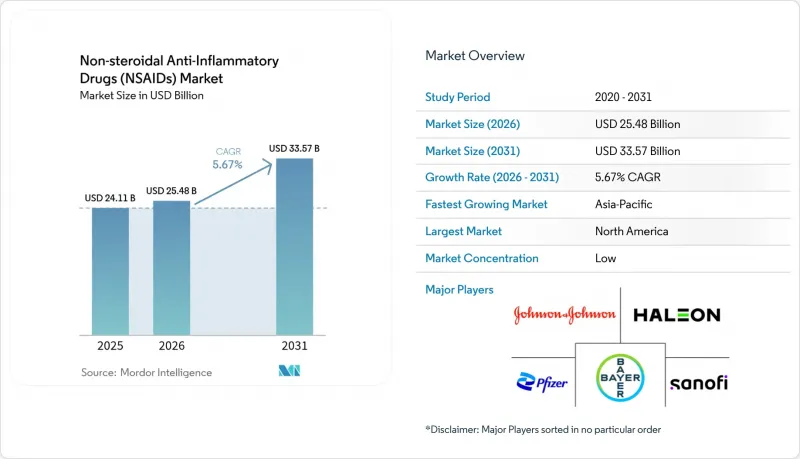
본 보고서에서는 업계를 투여 경로(경구, 비경구 등), 약물 분류별(비선택적 COX 억제제, COX-2 선택적 억제제), 적응증(관절염, 편두통·두통 등),유통 채널(병원 약국, 소매 약국 등), 지역(북미, 유럽, 아시아태평양 등)별로 분류하고 있습니다. 시장 예측은 금액(달러) 기준으로 제시되어 있습니다.
전 세계 비스테로이드성 항염증제(NSAIDs) 시장 동향 및 인사이트
전 세계적으로 증가하는 만성 통증 및 염증성 질환의 부담
만성 통증은 전 세계 1억 명 이상의 성인에게 영향을 미치고 있으며, 퇴행성 관절염의 유병률은 2050년까지 급격히 상승할 것으로 예상되어 항염증제에 대한 구조적인 수요가 증가하고 있습니다. 신흥국의 진단 능력 향상으로 환자층이 확대되는 한편, 각국 정부는 만성 통증을 독립된 질환으로 규정하고, 장기적인 NSAID 치료에 대한 보험 적용을 지원하고 있습니다. 치료되지 않은 통증으로 인한 노동 생산성 저하 또한 보험 적용 범위 확대를 정당화하는 요인이 되고 있습니다. 그 결과, NSAID 시장은 경기 순환을 초월한 안정적인 수요 기반을 확보하고 있습니다.
오피오이드 및 아세트아미노펜에 대한 NSAID 선호도
임상시험에 따르면, 이부프로펜과 아세트아미노펜의 병용 요법은 중독 위험을 전혀 수반하지 않으면서도 하이드로코돈과 동등한 진통 효과를 발휘하는 것으로 나타났습니다. 현재 미국 및 EU의 처방 지침에서는 비오피오이드계 약물을 1차 선택 요법으로 권장하고 있으며, 이는 NSAIDs가 보험 적용 약품 목록에 등재되는 데 힘을 실어주고 있습니다. 이러한 제품들은 염증 치료 효과도 겸비하고 있어, 관절염이나 스포츠 부상에서는 아세트아미노펜보다 뛰어난 효과를 발휘합니다. 보험사 측도 오피오이드 오용으로 인한 비용과 비교하여 비용 절감 효과를 인식하고 있으며, 이것이 가이드라인 채택을 뒷받침하고 있습니다. 이러한 변화로 인해 NSAIDs 시장은 중등도 통증 관리의 기반으로서 입지를 확립해 가고 있습니다.
소화기 및 심혈관계 이상반응이 규제 당국의 경고를 초래
현재 FDA 및 유럽의약품청(EMA)은 심혈관계, 소화기계 및 드문 피부 질환과 관련된 부작용을 포괄하는 박스 경고를 표기하도록 의무화하고 있습니다. 종단적 코호트 분석에 따르면, 강직성 척추염 환자에게 고용량의 NSAID를 투여하면 허혈성 심장 질환 및 뇌졸중의 위험이 높아집니다. 임상의들이 환자에 대한 선별 검사를 더욱 엄격하게 실시하고 투여 기간을 제한함에 따라 처방량은 감소하고 있습니다. 모니터링 강화로 인해 치료비가 증가하여, 꾸준한 수요가 있음에도 불구하고 NSAID 시장에 큰 부담이 되고 있습니다.
부문 분석
2025년, 경구 제제는 의사가 익숙한 치료법이며 환자에게 편리하다는 점 때문에 NSAID 시장 규모의 55.92%를 계속 차지했습니다. 그러나 위험을 회피하려는 성향의 처방 의사들이 퇴행성 관절염이나 연조직 손상에 대해 국소 요법을 권장하는 경향이 있어, 외용제는 연평균 성장률(CAGR) 6.18%로 성장하고 있습니다. 첨단 하이드로겔은 소화기 계통이나 심혈관 계통의 유해 사건을 증가시키지 않으면서도 경구 제제와 동등한 효능을 발휘하게 되었습니다.
고정 용량 배합 패치에는 최대 12시간 동안 방출을 지속시키는 투과 촉진제가 배합되어 있어, 투여 빈도를 줄이고 복약 순응도를 향상시키고 있습니다. 규제 당국의 지침에 따르면, 합병증이 있는 고령자에 대한 외용 NSAIDs의 사용이 권장되고 있습니다. 그 결과, 각 제조업체는 NSAIDs 시장 증가하는 수요를 확보하기 위해 젤 및 스프레이의 생산 능력을 확대되고 있습니다.
2025년 시점에서 비선택적 억제제는 비용 측면과 광범위한 적응증 기재에 힘입어 NSAIDs 시장 규모의 61.77%라는 최대 점유율을 유지했습니다. COX-2 억제제는 새로운 근거를 통해 심혈관 위험 평가가 정교해지고, 위장관 보호 효과가 강조됨에 따라 연평균 성장률(CAGR) 6.32%로 확대되고 있습니다. 신흥 후보 약물은 선택성 비율과 반감기를 최적화하여 치료 범위를 넓히려 하고 있습니다.
개발 중인 제품군은 이중 표적 억제를 목표로 하고 있으며, 프로스타글란딘과 류코트리엔 경로를 동시에 조절함으로써 부작용을 줄이면서 염증을 치료합니다. 후기 임상시험에서 그 유효성이 확인되면, 비선택성 약물의 우위는 약화되고, NSAIDs 시장에서 약물 분류별 매출 구성이 재편될 가능성이 있습니다.
지역별 분석
북미는 2025년에 매출의 41.35%를 차지했습니다. 이는 높은 의료비 지출과 NSAID 처방을 우선시하는 오피오이드 대체 정책에 힘입은 결과입니다. 규제 체계가 견고하고 보험사가 비용 대비 효과가 높은 제네릭 의약품을 장려하고 있기 때문에 이 지역의 NSAID 시장에서는 안정성과 가격 압박이 동시에 발생하고 있습니다.
아시아태평양은 인구 고령화와 저렴한 진통제를 찾는 중산층 소비자 증가로 인해 2031년까지 6.29%라는 가장 높은 연평균 성장률(CAGR)을 보일 것으로 전망됩니다. 현지 제조업체들은 생산 규모를 확대하고 있으며, 각국 정부는 필수 NSAID를 보험 적용 목록에 포함시킴으로써 접근성 확대를 가속화하고 있습니다. OTC(일반의약품)의 사용은 널리 보급되어 있지만, 1인당 진료 횟수는 증가하고 있으며, 관절염이나 편두통으로 진단된 사례가 더 많이 정식 의료 서비스의 대상이 되고 있습니다.
유럽에서는 국민건강보험제도를 기반으로 여전히 큰 시장 규모를 유지하고 있지만, 유럽의약품청(EMA)의 엄격한 평가로 인해 신제품 출시가 지연되고 있으며, 의약품 안전성 감시가 중시되고 있습니다. 중동 및 아프리카, 남미의 신흥 지역에서는 인프라 구축이 진행됨에 따라 성장세가 가속화되고 있습니다. 다국적 기업들은 국내 유통업체와 제휴하여 규제상의 미묘한 차이나 경제 변동에 대응하면서, 전 세계 NSAIDs 시장에서 추가적인 수요를 개척하고 있습니다.
기타 혜택:
- 엑셀 형식 시장 예측(ME) 시트
- 3개월간의 애널리스트 지원
자주 묻는 질문
목차
제1장 서론
제2장 조사 방법
제3장 주요 요약
제4장 시장 구도
제5장 시장 규모와 성장 예측
제6장 경쟁 구도
제7장 시장 기회와 향후 전망
JHS 26.08.28According to Mordor Intelligence, the NSAIDs market size was valued at USD 24.11 billion in 2025 and estimated to grow from USD 25.48 billion in 2026 to reach USD 33.57 billion by 2031, at a CAGR of 5.67% during the forecast period (2026-2031).
This report Segments the Industry Into by Route of Administration (Oral, Parenteral, and More), Drug Class (Non-Selective COX Inhibitors, COX-2 Selective Inhibitors), Application (Arthritis, Migraine & Headache, and More), by Distribution Channel (Hospital Pharmacies, Retail Pharmacies, and More), and Geography (North America, Europe, Asia-Pacific, and More). The Market Forecasts are Provided in Terms of Value (USD).
Global Non-steroidal Anti-Inflammatory Drugs (NSAIDs) Market Trends and Insights
Rising Global Burden of Chronic Pain & Inflammatory Disorders
Chronic pain affects more than 100 million adults worldwide, and osteoarthritis prevalence is set to climb sharply by 2050, reinforcing a structural need for anti-inflammatory drugs. Broader diagnostic capabilities in emerging economies widen the patient pool, while governments classify chronic pain as its own condition, supporting reimbursement for long-term NSAID therapy. Workforce productivity losses tied to untreated pain further justify coverage expansions. As a result, the NSAIDs market secures a stable demand base that transcends economic cycles.
Preference for NSAIDs Over Opioids & Acetaminophen
Clinical trials show an ibuprofen-acetaminophen regimen can equal hydrocodone's pain relief with none of the addiction risk. US and EU prescribing guidelines now advise non-opioid first-line therapy, propelling formulary placement of NSAIDs. Because these products also treat inflammation, they out-perform acetaminophen in arthritis and sports injuries. Payers see cost savings versus opioid misuse expenses, reinforcing guideline adoption. This shift repositions the NSAIDs market as the cornerstone of moderate-pain management.
GI & Cardiovascular Adverse Events Prompting Regulatory Warnings
The FDA and European Medicines Agency (EMA) now require boxed warnings covering cardiovascular, GI, and rare dermatologic events. High-dose NSAID courses in ankylosing spondylitis raise ischemic heart disease and stroke risk according to longitudinal cohort analyses. Clinicians screen patients more rigorously and limit duration, trimming prescription volumes. Added monitoring inflates treatment costs, weighing on the NSAIDs market despite unflagging underlying demand.
Other drivers and restraints analyzed in the detailed report include:
- Growing OTC Availability & Self-Medication Culture
- Fixed-Dose-Combination Topical Gels Improving GI Safety
- Patent Cliffs & Price Erosion for Blockbuster Brands
For complete list of drivers and restraints, kindly check the Table Of Contents.
Segment Analysis
Oral products kept 55.92% of NSAIDs market size in 2025 because of physician familiarity and patient convenience. Topical options, however, climb at 6.18% CAGR as risk-averse prescribers recommend localized therapy for osteoarthritis and soft-tissue injuries. Advanced hydrogels now match oral efficacy without increasing GI or cardiovascular events.
Fixed-dose combination patches embed permeation enhancers that sustain release for up to 12 hours, reducing dosing frequency and boosting adherence. Regulatory guidance encourages topical NSAIDs in older adults with comorbidities. Consequently, manufacturers expand plant capacity for gels and sprays to capture incremental volumes in the NSAIDs market.
Non-selective inhibitors retained the largest 61.77% slice of NSAIDs market size in 2025 by virtue of cost and broad indication labeling. COX-2 agents escalate at 6.32% CAGR as new evidence refines cardiovascular risk assessments and highlights GI protection. Emerging candidates optimize selectivity ratios and half-lives to widen their therapeutic window.
Pipeline products also aim for dual-target inhibition, modulating prostaglandin and leukotriene pathways simultaneously to tackle inflammation with fewer side effects. If late-stage trials confirm benefit, non-selective dominance could erode, reshaping drug-class revenue mix within the NSAIDs market.
Complete Report Scope:
- By Route of Administration
- Oral
- Parenteral
- Topical
- Others
- By Drug Class
- Non-selective COX Inhibitors
- COX-2 Selective Inhibitors
- By Application
- Arthritis
- Migraine & Headache
- Ophthalmic Conditions
- Fever & Flu
- Dysmenorrhea
- Others
- By Distribution Channel
- Hospital Pharmacies
- Retail Pharmacies
- E-commerce
- Geography
- North America
- United States
- Canada
- Mexico
- Europe
- Germany
- United Kingdom
- France
- Italy
- Spain
- Rest of Europe
- Asia-Pacific
- China
- Japan
- India
- South Korea
- Australia & New Zealand
- Rest of Asia-Pacific
- Middle East and Africa
- GCC
- South Africa
- Rest of Middle East and Africa
- South America
- Brazil
- Argentina
- Rest of South America
- North America
Geography Analysis
North America held 41.35% of revenue in 2025, supported by high healthcare outlays and opioid-replacement policies that prioritize NSAID prescriptions. Regulatory frameworks are robust, and insurers push cost-effective generics, creating both stability and price pressure in this zone of the NSAIDs market.
Asia-Pacific records the fastest 6.29% CAGR through 2031 as populations age and middle-class consumers seek affordable pain relief. Local manufacturers scale production, and governments integrate essential NSAIDs into reimbursement lists, accelerating access. OTC use is widespread, yet physician visits per capita are rising, bringing more diagnosed arthritis and migraine cases into formal care.
Europe retains sizeable volume anchored by universal health systems, yet strict EMA evaluations slow new launches and emphasize pharmacovigilance. Emerging regions in the Middle East, Africa, and South America gain momentum as infrastructure improves. Multinationals partner with domestic distributors to navigate regulatory nuance and economic swings while unlocking incremental demand in the global NSAIDs market.
- Pfizer
- Bayer
- Johnson & Johnson (McNeil)
- Haleon plc
- Reckitt Benckiser Group
- Sanofi
- Horizon Therapeutics
- Sun Pharmaceuticals Industries
- Assertio
- Perrigo Company
- Iroko Pharmaceuticals
- Viatris
- Novartis
- Dr. Reddy's Laboratories Ltd
- Teva Pharmaceutical Industries
- Boehringer Ingelheim
- Abbvie
- Endo International
- Hikma Pharmaceuticals
- Orion
Additional Benefits:
- The market estimate (ME) sheet in Excel format
- 3 months of analyst support
TABLE OF CONTENTS
1 Introduction
- 1.1 Study Assumptions & Market Definition
- 1.2 Scope of the Study
2 Research Methodology
3 Executive Summary
4 Market Landscape
- 4.1 Market Overview
- 4.2 Market Drivers
- 4.2.1 Rising Global Burden of Chronic Pain & Inflammatory Disorders
- 4.2.2 Preference for NSAIDs Over Opioids & Acetaminophen
- 4.2.3 Growing OTC Availability & Self-medication Culture
- 4.2.4 Emergence of Fixed-dose-combination Topical Gels Improving GI Safety
- 4.2.5 AI-driven Drug-repositioning Accelerating Low-cost Reformulations
- 4.2.6 Expanding Applications in Specialized Therapeutic Areas
- 4.3 Market Restraints
- 4.3.1 GI & Cardiovascular Adverse Events Prompting Regulatory Warnings
- 4.3.2 Patent Cliffs & Price Erosion for Blockbuster Brands
- 4.3.3 Increasing Healthcare Cost Pressures and Generic Competition
- 4.3.4 Growing Awareness of Drug Interactions and Contraindications
- 4.4 Value / Supply-Chain Analysis
- 4.5 Regulatory Landscape
- 4.6 Technological Outlook
- 4.7 Porter's Five Forces Analysis
- 4.7.1 Threat of New Entrants
- 4.7.2 Bargaining Power of Buyers
- 4.7.3 Bargaining Power of Suppliers
- 4.7.4 Threat of Substitutes
- 4.7.5 Intensity of Competitive Rivalry
5 Market Size & Growth Forecasts (Value in USD)
- 5.1 By Route of Administration
- 5.1.1 Oral
- 5.1.2 Parenteral
- 5.1.3 Topical
- 5.1.4 Others
- 5.2 By Drug Class
- 5.2.1 Non-selective COX Inhibitors
- 5.2.2 COX-2 Selective Inhibitors
- 5.3 By Application
- 5.3.1 Arthritis
- 5.3.2 Migraine & Headache
- 5.3.3 Ophthalmic Conditions
- 5.3.4 Fever & Flu
- 5.3.5 Dysmenorrhea
- 5.3.6 Others
- 5.4 By Distribution Channel
- 5.4.1 Hospital Pharmacies
- 5.4.2 Retail Pharmacies
- 5.4.3 E-commerce
- 5.5 Geography
- 5.5.1 North America
- 5.5.1.1 United States
- 5.5.1.2 Canada
- 5.5.1.3 Mexico
- 5.5.2 Europe
- 5.5.2.1 Germany
- 5.5.2.2 United Kingdom
- 5.5.2.3 France
- 5.5.2.4 Italy
- 5.5.2.5 Spain
- 5.5.2.6 Rest of Europe
- 5.5.3 Asia-Pacific
- 5.5.3.1 China
- 5.5.3.2 Japan
- 5.5.3.3 India
- 5.5.3.4 South Korea
- 5.5.3.5 Australia & New Zealand
- 5.5.3.6 Rest of Asia-Pacific
- 5.5.4 Middle East and Africa
- 5.5.4.1 GCC
- 5.5.4.2 South Africa
- 5.5.4.3 Rest of Middle East and Africa
- 5.5.5 South America
- 5.5.5.1 Brazil
- 5.5.5.2 Argentina
- 5.5.5.3 Rest of South America
- 5.5.1 North America
6 Competitive Landscape
- 6.1 Market Concentration
- 6.2 Strategic Moves
- 6.3 Market Share Analysis
- 6.4 Company Profiles
- 6.4.1 Pfizer Inc.
- 6.4.2 Bayer AG
- 6.4.3 Johnson & Johnson (McNeil)
- 6.4.4 Haleon plc
- 6.4.5 Reckitt Benckiser Group plc
- 6.4.6 Sanofi SA
- 6.4.7 Horizon Therapeutics plc
- 6.4.8 Sun Pharmaceutical Industries Ltd
- 6.4.9 Assertio Holdings Inc.
- 6.4.10 Perrigo Company plc
- 6.4.11 Iroko Pharmaceuticals Inc.
- 6.4.12 Viatris Inc.
- 6.4.13 Novartis AG
- 6.4.14 Dr. Reddy's Laboratories Ltd
- 6.4.15 Teva Pharmaceutical Industries Ltd
- 6.4.16 Boehringer Ingelheim GmbH
- 6.4.17 AbbVie Inc.
- 6.4.18 Endo International plc
- 6.4.19 Hikma Pharmaceuticals plc
- 6.4.20 Orion Corporation
7 Market Opportunities & Future Outlook
- 7.1 White-space & Unmet-Need Assessment


