

|
시장보고서
상품코드
2100613
항염증제 시장 : 시장 점유율 분석, 업계 동향 및 통계, 성장 예측(2026-2031년)Anti-Inflammatory Drugs - Market Share Analysis, Industry Trends & Statistics, Growth Forecasts (2026 - 2031) |
||||||
 Mordor Intelligence
Mordor Intelligence에 의하면, 2026년 항염증제 시장 규모는 1,293억 3,000만 달러로 추정되고, 2025년 1,203억 7,000만 달러에서 확대해, 2031년에는 1,852억 5,000만 달러에 이를 것으로 예측됩니다.
2026-2031년 연평균 성장률(CAGR) 7.45%로 성장할 것으로 전망됩니다.
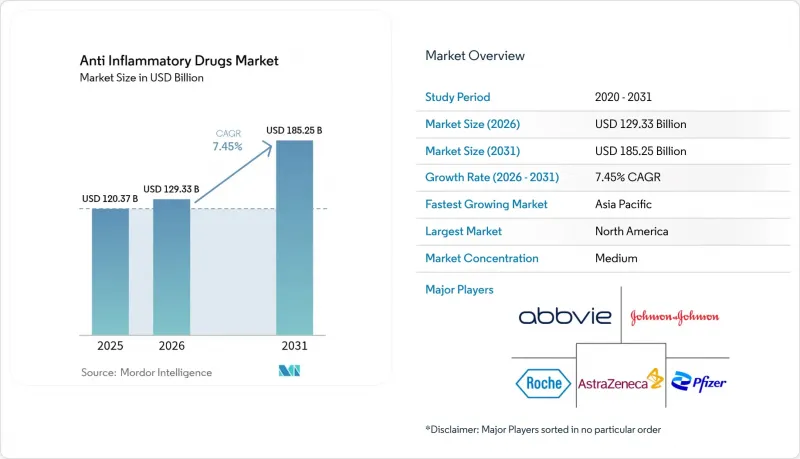
본 보고서에서는 시장을 용도별(관절염, 만성 폐쇄성 폐질환 등), 약물 분류별(항염증 바이오의약품, NSAIDs 등), 투여 경로별(경구, 비경구 등), 판매 채널별(처방약, 일반의약품), 지역별(북미, 유럽, 아시아태평양 등)으로 분류하고 있습니다. 시장 전망은 금액(달러) 기준으로 제시되어 있습니다.
세계의 항염증제 시장 동향 및 인사이트
비만과 관련된 퇴행성 관절염 유병률 증가
비만 증가와 수명 연장이 맞물려 퇴행성 관절염 환자 수가 증가하고 있으며, 이는 항염증제 시장의 확장을 뒷받침하고 있습니다. 기계적 부하와 경미한 전신성 염증이 연골 손실을 가속화하여, 안전한 진통법에 대한 지속적인 수요를 창출하고 있습니다. 관찰 연구에 따르면, 외용 디클로페낙 겔은 증상 완화를 가져오며, 사용자의 74.2%가 부작용을 보고하지 않은 것으로 나타났는데, 이는 심혈관계 동반 질환이 있는 비만 환자에게 중요한 안전상의 이점이 됩니다. 보험사는 체중에 의존하지 않는 치료법이나 대사 및 염증을 통합한 치료법을 권장하고 있으며, 외용 NSAID 및 글루코사민 복합제의 보험 적용 범위가 확대되고 있습니다. 의료기기와 연동된 약물 전달 시스템, 단 한 번의 내원만으로 끝나는 서방형 코르티코스테로이드 주사는 복약 순응도를 더욱 높여줍니다. 종합적으로 볼 때, 비만으로 인한 퇴행성 관절염은 항염증제 시장에 있어 장기적인 판매량의 기반이 됩니다.
AI를 활용한 신약 개발을 통한 바이오의약품 파이프라인 가속화
생성형 알고리즘을 통해 표적 특정 기간이 단축되고, 결합 친화성이 최적화되며, 리드 후보의 위험이 감소함에 따라 바이오의약품 시장 출시가 가속화되고 있습니다. 인실리코 메디신(InSilico Medicine)은 염증성 장질환 치료제 ISM5411을 인실리코 단계의 개념에서 1상 임상시험까지 불과 30개월 만에 발전시켰습니다. 대형 제약사들은 현재 사내 화합물 라이브러리와 AI 플랫폼을 결합해 면역학 분야의 포트폴리오를 쇄신하고 있으며, 차별화된 작용기전을 가진 제품으로 항염증제 시장을 활성화하고 있습니다. 유전체학을 기반으로 한 동반 진단을 통해 환자 선별이 정교화되어 임상시험 성공률과 보험사의 승인이 촉진되고 있습니다. 데이터, 모델링, 임상 검증을 통한 선순환은 2030년까지 바이오의약품의 지속적인 혁신을 약속하고 있습니다. 디지털 인프라가 잘 갖춰진 지역, 특히 미국, 독일, 영국이 이러한 활동의 상당 부분을 차지하고 있지만, 전략적 파트너십을 통해 중국이나 싱가포르의 연구 거점으로도 그 역량이 확대되고 있습니다.
COX-2 계열 NSAID에 관한 심혈관계 박스 경고
PRECISION 임상시험에서는 셀레코시브가 주요 심혈관 이상반응 측면에서 나프록센이나 이부프로펜에 뒤지지 않는 것으로 나타났으나, 처방 의사의 신중한 태도는 여전히 지속되고 있습니다. FDA 자문위원회는 셀레콕시브의 경고문 철회를 검토했으나 철회에는 이르지 못했으며, 관절염 재단에 따르면 인식상의 장벽이 여전히 남아 있습니다. 강직성 척추염에 관한 한국의 보험 데이터에 따르면, 심부전의 조정 후 위험비(HR)는 1.12로, 용량 의존적인 심혈관 위험이 나타났습니다(『Annals of the Rheumatic Diseases』). 따라서 임상의들은 특히 고령자나 고위험군 환자에서 고용량 또는 장기간의 COX-2 계열 NSAID 사용을 제한하고 있습니다. 이러한 제한으로 인해 전신용 NSAID의 성장이 정체되고, 판매량은 외용 NSAID 및 생물학적 제제로 이동하고 있어 항염증제 시장의 성장이 소폭 둔화되고 있습니다.
부문 분석
2025년에는 관절염 적응증이 시장 점유율의 27.42%를 차지한 것으로 평가되었습니다. 이는 해당 부문에서 확립된 치료 프로토콜과 만성적인 관리가 필요한 환자 수가 많기 때문입니다. 그러나 조기 개입과 표적화된 항염증 접근법을 중시하는 치료 패러다임의 진화에 힘입어, 건염은 2031년까지 연평균 성장률(CAGR) 8.05%를 기록하며 가장 빠르게 성장하는 적응증 분야로 부상하고 있습니다. 최근 비임상 연구에 따르면, 국소 투여 및 경구 투여용 NSAID 모두 힘줄 과사용과 관련된 통증에 대해 효과적인 단기적 완화를 제공하는 것으로 나타났으며, 특히 급성 어깨 건염 및 활액낭염에서 높은 유효성이 확인되었습니다. 다발성 경화증 및 염증성 장 질환 적응증 분야에서는 새로운 표적 치료법으로 인해 치료 선택지가 확대되면서 견조한 성장이 예상됩니다. 한편, COPD 적응증 분야에서는 장기적인 합병증을 완화하는 스테로이드 절약 요법의 혜택을 받고 있습니다.
특정 염증 경로와 표적화된 중재를 연결하는 정밀 의학(Precision Medicine) 접근법을 통해 적응증 분야의 양상이 재구성되고 있습니다. 힘줄과 뼈의 치유에 관한 연구에서는 염증 조절이 수행하는 중요한 역할이 강조되고 있으며, 회복 과정을 최적화하기 위해 대식세포의 분극 및 사이토카인 조절에 초점을 맞춘 새로운 치료법이 등장하고 있습니다. 천식 치료 분야에서는 JAK 억제제가 여러 염증 캐스케이드에 걸쳐 효능을 보이는 등 현저한 혁신이 나타나고 있습니다. 한편, 기타 치료 분야에서는 급성 증상과 기저 질환의 진행을 모두 다루는 병용 요법이 활용되고 있습니다. 적응증 특이적 바이오마커 및 동반 진단으로의 전환을 통해, 특히 여러 염증 경로가 질환의 병태에 관여하는 복잡한 병태에서 보다 정밀한 치료법 선택이 가능해졌습니다.
항염증성 바이오의약품은 2025년에 32.10%의 점유율로 시장을 계속 주도하였으며, 2031년까지 연평균 성장률(CAGR) 8.12%로 성장을 견인할 것으로 전망됩니다. 이는 표적화된 면역 조절 분야의 지속적인 혁신과 적응증 승인의 확대를 반영한 것입니다. 이 분야는 AI를 활용한 신약 개발의 혜택을 받고 있으며, 생성형 플랫폼을 통해 보다 정밀한 표적 식별과 분자 최적화가 가능해져 개발 기간 단축과 성공률 향상으로 이어지고 있습니다. 비스테로이드성 항염증제(NSAIDs)는 급성기 관리에 여전히 필수적이지만, 코르티코스테로이드의 경우 동등한 효능을 가지면서도 부작용 프로파일이 완화된 스테로이드 절약형 대체제로부터의 압박에 직면해 있습니다. 면역 선택성 항염증 유도체는 전신에 미치는 영향을 줄이면서 보다 정밀한 염증 조절을 가능하게 하는 유망한 신흥 카테고리입니다.
최근 규제 당국의 승인은 바이오의약품 부문의 성장세를 보여주고 있으며, 우파다시티닙은 거대세포동맥염에 대한 8번째 적응증을 획득하여 위약군의 29.0%에 비해 46.4%의 지속적 관해율을 나타냈습니다. 또한, 이 분야는 새로운 작용기전으로부터도 혜택을 받고 있으며, 염증성 장 질환에서 뛰어난 유효성을 보이고 있는 TL1A 억제제 등이 그 예입니다. 예를 들어, 머크의 PRA-023은 크론병 환자에서 49.1%의 관해율을 달성했습니다. 그 밖의 약물 분류별로도 투여 빈도와 전신 노출을 줄이면서 환자의 복약 순응도와 치료 성과를 향상시키는 병용 요법이나 서방형 제제로 진화하고 있습니다.
지역별 분석
북미는 선진적인 보험 급여 제도, 신약의 급속한 보급, 그리고 엄격한 임상 연구 역량을 바탕으로 2025년 전 세계 매출의 38.35%를 차지했습니다. 미국에서는 급성 통증에 대한 최초의 비오피오이드계 NaV1.8 차단제인 JOURNAVX가 승인되면서, 치료 분야에서의 리더십이 더욱 강화되었습니다. 아달리무맙 대체제를 포함한 바이오시밀러의 확산은 보험사 측의 비용 절감 목표와 부합하여 순매출 성장세를 소폭 둔화시키고 있습니다. 주요 원료의약품(API)의 국내 복귀 및 조달처 다각화를 촉진하는 연방 정부의 인센티브는 2024년 물류 혼란으로 드러난 공급 측면의 취약성을 해결하기 위한 것입니다. 캐나다는 실세계 데이터(REW) 요건을 확대하고 시판 후 조사를 강화하는 한편, 보험 적용 의약품 목록 재검토를 추진하고 있습니다.
아시아태평양은 2031년까지 연평균 성장률(CAGR)이 8.2%로 가장 높을 전망입니다. 중국에서는 중앙집권적인 조달 제도로 인해 생물학적 제제의 가격이 인하되어 병원에서의 도입이 가속화되는 한편, 국내 제조업체들은 TNF 억제제 바이오시밀러의 생산 규모를 확대되고 있습니다. 인도의 ‘아유슈만 바라트’ 보험 제도는 환자의 보험 적용 범위를 확대하여 소매 시장에서 OTC(일반의약품) 수요를 끌어올리고 있습니다. 일본은 노화에 따른 염증성 질환의 지표가 되는 시장으로 자리매김하며, 생물학적 제제의 꾸준한 사용을 뒷받침하고 있습니다. 동남아시아 시장에서는 임상시험 인프라에 대한 투자가 진행되어 다국적 기업의 후원을 유치하고 있습니다. 전반적으로 소득 증가, 도시화, 만성 질환 유병률 상승이 이 지역의 항염증제 시장 확대를 뒷받침하고 있습니다.
유럽은 여전히 중요한 시장 점유율을 차지하고 있지만, 바이오시밀러로 인한 가격 하락 압력이 커지고 있습니다. 독일의 조기 접근 제도와 디지털 치료제 시범 사업은 혁신에 대한 노력을 보여주고 있지만, 의료 기술 평가에서는 확고한 비용 대비 효과에 대한 증거가 요구되고 있습니다. 영국의 의약품 및 헬스케어 제품 규제청(MHRA)은 브렉시트 이후 유연한 대응을 통해 승인을 신속화하고, 경쟁과 환자의 접근성 사이의 균형을 맞추고 있습니다. 중동 및 아프리카에서는 치료 적용 범위를 확대하기 위해 단계적 처방약 목록 제도와 바이오시밀러 도입에 투자가 이루어지고 있는 반면, 라틴아메리카에서는 규제 체계의 현대화가 진행되며 다국적 기업의 현지 생산이 촉진되고 있습니다. 이러한 동향들이 맞물려 전 세계 항염증제 시장의 성장세를 유지하는 동시에 지역별 특징을 부각시키고 있습니다.
기타 혜택 :
- 엑셀 형식 시장 예측(ME) 시트
- 3개월간의 애널리스트 지원
자주 묻는 질문
목차
제1장 서론
제2장 조사 방법
제3장 주요 요약
제4장 시장 구도
제5장 시장 규모 및 성장 예측
제6장 경쟁 구도
제7장 시장 기회 및 향후 전망
AJY 26.08.07According to Mordor Intelligence, anti-inflammatory drugs market size in 2026 is estimated at USD 129.33 billion, growing from 2025 value of USD 120.37 billion with 2031 projections showing USD 185.25 billion, growing at 7.45% CAGR over 2026-2031.
This report Segments the Industry Into by Application (Arthritis, Chronic Obstructive Pulmonary Disease, and More. ), Drug Class (Anti-Inflammatory Biologics, Nsaids, and More), Route of Administration (Oral, Parenteral, and More), Sales Channel (Prescription, Over the Counter), and Geography (North America, Europe, Asia-Pacific, and More). The Market Forecasts are Provided in Terms of Value (USD).
Global Anti-Inflammatory Drugs Market Trends and Insights
Escalating Prevalence of Obesity-Linked Osteoarthritis
Growing obesity and longevity are jointly raising osteoarthritis caseloads, stimulating the anti-inflammatory drugs market. Mechanical strain and low-grade systemic inflammation accelerate cartilage loss, driving sustained demand for safe analgesia. Observational studies indicate topical diclofenac gel yields symptom relief with 74.2% of users reporting no adverse events, a meaningful safety edge for obese patients with cardiovascular comorbidity. Payers endorse weight-neutral therapeutics and integrated metabolic-inflammation regimens, expanding formularies for topical NSAIDs and glucosamine combinations. Device-coupled drug delivery and single-visit depot corticosteroid injections further heighten adherence. Collectively, obesity-driven osteoarthritis provides a long-run volume anchor for the anti-inflammatory drugs market.
Biologics Pipeline Acceleration Through AI-Enabled Discovery
Generative algorithms shorten target identification, optimize binding affinity and de-risk lead candidates, enabling faster biologic entry. Insilico Medicine progressed ISM5411 for inflammatory bowel disease from in-silico concept to Phase 1 inside 30 months. Big Pharma now pairs internal libraries with AI platforms to refresh immunology portfolios, enhancing the anti-inflammatory drugs market with differentiated mechanisms. Companion diagnostics derived from genomics refine patient selection, bolstering trial success rates and payer acceptance. The virtuous cycle of data, modeling and clinical validation promises sustained biologics innovation through 2030. Regions with strong digital infrastructure, notably the United States, Germany and the United Kingdom, capture much of this activity, but strategic partnerships extend capacity into China and Singapore research hubs.
Cardiovascular Boxed-Warnings on COX-2 NSAIDs
Although the PRECISION trial positioned celecoxib as non-inferior to naproxen or ibuprofen for major adverse cardiac events, prescriber caution persists. FDA advisory committees considered but did not remove celecoxib warnings, sustaining perception hurdles Arthritis Foundation. Korean insurance data on ankylosing spondylitis indicated dose-dependent cardiovascular risk with adjusted hazard ratio of 1.12 for heart failure Annals of the Rheumatic Diseases. Clinicians therefore limit high-dose or long-term COX-2 NSAID use, especially in older or high-risk patients. The restraint caps systemic NSAID growth and shifts volume toward topical NSAIDs and biologics, marginally slowing the anti-inflammatory drugs market.
Other drivers and restraints analyzed in the detailed report include:
- Prescription-to-OTC Switches for Topical NSAIDs
- Wider Uptake of JAK Inhibitors After Unified Safety Labels
- Biologic Price Erosion From Biosimilars in EU5
For complete list of drivers and restraints, kindly check the Table Of Contents.
Segment Analysis
Arthritis applications command 27.42% market share in 2025, reflecting the segment's established treatment protocols and large patient population requiring chronic management. However, tendonitis emerges as the fastest-growing application at 8.05% CAGR through 2031, driven by evolving treatment paradigms that emphasize early intervention and targeted anti-inflammatory approaches. Recent preclinical research demonstrates that both local and oral NSAIDs provide effective short-term relief for tendon overuse-related pain, with particular efficacy in acute shoulder tendonitis and bursitis. Multiple sclerosis and inflammatory bowel disease applications are experiencing robust growth as new targeted therapies expand treatment options, while COPD applications benefit from steroid-sparing regimens that reduce long-term complications.
The application landscape is being reshaped by precision medicine approaches that match specific inflammatory pathways to targeted interventions. Tendon-bone healing research emphasizes the critical role of inflammatory modulation, with emerging therapies focusing on macrophage polarization and cytokine regulation to optimize repair processes. Asthma applications are witnessing significant innovation with JAK inhibitors demonstrating efficacy across multiple inflammatory cascades, while other treatment categories benefit from combination approaches that address both acute symptoms and underlying disease progression. The shift toward application-specific biomarkers and companion diagnostics is enabling more precise treatment selection, particularly in complex conditions where multiple inflammatory pathways contribute to disease pathology.
Anti-inflammatory biologics maintain market leadership with 32.10% share in 2025 and drive growth at 8.12% CAGR through 2031, reflecting continued innovation in targeted immunomodulation and expanding indication approvals. The class benefits from AI-accelerated drug discovery, with generative platforms enabling more precise target identification and molecular optimization that reduces development timelines and improves success rates. Non-steroidal anti-inflammatory drugs remain essential for acute management, while corticosteroids face pressure from steroid-sparing alternatives that offer comparable efficacy with reduced adverse effect profiles. Immune-selective anti-inflammatory derivatives represent an emerging category that promises more precise inflammatory modulation with fewer systemic effects.
Recent regulatory approvals demonstrate the biologics segment's momentum, with upadacitinib receiving its eighth indication for giant cell arteritis and demonstrating 46.4% sustained remission rates compared to 29.0% for placebo. The segment is also benefiting from novel mechanisms of action, including TL1A inhibitors that are showing superior efficacy in inflammatory bowel disease, with Merck's PRA-023 achieving 49.1% remission rates in Crohn's disease patients. Other drug classes are evolving toward combination approaches and sustained-release formulations that improve patient compliance and therapeutic outcomes while reducing dosing frequency and systemic exposure.
Complete Report Scope:
- By Application
- Arthritis
- Chronic Obstructive Pulmonary Disease (COPD)
- Multiple Sclerosis
- Inflammatory Bowel Disease (IBD)
- Asthma
- Tendonitis
- Other Applications
- By Drug Class
- Anti-Inflammatory Biologics
- Non-steroidal Anti-Inflammatory Drugs (NSAIDs)
- Corticosteroids
- Immune-selective Anti-inflammatory Derivatives (ImSAIDs)
- Other Drug Classes
- By Route of Administration
- Oral
- Parenteral
- Topical
- Inhalation
- By Sales Channel
- Prescription
- Over-the-Counter (OTC)
- Geography
- North America
- United States
- Canada
- Mexico
- Europe
- Germany
- United Kingdom
- France
- Italy
- Spain
- Rest of Europe
- Asia-Pacific
- China
- Japan
- India
- Australia
- South Korea
- Rest of Asia-Pacific
- Middle East and Africa
- GCC
- South Africa
- Rest of Middle East and Africa
- South America
- Brazil
- Argentina
- Rest of South America
- North America
Geography Analysis
North America retained 38.35% of global revenue in 2025, underpinned by advanced reimbursement, rapid uptake of novel agents and rigorous clinical research capacity. The United States approved JOURNAVX, the first non-opioid NaV1.8 blocker for acute pain, reinforcing therapeutic leadership. Biosimilar penetration, including adalimumab alternatives, aligns with payer cost-containment goals, slightly moderating net sales growth. Federal incentives to reshore key APIs and diversify sourcing address supply vulnerabilities exposed during 2024 logistics disruptions. Canada expands real-world evidence requirements, enhancing post-marketing surveillance and driving formulary refinement.
Asia-Pacific records the highest 8.2% CAGR through 2031. China's centralized procurement lowers biologic prices and accelerates hospital uptake, while domestic manufacturers scale TNF inhibitor biosimilars. India's Ayushman Bharat insurance scheme enlarges patient coverage and boosts retail OTC demand. Japan remains a bellwether for aging-related inflammatory disease, supporting steady biologic utilization. Southeast Asian markets invest in clinical trial infrastructure, attracting multinational sponsors. Collectively, rising income, urbanization and chronic disease prevalence fuel anti-inflammatory drugs market expansion in the region.
Europe holds meaningful share but faces intensified price erosion from biosimilars. Germany's early access pathways and digital therapeutics pilots demonstrate commitment to innovation, yet health technology assessments demand robust cost-effectiveness evidence. The United Kingdom's Medicines and Healthcare products Regulatory Agency (MHRA) post-Brexit flexibility expedites approvals, balancing competition with patient access. The Middle East and Africa invest in tiered formulary systems and biosimilar adoption to widen therapy reach, while Latin America modernizes regulatory frameworks, encouraging multinationals to localize production. Those developments collectively sustain global momentum for the anti-inflammatory drugs market while highlighting regional nuances.
- Abbvie
- Amgen
- AstraZeneca
- Bayer
- Boehringer Ingelheim
- Bristol-Myers Squibb
- Eli Lilly and Company
- Roche
- GlaxoSmithKline
- Gilead Sciences
- Johnson & Johnson
- Merck
- Novartis
- Pfizer
- Regeneron
- Sanofi
- Teva Pharmaceutical Industries
- UCB
- Viatris
- Zydus Lifesciences
Additional Benefits:
- The market estimate (ME) sheet in Excel format
- 3 months of analyst support
TABLE OF CONTENTS
1 Introduction
- 1.1 Study Assumptions & Market Definition
- 1.2 Scope of the Study
2 Research Methodology
3 Executive Summary
4 Market Landscape
- 4.1 Market Overview
- 4.2 Market Drivers
- 4.2.1 Escalating Prevalence of Obesity-linked Osteoarthritis
- 4.2.2 Biologics pipeline Acceleration due to AI-enabled Target Discovery
- 4.2.3 Expansion of OTC Topical NSAID Switches in Europe & U.S.
- 4.2.4 Uptake of JAK-inhibitors after Safety-label Harmonisation
- 4.2.5 Growing Demand for Once-weekly Depot Corticosteroid Injectables
- 4.2.6 Hospital Antimicrobial-stewardship Programs Favouring Steroid-sparing Regimens
- 4.3 Market Restraints
- 4.3.1 Cardiovascular Boxed-warnings on COX-2 NSAIDs
- 4.3.2 Biologic Price Erosion from Biosimilars in EU5
- 4.3.3 Rising Litigation over Proton-pump-inhibitor Co-prescriptions
- 4.3.4 Supply-chain Vulnerability of API Precursors Sourced from China
- 4.4 Value / Supply-Chain Analysis
- 4.5 Regulatory Landscape
- 4.6 Technological Outlook
- 4.7 Porter's Five Forces Analysis
- 4.7.1 Threat of New Entrants
- 4.7.2 Bargaining Power of Buyers/Consumers
- 4.7.3 Bargaining Power of Suppliers
- 4.7.4 Threat of Substitute Products
- 4.7.5 Intensity of Competitive Rivalry
5 Market Size & Growth Forecasts (Value, USD)
- 5.1 By Application
- 5.1.1 Arthritis
- 5.1.2 Chronic Obstructive Pulmonary Disease (COPD)
- 5.1.3 Multiple Sclerosis
- 5.1.4 Inflammatory Bowel Disease (IBD)
- 5.1.5 Asthma
- 5.1.6 Tendonitis
- 5.1.7 Other Applications
- 5.2 By Drug Class
- 5.2.1 Anti-Inflammatory Biologics
- 5.2.2 Non-steroidal Anti-Inflammatory Drugs (NSAIDs)
- 5.2.3 Corticosteroids
- 5.2.4 Immune-selective Anti-inflammatory Derivatives (ImSAIDs)
- 5.2.5 Other Drug Classes
- 5.3 By Route of Administration
- 5.3.1 Oral
- 5.3.2 Parenteral
- 5.3.3 Topical
- 5.3.4 Inhalation
- 5.4 By Sales Channel
- 5.4.1 Prescription
- 5.4.2 Over-the-Counter (OTC)
- 5.5 Geography
- 5.5.1 North America
- 5.5.1.1 United States
- 5.5.1.2 Canada
- 5.5.1.3 Mexico
- 5.5.2 Europe
- 5.5.2.1 Germany
- 5.5.2.2 United Kingdom
- 5.5.2.3 France
- 5.5.2.4 Italy
- 5.5.2.5 Spain
- 5.5.2.6 Rest of Europe
- 5.5.3 Asia-Pacific
- 5.5.3.1 China
- 5.5.3.2 Japan
- 5.5.3.3 India
- 5.5.3.4 Australia
- 5.5.3.5 South Korea
- 5.5.3.6 Rest of Asia-Pacific
- 5.5.4 Middle East and Africa
- 5.5.4.1 GCC
- 5.5.4.2 South Africa
- 5.5.4.3 Rest of Middle East and Africa
- 5.5.5 South America
- 5.5.5.1 Brazil
- 5.5.5.2 Argentina
- 5.5.5.3 Rest of South America
- 5.5.1 North America
6 Competitive Landscape
- 6.1 Market Concentration
- 6.2 Market Share Analysis
- 6.3 Company Profiles
- 6.3.1 AbbVie
- 6.3.2 Amgen
- 6.3.3 AstraZeneca
- 6.3.4 Bayer
- 6.3.5 Boehringer Ingelheim
- 6.3.6 Bristol-Myers Squibb
- 6.3.7 Eli Lilly
- 6.3.8 F. Hoffmann-La Roche
- 6.3.9 GSK
- 6.3.10 Gilead Sciences
- 6.3.11 Johnson & Johnson
- 6.3.12 Merck & Co
- 6.3.13 Novartis
- 6.3.14 Pfizer
- 6.3.15 Regeneron
- 6.3.16 Sanofi
- 6.3.17 Teva Pharmaceutical
- 6.3.18 UCB Pharma
- 6.3.19 Viatris
- 6.3.20 Zydus Lifesciences
7 Market Opportunities & Future Outlook
- 7.1 White-space & Unmet-Need Assessment


