|
시장보고서
상품코드
2116278
자동차용 밸브 시장 : 점유율 분석, 업계 동향과 통계, 성장 예측(2026-2031년)Automotive Valves - Market Share Analysis, Industry Trends & Statistics, Growth Forecasts (2026 - 2031) |
||||||
 Mordor Intelligence
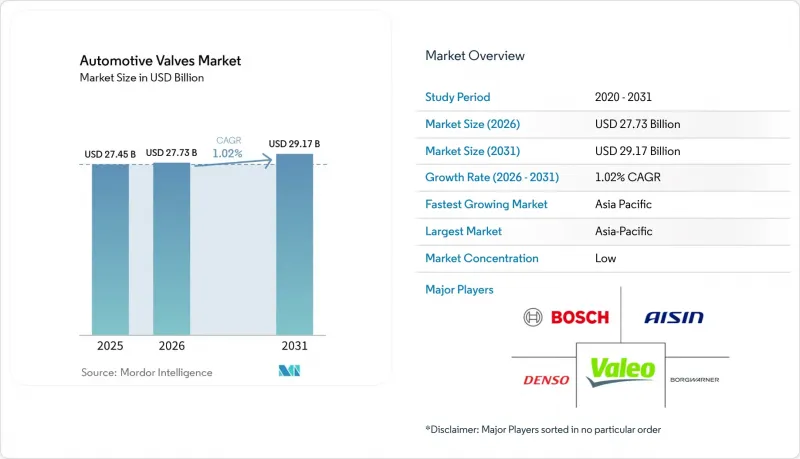
Mordor Intelligence에 의하면, 자동차용 밸브 시장 규모는 2025년 274억 5,000만 달러에서 2026년에는 277억 3,000만 달러로 확대되어 2026년부터 2031년까지 CAGR 1.02%로 성장을 지속하여, 2031년에는 291억 7,000만 달러에 이를 것으로 예측됩니다.
본 보고서는 용도별(엔진 밸브, 공조·열 관리용 밸브 등), 차종별(승용차, 소형 상용차 등), 기능별(공압식, 유압식 등),재질별(강철 등), 추진 방식별(내연기관 등), 판매 채널별(OEM 등), 지역별(북미 등)로 분류되어 있습니다. 시장 예측은 금액(달러) 기준으로 제시되어 있습니다.
전 세계 자동차용 밸브 시장 동향 및 인사이트
전동화에 따른 열 관리 아키텍처의 급속한 성장
배터리식 전기차 및 하이브리드 차량에는 기존의 ICE(내연기관) 냉각 회로를 뛰어넘는 완전히 새로운 밸브 용도를 창출하는 첨단 열 관리 시스템이 요구되고 있습니다. 전기식 냉각수 밸브는 엔진의 폐열을 이용하지 않고 배터리 팩의 온도 관리, 파워 일렉트로닉스 냉각 및 차량 내 난방을 수행해야 할 필요성에 힘입어 연평균 성장률(CAGR) 7.25%로 가장 빠르게 성장하는 부문으로 부상하고 있습니다. 라인메탈(Rheinmetall)의 첨단 냉각수 밸브 제품군은 하이브리드차 및 전기차 용도에 최적화되어 있으며, 수요에 따른 제어와 낮은 유동 저항 설계를 특징으로 하여, 이에 필요한 기술적 복잡성을 보여줍니다. EV의 배터리, 모터, 전력 전자 장치 및 차량 내부의 여러 냉각 회로를 통합하려면, 기존의 내연기관 차량 시스템에서는 결코 요구되지 않았던 정밀한 밸브 간 연동이 필요합니다. 산화 자동차(Sanhua Automotive)가 열팽창 밸브, 전동 팽창 밸브 및 냉매용 솔레노이드 밸브를 전문으로 하고 있다는 사실은 통합형 열 관리 솔루션을 향한 시장의 진화를 여실히 보여줍니다.
내연기관(ICE)의 다운사이징 및 터보화의 확산
유럽과 중국의 신형 승용차 개발에서는 배기량이 작은 엔진이 주류를 이루고 있으며, 터보차저의 채택으로 인해 작동 온도가 상승하고 있습니다. 고품질 티타늄 합금은 이러한 열 부하를 견딜 수 있어, 더욱 엄격한 밸브 타이밍 허용 범위를 실현합니다. 이를 통해 각 제조업체는 유로 7 및 EPA 29 규정을 준수할 수 있게 됩니다. 커민스(Cummins)는 2025년 4월, 수소 내연기관용 터보차저를 발표했습니다. 이는 과급 기술이 대체 연료로 전환되고, 기존의 밸브 기술 노하우와 새로운 연소 요구 사항이 융합됨에 따라 자동차용 밸브 시장 전체의 평균 단가를 끌어올리고 있음을 보여줍니다.
니켈 및 티타늄 가격의 슈퍼사이클
원자재 가격의 급등은 밸브 제조업체, 특히 고성능 용도에 고급 합금을 채택하고 있는 제조업체들에게 상당한 이익률 압박 요인이 되고 있습니다. 티타늄 및 합금 밸브는 연평균 성장률(CAGR) 5.55%로 가장 빠르게 성장하는 소재 부문임에도 불구하고, 가격에 민감한 용도에서의 채택을 제한할 수 있는 비용 측면의 역풍에 직면해 있습니다. 자동차 업계가 경량화 및 성능 향상을 위해 첨단 소재에 대한 의존도를 높이는 한편, 공급망 제약과 지정학적 긴장이 원자재 공급에 영향을 미치고 있습니다. 자동차 부품을 포함한 중국산 알루미늄 압출 제품에 대한 미국의 상계관세는 무역 정책이 소재 비용 압박을 얼마나 악화시키고 있는지를 여실히 보여주고 있습니다.
부문 분석
2025년에는 엔진 밸브가 자동차용 밸브 시장 전체의 40.87%를 차지하며 가장 큰 매출 점유율을 기록했습니다. 이러한 큰 기여도로 인해 자동차용 엔진 밸브 시장은 특히 흡기, 배기, 가변 밸브 타이밍(VVT) 용도에서 자동차용 밸브 업계 전체에서 중요한 구성 요소가 되었습니다. 터보차저가 장착된 다운사이징 엔진,실린더 비활성화 전략, 그리고 가변 밸브 타이밍(VVT)의 업그레이드로 인해 흡기 밸브와 배기 밸브의 중요성은 여전히 높으며, 모든 하이브리드 차량 및 BEV에는 멀티 루프 열 제어 기능이 필요하기 때문에 전동식 냉각수 밸브는 연평균 성장률(CAGR) 6.82%로 성장을 지속하고, 있습니다. 최종 소비자들은 현재 터보 부스트 상태에서 발생하는 핫스팟 형성을 완화하는 내마모성 밸브 면 코팅이나 나트륨 충전 스템에 대해 높은 가격을 지불하고 있습니다.
디지털 트윈 기술을 통해 모터, 배터리, 실내 각 루프의 유체 흐름이 시뮬레이션되고 있습니다. 이러한 통합으로 인해 냉각수 밸브 제조업체는 온도 및 압력 센서를 탑재해야 할 필요에 직면하고 있으며, 차량당 전자 부품 탑재량이 증가하고 있습니다. 한편, BEV의 연료 분사 밸브 수요는 둔화되고 있지만, 플러그인 하이브리드 차량 및 신흥 수소 내연기관(ICE) 프로그램에서는 여전히 수요가 지속되고 있습니다. 내연기관과 전기 구동 요건이 재편됨에 따라 총 판매 대수가 변화하는 가운데도, 차량 1대당 수명 주기 가치는 확대되고 있습니다.
2025년 자동차용 밸브 시장 매출에서 승용차가 차지하는 비중은 71.12%였으나, 중형 및 대형 상용차가 2.06%라는 가장 높은 연평균 성장률(CAGR)을 기록했습니다. 장거리 트럭 운송 분야에서는 견고한 밸브 소재와 긴 수명을 고려한 설계를 채택한 디젤 및 수소 내연기관 차량의 비중이 유지되고 있습니다. MAN 및 커민즈의 수소 시범 차량군에서는 높은 수분 함량과 연소 불균형에 대응하기 위해 개선된 시트 및 스템 코팅이 요구되고 있습니다. 상용차의 가동 주기에서는 정비 주기 연장(경우에 따라 40,000 가동 시간)이 요구되므로, 차량 운영 사업자들은 밸브 펌웨어에 내장된 예측 유지보수 기능을 우선시하고 있습니다.
도시 지역의 버스 및 배송용 차량의 전기화는 가장 빠르게 진행되고 있지만, 대형 트랙터 및 건설 기계는 내연기관의 최적화에 의존하고 있어 터보 웨스트게이트 밸브, EGR 및 후처리 액추에이터에 대한 수요가 장기적으로 지속되고 있습니다. 승용차의 아키텍처는 소형 배기량 하이브리드로 수렴하고 있으며, 고유량 밸브의 수는 감소하고 있지만, 부피 손실의 일부를 상쇄하는 전자식 냉각수 모듈이 추가되고 있습니다.
지역별 분석
2025년 자동차용 밸브 시장 매출 중 아시아태평양이 52.01%를 차지했습니다. 중국의 현지화 규제와 인도의 100% 외국인 직접 투자(FDI) 정책이 투자의 기반이 되고 있는 반면, 태국과 베트남은 지역의 OEM 허브로서 공급망의 깊이를 구축하고 있습니다. 현대자동차의 30억 달러 규모의 인도 계획은 현지 밸브 생산에 대한 장기적인 신뢰를 뒷받침하고 있으며, 인도네시아의 수출 우대 조치는 공압식 조립 라인을 유치하고 있습니다. 비용 경쟁력뿐만 아니라 막대한 내수 수요가 지정학적 위험에도 불구하고 아시아태평양의 성장을 뒷받침하고 있습니다. 아시아태평양은 예측 기간 동안 연평균 성장률(CAGR) 3.08%라는 가장 높은 성장률을 보일 것으로 예측됩니다.
남미에서는 자동차용 밸브에 대한 뚜렷한 수요가 예상됩니다. 스텔란티스의 브라질 내 300억 레알 규모 프로젝트와 BYD의 튀르키예 내 10억 달러 규모 공장은 원자재와 인접한 비용 효율적인 제조 거점에 대한 OEM 업체들의 관심을 여실히 보여주고 있습니다. 브라질의 ‘Rota 2030’ 프로그램은 저배출 기술에 대해 세제 혜택을 제공하여, 공급업체들이 EGR 및 냉각수 밸브 생산 라인을 도입하도록 유도하고 있습니다. 아르헨티나의 부품 현지화 추진으로 인해 공급업체의 사업 확장이 이루어지며, 환율 변동의 영향을 상쇄하고 있습니다.
유럽과 북미는 성숙한 시장이지만 혁신이 활발합니다. 유로 7 및 EPA 29 규제로 인해 독일, 프랑스, 미국 전역에서 첨단 EGR 밸브 및 VVT 밸브에 대한 투자가 활발해지고 있습니다. 튀르키예는 ‘가교 시장’으로서 번창하고 있으며, 2023년에는 140만 대의 자동차를 생산하여 유럽 상용차 생산 대수에서 1위를 기록했습니다. 중동 및 아프리카도 성장세를 보이고 있으며, 그 선두에는 사우디아라비아의 2024년 계획인 총액 29억 달러 규모의 자동차 클러스터가 있습니다. 여기에는 지역 수출 경로를 위한 전기차용 냉각 밸브 생산 라인이 포함되어 있습니다.
기타 혜택:
- 엑셀 형식 시장 예측(ME) 시트
- 3개월간의 애널리스트 지원
자주 묻는 질문
목차
제1장 서론
제2장 조사 방법
제3장 주요 요약
제4장 시장 구도
제5장 시장 규모와 성장 예측
제6장 경쟁 구도
제7장 시장 기회와 향후 전망
JHS 26.08.28According to Mordor Intelligence, the automotive valves market size is expected to grow from USD 27.45 billion in 2025 to USD 27.73 billion in 2026 and is forecast to reach USD 29.17 billion by 2031 at 1.02% CAGR over 2026-2031.
This report is Segmented by Application Type (Engine Valves, A/C and Thermal-Management Valves, and More), Vehicle Type (Passenger Cars, Light Commercial Vehicles, and More), Function Type (Pneumatic, Hydraulic, and More), Material Type (Steel and More), Propulsion (ICE and More), Sales Channel (OEM and More), and Geography (North America and More). The Market Forecasts are Provided in Terms of Value (USD).
Global Automotive Valves Market Trends and Insights
Electrified Thermal-management Architecture Boom
Battery electric and hybrid vehicles require sophisticated thermal management systems that create entirely new valve applications beyond traditional ICE cooling circuits. Electric coolant valves emerge as the fastest-growing segment at 7.25% CAGR, driven by the need to manage battery pack temperatures, power electronics cooling, and cabin heating without engine waste heat. Rheinmetall's advanced coolant valve portfolio demonstrates the technical complexity required, featuring demand-based control and low flow resistance designs optimized for hybrid and electric vehicle applications. The integration of multiple cooling circuits in EVs battery, motor, power electronics, and cabin requires precise valve coordination that traditional ICE systems never demanded. Sanhua Automotive's specialization in thermal expansion valves, electric expansion valves, and refrigerant solenoid valves illustrates the market's evolution toward integrated thermal solutions
ICE Downsizing and Turbo-penetration
Smaller displacement engines dominate new passenger-car programs in Europe and China, and turbochargers heighten operating temperatures. Premium titanium alloys resist these thermal loads and enable tighter valve-timing windows that help manufacturers comply with Euro 7 and EPA 29. Cummins introduced a hydrogen-ICE turbocharger in April 2025 that illustrates how boosting technology migrates to alternative fuels, blending conventional valve know-how with new combustion demands, and lifting average unit prices across the automotive valves market.
Nickel and Titanium Price Super-cycle
Material cost inflation creates significant margin pressure for valve manufacturers, particularly those utilizing premium alloys in high-performance applications. Titanium and alloy valves, despite representing the fastest-growing material segment at 5.55% CAGR, face cost headwinds that may limit adoption in price-sensitive applications. The automotive industry's increasing reliance on advanced materials for lightweighting and performance enhancement coincides with supply chain constraints and geopolitical tensions affecting raw material availability. U.S. countervailing duties on aluminum extrusions from China, including automotive components, exemplify how trade policies compound material cost pressures.
Other drivers and restraints analyzed in the detailed report include:
- Tightening Euro 7/EPA 29 norms
- Smart Valves with OTA Diagnostics
- BEV Electronics Replacing Multiple Valve Sets
For complete list of drivers and restraints, kindly check the Table Of Contents.
Segment Analysis
Engine valves generated the largest revenue slice in 2025, equal to 40.87% of the automotive valves market.This strong contribution makes the automotive engine valve market an important component of the broader automotive valves industry, particularly across intake, exhaust, and variable valve-timing applications. Turbocharged downsized engines, cylinder-deactivation strategies, and VVT upgrades keep intake and exhaust valves critical, yet electric coolant valves deliver a 6.82% CAGR because every hybrid or BEV needs multi-loop thermal control. End-users now pay premiums for wear-resistant face coatings and sodium-filled stems that mitigate hot-spot formation under turbo boost.
Digital twins simulate flow across motor, battery, and cabin loops. This integration forces coolant valve makers to embed temperature and pressure sensors, adding electronics content per unit. Conversely, demand for fuel-injection valves softens in BEVs but persists in plug-in hybrids and emerging hydrogen-ICE programs. The re-mix of combustion and electric requirements expands lifetime value per vehicle even as overall unit volumes migrate.
Passenger cars represented 71.12% of the automotive valves market revenue in 2025, yet medium and heavy commercial vehicles locked in the highest 2.06% CAGR. Long-haul trucking retains diesel and hydrogen-ICE routes that use robust valve chemistries and longer duty-cycle designs. Hydrogen pilot fleets from MAN and Cummins demand modified seats and stem coatings to accommodate higher water content and combustion variability. Commercial duty cycles require extended service intervals, sometimes 40,000 operating hours, so fleet operators prioritize predictive diagnostics embedded in valve firmware.
Urban bus and delivery fleets electrify fastest, but heavy tractors and construction machinery rely on ICE optimization, prolonging demand for turbo waste-gate valves, EGR, and after-treatment actuators. Passenger-car architectures converge on small-displacement hybrids, cutting high-flow valve counts yet adding electronic coolant modules that offset some volume losses .
Complete Report Scope:
- By Application Type
- Engine Valves
- Intake Valves
- Exhaust Valves
- Variable Valve-Timing Valves
- Cylinder-Deactivation Valves
- A/C and Thermal-Management Valves
- Expansion Valves
- Coolant Control Valves
- Fuel-System Valves
- EGR Valves
- Brake and Safety Valves (ABS, Proportioning)
- Engine Valves
- By Vehicle Type
- Passenger Cars
- Light Commercial Vehicles
- Medium and Heavy Commercial Vehicles
- By Function Type
- Pneumatic
- Conventional
- Smart Mechatronic
- Hydraulic
- Direct-acting
- Pilot-operated
- Electric / Solenoid
- Stepper-motor
- Pneumatic
- By Material Type
- Steel
- Titanium and Alloys
- Aluminum Alloys
- Ceramics and Composites
- By Propulsion
- Internal-Combustion Engine (ICE)
- Hybrid Powertrain (HEV/PHEV)
- Sales Channel
- OEM
- Aftermarket
- Geography
- North America
- United States
- Canada
- Rest of North America
- South America
- Brazil
- Argentina
- Rest of South America
- Europe
- Germany
- United Kingdom
- France
- Italy
- Spain
- Russia
- Rest of Europe
- Asia-Pacific
- China
- Japan
- India
- South Korea
- Australia and New Zealand
- Rest of Asia-Pacific
- Middle East and Africa
- Turkey
- Saudi Arabia
- UAE
- Israel
- South Africa
- Egypt
- Rest of Middle East and Africa
- North America
Geography Analysis
Asia-Pacific occupied 52.01% of the 2025 automotive valves market revenue. China's localization rules and India's 100% FDI policy anchor investment, while Thailand and Vietnam build supply-chain depth for regional OEM hubs. Hyundai's USD 3 billion India plan underscores long-term confidence in local valve production, and Indonesia's export incentives attract pneumatic assembly lines. Cost competitiveness plus vast domestic demand safeguard Asia-Pacific growth despite geopolitical risk. Asia-Pacific is anticipated to witness the fastest growth at 3.08% CAGR during the forecast period.
South America is expected to witness prominent demand for automotive valves. Stellantis' Brazilian Real 30 billion Brazil project and BYD's USD 1 billion Turkish plant highlight OEM interest in cost-effective manufacturing zones proximal to raw materials. Brazil's Rota 2030 program offers tax breaks for low-emission technologies, motivating suppliers to install EGR and coolant-valve production cells. Argentina's component-localization push widens supplier footprints, balancing currency volatility.
Europe and North America are mature but innovation-intensive. Euro 7 and EPA 29 spark investment in advanced EGR and VVT valves across Germany, France, and the United States. Turkey prospers as a bridge market, having produced 1.4 million vehicles in 2023 and ranking first in European commercial-vehicle output. Middle East & Africa gains traction, led by Saudi Arabia's USD 2.9 billion 2024 automotive cluster that includes EV cooling-valve lines targeting regional export corridors.
- Denso Corporation
- Robert Bosch GmbH
- BorgWarner Inc.
- Valeo SA
- Hitachi Astemo Ltd.
- Aisin Corporation
- Cummins Inc.
- Eaton Corporation plc
- Johnson Electric Holdings
- Mahle GmbH
- Continental AG
- Knorr-Bremse AG
- Tenneco Inc.
- Rheinmetall Automotive
- VOSS Automotive
- Mitsubishi Electric Corp.
- Woodward Inc.
- TiAL Sport Inc.
- Schaeffler AG
- Marelli Holdings
Additional Benefits:
- The market estimate (ME) sheet in Excel format
- 3 months of analyst support
TABLE OF CONTENTS
1 Introduction
- 1.1 Study Assumptions and Market Definition
- 1.2 Scope of the Study
2 Research Methodology
3 Executive Summary
4 Market Landscape
- 4.1 Market Overview
- 4.2 Market Drivers
- 4.2.1 Electrified thermal-management architecture boom
- 4.2.2 ICE downsizing and turbo-penetration
- 4.2.3 Tightening Euro 7/EPA 29 norms
- 4.2.4 Smart valves with OTA diagnostics
- 4.2.5 Hydrogen-ICE pilots in CV segment
- 4.2.6 Localisation mandates in India and Indonesia
- 4.3 Market Restraints
- 4.3.1 China export-rebate cuts on pneumatic sub-assemblies
- 4.3.2 ICE-plant repurposing in Europe 2027-30
- 4.3.3 Nickel and titanium price super-cycle
- 4.3.4 BEV electronics replacing multiple valve sets
- 4.4 Value/Supply-Chain Analysis
- 4.5 Regulatory Landscape
- 4.6 Technological Outlook
- 4.7 Porter's Five Forces
- 4.7.1 Threat of New Entrants
- 4.7.2 Bargaining Power of Buyers
- 4.7.3 Bargaining Power of Suppliers
- 4.7.4 Threat of Substitutes
- 4.7.5 Intensity of Competitive Rivalry
5 Market Size and Growth Forecasts (Value in USD)
- 5.1 By Application Type
- 5.1.1 Engine Valves
- 5.1.1.1 Intake Valves
- 5.1.1.2 Exhaust Valves
- 5.1.1.3 Variable Valve-Timing Valves
- 5.1.1.4 Cylinder-Deactivation Valves
- 5.1.2 A/C and Thermal-Management Valves
- 5.1.2.1 Expansion Valves
- 5.1.2.2 Coolant Control Valves
- 5.1.3 Fuel-System Valves
- 5.1.4 EGR Valves
- 5.1.5 Brake and Safety Valves (ABS, Proportioning)
- 5.1.1 Engine Valves
- 5.2 By Vehicle Type
- 5.2.1 Passenger Cars
- 5.2.2 Light Commercial Vehicles
- 5.2.3 Medium and Heavy Commercial Vehicles
- 5.3 By Function Type
- 5.3.1 Pneumatic
- 5.3.1.1 Conventional
- 5.3.1.2 Smart Mechatronic
- 5.3.2 Hydraulic
- 5.3.2.1 Direct-acting
- 5.3.2.2 Pilot-operated
- 5.3.3 Electric / Solenoid
- 5.3.3.1 Stepper-motor
- 5.3.1 Pneumatic
- 5.4 By Material Type
- 5.4.1 Steel
- 5.4.2 Titanium and Alloys
- 5.4.3 Aluminum Alloys
- 5.4.4 Ceramics and Composites
- 5.5 By Propulsion
- 5.5.1 Internal-Combustion Engine (ICE)
- 5.5.2 Hybrid Powertrain (HEV/PHEV)
- 5.6 Sales Channel
- 5.6.1 OEM
- 5.6.2 Aftermarket
- 5.7 Geography
- 5.7.1 North America
- 5.7.1.1 United States
- 5.7.1.2 Canada
- 5.7.1.3 Rest of North America
- 5.7.2 South America
- 5.7.2.1 Brazil
- 5.7.2.2 Argentina
- 5.7.2.3 Rest of South America
- 5.7.3 Europe
- 5.7.3.1 Germany
- 5.7.3.2 United Kingdom
- 5.7.3.3 France
- 5.7.3.4 Italy
- 5.7.3.5 Spain
- 5.7.3.6 Russia
- 5.7.3.7 Rest of Europe
- 5.7.4 Asia-Pacific
- 5.7.4.1 China
- 5.7.4.2 Japan
- 5.7.4.3 India
- 5.7.4.4 South Korea
- 5.7.4.5 Australia and New Zealand
- 5.7.4.6 Rest of Asia-Pacific
- 5.7.5 Middle East and Africa
- 5.7.5.1 Turkey
- 5.7.5.2 Saudi Arabia
- 5.7.5.3 UAE
- 5.7.5.4 Israel
- 5.7.5.5 South Africa
- 5.7.5.6 Egypt
- 5.7.5.7 Rest of Middle East and Africa
- 5.7.1 North America
6 Competitive Landscape
- 6.1 Market Concentration
- 6.2 Strategic Moves
- 6.3 Market Share Analysis
- 6.4 Company Profiles (Includes Global Level Overview, Market Level Overview, Core Segments, Financials as Available, Strategic Information, Market Rank/Share for Key Companies, Products and Services, SWOT Analysis, and Recent Developments)
- 6.4.1 Denso Corporation
- 6.4.2 Robert Bosch GmbH
- 6.4.3 BorgWarner Inc.
- 6.4.4 Valeo SA
- 6.4.5 Hitachi Astemo Ltd.
- 6.4.6 Aisin Corporation
- 6.4.7 Cummins Inc.
- 6.4.8 Eaton Corporation plc
- 6.4.9 Johnson Electric Holdings
- 6.4.10 Mahle GmbH
- 6.4.11 Continental AG
- 6.4.12 Knorr-Bremse AG
- 6.4.13 Tenneco Inc.
- 6.4.14 Rheinmetall Automotive
- 6.4.15 VOSS Automotive
- 6.4.16 Mitsubishi Electric Corp.
- 6.4.17 Woodward Inc.
- 6.4.18 TiAL Sport Inc.
- 6.4.19 Schaeffler AG
- 6.4.20 Marelli Holdings
7 Market Opportunities and Future Outlook
- 7.1 White-space and Unmet-Need Assessment