
|
시장보고서
상품코드
2116279
수의용 모니터링 장비 시장 : 점유율 분석, 업계 동향과 통계, 성장 예측(2026-2031년)Veterinary Monitoring Equipment - Market Share Analysis, Industry Trends & Statistics, Growth Forecasts (2026 - 2031) |
||||||
 Mordor Intelligence
Mordor Intelligence에 의하면, 수의용 모니터링 장비 시장 규모는 2025년 24억 6,000만 달러에서 2026년에는 26억 2,000만 달러로 확대되어 2026년부터 2031년까지 CAGR 6.59%로 성장을 지속하여, 2031년에는 36억 1,000만 달러에 이를 것으로 예측됩니다.
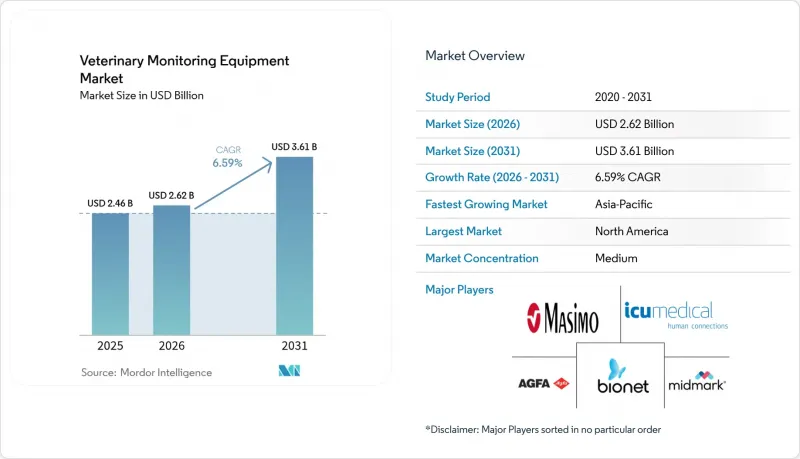
본 보고서에서는 업계를 기기 유형별(다중 매개변수 모니터, 카프노그래피 장치, 산소 포화도 측정 시스템 등), 동물 유형별(반려동물, 가축 등), 최종 사용자별(동물병원 및 진단센터 등), 지역별(북미, 유럽 등)로 분류하고 있습니다. 시장 예측은 금액(미 달러) 기준으로 제시되어 있습니다.
전 세계 수의용 모니터링 장비 시장 동향 및 인사이트
반려동물 사육 마릿수 증가와 수의학 의료비 지출 확대
반려동물 주인들은 동물을 가족의 일원으로 여기는 경향이 강해지고 있으며, 종합적인 관리를 요구하는 목소리가 높아지고 있습니다. 이에 따라 동물 병원은 장비를 일회성 진단 도구가 아닌 건강 유지를 위한 도구로 자리매김할 수 있게 되었습니다. 지속적인 데이터 스트림은 응급 상황 시 비용을 절감하고 삶의 질(QOL) 지표를 향상시키기 때문에 수의용 모니터링 장비 시장을 구독형 모델로 추진하고 있습니다.
반려동물의 만성 질환 유병률 증가
반려동물에서도 당뇨병, 심장 질환, 퇴행성 관절염 등이 현재는 인간의 만성 질환 패턴을 반영하는 양상을 보이고 있습니다. PetPace 2.0과 같은 AI 탑재 목걸이는 장기간에 걸쳐 생체 신호와 행동을 추적하여 수의사에게 치료 조정을 위한 상세한 추세 데이터를 제공합니다. 소의 경우, 조기 경보 시스템을 통해 사망률과 사료 낭비가 감소되어, 수의용 모니터링 장비 시장에서 수년에 걸친 기기 수요가 창출되고 있습니다.
고급 모니터링 장비의 높은 비용
동물병원 경영자들은 다중 매개변수를 지원하는 종합 플랫폼을 도입하기 위해 5만 달러 이상의 설비 투자를 감수해야 하며, 소프트웨어, 유지보수, 교육 비용을 포함하면 소유 비용은 2배로 늘어납니다. 이러한 경제적 요인이 개발도상국에서의 보급을 저해하고 있어, 수의용 모니터링 장비 시장의 단기적인 성장을 둔화시키고 있습니다.
부문 분석
다중 매개변수 시스템은 마취 및 집중 치료 워크플로우에서 차지하는 역할 덕분에 2025년 수의용 모니터링 장비 시장에서 35.05%의 점유율을 유지했습니다. 이 부문의 탄탄한 임상적 유효성이 구매의 기반이 되고 있으며, 3파운드 무게의 ‘LifeWindow One’과 같은 휴대용 기기는 수술실 이외의 상황에서도 사용이 확대되고 있습니다. 이러한 플랫폼에는 현재 Wi-Fi 및 클라우드 대시보드가 통합되어 있어, 원격지의 전문의가 파형을 실시간으로 확인할 수 있게 되었습니다. 구입 비용은 여전히 자본 집약적이지만, 리스 모델 및 서비스 계약 번들링을 통해 수익 전망이 확보되고 있습니다.
웨어러블 기기 및 원격 모니터링 장비는 연평균 성장률(CAGR) 6.88%를 기록하며 가장 빠르게 성장하는 부문으로, 재택 간호 및 대규모 농장에서의 새로운 보급을 주도하고 있습니다. AI가 탑재된 목걸이, 루멘용 볼러스, 비접촉식 도플러 장치는 임상 증상이 나타나기 몇 시간 전에 미묘한 생리적 이상을 감지하여 개입 비용을 절감합니다. 내장된 통신 모듈이 암호화된 데이터를 진료 관리 시스템으로 전송함으로써, 이러한 기기들은 예방 의료 계획에 통합되고 있습니다. 배터리 수명의 획기적인 향상과 에너지 수확 기술 덕분에 수년에 걸친 도입이 가능해졌으며, 수의용 모니터링 장비 시장에서 이 부문의 혁신적인 성장세가 확고해지고 있습니다.
지역별 분석
북미는 2025년 매출의 41.95%를 차지하며, 높은 반려동물 보유율, 견조한 보험 보급률, 그리고 기기 시장 출시를 촉진하는 FDA의 간소화된 승인 절차가 이를 뒷받침하고 있습니다. IDEXX사의 7% 유기적 성장과 프리미엄 기기 도입 대수가 사상 최고치를 기록한 것에서 알 수 있듯이, 반려동물에 대한 지출이 진료 방문 수의 정체 현상을 상쇄하고 있습니다. 캐나다의 광범위한 쇠고기 및 유제품 부문에서는 볼러스 센서와 귀 태그 센서가 채택되고 있는 반면, 멕시코에서는 신흥 중산층이 반려동물용 기기의 보급을 뒷받침하고 있습니다.
아시아태평양(APAC)은 중국의 1,062억 위안 규모의 반려동물 의료 시장과 가축 산업의 급속한 현대화에 힘입어 연평균 성장률(CAGR) 7.98%로 확대될 것으로 전망됩니다. 현지 생산으로 인해 가격대가 낮아지면서 중규모 동물병원 및 중규모 농장으로의 보급이 촉진되고 있습니다. 일본과 한국에서는 차세대 센서의 연구 개발이 진행되고 있으며, 인도의 낙농 협동조합에서는 대규모 IoT를 활용한 소 무리 건강 관리 시스템의 시범 운영이 이루어지고 있습니다. 각 지역 정부는 식품 안전의 추적성 향상을 위해 보조금을 지원하고 있으며, 이를 통해 수의용 모니터링 장비 시장 전반에 걸친 도입이 촉진되고 있습니다.
유럽에서는 엄격한 동물 복지 법규와 원격의료의 보험 적용을 배경으로 꾸준한 보급이 이루어지고 있습니다. 독일은 의료기기 제조의 거점이 되었고, 영국은 원격진료 체계를 선도하며, 프랑스는 클라우드 분석을 활용하여 젖소 군의 관리를 효율화하고 있습니다. 동유럽에서는 비용이 최적화된 웨어러블 기기가 소규모 농가들 사이에서 보급되고 있어, 새로운 시장 개척의 기회가 생겨나고 있습니다. CE 마킹 절차의 통합으로 인해 다른 규제 지역에 비해 시장 출시까지의 기간이 단축되었습니다.
기타 혜택:
- 엑셀 형식 시장 예측(ME) 시트
- 3개월간의 애널리스트 지원
자주 묻는 질문
목차
제1장 서론
제2장 조사 방법
제3장 주요 요약
제4장 시장 구도
제5장 시장 규모와 성장 예측
제6장 경쟁 구도
제7장 시장 기회와 향후 전망
JHS 26.08.28According to Mordor Intelligence, the veterinary monitoring equipment market size is expected to grow from USD 2.46 billion in 2025 to USD 2.62 billion in 2026 and is forecast to reach USD 3.61 billion by 2031 at 6.59% CAGR over 2026-2031.
This report Segments the Industry Into by Equipment Type (Multi Parameter Monitors, Capnography Device and Oximetry Systems, and More), by Animal Type (Companion Animals and Livestock Anaimals More), by End User (Veterinary Clinics and Diagnostic Centers, and More), and Geography (North America, Europe and More). The Market Forecasts are Provided in Terms of Value (USD).
Global Veterinary Monitoring Equipment Market Trends and Insights
Rising Pet Ownership & Spending on Veterinary Care
Pet owners increasingly view animals as family and demand comprehensive, enabling clinics to position devices as wellness tools rather than episodic diagnostics. Continuous data streams reduce emergency costs and improve life-quality metrics, pushing the veterinary monitoring equipment market toward subscription-based models.
Increasing Prevalence of Chronic Animal Diseases
Diabetes, cardiac disorders, and osteoarthritis now mirror human chronic disease patterns in pets. AI-enabled collars such as PetPace 2.0 track long-term vitals and behavior, giving veterinarians granular trendlines for treatment adjustments. For cattle, early-warning systems lower mortality and feed wastage, creating multi-year device demand within the veterinary monitoring equipment market.
High Cost of Advanced Monitoring Equipment
Practice owners face equipment outlays exceeding USD 50,000 for full multi-parameter platforms and doubling ownership costs once software, maintenance, and training are included. These economics stall penetration across developing economies, tempering near-term growth in the veterinary monitoring equipment market.
Other drivers and restraints analyzed in the detailed report include:
- Technological Advances in Multi-Parameter & Wearable Monitors
- Growth in Livestock Production & Herd-Health Programs
- Limited Awareness & Adoption in Developing Regions
For complete list of drivers and restraints, kindly check the Table Of Contents.
Segment Analysis
Multi-parameter systems retained 35.05% veterinary monitoring equipment market share in 2025, owing to their role in anesthesia and critical-care workflows. The segment's robust clinical validation underpins purchasing, and portable form factors such as the 3-lb LifeWindow One broaden use beyond surgical suites. These platforms now integrate Wi-Fi and cloud dashboards, allowing remote specialists to review waveforms in real time. Procurement remains capital-intensive, yet leasing models and bundled service contracts sustain revenue visibility.
Wearable and remote units are the fastest-growing category at 6.88% CAGR, driving fresh penetration in home-care and extensive-farm settings. AI-driven collars, rumen boluses, and non-contact Doppler devices detect subtle physiological deviations hours before clinical symptoms appear, cutting intervention costs. Embedded telecom modules transmit encrypted data to practice management systems, embedding these devices within preventive-care plans. Battery-life breakthroughs and energy harvesting support multi-year deployment, cementing the segment's disruptive momentum within the veterinary monitoring equipment market.
Complete Report Scope:
- By Product Type (Value)
- Multi-parameter Monitors
- ECG Monitors
- Pulse-Oximeters
- Capnography Devices
- Blood-Pressure Monitors
- Wearable / Remote Monitors
- Other Products
- By Animal Type (Value)
- Companion Animals
- Dogs
- Cats
- Horses
- Others
- Livestock Animals
- Cattle
- Swine
- Poultry
- Sheep & Goats
- Others
- Companion Animals
- By End User (Value)
- Veterinary Hospitals & Clinics
- Research Institutes & Universities
- Home-care Settings
- Others
- By Geography (Value)
- North America
- United States
- Canada
- Mexico
- Europe
- Germany
- United Kingdom
- France
- Italy
- Spain
- Rest of Europe
- APAC
- China
- Japan
- India
- South Korea
- Australia
- Rest of APAC
- Middle East and Africa
- GCC
- South Africa
- Rest of Middle East and Africa
- South America
- Brazil
- Argentina
- Rest of South America
- North America
Geography Analysis
North America generated 41.95% of 2025 sales, sustained by high pet ownership rates, robust insurance penetration, and streamlined FDA pathways that encourage device launches . Companion-animal spend offsets soft clinical-visit traffic, as reflected in IDEXX's 7% organic growth and record premium-instrument placements. Canada's extensive beef and dairy sectors adopt bolus and ear-tag sensors, while Mexico's emerging middle class fuels companion-animal device uptake.
APAC is forecast to expand at 7.98% CAGR, undergirded by China's 106.2 billion-yuan pet medical market and rapid livestock modernization. Local manufacturing lowers price points, aiding diffusion across mid-tier clinics and midsize farms. Japan and South Korea advance next-gen sensor R&D, while India's dairy cooperatives pilot large-scale IoT herd-health systems. Regional governments allocate subsidies for food-safety traceability, reinforcing adoption across the veterinary monitoring equipment market.
Europe exhibits steady uptake, driven by stringent animal-welfare statutes and tele-medicine reimbursements. Germany anchors device manufacturing, the United Kingdom pioneers remote-consult frameworks, and France leverages cloud analytics to streamline dairy herd management. Eastern Europe presents greenfield opportunities as cost-optimized wearables gain traction amongst smallholder farms. Harmonized CE-marking procedures shorten time-to-market relative to other regulated regions.
- IDEXX
- Masimo
- Smiths Group
- Mindray
- Nonin Medical
- Vetland Medical
- Digicare Biomedical Technologies
- Covetrus
- Bionet America
- Midmark
- Burtons Medical Equipment
- Avante Health - DRE Veterinary
- Compumedics
- SonoScape Medical
- Vetcorder (Sentier)
- SunTech Medical
- Meridian Medical
- IMV Imaging
- Qingdao Kangjin
- Anaequip Medical
Additional Benefits:
- The market estimate (ME) sheet in Excel format
- 3 months of analyst support
TABLE OF CONTENTS
1 Introduction
- 1.1 Study Assumptions & Market Definition
- 1.2 Scope of the Study
2 Research Methodology
3 Executive Summary
4 Market Landscape
- 4.1 Market Overview
- 4.2 Market Drivers
- 4.2.1 Rising pet ownership & spending on veterinary care
- 4.2.2 Increasing prevalence of chronic animal diseases
- 4.2.3 Technological advances in multi-parameter & wearable monitors
- 4.2.4 Growth in livestock production & herd-health programs
- 4.2.5 AI-driven predictive analytics in monitoring devices
- 4.2.6 Regulatory push for tele-veterinary remote monitoring
- 4.3 Market Restraints
- 4.3.1 High cost of advanced monitoring equipment
- 4.3.2 Limited awareness & adoption in developing regions
- 4.3.3 Data-privacy & interoperability concerns
- 4.3.4 Battery-life & durability limits in large-animal wearables
- 4.4 Value / Supply-Chain Analysis
- 4.5 Regulatory Landscape
- 4.6 Technological Outlook
- 4.7 Porter's Five Forces Analysis
- 4.7.1 Threat of New Entrants
- 4.7.2 Bargaining Power of Suppliers
- 4.7.3 Bargaining Power of Buyers
- 4.7.4 Threat of Substitutes
- 4.7.5 Competitive Rivalry
5 Market Size & Growth Forecasts
- 5.1 By Product Type (Value)
- 5.1.1 Multi-parameter Monitors
- 5.1.2 ECG Monitors
- 5.1.3 Pulse-Oximeters
- 5.1.4 Capnography Devices
- 5.1.5 Blood-Pressure Monitors
- 5.1.6 Wearable / Remote Monitors
- 5.1.7 Other Products
- 5.2 By Animal Type (Value)
- 5.2.1 Companion Animals
- 5.2.1.1 Dogs
- 5.2.1.2 Cats
- 5.2.1.3 Horses
- 5.2.1.4 Others
- 5.2.2 Livestock Animals
- 5.2.2.1 Cattle
- 5.2.2.2 Swine
- 5.2.2.3 Poultry
- 5.2.2.4 Sheep & Goats
- 5.2.2.5 Others
- 5.2.1 Companion Animals
- 5.3 By End User (Value)
- 5.3.1 Veterinary Hospitals & Clinics
- 5.3.2 Research Institutes & Universities
- 5.3.3 Home-care Settings
- 5.3.4 Others
- 5.4 By Geography (Value)
- 5.4.1 North America
- 5.4.1.1 United States
- 5.4.1.2 Canada
- 5.4.1.3 Mexico
- 5.4.2 Europe
- 5.4.2.1 Germany
- 5.4.2.2 United Kingdom
- 5.4.2.3 France
- 5.4.2.4 Italy
- 5.4.2.5 Spain
- 5.4.2.6 Rest of Europe
- 5.4.3 APAC
- 5.4.3.1 China
- 5.4.3.2 Japan
- 5.4.3.3 India
- 5.4.3.4 South Korea
- 5.4.3.5 Australia
- 5.4.3.6 Rest of APAC
- 5.4.4 Middle East and Africa
- 5.4.4.1 GCC
- 5.4.4.2 South Africa
- 5.4.4.3 Rest of Middle East and Africa
- 5.4.5 South America
- 5.4.5.1 Brazil
- 5.4.5.2 Argentina
- 5.4.5.3 Rest of South America
- 5.4.1 North America
6 Competitive Landscape
- 6.1 Market Concentration
- 6.2 Market Share Analysis
- 6.3 Company Profiles (includes Global-level Overview, Market-level Overview, Core Segments, Financials as available, Strategic Information, Market Rank/Share for key companies, Products & Services, and Recent Developments)
- 6.3.1 IDEXX Laboratories
- 6.3.2 Masimo Corporation
- 6.3.3 Smiths Medical (ICU Medical)
- 6.3.4 Mindray Medical International
- 6.3.5 Nonin Medical
- 6.3.6 Vetland Medical
- 6.3.7 Digicare Biomedical
- 6.3.8 Covetrus
- 6.3.9 Bionet America
- 6.3.10 Midmark Corporation
- 6.3.11 Burtons Medical Equipment
- 6.3.12 Avante Health - DRE Veterinary
- 6.3.13 Compumedics
- 6.3.14 SonoScape Medical
- 6.3.15 Vetcorder (Sentier)
- 6.3.16 SunTech Medical
- 6.3.17 Meridian Medical
- 6.3.18 IMV Imaging
- 6.3.19 Qingdao Kangjin
- 6.3.20 Anaequip Medical
7 Market Opportunities & Future Outlook
- 7.1 White-space & Unmet-need Assessment