

|
시장보고서
상품코드
2116308
포도막염 치료 : 시장 점유율 분석, 업계 동향 및 통계, 성장 예측(2026-2031년)Uveitis Treatment - Market Share Analysis, Industry Trends & Statistics, Growth Forecasts (2026 - 2031) |
||||||
 Mordor Intelligence
Mordor Intelligence에 의하면, 포도막염 치료 시장 규모는 2025년에 25억 6,000만 달러로 평가되었습니다. 2026년 27억 3,000만 달러에서 2031년까지 37억 8,000만 달러에 이를 것으로 예상되며, 예측 기간(2026-2031년) CAGR은 6.72%를 나타낼 전망입니다.
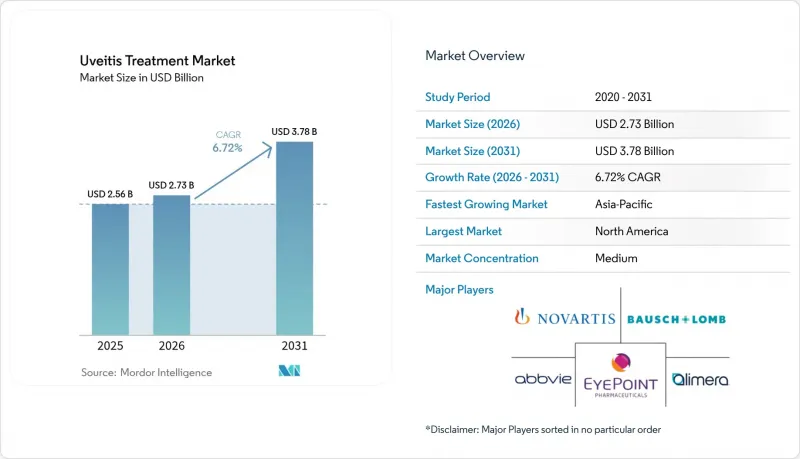
본 보고서는 약물 분류별(코르티코스테로이드, 면역억제제, 생물학적 제제/바이오시밀러 등), 질환 유형별(전부 포도막염, 후부 포도막염, 중간부 포도막염, 전포도막염), 투여 경로(국소 투여 등), 유통 채널(병원 약국 등), 지역(북미, 유럽 등)별로 분류되어 있습니다. 시장 예측은 금액(미 달러) 기준으로 제시되어 있습니다.
세계의 포도막염 치료 시장 동향 및 인사이트
우베이트의 발생률 증가와 시력을 위협하는 합병증
2023년까지 미국의 포도막염 누적 유병률은 10만 명당 60명, 유병률은 10만 명당 285명에 달했으나, 1차 진료 현장에서는 여전히 전방 포도막염 사례가 과소 진단되고 있습니다. 강직성 척추염과 같은 전신성 자가면역 질환을 동반한 경우, 류마티스과로 의뢰되는 사례가 증가함에 따라 검출률도 높아지고 있습니다. 현재 후부 및 중간형 사례는 전체 사례의 약 55%를 차지하고 있으며, 돌이킬 수 없는 시력 상실을 방지하기 위해서는 더 고가의 생물학적 제제나 임플란트가 필요하기 때문에 환자 1인당 의료비가 증가하고 있습니다. 더 중증인 표현형으로의 역학적 변화로 인해 치료 기간이 길어지고 복잡해지고 있으므로, 포도막염 치료 시장은 표면상의 환자 수 이상으로 확대되고 있습니다. 임상의들이 전신적 위험을 줄이면서 지속적인 염증 조절을 추구하는 가운데, 1회의 시술로 수개월 동안 약물을 방출하는 프리미엄 임플란트 플랫폼이 주목을 받고 있습니다.
신규 생물학적 제제 및 임플란트에 대한 연구개발비 증가
머크(Merck)가 4가 항체 프로그램을 목적으로 아이바이오(iBio)를 13억 달러에 인수한 것은 염증과 망막 회복을 모두 다루는 다중 표적 생물학적 제제에 대한 업계의 높은 수요를 여실히 보여주었습니다. 로슈의 ‘수스비모’가 FDA 승인을 획득하고 9개월마다 보충하는 주기를 실현함으로써, 서방형 임플란트의 상업적 실현 가능성이 입증되었습니다. 비바이러스성 유전자 치료를 다루는 스타트업 기업들은 새로운 벤처 캐피털을 유치하며, 평생 치료 비용을 절감하는 동시에 경쟁 구도를 일신할 가능성을 지닌 근본적인 접근 방식으로의 전환을 시사하고 있습니다. 이러한 발전들은 종합적으로 치료 선택지를 확대하고, 주사 빈도를 줄이며, 기존의 코르티코스테로이드에 대한 진입 장벽을 높이고 있습니다.
기존 치료법의 높은 비용과 전신성 부작용
아달리무맙을 이용한 연간 전신 요법은 환자 1인당 6만 달러를 초과할 수 있는 반면, YUTIQ와 같은 장시간 작용형 임플란트는 3년간 지속됨에도 불구하고 초기 비용이 고가입니다. 또한, TNF-α 억제제에는 감염증 모니터링 비용도 발생하여 총 지출을 최대 30%까지 끌어올리고 있습니다. 필고티닙의 긍정적인 데이터에도 불구하고 HUMBOLDT 임상시험이 중단된 사례에서 볼 수 있듯이, 상업적 이유로 인한 임상시험 중단은 치료의 전망이 얼마나 상업적 수익성에 좌우되는지를 여실히 보여주고 있습니다. 따라서 높은 비용은 특히 1인당 의료비 지출이 적은 시장에서 치료법의 보급을 저해하는 요인이 되고 있습니다.
부문별 분석
2025년, 코르티코스테로이드는 매출 점유율 40.89%를 유지했으나, 바이오의약품 및 바이오시밀러는 연평균 성장률(CAGR) 9.11%로 성장할 전망입니다. 이는 백내장 형성이나 안압의 급격한 상승을 피할 수 있는 표적 치료제로의 임상의 전환을 반영합니다. 최근 6개월 동안 발생한 트리암시놀론 아세토니드공급 부족은 공급망의 취약성을 여실히 드러냈을 뿐만 아니라, 서방형 임플란트로의 전환을 촉진했습니다. 개발 중인 JAK 억제제가 3상 임상시험 단계로 진입함에 따라, 2031년까지 포도막염 치료 분야의 바이오의약품 시장 규모는 다른 어떤 약물군보다 빠르게 확대될 것으로 예측됩니다. 면역억제제는 여전히 필수적인 가교 요법이며, 항감염제는 규모가 작은 감염증 하위 집단을 뒷받침하고 있어, 균형 잡히고 끊임없이 변화하는 약물 군의 상황이 유지되고 있습니다.
2세대 바이오의약품은 작용기전을 다양화하여 이중 특이성 항체 및 Wnt 경로 조절제 등을 포함하고 있으며, 경쟁을 심화시키면서도 선택의 폭을 넓히고 있습니다. 바이오시밀러의 출시로 단계적인 가격대가 형성되어, 판매 수량을 통해 제조업체의 이익률을 유지하면서 환자의 접근성을 확대되고 있습니다. 따라서 포도막염 치료 업계는 기존의 코르티코스테로이드 제품 라인의 통합과 더불어 제품의 급증에 직면해 있습니다.
2025년에는 높은 유병률과 점안 요법에 대한 의존도가 높아 전방 포도막염이 매출의 43.76%를 차지하며 1위를 차지했으나, 후방 포도막염은 맥락막 상 주사 등 특수한 투여 방법이 필요하기 때문에연평균 성장률(CAGR) 8.72%로 가장 빠르게 성장하는 부문이 될 것으로 예측됩니다. 재치료 빈도를 줄여주는 임플란트가 임상의들에게 채택됨에 따라, 후부 포도막염 치료 시장 점유율은 확대될 전망입니다. 포도막염에 수반되는 황반부종에 대한 파리시맙의 유효성을 입증하는 새로운 데이터는 프리미엄 치료의 길을 더욱 열어줄 것입니다. 중간 포도막염은 꾸준하지만 완만한 성장세를 보이는 반면, 전체포도막염은 여전히 중증도가 가장 높은 부문으로, 미충족 의료 수요가 지속되고 있습니다.
광시야 OCT 및 AI 알고리즘을 포함한 영상 진단 기술의 발전으로 후부 병변의 검출 정확도가 향상되어 조기 개입이 가능해졌습니다. 이에 따라 보험사의 심사가 엄격해지는 상황에서도 수익의 지속적인 증가가 기대됩니다. 그 결과, 포도막염 치료 시장은 복잡한 병태생리 및 고액 치료가 수반되는 부문으로 계속해서 이동하고 있습니다.
지역별 분석
북미는 보험 적용 범위가 넓고, 생물학적 제제의 조기 도입, 그리고 견고한 임상시험 생태계에 힘입어 2025년에는 전 세계 매출의 38.11%를 차지했습니다. 이 지역의 연평균 성장률(CAGR)은 시장의 성숙에 따라 둔화될 것으로 예상되지만, 프레드니솔론 아세테이트 및 디플루프레드네이트공급 부족은 공급망의 취약성을 부각시키고 있으며, 이로 인해 처방전이 대체 제제로 전환될 가능성이 있습니다. 인력 확보는 여전히 시급한 과제이며, 2035년까지 30%의 인력 부족이 예상되어 치료 수요가 높음에도 불구하고 시술 건수 증가를 억제할 가능성이 있습니다.
아시아태평양은 막대한 미치료 환자 수와 증가하는 의료비가 맞물려 연평균 성장률(CAGR) 8.74%라는 가장 빠른 성장 궤도를 보이고 있습니다. 중국에서 ARCATUS의 3상 임상시험 성공(ETDRS 문자 시력 개선률 15 이상에서 38.5%)은 이 지역에서 고부가가치 치료법 도입을 향한 진전을 상징합니다. 일본은 항-VEGF 요법의 투여 간격 연장 요법의 선구자 역할을 계속하고 있으며, 호주는 다국적 기업의 신약 출시를 위한 규제상의 관문 역할을 자주 수행합니다. 그러나 안과 전문의 밀도는 여전히 고르지 않아, 인구 100만 명당 전문의 수가 0명인 국가가 있는 반면, 일본은 100만 명당 114명에 달할 전망입니다.
유럽에서는 바이오시밀러에 우호적인 정책이 생물학적 제제의 보급을 뒷받침하며 균형 잡힌 성장을 유지하고 있습니다. EMA의 절차에 따라 예측 가능한 일정이 확보되어 있으며, 독일, 프랑스, 영국은 서방형 임플란트 수요를 지탱하는 핵심 시장입니다. 중동 및 아프리카에서는 걸프협력회의(GCC) 국가들의 의료 시스템 현대화에 따라 도입이 초기 단계이긴 하지만 증가 추세를 보이고 있습니다. 그러나 전문의 수가 제한적이어서 대륙 전체의 성장은 저해되고 있습니다. 남미에서는 브라질의 방대한 인구와 보험 급여 제도 개선에 힘입어 완만한 확대세가 나타나고 있으나, 환율 변동 및 예산 제약으로 인해 프리미엄 생물학적 제제의 보급은 제한되고 있습니다.
기타 혜택 :
- 엑셀 형식 시장 예측(ME) 시트
- 3개월간의 애널리스트 지원
자주 묻는 질문
목차
제1장 서론
제2장 조사 방법
제3장 개요
제4장 시장 구도
제5장 시장 규모 및 성장 예측
제6장 경쟁 구도
제7장 시장 기회 및 향후 전망
KTH 26.08.31According to Mordor Intelligence, the uveitis treatment market size was valued at USD 2.56 billion in 2025 and estimated to grow from USD 2.73 billion in 2026 to reach USD 3.78 billion by 2031, at a CAGR of 6.72% during the forecast period (2026-2031).
This report is Segmented by Drug Class (Corticosteroids, Immunosuppressants, Biologics / Biosimilars, and More), Disease Type (Anterior Uveitis, Posterior Uveitis, Intermediate Uveitis, and Panuveitis), Route of Administration (Topical, and More), Distribution Channel (Hospital Pharmacies, and More), and Geography (North America, Europe, and More). The Market Forecasts are Provided in Terms of Value (USD).
Global Uveitis Treatment Market Trends and Insights
Rising Incidence Of Uveitis & Vision-Threatening Complications
The cumulative incidence of uveitis reached 60 per 100,000 and prevalence hit 285 per 100,000 in the United States by 2023, yet anterior cases remain under-diagnosed in primary care. Systemic autoimmune disease comorbidities such as ankylosing spondylitis amplify detection rates as rheumatology referrals rise. Posterior and intermediate forms now represent about 55% of presentations and require costlier biologics or implants to avert irreversible vision loss, thereby boosting per-patient spend. Epidemiologic shifts toward more severe phenotypes elevate therapy duration and complexity, expanding the uveitis treatment market beyond headline patient numbers. Premium implant platforms that deliver drugs for months from a single procedure gain traction as clinicians seek durable inflammation control with fewer systemic risks.
Growing R&D Spend On Novel Biologics & Implants
Merck's USD 1.3 billion purchase of EyeBio for its tetravalent antibody program underscored industry appetite for multi-target biologics that address both inflammation and retinal repair. FDA approval of Roche's Susvimo, offering nine-month refill intervals, validated sustained-release implants as commercially viable. Non-viral gene therapy start-ups attracted fresh venture capital, signalling a pivot toward potentially curative approaches that could lower lifetime treatment costs while reshaping competitive dynamics. These developments collectively expand therapeutic choice, compress injection frequency, and raise barriers to entry for conventional corticosteroids.
High Cost & Systemic Side-Effects Of Current Therapies
Annual systemic adalimumab therapy can surpass USD 60,000 per patient, whereas long-acting implants such as YUTIQ demand high upfront outlays despite three-year durability. TNF-alpha inhibitors also impose infection monitoring costs that inflate total expenditure by up to 30%. Business-driven trial discontinuations, exemplified by the HUMBOLDT study ending despite favourable filgotinib data, highlight how commercial viability shapes the therapy landscape. High costs therefore restrict uptake, particularly in markets with low per-capita healthcare spend.
Other drivers and restraints analyzed in the detailed report include:
- Expanding Access To Ophthalmic Care In Emerging Economies
- Increasing Adoption Of Biosimilar Adalimumab & Infliximab
- Limited Ophthalmology Specialist Workforce In Low-Income Regions
For complete list of drivers and restraints, kindly check the Table Of Contents.
Segment Analysis
Corticosteroids retained 40.89% revenue share in 2025, yet biologics and biosimilars expanded at a 9.11% CAGR, reflecting clinician migration toward targeted agents that avoid cataract formation and intraocular pressure spikes. The recent six-month shortage of triamcinolone acetonide highlighted supply chain fragility and encouraged pivoting to sustained-release implants. The uveitis treatment market size for biologics is projected to advance faster than any other drug class through 2031 as pipeline JAK inhibitors progress into Phase 3. Immunosuppressants remain vital bridge therapies, and anti-infectives support the smaller infectious subset, maintaining a balanced but shifting drug-class landscape.
Second-generation biologics diversify mechanisms to include bispecific antibodies and Wnt pathway modulators, intensifying competition yet widening choice. Biosimilar launches create tiered price points that broaden patient access while preserving manufacturer margins through volume. The uveitis treatment industry therefore faces accelerating product proliferation alongside consolidation of legacy corticosteroid lines.
Anterior uveitis led revenue with 43.76% share in 2025 because of high incidence and topical therapy reliance, but posterior uveitis is forecast to be the fastest-growing category at an 8.72% CAGR on account of specialised delivery needs such as suprachoroidal injections. The uveitis treatment market share for posterior forms is poised to expand as clinicians adopt implants that reduce retreatment frequency. New data showing faricimab efficacy in uveitic macular edema open further premium therapy avenues. Intermediate uveitis shows steady but moderate growth, while panuveitis remains the highest acuity segment with persistent unmet needs.
Adoption of diagnostic imaging advances, including wide-field OCT and AI algorithms, improves posterior disease detection and supports earlier intervention. This contributes to sustained revenue gains even as payer scrutiny rises. Consequently, the uveitis treatment market continues to shift toward segments involving complex pathophysiology and expensive interventions.
Complete Report Scope:
- By Drug Class
- Corticosteroids
- Immunosuppressants
- Biologics / Biosimilars
- Antimicrobials (Antibiotics, Antivirals, Antifungals)
- NSAIDs & Analgesics
- Others
- By Disease Type
- Anterior Uveitis
- Posterior Uveitis
- Intermediate Uveitis
- Panuveitis
- By Route of Administration
- Topical (Eye Drops & Ointments)
- Oral / Systemic
- Local Ocular Injections (Intravitreal, Suprachoroidal, Periocular)
- Ocular Implants & Inserts
- By Distribution Channel
- Hospital Pharmacies
- Retail Pharmacies & Drug Stores
- Online Pharmacies
- Geography
- North America
- United States
- Canada
- Mexico
- Europe
- Germany
- United Kingdom
- France
- Italy
- Spain
- Rest of Europe
- Asia-Pacific
- China
- Japan
- India
- South Korea
- Australia
- Rest of Asia-Pacific
- Middle East and Africa
- GCC
- South Africa
- Rest of Middle East and Africa
- South America
- Brazil
- Argentina
- Rest of South America
- North America
Geography Analysis
North America generated 38.11% of global revenue in 2025, underpinned by widespread insurance coverage, early biologic uptake, and a robust clinical trial ecosystem. The region's CAGR is expected to moderate as the market matures, although shortages of prednisolone acetate and difluprednate highlight supply-chain vulnerabilities that could redirect prescriptions toward alternative formulations. Workforce adequacy remains a looming challenge, with a projected 30% deficit by 2035 that may cap procedure volumes despite strong therapy demand.
Asia-Pacific posts the fastest-growing trajectory at an 8.74% CAGR as large patient backlogs meet rising healthcare expenditure. China's Phase 3 success with ARCATUS, showing a 38.5% rate of 15+ ETDRS letter gains, exemplifies regional progress toward premium therapy adoption. Japan continues to pioneer extended-interval anti-VEGF regimens, and Australia often serves as a regulatory gateway for multinational launches. Nevertheless, ophthalmologist density remains uneven, with certain countries reporting zero specialists per million population compared with Japan's 114 per million.
Europe maintains balanced growth as biosimilar-friendly policies sustain biologic uptake. EMA procedures offer predictable timelines, and Germany, France, and the United Kingdom anchor demand for sustained-release implants. Middle East and Africa show nascent but rising adoption as Gulf Cooperation Council health systems modernise; however, broader continental growth is hampered by limited specialist capacity. South America records moderate expansion led by Brazil's sizeable population and improving reimbursement structures, though currency volatility and budget constraints temper premium biologic penetration.
- Abbvie
- Novartis
- Bausch + Lomb Corp.
- EyePoint Pharmaceuticals Inc.
- Alimera Sciences Inc.
- Santen Pharmaceutical Co. Ltd.
- Clearside Biomedical Inc.
- Eyegate Pharmaceuticals Inc.
- Roche
- Johnson & Johnson Vision Care
- UCB
- Regeneron Pharmaceuticals
- Aurinia Pharmaceuticals Inc.
- Sun Pharmaceuticals Industries
- ANI Pharmaceuticals Inc.
- ONL Therapeutics
- IVERIC Bio (Astellas)
- Oculis Holding AG
- Oxurion
- Acelyrin Inc.
Additional Benefits:
- The market estimate (ME) sheet in Excel format
- 3 months of analyst support
TABLE OF CONTENTS
1 Introduction
- 1.1 Study Assumptions & Market Definition
- 1.2 Scope of the Study
2 Research Methodology
3 Executive Summary
4 Market Landscape
- 4.1 Market Overview
- 4.2 Market Drivers
- 4.2.1 Rising Incidence Of Uveitis & Vision-Threatening Complications
- 4.2.2 Growing R&D Spend On Novel Biologics & Implants
- 4.2.3 Expanding Access To Ophthalmic Care In Emerging Economies
- 4.2.4 Increasing Adoption Of Biosimilar Adalimumab & Infliximab
- 4.2.5 AI-Enabled Retinal Imaging For Early Diagnosis
- 4.2.6 Venture Funding For Sustained-Release Ocular Drug-Delivery Start-Ups
- 4.3 Market Restraints
- 4.3.1 High Cost & Systemic Side-Effects Of Current Therapies
- 4.3.2 Limited Ophthalmology Specialist Workforce In Low-Income Regions
- 4.3.3 Regulatory Lag For Intravitreal/?Suprachoroidal Devices
- 4.3.4 Intermittent API Shortages For Corticosteroids
- 4.4 Porter's Five Forces Analysis
- 4.4.1 Threat of New Entrants
- 4.4.2 Bargaining Power of Buyers
- 4.4.3 Bargaining Power of Suppliers
- 4.4.4 Threat of Substitutes
- 4.4.5 Competitive Rivalry
5 Market Size & Growth Forecasts (Value, USD)
- 5.1 By Drug Class
- 5.1.1 Corticosteroids
- 5.1.2 Immunosuppressants
- 5.1.3 Biologics / Biosimilars
- 5.1.4 Antimicrobials (Antibiotics, Antivirals, Antifungals)
- 5.1.5 NSAIDs & Analgesics
- 5.1.6 Others
- 5.2 By Disease Type
- 5.2.1 Anterior Uveitis
- 5.2.2 Posterior Uveitis
- 5.2.3 Intermediate Uveitis
- 5.2.4 Panuveitis
- 5.3 By Route of Administration
- 5.3.1 Topical (Eye Drops & Ointments)
- 5.3.2 Oral / Systemic
- 5.3.3 Local Ocular Injections (Intravitreal, Suprachoroidal, Periocular)
- 5.3.4 Ocular Implants & Inserts
- 5.4 By Distribution Channel
- 5.4.1 Hospital Pharmacies
- 5.4.2 Retail Pharmacies & Drug Stores
- 5.4.3 Online Pharmacies
- 5.5 Geography
- 5.5.1 North America
- 5.5.1.1 United States
- 5.5.1.2 Canada
- 5.5.1.3 Mexico
- 5.5.2 Europe
- 5.5.2.1 Germany
- 5.5.2.2 United Kingdom
- 5.5.2.3 France
- 5.5.2.4 Italy
- 5.5.2.5 Spain
- 5.5.2.6 Rest of Europe
- 5.5.3 Asia-Pacific
- 5.5.3.1 China
- 5.5.3.2 Japan
- 5.5.3.3 India
- 5.5.3.4 South Korea
- 5.5.3.5 Australia
- 5.5.3.6 Rest of Asia-Pacific
- 5.5.4 Middle East and Africa
- 5.5.4.1 GCC
- 5.5.4.2 South Africa
- 5.5.4.3 Rest of Middle East and Africa
- 5.5.5 South America
- 5.5.5.1 Brazil
- 5.5.5.2 Argentina
- 5.5.5.3 Rest of South America
- 5.5.1 North America
6 Competitive Landscape
- 6.1 Market Concentration
- 6.2 Market Share Analysis
- 6.3 Company Profiles (includes Global level Overview, Market level overview, Core Segments, Financials as available, Strategic Information, Market Rank/Share for key companies, Products & Services, and Recent Developments)
- 6.3.1 AbbVie Inc.
- 6.3.2 Novartis AG
- 6.3.3 Bausch + Lomb Corp.
- 6.3.4 EyePoint Pharmaceuticals Inc.
- 6.3.5 Alimera Sciences Inc.
- 6.3.6 Santen Pharmaceutical Co. Ltd.
- 6.3.7 Clearside Biomedical Inc.
- 6.3.8 Eyegate Pharmaceuticals Inc.
- 6.3.9 Roche Holding AG
- 6.3.10 Johnson & Johnson Vision Care
- 6.3.11 UCB S.A.
- 6.3.12 Regeneron Pharmaceuticals Inc.
- 6.3.13 Aurinia Pharmaceuticals Inc.
- 6.3.14 Sun Pharmaceutical Industries Ltd.
- 6.3.15 ANI Pharmaceuticals Inc.
- 6.3.16 ONL Therapeutics
- 6.3.17 IVERIC Bio (Astellas)
- 6.3.18 Oculis Holding AG
- 6.3.19 Oxurion NV
- 6.3.20 Acelyrin Inc.
7 Market Opportunities & Future Outlook
- 7.1 White-space & Unmet-Need Assessment


