|
시장보고서
상품코드
2119050
전부 포도막염 : 시장 점유율 분석, 산업 동향 및 통계 데이터, 성장 예측(2026-2031년)Anterior Uveitis - Market Share Analysis, Industry Trends & Statistics, Growth Forecasts (2026 - 2031) |
||||||
 Mordor Intelligence
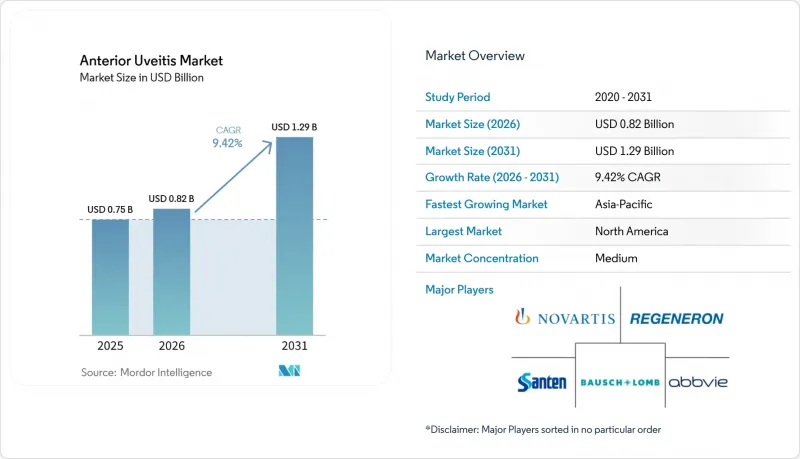
Mordor Intelligence에 의하면, 전부 포도막염 시장 규모는 2025년에 7억 5,000만 달러로 평가되었습니다. 2026년에 8억 2,000만 달러에 달하고, 2031년까지 12억 9,000만 달러에 이를 것으로 예측되며, 2026년부터 2031년에 걸쳐 CAGR 9.42%로 성장할 전망입니다.
본 보고서는 제공 내용(치료, 진단), 병인(감염성, 비감염성),중증도(경증, 중등도, 중증, 재발성, 기타), 최종 사용자(병원 및 진료소, ASC, 기타 최종 사용자), 지역(북미, 유럽, 아시아태평양, 중동 및 아프리카, 남미)별로 분류되어 있습니다. 시장 예측은 금액(미 달러) 기준으로 제시되어 있습니다.
세계의 전부 포도막염 시장 동향 및 인사이트
자가면역 질환 및 염증성 질환 유병률 증가
전신성 자가면역 질환, 특히 HLA-B27 관련 척추관절염은 전부 포도막염 시장 수요를 뒷받침하고 있습니다. 1억 900만 명을 대상으로 한 미국의 연구에 따르면, 염증성 척추관절염은 가장 빈번하게 보고된 전신성 동반 질환으로, 포도막염으로 진단받은 환자의 6.6%에 영향을 미치고 있었습니다. 또한, 안구 염증이 재발함에 따라 안과 의사가 지금까지 인식하지 못했던 척추관절염을 확인하는 계기가 되기도 합니다. 이러한 임상적 연관성으로 인해 수요는 국소용 항염증제에 그치지 않고, 임상 검사 및 안과와 류마티스과 간의 협력을 통한 진료로 확대되고 있습니다. 더 나아가, 재발 사례에 대한 추가 조사가 필요한 경우, 안과 진료 현장이 전신 평가를 수행하기 위한 중요한 관문이 될 수 있음이 시사되고 있습니다. 특정 비감염성 포도막염 적응증에 대한 아달리무맙의 승인은 전부 포도막염 시장에서 자가면역 질환이 치료 표적으로 중요함을 뒷받침하고 있습니다.
표적 치료 및 생물학적 제제의 확대
표적 치료제를 통해 치료는 반복적인 경험적 코르티코스테로이드 사용에서 작용기전에 특화된 면역 조절로 전환되고 있습니다. 아달리무맙은 특정 비감염성 포도막염 사례에서 FDA 승인을 받은 전신성 비코르티코스테로이드 치료 옵션으로 계속 자리 잡고 있으며, 이를 통해 생물학적 제제를 이용한 치료는 전문의의 진료에서 명확한 역할을 담당하고 있습니다. 로슈는 자사의 유리체 내 투여형 항-IL-6 항체인 바미키바트에 대해, 포도막염성 황반부종을 대상으로 한 3상 MEERKAT 및 SANDCAT 임상시험에서 중심 하위 영역의 두께를 통계적으로 유의미하게 감소시켰다고 보고했습니다. 이 투여 경로는 황반부종이 심각한 시력 저하의 원인이 되고 있으며, 코르티코스테로이드 노출이 우려되는 경우에 적합합니다. 따라서 전부 포도막염 시장에서는 국소 투여와 스테로이드 사용량 감소 효과를 겸비한 치료법이 주목을 받을 가능성이 있습니다. 또한, 이러한 개발 프로그램은 일반적인 국소 치료만으로는 병세를 충분히 조절할 수 없는 환자들에 대한 관심도 지속적으로 유지하고 있습니다.
코르티코스테로이드의 장기 사용에 따른 부작용
코르티코스테로이드는 여전히 많은 임상 현장에서 1차 치료제로 사용되고 있지만, 장기간 사용하면 안압 상승을 유발하여 백내장이나 이차성 녹내장의 원인이 될 수 있습니다. 미국의 TriNetX 연구에 따르면, 포도막염 사례의 22.6%에서 경구 프레드니손이 사용된 반면, 메토트렉세이트의 사용률은 5.7%였습니다. 이러한 경향으로 인해 많은 환자가 합병증이 발생했을 때 복약 순응도를 저하시킬 가능성이 있는 치료법에 의존할 수밖에 없는 상황에 처해 있습니다. 스테로이드 절약 요법을 이용할 수 없거나 경제적으로 감당할 수 없는 경우, 그 부담은 더욱 커집니다. 이러한 환자들은 근본적인 염증의 악순환이 해소되지 않은 채, 합병증에 대한 추가적인 안과적 치료가 필요할 가능성이 있습니다. 따라서 안전성 우려로 인해 치료 전환이 지연되고, 고부가가치 치료법에 대한 수요가 감소함에 따라 전부 포도막염 시장은 제약을 받고 있습니다.
부문별 분석
2025년 매출액 중 치료가 72.3%를 차지했습니다. 이는 코르티코스테로이드, 생물학적 제제 및 외과적 시술이 상업적 지출의 주요 분야였기 때문입니다. 전부 포도막염 치료 시장 규모는 국소용 프레드니솔론 아세테이트 및 덱사메타손 제제의 확립된 사용 현황을 반영한 것이었습니다. 이러한 의약품은 외래 진료에서 가장 많은 치료 건수를 차지했습니다. 생물학적 제제 요법은 전문의에 의한 사용과 프리미엄 가격 책정 구조로 인해 1코스당 매출액이 높았습니다. 유리체 절제술 및 이식형 코르티코스테로이드 장치를 포함한 외과적 치료법은 난치성 질환을 가진 환자에게 제공되었습니다. 통합 의료 현장에서는 수술의 가치가 컸음에도 불구하고, 전체적인 기여도는 여전히 소규모에 그쳤습니다. 전부 포도막염 분야에서는 새로운 면역 조절 프로그램의 개발이 진행됨에 따라 생물학적 제제에 대한 수요가 더욱 높아질 것으로 예측됩니다. 이러한 움직임으로 인해 기존의 국소 요법 이상의 치료가 필요한 환자들의 치료 선택지가 넓어질 가능성이 있습니다. 또한, 어떤 환자가 첨단 의료를 받을 수 있을지 결정하는 보험사의 판단이 더욱 중요시될 것입니다.
진단 분야는 2031년까지 연평균 성장률(CAGR) 11.6%를 나타낼 것으로 예측되며, 이는 시장 전체의 성장률을 상회하는 속도입니다. 이 분야에는 임상 검사, 영상 진단, 그리고 임상 검사 및 바이오마커 검사가 포함됩니다. 전부 포도막염 진단 시장 규모는 전안부 광간섭 단층촬영(OCT) 및 플루오레세인 형광 안저 조영법의 활용에 힘입어 성장하고 있습니다. AI를 활용한 염증 등급 평가는 학술적 검증 단계에서 3차 안과 의료 센터에서의 실용화 단계로 전환되고 있습니다. 싱가포르의 한 연구에서는 비전 트랜스포머를 활용하여 영상 데이터로부터 홍채의 혈관 밀도 및 전방 내 입자량을 정량화할 수 있음이 입증되었습니다. 객관적인 평가를 통해 염증 중증도 평가 시 관찰자 간 편차를 줄일 수 있습니다. 또한, 진료 현장에서 실시 가능한 HLA-B27 검사나 사이토카인 패널 검사도 안과 의사와 류마티스 전문의 간의 협력 강화라는 흐름에 부합합니다. 이러한 도구들은 급성 전부 포도막염이 전신성 류마티스 질환의 첫 번째 뚜렷한 징후인 경우에 유용합니다. 따라서 조기 분류를 통해 치료 방침 결정에 일관성이 확보된다면, 진단의 가치는 더욱 높아질 것입니다.
2025년에는 비감염성 전부 포도막염이 매출의 74.2%를 차지했으며, 2031년까지 연평균 성장률(CAGR) 10.2%로 성장할 것으로 전망됩니다. 이러한 추세는 선진 의료 시스템에서 HLA-B27 관련, 특발성 및 자가면역성 염증이 중요하게 여겨지고 있음을 반영합니다. 전부 포도막염 시장은 치료법 개발이 비감염성 질환에 집중되어 있어 주로 이 병인 범주를 중심으로 구성되어 있습니다. 노바릭(Novarick)은 2026년 1월 NOV05에 대해 FDA로부터 IND 승인을 획득한 후, 비감염성 전부 포도막염을 대상으로 한 EYETAC 2상 임상시험 프로그램을 설계했습니다. 바미키바트의 개발 또한 합병증에 대한 국소 치료가 필요한 면역 매개성 안구 염증에 대한 관심을 높이고 있습니다. 소개 시스템을 통해 안구 염증과 전신성 자가면역 질환 간의 연관성이 확인된다면, 이 범주는 그 혜택을 누리게 될 것입니다. 이는 새로운 치료법이 더 광범위한 상업적 의미를 찾을 수 있는 주요 분야로 남아 있습니다. 따라서 예측 기간 동안의 제품 출시는 비감염성 치료 분야에 중점을 둘 것으로 예측됩니다.
감염성 전부 포도막염은 매출 규모 면에서는 여전히 작지만, 치료 경로에서 지속적인 역할을 수행하고 있습니다. 단순 헤르페스나 대상포진과 관련된 헤르페스성 포도막염은 고령 환자들 사이에서 여전히 중요한 위치를 차지하고 있습니다. 2025년 연구에 따르면, 60-79세 환자에서 발생한 포도막염 사례의 20% 이상, 80세 이상 환자에서는 38.6%가 대상포진 바이러스에 의한 것이었습니다. 이로 인해 감염성 질환 범주에서는 항바이러스제 병용 요법에 대한 지속적인 수요가 발생하고 있습니다. 이 질환은 근본적인 원인이 면역 매개성 염증과 다르기 때문에 독자적인 치료 접근법이 필요합니다. 따라서 전부 포도막염 시장에서는 감염성 및 비감염성 원인 모두에 대응하는 치료 옵션을 유지해야 합니다. 규모가 작은 감염성 부문은 면역 조절 요법을 고려하기 전에 광범위한 임상 평가가 필요한 이유를 보여줍니다. 그 수요 패턴은 특히 고령층에서 존재하지 않는다고 하기보다는 오히려 특수한 성격을 띱니다. 이러한 구분은 임상 및 상업적 계획 수립에 있어 여전히 중요합니다.
지역별 분석
2025년, 북미는 매출의 43.6%를 차지하며 전부 포도막염 시장에서 가장 규모가 큰 지역 시장이 되었습니다. 미국은 펠로우십 과정을 수료한 포도막염 전문의의 밀도가 높고, 생물학적 제제에 대한 확립된 보험 급여 체계가 갖춰져 있다는 점이 강점으로 작용하고 있습니다. 성숙한 전문 의료 환경에서 민간 보험사 및 메디케어가 적격 환자의 치료 접근성을 지원하고 있습니다. 또한, 이 지역은 임상시험 수행 역량을 갖추고 있어 안과 분야의 후기 임상시험 프로그램을 유치하고 있습니다. HLA-B27 양성 환자의 경우, 안과 및 류마티스과 양쪽의 청구 경로가 모두 적용될 가능성이 있습니다. 이로 인해 이 지역의 의료 생태계는 안과 단독의 경우보다 더 폭넓은 전문 분야 기반을 갖추고 있습니다. 캐나다에서는 외래 치료 모델이 확대되고 있는 반면, 멕시코에서는 여전히 코르티코스테로이드에 대한 의존도가 높은 상황입니다. 또한 멕시코에서는 IMSS의 처방약 목록을 통해 아달리무브 바이오시밀러에 대한 접근이 시작되고 있습니다. 이러한 차이는 환급 제도와 의료 제공 체계가 해당 지역의 치료 이용에 어떤 영향을 미치는지를 보여줍니다.
유럽은 여전히 전부 포도막염 시장에서 중요한 2차 시장이며, 독일, 영국, 프랑스, 이탈리아, 스페인에서 활발한 움직임이 관찰됩니다. 비감염성 포도막염에 관한 임상 전문 지식은 확립된 연구 기관 및 전문 의료 센터에 집중되어 있습니다. 비감염성 포도막염에 대한 아달리무맙과 관련된 유럽의약품청(EMA)의 프레임워크는 주요 EU 국가들 간에 보다 조화로운 규제 접근 방식을 뒷받침하고 있습니다. 독일에서는 병원 예산을 통해 고가의 생물학적 제제를 보다 원활하게 도입할 수 있습니다. 잉글랜드에서는 기술 평가 과정을 통해 비용 대비 효과에 대한 증거가 요구되고 있으며, 이로 인해 고가 제품의 도입이 지연될 가능성이 있습니다. 동유럽 국가와 스칸디나비아 국가에서는 각국의 처방약 목록이 다르기 때문에 접근성에 차이가 나타납니다. 아달리무브 바이오시밀러에 대한 정부 조달로 인해 2026년 이후 일부 국가에서 접근성이 개선될 가능성이 있습니다. 따라서 유럽은 상당한 임상 역량을 보유하고 있지만, 도입 상황은 국가 차원의 자금 조달 규정에 따라 좌우됩니다. 이 지역은 전문적인 연구와 바이오시밀러 사용 모두에서 여전히 중요한 위치를 차지하고 있습니다.
아시아태평양은 2031년까지 연평균 성장률(CAGR) 12.3%로 확대될 것으로 예측되며, 전부 포도막염 시장에서 지역별 가장 높은 성장률을 보이고 있습니다. 중국은 발전 중인 안과 의약품 부문과 임상 개발에서의 역할 확대를 동시에 갖추고 있습니다. 일본은 고령화가 진행 중이며, 확립된 안과 의료 체계를 보유하고 있습니다. 호주와 싱가포르는 2025년 1월 ARCATUS의 규제 승인 체계를 마련했습니다. 또한 일본에서는 동아시아, 남아시아 및 히스패닉계 인구에 영향을 미치는 포크트-코야나기-하라다 증후군이 질병 양상을 형성하고 있습니다. 인도, 한국, 호주에는 대규모 도시 지역 안과 의료 네트워크가 존재하지만, 생물학적 제제의 보험 적용 범위는 지역에 따라 차이가 있습니다. 중동 및 아프리카 및 남미에서는 충족되지 않은 의료 수요가 상당하지만, 보험 급여 격차로 인해 고가의 치료법 이용은 여전히 제한적입니다. GCC(걸프협력회의)의 노력과 브라질의 공적 의료 제도를 통해 자가면역성 안과 질환에 대한 생물학적 제제의 보험 적용 범위가 확대되기 시작했습니다.
기타 혜택 :
- 엑셀 형식 시장 예측(ME) 시트
- 3개월간의 애널리스트 지원
자주 묻는 질문
목차
제1장 서론
제2장 분석 방법
제3장 주요 요약
제4장 시장 구도
제5장 시장 규모 및 성장률 예측
제6장 경쟁 구도
제7장 시장 기회 및 향후 전망
KTH 26.09.04According to Mordor Intelligence, the anterior uveitis market size is projected to be USD 0.75 billion in 2025, USD 0.82 billion in 2026, and reach USD 1.29 billion by 2031, growing at a CAGR of 9.42% from 2026 to 2031.
This report is Segmented by Offering (Treatment, Diagnosis), Cause (Infectious, Non-Infectious), Severity (Mild, Moderate, Severe, Recurrent, Others), End User (Hospitals and Clinics, Ascs, Other End Users), and Geography (North America, Europe, Asia-Pacific, Middle East and Africa, South America). The Market Forecasts are Provided in Terms of Value (USD).
Global Anterior Uveitis Market Trends and Insights
Increasing Prevalence of Autoimmune and Inflammatory Diseases
Systemic autoimmune conditions, especially HLA-B27-associated spondyloarthropathies, support demand in the anterior uveitis market. In a U.S. study covering 109 million individuals, inflammatory spondyloarthropathies were the most frequently documented systemic comorbidity and affected 6.6% of diagnosed uveitis patients. Recurrent eye inflammation can also lead ophthalmologists to identify previously unrecognized spondyloarthropathy. That clinical link extends demand beyond topical anti-inflammatory medicines to laboratory testing and coordinated eye and rheumatology care. It also makes ocular settings an important entry point for systemic assessment when recurrent episodes require further investigation. Regulatory approvals for adalimumab in specified noninfectious uveitis settings reinforce the importance of autoimmune disease as a treatment target in the anterior uveitis market.
Expansion of Targeted and Biologic Therapies
Targeted medicines are shifting care away from repeated empirical corticosteroid use toward mechanism-specific immunomodulation. Adalimumab remains the FDA-approved systemic non-corticosteroid option for specified noninfectious uveitis settings, which gives biologic treatment a defined role in specialist care. Roche reported that its intravitreal anti-IL-6 antibody vamikibart produced statistically significant reductions in central subfield thickness in the Phase 3 MEERKAT and SANDCAT trials for uveitic macular edema. That route is relevant where macular edema contributes to serious loss of vision and corticosteroid exposure is a concern. The anterior uveitis market could therefore gain from treatments that combine local administration with a steroid-sparing profile. These programs also keep attention on patients whose disease does not remain controlled with routine topical treatment.
Adverse Effects Associated With Long-Term Corticosteroid Use
Corticosteroids remain first-line treatment in many settings, but extended use can raise intraocular pressure and contribute to cataract and secondary glaucoma. In the U.S. TriNetX study, oral prednisone was used in 22.6% of uveitis cases, compared with 5.7% for methotrexate. This pattern leaves many patients dependent on treatments that can reduce adherence when complications emerge. The burden is greater where steroid-sparing therapies are unavailable or unaffordable. Those patients may then require further ophthalmic care for complications without resolving the underlying inflammatory cycle. The anterior uveitis market is therefore constrained when safety concerns delay treatment switching and reduce demand for premium options.
Other drivers and restraints analyzed in the detailed report include:
- Steroid-Free Topical Delivery Innovation for the Uveal Tract
- Increasing Use of Data-Enabled Referral and Diagnosis Pathways
- High Cost of Biologic and Advanced Local Therapies
For complete list of drivers and restraints, kindly check the Table Of Contents.
Segment Analysis
Treatment accounted for 72.3% of revenue in 2025 because corticosteroids, biologics, and surgical procedures represented the main areas of commercial spending. The anterior uveitis market size for treatment reflected the established use of topical prednisolone acetate and dexamethasone formulations. These medicines provided the largest treatment volumes across outpatient care. Biologic therapy generated higher revenue per course because of its specialist use and premium pricing structure. Surgical options, including vitrectomy and implantable corticosteroid devices, served patients with refractory disease. Their overall contribution remained smaller, although their procedure value was significant in integrated care settings. The anterior uveitis industry is expected to see stronger demand for biologics as new immunomodulatory programs progress through development. This movement could broaden treatment choices for patients who need more than conventional topical therapy. It also places greater importance on payer decisions that determine which patients can access advanced care.
Diagnosis is projected to grow at 11.6% CAGR through 2031, which is faster than the overall rate. Clinical examination, diagnostic imaging, and laboratory or biomarker testing make up this offering. The anterior uveitis market size for diagnosis is supported by the use of anterior segment optical coherence tomography and fluorescein angiography. AI-assisted inflammation grading is moving from academic validation toward deployment in tertiary ophthalmology centers. The Singapore study showed that a vision transformer could quantify iris vascularity and anterior chamber particle burden from imaging data. Objective assessment can reduce differences between observers when grading inflammation. Point-of-care HLA-B27 tests and cytokine panels also fit the increasing coordination between ophthalmologists and rheumatologists. These tools are relevant when acute anterior uveitis is the first visible sign of a systemic rheumatologic condition. Diagnosis therefore gains value when earlier classification leads to more consistent treatment decisions.
Non-Infectious Anterior Uveitis accounted for 74.2% of revenue in 2025 and is forecast to grow at 10.2% CAGR through 2031. This pattern reflected the importance of HLA-B27-associated, idiopathic, and autoimmune inflammation in developed healthcare systems. The anterior uveitis industry is organized mainly around this cause category because treatment development has concentrated on noninfectious disease. Novaliq designed the EYETAC Phase 2 program for noninfectious anterior uveitis after FDA IND clearance for NOV05 in January 2026. Vamikibart development also reinforces interest in immune-mediated ocular inflammation where complications need local treatment. The category benefits when referral systems identify links between eye inflammation and systemic autoimmune disease. It remains the main area in which new therapies can seek broader commercial relevance. Product launches over the forecast period are therefore expected to favor noninfectious treatment settings.
Infectious Anterior Uveitis remains smaller in revenue, but it has a lasting role in care pathways. Herpetic forms associated with herpes simplex or herpes zoster remain important among older patients. A 2025 study reported that herpes zoster virus accounted for more than 20% of uveitis cases in patients aged 60-79 years and 38.6% in those aged 80 years and above. This creates continuing need for antiviral combination protocols within the infectious category. The condition requires a distinct approach because its underlying cause differs from immune-mediated inflammation. The anterior uveitis market must therefore retain treatment options that address both infectious and noninfectious causes. The smaller infectious segment also shows why broad clinical assessment is necessary before immunomodulatory therapy is considered. Its demand pattern is specialized rather than absent, especially in older populations. That distinction remains important for clinical and commercial planning.
Complete Report Scope:
- By Offering
- Treatment
- Pharmacological Treatments
- Biologic Therapy
- Surgical Treatments
- Diagnosis
- Clinical Diagnosis
- Diagnostic Imaging
- Laboratory and Biomarker Testing
- Treatment
- By Cause
- Infectious Anterior Uveitis
- Non-Infectious Anterior Uveitis
- By Severity
- Mild Anterior Uveitis
- Moderate Anterior Uveitis
- Severe Anterior Uveitis
- Recurrent Anterior Uveitis
- Others
- By End User
- Hospitals and Clinics
- Ambulatory Surgical Centers
- Other End Users
- By Geography
- North America
- United States
- Canada
- Mexico
- Europe
- Germany
- United Kingdom
- France
- Italy
- Spain
- Rest of Europe
- Asia-Pacific
- China
- Japan
- India
- Australia
- South Korea
- Rest of Asia-Pacific
- Middle East and Africa
- GCC
- South Africa
- Rest of Middle East and Africa
- South America
- Brazil
- Argentina
- Rest of South America
- North America
Geography Analysis
North America held 43.6% of revenue in 2025, making it the largest regional part of the anterior uveitis market. The United States benefits from a high density of fellowship-trained uveitis specialists and established reimbursement pathways for biologics. Commercial payers and Medicare support access for eligible patients in a mature specialist-care environment. The region also has clinical trial capacity that attracts late-stage ophthalmology programs. Eye and rheumatology billing pathways can both be relevant for HLA-B27-positive patients. This gives the regional care ecosystem a broader specialty base than ophthalmology alone. Canada is expanding ambulatory treatment models, while Mexico remains more dependent on corticosteroids. Mexico is also beginning to access adalimumab biosimilars through IMSS formulary channels. These differences show how reimbursement and care delivery shape regional treatment use.
Europe remains a significant secondary region for the anterior uveitis market, with major activity in Germany, the United Kingdom, France, Italy, and Spain. Clinical expertise in noninfectious uveitis is concentrated in established research and specialist centers. The EMA framework for adalimumab in noninfectious uveitis supports a more harmonized regulatory approach across major EU countries. Germany can move more readily on expensive biologics through hospital budgets. England requires cost-effectiveness evidence through its technology appraisal process, which can delay uptake of premium products. Eastern European and Scandinavian countries have more varied access because national formularies differ. Government procurement for adalimumab biosimilars could improve access in several countries from 2026 onward. Europe therefore offers substantial clinical capability, although adoption is shaped by country-level funding rules. The region remains important for both specialist research and biosimilar use.
Asia-Pacific is forecast to expand at 12.3% CAGR through 2031, the fastest rate among regions in the anterior uveitis market. China combines a developing ophthalmic pharmaceutical sector with a growing role in clinical development. Japan has an aging population and established institutional ophthalmology capacity. Australia and Singapore created regulatory openings for ARCATUS in January 2025. Japan also has a disease profile shaped by Vogt-Koyanagi-Harada syndrome, which affects East Asian, South Asian, and Hispanic populations. India, South Korea, and Australia have large urban ophthalmology networks but different levels of biologic coverage. Middle East and Africa and South America have substantial unmet need, although premium therapy use remains limited by reimbursement gaps. GCC initiatives and Brazil's public health system are beginning to expand biologic formulary coverage for autoimmune ophthalmic conditions.
- Abbvie
- Aldeyra Therapeutics
- Alimera Sciences, Inc.
- Amgen
- Bausch + Lomb Corporation
- Clearside Biomedical
- EyePoint Pharmaceuticals, Inc.
- Roche
- Kiora Pharmaceuticals, Inc.
- Novaliq
- Novartis
- Ocular Therapeutix, Inc.
- Pfizer
- Priovant Therapeutics, Inc.
- Regeneron Pharmaceuticals
- Sanofi
- Santen Pharmaceuticals
- Sun Pharmaceuticals Industries
- Takeda Pharmaceuticals
- Tarsier Pharma
- Teva Pharmaceutical Industries
- UCB
Additional Benefits:
- The market estimate (ME) sheet in Excel format
- 3 months of analyst support
TABLE OF CONTENTS
1 Introduction
- 1.1 Study Assumptions and Market Definition
- 1.2 Scope of the Study
2 Research Methodology
3 Executive Summary
4 Market Landscape
- 4.1 Market Overview
- 4.2 Market Drivers
- 4.2.1 Increasing Prevalence of Autoimmune and Inflammatory Diseases
- 4.2.2 Rising Diagnosis of Anterior Uveitis Cases
- 4.2.3 Expansion of Targeted and Biologic Therapies
- 4.2.4 Increasing Geriatric Population and Ocular Disease Burden
- 4.2.5 Steroid-Free Topical Delivery Innovation for the Uveal Tract
- 4.2.6 Increasing Use of Data-Enabled Referral and Diagnosis Pathways
- 4.3 Market Restraints
- 4.3.1 Adverse Effects Associated With Long-Term Corticosteroid Use
- 4.3.2 High Cost of Biologic and Advanced Local Therapies
- 4.3.3 Delayed Diagnosis and Limited Specialist Access
- 4.3.4 Lack of Standardized Biomarker-Guided Treatment Pathways
- 4.4 Value Chain Analysis
- 4.5 Regulatory Landscape
- 4.6 Technological Outlook
- 4.7 Porter's Five Forces Analysis
- 4.7.1 Bargaining Power of Suppliers
- 4.7.2 Bargaining Power of Buyers
- 4.7.3 Threat of New Entrants
- 4.7.4 Threat of Substitutes
- 4.7.5 Competitive Rivalry
5 Market Size & Growth Forecasts (Value, USD)
- 5.1 By Offering
- 5.1.1 Treatment
- 5.1.1.1 Pharmacological Treatments
- 5.1.1.2 Biologic Therapy
- 5.1.1.3 Surgical Treatments
- 5.1.2 Diagnosis
- 5.1.2.1 Clinical Diagnosis
- 5.1.2.2 Diagnostic Imaging
- 5.1.2.3 Laboratory and Biomarker Testing
- 5.1.1 Treatment
- 5.2 By Cause
- 5.2.1 Infectious Anterior Uveitis
- 5.2.2 Non-Infectious Anterior Uveitis
- 5.3 By Severity
- 5.3.1 Mild Anterior Uveitis
- 5.3.2 Moderate Anterior Uveitis
- 5.3.3 Severe Anterior Uveitis
- 5.3.4 Recurrent Anterior Uveitis
- 5.3.5 Others
- 5.4 By End User
- 5.4.1 Hospitals and Clinics
- 5.4.2 Ambulatory Surgical Centers
- 5.4.3 Other End Users
- 5.5 By Geography
- 5.5.1 North America
- 5.5.1.1 United States
- 5.5.1.2 Canada
- 5.5.1.3 Mexico
- 5.5.2 Europe
- 5.5.2.1 Germany
- 5.5.2.2 United Kingdom
- 5.5.2.3 France
- 5.5.2.4 Italy
- 5.5.2.5 Spain
- 5.5.2.6 Rest of Europe
- 5.5.3 Asia-Pacific
- 5.5.3.1 China
- 5.5.3.2 Japan
- 5.5.3.3 India
- 5.5.3.4 Australia
- 5.5.3.5 South Korea
- 5.5.3.6 Rest of Asia-Pacific
- 5.5.4 Middle East and Africa
- 5.5.4.1 GCC
- 5.5.4.2 South Africa
- 5.5.4.3 Rest of Middle East and Africa
- 5.5.5 South America
- 5.5.5.1 Brazil
- 5.5.5.2 Argentina
- 5.5.5.3 Rest of South America
- 5.5.1 North America
6 Competitive Landscape
- 6.1 Market Concentration
- 6.2 Market Share Analysis
- 6.3 Company Profiles (includes Global Level Overview, Market Level Overview, Core Segments, Financials as available, Strategic Information, Market Rank/Share, Products and Services, Recent Developments)
- 6.3.1 AbbVie Inc.
- 6.3.2 Aldeyra Therapeutics, Inc.
- 6.3.3 Alimera Sciences, Inc.
- 6.3.4 Amgen Inc.
- 6.3.5 Bausch + Lomb Corporation
- 6.3.6 Clearside Biomedical, Inc.
- 6.3.7 EyePoint Pharmaceuticals, Inc.
- 6.3.8 F. Hoffmann-La Roche Ltd
- 6.3.9 Kiora Pharmaceuticals, Inc.
- 6.3.10 Novaliq GmbH
- 6.3.11 Novartis AG
- 6.3.12 Ocular Therapeutix, Inc.
- 6.3.13 Pfizer Inc.
- 6.3.14 Priovant Therapeutics, Inc.
- 6.3.15 Regeneron Pharmaceuticals, Inc.
- 6.3.16 Sanofi
- 6.3.17 Santen Pharmaceutical Co., Ltd.
- 6.3.18 Sun Pharmaceutical Industries Ltd.
- 6.3.19 Takeda Pharmaceutical Company Limited
- 6.3.20 Tarsier Pharma Ltd.
- 6.3.21 Teva Pharmaceutical Industries Ltd.
- 6.3.22 UCB S.A.
7 Market Opportunities and Future Outlook
- 7.1 White-Space and Unmet-Need Assessment