
|
시장보고서
상품코드
2116340
유럽의 드론 서비스 : 시장 점유율 분석, 업계 동향 및 통계, 성장 예측(2026-2031년)Europe Drone Services - Market Share Analysis, Industry Trends & Statistics, Growth Forecasts (2026 - 2031) |
||||||
 Mordor Intelligence
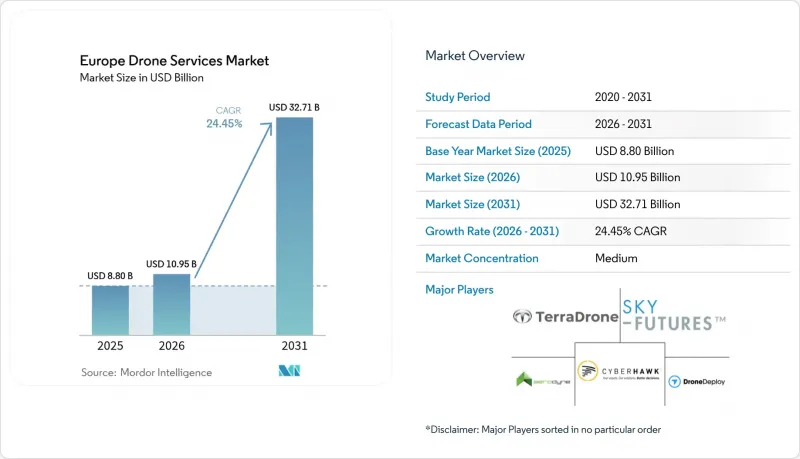
Mordor Intelligence에 의하면, 2026년 유럽의 드론 서비스 시장 규모는 109억 5,000만 달러로 추정되고 2025년 88억 달러에서 확대해, 2031년에는 327억 1,000만 달러에 이를 것으로 예측됩니다.
2026년부터 2031년까지의 연평균 성장률(CAGR)은 24.45%를 나타낼 것으로 전망됩니다.
본 보고서는 서비스 유형(드론 플랫폼 서비스 등), 최종 사용자 산업(건설 및 인프라, 농림업 등), 드론 유형(회전익, 고정익, 하이브리드 VTOL), 운용 범위(시야 내(VLOS) 등), 지역(영국, 독일, 프랑스 등)별로 세분화되어 있습니다. 시장 전망은 금액(달러) 기준으로 제시되어 있습니다.
유럽의 드론 서비스 시장 동향 및 인사이트
EU 규제 조화로 BVLOS 승인 가속화
유럽의 드론 서비스 시장은 기존의 국내법보다 우선하는 단일 규칙집의 혜택을 받고 있습니다. 2024년 1월에 발효된 EASA의 ‘표준 시나리오’에 따라, 일상적인 BVLOS 운영에 필요한 번거로운 면허 발급 절차가 자가 신고제로 대체되었습니다. 서비스 제공업체는 추가 허가 절차 없이 국경을 넘어 기체와 조종사를 재배치할 수 있게 되어, 2년 전만 해도 불가능했던 범유럽적 계약이 가능해졌습니다. 조종사 자격의 상호 인정을 통해 인력 통합이 더욱 진전되고 있습니다. 다만, 일부 국가에서는 여전히 엄격한 해석이 적용되고 있어 승인이 지연되는 경우도 있습니다. 완전한 조화는 2026년까지 달성될 전망이며, 이에 따라 BVLOS 수요가 더욱 확대되고, 대기업들이 규모의 경제를 실현하기 위해 지역 전문 업체들을 통합함에 따라 경쟁이 격화될 것으로 예측됩니다.
자산 점검 및 감시에 대한 수요 증가
자산 집약형 산업에서는 비용, 가동 중단 시간, 안전상의 위험을 줄이기 위해 드론을 도입하고 있습니다. 교량 소유주는 점검 작업을 75% 단축할 수 있을 뿐만 아니라, 예측 유지보수 분석에 활용할 수 있는 고해상도 이미지도 수집할 수 있게 되었습니다. 풍력 터빈의 점검 비용은 1기당 300-769달러인 반면, 로프 액세스를 통한 점검 비용은 2,000달러 이상 소요됩니다. 북유럽의 전력 회사들은 혹독한 겨울 기후로 인해 작업자의 가동 일수가 제한되기 때문에 드론을 선호하고 있지만, 제빙 시스템을 탑재한 지상형 무인 항공기는 거의 사용하지 않고 있습니다. 그 결과, 소유주들이 수작업 방식에서 자율 비행기단이 유지 관리하는 디지털 트윈으로 예산을 전환함에 따라, 유럽의 드론 서비스 시장은 에너지, 운송, 산업 시설 분야에서 입지를 더욱 공고히 하고 있습니다.
엄격한 BVLOS 인증의 장벽
규제 조화가 진행된 후에도 BVLOS(시야등) 운항 사업자는 300페이지가 넘는 상세한 ‘특정 운항 위험 평가’를 제출해야 하며, 승인까지 최대 12개월이 소요될 수 있습니다. 중소기업들은 변호사 비용과 보험료 부담으로 어려움을 겪고 있으며, 이는 시장 진입을 방해하고 육안 운항에서 벗어나는 전환을 지연시키고 있습니다. 표준 시나리오는 정형화된 임무만을 대상으로 하기 때문에 인구 밀집 도시 상공이나 공항 인근에서의 비행과 같은 복잡한 비행에 대해서는 여전히 개별 승인이 필요합니다. 각국 당국의 규제 집행에 따른 편차는 불확실성을 가중시켜, 전환 기간 중 유럽의 드론 서비스 시장의 성장을 저해하고 있습니다.
부문별 분석
드론 플랫폼 서비스는 2025년 초 기준 유럽의 드론 서비스 시장 점유율의 55.12%를 차지했으며, 이는 비행 운영, 클라우드 분석, 규정 준수 보고를 하나의 계약으로 통합한 턴키형 서비스로 기업들이 전환하고 있음을 반영합니다. 구매 기업들은 자체 기체 보유에 따른 자본 비용을 피하기 위해 Cyberhawk와 같은 제공업체를 이용하고 있습니다. 이 회사의 iHawk 플랫폼은 드론 영상과 위성 데이터, IoT 피드를 통합하여 자산 상태 대시보드를 구축합니다. 일원화된 데이터 파이프라인을 통해 고객은 EU의 통일된 기록 보관 규정을 준수하면서 여러 국가에 걸친 거점을 벤치마킹할 수 있으며, 이러한 기능은 다국적 유틸리티체와 대형 건설 회사의 관심을 끌고 있습니다. 서비스 제공업체는 자산 단위 또는 구독 방식으로 요금을 청구하므로, 이 수익 모델은 예측 가능한 현금 흐름을 창출하며, 고객이 현재 기대하는 지속적인 소프트웨어 업그레이드 자금 조달에 도움이 되고 있습니다.
훈련 및 시뮬레이션 서비스는 현재 시장 점유율은 작지만, 보험사 및 규제 당국이 조종사 자격 기준을 강화하고 있어 연평균 성장률(CAGR) 29.74%로 확대되고 있습니다. 고해상도 가상 환경을 통해 BVLOS(시야 외 비행) 시나리오가 재현되므로, 승무원은 하드웨어를 위험에 노출시키거나 공역 제한을 위반하지 않고도 기술 훈련 시간을 쌓을 수 있습니다. 항공사 및 긴급 대응 기관은 현재 조종사가 실제 비행을 수행하기 전에 시뮬레이터를 통한 자격 취득을 의무화하고 있으며, 이로 인해 유럽의 드론 서비스 시장 전체에서 인증된 교육 과정에 대한 수요가 증가하고 있습니다. 이러한 수요의 급증은 조종사 부족 해소, 사고율 감소, 보험료 절감, 그리고 고객의 도입 확대로 이어져 유럽의 드론 서비스 시장 전체의 규모를 확대시키고 있습니다.
2025년에는 정부가 교량, 도로, 터널의 점검 빈도를 높일 것을 요구함에 따라 건설 및 인프라 소유자가 매출의 32.30%를 차지했습니다. 드론은 차선 통제 시간을 단축하고, 고소 작업에 따른 노동 위험을 대폭 낮출 뿐만 아니라 더 상세한 데이터를 수집할 수 있으므로, 프로젝트 관리자는 결함이 심각해지기 전에 이를 감지할 수 있게 됩니다. 현재 많은 대형 건설사가 드론을 활용한 준공 스캔 데이터를 빌딩 정보 모델링(BIM) 워크플로우에 통합하고 있어, 서비스 제공업체는 수익을 안정화할 수 있는 다년 계약을 확보하고 있습니다. 민관 협력(PPP)도 이러한 확산을 더욱 촉진하고 있습니다. 컨세션 사업자는 대출 기관 및 규제 당국에 자산의 건전성을 입증해야 하므로, 드론은 유지 관리 예산의 표준 항목으로 자리 잡아가고 있습니다.
의료 및 소포 배송 분야는 현재 규모는 작지만 연평균 성장률(CAGR) 29.35%로 급속히 확대되고 있으며, 2031년까지 유럽의 드론 서비스 시장 규모의 다각화를 촉진할 전망입니다. 런던에서 Wing사가 NHS를 위해 운영한 혈액 샘플 수송 노선에서는 도심에서 2분간 비행이 가능함이 입증되었으며, 이에 따라 독일과 네덜란드의 병원들도 병리 검사, 의약품, 장기 수송을 위한 유사한 서비스 예산을 편성하고 있습니다. 전자상거래 플랫폼은 디젤 밴에 대한 저배출 위반 벌금이 상승하고 있는 교통 체증 지역에서 당일 배송을 추구하고 있으며, 이로 인해 경량 BVLOS 드론은 경제적 측면에서 필수 불가결한 요소가 되었습니다. 의료 및 소매 부문 모두에서 나타나는 이러한 이중적인 성장세는 건설 활동의 주기적인 둔화로부터 공급업체를 보호하고, 지속적인 수익을 창출하는 비즈니스 모델을 뒷받침하고 있습니다.
기타 혜택 :
- 엑셀 형식 시장 예측(ME) 시트
- 3개월간의 애널리스트 지원
자주 묻는 질문
목차
제1장 서론
제2장 조사 방법
제3장 개요
제4장 시장 구도
제5장 시장 규모 및 성장 예측
제6장 경쟁 구도
제7장 시장 기회 및 향후 전망
KTH 26.08.31According to Mordor Intelligence, Europe drone services market size in 2026 is estimated at USD 10.95 billion, growing from 2025 value of USD 8.80 billion with 2031 projections showing USD 32.71 billion, growing at 24.45% CAGR over 2026-2031.
This report is Segmented by Service Type (Drone Platform Services, and More), End User Industry (Construction and Infrastructure, Agriculture and Forestry, and More), Drone Type (Rotary-Wing, Fixed-Wing, and Hybrid VTOL), Operating Range (Visual Line-Of-Sight, and More), and Geography (United Kingdom, Germany, France, and More). The Market Forecasts are Provided in Terms of Value (USD).
Europe Drone Services Market Trends and Insights
EU Regulatory Harmonization Accelerates BVLOS Approvals
The Europe drone services market benefits from a single rulebook that supersedes legacy national laws. EASA's Standard Scenarios, effective January 2024, replace lengthy authorizations with self-declarations for routine BVLOS work. Providers redeploy aircraft and pilots across borders without extra licensing, enabling pan-European contracts that were impossible two years ago. Pilot-certificate reciprocity further unifies labor pools, though some states still apply stricter interpretations that delay approvals. Full alignment will likely be by 2026, unlocking another tier of BVLOS demand and sharpening competition as larger firms consolidate regional specialists to gain scale.
Rising Demand for Asset Inspection and Monitoring
Asset-heavy sectors choose drones to reduce cost, downtime, and safety risks. Bridge owners finish inspections 75% faster while collecting higher-resolution imagery that feeds predictive-maintenance analytics. Wind turbine surveys cost USD 300-769 per unit compared to rope access costs of more than USD 2,000. Nordic utilities favor drones because harsh winter conditions limit climber days, but rarely use ground uncrewed aircraft equipped with de-icing systems. Therefore, the Europe drone services market deepens its presence in energy, transport, and industrial facilities as owners shift budgets from manual methods to digital twins maintained by autonomous fleets.
Strict BVLOS Certification Hurdles
Even after harmonization, BVLOS operators submit detailed Specific Operations Risk Assessments that can exceed 300 pages and take up to 12 months to clear. Smaller firms struggle with legal fees and insurance premiums, discouraging market entry and slowing the shift from visual operations. Standard Scenarios cover only routine missions, so complex flights-such as over dense urban areas or near airports-continue to demand bespoke approvals. Uneven enforcement across national authorities adds uncertainty that restrains the European drone services market during the transition phase.
Other drivers and restraints analyzed in the detailed report include:
- Logistics and E-commerce Pilots Scaling Drone Delivery
- Cost Advantage Versus Helicopters for Energy Inspections
- Shortage of Skilled Drone Pilots/Operators
For complete list of drivers and restraints, kindly check the Table Of Contents.
Segment Analysis
Drone platform services entered 2025 with 55.12% of Europe drone services market share, reflecting an enterprise shift toward turnkey offerings that wrap flight operations, cloud analytics, and compliance reporting into one contract. Buyers avoid the capital cost of in-house fleets and tap providers such as Cyberhawk, whose iHawk platform merges drone imagery with satellite and IoT feeds to power asset-health dashboards. Centralized data pipelines let clients benchmark sites across several countries while meeting harmonized EU record-keeping rules, a capability that attracts multinational utilities and construction majors. Because providers invoice on a per-asset or subscription basis, the revenue model delivers predictable cash flow that helps finance the continual software upgrades now expected by customers.
Training and simulation services, although a smaller slice today, are expanding at a 29.74% CAGR as insurers and regulators tighten pilot-qualification standards. High-fidelity virtual environments replicate BVLOS scenarios so crews can log competency hours without risking hardware or breaching airspace limits. Airlines and emergency-response agencies now mandate simulator credentials before pilots fly live sorties, pushing demand for accredited courseware across the Europe drone services market. This surge strengthens the overall European drone services market size by easing the pilot bottleneck, lowering accident rates, reducing insurance premiums, and broadening customer adoption.
Construction and infrastructure owners commanded 32.30% revenue share in 2025 because governments require more frequent inspections of bridges, roads, and tunnels. Drones cut lane-closure times, slash labor exposure at height, and capture richer data, enabling project managers to detect defects before they escalate. With most large contractors now embedding as-built drone scans into Building Information Modeling workflows, service providers secure multi-year framework agreements that stabilize income. Public-private partnerships drive further uptake as concessionaires must prove asset integrity to lenders and regulators, reinforcing drones as a standard line item in maintenance budgets.
Healthcare and parcel delivery, while smaller today, are racing ahead at a 29.35% CAGR and will diversify the Europe drone services market size through 2031. Wing's NHS blood-sample corridor in London validated two-minute urban flights, prompting hospitals in Germany and the Netherlands to budget similar services for pathology, pharmacy, and organ transport. E-commerce platforms pursue same-day delivery in congestion zones where diesel vans incur rising low-emission penalties, turning lightweight BVLOS drones into an economic necessity. This dual momentum across health and retail buffers providers against cyclical slowdowns in construction activity and supports recurring-revenue business models.
Complete Report Scope:
- By Service Type
- Drone Platform Services
- Piloting and Operations
- Data Analytics
- Data Processing
- Maintenance, Repair and Overhaul (MRO)
- Training and Simulation
- Drone Platform Services
- By End User Industry
- Construction and Infrastructure
- Agriculture and Forestry
- Energy and Utilities
- Law Enforcement and Public Safety
- Medical and Parcel Delivery
- Others (Mining, Real-estate, Media)
- By Drone Type
- Rotary-wing
- Fixed-wing
- Hybrid VTOL
- By Operating Range
- Visual Line-of-Sight (VLOS)
- Beyond Visual Line-of-Sight (BVLOS)
- By Geography
- United Kingdom
- Germany
- France
- Spain
- Italy
- Netherlands
- Nordic Countries
- Rest of Europe
List of Companies Covered in this Report:
- Cyberhawk Innovations Limited
- Sky Futures Partners Limited
- DroneDeploy, Inc.
- SkySpecs, Inc.
- AgEagle Aerial Systems Inc.
- Skycatch, Inc.
- Sharper Shape Inc.
- Sulzer & Schmid Laboratories AG
- Terra Drone Corporation
- Aerodyne Group
- SZ DJI Technology Co., Ltd.
- DELAIR SAS
- Parrot Drones SAS
- Zipline International Inc.
- Wing Aviation LLC
- Skyports Drone Services
- SIA Aerones Engineering
- Dronamics Global Limited
Additional Benefits:
- The market estimate (ME) sheet in Excel format
- 3 months of analyst support
TABLE OF CONTENTS
1 INTRODUCTION
- 1.1 Study Assumptions and Market Definition
- 1.2 Scope of the Study
2 RESEARCH METHODOLOGY
3 EXECUTIVE SUMMARY
4 MARKET LANDSCAPE
- 4.1 Market Overview
- 4.2 Market Drivers
- 4.2.1 EU regulatory harmonization accelerates BVLOS approvals
- 4.2.2 Rising demand for asset inspection and monitoring
- 4.2.3 Logistics and e-commerce pilots scaling drone delivery
- 4.2.4 Cost advantage vs. helicopters for energy inspections
- 4.2.5 Subsidies for pesticide-reduction via ag-spraying drones
- 4.2.6 Defense-sector pilot training spill-over to civil market
- 4.3 Market Restraints
- 4.3.1 Strict BVLOS certification hurdles
- 4.3.2 Shortage of skilled drone pilots/operators
- 4.3.3 Public privacy and noise-nuisance concerns
- 4.3.4 Limited drone-specific insurance underwriting capacity
- 4.4 Value Chain Analysis
- 4.5 Regulatory Landscape
- 4.6 Technological Outlook
- 4.7 Porter's Five Forces Analysis
- 4.7.1 Threat of New Entrants
- 4.7.2 Bargaining Power of Buyers
- 4.7.3 Bargaining Power of Suppliers
- 4.7.4 Threat of Substitutes
- 4.7.5 Competitive Rivalry
5 MARKET SIZE AND GROWTH FORECASTS (VALUE)
- 5.1 By Service Type
- 5.1.1 Drone Platform Services
- 5.1.1.1 Piloting and Operations
- 5.1.1.2 Data Analytics
- 5.1.1.3 Data Processing
- 5.1.2 Maintenance, Repair and Overhaul (MRO)
- 5.1.3 Training and Simulation
- 5.1.1 Drone Platform Services
- 5.2 By End User Industry
- 5.2.1 Construction and Infrastructure
- 5.2.2 Agriculture and Forestry
- 5.2.3 Energy and Utilities
- 5.2.4 Law Enforcement and Public Safety
- 5.2.5 Medical and Parcel Delivery
- 5.2.6 Others (Mining, Real-estate, Media)
- 5.3 By Drone Type
- 5.3.1 Rotary-wing
- 5.3.2 Fixed-wing
- 5.3.3 Hybrid VTOL
- 5.4 By Operating Range
- 5.4.1 Visual Line-of-Sight (VLOS)
- 5.4.2 Beyond Visual Line-of-Sight (BVLOS)
- 5.5 By Geography
- 5.5.1 United Kingdom
- 5.5.2 Germany
- 5.5.3 France
- 5.5.4 Spain
- 5.5.5 Italy
- 5.5.6 Netherlands
- 5.5.7 Nordic Countries
- 5.5.8 Rest of Europe
6 COMPETITIVE LANDSCAPE
- 6.1 Market Concentration
- 6.2 Strategic Moves
- 6.3 Market Share Analysis
- 6.4 Company Profiles (includes Global level Overview, Market level overview, Core Segments, Financials as available, Strategic Information, Market Rank/Share for key companies, Products and Services, and Recent Developments)
- 6.4.1 Cyberhawk Innovations Limited
- 6.4.2 Sky Futures Partners Limited
- 6.4.3 DroneDeploy, Inc.
- 6.4.4 SkySpecs, Inc.
- 6.4.5 AgEagle Aerial Systems Inc.
- 6.4.6 Skycatch, Inc.
- 6.4.7 Sharper Shape Inc.
- 6.4.8 Sulzer & Schmid Laboratories AG
- 6.4.9 Terra Drone Corporation
- 6.4.10 Aerodyne Group
- 6.4.11 SZ DJI Technology Co., Ltd.
- 6.4.12 DELAIR SAS
- 6.4.13 Parrot Drones SAS
- 6.4.14 Zipline International Inc.
- 6.4.15 Wing Aviation LLC
- 6.4.16 Skyports Drone Services
- 6.4.17 SIA Aerones Engineering
- 6.4.18 Dronamics Global Limited
7 MARKET OPPORTUNITIES AND FUTURE OUTLOOK
- 7.1 White-space and Unmet-need Assessment