|
시장보고서
상품코드
2116479
치과용 골결손부 골이식재 : 시장 점유율 분석, 업계 동향 및 통계, 성장 예측(2026-2031년)Dental Bone Void Filler - Market Share Analysis, Industry Trends & Statistics, Growth Forecasts (2026 - 2031) |
||||||
 Mordor Intelligence
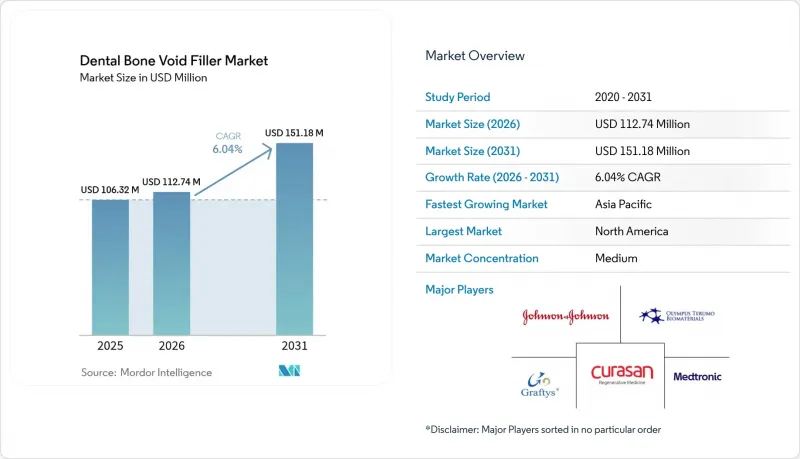
Mordor Intelligence에 의하면, 치과용 골결손부 골이식재 시장 규모는 2025년에 1억 632만 달러로 평가되었습니다. 2026년 1억 1,274만 달러에서 2031년까지 1억 5,118만 달러에 이를 것으로 예상되며, 예측 기간(2026-2031년) CAGR은 6.04%를 나타낼 전망입니다.
본 보고서는 재료 유형(B-인산 삼칼슘(B-TCP), 이상성 인산 칼슘 등), 형태(과립, 퍼티/페이스트 등), 용도(소켓 보존, 리지 증대, 기타),최종 사용자(병원, 외래수술센터(ASC), 기타), 지역(북미, 유럽, 아시아태평양, 기타)별로 분류되어 있습니다. 시장 예측은 금액(달러) 기준으로 제시되어 있습니다.
세계의 치과용 골결손부 골이식재 시장 동향 및 인사이트
치과 재건 분야에서 바이오세라믹의 채택 확대
차세대 이온 도핑형 하이드록시아파타이트 및 B-TCP 제제는 뛰어난 골형성 능력과 염증 반응 감소를 보여주고 있습니다. 불소를 함유한 하이드록시아파타이트는 대식세포의 활성을 조절함으로써 치조와의 치유를 크게 촉진합니다. 임상의들은 기증 부위의 합병증을 피하고 예측 가능한 치료 결과를 얻기 위해 이러한 합성 재료를 채택하고 있습니다. 규제 당국의 승인 범위 확대와 양호한 장기 데이터가 외과의들의 신뢰를 높이고 있습니다. 가격이 안정됨에 따라 중견 시장으로의 도입이 진행되어, 치과용 골공 충진재 시장의 성장을 뒷받침하고 있습니다.
고령화 사회에서 치과 임플란트 시술의 급속한 증가
세계적으로 2억 8,000만 명 이상의 고령자가 치아를 상실했음에도 불구하고, 틀니가 아닌 고정식 보철물을 원하고 있습니다. 고품질 골이식재의 지원이 있다면 임플란트 성공률은 95%를 초과하며, 이는 시술 건수 증가를 뒷받침하고 있습니다. 노화에 따른 치조골 흡수로 인해 골증식이 필요해지며, 이는 충전재에 대한 지속적인 수요를 뒷받침하고 있습니다. 노인 돌봄 분야에서 구강 건강을 중시하는 공중보건 캠페인 또한 시술 이용을 더욱 촉진하고 있습니다. 그 결과, 치과용 골공동 충전재 시장은 향후 수년에 걸친 시술 수요를 보장해 줄 인구 동향의 혜택을 누리고 있습니다.
예측 불가능한 흡수 및 특정 바이오세라믹의 임상적 한계
바이오세라믹의 분해 속도는 환자마다 차이가 있어, 이로 인해 치료 계획 수립 및 임플란트의 안정성이 복잡해지고 있습니다. 다공성이 높은 스캐폴드는 하중이 가해지면 파절될 가능성이 있어, 하악 후방부에서의 사용이 제한됩니다. 체계적 문헌고찰에서는 생체적합성을 저해하는 오염 위험이 지적되고 있습니다. 규제 당국은 철저한 시판 후 조사를 요구하고 있어 제품 승인 주기가 장기화되고 있습니다. 이러한 불확실성으로 인해 차세대 제제가 일관된 성능을 발휘하기 전까지는 치과용 골결손부 골이식재 시장의 성장이 억제될 것입니다.
부문별 분석
B-인산 삼칼슘은 외과의들이 그 흡수 특성과 골전도성을 신뢰하고 있어, 2025년 치과용 골결손부 골이식재 시장에서 40.78%의 점유율을 유지했습니다. 연평균 성장률(CAGR) 9.03%로 성장하고 있는 인산칼슘 시멘트는 최소 침습 수술법을 간소화하는 주입형 솔루션에 대한 수요를 충족시키고 있습니다. 이상 혼합물은 하이드록시아파타이트의 부피 안정성과 B-TCP의 흡수 특성을 결합하여, 균형 잡힌 재형성이 필요한 사례에서 선호되고 있습니다. 최근 시멘트의 개량을 통해 경화 시간이 단축되고 압축 강도가 향상됨에 따라, 치조와 보존을 넘어 적응증이 확대되고 있습니다. 성장 전망은 외과의사가 다루기 쉽고, 예측 가능한 골유착, 그리고 디지털 전달 시스템과의 호환성을 갖춘 재료에 유리하게 작용하고 있습니다.
현재 시술법 선택은 임상적 목적에 따라 달라집니다. 치조와에는 속흡수성 분말이, 치조제 증대술에는 흡수 속도가 느린 재료가 사용됩니다. 신청 자료의 증거가 엄격한 안전성 기준을 충족함에 따라 규제 당국의 승인도 가속화되고 있습니다. 합성 생산에 기반한 안정적인 공급 덕분에 임상의들은 이종 골 이식재 부족으로부터 보호받고 있습니다. 그 결과, 경쟁의 초점은 비용을 증가시키지 않으면서 생체 활성을 높이는 독자적인 이온 도핑 기술 및 나노 구조화 기술에 집중되고 있습니다.
2025년, 치과용 골결손부 골이식재 시장에서 과립형이 40.12%의 점유율을 차지했습니다. 그 범용성과 간편한 적용성이 높이 평가받고 있습니다. 주사용 제제는 전용 캐뉼라를 통한 정확한 주입을 가능하게 하고 외과적 상처를 줄임으로써 연평균 성장률(CAGR) 8.12%로 시장 점유율을 확대되고 있습니다. 퍼티나 페이스트는 불규칙한 결손을 채우는 데 적합하며, 반면 비봉입형 골증식술에는 여전히 경질 블록이 필수적입니다. 맞춤형 체어사이드 프린팅 스캐폴드는 기존 형태와 주문 제작 구조의 경계를 모호하게 만들고 있습니다.
디지털 가이드 방식의 투여 시스템은 임플란트 드릴과 이식재 주입을 동기화하여 재료 낭비와 수술 시간을 줄여줍니다. 외과의들 사이에서는 무균 상태를 유지하고 워크플로우를 원활하게 하는 밀폐형 주사기 포장의 가치가 점점 더 높아지고 있습니다. 인쇄 기술이 성숙해짐에 따라, 인쇄된 코어 주위에 유동성 있는 상을 주입하는 하이브리드 접근법은 안정성과 혈관 신생을 향상시킬 것으로 기대됩니다. 시장에서의 수용 여부는 편의성이 장기적인 구조적 무결성을 훼손하지 않음을 입증하는 임상적 증거에 달려 있습니다.
지역별 분석
북미는 2025년 치과용 골결손부 골이식재 시장에서 35.41%의 점유율을 유지했습니다. 이는 정교한 보험 환급 제도, 첨단 생체 재료에 대한 임상의의 숙련도, 그리고 혁신 투자를 보호하는 FDA의 엄격한 성능 평가 절차에 힘입은 결과입니다. 치과의사들은 재료비보다 장기적인 성공을 우선시하기 때문에 프리미엄 가격 책정이 주류를 이루고 있습니다. 전문 학회가 근거 기반의 프로토콜을 보급함에 따라 이온 도핑 및 나노 구조화 이식재의 채택이 가속화되고 있습니다.
아시아태평양은 치과 관광을 통해 국제 환자들이 비용 경쟁력이 있는 거점으로 유입됨에 따라 2031년까지 연평균 성장률(CAGR) 9.33%로 성장을 지속하고 있습니다. 말레이시아나 태국 등의 목적지에서 시술 비용은 호주나 미국에 비해 평균 60-80% 저렴하면서도 견고한 품질 기준을 유지하고 있습니다. 중산층의 소득 증가와 구강 보건 인프라에 대한 정부 지출 확대가 국내 수요를 뒷받침하고 있습니다. 다국적 제조업체들은 관세 인하와 공급망 회복력의 혜택을 누리기 위해 생산 현지화를 추진하고 있습니다.
유럽에서는 고령화 진행과 근거 기반 생체 재료 비용을 보상하는 보험 제도의 뒷받침을 받아 꾸준한 성장이 나타나고 있습니다. 조화 의료기기 규정(MDR)에 따라 지속가능성과 추적성을 중시하는 합성 이식재의 승인 절차가 예측 가능해졌습니다. 스위스와 독일의 연구개발 센터는 대학과 협력하여 인산칼슘의 화학적 특성을 개선하고 있는 한편, 해당 지역의 국경을 초월한 지침으로 인해 환자 이동이 용이해지면서, 스페인과 포르투갈의 클리닉은 경쟁력 있는 가격을 찾는 북유럽 환자들을 유치할 수 있게 되었습니다.
기타 혜택 :
- 엑셀 형식 시장 예측(ME) 시트
- 3개월간의 애널리스트 지원
자주 묻는 질문
목차
제1장 서론
제2장 조사 방법
제3장 개요
제4장 시장 구도
제5장 시장 규모 및 성장 예측
제6장 경쟁 구도
제7장 시장 기회 및 향후 전망
KTH 26.08.31According to Mordor Intelligence, the dental bone void filler market size was valued at USD 106.32 million in 2025 and estimated to grow from USD 112.74 million in 2026 to reach USD 151.18 million by 2031, at a CAGR of 6.04% during the forecast period (2026-2031).
This report is Segmented by Material Type (B-Tricalcium Phosphate (B-TCP), Biphasic Calcium-Phosphate, and More), Form Factor (Granules, Putty/Paste, and More), Application (Socket Preservation, Ridge Augmentation, and More), End User (Hospitals, Ambulatory Surgical Centers, and More), and Geography (North America, Europe, Asia-Pacific, and More). The Market Forecasts are Provided in Terms of Value (USD).
Global Dental Bone Void Filler Market Trends and Insights
Growing Adoption of Bioceramics for Dental Reconstruction
Next-generation, ion-doped hydroxyapatite and B-TCP formulations demonstrate superior bone formation and reduced inflammatory response. Fluorine-incorporated hydroxyapatite significantly accelerates socket healing by modulating macrophage activity. Clinicians embrace these synthetic options to avoid donor-site morbidity and achieve predictable outcomes. Broader regulatory acceptance and positive long-term data boost surgeon confidence. As prices stabilize, adoption permeates mid-tier markets, reinforcing the dental bone void filler market growth.
Rapid Rise in Dental-Implant Procedures Among Aging Population
A global cohort of more than 280 million older adults experiences tooth loss yet seeks fixed restorations rather than dentures. Implant success exceeding 95% when supported by quality grafts fuels procedure volumes. Age-related alveolar resorption necessitates bone augmentation, anchoring sustained demand for fillers. Public-health campaigns that emphasize oral health in senior care further lift procedure utilization. Consequently, the dental bone void filler market benefits from demographics that ensure multi-year procedural pipelines.
Unpredictable Resorption & Clinical Limitations of Certain Bioceramics
Interpatient variability in bioceramic degradation complicates treatment planning and implant stability. Highly porous scaffolds may fracture under load, restricting posterior-jaw usage. Systematic reviews highlight contamination risks that compromise biocompatibility. Regulators demand extensive post-market surveillance, lengthening product approval cycles. These uncertainties temper the dental bone void filler market expansion until next-wave formulations demonstrate consistent performance.
Other drivers and restraints analyzed in the detailed report include:
- Advances in Synthetic Biomaterials (Nano-HA, B-TCP) Enhancing Osteoinduction
- Chair-Side 3-D Printing of Custom Graft Scaffolds
- High Procedure Cost & Reimbursement Gaps
For complete list of drivers and restraints, kindly check the Table Of Contents.
Segment Analysis
B-tricalcium phosphate retains 40.78% share of the dental bone void filler market in 2025 because surgeons trust its resorption profile and osteoconductivity. Calcium-phosphate cements, advancing at a 9.03% CAGR, satisfy demand for injectable solutions that simplify minimally invasive techniques. Biphasic blends combine hydroxyapatite volume stability with B-TCP resorption, winning cases that need balanced remodeling. Recent cement upgrades shorten setting times and improve compressive strength, broadening indications beyond socket preservation. Growth prospects favor materials offering surgeon-friendly handling, predictable integration, and compatibility with digital delivery systems.
Procedural selection now hinges on clinical objective: fast-resorbing powders for sockets, slower materials for ridge augmentation. Regulatory approvals are accelerating as dossier evidence meets stringent safety endpoints. Supply resilience, aided by synthetic production, shields clinicians from xenograft shortages. Consequently, competitive intensity centers on proprietary ion-doping and nanostructuring that enhance bioactivity without escalating cost.
Granules commanded 40.12% of the dental bone void filler market in 2025, favored for versatility and straightforward application. Injectable formats rise at an 8.12% CAGR by providing precise placement through specialized cannulas and reducing surgical trauma. Putty and paste options fill irregular defects, while rigid blocks remain essential for non-contained augmentation. Customizable, chair-side printed scaffolds blur the line between traditional form factors and bespoke constructs.
Digitally guided delivery systems synchronize implant drills with graft injection, decreasing material wastage and operative time. Surgeons increasingly value closed syringe packaging that maintains sterility and eases workflow. As printing technologies mature, hybrid approaches-injecting a flowable phase around a printed core-promise enhanced stability and vascularization. Market acceptance will hinge on clinical evidence demonstrating that convenience does not sacrifice long-term structural integrity.
Complete Report Scope:
- By Material Type
- Beta-Tricalcium Phosphate (Beta-TCP)
- Biphasic Calcium-Phosphate
- Calcium-Phosphate Cements
- Others
- By Form Factor
- Granules
- Putty/Paste
- Injectable
- Blocks/Molds & Others
- By Application
- Socket Preservation
- Ridge Augmentation
- Periodontal Defect Regeneration
- Implant Bone Regeneration
- Others
- By End User
- Hospitals
- Dental Clinics
- Ambulatory Surgical Centers
- Academic & Research Institutes
- Geography
- North America
- United States
- Canada
- Mexico
- Europe
- Germany
- United Kingdom
- France
- Italy
- Spain
- Rest of Europe
- Asia-Pacific
- China
- Japan
- India
- South Korea
- Australia
- Rest of Asia-Pacific
- Middle East and Africa
- GCC
- South Africa
- Rest of Middle East and Africa
- South America
- Brazil
- Argentina
- Rest of South America
- North America
Geography Analysis
North America maintained 35.41% of the dental bone void filler market in 2025, driven by sophisticated reimbursement, clinician familiarity with advanced biomaterials, and stringent FDA performance pathways that protect innovation investment. Premium pricing prevails because practitioners prioritize long-term success over material cost. Professional societies disseminate evidence-based protocols, accelerating uptake of ion-doped and nano-structured grafts.
Asia-Pacific records a 9.33% CAGR through 2031 as dental tourism funnels international patients into cost-competitive hubs. Procedure pricing in destinations like Malaysia and Thailand averages 60-80% lower than in Australia or the United States, yet maintains robust quality benchmarks. Rising middle-class incomes and government spending on oral-health infrastructure amplify domestic demand. Multinational manufacturers localize production to benefit from tariff relief and supply-chain resiliency.
Europe exhibits steady expansion supported by an aging populace and payer systems that reimburse evidence-backed biomaterials. Harmonized Medical Device Regulation fosters predictable approvals for synthetic grafts emphasizing sustainability and traceability. Swiss and German R&D centers collaborate with universities to refine calcium-phosphate chemistries, while the region's cross-border directive facilitates patient mobility, allowing clinics in Spain and Portugal to attract Northern European patients seeking competitive pricing.
- Medtronic
- Johnson & Johnson
- ZimVie
- Dentsply Sirona
- Geistlich Pharma
- Straumann Group
- BioHorizons
- RTI Surgical
- BoneSupport AB
- Graftys
- Olympus-Terumo Biomaterials
- Orthorebirth Co Ltd
- OsteoBiol (Tecnoss)
- Kuros Biosciences
- NovaBone Products
- Collagen Matrix
- Genoss
- Stryker
- LifeNet Health
- Curasan
Additional Benefits:
- The market estimate (ME) sheet in Excel format
- 3 months of analyst support
TABLE OF CONTENTS
1 Introduction
- 1.1 Study Assumptions & Market Definition
- 1.2 Scope of the Study
2 Research Methodology
3 Executive Summary
4 Market Landscape
- 4.1 Market Overview
- 4.2 Market Drivers
- 4.2.1 Growing Adoption Of Bioceramics For Dental Reconstruction
- 4.2.2 Rapid Rise In Dental-Implant Procedures Among Aging Population
- 4.2.3 Advances In Synthetic Biomaterials (Nano-HA, B-TCP) Enhancing Osteoinduction
- 4.2.4 Chair-Side 3-D Printing Of Custom Graft Scaffolds
- 4.2.5 Dental-Tourism-Led Demand Surge In Cost-Competitive APAC & MEA Hubs
- 4.3 Market Restraints
- 4.3.1 Unpredictable Resorption & Clinical Limitations Of Certain Bioceramics
- 4.3.2 High Procedure Cost & Reimbursement Gaps
- 4.3.3 Supply-Chain Risk For Xenografts Amid Tighter Zoonotic-Disease Surveillance
- 4.4 Technological Outlook
- 4.5 Porter's Five Forces
- 4.5.1 Threat of New Entrants
- 4.5.2 Bargaining Power of Buyers/Consumers
- 4.5.3 Bargaining Power of Suppliers
- 4.5.4 Threat of Substitute Products
- 4.5.5 Intensity of Competitive Rivalry
5 Market Size & Growth Forecasts (Value, USD)
- 5.1 By Material Type
- 5.1.1 Beta-Tricalcium Phosphate (Beta-TCP)
- 5.1.2 Biphasic Calcium-Phosphate
- 5.1.3 Calcium-Phosphate Cements
- 5.1.4 Others
- 5.2 By Form Factor
- 5.2.1 Granules
- 5.2.2 Putty/Paste
- 5.2.3 Injectable
- 5.2.4 Blocks/Molds & Others
- 5.3 By Application
- 5.3.1 Socket Preservation
- 5.3.2 Ridge Augmentation
- 5.3.3 Periodontal Defect Regeneration
- 5.3.4 Implant Bone Regeneration
- 5.3.5 Others
- 5.4 By End User
- 5.4.1 Hospitals
- 5.4.2 Dental Clinics
- 5.4.3 Ambulatory Surgical Centers
- 5.4.4 Academic & Research Institutes
- 5.5 Geography
- 5.5.1 North America
- 5.5.1.1 United States
- 5.5.1.2 Canada
- 5.5.1.3 Mexico
- 5.5.2 Europe
- 5.5.2.1 Germany
- 5.5.2.2 United Kingdom
- 5.5.2.3 France
- 5.5.2.4 Italy
- 5.5.2.5 Spain
- 5.5.2.6 Rest of Europe
- 5.5.3 Asia-Pacific
- 5.5.3.1 China
- 5.5.3.2 Japan
- 5.5.3.3 India
- 5.5.3.4 South Korea
- 5.5.3.5 Australia
- 5.5.3.6 Rest of Asia-Pacific
- 5.5.4 Middle East and Africa
- 5.5.4.1 GCC
- 5.5.4.2 South Africa
- 5.5.4.3 Rest of Middle East and Africa
- 5.5.5 South America
- 5.5.5.1 Brazil
- 5.5.5.2 Argentina
- 5.5.5.3 Rest of South America
- 5.5.1 North America
6 Competitive Landscape
- 6.1 Market Concentration
- 6.2 Market Share Analysis
- 6.3 Company Profiles (includes Global level Overview, Market level overview, Core Business Segments, Financials, Headcount, Key Information, Market Rank, Market Share, Products and Services, and analysis of Recent Developments)
- 6.3.1 Medtronic plc
- 6.3.2 Johnson & Johnson
- 6.3.3 ZimVie Inc
- 6.3.4 Dentsply Sirona
- 6.3.5 Geistlich Pharma
- 6.3.6 Straumann Group
- 6.3.7 BioHorizons
- 6.3.8 RTI Surgical
- 6.3.9 BoneSupport AB
- 6.3.10 Graftys
- 6.3.11 Olympus-Terumo Biomaterials
- 6.3.12 Orthorebirth Co Ltd
- 6.3.13 OsteoBiol (Tecnoss)
- 6.3.14 Kuros Biosciences
- 6.3.15 NovaBone Products
- 6.3.16 Collagen Matrix
- 6.3.17 Genoss
- 6.3.18 Stryker Corporation
- 6.3.19 LifeNet Health
- 6.3.20 Curasan Inc
7 Market Opportunities & Future Outlook
- 7.1 White-space & Unmet-Need Assessment