|
시장보고서
상품코드
2116491
검사 기기 시장 : 점유율 분석, 업계 동향과 통계, 성장 예측(2026-2031년)Inspection Machines - Market Share Analysis, Industry Trends & Statistics, Growth Forecasts (2026 - 2031) |
||||||
 Mordor Intelligence
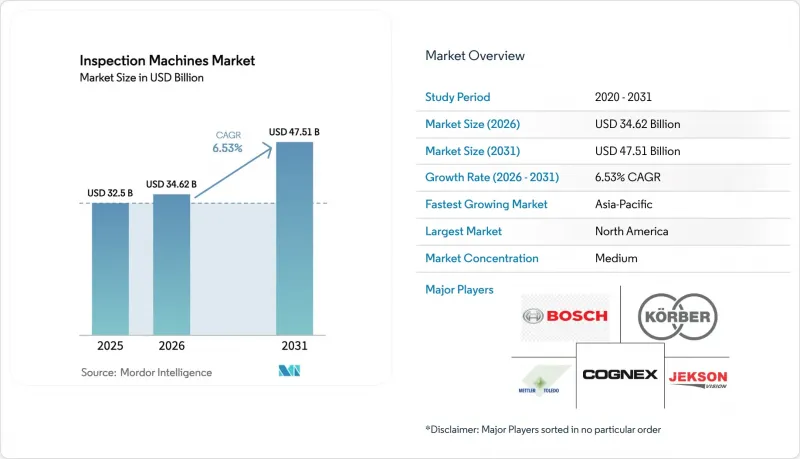
Mordor Intelligence에 의하면, 검사 기기 시장 규모는 2025년에 325억 달러, 2026년에 346억 2,000만 달러되어, 2031년까지 475억 1,000만 달러에 이를 것으로 예측되며, 2026년부터 2031년까지 CAGR 6.53%로 성장할 전망입니다.
본 보고서는 제품별(비전 검사 시스템 등), 기계 유형별(전자동 등), 포장 유형별(앰플 등), 최종 사용자별(제약 제조업체, 생명공학 기업, CRO 및 CDMO), 지역별(북미, 유럽, 아시아태평양, 중동 및 아프리카, 남미)로 분류되어 있습니다. 시장 전망은 금액(달러) 기준으로 제시되어 있습니다.
세계 검사 기기 시장 동향 및 인사이트
엄격한 규제 준수 요건
규제 당국은 데이터 무결성 문제를 해결하고 의약품 제조 공정에 대한 신뢰를 회복하기 위해 검사 프로토콜을 강화하고 있습니다. 2024년, FDA는 621건의 해외 감사를 실시했으며, 이는 2023년 대비 28% 증가한 수치입니다. 또한, 21 CFR Part 11에 따라 검증 절차가 완료되지 않은 자동화 시스템을 대상으로 105건의 경고장을 발부했습니다. 2025년 1월, 중국 국가의약품감독관리국(NMPA)은 GMP 부록 1을 개정하여 주사제에 대해 100% 자동화된 육안 검사를 의무화하고, 3개의 연속된 검증 로트에 걸친 통계적 통제의 증명을 요구했습니다. 또한, 2025년 5월에 출범한 유럽의약품청(EMA)의 EUDAMED 데이터베이스에서는 이상반응 보고가 제조 시설 식별자와 연계되도록 되어, 부적합률이 높은 시설에 대한 감시가 강화되고 있습니다. 이러한 끊임없이 변화하는 규제를 준수하기 위해 각 공급업체는 모든 이미지, 판정 및 운영자의 수동 개입을 기록하는 타임스탬프가 포함된 감사 추적 모듈을 통합하고 있습니다. 이러한 조치는 기업이 FDA 양식 483의 지적 사항을 해결하고 ISO 13485 인증을 유지하는 데 도움이 됩니다. 규제 요건에 따라 기존 공장의 개보수가 진행되고 있으며, 특히 여러 스폰서의 품질 시스템을 관리하는 CDMO를 중심으로 신규 시설에 대한 설비 투자가 가속화되고 있습니다.
전 세계적으로 증가하는 제품 리콜 사례
2024 회계연도, FDA는 260건의 의약품 리콜을 지시했습니다. 주요 원인은 표시 오류, 미립자 오염, 그리고 용기 및 밀봉 시스템의 결함이었습니다. 클래스 I 리콜은 이러한 사례의 18%를 차지하여, 2023년의 12%에서 증가했습니다. 2025년 1월에 발생한 주목할 만한 리콜 사례에서는 유리 파편에 의한 오염으로 인해 120만 개의 에피네프린 주사기가 회수되었으며, 이를 계기로 레이저 회절식 카운터 도입 및 더욱 엄격한 불량품 선별 검증 프로토콜의 시행이 추진되었습니다. 2019년부터 2023년까지 발생한 니트로소아민 오염 사고에 대한 규제 당국의 대응으로, 표준 이미지 인식 시스템의 한계를 해소하기 위해 유효 성분(API)을 확인하기 위한 하이퍼스펙트럼 근적외선 분광법의 도입이 의무화되었습니다. 클래스 I 리콜 1건으로 인한 재무적 영향은 제품 리콜 비용, 벌금, 매출 손실을 포함해 5,000만 달러를 초과할 가능성이 있습니다. 그 결과, 대개 300만 달러 이상이 소요되는 AI 탑재 검사 라인에 대한 투자가 점점 더 정당화되고 있습니다. 또한, 보험사는 검사 시스템의 검증 현황에 따라 배상 책임 보험료를 조정하고 있으며, 이로 인해 제조업체가 고급 분석 기술이나 온라인 통계적 공정 관리(SPC)를 도입할 유인이 더욱 높아지고 있습니다.
저비용 재생품의 입수 가능성
비전, X선, 계량 기술을 결합한 통합 검사 라인의 가격은 500만 달러를 초과합니다. FDA 21 CFR Part 11, EU Annex 11 및 ISO 13485를 준수하는 완전한 IQ-OQ-PQ 프로토콜을 수행하는 데는 일반적으로 12-18개월이 소요됩니다. 그 결과, 비용을 중시하는 제네릭 의약품 제조업체들은 10만-30만 달러 규모의 반자동 검사대를 선택하는 경향이 있지만, 이러한 시스템에는 일련 번호 부여 기능이 탑재되어 있지 않습니다. 40%-50% 할인된 가격으로 제공되는 리퍼브 시스템은 라틴아메리카, 중동 및 아시아태평양의 일부에서 수요의 분산을 초래하고 있습니다. 그러나 부품 부족이나 소프트웨어 노후화와 같은 과제는 감사 대응 준비에 위험을 초래하고 있습니다. 앰플, 바이알, 주사기 간에 통계적 동등성을 확립하려면 추가적인 카메라 설정, 조명 프로파일, 결함 라이브러리가 필요합니다. 이러한 복잡성으로 인해 전담 검증 팀을 보유한 대형 다국적 기업이 경쟁 우위를 점하고 있으며, Tier 1 기업과 Tier 2 기업 간의 기술 격차가 더욱 확대되고 있습니다.
부문 분석
X선 시스템은 연평균 성장률(CAGR) 8.54%를 나타낼 것으로 예측되며, 이는 검사 기기 시장 전체의 성장률인 6.53%를 상회할 것으로 보입니다. 이는 규제 당국이 현재 동결 건조된 항암제 및 유전자 치료용 바이알에 대해 용기 및 밀봉부의 무결성 검사를 100% 실시하도록 의무화하고 있기 때문입니다. 2025년에는 외관 검사가 화장품 및 라벨 검사 등 폭넓은 용도에 대응할 수 있기 때문에 검사 기기 시장에서 32.65%의 점유율을 차지하며 시장을 휩쓸었습니다. 그러나 표면 아래의 균열을 감지할 수 없습니다는 단점 때문에 메틀러-톨레도(Mettler-Toledo)사의 X38과 같은 듀얼 에너지 X선 플랫폼에 점유율을 내주고 있습니다. X38은 1분당 400개의 주사기를 스캔할 수 있습니다.
레이저 회절식 입자 계수기나 하이퍼스펙트럼 이미저의 경우 가격 프리미엄이 높기 때문에 그 도입은 바이오의약품이나 위조품 감지 라인으로 제한되어 있습니다. 진공 감쇠법이나 헬륨 질량 분석법을 이용한 누출 검사기는 사이클 타임이 길기 때문에 현 시점에서는 틈새 시장 수준에 머물러 있습니다. 체크웨이터, 비전, X선 검사를 결합한 장치는 설치 면적 축소와 검증 절차 간소화를 추구하는 CDMO(위탁 개발·제조 기관)로부터 지지를 받고 있으며, WIPOTEC-OCS사의 2025년 수주량은 42% 증가할 전망입니다.
2025년에는 전자동 장비가 검사 기기 시장 규모의 56.43%를 차지하며, 유럽과 미국의 인건비 급등으로 인해 5만 유닛을 초과하는 배치에서는 로봇을 이용한 적재가 매력적인 선택지가 되고 있어, 2031년까지 연평균 성장률(CAGR) 8.21%를 나타낼 것으로 예측됩니다. 교대당 3-4명의 작업자를 감축함으로써, 유럽에서는 연간 30만-50만 달러, 미국에서는 15만-25만 달러의 비용 절감이 가능해져 설비 투자(CAPEX)를 신속하게 회수할 수 있습니다.
반자동 장비는 예산 제약이 있는 동시에 수작업 검사에 따른 규정 준수 위험을 우려하는 중규모 제네릭 의약품 제조업체에 적합합니다. 15만 미 달러 미만의 벤치탑 시스템은 임상시험용 시료에는 여전히 유용하지만, 전자 감사 추적 및 일련 번호 부여 기능이 없어 확장성에 한계가 있습니다. 반자동 프레임에 AI 비전 기능을 추가하는 개조 키트를 활용하면, 소유자는 자산의 수명을 연장하는 동시에 데이터 무결성을 향상시킬 수 있습니다.
지역별 분석
북미는 2025년에도 전 세계 매출의 42.76%를 차지했습니다. 이는 DSCSA의 일련번호 부여 기한과, 충전 및 마무리 공정을 국내 CDMO로 유도한 BIOSECURE법의 인센티브에 힘입은 결과입니다. 2024년부터 2025년까지 발표된 멕시코의 7개 그린필드 프로젝트에서는 2027년까지 2억 달러가 넘는 자동 검사 시스템이 도입될 전망입니다. 한편, 캐나다는 규제 조화를 활용하여 검증 효율화를 도모하고 있습니다.
아시아태평양은 2031년까지 연평균 성장률(CAGR) 7.43%로 가장 높은 성장률을 기록할 전망입니다. 이는 중국의 2026년 12월 시리얼화 마감 기한과, 인도가 2028년까지 WHO 사전 승인을 받은 주사제 제조 거점을 200곳 증설하겠다는 목표에 힘입은 결과입니다. 일본과 한국에서는 인력 부족을 완화하고 바이오의약품 수출을 유지하기 위해 AI 분석을 도입하고 있는 반면, 동남아시아에서는 자금면의 제약이나 재생 의약품의 수입이 수요를 좌우하고 있습니다.
2025년 매출에서 유럽이 차지하는 비중은 약 28%였습니다. 독일은 ‘인더스트리 4.0’ 통합을 주도하고 있지만, IEC 62443 사이버 보안 규제로 인해 생산 라인 1개당 20만-50만 달러의 추가 비용이 발생하고 있습니다. 영국에서는 브렉시트 이후 규제의 차이로 인해 듀얼 마켓 공급업체에 대한 검증 작업이 두 배로 늘어났으며, 남유럽에서는 FMD 코드 대응을 위해 기존 비전 시스템의 업그레이드가 진행되고 있습니다. 중동 및 아프리카, 남미는 여전히 신흥 시장으로, 반자동화 제품이나 재생품 구매를 통해 가격과 규정 준수의 균형을 맞추고 있습니다.
기타 혜택:
- 엑셀 형식 시장 예측(ME) 시트
- 3개월간의 애널리스트 지원
자주 묻는 질문
목차
제1장 서론
제2장 조사 방법
제3장 주요 요약
제4장 시장 구도
제5장 시장 규모와 성장 예측
제6장 경쟁 구도
제7장 시장 기회와 향후 전망
JHSAccording to Mordor Intelligence, the inspection machines market size is projected to be USD 32.5 billion in 2025, USD 34.62 billion in 2026, and reach USD 47.51 billion by 2031, growing at a CAGR of 6.53% from 2026 to 2031.
This report is Segmented by Product (Vision Inspection Systems, and More), Machine Type (Fully-Automated, and More), Packaging Type (Ampoules, and More), End User (Pharmaceutical Manufacturers, Biotechnology Companies, and CROs & CDMOs), and Geography (North America, Europe, Asia-Pacific, Middle East & Africa, and South America). The Market Forecasts are Provided in Terms of Value (USD).
Global Inspection Machines Market Trends and Insights
Stringent Regulatory Compliance Requirements
Regulators are intensifying inspection protocols to address data-integrity issues and restore trust in the drug manufacturing process. In 2024, the FDA conducted 621 foreign inspections, marking a 28% increase from 2023, and issued 105 warning letters targeting unvalidated automated systems under 21 CFR Part 11. In January 2025, China's NMPA updated GMP Annex 1, requiring 100% automated visual inspection for parenterals and proof of statistical control across three consecutive validation batches. Additionally, the EMA's EUDAMED database, launched in May 2025, now links adverse-event reports to plant identifiers, increasing scrutiny of facilities with high reject ratios. To comply with these evolving regulations, vendors are integrating time-stamped audit-trail modules that record every image, decision, and operator override. These measures help companies address FDA Form 483 citations and maintain ISO 13485 certification. The regulatory demands are driving retrofits in legacy plants and accelerating capital investments in new facilities, particularly among CDMOs managing multiple sponsor quality systems.
Rising Global Product Recall Incidents
In fiscal 2024, the FDA initiated 260 drug recalls, primarily driven by labeling errors, particulate contamination, and container-closure failures. Class I recalls accounted for 18% of these cases, up from 12% in 2023. A notable recall in January 2025 involved 1.2 million epinephrine syringes due to contamination with glass fragments, prompting the implementation of laser-diffraction counters and stricter reject verification protocols. Regulatory responses to nitrosamine contamination incidents from 2019 to 2023 have led to mandates for hyperspectral near-infrared spectroscopy to confirm active pharmaceutical ingredients (APIs), addressing limitations in standard vision systems. The financial impact of a single Class I recall can exceed USD 50 million, including product recall costs, fines, and lost sales. Consequently, investments in AI-enabled inspection lines, often costing over USD 3 million, are increasingly justified. Additionally, insurers are adjusting liability premiums based on the validation status of inspection systems, further incentivizing manufacturers to adopt advanced analytics and online statistical process control.
Availability of Lower-Cost Refurbished Equipment
Integrated inspection lines, combining vision, X-ray, and weighing technologies, are priced at over USD 5 million. Implementing full IQ-OQ-PQ protocols, in line with FDA 21 CFR Part 11, EU Annex 11, and ISO 13485, typically requires 12-18 months. Consequently, cost-sensitive generic manufacturers are opting for semi-automated benches priced between USD 100,000 and USD 300,000, though these systems lack serialization capabilities. Refurbished systems, offered at 40%-50% discounts, drive fragmented demand across Latin America, the Middle East, and parts of the Asia-Pacific. However, challenges such as parts shortages and software obsolescence pose risks to audit readiness. Establishing statistical equivalence across ampoules, vials, and syringes increases the need for additional camera setups, lighting profiles, and defect libraries. This complexity gives large multinationals with dedicated validation teams a competitive edge, further widening the technology gap between tier-1 and tier-2 firms.
Other drivers and restraints analyzed in the detailed report include:
- Growing Adoption of Production-Line Automation
- Increased Implementation of Pharmaceutical Serialisation Programs
- Cyber-Security Concerns in Connected Inspection Ecosystems
For complete list of drivers and restraints, kindly check the Table Of Contents.
Segment Analysis
X-ray systems are forecast to grow at an 8.54% CAGR, eclipsing the 6.53% pace of the overall inspection machines market, because regulators now require 100% container-closure-integrity checks for lyophilized oncology and gene-therapy vials. Vision inspection dominated the inspection machines market with 32.65% market share in 2025, given its breadth across cosmetic and label tasks, but its inability to detect subsurface cracks is ceding ground to dual-energy X-ray platforms such as Mettler-Toledo's X38, which scans 400 syringes per minute.
Laser-diffraction particle counters and hyperspectral imagers command high price premiums, confining uptake to biologics and counterfeit-detection lines. Leak testers using vacuum decay or helium mass spectrometry remain niche for now due to slow cycle times. Combination checkweigher-vision-X-ray units appeal to CDMOs seeking narrow footprints and simplified validation, with WIPOTEC-OCS booking a 42% rise in 2025 orders.
Fully automated equipment held 56.43% inspection machines market size in 2025 and is projected to post an 8.21% CAGR to 2031 as Western labor inflation makes robotic loading attractive for batches above 50,000 units. Removing three to four operators per shift saves USD 300,000-USD 500,000 annually in Europe and USD 150,000-USD 250,000 in the U.S., offsetting capex quickly.
Semi-automated rigs suit mid-volume generics producers constrained by budget yet wary of manual inspection's compliance risks. Benchtop systems under USD 150,000 remain relevant for clinical-trial material but lack electronic audit trails and serialization hooks, limiting scalability. Retrofit kits that bolt AI vision onto semi-automated frames help owners extend asset life while improving data integrity.
Complete Report Scope:
- By Product
- Vision Inspection Systems
- X-Ray Inspection Systems
- Leak-Detection Systems
- Metal Detectors
- Combination Checkweigher-Vision-X-Ray Systems
- Other Inspection Systems
- By Machine Type
- Fully-Automated
- Semi-Automated
- Manual / Benchtop
- By Packaging Type
- Ampoules
- Vials
- Blister Packs
- Syringes & Cartridges
- Bottles & Containers
- By End User
- Pharmaceutical Manufacturers
- Biotechnology Companies
- CROs & CDMOs
- Geography
- North America
- United States
- Canada
- Mexico
- Europe
- Germany
- United Kingdom
- France
- Italy
- Spain
- Rest of Europe
- Asia-Pacific
- China
- Japan
- India
- Australia
- South Korea
- Rest of Asia-Pacific
- Middle East & Africa
- GCC
- South Africa
- Rest of Middle East & Africa
- South America
- Brazil
- Argentina
- Rest of South America
- North America
Geography Analysis
North America retained 42.76% of global revenue in 2025, buoyed by the DSCSA's serialization deadline and BIOSECURE Act incentives that steered fill-finish contracts to domestic CDMOs. Seven Mexican greenfield projects announced in 2024-2025 will install over USD 200 million in automated inspection by 2027, while Canada leverages regulatory harmonization to streamline validation.
Asia-Pacific is set to log the fastest 7.43% CAGR to 2031, driven by China's December 2026 serialization cutoff and India's goal to add 200 WHO-prequalified injectable sites by 2028. Japan and South Korea deploy AI analytics to mitigate labor shortages and sustain biologics exports, whereas capital constraints and refurbished imports shape demand in Southeast Asia.
Europe represented roughly 28% of 2025 sales. Germany leads Industry 4.0 integration, yet IEC 62443 cyber rules add USD 200,000-USD 500,000 per line. The U.K.'s post-Brexit divergence doubles validation for dual-market suppliers, and southern Europe upgrades legacy vision systems to meet FMD codes. The Middle East, Africa and South America remain emerging territories, balancing price with compliance through semi-automated or refurbished purchases.
- ACG Worldwide
- Anritsu Corporation
- Antares Vision Group
- Brevetti CEA SpA
- CMP Phar.ma
- Cognex
- Ishida Co. Ltd
- Jekson Vision
- Keyence Corporation
- Korber AG (Seidenader)
- Mettler Toledo
- Minebea Intec
- OMRON
- OPTEL Group
- Sesotec GmbH
- TapTone (Teledyne)
- Teledyne Technologies
- Thermo Fisher Scientific
- Uhlmann Pac-Systeme
- WIPOTEC-OCS
Additional Benefits:
- The market estimate (ME) sheet in Excel format
- 3 months of analyst support
TABLE OF CONTENTS
1 Introduction
- 1.1 Study Assumptions & Market Definition
- 1.2 Scope of the Study
2 Research Methodology
3 Executive Summary
4 Market Landscape
- 4.1 Market Overview
- 4.2 Market Drivers
- 4.2.1 Stringent Regulatory Compliance Requirements
- 4.2.2 Rising Global Product Recall Incidents
- 4.2.3 Growing Adoption of Production-Line Automation
- 4.2.4 Increased Implementation of Pharmaceutical Serialisation Programs
- 4.2.5 Deployment of Edge-AI for Real-Time Defect Analytics
- 4.2.6 Emergence of Hyperspectral 3-D Vision Technologies
- 4.3 Market Restraints
- 4.3.1 High Capital Expenditure & Lengthy Validation Cycles
- 4.3.2 Availability of Lower-Cost Refurbished Equipment
- 4.3.3 Integration Challenges with Legacy MES
- 4.3.4 Cyber-Security Concerns in Connected Inspection Ecosystems
- 4.4 Value / Supply-Chain Analysis
- 4.5 Regulatory Landscape
- 4.6 Technological Outlook
- 4.7 Porter's Five Forces Analysis
- 4.7.1 Threat of New Entrants
- 4.7.2 Bargaining Power of Buyers
- 4.7.3 Bargaining Power of Suppliers
- 4.7.4 Threat of Substitutes
- 4.7.5 Competitive Rivalry
5 Market Size & Growth Forecasts (Value, USD)
- 5.1 By Product
- 5.1.1 Vision Inspection Systems
- 5.1.2 X-Ray Inspection Systems
- 5.1.3 Leak-Detection Systems
- 5.1.4 Metal Detectors
- 5.1.5 Combination Checkweigher-Vision-X-Ray Systems
- 5.1.6 Other Inspection Systems
- 5.2 By Machine Type
- 5.2.1 Fully-Automated
- 5.2.2 Semi-Automated
- 5.2.3 Manual / Benchtop
- 5.3 By Packaging Type
- 5.3.1 Ampoules
- 5.3.2 Vials
- 5.3.3 Blister Packs
- 5.3.4 Syringes & Cartridges
- 5.3.5 Bottles & Containers
- 5.4 By End User
- 5.4.1 Pharmaceutical Manufacturers
- 5.4.2 Biotechnology Companies
- 5.4.3 CROs & CDMOs
- 5.5 Geography
- 5.5.1 North America
- 5.5.1.1 United States
- 5.5.1.2 Canada
- 5.5.1.3 Mexico
- 5.5.2 Europe
- 5.5.2.1 Germany
- 5.5.2.2 United Kingdom
- 5.5.2.3 France
- 5.5.2.4 Italy
- 5.5.2.5 Spain
- 5.5.2.6 Rest of Europe
- 5.5.3 Asia-Pacific
- 5.5.3.1 China
- 5.5.3.2 Japan
- 5.5.3.3 India
- 5.5.3.4 Australia
- 5.5.3.5 South Korea
- 5.5.3.6 Rest of Asia-Pacific
- 5.5.4 Middle East & Africa
- 5.5.4.1 GCC
- 5.5.4.2 South Africa
- 5.5.4.3 Rest of Middle East & Africa
- 5.5.5 South America
- 5.5.5.1 Brazil
- 5.5.5.2 Argentina
- 5.5.5.3 Rest of South America
- 5.5.1 North America
6 Competitive Landscape
- 6.1 Market Concentration
- 6.2 Market Share Analysis
- 6.3 Company Profiles {(Includes Global Level Overview, Market Level Overview, Core Segments, Financials as Available, Strategic Information, Market Rank/Share for Key Companies, Products & Services, and Recent Developments)}
- 6.3.1 ACG
- 6.3.2 Anritsu Corporation
- 6.3.3 Antares Vision Group
- 6.3.4 Brevetti CEA SpA
- 6.3.5 CMP Phar.ma
- 6.3.6 Cognex Corporation
- 6.3.7 Ishida Co. Ltd
- 6.3.8 Jekson Vision
- 6.3.9 Keyence Corporation
- 6.3.10 Korber AG (Seidenader)
- 6.3.11 Mettler-Toledo International Inc
- 6.3.12 Minebea Intec
- 6.3.13 Omron Corporation
- 6.3.14 OPTEL Group
- 6.3.15 Sesotec GmbH
- 6.3.16 TapTone (Teledyne)
- 6.3.17 Teledyne Technologies
- 6.3.18 Thermo Fisher Scientific
- 6.3.19 Uhlmann Pac-Systeme
- 6.3.20 WIPOTEC-OCS
7 Market Opportunities & Future Outlook
- 7.1 White-Space & Unmet-Need Assessment