

|
시장보고서
상품코드
2116492
의료 스케줄링 소프트웨어 시장 : 점유율 분석, 업계 동향과 통계, 성장 예측(2026-2031년)Medical Scheduling Software - Market Share Analysis, Industry Trends & Statistics, Growth Forecasts (2026 - 2031) |
||||||
 Mordor Intelligence
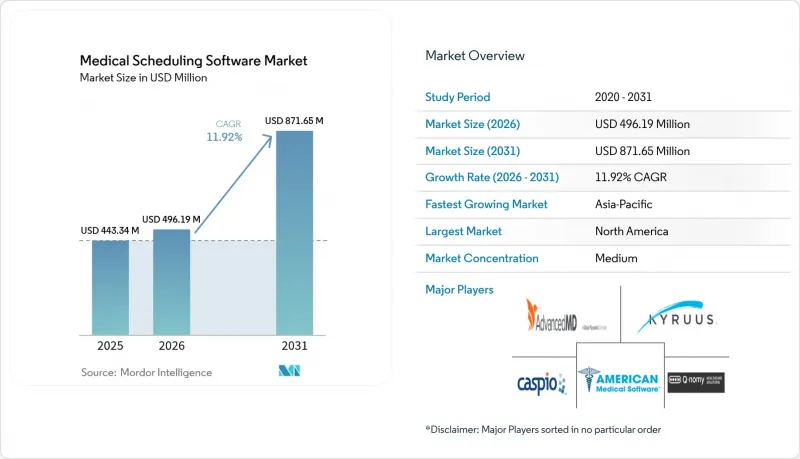
Mordor Intelligence에 의하면, 2026년 의료 스케줄링 소프트웨어 시장 규모는 4억 9,619만 달러로 추정되고 있어 2025년 4억 4,334만 달러에서 확대해, 2031년에는 8억 7,165만 달러에 이를 것으로 예측됩니다.
2026년부터 2031년까지 연평균 성장률(CAGR)은 11.92%를 나타낼 것으로 전망됩니다.
본 보고서는 제품 유형(환자 예약, 의료진 예약, 기타),도입 모델(클라우드 기반, On-Premise형, 하이브리드형), 최종 사용자(병원, 진료소, 외래수술센터(ASC) 등), 전문 분야(1차 진료, 치과, 행동·정신 건강, 기타) 및 지역(북미 등)별로 분류되어 있습니다. 시장 전망은 금액(달러) 기준으로 제시되어 있습니다.
세계 의료 스케줄링 소프트웨어 시장 동향 및 인사이트
워크플로우의 효율적인 관리 및 최적화에 대한 수요 증가
수동 예약 조정은 평균적인 외래 진료 시설에서월최대 반나절의 관리 업무 시간을 소모하고 있으며, 이에 따라 경영진은 템플릿 작성, 대기 목록 처리 및 자원 균형 조정의 자동화를 추진하고 있습니다. 플로리다주에 본사를 둔 한 의료 시스템은 교대 근무 계획 주기를 3영업일에서 4시간 미만으로 단축함으로써 계약 인건비를 200만 달러 절감했습니다. 또한, 예측 기반 스케줄링 도입을 통해 대규모 학술 의료 센터에서는 인건비를 8% 절감하는 동시에 의료 제공업체의 만족도도 향상시켰습니다. 경영진은 스케줄링 효율화를 순영업이익률 향상, 직원 번아웃 억제, 환자 처리 능력 향상을 위한 중요한 수단으로 점점 더 중요하게 여기고 있습니다.
환자 중심 진료 모델의 확산
미국 소비자 10명 중 8명은 온라인 예약을 선호하며, 셀프 서비스 예약의 절반 이상은 신규 환자가 차지합니다. 디지털의 편의성 덕분에 예약 무단 취소 위험은 17% 감소했으며, 진료소의 신규 환자 유치 경로는 3분의 1 이상 확대되었습니다. 밀레니얼 세대가 여전히 가장 빈번하게 이용하고 있지만, 셀프 스케줄링 포털을 통해 이루어진 예약의 40% 가까이는 40세 이상 환자가 차지합니다. 따라서 웹사이트나 모바일 앱에 실시간 예약 가능 여부 표시 및 자동 알림 기능을 탑재한 의료 기관은 신규 환자 유치와 기존 환자 유지 두 가지 지표 모두에서 다른 기관보다 뛰어난 성과를 거두고 있습니다.
데이터 보안 침해 및 사이버 공격의 위험
의료 기록은 여전히 다크웹에서 가장 가치가 높은 데이터 범주이며, 정보 유출 건수는 3년 연속 증가하고 있습니다. 보안에 대한 우려로 인해 클라우드로의 전환을 진행하지 않은 의료 기관의 60%가 예약 관리 시스템의 클라우드 전환을 주저하고 있습니다. HIPAA, GDPR(EU 개인정보보호규정) 및 미국 각 주에서 제정되고 있는 개인정보 보호법에서는 다층 암호화, 역할 기반 접근 제어 및 감사 추적이 요구되고 있습니다. 정보 유출 사고 복구 비용은 건당 950만 달러에 달할 수 있으며, 그 결과 신규 도입을 위한 예산이 압박받고 있습니다. 따라서 SOC 2 및 HITRUST 인증을 유지하고 있는 벤더들은 경쟁 우위를 점하고 있습니다.
부문 분석
2025년, 병원이 환자의 원활한 접근을 우선시한 결과, 환자 예약 부문은 매출의 58.25%를 차지하며 의료 예약 소프트웨어 시장 전체에서 가장 큰 점유율을 기록했습니다. 현재 플랫폼에는 AI 기반 제안 기능이 통합되어 있어, 의사와 환자의 최적의 매칭을 제안함으로써 진료 완료율을 9% 향상시키고 있습니다. CAGR 12.64%로 가장 빠르게 성장하고 있는 ‘의료 제공업체 스케줄링’ 분야에서는 중증도 점수와 직원의 기술 세트를 대조하는 모듈을 활용하여 인력 부족으로 인한 불이익을 줄이고 있습니다.
통합업체들은 두 모듈을 결합하는 사례가 증가하고 있으며, 이를 통해 빈 의료 제공업체 슬롯이 환자에게 자동으로 표시되어 수요 관리와 수용 능력 관리가 통합되고 있습니다. 고급 의료 제공업체 스케줄링 제품군은 근무 시간 준수 현황, 피로 지수, 면허 관련 경고를 모니터링하여 품질 관리를 한층 더 강화하고 있습니다. 이러한 기능을 묶어 제공하는 벤더들은 제안 요청서(RFP) 심사 과정에서 특히 여러 시간대에 걸쳐 운영되는 통합 의료 네트워크(IDN) 사이에서 타사와의 차별화를 꾀하고 있습니다.
퍼블릭 클라우드로의 확장은 2025년 매출의 69.10%를 차지하며, 의료 스케줄링 소프트웨어 시장의 기본 인프라로서 클라우드의 입지를 공고히 하고 있습니다. 멀티테넌트 아키텍처는 분기별 기능 출시를 가속화하고, 버전 간 차이를 최소화하며, 옴니채널 환자 참여를 위한 API 툴킷을 제공합니다. 그럼에도 불구하고, 의료 서비스 제공업체가 기밀성이 높은 임상의 급여 데이터를 On-Premise에서 격리하는 한편, 소비자 대상 워크플로를 하이퍼스케일 데이터센터로 이전함에 따라 하이브리드 모델 시장 규모는 연평균 성장률(CAGR) 12.70%로 성장할 전망입니다.
병원 데이터룸에 위치한 엣지 컴퓨팅 노드는 지연에 민감한 이미지 업로드나 수술의 실시간 업데이트를 처리하는 반면, 일괄 분석 및 AI 훈련은 클라우드에서 실행됩니다. 이러한 분리를 통해 대역폭 제약이 완화될 뿐만 아니라, 현재 전 세계 65개 이상의 관할 구역에서 시행되고 있는 국내 데이터 거주 관련 법규 준수를 지원합니다. 워크로드 배치를 원활하게 조정할 수 있는 벤더는 계약 기간 연장 및 순추천지수(NPS) 향상을 실현하고 있습니다.
지역별 분석
북미는 EHR(전자 건강 기록)의 보급이 진행되고 있는 점, 전자 워크플로우를 권장하는 보험사의 보상 요건, 그리고 AI 시범 운영을 본환경으로 확대하고자 하는 통합 병원 네트워크를 배경으로, 2025년에는 전 세계 매출의 42.10%를 차지했습니다. Epic Systems는 Cadence 도입 시설을 176곳 늘린 반면, Oracle Health는 시장 점유율이 하락하여 스케줄링 모듈의 성능에 따른 성장세 변화를 엿볼 수 있습니다. 그러나 Tier 1 의료 시스템의 포화 상태로 인해 라이선스 단계적 확대가 둔화되고 있으며, 비용에 민감한 지방 병원들이 보다 가벼운 SaaS 신규 진출기업을 시험해 볼 여지가 생기고 있습니다.
유럽에서는 e-헬스에 대한 협력적인 규제와 국경을 초월한 상호 운용성을 목표로 한 투자에 힘입어 안정적인 한 자릿수 성장을 보이고 있습니다. 각국 수준의 개인정보 보호법에 따라 설정 가능한 동의 추적 기능과 환자를 위한 현지 언어 지원 화면이 필수적입니다. 영국의 국민보건서비스(NHS) 트러스트는 최근 개방형 예약 API를 의무화하고, 표준 준수에 중점을 둔 공급업체 평가 기준을 강화했습니다. 팬데믹 이후 재구축을 추진 중인 동유럽의 진료소에서는 성과 연계형 계약과 결합된 구독 모델의 도입이 점점 더 늘어나고 있습니다.
연평균 성장률(CAGR) 13.02%로 예측되는 아시아태평양은 여전히 가장 큰 성장 지역입니다. 인도와 인도네시아에서는 공공 및 민간 자금이 결합되어, 견고한 IT 팀을 갖추지 못한 중규모 병원을 위한 클라우드 예약 시스템에 보조금이 지급되고 있습니다. 중국의 ‘스마트 병원 계획’ 3단계에서는 성(省) 수도의 의료 센터에서 AI 트리아지 및 실시간 예약 대시보드에 예산이 배정되었습니다. 현지 데이터 거주지 관련 법률에 따라 국내 클라우드 제공업체와의 제휴가 진행되고 있으며, 다국적 벤더들은 국내 호스팅을 지원하기 위해 코드를 재구축해야 하는 상황에 직면해 있습니다.
중동에서는 걸프협력회의(GCC) 회원국 병원들의 전자건강기록(EHR) 도입률이 75%를 넘어, 엔터프라이즈 스케줄링 시스템과의 연동 길이 열리며 새로운 활기를 보이고 있습니다. 아프리카와 남미는 여전히 발전 단계에 있지만, 혁신의 ‘샌드박스’로서 예약과 연동된 차량 호출 서비스가 결합된 모바일 우선 예약 앱 등이 존재하며, 통신 환경이 개선된다면 기존의 데스크톱형 시스템을 비약적으로 능가할 가능성이 있습니다.
기타 혜택:
- 엑셀 형식 시장 예측(ME) 시트
- 3개월간의 애널리스트 지원
자주 묻는 질문
목차
제1장 서론
제2장 조사 방법
제3장 주요 요약
제4장 시장 구도
제5장 시장 규모와 성장 예측
제6장 경쟁 구도
제7장 시장 기회와 향후 전망
JHS 26.08.28According to Mordor Intelligence, the medical scheduling software market size in 2026 is estimated at USD 496.19 million, growing from 2025 value of USD 443.34 million with 2031 projections showing USD 871.65 million, growing at 11.92% CAGR over 2026-2031.
This report is Segmented by Product Type (Patient Scheduling, Care Provider Scheduling, Others), Deployment Model (Cloud-Based, On-Premise, Hybrid), End User (Hospitals, Clinics, Ambulatory Surgical Centers, and More), Specialty (Primary Care, Dentistry, Behavioral and Mental Health, Others), and Geography (North America, and More). The Market Forecasts are Provided in Terms of Value (USD).
Global Medical Scheduling Software Market Trends and Insights
Increasing Demand to Efficiently Manage & Optimize Workflow
Manual appointment coordination consumes up to half a day of administrative time per month in the average ambulatory facility, driving leaders to automate template creation, wait-list handling, and resource balancing. A Florida-based health system saved USD 2 million in contract labor by shrinking the shift-planning cycle from three business days to less than four hours. Predictive scheduling has also dropped labor costs 8% at large academic centers, while simultaneously lifting provider satisfaction scores. Executives increasingly view streamlined scheduling as a lever to bolster net operating margins, curb staff burnout, and improve patient throughput .
Rising Adoption of Patient-Centric Care Models
Eight in ten U.S. consumers prefer to set appointments online, and more than half of self-service bookings originate from new patients. Digital convenience lowers missed-visit risk by 17% and enlarges clinics' new-patient funnel by over one-third. Millennials remain the most prolific users, yet nearly 40% of bookings placed through self-scheduling portals come from patients aged >40 years. Providers that embed real-time slot visibility and automated reminders into websites and mobile apps are therefore outpacing peers on both acquisition and retention metrics.
Risk of Data Security Breaches & Cyber-Attacks
Health records remain the most valuable data category on the dark web, and breaches rose for a third consecutive year. Security fears deter 60% of non-migrated providers from moving scheduling to the cloud. HIPAA, GDPR, and emerging U.S. state privacy laws demand multi-layer encryption, role-based access, and audit trails. Breach remediation can cost USD 9.5 million per incident, diverting budgets away from new deployments. Vendors that maintain SOC 2 and HITRUST certifications are consequently gaining a competitive edge.
Other drivers and restraints analyzed in the detailed report include:
- Accelerated Shift Toward Cloud-Native Healthcare IT Stacks
- Expansion of Telehealth & Remote Consultations
- Shortage of Skilled Health-IT Professionals
For complete list of drivers and restraints, kindly check the Table Of Contents.
Segment Analysis
The patient-scheduling segment generated 58.25% revenue in 2025-the highest within the medical scheduling software market size-as hospitals prioritized frictionless consumer access. Platforms now embed AI suggestions to propose optimal physician-patient matches, boosting completed-visit ratios by 9%. Care-provider scheduling, the fastest-expanding niche at 12.64% CAGR, benefits from modules that map acuity scores against staffing skillsets to reduce understaffing penalties.
Integrators increasingly combine both modules so a vacant provider slot automatically surfaces to patients, uniting demand and capacity management. Advanced provider-scheduling suites supervise duty-hour compliance, fatigue indices, and licensure alerts, further tightening quality control. Vendors that bundle these capabilities are differentiating in request-for-proposal (RFP) cycles, especially among IDNs operating across multiple time zones.
Public-cloud rollouts contributed 69.10% of 2025 revenue, reinforcing cloud as the default backbone of the medical scheduling software market. Multitenant architectures accelerate quarterly feature drops, keep version skew low, and provide API toolkits for omnichannel patient engagement. Nonetheless, hybrid models will climb at 12.70% CAGR as providers isolate sensitive clinician payroll data on-premise while steering consumer-facing workflows toward hyperscale data centers.
Edge-compute nodes inside hospital data rooms handle latency-sensitive image uploads or real-time surgery updates, while bulk analytics and AI training run in the cloud. This split mitigates bandwidth constraints and supports national-data-residency statutes now active in 65+ jurisdictions worldwide. Vendors able to orchestrate workload placement seamlessly are seeing longer contract tenures and higher net-promoter scores.
Complete Report Scope:
- By Product Type
- Patient Scheduling
- Care Provider Scheduling
- Others
- By Deployment Model
- Cloud-Based
- On-Premise
- Hybrid
- By End User
- Hospitals
- Clinics
- Ambulatory Surgical Centers
- Telehealth Providers
- Others
- By Specialty
- Primary Care
- Dentistry
- Behavioral and Mental Health
- Others
- By Geography
- North America
- United States
- Canada
- Mexico
- Europe
- Germany
- United Kingdom
- France
- Italy
- Spain
- Rest of Europe
- Asia-Pacific
- China
- Japan
- India
- Australia
- South Korea
- Rest of Asia-Pacific
- Middle East and Africa
- GCC
- South Africa
- Rest of Middle East and Africa
- South America
- Brazil
- Argentina
- Rest of South America
- North America
Geography Analysis
North America commanded 42.10% of global revenue in 2025 on the strength of mature EHR penetration, payer reimbursement mandates favoring electronic workflows, and a consolidated hospital network eager to scale AI pilots into production. Epic Systems added 176 facilities to its Cadence install base, while Oracle Health lost ground, illustrating momentum shifts based on scheduling-module performance. Yet saturation among tier-one health systems is slowing incremental license expansion, opening space for cost-conscious regional hospitals to experiment with lighter SaaS entrants.
Europe posts stable single-digit growth underpinned by coordinated e-health regulations and investments targeting cross-border interoperability. Country-level privacy statutes necessitate configurable consent tracking and in-language patient-facing screens. National Health Service trusts in the United Kingdom recently mandated open-Booking APIs, elevating vendor scoring criteria focused on standards adherence. Eastern European clinics, retooling post-pandemic, increasingly adopt subscription models bundled with outcome-based contracting.
Asia-Pacific, forecast at 13.02% CAGR, remains the prime acceleration zone. Public-private funding blends in India and Indonesia subsidize cloud scheduling for mid-size hospitals lacking robust IT teams. China's smart-hospital plan Phase III earmarks budget for AI triage and real-time scheduling dashboards in provincial centers. Local data-residency laws drive partnerships with domestic cloud providers, requiring multinational vendors to refactor code for onshore hosting.
The Middle East shows emergent momentum as Gulf Cooperation Council hospitals surpass 75% EHR adoption, paving the way for enterprise scheduling tie-ins. Africa and South America remain nascent but feature innovation sandboxes-mobile-first booking apps bundled with appointment-linked ride services-that could leapfrog legacy desktop systems once connectivity improves.
- PatientStudio
- Yocale Network
- Tinivia
- 10to8
- American Medical Software
- Kyruus
- Caspio
- AdvancedMD
- Q-nomy
- Terminapp
- SuperSaaS
- Biosoftworld Medical Software
- Vocantas
- Epic Systems
- Oracle Health (Cerner)
- AthenaHealth
- Qgenda
- PerfectServe
- Zocdoc
- Relatient
- NextGen Healthcare
- eClinicalWorks
- Meditech
Additional Benefits:
- The market estimate (ME) sheet in Excel format
- 3 months of analyst support
TABLE OF CONTENTS
1 Introduction
- 1.1 Study Assumptions & Market Definition
- 1.2 Scope of the Study
2 Research Methodology
3 Executive Summary
4 Market Landscape
- 4.1 Market Overview
- 4.2 Market Drivers
- 4.2.1 Increasing demand to efficiently manage & optimize workflow
- 4.2.2 Rising adoption of patient-centric care models
- 4.2.3 Accelerated shift toward cloud-native healthcare IT stacks
- 4.2.4 Expansion of telehealth & remote consultations
- 4.2.5 AI-driven dynamic capacity management adoption
- 4.2.6 Real-time insurance-verification integration
- 4.3 Market Restraints
- 4.3.1 Risk of data security breaches & cyber-attacks
- 4.3.2 Shortage of skilled health-IT professionals
- 4.3.3 Fragmented interoperability across specialty EHRs
- 4.3.4 Price-deflation from freemium scheduling apps
- 4.4 Regulatory Landscape
- 4.5 Porters Five Forces Analysis
- 4.5.1 Threat of New Entrants
- 4.5.2 Bargaining Power of Buyers
- 4.5.3 Bargaining Power of Suppliers
- 4.5.4 Threat of Substitute Products
- 4.5.5 Intensity of Competitive Rivalry
5 Market Size & Growth Forecasts (Value, USD)
- 5.1 By Product Type
- 5.1.1 Patient Scheduling
- 5.1.2 Care Provider Scheduling
- 5.1.3 Others
- 5.2 By Deployment Model
- 5.2.1 Cloud-Based
- 5.2.2 On-Premise
- 5.2.3 Hybrid
- 5.3 By End User
- 5.3.1 Hospitals
- 5.3.2 Clinics
- 5.3.3 Ambulatory Surgical Centers
- 5.3.4 Telehealth Providers
- 5.3.5 Others
- 5.4 By Specialty
- 5.4.1 Primary Care
- 5.4.2 Dentistry
- 5.4.3 Behavioral and Mental Health
- 5.4.4 Others
- 5.5 By Geography
- 5.5.1 North America
- 5.5.1.1 United States
- 5.5.1.2 Canada
- 5.5.1.3 Mexico
- 5.5.2 Europe
- 5.5.2.1 Germany
- 5.5.2.2 United Kingdom
- 5.5.2.3 France
- 5.5.2.4 Italy
- 5.5.2.5 Spain
- 5.5.2.6 Rest of Europe
- 5.5.3 Asia-Pacific
- 5.5.3.1 China
- 5.5.3.2 Japan
- 5.5.3.3 India
- 5.5.3.4 Australia
- 5.5.3.5 South Korea
- 5.5.3.6 Rest of Asia-Pacific
- 5.5.4 Middle East and Africa
- 5.5.4.1 GCC
- 5.5.4.2 South Africa
- 5.5.4.3 Rest of Middle East and Africa
- 5.5.5 South America
- 5.5.5.1 Brazil
- 5.5.5.2 Argentina
- 5.5.5.3 Rest of South America
- 5.5.1 North America
6 Competitive Landscape
- 6.1 Market Concentration
- 6.2 Market Share Analysis
- 6.3 Company Profiles (includes Global level Overview, Market level overview, Core Segments, Financials as available, Strategic Information, Market Rank/Share for key companies, Products & Services, and Recent Developments)
- 6.3.1 PatientStudio
- 6.3.2 Yocale Network Corporation
- 6.3.3 Tinivia
- 6.3.4 10to8 Ltd.
- 6.3.5 American Medical Software
- 6.3.6 Kyruus
- 6.3.7 Caspio
- 6.3.8 AdvancedMD, Inc.
- 6.3.9 Q-nomy Inc.
- 6.3.10 Terminapp GmbH
- 6.3.11 SuperSaaS
- 6.3.12 Biosoftworld Medical Software
- 6.3.13 Vocantas Inc.
- 6.3.14 Epic Systems Corporation
- 6.3.15 Oracle Health (Cerner)
- 6.3.16 AthenaHealth
- 6.3.17 Qgenda
- 6.3.18 PerfectServe
- 6.3.19 Zocdoc
- 6.3.20 Relatient
- 6.3.21 NextGen Healthcare
- 6.3.22 eClinicalWorks
- 6.3.23 MEDITECH
7 Market Opportunities & Future Outlook
- 7.1 White-space & Unmet-Need Assessment


