

|
시장보고서
상품코드
2116512
마이크로 RNA 시장 : 점유율 분석, 업계 동향과 통계, 성장 예측(2026-2031년)MicroRNA - Market Share Analysis, Industry Trends & Statistics, Growth Forecasts (2026 - 2031) |
||||||
 Mordor Intelligence
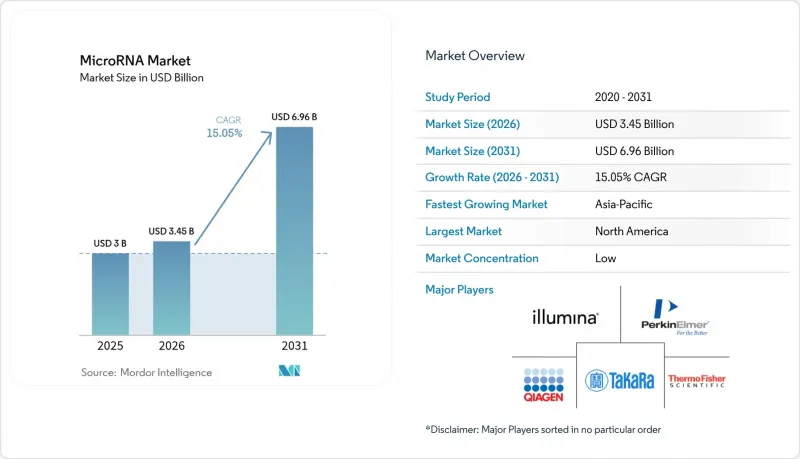
Mordor Intelligence에 의하면, 마이크로 RNA 시장 규모는 2025년에 30억 달러로 평가되었고 2026년 34억 5,000만 달러에서 2031년까지 69억 6,000만 달러에 이를 것으로 예측되며, 예측 기간(2026-2031년) CAGR은 15.05%를 나타낼 전망입니다.
본 보고서에서는 업계를 기술별(실시간 중합효소 연쇄반응, 마이크로어레이, 차세대 염기서열 분석(NGS), 면역측정법),용도별(암, 면역 질환, 감염증, 심혈관 질환 등), 최종 사용자별(학술·연구 기관, 바이오의약품 기업, 수탁 연구 기관 등), 그리고 지역별로 분류하고 있습니다.
전 세계 마이크로 RNA 시장 동향 및 인사이트
만성 질환 및 암 발병률 증가
만성 질환은 계속 증가하고 있으며, 2024년에는 암만으로도 1,000만 명의 사망자가 발생할 것으로 예상되어, 이에 따라 마이크로 RNA 기반의 진단법 및 치료법에 대한 수요가 높아지고 있습니다. 새로운 연구 결과에 따르면, miR-4454 등의 마이크로 RNA는 2형 당뇨병 검출에서 AUC 0.889를 보였으며, 대사성 질환 분야에서 그 잠재력이 주목받고 있습니다. 심혈관계 연구에서는 관상동맥 미세색전증 후 심근 손상을 조절하는 마이크로 RNA가 확인되어, 기존 치료법을 뛰어넘는 치료법의 가능성이 시사되고 있습니다. 이처럼 질환의 범위가 확대됨에 따라 암 치료에 대한 의존도가 낮아지고, 고소득국의 고령화 사회 및 신흥 시장의 생활습관성 질환에 대한 예방의학적 노력이 뒷받침되고 있습니다.
정밀 분자진단 및 액체 생검의 급속한 보급
마이크로 RNA 시그니처를 이용한 체액 생검 분석법은 9가지 암에서 90%의 민감도를 달성하면서도 99%의 특이도를 유지하고 있습니다. 비침습적 검사는 췌장암 등 발생률은 낮지만 치사율이 높은 종양의 선별 검사에서 존재하던 공백을 메우고 있습니다. 소변 내 miR-210-3p는 조기 발견에서 82.8%의 민감도와 74.3%의 특이도를 달성하고 있습니다. 진단센터에서는 이러한 분석법을 단백질 마커 및 영상 진단과 결합하여 활용하고 있으며, 일상적인 도입이 가속화되고 있습니다. AI를 활용한 시그니처 발견을 통해 분석 시간이 단축되고 정확도가 향상되어, 데이터 분석에 머신러닝을 도입한 검사 기관에 선구자적 우위를 제공합니다.
miRNA 치료제의 전달 및 안정성 과제
간 이외의 조직으로의 특이적 전달을 실현하는 것은 여전히 어려운 과제입니다. 지질 나노입자는 순환계 내에서 급속히 분해되기 때문에 투여량 증가나 독성 증대를 초래합니다. 단일 마이크로 RNA가 여러 신호 전달 경로를 조절하기 때문에 의도파관 않은 생리학적 영향을 피하기 위해서는 정밀한 설계가 요구됩니다. 현재 연구는 약동학 개선을 목표로 하는 이온화 가능한 고분자 운반체나 생분해성 링커로 초점을 옮기고 있습니다. 이러한 기술적 격차는 광범위한 전신 적응증의 실현을 지연시키는 한편, 차세대 전달 시스템을 제공하는 스타트업 기업들 간의 혁신을 촉진하고 있습니다.
부문 분석
2025년, 서비스 부문은 miRNA 시장 점유율의 47.78%를 차지했으며, 지출액은 14억 3,000만 달러에 달했습니다. 이는 연구소가 추출, 정량, 바이오인포매틱스 워크플로우를 계약 연구 기관(CRO)에 위탁했기 때문입니다. 높은 자본 진입 장벽, 인력 부족, 그리고 멀티오믹스 데이터 분석의 복잡성이 심화됨에 따라, 연구 기관 및 생명공학 기업들은 사내 체제를 구축하기보다는 외부 전문 지식을 활용하는 추세입니다. CRO는 ?랩(wet lab) 실험과 AI를 활용한 분석을 결합한 패키지형 서비스 제공을 확대하며 고객 유지율을 높이고 있습니다.
‘키트 및 시약’은 2031년까지 연평균 성장률(CAGR) 15.92%를 기록하며 가장 빠르게 성장하는 카테고리입니다. 표준화되어 즉시 사용할 수 있는 소모품은 프로토콜의 편차를 줄이고 처리 시간을 단축하기 때문에 중규모 임상 실험실에서의 도입 확대를 가능하게 하고 있습니다. 혁신적인 실리콘 카바이드 스핀 컬럼 및 자성 비드를 활용한 화학 기술로 수율과 순도가 향상되어, 다운스트림 공정인 NGS 및 RT-qPCR을 뒷받침하고 있습니다. 장비는 중앙 집중식 핵심 시설에 여전히 필수적이지만, 높은 단가와 긴 교체 주기가 성장을 저해하고 있습니다. 주요 공급업체들은 자동 액체 처리 및 클라우드 네이티브 소프트웨어와 같은 모듈식 업그레이드를 통해 제품 라인업을 쇄신하고, 자산의 수명을 연장하면서 처리 능력을 향상시키고 있습니다.
실시간 PCR은 규제 측면에서의 정착도, 확장 가능한 처리 능력, 그리고 임상 실험실에서의 사용 편의성 덕분에 2025년에는 총 매출의 38.25%를 차지했습니다. LNA 강화 프라이머와 한 번의 실행으로 수십 개의 표적을 다중 분석할 수 있는 마이크로플루이딕스 칩을 통해 감도는 지속적으로 향상되고 있습니다.
마이크로어레이 플랫폼은 이미 성숙한 기술이지만, 탐색적 연구나 시퀀싱 깊이를 확보하는 데 비용이 많이 드는 원형 RNA 분석 분야에서 경제적인 전체 패널 프로파일링을 제공함으로써 15.54%라는 가장 높은 연평균 성장률(CAGR)을 기록하고 있습니다. 프로브 설계 및 염료 화학 분야의 혁신으로 인해, 대규모 코호트 스크리닝이 필요한 학술 연구자 및 CRO 사이에서 다시 주목받고 있습니다. NovaSeq X와 같은 장비에서는 염기당 비용이 낮아지고 있으며, 높은 처리량과 탐색적 연구 및 임상 검증 모두에 적합한 유연한 레인 구성을 겸비하고 있어 NGS의 점유율이 확대되고 있습니다.
지역별 분석
북미는 성숙한 생명공학 생태계, NIH 및 벤처 기업들의 막대한 자금 지원, 그리고 혁신적인 올리고뉴클레오티드 치료제를 우선시하는 FDA의 프로그램에 힘입어 2025년에는 전 세계 매출의 41.72%를 차지했습니다. 액체 생검 및 동반 진단을 포괄하는 환급 체계 덕분에 병원에서의 신속한 도입이 촉진되고 있습니다.
아시아태평양은 2031년까지 연평균 성장률(CAGR)이 16.95%에 달하고, 가장 빠르게 성장하는 지역이 될 것으로 예측됩니다. 중국, 일본, 한국의 각 정부는 RNA 연구 인프라에 대해 매칭 보조금 및 세제 혜택 조치를 제공하고 있는 반면, 위탁 개발·제조 기관(CDMO)은 비용 효율적인 공급망을 활용하여 전 세계의 스폰서를 유치하고 있습니다. 만성 질환 유병률 증가와 인구 고령화가 맞물리면서 조기 발견 검사에 대한 수요가 높아지고 있습니다. 국내 기업들은 간염과 위암을 중심으로 한 질환 프로파일에 맞춘 검사법을 개발하고 있으며, 국가약품감독관리국(NMPA) 및 의약품 및 의료기기청(PMDA)의 개혁을 통해 규제 승인 절차를 구축하고 있습니다.
유럽은 ‘호라이즌(Horizon)’ 프로그램의 자금 지원을 받는 컨소시엄, 첨단 임상시험 네트워크, 그리고 다기관 바이오마커 검증을 촉진하는 일관된 데이터 보호 규정을 통해 강력한 시장 지위를 유지하고 있습니다. ARTHEx Biotech의 최근 4,200만 유로 규모의 자금 조달 라운드는 이 지역에 본사를 둔 마이크로 RNA 표적 치료제에 대한 벤처 기업의 강한 관심을 보여줍니다. 중동 및 아프리카 및 남미는 여전히 발전 단계에 있지만, 미래가 기대되고 있습니다. 3차 의료 병원 및 검사실 자동화에 대한 지출 증가가 마이크로 RNA 진단의 점진적인 확대를 위한 기반을 마련하고 있습니다.
기타 혜택:
- 엑셀 형식 시장 예측(ME) 시트
- 3개월간의 애널리스트 지원
자주 묻는 질문
목차
제1장 서론
제2장 조사 방법
제3장 주요 요약
제4장 시장 구도
제5장 시장 규모와 성장 예측
제6장 경쟁 구도
제7장 시장 기회와 향후 전망
JHS 26.08.28According to Mordor Intelligence, the micro RNA market size was valued at USD 3.00 billion in 2025 and estimated to grow from USD 3.45 billion in 2026 to reach USD 6.96 billion by 2031, at a CAGR of 15.05% during the forecast period (2026-2031).
This report Segments the Industry Into by Technology (Real Time Polymerase Chain Reaction, Microarray, Next Generation Sequencing (NGS), Immunoassay), by Application (Cancer, Immunological Disorder, Infectious Diseases, Cardiovascular Disease, and More), by End-User (Academic and Research Institutes, Biopharmaceutical Companies, Contract Research Organizations, and More) and Geography.
Global MicroRNA Market Trends and Insights
Rising prevalence of chronic & oncological diseases
Chronic illnesses continue to rise, with cancer alone causing 10 million deaths in 2024, amplifying demand for microRNA-based diagnostics and therapeutics . Emerging evidence shows microRNAs such as miR-4454 yielding an AUC of 0.889 for type 2 diabetes detection, spotlighting metabolic disease potential. Cardiovascular research indicates microRNAs regulating myocardial injury post-coronary microembolization, pointing to treatments beyond existing care. This widening disease spectrum reduces dependence on oncology and supports preventive medicine initiatives across aging populations in high-income countries and lifestyle-driven morbidity in emerging markets.
Rapid adoption of precision molecular diagnostics & liquid biopsy
Liquid biopsy assays using microRNA signatures now reach 90% sensitivity across nine cancers while maintaining 99% specificity. Non-invasive tests fill screening gaps for low-incidence yet deadly tumors such as pancreatic cancer; urinary miR-210-3p achieves 82.8% sensitivity and 74.3% specificity for early detection . Diagnostic centers integrate these assays alongside protein markers and imaging, accelerating routine adoption. AI-enhanced signature discovery shortens analysis time and boosts accuracy, granting first-mover advantage to laboratories embedding machine learning into data interpretation.
Delivery & stability challenges for miRNA therapeutics
Achieving tissue-specific delivery beyond the liver remains elusive. Lipid nanoparticles degrade rapidly in circulation, driving up dosage and toxicity. Single microRNAs modulate multiple pathways, demanding precision engineering to avoid unintended physiology. Research now pivots to ionizable polymer carriers and bioreducible linkers seeking enhanced pharmacokinetics. The technical gap delays broad systemic indications but spurs innovation among startups offering next-generation vehicles.
Other drivers and restraints analyzed in the detailed report include:
- Intensifying R&D funding and strategic partnerships in miRNA therapeutics
- Advancements in NGS & RT-qPCR platforms for small-RNA analysis
- Regulatory fast-track / orphan-drug incentives for oligonucleotide drugs
- AI-enabled multi-omics pipelines and exosome-based miRNA assays
- Safety and off-target toxicity concerns
For complete list of drivers and restraints, kindly check the Table Of Contents.
Segment Analysis
Services held 47.78% micro RNA market share in 2025, equal to USD 1.43 billion of spending, as laboratories outsourced extraction, quantification, and bioinformatics workflows to contract research organizations (CROs). High capital barriers, talent shortages, and the rising complexity of multi-omic data interpretation encourage research institutes and biotech firms to tap external expertise rather than build internal capacity. CROs expand bundled offerings that marry wet-lab testing with AI-assisted analytics, reinforcing stickiness.
Kits & Reagents form the fastest-growing category at a 15.92% CAGR through 2031. Standardized, ready-to-use consumables shrink protocol variability and reduce turnaround time, enabling wider adoption by mid-tier clinical labs. Innovative silicon-carbide spin columns and magnetic bead chemistries improve yield and purity, supporting downstream NGS or RT-qPCR. Instruments remain essential for centralized core facilities, yet high unit costs and long replacement cycles temper growth. Major vendors refresh portfolios with modular upgrades-automated liquid handling, cloud-native software-that extend asset life while boosting throughput.
Real-Time PCR accounted for 38.25% of total revenue in 2025 due to regulatory familiarity, scalable throughput, and ease of use in clinical labs. Sensitivity continues to climb through LNA-enhanced primers and microfluidic chips capable of multiplexing dozens of targets per run.
Microarray platforms, although matured, log the highest 15.54% CAGR by offering economical whole-panel profiling for exploratory studies and circular RNA analyses where sequencing depth proves costly. Innovations in probe design and dye chemistry revive interest among academic researchers and CROs requiring large cohort screens. NGS gains ground through falling per-base costs on instruments such as NovaSeq X, which marry high throughput with flexible lane configurations suitable for both discovery and clinical validation use cases.
Complete Report Scope:
- By Product & Service
- Kits & Reagents
- Instruments
- Services
- By Technology
- Real-Time PCR
- Microarray
- Next-Generation Sequencing (NGS)
- Immunoassay
- Northern Blotting
- In-situ Hybridization (ISH)
- By Application
- Cancer
- Cardiovascular Disease
- Neurological Disease
- Infectious Diseases
- Immunological Disorders
- Other Applications
- By End-User
- Biopharmaceutical Companies
- Diagnostic Centers
- Hospitals & Clinics
- Others
- By Geography
- North America
- United States
- Canada
- Mexico
- Europe
- Germany
- United Kingdom
- France
- Italy
- Spain
- Rest of Europe
- Asia-Pacific
- China
- Japan
- India
- Australia
- South Korea
- Rest of Asia-Pacific
- Middle East & Africa
- GCC
- South Africa
- Rest of Middle East & Africa
- South America
- Brazil
- Argentina
- Rest of South America
- North America
Geography Analysis
North America contributed 41.72% of global revenue in 2025 underpinned by a mature biotechnology ecosystem, sizable NIH and venture funding, and FDA programs that prioritize innovative oligonucleotide therapeutics. Reimbursement frameworks covering liquid biopsy and companion diagnostics facilitate rapid hospital uptake.
Asia-Pacific is forecast as the fastest-growing region at 16.95% CAGR to 2031. Governments in China, Japan, and South Korea offer matching grants and tax incentives for RNA research infrastructure, while contract development and manufacturing organizations leverage cost-efficient supply chains to attract global sponsors. Rising chronic disease prevalence, together with aging demographics, lifts demand for early detection tests. Domestic firms tailor assays for hepatitis- and gastric cancer-heavy disease profiles, building regulatory pathways through National Medical Products Administration and Pharmaceuticals and Medical Devices Agency reforms.
Europe maintains strong market positioning through Horizon-funded consortia, sophisticated clinical trial networks, and cohesive data-protection rules that facilitate multi-center biomarker validation. ARTHEx Biotech's latest EUR 42 million round illustrates venture appetite for microRNA-targeting therapeutics headquartered in the region. Middle East & Africa and South America remain nascent but promising; increased expenditure on tertiary care hospitals and laboratory automation sets the foundation for gradually expanding microRNA diagnostics.
- Thermo Fisher Scientific
- QIAGEN
- Illumina
- Agilent Technologies
- Merck
- NanoString Technologies Inc.
- Horizon Discovery
- GeneCopoeia
- OriGene Technologies
- Norgen Biotek
- Regulus Therapeutics Inc.
- Miragen Therapeutics Inc.
- Biorchestra Co. Ltd.
- Mirxes Pte Ltd.
- TransCode Therapeutics Inc.
- Quantabio
- Miltenyi Biotec
- LGC Biosearch Technologies
Additional Benefits:
- The market estimate (ME) sheet in Excel format
- 3 months of analyst support
TABLE OF CONTENTS
1 Introduction
- 1.1 Study Assumptions & Market Definition
- 1.2 Scope of the Study
2 Research Methodology
3 Executive Summary
4 Market Landscape
- 4.1 Market Overview
- 4.2 Market Drivers
- 4.2.1 Rising prevalence of chronic & oncological diseases
- 4.2.2 Rapid adoption of precision molecular diagnostics & liquid biopsy
- 4.2.3 Intensifying R&D funding and strategic partnerships in miRNA therapeutics
- 4.2.4 Advancements in NGS & RT-qPCR platforms for small-RNA analysis
- 4.2.5 Regulatory fast-track / orphan-drug incentives for oligonucleotide drugs
- 4.2.6 AI-enabled multi-omics pipelines and exosome-based miRNA assays
- 4.3 Market Restraints
- 4.3.1 Delivery & stability challenges for miRNA therapeutics
- 4.3.2 Safety and off-target toxicity concerns
- 4.3.3 Patent expiry of first-generation miRNA assay technologies
- 4.3.4 Batch-to-batch variability in synthetic miRNA reagents
- 4.4 Value / Supply-Chain Analysis
- 4.5 Technological Outlook
- 4.6 Regulatory Landscape
- 4.7 Porter's Five Forces Analysis
- 4.7.1 Threat of New Entrants
- 4.7.2 Bargaining Power of Buyers/Consumers
- 4.7.3 Bargaining Power of Suppliers
- 4.7.4 Threat of Substitute Products
- 4.7.5 Intensity of Competitive Rivalry
5 Market Size & Growth Forecasts (Value, USD)
- 5.1 By Product & Service
- 5.1.1 Kits & Reagents
- 5.1.2 Instruments
- 5.1.3 Services
- 5.2 By Technology
- 5.2.1 Real-Time PCR
- 5.2.2 Microarray
- 5.2.3 Next-Generation Sequencing (NGS)
- 5.2.4 Immunoassay
- 5.2.5 Northern Blotting
- 5.2.6 In-situ Hybridization (ISH)
- 5.3 By Application
- 5.3.1 Cancer
- 5.3.2 Cardiovascular Disease
- 5.3.3 Neurological Disease
- 5.3.4 Infectious Diseases
- 5.3.5 Immunological Disorders
- 5.3.6 Other Applications
- 5.4 By End-User
- 5.4.1 Biopharmaceutical Companies
- 5.4.2 Diagnostic Centers
- 5.4.3 Hospitals & Clinics
- 5.4.4 Others
- 5.5 By Geography
- 5.5.1 North America
- 5.5.1.1 United States
- 5.5.1.2 Canada
- 5.5.1.3 Mexico
- 5.5.2 Europe
- 5.5.2.1 Germany
- 5.5.2.2 United Kingdom
- 5.5.2.3 France
- 5.5.2.4 Italy
- 5.5.2.5 Spain
- 5.5.2.6 Rest of Europe
- 5.5.3 Asia-Pacific
- 5.5.3.1 China
- 5.5.3.2 Japan
- 5.5.3.3 India
- 5.5.3.4 Australia
- 5.5.3.5 South Korea
- 5.5.3.6 Rest of Asia-Pacific
- 5.5.4 Middle East & Africa
- 5.5.4.1 GCC
- 5.5.4.2 South Africa
- 5.5.4.3 Rest of Middle East & Africa
- 5.5.5 South America
- 5.5.5.1 Brazil
- 5.5.5.2 Argentina
- 5.5.5.3 Rest of South America
- 5.5.1 North America
6 Competitive Landscape
- 6.1 Market Concentration
- 6.2 Market Share Analysis
- 6.3 Company Profiles (includes Global level Overview, Market level overview, Core Segments, Financials as available, Strategic Information, Market Rank/Share for key companies, Products & Services, and Recent Developments)
- 6.3.1 Thermo Fisher Scientific Inc.
- 6.3.2 QIAGEN N.V.
- 6.3.3 Illumina Inc.
- 6.3.4 Agilent Technologies Inc.
- 6.3.5 Merck KGaA (Sigma-Aldrich)
- 6.3.6 NanoString Technologies Inc.
- 6.3.7 Horizon Discovery Ltd.
- 6.3.8 GeneCopoeia Inc.
- 6.3.9 OriGene Technologies Inc.
- 6.3.10 Norgen Biotek Corp.
- 6.3.11 Regulus Therapeutics Inc.
- 6.3.12 Miragen Therapeutics Inc.
- 6.3.13 Biorchestra Co. Ltd.
- 6.3.14 Mirxes Pte Ltd.
- 6.3.15 TransCode Therapeutics Inc.
- 6.3.16 Quantabio
- 6.3.17 Miltenyi Biotec
- 6.3.18 LGC Biosearch Technologies
7 Market Opportunities & Future Outlook
- 7.1 White-space & Unmet-need Assessment


