|
시장보고서
상품코드
2116515
제품 설계 및 개발 : 시장 점유율 분석, 업계 동향 및 통계, 성장 예측(2026-2031년)Product Design And Development - Market Share Analysis, Industry Trends & Statistics, Growth Forecasts (2026 - 2031) |
||||||
 Mordor Intelligence
Mordor Intelligence에 의하면, 제품 설계 및 개발 시장 규모는 2025년 134억 9,000만 달러로 평가되었습니다. 2026년에는 142억 7,000만 달러로 확대되어 2031년까지 186억 1,000만 달러에 이른다고 전망되고 있어 2026년부터 2031년에 걸쳐 CAGR 5.45%를 나타낼 것으로 예측됩니다.
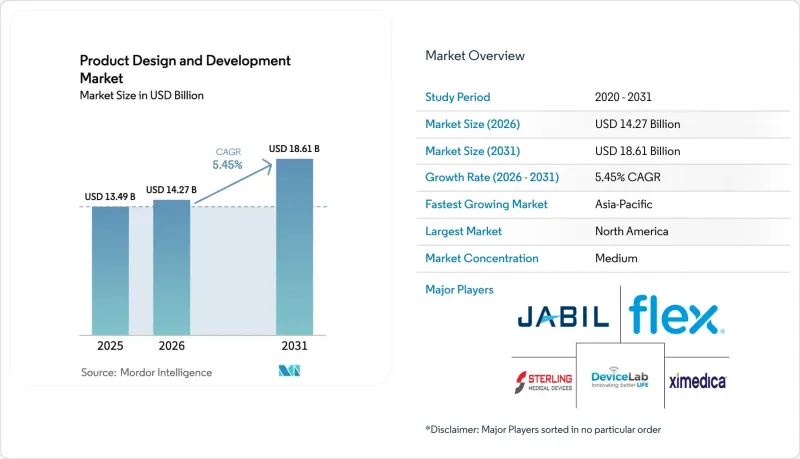
본 보고서는 서비스 유형별(조사, 전략·컨셉 수립, 컨셉·요구사항 수립 등), 용도별(진단 기기, 치료 기기, 임상 검사 기기 등), 최종 사용자별(의료기기 제조업체 등), 지역별(북미, 유럽, 아시아태평양, 중동 및 아프리카, 남미)로 분류되어 있습니다. 시장 예측은 금액(달러)으로 표시되어 있습니다.
세계의 제품 설계 및 개발 시장 동향 및 인사이트
AI를 활용한 설계 자동화 플랫폼이 컨셉에서 프로토타입에 이르는 사이클 타임을 단축
생성 알고리즘은 몇 시간 만에 수천 개의 형상을 반복 처리하여, 과거에는 수 주간에 걸쳐 수작업으로 진행되던 CAD 작업을 통해 강도, 생체 적합성, 제조성을 최적화합니다. 510(k) 승인의 신속화를 원하는 병원들은 첫 번째 시제품의 리드 타임을 최대 35% 단축할 수 있는 공급업체를 선호하고 있습니다. 소규모 스타트업 기업들은 사내에 엔지니어링 부서를 통째로 설립하는 대신, 클라우드 시뮬레이션을 활용하여 제품 설계 및 개발 시장에 진출하고 있습니다. 이러한 접근 방식을 통해 자재 낭비를 20% 이상 줄일 수 있을 뿐만 아니라, ISO 14971에 기반한 위험 관리 하에서 조기 검증도 지원합니다. 규제 당국은 AI로 생성된 설계 근거를 어떻게 문서화해야 하는지에 대해 아직 명확한 규정을 마련하지 않아, 설계 이력 파일(DHF) 요건에 불확실성이 발생하고 있습니다.
임베디드 및 웨어러블 기기의 소형화에는 고도의 시스템 엔지니어링이 요구됩니다.
연속 혈당 모니터, 루프 레코더, 신경 자극 장치의 경우, 현재 멀티 센서 어레이, 안테나, 충전식 배터리가 10g 미만의 케이스에 담겨 있습니다. 정밀 마이크로 어셈블리에서는 반도체 기술과 의료용 봉지 기술이 결합되어 있으며, 설계 회사는 RF 엔지니어, 재료 과학자, 인체공학 전문가를 채용하고 있습니다. 원격 환자 모니터링의 보상 모델을 지원하는 패치형 바이오센서의 등장으로 이러한 수요는 더욱 증가하고 있습니다. ISO 14708 능동형 임플란트 규격에는 전자기 호환성(EMC) 및 배터리 안전성 요건이 추가되었으며, 많은 OEM 제조업체는 이러한 업무를 외부에 위탁하는 것을 선호합니다. 보험사가 조기 개입에 대해 보상을 지급하게 됨에 따라 웨어러블 기기의 출하 대수가 증가하고 있으며, 이는 제품 설계 및 개발 시장에 장기적인 호재가 되고 있습니다.
사이버 보안에 대한 법적 책임이 커짐에 따라 설계 IP 공유에 대한 소극적인 태도가 나타나고 있습니다.
2025년에는 의료 분야의 랜섬웨어 공격이 전년 대비 19% 증가했으며, 그중 일부 사례는 타사 펌웨어의 취약점으로 인해 발생했습니다. OEM 업체들은 현재 에어 갭 방식의 개발 환경을 의무화하고, 계약업체의 코드 보유를 금지하고 있으며, 이로 인해 각 반복 작업에 몇 주간의 지연이 발생하고 있습니다. 설계 회사의 배상 책임 보험료는 30-40% 상승했으며, 보험사는 현재 ISO 27001 인증에 더해 연 1회의 침투 테스트를 의무화하고 있습니다. 규정 준수 비용은 소규모 컨설팅 회사에 부담을 주고, 협업을 지연시키며, 제품 설계 및 개발 시장의 성장을 둔화시키고 있습니다. FDA의 지침 초안에서는 소프트웨어 부품 목록(SBOM)과 취약점 공개 프로토콜이 의무화되어 있어, 모든 이해관계자에게 문서화 부담이 증가하고 있습니다.
부문별 분석
규제 당국이 사용성, 소프트웨어 타당성 확인 및 실제 증거에 대한 감시를 강화함에 따라 서비스 구성은 계속해서 검증으로 전환되고 있습니다. 설계 및 프로세스 검증은 2031년까지 연평균 성장률(CAGR) 6.96%를 나타낼 것으로 예측됩니다. FDA의 인체공학 지침에 따라 현재 대표 사용자를 대상으로 한 형성적 및 총괄적 조사가 의무화되어, 이로 인해 일반적인 검증 예산에 15만-30만 달러가 추가되고 있습니다. 이와 병행하여 설계 업계에서는 AI를 활용한 테스트 자동화가 도입되어, 정해진 일정 내에서 반복 횟수를 늘리면서 1회당 비용을 절감하고 있습니다. 따라서 소프트웨어를 많이 사용하는 의료기기의 경우, 시판 후에도 지속적인 위험 모니터링이 필요하기 때문에 검증 서비스 분야의 제품 설계 및 개발 시장 규모는 확대될 전망입니다.
2025년에는 설계·프로세스 검증 부문이 매출의 34.81%를 차지했으며, 이는 초기 단계의 아이디어 창출, 실현 가능성 평가 및 초기 아키텍처 정의에 대한 견조한 수요를 반영한 것입니다. 그러나 OEM 기업들은 자금 조달이 확실해질 때까지 대규모 컨셉 프로그램을 미루는 경우가 많아 매출에 변동이 발생하지만, 설계 회사는 출시 후 라이프사이클 최적화에 주력함으로써 이를 보완하고 있습니다. 예를 들어, Jabil사는 2025년에 라이프사이클 서비스가 의료기기 관련 매출의 18%를 차지했다고 보고했습니다. 고객이 생산을 저비용 지역으로 이전할 때, 파일럿 생산에서 양산으로의 전환은 여전히 매우 중요하며, ISO 14644 클린룸 표준에 기반한 공정 검증에는 고액의 수수료가 부과됩니다. 규제 당국의 기대가 높아지는 가운데, 통합된 품질 관리 시스템을 갖춘 서비스 제공업체는 검증 및 전환 과정을 보다 효율적으로 마무리할 수 있어, 이를 통해 제품 설계 및 개발 시장에서 경쟁력을 강화할 수 있습니다.
지역별 분석
북미는 2025년 매출의 39.24%를 차지했으며, OEM 본사가 밀집된 생태계, 벤처 자금, 그리고 설계 파트너가 효율적으로 진행할 수 있는 투명성이 높은 FDA 승인 절차가 이를 뒷받침하고 있습니다. 고객들은 고도로 복잡한 임플란트 및 클래스 III 로봇 기기에 대한 현지 설계 지원을 중요하게 여기고 있으며, 그 결과 프로젝트의 평균 계약 금액은 세계 평균보다 25% 높습니다. 또한, 미국의 제품 설계 및 개발 시장 규모는 원격 모니터링 기기의 보급을 가속화하고, 재택 사용을 목적으로 한 설계 개편 프로젝트를 촉진하는 메디케어(Medicare)의 환급 제도의 혜택도 받고 있습니다.
아시아태평양은 2031년까지 연평균 성장률(CAGR) 8.73%를 나타낼 것으로 예측되며, 이는 지역별로는 가장 높은 성장세입니다. 중국 규제 당국은 국내 지적 재산권에 대한 신속한 심사 절차의 지원을 받아 2025년에 87건의 혁신적인 클래스 III 의료기기를 승인했습니다. APAC 지역의 여러 거점에서 ISO 13485 인증을 획득한 설계 회사는 고객이 중복된 서류 작성 없이 미국, EU, 중국에 동시 신청을 요청함에 따라 구조적인 우위를 확보하고 있습니다.
유럽에서는 의료기기 규정(MDR) 및 체외진단 의료기기 규정(IVDR)에 따른 병목 현상이 성장의 걸림돌이 되고 있습니다. 인증 기관의 업무 처리 지연으로 인해 2025년에는 CE 마크 취득까지 소요되는 리드타임이 24개월로 늘어났으며, 일부 OEM 업체들은 미국이나 아시아태평양에서의 출시를 우선시할 수밖에 없는 상황입니다. 그럼에도 불구하고, 사전에 인증을 받은 품질 관리 시스템을 갖춘 전문 컨설팅 기업들은 MDR의 엄격한 요건을 효율적으로 충족함으로써 시장 점유율을 확대되고 있습니다. 중동, 아프리카 및 남미에서는 병원 수용 능력 확대가 진단 기기 및 외과용 기구에 대한 완만한 수요를 견인하고 있습니다. 브라질의 ANVISA가 FDA 및 EU 기준을 준수함에 따라 신청 서류의 재사용이 간소화되어 국경을 초월한 설계 프로젝트가 촉진되고 있습니다. GCC 국가들은 현지 조달을 조건으로 한 설계 파트너십을 장려하는 의료기기 산업 단지에 자금을 지원하고 있으며, 이를 통해 제품 설계 및 개발 시장의 장기적인 목표 시장이 확대되고 있습니다.
기타 혜택 :
- 엑셀 형식 시장 예측(ME) 시트
- 3개월간 애널리스트 지원
자주 묻는 질문
목차
제1장 서론
제2장 조사 방법
제3장 개요
제4장 시장 구도
제5장 시장 규모 및 성장 예측
제6장 경쟁 구도
제7장 시장 기회 및 향후 전망
KTH 26.08.31According to Mordor Intelligence, the product design and development market size is expected to increase from USD 13.49 billion in 2025 to USD 14.27 billion in 2026 and reach USD 18.61 billion by 2031, growing at a CAGR of 5.45% over 2026-2031.
This report is Segmented by Service Type (Research, Strategy & Concept Generation, Concept & Requirements Development, and More), Application (Diagnostic Equipment, Therapeutic Equipment, Clinical Laboratory Equipment, and More), End User (Medical-Device Manufacturer, and More), and Geography (North America, Europe, Asia-Pacific, MEA, South America). The Market Forecasts are in Value (USD).
Global Product Design And Development Market Trends and Insights
AI-Enabled Design-Automation Platforms Reduce Concept-to-Prototype Cycle Time
Generative algorithms iterate thousands of geometries in hours, optimizing for strength, biocompatibility, and manufacturability that once required weeks of manual CAD effort. Hospitals seeking faster 510(k) clearances favor suppliers who slash first-article lead times by up to 35%. Smaller startups are now entering the product design and development market with cloud simulations rather than establishing whole internal engineering departments. The approach also cuts material waste by more than 20% and supports early verification under ISO 14971 risk management. Regulators have yet to codify how AI-generated design rationale must be documented, adding uncertainty to Design History File requirements.
Miniaturization of Implantable & Wearable Devices Demands Advanced Systems Engineering
Continuous glucose monitors, loop recorders, and neurostimulators now package multisensor arrays, antennas, and rechargeable batteries into sub-10 g footprints. Precision micro-assembly combines semiconductor techniques with medical-grade encapsulation, prompting design houses to recruit RF engineers, materials scientists, and human factors specialists. Demand is amplified by patch-based biosensors that support remote patient monitoring reimbursement models. ISO 14708 active-implant standards add electromagnetic compatibility and battery safety layers that most OEMs prefer to outsource. As payers reimburse earlier interventions, wearable volumes expand, fortifying a long-term tailwind for the product design and development market.
Rising Cybersecurity Liability Drives Reluctance to Share Design IP
Health-sector ransomware attacks increased by 19% year-over-year in 2025, with several incidents attributed to vulnerabilities in third-party firmware. OEMs now require air-gapped development environments and prohibit contractors from retaining code, which adds weeks to each iteration. Liability insurance premiums for design houses have increased by 30-40%, and underwriters now require ISO 27001 certification, as well as annual penetration testing. Compliance costs strain small consultancies and delay collaborations, tempering growth in the product design and development market. Draft FDA guidance mandates a software bill of materials and vulnerability disclosure protocols, heightening documentation overhead for all parties.
Other drivers and restraints analyzed in the detailed report include:
- Med-Tech Venture Capital Funding Surge in Robotics & Cardiovascular Devices
- OEM Pivot to Asset-Light Models Outsourcing Design to Control R&D Burn
- Talent Deficit in ISO 13485 Systems Engineers Inflates Project Cost
For complete list of drivers and restraints, kindly check the Table Of Contents.
Segment Analysis
The service-mix continues to pivot toward verification as regulators intensify scrutiny of usability, software validation, and real-world evidence. Design & process verification is projected to grow at a 6.96% CAGR through 2031. FDA human-factors guidance now mandates formative and summative studies with representative users, adding USD 150,000-USD 300,000 to typical verification budgets. In parallel, the design community embeds AI-driven test automation, lowering per-iteration costs while increasing the number of iterations within fixed timelines. The product design and development market size for verification services is therefore set to expand as software-heavy devices require continuous risk monitoring even after commercial launch.
The design & process verification segment accounted for 34.81% of revenue in 2025, reflecting robust demand for early-stage ideation, feasibility, and initial architecture definition. However, OEMs often postpone large-scale concept programs until financing is secured, introducing revenue lumpiness that design houses offset by engaging in post-launch lifecycle optimization. Jabil, for example, reported that lifecycle services accounted for 18% of its medical device revenue in 2025. Pilot-to-volume manufacturing transfer remains crucial when clients shift production to low-cost regions; process validation under ISO 14644 cleanroom standards commands premium fees. As regulatory expectations intensify, service providers with integrated quality management systems can close verification and transfer loops more efficiently, thereby strengthening their competitive position within the product design and development market.
Complete Report Scope:
- By Service Type
- Research, Strategy & Concept Generation
- Concept & Requirements Development
- Design & Process Development
- Design & Process Verification
- Pilot-to-Volume Manufacturing Transfer
- Post-Launch Lifecycle Optimisation
- By Application
- Diagnostic Equipment
- Therapeutic Equipment
- Clinical Laboratory Equipment
- Surgical Equipment
- Consumables & Disposables
- Digital & Connected Health Solutions
- By End User
- Medical-Device Manufacturer
- Pharmaceutical & Biopharmaceutical Firms
- Contract Research & Manufacturing Organisations
- By Geography
- North America
- United States
- Canada
- Mexico
- Europe
- Germany
- United Kingdom
- France
- Italy
- Spain
- Rest of Europe
- Asia-Pacific
- China
- Japan
- India
- Australia
- South Korea
- Rest of Asia-Pacific
- Middle East & Africa
- GCC
- South Africa
- Rest of Middle East & Africa
- South America
- Brazil
- Argentina
- Rest of South America
- North America
Geography Analysis
North America accounted for 39.24% of 2025 revenue, supported by a dense ecosystem of OEM headquarters, venture funding, and a transparent FDA path that design partners navigate efficiently. Clients prize local design support for high-complexity implants and Class III robotics, leading to average project values 25% above global norms. The product design and development market size in the United States also benefits from Medicare reimbursement that accelerates adoption of remote-monitoring devices and stimulates design refresh projects directed at home use.
Asia-Pacific is projected to grow at 8.73% CAGR through 2031, the highest regional pace. China's regulator approved 87 innovative Class III devices in 2025, aided by expedited pathways for domestic intellectual property. India's Production-Linked Incentive scheme offers 5% rebates on incremental sales, prompting multinationals to establish engineering hubs in Bangalore and Hyderabad. South Korea's fast-track review program for AI-driven diagnostics further boosts regional demand. Design firms with ISO 13485 certificates across multiple APAC sites gain a structural edge as clients seek simultaneous U.S., EU, and China submissions without redundant documentation.
Europe faces growth headwinds from Medical Device Regulation (MDR) and In-Vitro Diagnostic Regulation (IVDR) bottlenecks. Notified-body queues stretched CE-marking lead times to 24 months in 2025, causing some OEMs to prioritize U.S. or APAC launches. Nevertheless, specialist consultancies with pre-certified quality management systems win share by navigating MDR rigor efficiently. In the Middle East & Africa and South America, hospital capacity expansion drives modest demand for diagnostic and surgical instrumentation. Brazil's ANVISA alignment with FDA and EU standards simplifies dossier reuse, fostering cross-border design engagements. GCC countries fund medical-device industrial zones that reward local-content design partnerships, broadening the long-term addressable base for the product design and development market.
- Aran Biomedical
- Cambridge Consultants
- Cambridge Design Partnership
- Celestica
- Cirtec Medical
- Delve
- Devicelab
- Donatelle
- Exponent Inc.
- Flex
- Integer Holdings Corp.
- Jabil
- Nordson Medical
- Planet Innovation
- Plexus Corp.
- StarFish Medical
- Sterling Medical Devices
- TE Connectivity
- TTP plc
- Viant
- Ximedica (Veranex)
Additional Benefits:
- The market estimate (ME) sheet in Excel format
- 3 months of analyst support
TABLE OF CONTENTS
1 Introduction
- 1.1 Study Assumptions & Market Definition
- 1.2 Scope of the Study
2 Research Methodology
3 Executive Summary
4 Market Landscape
- 4.1 Market Overview
- 4.2 Market Drivers
- 4.2.1 AI-Enabled Design-Automation Platforms Reduce Concept-To-Prototype Cycle-Time
- 4.2.2 Miniaturisation of Implantable & Wearable Devices Demands Advanced Systems-Engineering
- 4.2.3 Med-Tech VC Funding Surge in Robotics & Cardiovascular Devices
- 4.2.4 OEM Pivot to Asset-Light Models Outsourcing Design to Control R&D Burn
- 4.2.5 Regulatory Harmonisation Favours Specialist Design Partners
- 4.2.6 Sustainability Mandates Push Eco-Design & Circular-Economy Services
- 4.3 Market Restraints
- 4.3.1 Rising Cybersecurity Liability Drives Reluctance to Share Design IP
- 4.3.2 Talent Deficit in ISO 13485 Systems-Engineers Inflates Project Cost
- 4.3.3 Fragmented Data Interoperability Standards Slow Software-Heavy Device Programmes
- 4.3.4 Inflationary Metals & Electronics Pricing Erodes Design-To-Value Gains
- 4.4 Value / Supply-Chain Analysis
- 4.5 Regulatory Landscape
- 4.6 Technological Outlook
- 4.7 Porter's Five Forces Analysis
- 4.7.1 Threat of New Entrants
- 4.7.2 Bargaining Power of Buyers
- 4.7.3 Bargaining Power of Suppliers
- 4.7.4 Threat of Substitutes
- 4.7.5 Competitive Rivalry
5 Market Size & Growth Forecasts
- 5.1 By Service Type
- 5.1.1 Research, Strategy & Concept Generation
- 5.1.2 Concept & Requirements Development
- 5.1.3 Design & Process Development
- 5.1.4 Design & Process Verification
- 5.1.5 Pilot-to-Volume Manufacturing Transfer
- 5.1.6 Post-Launch Lifecycle Optimisation
- 5.2 By Application
- 5.2.1 Diagnostic Equipment
- 5.2.2 Therapeutic Equipment
- 5.2.3 Clinical Laboratory Equipment
- 5.2.4 Surgical Equipment
- 5.2.5 Consumables & Disposables
- 5.2.6 Digital & Connected Health Solutions
- 5.3 By End User
- 5.3.1 Medical-Device Manufacturer
- 5.3.2 Pharmaceutical & Biopharmaceutical Firms
- 5.3.3 Contract Research & Manufacturing Organisations
- 5.4 By Geography
- 5.4.1 North America
- 5.4.1.1 United States
- 5.4.1.2 Canada
- 5.4.1.3 Mexico
- 5.4.2 Europe
- 5.4.2.1 Germany
- 5.4.2.2 United Kingdom
- 5.4.2.3 France
- 5.4.2.4 Italy
- 5.4.2.5 Spain
- 5.4.2.6 Rest of Europe
- 5.4.3 Asia-Pacific
- 5.4.3.1 China
- 5.4.3.2 Japan
- 5.4.3.3 India
- 5.4.3.4 Australia
- 5.4.3.5 South Korea
- 5.4.3.6 Rest of Asia-Pacific
- 5.4.4 Middle East & Africa
- 5.4.4.1 GCC
- 5.4.4.2 South Africa
- 5.4.4.3 Rest of Middle East & Africa
- 5.4.5 South America
- 5.4.5.1 Brazil
- 5.4.5.2 Argentina
- 5.4.5.3 Rest of South America
- 5.4.1 North America
6 Competitive Landscape
- 6.1 Market Concentration
- 6.2 Market Share Analysis
- 6.3 Company Profiles (includes Global level Overview, Market level overview, Core Segments, Financials as available, Strategic Information, Market Rank/Share for key companies, Products & Services, and Recent Developments)
- 6.3.1 Aran Biomedical
- 6.3.2 Cambridge Consultants
- 6.3.3 Cambridge Design Partnership
- 6.3.4 Celestica Inc.
- 6.3.5 Cirtec Medical
- 6.3.6 Delve
- 6.3.7 DeviceLab Inc.
- 6.3.8 Donatelle
- 6.3.9 Exponent Inc.
- 6.3.10 Flex Ltd.
- 6.3.11 Integer Holdings Corp.
- 6.3.12 Jabil Inc.
- 6.3.13 Nordson Medical
- 6.3.14 Planet Innovation
- 6.3.15 Plexus Corp.
- 6.3.16 StarFish Medical
- 6.3.17 Sterling Medical Devices
- 6.3.18 TE Connectivity
- 6.3.19 TTP plc
- 6.3.20 Viant
- 6.3.21 Ximedica (Veranex)
7 Market Opportunities & Future Outlook
- 7.1 White-Space & Unmet-Need Assessment