

|
시장보고서
상품코드
2116529
외음부통 치료 : 시장 점유율 분석, 업계 동향 및 통계, 성장 예측(2026-2031년)Vulvodynia Treatment - Market Share Analysis, Industry Trends & Statistics, Growth Forecasts (2026 - 2031) |
||||||
 Mordor Intelligence
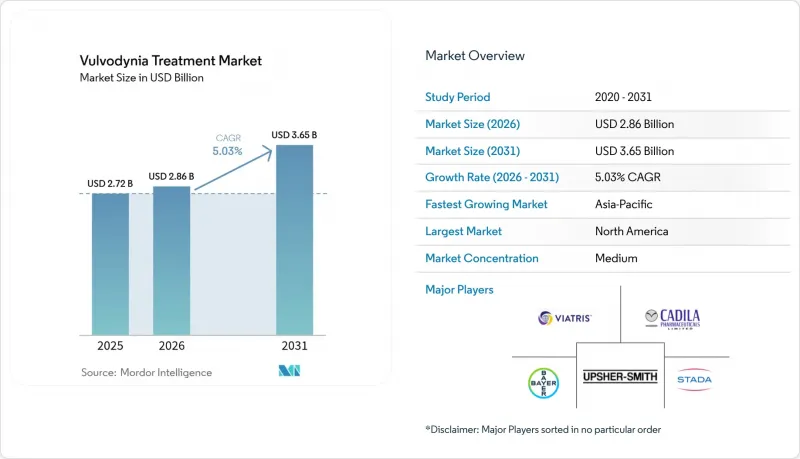
외음부통 치료 시장 규모는 2026년에 28억 6,000만 달러로 추정되고 2025년 27억 2,000만 달러에서 확대해, 2031년에는 36억 5,000만 달러에 이를 것으로 예측됩니다.
2026년부터 2031년까지 연평균 성장률(CAGR) 5.03%로 성장할 것으로 전망됩니다.
본 보고서는 약물 분류별(국소 마취제, 항경련제, 삼환계 항우울제, SNRI, 호르몬 요법, 기타),투여 경로(외용, 경구, 주사, 기타), 유통 채널(병원 약국, 소매 약국 및 드럭스토어, 온라인 약국), 지역(북미, 유럽, 기타)별로 분류되어 있습니다. 시장 예측은 금액(미 달러) 기준으로 제시되어 있습니다.
세계의 외음부통 치료 시장 동향 및 인사이트
유병률 상승 및 진단율 향상
임상 조사에 따르면, 외음부통의 평생 유병률은 8%에서 16% 사이로 추정되지만, 이 수치는 진단의 모호성으로 인해 오랫동안 과소평가되어 왔습니다. 미국 산부인과 학회(ACOG)의 새로운 지침에서는 정기적인 골반 내 검사 시 표준화된 통증 평가를 권장하고 있어, 사례의 조기 발견이 촉진되고 있습니다. 미국 및 독일의 외음부·질 질환 전문 클리닉에서는 검증된 통증 평가 척도를 전자의무기록에 도입한 결과, 검출률이 40%-60% 향상되었다고 보고되고 있습니다. 검출률 향상으로 환자층이 확대되면서, 국소 치료 및 전신 치료에 걸친 파이프라인에 대한 투자가 촉진되고 있습니다.
국소 마취제의 사용 확대
5% 리도카인 제제는 전신성 부작용 없이 신속한 통증 완화를 가져오기 때문에 여전히 1차 선택 약물로 사용되고 있습니다. 전문 조제 기업들은 현재 리도카인에 프리로카인이나 가바펜틴을 배합하여, 장기적인 진통이 필요한 환자의 15%를 대상으로 하고 있습니다. 미국피부과학회(AAD) 보고에 따르면, FDA와의 적극적인 협력을 통해 2024년 리도카인 부족 사태가 해소되어 국소 마취제의 안정적인 공급 체계가 회복되었습니다.
FDA 승인 외음부통 특이적 약물의 부재
치료제는 적응증 외 사용으로 처방되고 있어 보험 급여의 불확실성이 발생하고, 판촉 활동도 제약을 받고 있습니다. 듀크 대학교에서 여성 400명을 대상으로 진행 중인 미국 국립보건원(NIH)의 비교 연구는 직접 비교를 통한 근거 확립을 목표로 하고 있으나, 최종 결과가 밝혀지는 것은 2027년 이후가 될 전망입니다. 규제상의 공백으로 인해 신규 분자의 도입이 지연되고 있으며, 임상적 필요성이 높음에도 불구하고 외음부통 치료 시장의 성장 가능성이 둔화되고 있습니다.
부문별 분석
이 부문은 2025년에 37.85%의 점유율을 기록하며, 국소적이고 신속한 통증 완화를 제공하는 리도카인을 중심으로 한 치료법에 대한 꾸준한 지지를 입증했습니다. 의료진의 신뢰와 환자의 익숙함이 지속되고 있다는 점을 고려할 때, 이러한 선도적 지위는 앞으로도 유지될 전망입니다. 그러나 SNRI(세로토닌·노르아드레날린 재흡수 억제제)는 5.61%라는 가장 높은 연평균 성장률(CAGR)을 보이고 있으며, 이는 두록세틴이 중추적인 통증 전달 경로를 조절하고 동반된 기분 장애를 개선한다는 증거가 늘어나고 있음을 반영합니다. 항경련제는 틈새 시장에서 중요한 위치를 유지하고 있지만, 가바펜틴 및 프레가발린과 관련된 심혈관계 안전성 경고로 인해 단기적인 성장 가속화는 억제되고 있습니다. 아미트립틸린을 필두로 한 삼환계 항우울제는 59.3%의 반응률에 힘입어 안정적인 수요를 보이고 있습니다. 호르몬 요법, 특히 폐경 후 외음부통에 대한 국소용 에스트라디올은 지지하는 증거가 늘어남에 따라 임상의의 치료 선택지에 다시 포함되고 있습니다.
국소 마취제에 대한 지속적인 선호는 리도카인·프릴로카인 복합제를 조제하는 견고한 조제 생태계를 조성하고 있으며, 이를 통해 치료 경로에서 약사의 참여가 강화되고 있습니다. 한편, 생명공학 기업들은 골반저근 경련에 대한 보툴리눔툭신(보톡스) 등의 주사제 혁신을 추구하고 있습니다. 이러한 새로운 치료법은 점차 시장 점유율을 확대할 가능성이 있지만, 시술에 대한 학습 곡선을 고려할 때 임상의에 대한 교육이 필수적일 것입니다.
지역별 분석
북미는 외음부통 클리닉의 밀집된 네트워크, 학술 연구 자금, 그리고 증거 기반 치료에 대한 보험사의 폭넓은 적용을 원동력으로 2025년 매출의 41.88%를 차지했습니다. 국경을 초월한 원격의료 협력을 통해 대기 목록이 단축되고 있는 한편, 여성 건강 관련 의약품에 대한 FDA의 패스트트랙 지정은 해당 지역의 파이프라인을 더욱 활성화시킬 가능성이 있습니다.
아시아태평양은 2031년까지 연평균 성장률(CAGR) 6.75%를 나타낼 것으로 예측되며, 이는 전 세계에서 가장 높은 성장률입니다. 가처분 소득 증가, 성 건강에 대한 이야기를 자연스럽게 다룰 수 있도록 하는 공공 캠페인, 그리고 스마트폰 보급의 가속화가 맞물려 온라인 진료 및 온라인 약국에 대한 접근성이 확대되고 있습니다. 중국과 인도의 정부 주도 여성 건강 프로그램은 골반저 치료 시범 프로젝트에 자금을 지원하고 있어 정책적 추진력을 보여주고 있습니다.
유럽에서는 국민건강보험 제도를 기반으로 안정적인 성장을 유지하고 있습니다. 임상시험 실시 빈도는 독일과 영국이 가장 높지만, 엄격한 보험 급여 심사로 인해 고가의 혁신 의약품 도입은 둔화되고 있습니다. 남미, 중동 및 아프리카는 여전히 초기 단계에 있습니다. 도시 지역이 발달한 브라질에서는 민간 여성 건강 클리닉이 증가하는 반면, 사하라 이남 아프리카의 농촌 지역에서는 문화적 금기와 의료 인력 부족에 직면해 있습니다.
기타 혜택 :
- 엑셀 형식 시장 예측(ME) 시트
- 3개월간의 애널리스트 지원
자주 묻는 질문
목차
제1장 서론
제2장 조사 방법
제3장 개요
제4장 시장 구도
제5장 시장 규모 및 성장 예측
제6장 경쟁 구도
제7장 시장 기회 및 향후 전망
KTH 26.08.31According to Mordor Intelligence, vulvodynia treatment market size in 2026 is estimated at USD 2.86 billion, growing from 2025 value of USD 2.72 billion with 2031 projections showing USD 3.65 billion, growing at 5.03% CAGR over 2026-2031.
This report is Segmented by Drug Class (Local Anesthetics, Anticonvulsants, Tricyclic Antidepressants, Snris, Hormonal Therapies, Others), Route of Administration (Topical, Oral, Injectable, Others), Distribution Channel (Hospital Pharmacies, Retail Pharmacies & Drug Stores, Online Pharmacies), and Geography (North America, Europe, and More). The Market Forecasts are Provided in Terms of Value (USD).
Global Vulvodynia Treatment Market Trends and Insights
Rising Prevalence and Better Diagnosis Rates
Clinical surveys now place lifetime vulvodynia prevalence between 8% and 16%, a figure long underestimated because of diagnostic ambiguity. New American College of Obstetricians and Gynecologists guidelines promote standardized pain assessment during routine pelvic exams, pushing earlier case recognition. Dedicated vulvovaginal disorder clinics in the United States and Germany report 40%-60% higher detection after embedding validated pain scales into electronic health records. Heightened detection broadens the patient base, incentivizing pipeline investment across topical and systemic therapies.
Greater Adoption of Topical Anesthetics
A 5% lidocaine formulation remains the frontline agent because it delivers quick relief without systemic adverse events. Specialty compounding firms now combine lidocaine with prilocaine or gabapentin, responding to 15% of patients who require extended analgesia. The American Academy of Dermatology reported that proactive FDA engagement solved the 2024 lidocaine shortage, restoring a stable supply chain for topical anesthetics.
Absence of FDA-Approved Vulvodynia-Specific Drugs
Therapies are prescribed off-label, creating reimbursement uncertainty and constraining promotional activities. A National Institutes of Health comparative study enrolling 400 women at Duke University seeks to generate head-to-head evidence but final results will not emerge before 2027. The regulatory vacuum slows uptake of novel molecules, dampening the vulvodynia treatment market growth potential despite strong clinical need.
Other drivers and restraints analyzed in the detailed report include:
- Expansion of E-commerce and Tele-prescribing
- Awareness Campaigns by Women's-Health NGOs
- Limited Reimbursement for Multimodal Regimens
For complete list of drivers and restraints, kindly check the Table Of Contents.
Segment Analysis
The segment registered a 37.85% share in 2025, underscoring the entrenched preference for lidocaine-centered regimens that offer localized and rapid relief. This leadership is poised to persist given continued physician confidence and patient familiarity. However, SNRIs post the fastest 5.61% CAGR, reflecting mounting evidence that duloxetine modulates central pain pathways and improves comorbid mood disorders. Anticonvulsants maintain niche relevance, though cardiovascular safety alerts for gabapentin and pregabalin temper near-term acceleration. Tricyclic antidepressants, led by amitriptyline, exhibit stable demand supported by 59.3% responder rates. Hormonal therapies, notably topical estradiol for post-menopausal vulvodynia, re-enter clinician toolkits as supportive evidence grows.
Continued preference for local anesthetics feeds a robust compounding ecosystem that crafts lidocaine-prilocaine blends, thereby reinforcing pharmacist engagement in care pathways. Meanwhile, biotechnology firms pursue injectable innovations such as botulinum toxin for spastic pelvic-floor musculature. These novel modalities could capture incremental share but will rely on clinician education given procedural learning curves.
Complete Report Scope:
- By Drug Class
- Local Anesthetics
- Anticonvulsants
- Tricyclic Antidepressants
- SNRIs
- Hormonal Therapies
- Others
- By Route of Administration
- Topical
- Oral
- Injectable
- Others
- By Distribution Channel
- Hospital Pharmacies
- Retail Pharmacies & Drug Stores
- Online Pharmacies
- By Geography
- North America
- United States
- Canada
- Mexico
- Europe
- Germany
- United Kingdom
- France
- Italy
- Spain
- Rest of Europe
- Asia-Pacific
- China
- India
- Japan
- South Korea
- Australia
- Rest of Asia-Pacific
- South America
- Brazil
- Argentina
- Rest of South America
- Middle East and Africa
- GCC
- South Africa
- Rest of Middle East and Africa
- North America
Geography Analysis
North America generated 41.88% of 2025 revenue, powered by dense networks of vulvar pain clinics, academic research funding, and broad insurer coverage for evidence-based treatments. Cross-border telehealth linkages are shortening waitlists, while FDA fast-track designations for women's-health drugs could further energize the region's pipeline.
Asia-Pacific is projected to record a 6.75% CAGR through 2031, the briskest worldwide. Rising disposable income, public campaigns that normalize conversations about intimate health, and accelerated smartphone penetration collectively broaden access to virtual consults and online pharmacies. Government-sponsored women's-health programs in China and India finance pelvic-floor therapy pilot projects, signaling policy momentum.
Europe maintains steady growth anchored by universal coverage. Germany and the United Kingdom lead clinical trial density, although stringent reimbursement review slows the adoption of premium-priced innovations. South America and the Middle East & Africa remain early-stage. Urban Brazil witnesses growth in private women's-health clinics, whereas rural sub-Saharan Africa struggles with cultural taboos and clinician shortages.
List of Companies Covered in this Report:
- Pfizer
- Teva Pharmaceutical Industries
- Endo International
- GlaxoSmithKline
- Abbvie
- Sun Pharmaceuticals Industries
- Mylan (Viatris)
- Zydus Group
- Amneal Pharma
- Glenmark Pharma
- Hologic
- Scilex Holding
- Hisamitsu Pharmaceutical
- Grunenthal GmbH
- Taro Pharmaceutical Industries
- Merz Pharma (Botulinum-toxin)
- Dr. Reddy's Laboratories
Additional Benefits:
- The market estimate (ME) sheet in Excel format
- 3 months of analyst support
TABLE OF CONTENTS
1 Introduction
- 1.1 Study Assumptions & Market Definition
- 1.2 Scope of the Study
2 Research Methodology
3 Executive Summary
4 Market Landscape
- 4.1 Market Overview
- 4.2 Market Drivers
- 4.2.1 Rising prevalence & better diagnosis rates
- 4.2.2 Awareness campaigns by women's-health NGOs
- 4.2.3 Greater adoption of topical anesthetics (5 % lidocaine, etc.)
- 4.2.4 Expansion of e-commerce & tele-prescription channels
- 4.2.5 High-intensity laser therapy (HILT) clinics gaining traction
- 4.2.6 Pipeline muco-adhesive thin films for rapid drug delivery
- 4.3 Market Restraints
- 4.3.1 Absence of FDA-approved vulvodynia-specific drugs
- 4.3.2 Limited reimbursement for multimodal regimens
- 4.3.3 Heterogeneous etiology complicates treatment protocols
- 4.3.4 Periodic API shortages of lidocaine & price spikes
- 4.4 Value / Supply-Chain Analysis
- 4.5 Regulatory Landscape
- 4.6 Technological Outlook
- 4.7 Porter's Five Forces
- 4.7.1 Threat of New Entrants
- 4.7.2 Bargaining Power of Suppliers
- 4.7.3 Bargaining Power of Buyers
- 4.7.4 Threat of Substitutes
- 4.7.5 Competitive Rivalry
5 Market Size & Growth Forecasts (Value)
- 5.1 By Drug Class
- 5.1.1 Local Anesthetics
- 5.1.2 Anticonvulsants
- 5.1.3 Tricyclic Antidepressants
- 5.1.4 SNRIs
- 5.1.5 Hormonal Therapies
- 5.1.6 Others
- 5.2 By Route of Administration
- 5.2.1 Topical
- 5.2.2 Oral
- 5.2.3 Injectable
- 5.2.4 Others
- 5.3 By Distribution Channel
- 5.3.1 Hospital Pharmacies
- 5.3.2 Retail Pharmacies & Drug Stores
- 5.3.3 Online Pharmacies
- 5.4 By Geography
- 5.4.1 North America
- 5.4.1.1 United States
- 5.4.1.2 Canada
- 5.4.1.3 Mexico
- 5.4.2 Europe
- 5.4.2.1 Germany
- 5.4.2.2 United Kingdom
- 5.4.2.3 France
- 5.4.2.4 Italy
- 5.4.2.5 Spain
- 5.4.2.6 Rest of Europe
- 5.4.3 Asia-Pacific
- 5.4.3.1 China
- 5.4.3.2 India
- 5.4.3.3 Japan
- 5.4.3.4 South Korea
- 5.4.3.5 Australia
- 5.4.3.6 Rest of Asia-Pacific
- 5.4.4 South America
- 5.4.4.1 Brazil
- 5.4.4.2 Argentina
- 5.4.4.3 Rest of South America
- 5.4.5 Middle East and Africa
- 5.4.5.1 GCC
- 5.4.5.2 South Africa
- 5.4.5.3 Rest of Middle East and Africa
- 5.4.1 North America
6 Competitive Landscape
- 6.1 Market Concentration
- 6.2 Market Share Analysis
- 6.3 Company Profiles (includes Global level Overview, Market level overview, Core Segments, Financials as available, Strategic Information, Market Rank/Share for key companies, Products & Services, and Recent Developments)
- 6.3.1 Pfizer Inc.
- 6.3.2 Teva Pharmaceutical Industries Ltd.
- 6.3.3 Endo International plc
- 6.3.4 GlaxoSmithKline plc
- 6.3.5 Allergan (AbbVie)
- 6.3.6 Sun Pharmaceutical
- 6.3.7 Mylan (Viatris)
- 6.3.8 Cadila Healthcare
- 6.3.9 Amneal Pharma
- 6.3.10 Glenmark Pharma
- 6.3.11 Hologic Inc.
- 6.3.12 Scilex Holding
- 6.3.13 Hisamitsu Pharmaceutical
- 6.3.14 Grunenthal GmbH
- 6.3.15 Taro Pharmaceutical Industries
- 6.3.16 Merz Pharma (Botulinum-toxin)
- 6.3.17 Dr. Reddy's Laboratories
7 Market Opportunities & Future Outlook
- 7.1 White-space & Unmet-Need Assessment


