|
시장보고서
상품코드
2116530
의료용 가구 시장 : 점유율 분석, 업계 동향과 통계, 성장 예측(2026-2031년)Medical Furniture - Market Share Analysis, Industry Trends & Statistics, Growth Forecasts (2026 - 2031) |
||||||
 Mordor Intelligence
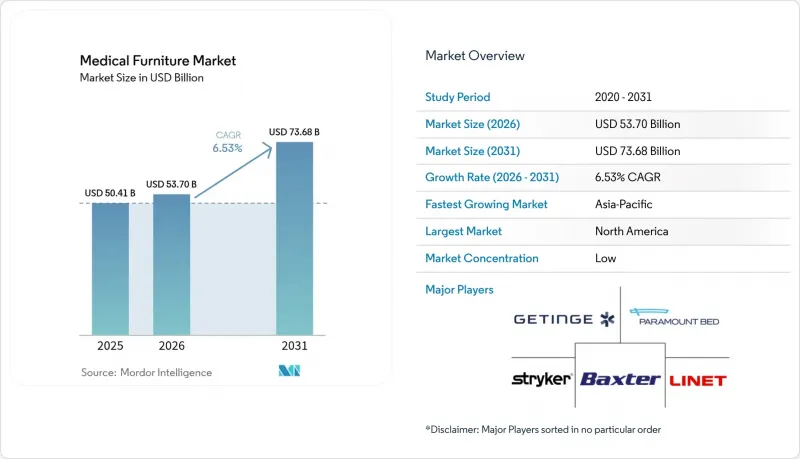
Mordor Intelligence에 의하면, 의료용 가구 시장 규모는 2025년 504억 1,000만 달러에서 2026년에는 537억 달러로 확대되어 2026년부터 2031년까지 CAGR 6.53%로 성장을 지속하여, 2031년에는 736억 8,000만 달러에 이를 것으로 예측됩니다.
본 보고서는 제품 유형(침대(범용 침대 등), 의자 등),구동·연결 방식(수동, 반전동 등), 대여 대 소유(자본 구매 등), 최종 사용자(병원, 군용·야전 병원 등), 유통 채널(직접 입찰·기관 대상 판매 등), 지역별로 분류되어 있습니다. 시장 예측은 금액(미 달러) 기준으로 제시되어 있습니다.
세계 의료용 가구 시장 동향 및 인사이트
고령화와 만성기 치료의 급증
현재 65세 이상 고령자 증가율이 병원용 침대 증가율을 상회하고 있어, 범용 침대의 재고가 부족해지는 한편, 비만 환자용 프레임, 체압 분산 매트리스, 낙상 위험 대책 프로토콜을 준수하는 사이드 레일에 대한 수요가 증가하고 있습니다. 비감염성 질환이 전 세계 사망 원인의 74%를 차지하고 있으며, 평균 입원 일수가 과거 기준을 크게 상회함에 따라 의료 제공업체들은 간병인의 근골격계 손상을 최소화하기 위해 전동식 가동 침대로의 교체를 추진하고 있습니다. 일본에서는 2030년까지 75세 이상 고령자가 총인구의 20%를 차지하며, 이에 따라 각 도도부현에서는 JIS T 9254 안전 기준을 충족하는 조절 가능한 재택 간호용 침대에 대해 보조금을 지급하는 프로그램이 도입되고 있습니다. 이에 따라 각 벤더사는 기술적 지식이 제한적인 고령 사용자에게 대응할 수 있도록, 사용하기 쉬운 펜던트형 조작 장치, 대형 화면 디스플레이, 음성 명령 기능 등을 설계하고 있습니다.
병원 건설 파이프라인 확대
인도, 중국, 브라질의 정부 자본 계획에 따라 수백 개의 새로운 지역 병원 및 3차 병원에 자금이 지원되고 있으며, 이는 기존의 입찰 주기를 뛰어넘는 조달량을 이끌어내고 대규모 프레임워크 계약이 체결되고 있습니다. 인도 보건부는 157개 신규 의과대학 건설에 착수했으며, 각 학교마다 300-500개의 병상이 필요하여 2028년까지 5만 대 이상의 의료용 가구 수요가 예상됩니다. 중국에서는 2027년까지 약 120만 개의 현급 병상이 추가될 예정이며, 각 성의 입찰에서는 반전동식 의료용 가구가 기본 기준으로 지정되어 있습니다. 이러한 규모 확대로 인해 세계 공급업체들은 현지 조립 라인 설치를 추진하고 있는 반면, 중소규모의 국내 공급업체들은 우대 조달 규정의 혜택을 받고 있습니다.
첨단 의료용 침대에는 막대한 설비 투자가 필요
전동식이나 스마트 침대는 수동식 대체품에 비해 150%-300% 더 비싸기 때문에 예산에 제약이 있는 지방 병원이나 응급 의료시설에서는 영업 이익률이 2% 미만이면 구매를 미룹니다. 벤더 측은 리스 투 오너(Lease-to-Own) 방식이나 사용량에 따른 요금 체계로 대응하고 있지만, 많은 의료 기관은 이러한 모델에 필요한 신용 등급 요건을 충족하지 못하고 있습니다. 또한, 자금 부족은 계절적인 환자 수 변동에 직면한 외래수술센터(ASC)의 도입도 제한하고 있습니다.
부문 분석
병상은 2025년 매출의 33.55%를 차지하며, 의료용 가구 시장에서 가장 큰 점유율을 기록하고 있습니다. 중환자용 병상에는 자동 회전 기능과 내장형 체중계가 탑재되어 있으며, 그 가격은 범용 프레임의 약 3배에 달할 전망입니다. 한편, 정신과 및 소아과용 모듈식 유닛은 행동 의학 및 소아 병원이 전용 병동을 개설함에 따라 연평균 성장률(CAGR) 9.85%를 나타낼 것으로 예측됩니다. 자살 방지 기능을 갖춘 가구는 정신과 안전에 관한 조인트 커미션(Joint Commission) 규정을 준수하며, 소아용 모델에는 장난기 넘치는 헤드보드와 모듈식 수납공간이 통합되어 있어 가족의 숙박을 용이하게 합니다.
의자, 카트, 캐비닛, 이동 보조 기구가 제품 라인업을 풍성하게 하고 있습니다. 공간이 제한된 외래 진료소에서는 진찰용 및 투석용 의자가 주류를 이루고 있습니다. 바코드 스캐너가 내장된 이동식 카트는 약물 투여 안전 프로그램의 확산 추세에 힘입어 인기를 얻고 있습니다. 비만 환자용 침대는 강화된 액추에이터와 넓은 프레임을 채택함으로써, 2024년에는 성인의 16%를 나타낼 것으로 예측되는 비만 유병률 증가에 대응하고 있습니다. 침대 옆 탁자나 환자 리프트 등의 부속품은 재택치료 분야에서의 도입으로 안정적인 성장을 이루고 있습니다.
2025년에는 세미 전동 모델이 매출의 34.53%를 차지했으나, 병원 IT 팀이 HL7 FHIR 통합 로드맵을 완료하면 스마트 제품군은 연평균 성장률(CAGR) 11.75%로 성장할 전망입니다. 스마트 유닛은 AI 기반 의료기기 관리 플랫폼에 필요한 실시간 데이터를 전송하며, 미국 내 12개 병원을 대상으로 한 조사에 따르면 환자의 대기 시간을 18% 단축한 것으로 나타났습니다. 정전이 빈번한 시장에서는 여전히 수동식 의료용 가구가 사용되고 있지만, 배터리 백업 모듈의 가격이 하락함에 따라 그 점유율은 축소될 전망입니다.
중환자용 침대의 경우, 예측적 압력 매핑이 병원 내 욕창 예방에 도움이 되기 때문에 전동식 및 IoT 지원 모델의 도입이 점점 더 필수화되고 있습니다. 이는 미국의 가치 기반 구매 제도에서 부과되는 페널티와 관련된 지표입니다. 현재 FDA의 새로운 지침에서 의무화하고 있는 사이버 보안 인증이 입찰의 표준 요건이 됨에 따라, 완전 스마트 침대와 관련된 의료용 가구 시장 규모는 수 배로 확대될 것으로 예측됩니다. 전담 보안 팀과 소프트웨어 파트너를 보유한 공급업체가 이 프리미엄 시장을 선점하는 데 가장 유리한 위치에 있습니다.
지역별 분석
북미는 커넥티드 침대 비용을 상환하는 메디케어 어드밴티지 플랜과 활발한 교체 수요 덕분에 2025년 매출의 36.55%를 차지했습니다. 현재 미국 병원 침대의 약 60%는 사용 기간이 10년을 초과했습니다. 캐나다 각 주에서는 공동 구매 계약을 통해 연장 보증을 확보하고 있는 반면, 미국 벤더가 멕시코에 설립한 공장은 리드 타임을 단축하고 운임 할증료를 피하고 있습니다.
아시아태평양은 2031년까지 7.72%라는 지역별 최고 연평균 성장률(CAGR)을 나타낼 전망입니다. 중국만 해도 2027년까지 현급 병원 병상을 120만 개 증설할 계획입니다. 인도에서는 의과대학 확대로 인해 연간 5만 개 이상의 병상 수요가 발생하고 있습니다. 일본에서는 JIS 규격을 준수한 재택 간호용 침대에 대한 도도부현의 보조금이, 고령화가 진행되는 가운데 주거용 수요가 어떻게 증가하고 있는지를 보여주고 있습니다. 호주와 한국에서는 HL7 규격을 지원하는 가구가 필요한 스마트 병원 시범 사업이 추진되고 있어, 장기적인 전자화 진전을 뒷받침하고 있습니다.
유럽에서는 규제 갱신 주기에 힘입어 완만한 성장이 나타나고 있습니다. 2025년 EU MDR 재인증 기한에 따라 병원들은 갱신된 기술 문서를 갖추지 못한 2017년 이전 재고를 폐기할 수밖에 없게 되었습니다. 독일과 영국에서는 여러 국가를 지원하는 지원팀을 보유한 공급업체를 우대하는 중앙집권적인 입찰 제도를 활용하고 있습니다. 중동에서는 GCC 국가들이 의료 관광의 주력 시설을 위해 항공 운송 사양의 스마트 ICU 침대를 지정하고 있는 반면, 사하라 이남 아프리카 국가들의 보건부는 예산상의 이유로 수동식 및 반전동식 제품 라인을 고수하고 있습니다. 브라질은 2024년, 의료 서비스가 부족한 지역의 병원 설비를 위해 42억 레알(8억 4,000만 달러)을 배정했으며, 현지 조립을 조건으로 하여 제조업체가 수입 관세를 회피할 수 있도록 지원하고 있습니다.
기타 혜택:
- 엑셀 형식 시장 예측(ME) 시트
- 3개월간의 애널리스트 지원
자주 묻는 질문
목차
제1장 서론
제2장 조사 방법
제3장 주요 요약
제4장 시장 구도
제5장 시장 규모와 성장 예측
제6장 경쟁 구도
제7장 시장 기회와 향후 전망
JHSAccording to Mordor Intelligence, the medical furniture market size is expected to grow from USD 50.41 billion in 2025 to USD 53.70 billion in 2026 and is forecast to reach USD 73.68 billion by 2031 at 6.53% CAGR over 2026-2031.
This report is Segmented by Product Type (Beds [General Purpose Beds, and More], Chairs, and More), Power & Connectivity (Manual, Semi-Electric, and More), Rental Vs Ownership (Capital Purchase, and More), End User (Hospitals, Military & Field Hospitals, and More), Distribution Channel (Direct Tender & Institutional Sales, and More), and Geography. The Market Forecasts are Provided in Terms of Value (USD).
Global Medical Furniture Market Trends and Insights
Aging Population and Chronic-Care Surge
People aged 65 and older now outpace hospital bed additions, stretching general-purpose inventories and raising demand for bariatric frames, pressure-redistribution surfaces, and side-rails compliant with fall-risk protocols. Non-communicable diseases account for 74% of global deaths, pushing average length of stay well beyond historical norms, so providers upgrade to electric articulation that minimizes caregiver musculoskeletal injuries. In Japan, citizens aged 75+ will represent 20% of the total population by 2030, prompting prefectural programs that subsidize adjustable home-care beds meeting JIS T 9254 safety codes. Vendors therefore design easy-to-use pendant controls, large-format displays, and voice commands to serve older users with limited technical literacy.
Expansion of Hospital-Build Pipelines
Government capital programs in India, China, and Brazil are funding hundreds of new district or tertiary hospitals, driving procurement volumes that eclipse traditional tender cycles and secure large framework deals. India's health ministry has broken ground on 157 new medical colleges, each demanding 300-500 beds, equivalent to more than 50,000 units of medical furniture through 2028. China will add about 1.2 million county-level beds by 2027, with provincial tenders specifying semi-electric furniture as the default baseline. Such scale encourages global vendors to set up local assembly lines, while smaller domestic suppliers benefit from preferential procurement rules.
High Capex for Advanced Furniture
Fully electric or smart beds can cost 150%-300% more than manual alternatives, so budget-constrained rural hospitals and critical-access facilities defer purchases when operating margins fall below 2%. Vendors counter with lease-to-own plans and usage-based pricing, but many providers lack the credit ratings these models demand. Capital scarcity also limits adoption in ambulatory surgical centers that face seasonal case swings.
Other drivers and restraints analyzed in the detailed report include:
- Rapid Shift to Home-Health and Tele-Rehab
- Global Pivot to Electric and Smart Beds
- Patchy Reimbursement in Long-Term Care
For complete list of drivers and restraints, kindly check the Table Of Contents.
Segment Analysis
Beds underpinned 33.55% of 2025 revenue, making them the largest slice of the medical furniture market. Intensive-care variants feature auto-rotation and integrated scales that command prices roughly three times those of general-purpose frames. Modular psychiatric and pediatric units, however, are forecast to grow at a 9.85% CAGR as behavioral-health and children's hospitals open dedicated wards. Ligature-resistant furniture complies with Joint Commission rules for psychiatric safety, while pediatric models integrate playful headboards and modular storage that facilitate family overnight stays.
Chairs, carts, cabinets, and mobility aids round out portfolios. Examination and dialysis chairs dominate outpatient clinics where space is tight. Mobile carts with embedded barcode scanners ride the wave of medication-administration-safety programs. Bariatric beds meet rising obesity prevalence-16% of adults in 2024-by offering reinforced actuators and wider frames. Accessories such as over-bed tables and patient lifts enjoy stable growth thanks to home-health adoption.
Semi-electric models delivered 34.53% of revenue in 2025, yet smart ranges will climb at an 11.75% CAGR once hospital IT teams complete HL7 FHIR integration roadmaps. Smart units transmit real-time data needed for AI fleet-management platforms, reducing patient wait times by 18% according to a 12-hospital U.S. study. Manual furniture persists in markets with intermittent electricity but will concede share as battery backup modules become cheaper.
Electric and IoT models are increasingly mandatory in intensive-care beds because predictive pressure-mapping helps avert hospital-acquired ulcers, a metric tied to U.S. value-based purchasing penalties. The medical furniture market size attached to fully smart beds is expected to multiply as cybersecurity certifications-now required by new FDA guidance-become default bid requirements. Vendors with dedicated security teams and software partners are best positioned to capture this premium.
Complete Report Scope:
- By Product Type
- Beds
- General Purpose Beds
- ICU / Critical-care Beds
- Pediatric Beds
- Maternity Beds
- Bariatric Beds
- Electric / Smart Beds
- Chairs
- Examination Chairs
- Treatment & Dialysis Chairs
- Recliners & Lift Chairs
- Carts & Workstations
- Medication Carts
- Emergency / Crash Carts
- Anesthesia Carts
- Computing Workstations
- Cabinets & Storage
- Sterile Cabinets
- Bedside Cabinets
- Instrument Cabinets
- Secure Drug Cabinets
- Tables & Stools
- Examination Tables
- Operating Tables
- Imaging Tables
- Mobility, Support & Accessories
- Over-bed Tables
- IV Poles & Stands
- Patient Lifts & Transfer Aids
- Commodes & Walkers
- Modular & Specialized Furniture
- Behavioral-health Furniture
- Pediatric-specialty Furniture
- Antimicrobial-coated Lines
- Beds
- By Power & Connectivity
- Manual
- Semi-Electric
- Fully Electric
- Smart / IoT-Enabled
- By Rental vs Ownership
- Capital Purchase
- Long-Term Lease
- Surge / Short-Term Rental
- By End User
- Hospitals
- Ambulatory Surgical & Specialty Clinics
- Home-Health & Long-Term Care Facilities
- Rehabilitation & Physiotherapy Centers
- Military & Field Hospitals
- By Distribution Channel
- Direct Tender & Institutional Sales
- Dealer & Distributor Sales
- E-commerce & Digital Catalog
- By Geography
- North America
- United States
- Canada
- Mexico
- Europe
- Germany
- United Kingdom
- France
- Italy
- Spain
- Rest of Europe
- Asia-Pacific
- China
- India
- Japan
- Australia
- South Korea
- Rest of Asia-Pacific
- Middle East and Africa
- GCC
- South Africa
- Rest of Middle East and Africa
- South America
- Brazil
- Argentina
- Rest of South America
- North America
Geography Analysis
North America accounted for 36.55% of 2025 revenue thanks to Medicare Advantage plans that reimburse connected beds and strong replacement demand; roughly 60% of U.S. hospital beds now exceed 10 years of service. Canadian provinces use group-purchasing agreements to secure extended warranties, while Mexican plants established by U.S. vendors shorten lead times and sidestep freight surcharges.
Asia-Pacific is projected to log the fastest regional CAGR at 7.72% through 2031. China alone plans to add 1.2 million county-level hospital beds by 2027. India's medical-college expansion funnels demand exceeding 50,000 beds a year. Japan's prefectural subsidies for home-care beds that meet JIS standards illustrate how aging demographics lift residential demand. Australia and South Korea anchor smart-hospital pilots that require HL7-ready furniture, reinforcing long-run electrification.
Europe displays moderate growth driven by regulatory refresh cycles. The 2025 EU MDR re-certification deadline forces hospitals to retire pre-2017 inventory lacking updated technical files. Germany and the U.K. leverage centralized tenders that favor vendors with multi-country support teams. In the Middle East, GCC states spec flight smart ICU beds for medical-tourism flagships, whereas Sub-Saharan health ministries stick to manual and semi-electric lines for budget reasons. Brazil earmarked BRL 4.2 billion (USD 840 million) in 2024 for hospital equipment in underserved regions, with local-assembly stipulations that help manufacturers dodge import tariffs.
- Amico Corporation
- Arjo AB
- Baxter International Inc. (Hill-Rom)
- Capsa Healthcare
- Drive DeVilbiss Healthcare
- Getinge
- GF Health Products
- GPC Medical Ltd.
- Invacare
- Joerns Healthcare
- LINET Group
- Malvestio S.p.A.
- Medifa GmbH & Co. KG
- Medline Industries
- Merivaara Oy
- Midmark
- MillerKnoll Inc.
- Paramount Bed Holdings
- Savaria Corp. (Span-America)
- Steelcase Health
- Stiegelmeyer
- Stryker
- Sunrise Medical
- Wieland Healthcare
Additional Benefits:
- The market estimate (ME) sheet in Excel format
- 3 months of analyst support
TABLE OF CONTENTS
1 Introduction
- 1.1 Study Assumptions & Market Definition
- 1.2 Scope of the Study
2 Research Methodology
3 Executive Summary
4 Market Landscape
- 4.1 Market Overview
- 4.2 Market Drivers
- 4.2.1 Aging population & chronic-care surge
- 4.2.2 Expansion of hospital-build pipelines
- 4.2.3 Rapid shift to home-health & tele-rehab
- 4.2.4 Global pivot to electric & smart beds
- 4.2.5 AI-driven fleet-optimization contracts
- 4.2.6 Antimicrobial-surface mandates
- 4.3 Market Restraints
- 4.3.1 High capex for advanced furniture
- 4.3.2 Patchy reimbursement in long-term care
- 4.3.3 Sustainability-compliance cost spikes
- 4.3.4 PCB-chip shortages for smart furniture
- 4.4 Supply-Chain Analysis
- 4.5 Regulatory Landscape
- 4.6 Technological Outlook
- 4.7 Porter's Five Forces
- 4.7.1 Threat of New Entrants
- 4.7.2 Bargaining Power of Suppliers
- 4.7.3 Bargaining Power of Buyers
- 4.7.4 Threat of Substitutes
- 4.7.5 Competitive Rivalry
5 Market Size & Growth Forecasts (Value, USD)
- 5.1 By Product Type
- 5.1.1 Beds
- 5.1.1.1 General Purpose Beds
- 5.1.1.2 ICU / Critical-care Beds
- 5.1.1.3 Pediatric Beds
- 5.1.1.4 Maternity Beds
- 5.1.1.5 Bariatric Beds
- 5.1.1.6 Electric / Smart Beds
- 5.1.2 Chairs
- 5.1.2.1 Examination Chairs
- 5.1.2.2 Treatment & Dialysis Chairs
- 5.1.2.3 Recliners & Lift Chairs
- 5.1.3 Carts & Workstations
- 5.1.3.1 Medication Carts
- 5.1.3.2 Emergency / Crash Carts
- 5.1.3.3 Anesthesia Carts
- 5.1.3.4 Computing Workstations
- 5.1.4 Cabinets & Storage
- 5.1.4.1 Sterile Cabinets
- 5.1.4.2 Bedside Cabinets
- 5.1.4.3 Instrument Cabinets
- 5.1.4.4 Secure Drug Cabinets
- 5.1.5 Tables & Stools
- 5.1.5.1 Examination Tables
- 5.1.5.2 Operating Tables
- 5.1.5.3 Imaging Tables
- 5.1.6 Mobility, Support & Accessories
- 5.1.6.1 Over-bed Tables
- 5.1.6.2 IV Poles & Stands
- 5.1.6.3 Patient Lifts & Transfer Aids
- 5.1.6.4 Commodes & Walkers
- 5.1.7 Modular & Specialized Furniture
- 5.1.7.1 Behavioral-health Furniture
- 5.1.7.2 Pediatric-specialty Furniture
- 5.1.7.3 Antimicrobial-coated Lines
- 5.1.1 Beds
- 5.2 By Power & Connectivity
- 5.2.1 Manual
- 5.2.2 Semi-Electric
- 5.2.3 Fully Electric
- 5.2.4 Smart / IoT-Enabled
- 5.3 By Rental vs Ownership
- 5.3.1 Capital Purchase
- 5.3.2 Long-Term Lease
- 5.3.3 Surge / Short-Term Rental
- 5.4 By End User
- 5.4.1 Hospitals
- 5.4.2 Ambulatory Surgical & Specialty Clinics
- 5.4.3 Home-Health & Long-Term Care Facilities
- 5.4.4 Rehabilitation & Physiotherapy Centers
- 5.4.5 Military & Field Hospitals
- 5.5 By Distribution Channel
- 5.5.1 Direct Tender & Institutional Sales
- 5.5.2 Dealer & Distributor Sales
- 5.5.3 E-commerce & Digital Catalog
- 5.6 By Geography
- 5.6.1 North America
- 5.6.1.1 United States
- 5.6.1.2 Canada
- 5.6.1.3 Mexico
- 5.6.2 Europe
- 5.6.2.1 Germany
- 5.6.2.2 United Kingdom
- 5.6.2.3 France
- 5.6.2.4 Italy
- 5.6.2.5 Spain
- 5.6.2.6 Rest of Europe
- 5.6.3 Asia-Pacific
- 5.6.3.1 China
- 5.6.3.2 India
- 5.6.3.3 Japan
- 5.6.3.4 Australia
- 5.6.3.5 South Korea
- 5.6.3.6 Rest of Asia-Pacific
- 5.6.4 Middle East and Africa
- 5.6.4.1 GCC
- 5.6.4.2 South Africa
- 5.6.4.3 Rest of Middle East and Africa
- 5.6.5 South America
- 5.6.5.1 Brazil
- 5.6.5.2 Argentina
- 5.6.5.3 Rest of South America
- 5.6.1 North America
6 Competitive Landscape
- 6.1 Market Concentration
- 6.2 Market Share Analysis
- 6.3 Company Profiles (includes Global level Overview, Market level overview, Core Segments, Financials as available, Strategic Information, Market Rank/Share for key companies, Products & Services, and Recent Developments)
- 6.3.1 Amico Corporation
- 6.3.2 Arjo AB
- 6.3.3 Baxter International Inc. (Hill-Rom)
- 6.3.4 Capsa Healthcare
- 6.3.5 Drive DeVilbiss Healthcare
- 6.3.6 Getinge AB
- 6.3.7 GF Health Products Inc.
- 6.3.8 GPC Medical Ltd.
- 6.3.9 Invacare Corporation
- 6.3.10 Joerns Healthcare LLC
- 6.3.11 LINET Group SE
- 6.3.12 Malvestio S.p.A.
- 6.3.13 Medifa GmbH & Co. KG
- 6.3.14 Medline Industries LP
- 6.3.15 Merivaara Oy
- 6.3.16 Midmark Corporation
- 6.3.17 MillerKnoll Inc.
- 6.3.18 Paramount Bed Holdings
- 6.3.19 Savaria Corp. (Span-America)
- 6.3.20 Steelcase Health
- 6.3.21 Stiegelmeyer GmbH & Co. KG
- 6.3.22 Stryker Corporation
- 6.3.23 Sunrise Medical
- 6.3.24 Wieland Healthcare
7 Market Opportunities & Future Outlook
- 7.1 White-space & Unmet-need Assessment