|
시장보고서
상품코드
2116532
조산 및 조기양막파수 검사 : 시장 점유율 분석, 업계 동향 및 통계, 성장 예측(2026-2031년)Preterm Birth And PROM Testing - Market Share Analysis, Industry Trends & Statistics, Growth Forecasts (2026 - 2031) |
||||||
 Mordor Intelligence
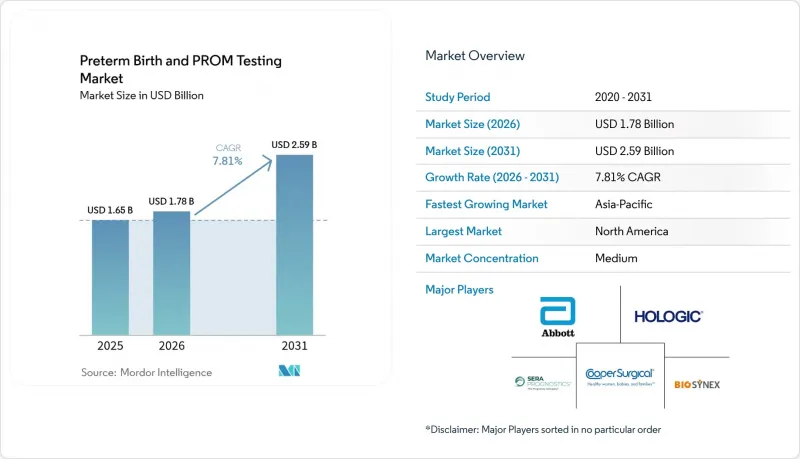
조산 및 조기양막파수 검사 시장 규모는 2025년 16억 5,000만 달러로 평가되었습니다. 2026년에는 17억 8,000만 달러로 확대되어 2026년부터 2031년에 걸쳐 CAGR 7.81%로 성장을 지속하여, 2031년에는 25억 9,000만 달러에 이를 것으로 예측됩니다.
본 보고서는 검사 유형(골반 검사 등), 바이오마커 범주(태아 피브로넥틴(fFN), 태반 알파 마이크로글로불린-1(PAMG-1) 등), 실시 장소(검사실 검사 및 현장 진단/응급실),지역(북미, 유럽, 아시아태평양, 중동 및 아프리카, 남미)별로 분류되어 있습니다. 시장 예측은 금액(달러) 기준으로 제시되어 있습니다.
세계의 조산 및 조기양막파수 검사 시장 동향 및 인사이트
전 세계 조산 발생률 증가
연간 조산아 수는 이미 1,500만 명을 넘어섰으며, 의료 기술의 발전에도 불구하고 계속 증가하는 추세입니다. 그중 절반 이상이 아시아에서 출생하고 있어, 인구가 많은 지역에서의 진단 수요가 높아지고 있습니다. 조산으로 인한 합병증은 미국 의료 시스템에 매년 250억 달러 이상의 부담을 주고 있으며, 이는 신생아 중환자실(NICU) 입원 기간을 단축하는 조기 발견 기술에 대한 보험사의 투자를 촉진하고 있습니다. 신생아 사망률 감소는 각국의 모자보건 계획에서 주요 성과 지표로 자리 잡고 있으며, 이에 따라 근거 기반 진단 도구에 대한 예산 배분이 확실하게 이루어지고 있습니다. 선진국에서 점점 더 보편화되고 있는 고령 출산은 기초 위험도를 높여, 장기적으로 수요를 높은 수준으로 유지하고 있습니다.
현장 진단(Point-of-Care) 분야의 기술적 진보
현재 휴대용 및 병상용 분석 장치는 몇 분 이내에 결과를 표시하므로, 급성 산과 평가 시 검사실에서의 지연이 해소되고 있습니다. 자궁경부의 미세 구조를 매핑하는 정량적 초음파 검사는 임신 23주라는 이른 단계부터 조산 위험을 예측할 수 있어, 병력에 기반한 평가에 비해 현저한 개선이 나타납니다. 심박 변이를 측정하는 웨어러블 센서가 실시간 데이터를 제공하며, 머신러닝 모델을 통해 82%의 정확도로 위험 점수로 변환됩니다. 인공지능과 확립된 바이오마커를 결합함으로써, 진단의 특이도를 높이는 동시에 위양성을 최소화할 수 있습니다. 이러한 융합 플랫폼은 조산 및 조기 양수 파열 검사 시장에서 현장 진단(Point-of-Care) 검사의 역할을 강화하고 있습니다.
자원이 부족한 지역에서의 활용 제한
의료 인프라가 취약하고 조산율이 가장 높은 지역에서는 진단 기술의 보급이 더딘 실정입니다. 훈련된 인력과 검사 장비의 부족으로 인해 바이오마커 검사의 적용 범위가 제한되고 있습니다. 호주의 외딴 지역 진료소에서 태아 피브로넥틴 공급이 중단되면서 비용이 많이 드는 환자 이송을 피할 수 없게 되었고, 공급망의 취약성이 여실히 드러났습니다. 고질적인 디지털 격차가 원격의료 솔루션 도입을 방해하고 있으며, 콜드체인 요건 또한 물류상의 장벽이 되고 있습니다. 이러한 체계적인 장벽들로 인해 의료 서비스가 미치지 않는 지역에서의 조산 및 조기양막파수 검사 시장 침투가 지연되고 있습니다.
부문별 분석
초음파 검사는 2025년에도 매출 점유율 38.12%를 유지하며, 자궁경부 길이 평가 및 태아 모니터링 분야에서 주요 검사법으로서의 입지를 공고히 했습니다. 정량적 초음파 검사를 통해 기존 영상 진단법보다 몇 주 더 빨리 조산 위험을 예측할 수 있는 자궁경관의 미세 구조 변화를 감지할 수 있게 되었습니다. 2025년 시장 규모에서 비교적 작은 비중을 차지하는 생화학적 마커는 임상의들이 영상 진단을 보완할 객관적인 분자 수준의 지표를 모색함에 따라 9.96%라는 가장 높은 연평균 성장률(CAGR)을 보이고 있습니다. 골반 검사 및 자궁 모니터링은 여전히 보조적인 역할을 하고 있지만, 여러 바이오마커를 조합한 패널 검사만큼의 예측 능력은 부족합니다. 신흥 디지털 바이오마커와 AI를 활용한 분석 기술은 통합적인 솔루션을 약속하며, 조산 및 조기양막파수 검사 시장의 장기적인 진화를 시사하고 있습니다.
다중 모드 평가에 대한 지지가 확대되고 있는 것은 종합적인 위험 프로파일링으로의 전환을 부각시키고 있습니다. 초고속 영상 진단과 바이오마커 정량화를 통해 산전 스테로이드 투여와 같은 조기 개입을 촉진하는 실용적인 확률 정보를 얻을 수 있습니다. 전문의의 진단과 연계된 원격 초음파 시스템은 지역 의료 현장에서의 활용을 가능하게 하며, 한편 일회용 생화학 카트리지는 병상에서의 워크플로우를 간소화합니다. 이러한 수렴되는 추세로 인해, 영상 진단과 분자진단을 융합한 하이브리드 플랫폼에 대한 조산 및 조기양막파수 검사 시장의 향후 수요가 강화될 것입니다.
태아 피브로넥틴(fFN)은 41.88%의 점유율을 차지하고 있으며, 가이드라인에 따른 강력한 지지를 바탕으로 임상 현장에서 확고한 입지를 다지고 있습니다. fFN의 음성 결과로 임상의는 2주 이내에 분만이 일어나지 않을 것이라는 96%의 확신을 얻을 수 있어, 안전한 퇴원과 비용 절감이 가능해집니다. 태반 알파 마이크로글로불린-1(PAMG-1)은 연평균 성장률(CAGR) 10.07%로 성장하고 있으며, 7일 이내 분만에 대한 뛰어난 예측 성능을 보여주고 있습니다. IGFBP-1은 자원이 부족한 환경에서 지지를 얻고 있으며, 비침습적인 검체 채취로 91%의 민감도와 82.6%의 특이도를 실현하고 있습니다. 사이토카인 및 무세포 RNA는 현재 임상 검증이 진행 중인 최첨단 분야입니다.
새로운 표적이 다중 분석 패널에 도입됨에 따라 바이오마커 분야의 경쟁은 격화되고 있습니다. 분석법 개발자들은 불필요한 개입을 최소화하기 위해 높은 양성 예측 값을 중시하고 있습니다. 검사 기관은 디지털 PCR을 활용하여 정량 측정을 수행하고, 컷오프 값을 정밀화하며, 위험 수준을 계층화함으로써, 첨단 바이오마커 패널을 이용한 조산 및 조기 양수 파열 검사 시장 규모를 확대되고 있습니다.
지역별 분석
북미는 주요 바이오마커 검사에 대한 거의 전면적인 보험 적용으로 인해 2025년 매출의 42.76%를 차지했습니다. 여기에는 기존의 접근 장벽을 제거한 재택 태아 모니터링에 대한 새로운 CPT(진료 행위 분류) 지급이 포함됩니다. 미국은 디지털 헬스의 성숙도와 높은 환자 참여도를 반영하여 전 세계 D2C(소비자 직접 판매) 서비스의 보급을 주도하고 있습니다. 캐나다의 단일 지불자 제도는 전국적인 선별 검사 프로그램에 자금을 지원하여 안정적인 수요를 확보하고 있습니다. 멕시코에서는 민관 협력을 통해 검사가 농촌 지역으로 확대되고 있으나, 물류상의 병목 현상은 여전히 남아 있습니다. 도시 지역에서는 보급률이 높은 반면, 원주민 커뮤니티나 외딴 지역 커뮤니티에서는 여전히 이용률이 낮아, 조산 및 조기양막파수 검사 시장에서 수요가 충족되지 않은 지역이 존재함을 보여줍니다.
아시아태평양은 2031년까지 연평균 성장률(CAGR)이 9.28%로 가장 빠르게 성장하고 있는 지역입니다. 중국은 모자 보건에 막대한 공적 자금을 투입하고 있으며, 60개의 신생아 중환자실(NICU)에서 코호트 연구를 실시하여 진단법의 검증에 기여하고 있습니다. 인도의 민간 의료 서비스 제공업체들은 대규모 산전 검진 캠프에 비용 효율적인 검사를 도입하고 있으며, 정책 개혁을 통해 본인 부담금을 낮추는 것을 목표로 하고 있습니다. 일본과 한국에서는 선진적인 병원 네트워크에 힘입어 고감도 바이오마커 패널에 대한 프리미엄 부문 수요가 주도되고 있습니다. 호주공급 차질은 공급업체들이 지방 시장의 기회를 포착하기 위해 해결해야 할 지속적인 인프라 과제를 부각시키고 있습니다. 이 지역의 다양한 소득 수준으로 인해 조산 및 조기양막파수 검사 시장 전반에 걸쳐 세분화된 가격 전략이 형성되고 있습니다.
유럽에서는 통일된 임상 지침과 안정적인 보험 환급을 배경으로 꾸준한 확장이 이어지고 있습니다. NICE(영국 국립의료기술평가기구)의 권고에 따라 영국 전역에서 바이오마커 사용이 표준화되어 병원 내 도입이 가속화되고 있습니다. 독일과 프랑스에서는 예방적 선별 검사에 공공 예산을 배정하고, 검사를 산전 관리 패키지에 포함시키고 있습니다. 이탈리아와 스페인에서는 조산사가 주도하는 클리닉에서 현장 진단 키트를 도입하여 의뢰로 인한 지연을 줄이고 있습니다. 규제의 명확화가 혁신을 촉진하고 있지만, 가치 평가는 여전히 엄격합니다. 한편, 중동, 아프리카 및 남미에서는 다자간 원조 프로그램의 관심이 높아지고 있습니다. 인프라 부족으로 당장의 성장은 둔화되고 있지만, 충족되지 않은 임상적 수요는 여전히 두드러져 조산 및 조기양막파수 검사 시장에 장기적인 성장 여지가 있음을 시사합니다.
기타 혜택 :
- 엑셀 형식 시장 예측(ME) 시트
- 3개월간의 애널리스트 지원
자주 묻는 질문
목차
제1장 서론
제2장 조사 방법
제3장 개요
제4장 시장 구도
제5장 시장 규모 및 성장 예측
제6장 경쟁 구도
제7장 시장 기회 및 향후 전망
KTH 26.08.31According to Mordor Intelligence, the preterm birth and PROM testing market size is expected to grow from USD 1.65 billion in 2025 to USD 1.78 billion in 2026 and is forecast to reach USD 2.59 billion by 2031 at 7.81% CAGR over 2026-2031.
This report is Segmented by Test Type (Pelvic Examination, and More), Biomarker Category (Fetal Fibronectin (fFN), Placental Alpha-Microglobulin-1 (PAMG-1), and More), Setting (Laboratory-Based Testing and Point-Of-Care/Emergency Dept. ), Geography (North America, Europe, Asia-Pacific, The Middle East and Africa, and South America). The Market Forecasts are Provided in Terms of Value (USD).
Global Preterm Birth And PROM Testing Market Trends and Insights
Rising Global Preterm Birth Incidence
Annual preterm births already exceed 15 million and continue climbing despite medical advances. Asia accounts for more than half of those births, intensifying diagnostic demand in high-population regions. Preterm complications cost the United States health system over USD 25 billion each year, spurring payer investment in early detection technologies that reduce neonatal intensive care stays. Reduction of neonatal mortality has become a central performance metric in national maternal-child health plans, ensuring that budget allocations favor evidence-based diagnostic tools. Advanced maternal age, increasingly common in developed economies, raises baseline risk and keeps demand elevated over the long term.
Technological Advancements in Point-of-Care Diagnostics
Hand-held and bedside analyzers now deliver results within minutes, eliminating laboratory delays during acute obstetric evaluations. Quantitative ultrasound that maps cervical microstructure predicts preterm risk as early as week 23, a notable improvement over history-based assessments. Wearable sensors capturing heart-rate variability supply real-time data feeds that machine-learning models convert into 82% accurate risk scores. Combining artificial intelligence with established biomarkers increases diagnostic specificity while minimizing false positives. Such converged platforms strengthen the role of point-of-care testing within the preterm birth and PROM testing market.
Limited Accessibility in Low-Resource Settings
Diagnostics uptake lags in regions with fragile health infrastructure where preterm birth rates are highest. Shortages of trained personnel and laboratory equipment restrict biomarker testing coverage. The cessation of fetal fibronectin supply in remote Australian clinics forced costly patient transfers and highlighted supply chain fragility. Persistent digital divides hamper telehealth solutions, and cold-chain requirements add logistical hurdles. These systemic barriers slow penetration of the preterm birth and PROM testing market in underserved regions.
Other drivers and restraints analyzed in the detailed report include:
- Expansion of Prenatal Screening Programs
- Increasing Healthcare Expenditure on Maternal Care
- High Cost of Advanced Diagnostic Tests
For complete list of drivers and restraints, kindly check the Table Of Contents.
Segment Analysis
Ultrasound retained a 38.12% revenue share in 2025, securing its place as the primary modality for cervical-length assessment and fetal surveillance. Quantitative ultrasound now detects microstructural cervical changes that forecast preterm birth risk several weeks earlier than legacy imaging approaches. Biochemical markers, accounting for a smaller 2025 base, exhibit the fastest 9.96% CAGR as clinicians seek objective molecular readouts that complement imaging. Pelvic examination and uterine monitoring continue to serve supportive roles but lack the predictive power of combined biomarker panels. Emerging digital biomarkers and AI-powered analytics promise integrated solutions, signaling longer-term evolution of the preterm birth and PROM testing market.
The widening preference for multimodal assessment underscores a shift toward comprehensive risk profiling. Ultrafast imaging plus biomarker quantification delivers actionable probabilities that drive early interventions such as antenatal steroids. Remote ultrasound systems linked to specialist review extend capability to community settings, while disposable biochemical cartridges simplify bedside workflows. These converging trends strengthen future demand within the preterm birth and PROM testing market size for hybrid platforms that merge imaging with molecular diagnostics.
Fetal fibronectin (fFN) commands 41.88% share and remains clinically entrenched due to robust guideline support. Negative fFN results give clinicians 96% confidence that delivery will not occur within two weeks, allowing safe discharge and cost avoidance. Placental alpha-microglobulin-1 (PAMG-1) is growing at a 10.07% CAGR and demonstrates superior predictive performance for delivery within seven days. IGFBP-1 gains traction in low-resource environments because it delivers 91% sensitivity and 82.6% specificity using minimally invasive collection. Cytokines and cell-free RNA represent frontier categories undergoing clinical validation.
Competitive dynamics within the biomarker space are intensifying as novel targets enter multi-analyte panels. Assay developers emphasize high positive predictive value to minimize unnecessary interventions. Laboratories leverage digital PCR for quantitative reads that refine cutoffs and stratify risk tiers, thereby expanding the preterm birth and PROM testing market size for advanced biomarker panels.
Complete Report Scope:
- By Test Type
- Pelvic Examination
- Ultrasound
- Biochemical Markers
- Uterine Monitoring
- Other Test Types
- By Biomarker Category
- Fetal Fibronectin (fFN)
- Placental Alpha-Microglobulin-1 (PAMG-1)
- Insulin-Like Growth Factor-Binding Protein-1 (IGFBP-1)
- Interleukins & Other Cytokines
- By Setting
- Laboratory-Based Testing
- Point-Of-Care / Emergency Dept.
- By End User
- Hospitals & Maternity Centers
- Diagnostic Laboratories
- Ambulatory & Freestanding Birth Centers
- Home-Care & Remote Monitoring
- Geography
- North America
- United States
- Canada
- Mexico
- Europe
- Germany
- United Kingdom
- France
- Italy
- Spain
- Rest of Europe
- Asia-Pacific
- China
- Japan
- India
- Australia
- South Korea
- Rest of Asia-Pacific
- Middle East & Africa
- GCC
- South Africa
- Rest of Middle East & Africa
- South America
- Brazil
- Argentina
- Rest of South America
- North America
Geography Analysis
North America held 42.76% of 2025 revenue due to near-universal insurance coverage for key biomarker assays, including new CPT payment for at-home fetal monitoring that removed a traditional access barrier. The United States leads global direct-to-consumer uptake, reflecting strong digital health maturity and patient engagement. Canada's single-payer system funds national screening programs, ensuring consistent demand. Mexico's public-private partnerships extend testing to rural areas, though logistic bottlenecks remain. While urban centers showcase high penetration, Indigenous and remote communities still report lower utilization, indicating pockets of unmet need within the preterm birth and PROM testing market.
Asia-Pacific is the fastest-growing region at 9.28% CAGR through 2031. China channels substantial public funds into maternal-child health and conducts cohort studies across 60 neonatal intensive care units that help validate diagnostics. India's private providers integrate cost-efficient assays into large antenatal camps, while policy reforms aim to lower out-of-pocket costs. Japan and South Korea drive premium-segment demand for high-sensitivity biomarker panels, supported by advanced hospital networks. Australia's supply disruptions underscore ongoing infrastructure challenges that vendors must address to capture rural opportunities. Diverse income profiles in the region create segmented pricing strategies across the preterm birth and PROM testing market.
Europe maintains steady expansion on the strength of harmonized clinical guidelines and stable reimbursement. NICE recommendations standardize biomarker use across the United Kingdom, which speeds hospital adoption. Germany and France allocate public budgets for preventive screening, integrating tests into bundled antenatal packages. Italy and Spain deploy point-of-care kits in midwife-led clinics to reduce referral delays. Regulatory clarity encourages innovation, though value assessments remain stringent. Meanwhile, Middle East & Africa and South America register rising attention from multilateral aid programs. Limited infrastructure slows immediate growth, yet unmet clinical need remains pronounced, signaling longer-term upside for the preterm birth and PROM testing market.
- Hologic
- Abbott Laboratories
- QIAGEN
- Sera Prognostics
- The Cooper Companies
- Biosynex
- Intelligent Implants
- NX Prenatal
- Clinical Innovations
- LifeCell International
- Medix Biochemica
- Hangzhou Singclean Medical
- Shuwen Biotech
- Creative Diagnostics
- LabCorp
- Quest Diagnostics
- Eurofins
- Genova Diagnostics
- Sysmex
- Randox Laboratories
Additional Benefits:
- The market estimate (ME) sheet in Excel format
- 3 months of analyst support
TABLE OF CONTENTS
1 Introduction
- 1.1 Study Assumptions & Market Definition
- 1.2 Scope of the Study
2 Research Methodology
3 Executive Summary
4 Market Landscape
- 4.1 Market Overview
- 4.2 Market Drivers
- 4.2.1 Rising Global Preterm Birth Incidence
- 4.2.2 Technological Advancements In Point-Of-Care Diagnostics
- 4.2.3 Expansion Of Prenatal Screening Programs
- 4.2.4 Increasing Healthcare Expenditure On Maternal Care
- 4.2.5 Favorable Reimbursement And Regulatory Support
- 4.2.6 Growing Adoption Of Telehealth And Home Testing
- 4.3 Market Restraints
- 4.3.1 Limited Accessibility In Low-Resource Settings
- 4.3.2 High Cost Of Advanced Diagnostic Tests
- 4.3.3 Stringent Regulatory Approval Processes
- 4.3.4 Competition From Alternative Monitoring Modalities
- 4.4 Regulatory Landscape
- 4.5 Porter's Five Forces Analysis
- 4.5.1 Threat Of New Entrants
- 4.5.2 Bargaining Power Of Buyers/Consumers
- 4.5.3 Bargaining Power Of Suppliers
- 4.5.4 Threat Of Substitute Products
- 4.5.5 Intensity Of Competitive Rivalry
5 Market Size & Growth Forecasts (Value, USD)
- 5.1 By Test Type
- 5.1.1 Pelvic Examination
- 5.1.2 Ultrasound
- 5.1.3 Biochemical Markers
- 5.1.4 Uterine Monitoring
- 5.1.5 Other Test Types
- 5.2 By Biomarker Category
- 5.2.1 Fetal Fibronectin (fFN)
- 5.2.2 Placental Alpha-Microglobulin-1 (PAMG-1)
- 5.2.3 Insulin-Like Growth Factor-Binding Protein-1 (IGFBP-1)
- 5.2.4 Interleukins & Other Cytokines
- 5.3 By Setting
- 5.3.1 Laboratory-Based Testing
- 5.3.2 Point-Of-Care / Emergency Dept.
- 5.4 By End User
- 5.4.1 Hospitals & Maternity Centers
- 5.4.2 Diagnostic Laboratories
- 5.4.3 Ambulatory & Freestanding Birth Centers
- 5.4.4 Home-Care & Remote Monitoring
- 5.5 Geography
- 5.5.1 North America
- 5.5.1.1 United States
- 5.5.1.2 Canada
- 5.5.1.3 Mexico
- 5.5.2 Europe
- 5.5.2.1 Germany
- 5.5.2.2 United Kingdom
- 5.5.2.3 France
- 5.5.2.4 Italy
- 5.5.2.5 Spain
- 5.5.2.6 Rest of Europe
- 5.5.3 Asia-Pacific
- 5.5.3.1 China
- 5.5.3.2 Japan
- 5.5.3.3 India
- 5.5.3.4 Australia
- 5.5.3.5 South Korea
- 5.5.3.6 Rest of Asia-Pacific
- 5.5.4 Middle East & Africa
- 5.5.4.1 GCC
- 5.5.4.2 South Africa
- 5.5.4.3 Rest of Middle East & Africa
- 5.5.5 South America
- 5.5.5.1 Brazil
- 5.5.5.2 Argentina
- 5.5.5.3 Rest of South America
- 5.5.1 North America
6 Competitive Landscape
- 6.1 Market Concentration
- 6.2 Market Share Analysis
- 6.3 Company Profiles (includes Global level Overview, Market level overview, Core Business Segments, Financials, Headcount, Key Information, Market Rank, Market Share, Products and Services, and analysis of Recent Developments)
- 6.3.1 Hologic, Inc.
- 6.3.2 Abbott
- 6.3.3 QIAGEN
- 6.3.4 Sera Prognostics
- 6.3.5 CooperSurgical
- 6.3.6 Biosynex
- 6.3.7 Intelligent Implants
- 6.3.8 NX Prenatal
- 6.3.9 Clinical Innovations
- 6.3.10 LifeCell International
- 6.3.11 Medix Biochemica
- 6.3.12 Hangzhou Singclean Medical
- 6.3.13 Shuwen Biotech
- 6.3.14 Creative Diagnostics
- 6.3.15 Labcorp
- 6.3.16 Quest Diagnostics
- 6.3.17 Eurofins Scientific
- 6.3.18 Genova Diagnostics
- 6.3.19 Sysmex
- 6.3.20 Randox Laboratories
7 Market Opportunities & Future Outlook
- 7.1 White-Space & Unmet-Need Assessment