

|
시장보고서
상품코드
2116562
화학요법 유발성 호중구 감소증 시장 : 점유율 분석, 업계 동향과 통계, 성장 예측(2026-2031년)Chemotherapy-Induced Neutropenia - Market Share Analysis, Industry Trends & Statistics, Growth Forecasts (2026 - 2031) |
||||||
 Mordor Intelligence
Mordor Intelligence에 의하면, 화학요법 유발성 호중구 감소증 시장 규모는 2025년에 6억 5,126만 달러로 평가되었고 2026년 6억 7,431만 달러에서 2031년까지 8억 157만 달러에 이를 것으로 예측되며, 예측 기간(2026-2031년) CAGR은 3.54%를 나타낼 전망입니다.
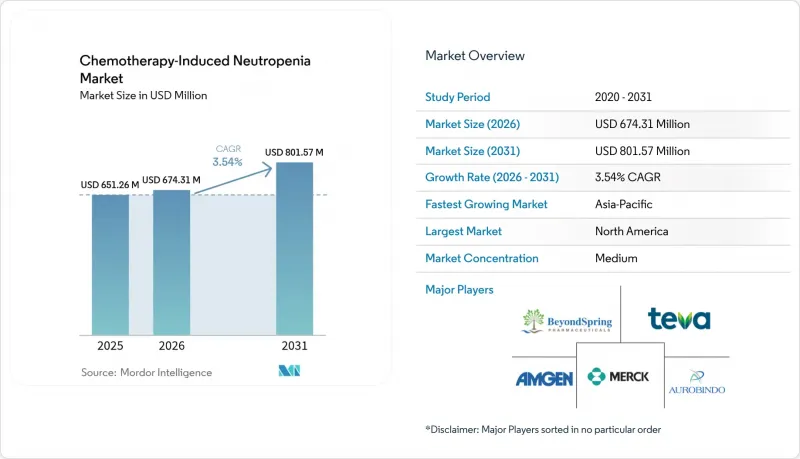
본 보고서는 유형별(항생제 요법, 과립구 콜로니 자극 인자 요법 등), 유통 채널별(병원 약국, 소매 약국, 온라인 약국), 지역별(북미, 유럽, 아시아태평양, 중동 및 아프리카, 남미)로 분류되어 있습니다. 시장 예측은 금액(달러) 단위로 제시되어 있습니다.
전 세계 화학요법 유발성 호중구 감소증 시장 동향 및 인사이트
전 세계 암 부담 증가
고형암 및 혈액 악성 종양의 발생률 증가에 따라 예방적 지원 요법에 대한 수요가 높아지고 있습니다. 베네토클락스와 기존의 7+3 화학요법을 병용하는 급성 골수성 백혈병 치료 프로토콜에서는 골수 억제가 강화되기 때문에 G-CSF의 사용 빈도가 증가하고 있습니다. 북미 및 유럽에서는 고령화가 진행되고 있으며, 고령자는 발열성 호중구 감소증의 위험이 높기 때문에 대상 환자층이 더욱 확대되고 있습니다. 아시아태평양에서는 종양학 의료 체계가 확충됨에 따라 서유럽식 고빈도 투여 요법의 도입이 진행되어 대상 환자 수가 확대되고 있습니다. 또한, 인구 기반 선별 검진 프로그램을 통해 암의 조기 발견이 진전되면서, 예방적 투여가 필요한 여러 주기의 화학요법을 완료할 수 있는 환자가 증가하고 있습니다. 그 결과, 화학요법 유발성 호중구 감소증 시장은 화학요법 전반의 이용이 면역요법으로부터의 경쟁 압력에 직면하고 있음에도 불구하고, 꾸준한 환자 유입을 유지하고 있습니다.
바이오시밀러 성장 인자의 접근성 확대
페그필글라스팀 바이오시밀러의 평균 판매 가격은 2,050달러에 달한 반면, 참조 의약품은 3,600달러를 초과하여, 이로 인해 지불자의 부담이 경감되고 보험 적용 범위가 불충분한 환자들에게 치료의 길이 열렸습니다. 분석적 유사성 시험을 명확히 한 FDA 지침의 간소화로 인해 2024년에는 심사 주기가 3개월 단축되어 중견 제약사가 간소화된 생물학적 제제 허가 신청을 할 수 있게 되었습니다. Tanvex BioPharma사의 필그라스팀 바이오시밀러는 FDA 승인을 획득하여 4억 300만 달러 규모 시장 기회를 확보했습니다. 이는 탁월한 규제 대응을 통해 달성 가능한 잠재적 규모를 여실히 보여줍니다. 유럽에서는 상호 대체성에 관한 권고 사항으로 인해 병원 처방집에서의 대체가 간소화되어, 병원의 입찰 물량이 증가하고 있습니다. 동등한 효능에 더해 단가 하락으로 인해, 지불 기관이 보다 광범위한 예방적 투여에 대한 보험 적용을 승인함에 따라 화학요법 유발성 호중구 감소증(CIN) 시장이 강화되고 있습니다.
높은 치료비와 보험 급여 격차
2024년 발열성 호중구 감소증의 1회 입원당 평균 비용은 3만 5,899달러에 달하여 의료 시스템에 막대한 부담을 주고 있습니다. 저소득 국가의 환자들은 연간 가구 소득을 초과하는 본인 부담 비용에 직면해 있습니다. 바이오시밀러는 약제 구매 비용을 절감하지만, 점적 의자 사용 시간이나 임상 검사를 통한 모니터링 등의 부수적 비용은 여전히 발생합니다. 보험사의 감사에 따르면, 사전 승인 절차로 인해 치료 시작이 최대 4일까지 지연될 수 있으며, 이는 감염 위험을 높일 가능성이 있습니다. 자선 재단이 경제적 격차를 메우고는 있지만, 평생 상한액으로 인해 지원은 연간 2,200달러로 제한되어 있으며, 이는 일반적인 다주기 예방 요법 비용보다 훨씬 낮은 수준입니다. 이러한 경제적 장벽이 화학요법 유발성 호중구 감소증 시장 전망을, 본래라면 밝았을 법한 것을 억제하고 있습니다.
부문 분석
2025년에는 G-CSF 요법이 화학요법 유발성 호중구 감소증 시장 규모에 가장 크게 기여하여, 병원이 증거 기반 예방 프로토콜을 준수함에 따라 매출의 63.78%를 차지했습니다. 이 제품군에는 필그라스팀, 페그필그라스팀, 에프베마레노그라스팀 알파가 포함되어 있으며, 각각 다른 반감기를 가지고 있어 다양한 화학요법 일정에 대응하고 있습니다. 유럽의 경쟁 입찰로 인해 바이오시밀러의 급속한 보급이 촉진되었지만, 체내 삽입형 기기에 대한 브랜드 충성도로 인해 프리미엄 부문은 견조한 추세를 보이고 있습니다. 지속형 약물은 내원 횟수를 줄이고 복약 순응도를 높이기 때문에 가치 기반 계약에서 유리한 입장에 있습니다. 유전자 변형된 변이체 파이프라인은 골통 발생률을 높이지 않으면서 수용체 친화성을 향상시키는 것을 목표로 하고 있으며, 이미 성숙기에 접어든 이 분야에서도 지속적인 혁신이 나타나고 있습니다.
과립구 수혈은 틈새 시장이지만, 유전자 편집된 기증자 세포와 체외 증식 기술을 통해 기존공급 제약을 극복함으로써, 2031년까지 연평균 성장률(CAGR)이 5.21%로 가장 높은 성장세를 기록하고 있습니다. 소아 종양 센터에서는 성장 인자에 반응하지 않는 난치성 감염증에 대해 고용량 수혈을 채택하고 있으며, 이를 통해 독자적인 임상 기반을 구축하고 있습니다. 학술적 공동 연구에서는 유도 만능 줄기세포를 이용하여 기능성 호중구를 대량 생산하는 노력이 진행되고 있으며, 이러한 진전은 지지 요법의 방식을 재정의할 가능성이 있습니다. 항생제 요법은 여전히 필수적인 축이지만, 스튜어드십 프로그램을 통해 배양 결과가 음성으로 나타난 시점에서 투여를 단계적으로 줄이는 것이 권장됨에 따라 투여량 증가는 억제되고 있습니다. 트리라시클리브와 같은 신규 예방약은 골수 세포의 세포 주기를 일시적으로 정지시켜 호중구 감소증을 미연에 방지하는 것을 목적으로 하며, 제3상 임상시험의 양호한 결과를 바탕으로 2027년까지 시장 진입을 위한 기반이 마련되어 있습니다. 이러한 하위 부문들이 결합되어, 화학요법 유발성 호중구 감소증 시장은 다양성과 탄력성을 확보하고 있습니다.
지역별 분석
북미는 광범위한 보험 적용 범위와 장시간 작용형 바이오시밀러의 조기 도입에 힘입어, 2025년에는 화학요법 유발성 호중구 감소증 시장의 42.10%를 차지하며 지역별 매출 1위를 기록했습니다. 메디케어(Medicare)의 환급 제도는 적격 치료 요법에 대한 G-CSF 당일 투여를 지원하고 있으며, 이로 인해 점적 주사 의자의 가동률이 낮아지고 외래 진료 확대가 촉진되고 있습니다. 이 지역에서는 전자 건강 기록과 위험도 알고리즘을 통합한 고급 분석 기술이 도입되어, 이를 통해 종양 전문의는 예방적 투여 주기를 환자별로 맞춤화함과 동시에 불필요한 지출을 억제할 수 있게 되었습니다. 암젠(Amgen)과 코헬라스(Cohteras)는 미국 병원 시스템 전반에 걸쳐 높은 처방약 목록 등재율을 확보하는 견고한 상업적 인프라를 유지하고 있는 반면, 의약품 급여 관리 회사는 바이오시밀러 간의 경쟁을 활용하여 더 낮은 가격대에서 협상을 진행하고 있습니다.
아시아태평양은 2031년까지 연평균 성장률(CAGR) 4.70%를 기록하며 가장 빠르게 성장하는 지역입니다. 중국은 2025년에 Mabwell사의 ‘Mailisheng’ 주사제를 승인하여, 수입 의존도를 줄여줄 국산 장기 작용형 G-CSF가 추가되었습니다. 2급 도시에서는 서유럽식 고빈도 화학요법의 도입이 진행되고 있으며, 예방 투여량이 확대되고 있습니다. 일본에서는 근거 기반 진료 지침에 따라 급성 골수성 백혈병(AML) 집중 치료 후 조기 G-CSF 예방 투여가 권장되고 있어, 이로 인해 해당 약제군의 채택이 확고해지고 있습니다. 인도 및 동남아시아에서는 정부 조달 시 국가 암 프로그램을 위한 비용 대비 효과가 높은 옵션이 우선시됨에 따라 바이오시밀러의 보급률이 높아지고 있습니다. 원격 종양학 서비스는 지리적 장벽을 해소하여 지방 주에서도 원격으로 G-CSF 투여가 가능하게 하고 있습니다.
유럽은 성숙해 가면서도 기회가 넘치는 환경을 유지하고 있으며, 입찰 동향에 따라 오리지널 의약품과 바이오시밀러 간 시장 점유율에 급격하고 미세한 변화가 일어나고 있습니다. EMA는 2024년에 ‘Ryzneuta’를 승인하여, 환자의 투여 간격을 연장하는 새로운 지속형 대체 의약품이 추가되었습니다. 각국의 국민건강보험 서비스는 중앙 조달을 활용하여 가격 인하를 추진하고 있으며, 이는 예산의 지속가능성에 기여하고 있지만 이익률은 압박받고 있습니다. 그동안 생물학적 제제에 대한 접근이 제한적이었던 동유럽 국가들에서는 보험 급여 정책의 진전에 따라 바이오시밀러 도입이 가속화되고 있습니다. 라틴아메리카, 중동 및 아프리카 시장 규모는 여전히 작지만, 테바(Teva)사의 ‘Global HOPE’ 프로그램과 같은 파트너십 모델을 통해 소아 종양학 분야의 지지 요법이 개선되고 있으며, 향후 화학요법 유발성 호중구 감소증(CNI) 시장의 확대를 위한 기반이 마련되고 있습니다.
기타 혜택:
- 엑셀 형식 시장 예측(ME) 시트
- 3개월간의 애널리스트 지원
자주 묻는 질문
목차
제1장 서론
제2장 조사 방법
제3장 주요 요약
제4장 시장 구도
제5장 시장 규모와 성장 예측
제6장 경쟁 구도
제7장 시장 기회와 향후 전망
JHS 26.08.28According to Mordor Intelligence, the chemotherapy-induced neutropenia market size was valued at USD 651.26 million in 2025 and estimated to grow from USD 674.31 million in 2026 to reach USD 801.57 million by 2031, at a CAGR of 3.54% during the forecast period (2026-2031).
This report is Segmented by Type (Antibiotic Therapy, Granulocyte Colony-Stimulating Factor Therapy, and More), Distribution Channel (Hospital Pharmacies, Retail Pharmacies, and Online Pharmacies), and Geography (North America, Europe, Asia-Pacific, Middle East & Africa, South America). The Market Forecasts are Provided in Terms of Value (USD).
Global Chemotherapy-Induced Neutropenia Market Trends and Insights
Rising Global Cancer Burden
Higher incidence of solid tumors and hematologic malignancies raises demand for prophylactic supportive care. Acute myeloid leukemia treatment protocols that combine venetoclax with conventional 7+3 chemotherapy intensify myelosuppression, leading to more frequent G-CSF use. Aging populations in North America and Europe further enlarge the eligible patient base because elderly individuals carry increased risk for febrile neutropenia. In Asia-Pacific, adoption of Western-style dose-dense regimens expands addressable volumes as oncology capacity scales. Population-based screening programs also detect cancers earlier, allowing more patients to complete multi-cycle chemotherapy that necessitates prophylaxis. The Chemotherapy-Induced Neutropenia market therefore gains steady patient inflow even as overall chemotherapy utilization faces competitive pressure from immunotherapy.
Expanding Access to Biosimilar Growth Factors
Pegfilgrastim biosimilar average selling prices reached USD 2,050 compared with reference products above USD 3,600, reducing payer burden and unlocking treatment for under-insured patients. Streamlined FDA guidance that clarifies analytical similarity testing decreased review cycles by three months in 2024 and encouraged mid-size manufacturers to file abbreviated biologics license applications. Tanvex BioPharma's filgrastim biosimilar won FDA approval and accessed a USD 403 million opportunity, illustrating the potential scale achievable through regulatory excellence. In Europe, interchangeability recommendations simplify substitution in hospital formularies and accelerate hospital tender volumes. Lower unit prices, paired with equivalent efficacy, strengthen the Chemotherapy-Induced Neutropenia market as payers authorize broader prophylaxis coverage.
High Treatment Costs and Reimbursement Gaps
Average hospitalization cost for a febrile neutropenia episode reached USD 35,899 in 2024, placing a heavy burden on health systems. Patients in low-income countries confront out-of-pocket expenses exceeding annual household income. Although biosimilars reduce drug acquisition prices, ancillary costs such as infusion chair time and laboratory monitoring persist. Prior authorization processes delay therapy start by up to four days according to payer audits, potentially heightening infection risk. Charitable foundations fill financial gaps, yet lifetime maximums cap assistance at USD 2,200 per year, well below typical multi-cycle prophylaxis costs. These financial frictions temper the otherwise positive outlook for the Chemotherapy-Induced Neutropenia market.
Other drivers and restraints analyzed in the detailed report include:
- Favorable Clinical Guidelines for Prophylactic G-CSF Use
- Integration of Predictive Analytics for Neutropenia Risk Profiling
- Stringent Regulatory Requirements for Biologics and Biosimilars
For complete list of drivers and restraints, kindly check the Table Of Contents.
Segment Analysis
G-CSF therapy generated the largest Chemotherapy-Induced Neutropenia market size contribution in 2025, accounting for 63.78% of revenues as hospitals adhere to evidence-based prophylaxis protocols. The product class includes filgrastim, pegfilgrastim, and efbemalenograstim alfa, each offering varying half-lives that align with different chemotherapy schedules. Competitive tendering in Europe fostered rapid biosimilar uptake, yet brand loyalty in on-body devices sustains premium segments. Long-acting agents reduce clinic visits and enhance adherence, which positions them favourably in value-based contracts. A pipeline of engineered variants aims to improve receptor affinity without raising bone pain incidence, indicating continued innovation within an already mature class.
Granulocyte transfusion, while niche, records the fastest CAGR at 5.21% through 2031 as gene-edited donor cells and ex-vivo expansion technologies overcome historical supply limitations. Pediatric oncology centres adopt high-dose transfusions for refractory infections that fail to respond to growth factors, thereby carving a unique clinical foothold. Academic collaborations investigate induced pluripotent stem cells to mass-produce functional neutrophils, an advance that could redefine supportive care. Antibiotic therapy remains an indispensable pillar, yet stewardship programs temper volume growth by encouraging de-escalation once cultures clear. Novel prophylactic agents such as trilaciclib aim to pre-empt neutropenia by transiently arresting bone-marrow cell cycling; positive phase III data sets the stage for commercial entry by 2027. Together, these sub-segments ensure a diversified and resilient Chemotherapy-Induced Neutropenia market.
Complete Report Scope:
- By Therapy Type
- Antibiotic Therapy
- Granulocyte Colony-Stimulating Factor (G-CSF) Therapy
- Granulocyte Transfusion
- Other Therapy Types
- By Distribution Channel
- Hospital Pharmacies
- Retail Pharmacies
- Online Pharmacies
- Geography
- North America
- United States
- Canada
- Mexico
- Europe
- Germany
- United Kingdom
- France
- Italy
- Spain
- Rest of Europe
- Asia-Pacific
- China
- Japan
- India
- Australia
- South Korea
- Rest of Asia-Pacific
- Middle East & Africa
- GCC
- South Africa
- Rest of Middle East & Africa
- South America
- Brazil
- Argentina
- Rest of South America
- North America
Geography Analysis
North America delivered the largest regional revenue pool, holding 42.10% share of the chemotherapy-induced neutropenia market in 2025, propelled by broad insurance coverage and early adoption of long-acting biosimilars. Medicare reimbursement supports same-day G-CSF administration for qualifying regimens, which lowers infusion chair utilisation and supports outpatient growth. The region features advanced analytics that integrate electronic health records with risk algorithms, allowing oncologists to personalise prophylactic cycles and limit unnecessary spending. Amgen and Coherus maintain robust commercial infrastructure that secures high formulary presence across US hospital systems, while pharmaceutical benefit managers leverage biosimilar competition to negotiate lower price corridors.
Asia-Pacific represents the fastest expanding territory with a 4.70% CAGR to 2031. China approved Mabwell's Mailisheng injection in 2025, adding a domestically produced long-acting G-CSF that reduces dependence on imports. Uptake of Western-style dose-dense chemotherapy grows across tier-2 cities, boosting prophylaxis volumes. Japan's evidence-anchored guidelines encourage early G-CSF prophylaxis after intensive AML therapy, which solidifies class uptake. India and South-East Asia witness rising biosimilar penetration as government procurement favours cost-effective options for national cancer programmes. Tele-oncology services bridge geographic barriers, making remote G-CSF administration feasible in rural provinces.
Europe maintains a mature yet opportunity-laden environment where tender dynamics foster rapid micro-shifts in share between originators and biosimilars. The EMA approved Ryzneuta in 2024, adding a novel long-acting alternative that lengthens patient dosing intervals. National health services leverage central procurement to drive price deflation, benefiting budget sustainability but compressing margins. Eastern European countries with historically limited access to biologics adopt biosimilars at accelerated rates as reimbursement policies evolve. Latin America, the Middle East, and Africa still account for modest volumes, yet partnership models such as Teva's Global HOPE programme improve paediatric oncology supportive care and lay groundwork for future chemotherapy-induced neutropenia market expansion.
- Amgen
- Pfizer
- Sandoz (Novartis)
- Teva Pharmaceutical Industries
- Merck
- GlaxoSmithKline
- Coherus BioSciences
- Aurobindo Pharma
- Fresenius
- BeyondSpring Pharma
- Kyowa Kirin
- Intas Pharmaceuticals
- Dr. Reddy's Laboratories
- Accord Healthcare
- Viatris
- Hanmi Pharmaceutical
- Apotex
- Mundipharma
- Lupin
- Celltrion
Additional Benefits:
- The market estimate (ME) sheet in Excel format
- 3 months of analyst support
TABLE OF CONTENTS
1 Introduction
- 1.1 Study Assumptions & Market Definition
- 1.2 Scope of the Study
2 Research Methodology
3 Executive Summary
4 Market Landscape
- 4.1 Market Overview
- 4.2 Market Drivers
- 4.2.1 Rising Global Cancer Burden
- 4.2.2 Growing Adoption of Chemotherapy Regimens
- 4.2.3 Expanding Access to Biosimilar Growth Factors
- 4.2.4 Favorable Clinical Guidelines for Prophylactic G-CSF Use
- 4.2.5 Shift Toward Outpatient Oncology Care Models
- 4.2.6 Integration of Predictive Analytics for Neutropenia Risk Profiling
- 4.3 Market Restraints
- 4.3.1 High Treatment Costs and Reimbursement Gaps
- 4.3.2 Stringent Regulatory Requirements for Biologics And Biosimilars
- 4.3.3 Declining Chemotherapy Utilization in Immuno-Oncology Era
- 4.3.4 Manufacturing Capacity Constraints for Biologic APIs
- 4.4 Regulatory Landscape
- 4.5 Porter's Five Forces Analysis
- 4.5.1 Bargaining Power of Buyers
- 4.5.2 Bargaining Power of Suppliers
- 4.5.3 Threat of New Entrants
- 4.5.4 Threat of Substitutes
- 4.5.5 Intensity of Competitive Rivalry
5 Market Size & Growth Forecasts (Value, USD)
- 5.1 By Therapy Type
- 5.1.1 Antibiotic Therapy
- 5.1.2 Granulocyte Colony-Stimulating Factor (G-CSF) Therapy
- 5.1.3 Granulocyte Transfusion
- 5.1.4 Other Therapy Types
- 5.2 By Distribution Channel
- 5.2.1 Hospital Pharmacies
- 5.2.2 Retail Pharmacies
- 5.2.3 Online Pharmacies
- 5.3 Geography
- 5.3.1 North America
- 5.3.1.1 United States
- 5.3.1.2 Canada
- 5.3.1.3 Mexico
- 5.3.2 Europe
- 5.3.2.1 Germany
- 5.3.2.2 United Kingdom
- 5.3.2.3 France
- 5.3.2.4 Italy
- 5.3.2.5 Spain
- 5.3.2.6 Rest of Europe
- 5.3.3 Asia-Pacific
- 5.3.3.1 China
- 5.3.3.2 Japan
- 5.3.3.3 India
- 5.3.3.4 Australia
- 5.3.3.5 South Korea
- 5.3.3.6 Rest of Asia-Pacific
- 5.3.4 Middle East & Africa
- 5.3.4.1 GCC
- 5.3.4.2 South Africa
- 5.3.4.3 Rest of Middle East & Africa
- 5.3.5 South America
- 5.3.5.1 Brazil
- 5.3.5.2 Argentina
- 5.3.5.3 Rest of South America
- 5.3.1 North America
6 Competitive Landscape
- 6.1 Market Concentration
- 6.2 Market Share Analysis
- 6.3 Company Profiles (includes Global level Overview, Market level overview, Core Business Segments, Financials, Headcount, Key Information, Market Rank, Market Share, Products and Services, and analysis of Recent Developments)
- 6.3.1 Amgen, Inc.
- 6.3.2 Pfizer, Inc.
- 6.3.3 Sandoz (Novartis)
- 6.3.4 Teva Pharmaceuticals Industries Ltd.
- 6.3.5 Merck & Co.
- 6.3.6 GlaxoSmithKline
- 6.3.7 Coherus BioSciences
- 6.3.8 Aurobindo Pharma
- 6.3.9 Fresenius Kabi
- 6.3.10 BeyondSpring Pharma
- 6.3.11 Kyowa Kirin
- 6.3.12 Intas Pharmaceuticals
- 6.3.13 Dr. Reddy's Laboratories
- 6.3.14 Accord Healthcare
- 6.3.15 Viatris
- 6.3.16 Hanmi Pharmaceutical
- 6.3.17 Apotex
- 6.3.18 Mundipharma
- 6.3.19 Lupin
- 6.3.20 Celltrion
7 Market Opportunities & Future Outlook
- 7.1 White-Space & Unmet-Need Assessment


