

|
시장보고서
상품코드
2116580
치료 저항성 우울증 시장 : 점유율 분석, 업계 동향과 통계, 성장 예측(2026-2031년)Global Treatment-Resistant Depression - Market Share Analysis, Industry Trends & Statistics, Growth Forecasts (2026 - 2031) |
||||||
 Mordor Intelligence
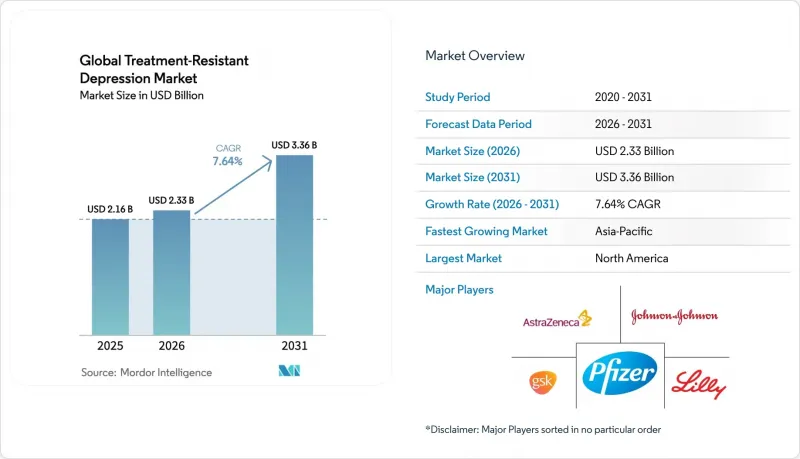
Mordor Intelligence에 의하면, 치료 저항성 우울증 시장 규모는 2025년 21억 6,000만 달러에서 2026년에는 23억 3,000만 달러로 확대되어 2026년부터 2031년까지 CAGR 7.64%로 성장을 지속하여, 2031년에는 33억 6,000만 달러에 이를 것으로 예측됩니다.
본 보고서에서는 시장을 약물 분류별(NMDA 수용체 길항제, 비정형 항정신병제를 이용한 증강 요법 등), 최종 사용자별(병원, 전문 클리닉 등), 유통 채널별(소매 약국, 병원 약국 등), 지역별(북미, 유럽, 아시아태평양 등)로 분류하고 있습니다. 시장 예측은 금액(달러) 기준으로 제시됩니다.
치료 저항성 우울증 세계 시장 동향 및 인사이트
모노아민계 항우울제의 경우, 환자의 70%가 완전 관해에 이르지 못하며, 이러한 미해결 과제가 글루타메이트계, GABA계 및 신경 가소성 경로에 작용하는 대체 요법에 대한 지속적인 수요를 뒷받침하고 있습니다. 스탠퍼드 대학의 연구진은 주요 우울 장애를 6가지 생물학적 아형으로 분류하고, 치료 저항성 우울증이 단일 질환이 아니라 이질적인 증상의 집합체임을 입증했습니다. 바이오마커 기반 임상시험은 현재 규모는 작지만 반응성이 높은 피험자 집단을 대상으로 하고 있으며, 이를 통해 연구의 검출력이 높아지고 개발 위험이 감소하고 있습니다. 제약 기업의 파이프라인에서는 반응률이 높을 것으로 예상되는 대상 집단에 초점을 맞추어 약물 시험이 점점 더 많이 이루어지고 있습니다. 의료 경제 모델에 따르면, 기능적 관해율이 1퍼센트 포인트 향상될 때마다 미국에서만 장기적인 의료비가 2억 2,000만 달러 절감될 것으로 예측되며, 이는 개인 맞춤형 전략의 상업적 타당성을 뒷받침합니다. 이러한 동향들이 결합되어, 더 빠른 효과, 신경 가소성의 회복, 그리고 지속적인 증상 완화를 약속하는 치료법에 대한 모멘텀이 지속적으로 유지될 것으로 확실시되고 있습니다.
주요 시장에서 에스케타민의 급속한 시장 침투
에스케타민의 실제 임상에서 기능적 관해율은 25.6%로, 기존 보조 요법의 11.5%와 비교하여 직장에서의 생산성 향상을 구체적으로 이끌어내며, 정신과 의사들 사이에서 긍정적인 입소문을 퍼뜨리고 있습니다. 미국에서는 2025년 1월에 적응증이 확대되어 단독 요법이 승인되었습니다. 이로 인해 임상의들이 에스케타민 투여를 더 조기에 시작할 수 있게 되어, 치료 대상 환자 수는 사실상 2배로 늘어났습니다. 유럽에서는 신중하면서도 긍정적인 방침이 채택되고 있으며, 일부 국가의 규제 당국이 치료 성과 모니터링을 조건으로 한 조건부 보험 급여를 승인하고 있습니다. 캐나다, 독일, 일본의 레지스트리에서는 도입 후 6개월간의 기능적 변화를 추적하고, 그 데이터를 실시간 대시보드에 반영함으로써 보험사가 보험 적용 갱신 여부를 판단하는 근거로 삼고 있습니다. 병원 구매위원회에서는 REMS(위험 평가 및 관리 전략)에 부합하는 전용실을 에스케타민 공급 계약에 포함시키는 사례가 증가하고 있어, 안정적인 수요가 확보되고 있습니다.
비강 내 에스케타민 투여에 따른 높은 비용과 REMS의 부담
위험 평가 및 완화 전략(REMS) 프로토콜에서는 투여 시마다 2시간의 현장 모니터링이 의무화되어 있어, 환자 수와 관계없이 진료소의 고정비가 증가하고 있습니다. 현장 감사에 따르면, 도입 기간의 중앙값은 권장되는 28일이 아닌 64일에 달하며, 이로 인해 인건비와 시설비가 증가하고 있습니다. 소규모 병원에서는 전용실이나 훈련을 받은 인력을 확보하기 어렵기 때문에 환자들이 더 큰 규모의 의료 센터로 몰리게 되어 이동 시간이 길어지고 있습니다. 영국의 의료비 감독 기관은 2024년, 증분 비용 대비 효과 비율이 불충분하다는 이유로 국민보건서비스(NHS)의 광범위한 자금 지원을 기각했습니다. 이는 임상적 이점이 분명하더라도 재정적·운영상의 장벽이 도입을 방해할 수 있음을 보여줍니다. 이에 대응하여 제약사들은 모니터링 기간을 절반으로 줄일 수 있는 주 1회 투여 제제나 서방형 제제의 개발을 추진하고 있지만, 이들이 승인되기까지는 아직 수년이 걸릴 것으로 예측됩니다.
부문 분석
2025년, NMDA 수용체 길항제는 치료 저항성 우울증 시장의 매출의 41.78%를 차지했습니다. 이 점유율의 대부분은 에스케타민이 차지하고 있으며, 일관된 실제 임상에서의 관해 데이터에 더해 2025년 1월 단일 요법으로서의 승인으로 적용 범위가 확대된 것이 이를 뒷받침하고 있습니다. 환각제 및 신규 화합물은 2031년까지 연평균 성장률(CAGR)이 7.80%를 나타낼 것으로 예측되는 가장 빠르게 성장하는 약물군이며,이러한 성장 추세는 위약 대비 MADRS 점수에서 평균 3.6점의 우위를 보인 COMP360의 3상 임상시험 성공에 의해 뒷받침되고 있습니다. 적어도 3개 주요 지역에서 규제 당국의 승인을 전제로 할 때, 환각제로 치료되는 치료 저항성 우울증 시장 규모는 2031년까지 6억 4,570만 달러를 넘어설 것으로 예측됩니다.
대형 제약사들이 기존 포트폴리오를 보완할 가능성을 인식하고 초기 단계의 환각제 관련 자산을 인수하거나 라이선스 계약을 체결함에 따라 경쟁 환경은 변화하고 있습니다. 동시에, 서방형 케타민 후보 약물은 모니터링 부담을 줄여주고, 이미 확립된 NMDA 수용체 길항제 카테고리에 대한 수요를 다시 불러일으킬 가능성이 있습니다. 비정형 항정신병 약물을 이용한 증강 요법은 해당 프로토콜에 익숙한 임상의에게는 여전히 유용하지만, 대사 관련 부작용과 보험사의 엄격한 감시로 인해 그 성장세는 완만해지고 있습니다. 3중 재흡수 억제제 및 신경 활성 스테로이드는 유망하지만 여전히 신흥 틈새 시장을 차지하고 있으며, 초기 단계의 데이터에 따르면 글루타메이트계 조절제와 병용할 경우 시너지 효과가 나타날 가능성이 시사되고 있습니다.
지역별 분석
북미는 2025년 매출의 47.91%를 차지하며, 규제 및 보험 환급 선례에 있어 기준 시장으로서의 지위를 유지하고 있습니다. 2025년 1월, 미국이 에스케타민 단독 요법을 승인함에 따라 해당 지역 전체의 치료 저항성 우울증 시장 규모는 즉시 확대되었습니다. 캐나다의 ‘특별 접근 프로그램’에서는 176건의 실로시빈 적용 면제가 승인되어 승인률이 78%에 달했습니다. 이를 통해 향후 적응증 확대에 도움이 될 치료 후 데이터가 확보되었습니다. 기능적 관해, 출근 현황, 재입원 현황을 거의 실시간으로 추적하는 확립된 진단 코드 및 결과 등록 제도 덕분에 보험사의 도입이 원활하게 이루어지고 있습니다. 이러한 생태계의 높은 성숙도 덕분에 신규 진출기업은 승인을 획득하는 즉시 신속하게 사업 규모를 확대할 수 있습니다.
유럽에서는 3상 임상시험을 촉진하는 강력한 학술 네트워크와 다국적 컨소시엄 덕분에 큰 수익원이 되고 있습니다. 유럽의약품청(EMA)은 2024년 워크숍에서 혁신적인 정신건강 중재에 대해 긍정적인 태도를 보였으나, 회원국 차원에서는 여전히 보험 급여에 관한 논의가 계속되고 있습니다. 독일과 네덜란드는 진료소 밀도가 가장 높고, 환각제 파일럿 프로그램도 가장 빨리 시작되었지만, 일부 남유럽 시장에서는 여전히 기존 약물 치료에 자원을 집중하고 있습니다. 이러한 편차에도 불구하고, 임상시험 요건에 대한 유럽 대륙 전체의 발맞춤으로 인해 환각제, NMDA 조절제, 신경활성 스테로이드 모두에 대한 신청 서류 준비가 가속화되고 있습니다.
아시아태평양은 2031년까지 연평균 성장률(CAGR)이 8.51%를 나타낼 것으로 예측되는 가장 빠르게 성장하는 지역입니다. 일본은 비침습적 뇌 자극 요법의 임상 도입을 주도하고 있으며, 치료 성과에 기반한 보험 급여 모델을 제공합니다. 호주는 2023년에 실로시빈 요법을 승인하며 새로운 지평을 열었습니다. 이에 따라 전용 클리닉 건설 및 치료사 양성 프로그램에 대한 지역적 투자가 촉진되고 있습니다. 중국의 정신건강 개혁으로 조기 진단의 중요성이 부각되며 즉각적인 효과가 있는 솔루션에 대한 수요가 확대되고 있지만, 국내 승인 절차에서는 여전히 현지 데이터가 우선시되고 있습니다. 한국과 싱가포르는 견고한 생명공학 생태계를 활용하여 다기관 공동 임상시험을 실시하고, 아시아 특유의 안전성 및 유효성 근거를 창출하고 있습니다. 전반적으로 이 지역의 인구 규모, 가처분 소득 증가, 그리고 규제 명확화가 진행되고 있어 세계 기업에게 필수적인 성장 동력이 되고 있습니다.
기타 혜택:
- 엑셀 형식 시장 예측(ME) 시트
- 3개월간의 애널리스트 지원
자주 묻는 질문
목차
제1장 서론
제2장 조사 방법
제3장 개요
제4장 시장 구도
제5장 시장 규모와 성장 예측
제6장 경쟁 구도
제7장 시장 기회와 향후 전망
JHS 26.09.01According to Mordor Intelligence, the treatment-resistant depression market size is expected to grow from USD 2.16 billion in 2025 to USD 2.33 billion in 2026 and is forecast to reach USD 3.36 billion by 2031 at 7.64% CAGR over 2026-2031.
This report Segments the Industry Into by Drug Class (NMDA Receptor Antagonists, Atypical Antipsychotic Augmentation and More ), by End User (Hospitals, Specialty Clinics and More), by Distribution Channel (Retail Pharmacies, Hospital Pharmacies and More) and Geography (North America, Europe, Asia-Pacific and More). The Market Forecasts are Provided in Terms of Value (USD).
Global Treatment-Resistant Depression Market Trends and Insights
Monoamine-based antidepressants leave 70% of patients without full remission, and this unresolved burden fuels continuous demand for alternatives that work on glutamatergic, GABAergic, and neuroplasticity pathways. Stanford researchers segmented major depressive disorder into six biological subtypes, demonstrating that treatment-resistant depression is a heterogeneous collection of conditions rather than a single disease. Biomarker-driven trials now enroll smaller but more responsive cohorts, improving study power and reducing development risk. Pharmaceutical pipelines increasingly test agents in matched subpopulations where response probabilities are higher. Health-economic models forecast that every 1-percentage-point improvement in functional remission cuts long-term medical spending by USD 220 million across the United States alone, reinforcing the commercial logic behind personalized strategies. Together, these dynamics ensure sustained momentum for therapies that promise faster action, neuroplastic repair, and durable symptom relief.
Rapid Commercial Uptake of Esketamine in Key Markets
Esketamine's real-world 25.6% functional remission rate versus 11.5% for older add-on options translates into tangible workplace productivity gains and drives positive word-of-mouth among psychiatrists. The United States widened the label to include monotherapy in January 2025, effectively doubling the treatable population because clinicians can now start esketamine earlier. Europe follows a cautious but still positive course, with several national agencies issuing conditional reimbursement linked to outcomes monitoring. Registries in Canada, Germany, and Japan track functional changes six months post-induction and feed live dashboards that inform payer renewals. Hospital buying committees increasingly bundle REMS-compliant rooms with esketamine supply contracts, locking in steady demand.
High Cost and REMS Burden for Intranasal Esketamine Administration
Risk Evaluation and Mitigation Strategy protocols stipulate two-hour on-site monitoring after each dose, driving fixed clinic costs independent of patient numbers. Real-world audits show median induction phases extending to 64 days instead of the recommended 28 days, inflating staffing and facility expenses. Smaller hospitals struggle to justify dedicated rooms and trained personnel, pushing patients toward larger centers and lengthening travel times. The United Kingdom's cost watchdog declined broad National Health Service funding in 2024, citing unfavorable incremental cost-effectiveness ratios, which illustrates how financial and operational hurdles can stall adoption even when clinical benefit is clear. Manufacturers respond by developing once-weekly or extended-release formulations that could cut monitoring windows in half, but these remain several years from approval.
Other drivers and restraints analyzed in the detailed report include:
- Rising Payer Willingness to Reimburse Novel-Mechanism Add-Ons
- Psychedelic-Assisted Therapy Clinics Scaling in North America & Europe
- Stringent Insurance Step-Edit Requirements Delaying Uptake
For complete list of drivers and restraints, kindly check the Table Of Contents.
Segment Analysis
In 2025, NMDA receptor antagonists generated 41.78% of treatment-resistant depression market revenue. Esketamine accounts for the bulk of this share, buoyed by consistent real-world remission data and the January 2025 monotherapy approval that broadened its reach. Psychedelics and novel compounds represent the fastest-growing drug class with an 7.80% CAGR forecast to 2031, a trajectory underpinned by the COMP360 Phase 3 success that demonstrated a 3.6-point mean MADRS advantage over placebo. The treatment-resistant depression market size attributable to psychedelics is expected to surpass USD 645.7 million by 2031, assuming regulatory approvals across at least three major regions.
Competitive dynamics are shifting as large pharmaceutical firms buy or license early-stage psychedelic assets, recognizing their potential to complement existing portfolios. At the same time, extended-release ketamine candidates could lower monitoring burdens and draw volume back toward the established NMDA category. Atypical antipsychotic augmentation regimens remain relevant for clinicians familiar with the protocols, but their growth moderates because of metabolic side-effects and payer scrutiny. Triple reuptake inhibitors and neuroactive steroids occupy a promising but still emergent niche, with early-phase data suggesting synergistic action when combined with glutamatergic modulators.
Complete Report Scope:
- By Drug Class (Value)
- NMDA Receptor Antagonists
- Atypical Antipsychotic Augmentation
- Monoamine Modulators (SSRI/SNRI, MAOI, TCA)
- Psychedelics & Novel Compounds
- Others
- By End User (Value)
- Hospitals
- Specialty Clinics
- Homecare & Telepsychiatry
- Research & Academic Centers
- By Distribution Channel (Value)
- Retail Pharmacies
- Hospital Pharmacies
- Online Pharmacies
- By Geography (Value)
- North America
- United States
- Canada
- Mexico
- Europe
- Germany
- United Kingdom
- France
- Italy
- Spain
- Rest of Europe
- Asia-Pacific
- China
- India
- Japan
- South Korea
- Australia
- Rest of Asia-Pacific
- South America
- Brazil
- Argentina
- Rest of South America
- Middle East and Africa
- GCC
- South Africa
- Rest of Middle East and Africa
- North America
Geography Analysis
North America generated 47.91% of 2025 revenue and remains the reference market for regulatory and reimbursement precedents. The January 2025 United States decision to permit esketamine monotherapy immediately expanded the treatment-resistant depression market size across the region. Canada's Special Access Program issued 176 psilocybin exemptions with a 78% approval rate, producing post-session data that informs subsequent label expansions. Payer adoption is streamlined by established diagnostic coding and outcome registries that track functional remission, work attendance, and hospital readmission in near real time. The ecosystem's maturity ensures that new entrants can scale quickly once they secure approval.
Europe contributes a significant revenue block thanks to strong academic networks and multinational consortia that facilitate Phase 3 trials. The European Medicines Agency signaled openness to innovative mental-health interventions during its 2024 workshop, yet reimbursement debates continue at the member-state level. Germany and the Netherlands show the highest clinic density and earliest psychedelic pilot programs, whereas some Southern European markets still focus resources on conventional pharmacotherapy. Despite this variability, continental alignment on clinical-trial requirements accelerates dossier preparation for psychedelics, NMDA modulators, and neuroactive steroids alike.
Asia Pacific is the fastest-growing geography with an 8.51% CAGR projected through 2031. Japan leads clinical adoption of non-invasive brain stimulation and provides a model for outcome-based reimbursement. Australia broke new ground by approving psilocybin therapy in 2023, catalyzing regional investment in purpose-built clinics and therapist training pipelines. China's mental-health reforms elevate the importance of early diagnosis and escalate demand for rapid-acting solutions, although domestic approval pathways still prioritize local data. South Korea and Singapore leverage robust biotech ecosystems to host multi-center trials that produce Asia-specific safety and efficacy evidence. Overall, the region's demographic scale, rising disposable income, and evolving regulatory clarity make it an indispensable growth vector for global players.
- Johnson & Johnson
- Alkermes plc
- H. Lundbeck
- Otsuka
- Axsome Therapeutics
- Relmada Therapeutics, Inc.
- Sage Therapeutics
- Seelos Therapeutics, Inc.
- COMPASS Pathways plc
- GH Research PLC
- Biohaven Ltd.
- Atai Life Sciences N.V.
- Revive Therapeutics Ltd.
- Teva Pharmaceutical Industries
- Dr. Reddy's Laboratories Ltd.
- Cipla
- Sun Pharmaceuticals Industries
- Viatris
- Pfizer
- GlaxoSmithKline
Additional Benefits:
- The market estimate (ME) sheet in Excel format
- 3 months of analyst support
TABLE OF CONTENTS
1 Introduction
- 1.1 Study Assumptions & Market Definition
- 1.2 Scope of the Study
2 Research Methodology
3 Executive Summary
4 Market Landscape
- 4.1 Market Overview
- 4.2 Market Drivers
- 4.2.1 Growing Prevalence of Partial/non-response to SSRI/SNRI Therapy
- 4.2.2 Rapid Commercial Uptake of Esketamine (Spravato) in Key Markets
- 4.2.3 Rising Payer Willingness to Reimburse Novel-mechanism Add-ons
- 4.2.4 Psychedelic-assisted Therapy Clinics Scaling in North America & Europe
- 4.2.5 FDA Breakthrough & Fast-Track Designations Accelerating Pipelines
- 4.2.6 AI-enabled Precision-psychiatry Tools Boosting Treatment Matching
- 4.3 Market Restraints
- 4.3.1 High cost & REMS Burden for Intranasal Esketamine Administration
- 4.3.2 Stringent Insurance Step-edit Requirements Delaying Uptake
- 4.3.3 Social-stigma & Regulatory Uncertainty Around Psychedelic Agents
- 4.3.4 Limited Specialist Capacity for Intensive Dosing & Monitoring
- 4.4 Value / Supply-Chain Analysis
- 4.5 Regulatory Landscape
- 4.6 Technological Outlook
- 4.7 Porter's Five Forces
- 4.7.1 Threat of New Entrants
- 4.7.2 Bargaining Power of Buyers
- 4.7.3 Bargaining Power of Suppliers
- 4.7.4 Threat of Substitutes
- 4.7.5 Competitive Rivalry
5 Market Size & Growth Forecasts
- 5.1 By Drug Class (Value)
- 5.1.1 NMDA Receptor Antagonists
- 5.1.2 Atypical Antipsychotic Augmentation
- 5.1.3 Monoamine Modulators (SSRI/SNRI, MAOI, TCA)
- 5.1.4 Psychedelics & Novel Compounds
- 5.1.5 Others
- 5.2 By End User (Value)
- 5.2.1 Hospitals
- 5.2.2 Specialty Clinics
- 5.2.3 Homecare & Telepsychiatry
- 5.2.4 Research & Academic Centers
- 5.3 By Distribution Channel (Value)
- 5.3.1 Retail Pharmacies
- 5.3.2 Hospital Pharmacies
- 5.3.3 Online Pharmacies
- 5.4 By Geography (Value)
- 5.4.1 North America
- 5.4.1.1 United States
- 5.4.1.2 Canada
- 5.4.1.3 Mexico
- 5.4.2 Europe
- 5.4.2.1 Germany
- 5.4.2.2 United Kingdom
- 5.4.2.3 France
- 5.4.2.4 Italy
- 5.4.2.5 Spain
- 5.4.2.6 Rest of Europe
- 5.4.3 Asia-Pacific
- 5.4.3.1 China
- 5.4.3.2 India
- 5.4.3.3 Japan
- 5.4.3.4 South Korea
- 5.4.3.5 Australia
- 5.4.3.6 Rest of Asia-Pacific
- 5.4.4 South America
- 5.4.4.1 Brazil
- 5.4.4.2 Argentina
- 5.4.4.3 Rest of South America
- 5.4.5 Middle East and Africa
- 5.4.5.1 GCC
- 5.4.5.2 South Africa
- 5.4.5.3 Rest of Middle East and Africa
- 5.4.1 North America
6 Competitive Landscape
- 6.1 Market Concentration
- 6.2 Market Share Analysis
- 6.3 Company Profiles (includes Global level Overview, Market level overview, Core Segments, Financials as available, Strategic Information, Market Rank/Share for key companies, Products & Services, and Recent Developments)
- 6.3.1 Johnson & Johnson (Janssen)
- 6.3.2 Alkermes plc
- 6.3.3 H. Lundbeck A/S
- 6.3.4 Otsuka Pharmaceutical Co., Ltd.
- 6.3.5 Axsome Therapeutics, Inc.
- 6.3.6 Relmada Therapeutics, Inc.
- 6.3.7 Sage Therapeutics, Inc.
- 6.3.8 Seelos Therapeutics, Inc.
- 6.3.9 COMPASS Pathways plc
- 6.3.10 GH Research PLC
- 6.3.11 Biohaven Ltd.
- 6.3.12 Atai Life Sciences N.V.
- 6.3.13 Revive Therapeutics Ltd.
- 6.3.14 Teva Pharmaceutical Industries Ltd.
- 6.3.15 Dr. Reddy's Laboratories Ltd.
- 6.3.16 Cipla Ltd.
- 6.3.17 Sun Pharmaceutical Industries Ltd.
- 6.3.18 Viatris Inc. (Mylan)
- 6.3.19 Pfizer Inc.
- 6.3.20 GlaxoSmithKline plc
7 Market Opportunities & Future Outlook
- 7.1 White-space & Unmet-need Assessment


