

|
시장보고서
상품코드
2116613
면역 조절제 시장 : 점유율 분석, 업계 동향과 통계, 성장 예측(2026-2031년)Immunomodulators - Market Share Analysis, Industry Trends & Statistics, Growth Forecasts (2026 - 2031) |
||||||
 Mordor Intelligence
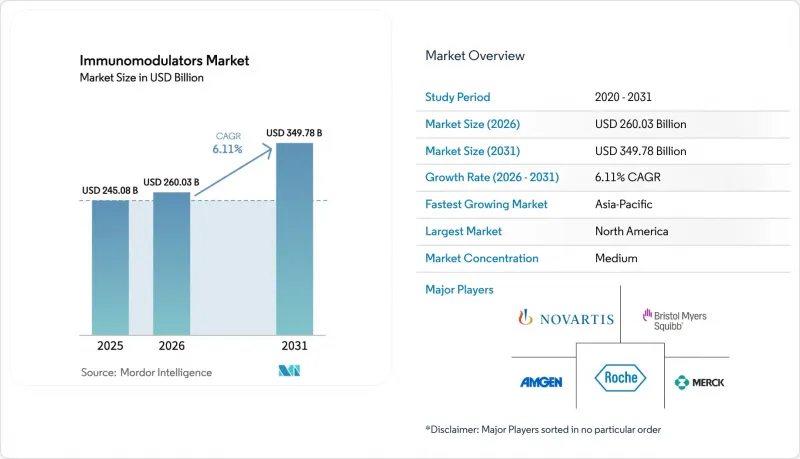
Mordor Intelligence에 의하면, 2026년 면역 조절제 시장 규모는 2,600억 3,000만 달러로 추정되고 있어 2025년 2,450억 8,000만 달러에서 확대해, 2031년에는 3,497억 8,000만 달러에 이를 것으로 예측됩니다.
2026년부터 2031년까지 연평균 성장률(CAGR) 6.11%로 성장할 것으로 전망됩니다.
본 보고서는 제품 유형(면역억제제 및 면역자극제), 작용기전(사이토카인 조절 등), 용도(종양학, 자가면역질환, 기타), 최종 사용자(병원, 전문 클리닉, 기타), 투여 경로(경구, 기타), 지역(북미, 유럽, 아시아태평양, 기타)별로 분류되어 있습니다. 시장 전망은 금액(달러) 기준으로 제시되어 있습니다.
세계 면역 조절제 시장 동향 및 인사이트
암 및 자가면역 질환의 부담 증가
세계 암 발병률은 상승하고 있으며, 국제암연구소(IARC)는 2050년까지 신규 환자 수가 3,500만 건에 달하고, 2022년 대비 77% 증가할 것으로 예측했습니다. 자가면역 질환의 유병률도 증가하고 있으며, 미국 국립보건원(NIH)의 보고에 따르면 5,000만 명의 미국인이 자가면역 질환을 앓고 있습니다. 선진국의 고령화와 신흥 지역의 진단 기술 향상으로 인해, 면역 중심 치료법의 적용 대상층이 확대되고 있습니다. 기존의 화학요법에서는 내약성이나 유효성이 낮은 것으로 밝혀지는 가운데, 분자 수준의 요인에 초점을 맞춘 정밀 의학이 지지를 얻고 있습니다.
기존 치료법을 대체하는 표적 면역요법의 도입
체크포인트 억제제의 병용 요법은 세포독성 요법과 비교하여 우수한 위험-이익 프로파일을 보여주고 있습니다. 제3상 IMforte 임상시험에서 로슈사의 ‘테센트릭’과 루루비넥테딘의 병용 요법은 진행성 소세포 폐암 환자에서 관리 가능한 안전성 기준을 유지하면서 질병 진행 위험을 46% 감소시켰습니다. ‘테센트릭 하이브레자’와 같은 피하 투여 제제는 진료 시간을 7분으로 단축하여, 복약 순응도와 의료 자원의 효율적 활용을 향상시키고 있습니다. 메모리얼 슬론 케터링 암 센터가 실시한 도스탈리맙 임상시험에서는 불일치 복구 결손(MMR-D) 직장암 환자에서 100%의 완전 반응을 달성하여, 대부분의 참가자가 수술을 받지 않아도 되었습니다.
정밀 투여를 위한 동반 진단 바이오마커의 보급
고도의 검사 능력을 갖춘 의료 시스템에서는 치료 효과를 극대화하고 독성을 억제하기 위해 바이오마커에 기반한 투여량이 채택되고 있습니다. 현재 PD-L1 발현 검사가 체크포인트 억제제 사용을 결정하는 한편, 사이토카인 농도를 측정하는 분자 검사를 통해 인터루킨 억제제의 투여량이 최적화되고 있습니다. 계층화의 향상은 성과 연계형 계약의 기반이 되며, 고가 의약품의 가치에 대한 주장을 강화하고 있습니다.
부문 분석
면역 억제제는 2025년 매출의 50.62%를 차지하며, 면역 조절제 시장의 기반을 이루고 있습니다. 칼시뉴린 억제제나 mTOR 억제제 등의 주력 제품은 장기 이식 후에도 필수적이며, 단일클론항체는 만성 자가면역 질환 치료에 계속해서 채택되고 있습니다. 우스테키누맙 및 아달리무맙의 바이오시밀러 등장으로 가격 탄력성은 변화하고 있으나, 판매량은 견조한 추세를 보이고 있습니다. 대조적으로, 면역 자극제는 2031년까지 연평균 성장률(CAGR) 9.74%를 기록할 전망입니다. CAR-T, 체크포인트 작용제 및 IL-15 유도체 분야의 획기적인 진전으로 인해 고형암에 대한 임상적 적용 범위가 확대되고 있습니다. 최초의 IL-15 작용제인 ImmunityBio사의 ‘ANKTIVA’가 승인되어 방광암에서 71%의 완전 반응률을 보인 것은 이 부문의 급속한 발전을 여실히 보여주고 있습니다.
암 치료법이 세포독성 요법에서 면역 활성화 요법으로 전환됨에 따라, 면역 자극제를 포함한 면역 조절제 시장 규모는 현저히 확대될 전망입니다. 혁신의 다양성은 백신 보조제, TLR 작용제 및 이중 특이성 결합제에 이르기까지 광범위합니다. 안전성 모니터링은 엄격하지만, 지속적인 반응 효과를 원하는 환자들 수요가 도입을 뒷받침하고 있습니다. 바이오시밀러로 인해 억제 요법의 이익률이 압박받는 가운데, 혁신적인 기업들은 성장을 되찾기 위해 면역 자극제에 주력하고 있습니다. 면역 조절제 시장에서는 차세대 자산을 통해 가격 하락을 헤지하는 균형 잡힌 포트폴리오가 계속해서 나타나고 있습니다.
2025년에는 세포 표면 수용체 차단제가 41.88%의 점유율을 차지하며, 이는 임상의들의 높은 숙련도와 투여량의 예측 가능성을 반영한 것입니다. PD-1, CTLA-4 및 IL-6를 표적으로 하는 프로그램은 위험-이익 비율이 명확하게 나타나 있어 보험사의 승인이 용이합니다. 그럼에도 불구하고, 후성유전적 조절은 9.21%라는 가장 높은 연평균 성장률(CAGR)을 기록하고 있으며, 각 기업이 면역 세포의 유전자 발현을 재설정하는 약물 개발을 주도하고 있습니다. 이러한 약물은 유지 용량을 줄이면서 지속적인 관해를 목표로 하고 있습니다.
면역 조절제 업계에서는 사이토카인 조절제나 JAK 억제제가 꾸준한 성장을 유지하고 있지만, 바이오시밀러의 부상으로 인해 가격 상승세는 둔화되고 있습니다. 대부분 저분자 화합물인 후성유전학 치료제는 경구 투여 및 더 광범위한 조직으로의 침투가 기대되고 있습니다. MDPI가 보고한 임상시험 초기 데이터에 따르면, 전신 면역 기능을 손상시키지 않으면서 자가면역 질환의 재발을 유의미하게 억제할 수 있는 것으로 나타났습니다(mdpi.com). 안전성에 대한 징후가 계속해서 양호하다면, 후성유전학 치료제는 치료 단계에서 더 이른 시점에 위치하게 되어 면역 조절제 시장 전체를 견인할 가능성이 있습니다.
지역별 분석
북미는 탄탄한 연구개발 파이프라인, 견고한 보험 체계, 그리고 신속한 FDA 심사 프로그램을 바탕으로 2025년 매출의 38.02%를 차지했습니다. 이 지역은 체크포인트 억제제 및 CAR-T의 생산 능력 면에서 계속해서 주도적인 위치를 유지하고 있습니다. 아달리무맙의 23% 점유율로 대표되는 바이오시밀러의 보급은 가격에 압박을 가하는 한편, 치료 적용 범위를 확대되고 있습니다. 머크(Merck)가 프로메테우스 바이오사이언스(Prometheus Biosciences)를 108억 달러에 인수한 것과 같은 대규모 M&A는 염증성 장질환 치료 분야를 주도하겠다는 전략적 의도를 재차 보여주고 있습니다.
아시아태평양은 연평균 성장률(CAGR) 7.48%로 가장 빠르게 성장하고 있는 지역입니다. 중국과 인도는 정부의 인센티브에 힘입어 생물학적 제제 생산을 확대하고 있는 반면, 일본은 mRNA 및 세포 치료 분야의 거점 구축을 추진하고 있습니다. 아시아태평양의 규제 당국은 ICH 지침과 조화를 이룬 ‘레퍼런스 패스웨이’를 채택하여, 안전성 기준을 낮추지 않으면서도 신청 서류 심사 기간을 단축하고 있습니다. 지역의 소득 수준이 향상됨에 따라 지불 기관의 예산도 확대되어, 혁신적인 면역 조절제 시장 출시가 가능해졌습니다.
유럽에서는 EMA(유럽의약품청)의 집중 심사 절차와 적극적인 바이오시밀러 정책 아래 꾸준한 진전이 나타나고 있습니다. 2024년에는 28건의 바이오시밀러에 대한 심사 의견이 발표되었으며, 그 중에는 우스테키누맙의 바이오시밀러 4건도 포함되어 있어, 이를 통해 면역 조절제의 보급 범위가 확대되는 동시에 의료비 절감 효과도 거두고 있습니다. 로슈의 페네부르티닙과 노바티스의 이스칼리맙은 내성 유도에 초점을 맞춘 파이프라인을 주도하고 있습니다. 중동 및 아프리카 시장 규모는 작지만, 사우디아라비아의 종양학 분야에 대한 투자와 UAE의 암 센터 확장에 힘입어 항종양제 및 면역 조절제 부문에서 전년 대비 17%의 성장을 기록했습니다. ImmunityBio가 사우디아라비아 당국과 체결한 ‘Cancer BioShield’ 파트너십은 이 지역에서 첨단 면역요법에 대한 수요가 증가하고 있음을 시사합니다.
기타 혜택:
- 엑셀 형식 시장 예측(ME) 시트
- 3개월간의 애널리스트 지원
자주 묻는 질문
목차
제1장 서론
제2장 조사 방법
제3장 주요 요약
제4장 시장 구도
제5장 시장 규모와 성장 예측
제6장 경쟁 구도
제7장 시장 기회와 향후 전망
JHS 26.08.28According to Mordor Intelligence, immunomodulators market size in 2026 is estimated at USD 260.03 billion, growing from 2025 value of USD 245.08 billion with 2031 projections showing USD 349.78 billion, growing at 6.11% CAGR over 2026-2031.
This report is Segmented by Product Type (Immunosuppressants and Immunostimulants), Mechanism of Action (Cytokine Modulation, and More), Application (Oncology, Autoimmune Disorders, and More), End-User (Hospitals, Specialty Clinics, and More), Route of Administration (Oral, and More), and Geography (North America, Europe, Asia-Pacific, and More). The Market Forecasts are Provided in Terms of Value (USD).
Global Immunomodulators Market Trends and Insights
Rising Burden of Cancer & Autoimmune Diseases
Global cancer incidence is climbing, with the International Agency for Research on Cancer projecting 35 million new cases by 2050, a 77% jump on 2022. Autoimmune prevalence also rises; the National Institutes of Health reports that 50 million Americans live with autoimmune disorders. Older populations in developed economies and improved diagnostics in emerging regions converge to enlarge the candidate pool for immune-centric therapy. Precision medicines that zero in on molecular drivers gain favor as conventional chemotherapy shows lower tolerance and efficacy.
Adoption of Targeted Immunotherapy Over Conventional Care
Checkpoint inhibitor combinations deliver superior benefit-risk profiles compared with cytotoxic regimens. In the Phase III IMforte study, Roche's Tecentriq plus lurbinectedin cut progression risk by 46% in extensive-stage small-cell lung cancer while preserving manageable safety requirements. Subcutaneous variants such as Tecentriq Hybreza trim clinic time to seven minutes, improving compliance and resource use. A Memorial Sloan Kettering trial of dostarlimab achieved a 100% complete response in mismatch-repair-deficient rectal cancer, eliminating surgery for most participants.
Uptake of Companion-Diagnostic Biomarkers for Precision Dosing
Healthcare systems with advanced lab capacity are adopting biomarker-guided dosing to maximize response and limit toxicity. PD-L1 expression testing now steers checkpoint inhibitor use, while molecular assays for cytokine levels refine dosing of interleukin blockers. Improved stratification underpins pay-for-performance contracts, strengthening value arguments for premium drugs.
Other drivers and restraints analyzed in the detailed report include:
- AI-Enabled Discovery of Next-Gen Immunomodulators
- High Cost of Treatment
- Biosimilar Price Erosion Pressure
For complete list of drivers and restraints, kindly check the Table Of Contents.
Segment Analysis
Immunosuppressants generated 50.62% of 2025 revenue, anchoring the immunomodulators market. Mainstays such as calcineurin and mTOR inhibitors remain essential after organ transplants, and monoclonal antibodies sustain uptake in chronic autoimmune care. Biosimilar arrivals for ustekinumab and adalimumab are reshaping price elasticity yet volumes hold steady. In contrast, immunostimulants chart a 9.74% CAGR to 2031. Breakthroughs in CAR-T, checkpoint agonists, and IL-15 derivatives expand the clinical footprint across solid tumors. Approval of ImmunityBio's ANKTIVA, the first IL-15 agonist, with 71% bladder-cancer complete response rates, highlights the category's rapid pace.
The immunomodulators market size for immunostimulants is set to jump markedly as oncology regimens shift from cytotoxic protocols toward immune activation. Innovation variety spans vaccine adjuvants, TLR agonists, and bispecific engagers. Although safety monitoring is intense, patient demand for durable responses bolsters uptake. As biosimilars compress suppressive-therapy margins, innovators lean on immunostimulants to rebuild growth. The immunomodulators market continues to see balanced portfolios that hedge price erosion with next-generation assets.
Cell-surface receptor blockade held 41.88% share in 2025, reflecting clinician familiarity and predictable dosing. Programs targeting PD-1, CTLA-4, and IL-6 show well-charted benefit-risk ratios, which eases payer acceptance. Still, epigenetic modulation posts the fastest 9.21% CAGR as companies pioneer agents that reset immune cell gene expression. These assets aim for durable remission with lower maintenance dosing.
Within the immunomodulators industry, cytokine modulators and JAK inhibitors keep steady growth, although biosimilar challenge cools pricing. Epigenetic drugs, often small molecules, promise oral delivery and broader tissue penetration. Early data from MDPI-reported trials indicate meaningful reduction in autoimmune flares while sparing systemic immunity mdpi.com. If safety signals remain favorable, epigenetic options could move upstream in treatment lines and lift the overall immunomodulators market.
Complete Report Scope:
- By Product Type
- Immunosuppressants
- Corticosteroids
- Calcineurin Inhibitors
- mTOR Inhibitors
- Anti-proliferative Agents
- Monoclonal Antibodies
- Immunostimulants
- Cytokines & Interleukins
- Checkpoint Agonists
- Vaccine Adjuvants
- Toll-like Receptor Agonists
- Small-molecule Modulators
- Immunosuppressants
- By Mechanism of Action
- Cytokine Modulation
- Cell-surface Receptor Blockade
- Signal-transduction Inhibition
- Epigenetic Modulation
- By Application
- Oncology
- Autoimmune Disorders
- Rheumatoid Arthritis
- Multiple Sclerosis
- Inflammatory Bowel Disease
- Systemic Lupus Erythematosus
- Respiratory
- HIV
- Other Applications
- By End-User
- Hospitals
- Specialty Clinics
- Home-care Settings
- Other End-Users
- By Route of Administration
- Parenteral
- Oral
- Topical
- Geography
- North America
- United States
- Canada
- Mexico
- Europe
- Germany
- United Kingdom
- France
- Italy
- Spain
- Rest of Europe
- Asia-Pacific
- China
- Japan
- India
- Australia
- South Korea
- Rest of Asia-Pacific
- Middle East & Africa
- GCC
- South Africa
- Rest of Middle East & Africa
- South America
- Brazil
- Argentina
- Rest of South America
- Rest of Africa
- North America
Geography Analysis
North America produced 38.02% of 2025 revenue on the back of deep R&D pipelines, robust payer frameworks, and swift FDA review programs. The region retains leadership in checkpoint inhibitors and CAR-T production capacity. Biosimilar penetration, exemplified by 23% adalimumab share, pressures pricing yet broadens reach. Major acquisitions like Merck's USD 10.8 billion purchase of Prometheus Biosciences reaffirm strategic intent to command inflammatory bowel disease therapy lanes.
Asia-Pacific is the fastest-growing region at 7.48% CAGR. China and India ramp biologic manufacturing with government incentives, while Japan sponsors mRNA and cell-therapy hubs. Regulators across APAC adopt reference pathways harmonized with ICH guidelines that shorten dossier reviews without cutting safety thresholds. As regional incomes lift, payer budgets widen, enabling uptake of innovative immunomodulators market offerings.
Europe advances steadily under the EMA's centralized procedure and aggressive biosimilar policy. Twenty-eight biosimilar opinions issued in 2024, including four ustekinumab copies, extend immunomodulator reach while curbing spend. Roche's fenebrutinib and Novartis's iscalimab head a pipeline focused on tolerance induction. Markets in the Middle East and Africa are smaller but grew 17% year over year in antineoplastic and immunomodulator categories, driven by Saudi Arabia's oncology investment and UAE cancer center expansion. ImmunityBio's Cancer BioShield partnership with Saudi authorities signals rising demand for advanced immune therapies in these locales.
- Roche
- Bristol-Myers Squibb
- Novartis
- Merck
- Amgen
- Pfizer
- Eli Lilly and Company
- Biogen
- AstraZeneca
- Gilead Sciences
- Abbvie
- Astellas Pharma
- Horizon Therapeutics
- Biocon
- CSL Behring
- Sanofi
- Takeda Pharmaceutical Co.
- Regeneron Pharmaceuticals
- Seagen
- Acrotech Biopharma
- Step-Pharma
Additional Benefits:
- The market estimate (ME) sheet in Excel format
- 3 months of analyst support
TABLE OF CONTENTS
1 Introduction
- 1.1 Study Assumptions & Market Definition
- 1.2 Scope of the Study
2 Research Methodology
3 Executive Summary
4 Market Landscape
- 4.1 Market Overview
- 4.2 Market Drivers
- 4.2.1 Rising Burden of Cancer & Autoimmune Diseases
- 4.2.2 Growing Investment in Biologics R&D
- 4.2.3 Adoption of Targeted Immunotherapy Over Conventional Care
- 4.2.4 AI-Enabled Discovery of Next-Gen Immunomodulators
- 4.2.5 Uptake of Companion-Diagnostic Biomarkers for Precision Dosing
- 4.2.6 Post-COVID Fast-Track Pathways for Antiviral Immunomodulators
- 4.3 Market Restraints
- 4.3.1 Stringent Regulatory Guidelines
- 4.3.2 High Cost of Treatment
- 4.3.3 Biosimilar Price Erosion Pressure
- 4.3.4 Immunotoxicity-Driven Label Warnings
- 4.4 Regulatory Landscape
- 4.5 Porter's Five Forces Analysis
- 4.5.1 Threat of New Entrants
- 4.5.2 Bargaining Power of Buyers
- 4.5.3 Bargaining Power of Suppliers
- 4.5.4 Threat of Substitutes
- 4.5.5 Intensity of Competitive Rivalry
5 Market Size & Growth Forecasts (Value, USD)
- 5.1 By Product Type
- 5.1.1 Immunosuppressants
- 5.1.1.1 Corticosteroids
- 5.1.1.2 Calcineurin Inhibitors
- 5.1.1.3 mTOR Inhibitors
- 5.1.1.4 Anti-proliferative Agents
- 5.1.1.5 Monoclonal Antibodies
- 5.1.2 Immunostimulants
- 5.1.2.1 Cytokines & Interleukins
- 5.1.2.2 Checkpoint Agonists
- 5.1.2.3 Vaccine Adjuvants
- 5.1.2.4 Toll-like Receptor Agonists
- 5.1.2.5 Small-molecule Modulators
- 5.1.1 Immunosuppressants
- 5.2 By Mechanism of Action
- 5.2.1 Cytokine Modulation
- 5.2.2 Cell-surface Receptor Blockade
- 5.2.3 Signal-transduction Inhibition
- 5.2.4 Epigenetic Modulation
- 5.3 By Application
- 5.3.1 Oncology
- 5.3.2 Autoimmune Disorders
- 5.3.2.1 Rheumatoid Arthritis
- 5.3.2.2 Multiple Sclerosis
- 5.3.2.3 Inflammatory Bowel Disease
- 5.3.2.4 Systemic Lupus Erythematosus
- 5.3.3 Respiratory
- 5.3.4 HIV
- 5.3.5 Other Applications
- 5.4 By End-User
- 5.4.1 Hospitals
- 5.4.2 Specialty Clinics
- 5.4.3 Home-care Settings
- 5.4.4 Other End-Users
- 5.5 By Route of Administration
- 5.5.1 Parenteral
- 5.5.2 Oral
- 5.5.3 Topical
- 5.6 Geography
- 5.6.1 North America
- 5.6.1.1 United States
- 5.6.1.2 Canada
- 5.6.1.3 Mexico
- 5.6.2 Europe
- 5.6.2.1 Germany
- 5.6.2.2 United Kingdom
- 5.6.2.3 France
- 5.6.2.4 Italy
- 5.6.2.5 Spain
- 5.6.2.6 Rest of Europe
- 5.6.3 Asia-Pacific
- 5.6.3.1 China
- 5.6.3.2 Japan
- 5.6.3.3 India
- 5.6.3.4 Australia
- 5.6.3.5 South Korea
- 5.6.3.6 Rest of Asia-Pacific
- 5.6.4 Middle East & Africa
- 5.6.4.1 GCC
- 5.6.4.2 South Africa
- 5.6.4.3 Rest of Middle East & Africa
- 5.6.5 South America
- 5.6.5.1 Brazil
- 5.6.5.2 Argentina
- 5.6.5.3 Rest of South America
- 5.6.5.3.1 Rest of Africa
- 5.6.1 North America
6 Competitive Landscape
- 6.1 Market Concentration
- 6.2 Market Share Analysis
- 6.3 Company Profiles (includes Global-level Overview, Market-level Overview, Core Segments, Financials, Strategic Information, Market Rank/Share, Products & Services, Recent Developments)
- 6.3.1 F. Hoffmann-La Roche Ltd
- 6.3.2 Bristol-Myers Squibb Co.
- 6.3.3 Novartis AG
- 6.3.4 Merck & Co., Inc.
- 6.3.5 Amgen Inc.
- 6.3.6 Pfizer Inc.
- 6.3.7 Eli Lilly and Co.
- 6.3.8 Biogen Inc.
- 6.3.9 AstraZeneca plc
- 6.3.10 Gilead Sciences Inc.
- 6.3.11 AbbVie Inc.
- 6.3.12 Astellas Pharma Inc.
- 6.3.13 Horizon Therapeutics
- 6.3.14 Biocon Ltd.
- 6.3.15 CSL Behring
- 6.3.16 Sanofi SA
- 6.3.17 Takeda Pharmaceutical Co.
- 6.3.18 Regeneron Pharmaceuticals
- 6.3.19 Seagen Inc.
- 6.3.20 Acrotech Biopharma
- 6.3.21 Step-Pharma
7 Market Opportunities & Future Outlook
- 7.1 White-space & Unmet-Need Assessment


